Chapter 11 
Op-Amp Applications
Op-Amp Applications 
Constant-gain multiplier 
Voltage summing 
Voltage buffer 
Controlled sources 
Instrumentation circuits 
Active filters 
Copyright ©2009 by Pearson Education, Inc. 
Upper Saddle River, New Jersey 07458 • All rights reserved. 
Electronic Devices and Circuit Theory, 10/e 
Robert L. Boylestad and Louis Nashelsky 
2
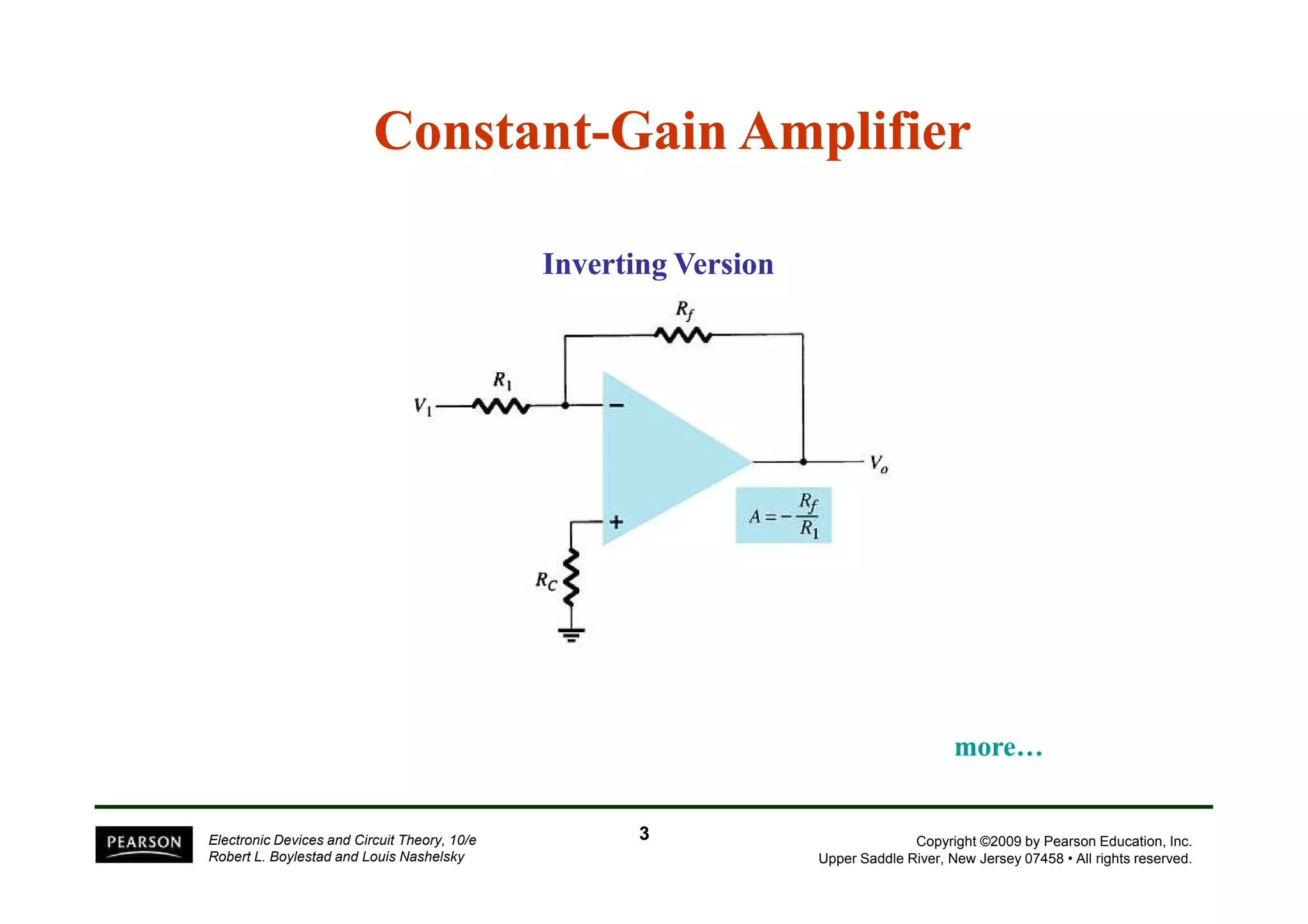
Constant-Gain Amplifier 
Inverting Version 
Copyright ©2009 by Pearson Education, Inc. 
Upper Saddle River, New Jersey 07458 • All rights reserved. 
Electronic Devices and Circuit Theory, 10/e 
Robert L. Boylestad and Louis Nashelsky 
more…… 
3
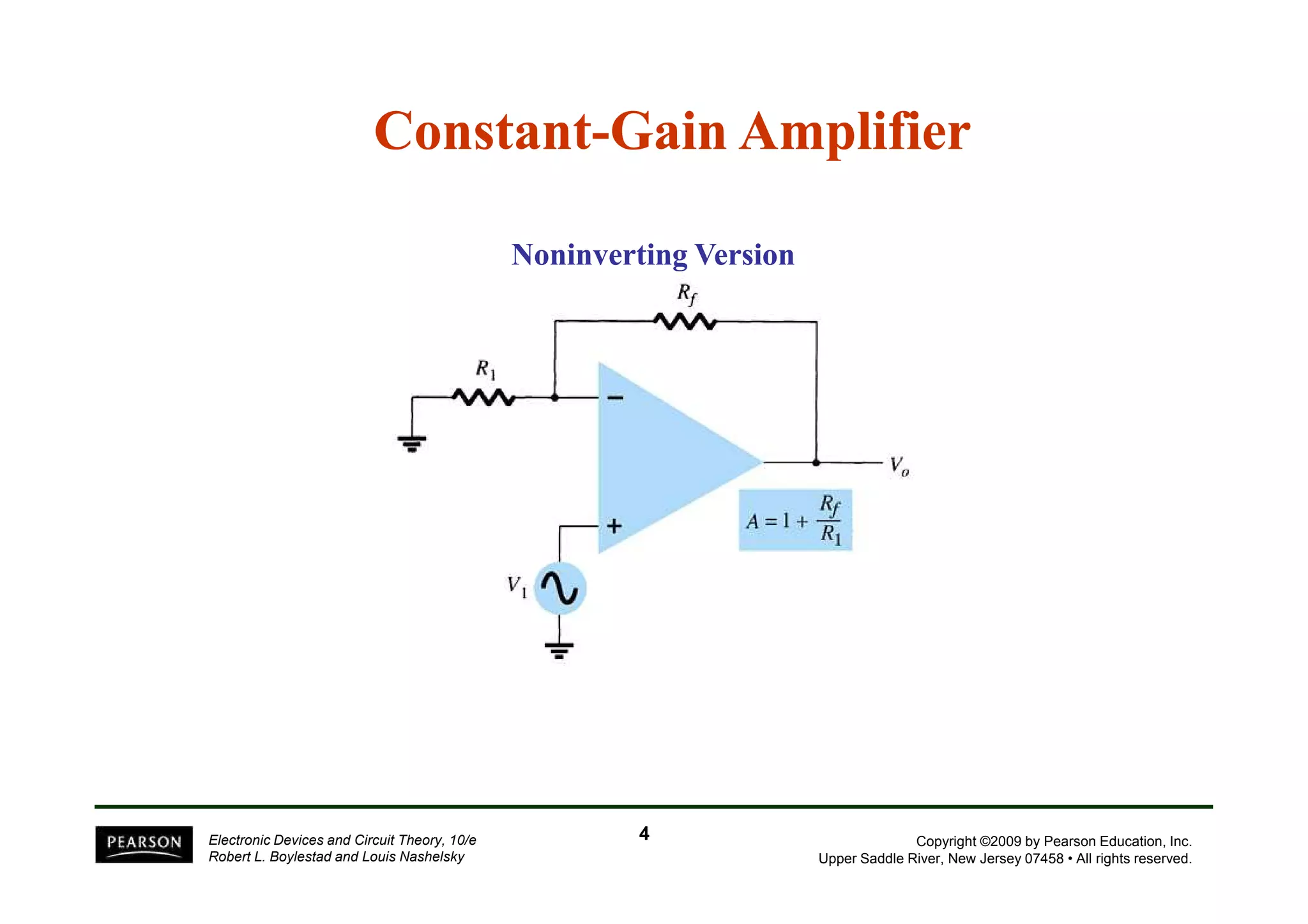
Constant-Gain Amplifier 
Noninverting Version 
Copyright ©2009 by Pearson Education, Inc. 
Upper Saddle River, New Jersey 07458 • All rights reserved. 
Electronic Devices and Circuit Theory, 10/e 
Robert L. Boylestad and Louis Nashelsky 
4
Multiple-Stage Gains 
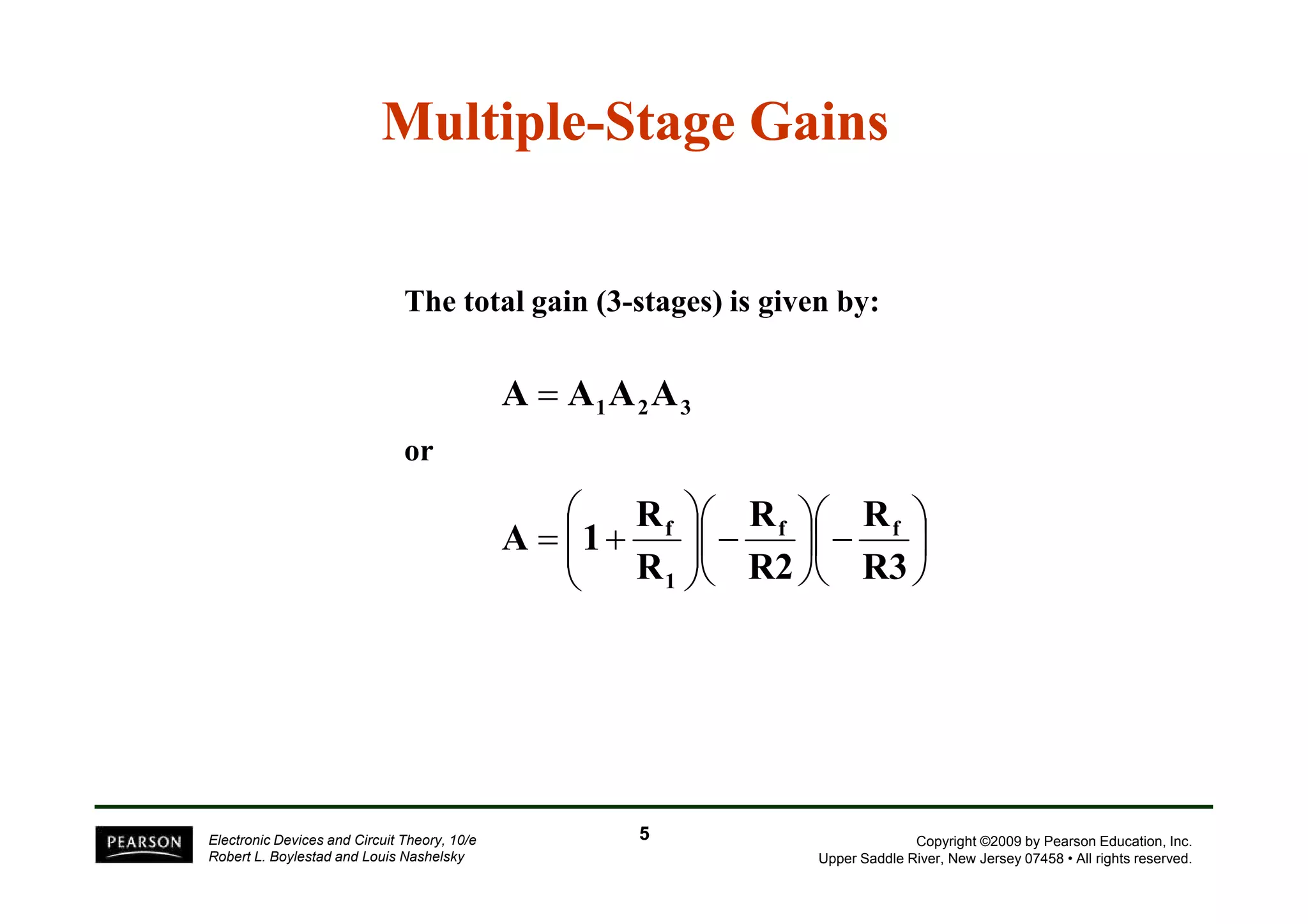
The total gain (3-stages) is given by: 
A = A A A1 2 3 
or 
 
Copyright ©2009 by Pearson Education, Inc. 
−  
R 
A 1 f f 
Upper Saddle River, New Jersey 07458 • All rights reserved. 
Electronic Devices and Circuit Theory, 10/e 
Robert L. Boylestad and Louis Nashelsky 
R 
5 
 
 
 
 
−   
 
 
= + 
  
R3 
R 
R2 
R 
f 
1
Voltage Summing 
 
 
 
The output is the sum 
of individual signals 
times the gain: 
 
 
 
R 
= − f 
+ f 
V 
+ f 
V 
R 
V 
R 
V 
Copyright ©2009 by Pearson Education, Inc. 
Upper Saddle River, New Jersey 07458 • All rights reserved. 
 
 
Electronic Devices and Circuit Theory, 10/e 
Robert L. Boylestad and Louis Nashelsky 
[Formula 14.3] 
 
 
  3 
3 
2 
2 
1 
1 
o R 
R 
R 
6
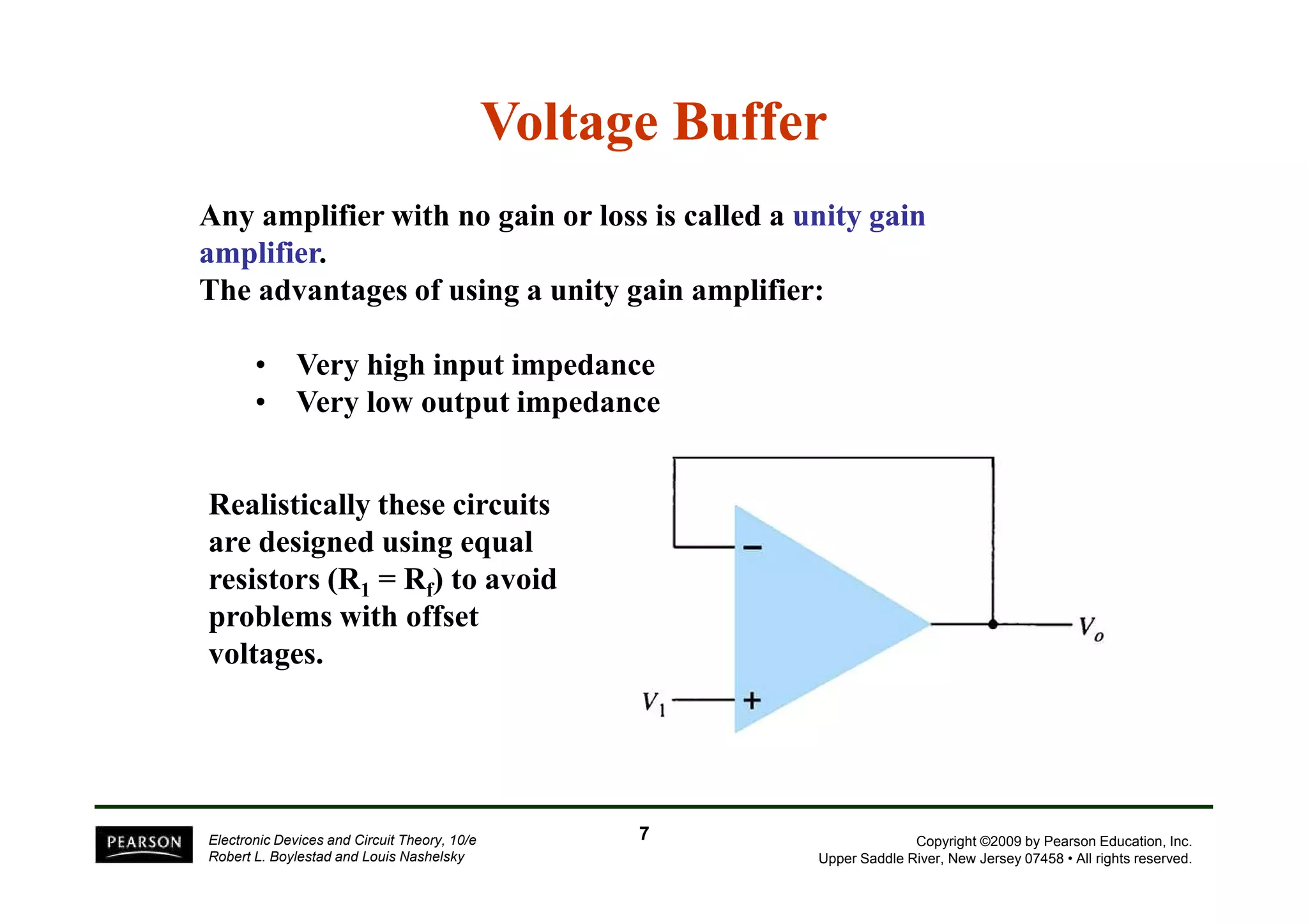
Voltage Buffer 
Any amplifier with no gain or loss is called a unity gain 
amplifier. 
The advantages of using a unity gain amplifier: 
• Very high input impedance 
• Very low output impedance 
Copyright ©2009 by Pearson Education, Inc. 
Upper Saddle River, New Jersey 07458 • All rights reserved. 
Realistically these circuits 
are designed using equal 
resistors (R1 = Rf) to avoid 
problems with offset 
voltages. 
Electronic Devices and Circuit Theory, 10/e 
Robert L. Boylestad and Louis Nashelsky 
7
Controlled Sources 
Voltage-controlled voltage source 
Voltage-controlled current source 
Current-controlled voltage source 
Current-controlled current source 
Copyright ©2009 by Pearson Education, Inc. 
Upper Saddle River, New Jersey 07458 • All rights reserved. 
Electronic Devices and Circuit Theory, 10/e 
Robert L. Boylestad and Louis Nashelsky 
8
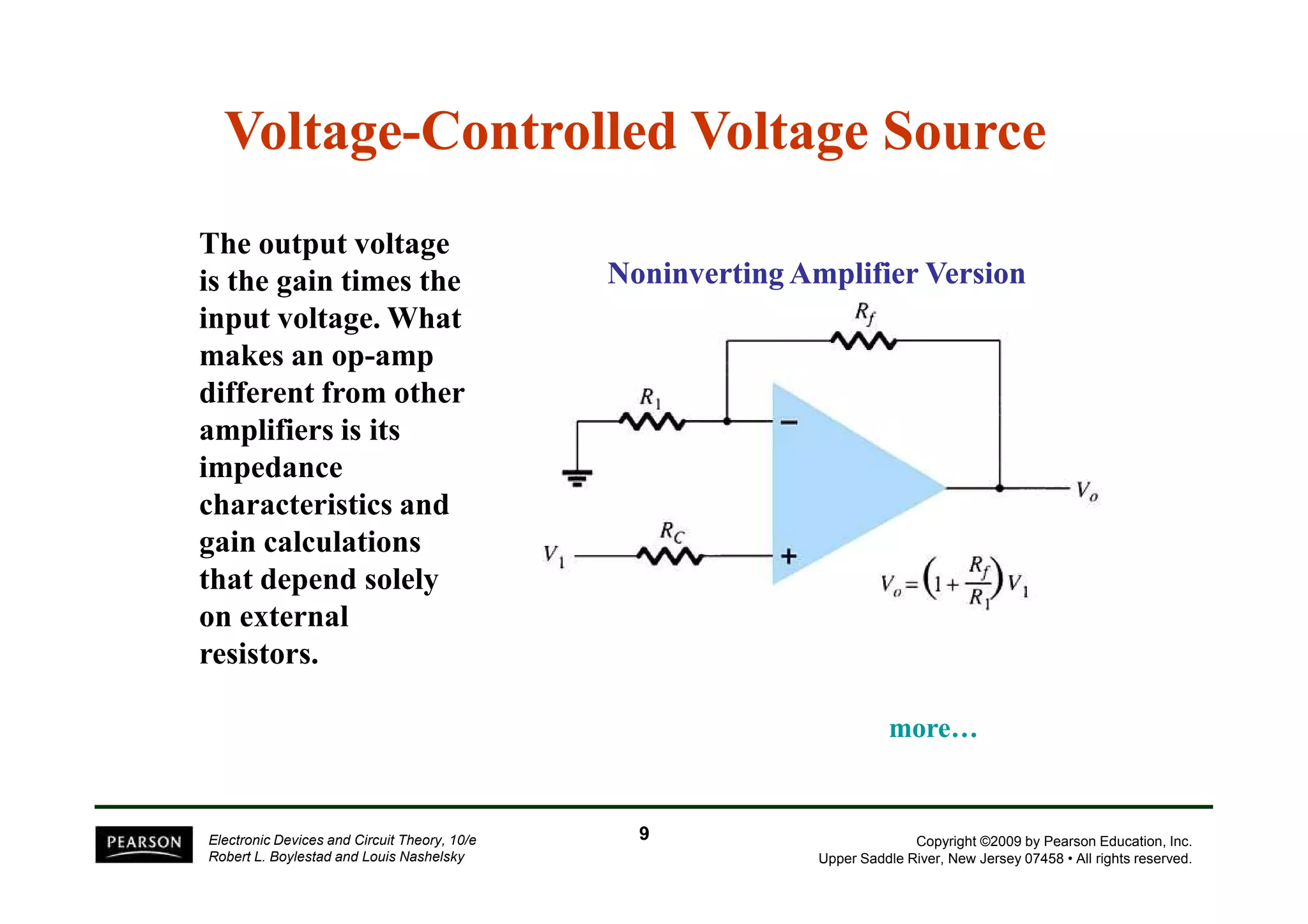
Voltage-Controlled Voltage Source 
The output voltage 
is the gain times the 
input voltage. What 
makes an op-amp 
different from other 
amplifiers is its 
impedance 
Noninverting Amplifier Version 
Copyright ©2009 by Pearson Education, Inc. 
Upper Saddle River, New Jersey 07458 • All rights reserved. 
characteristics and 
gain calculations 
that depend solely 
on external 
resistors. 
Electronic Devices and Circuit Theory, 10/e 
Robert L. Boylestad and Louis Nashelsky 
more…… 
9
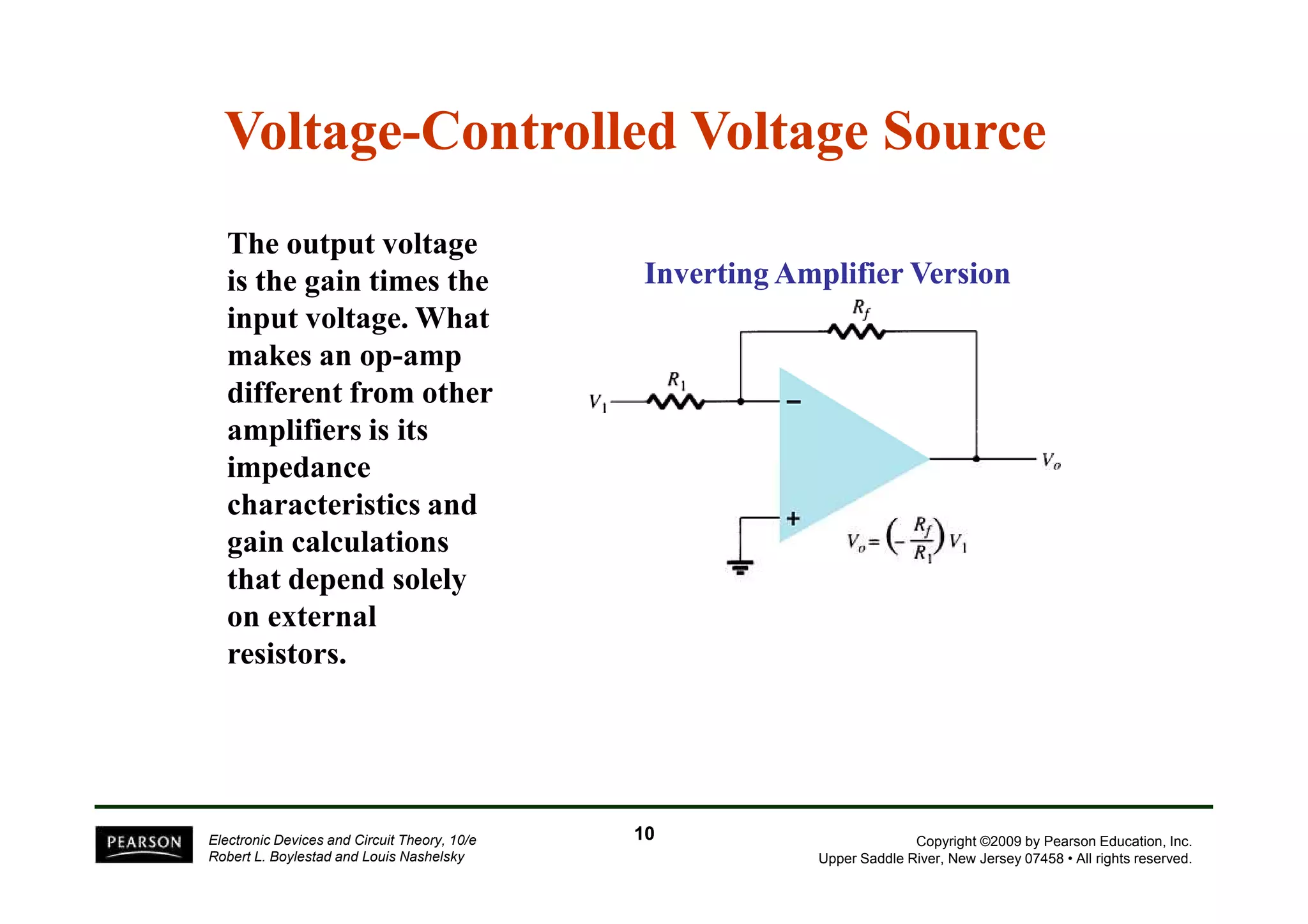
Voltage-Controlled Voltage Source 
The output voltage 
is the gain times the 
input voltage. What 
makes an op-amp 
different from other 
amplifiers is its 
impedance 
Inverting Amplifier Version 
Copyright ©2009 by Pearson Education, Inc. 
Upper Saddle River, New Jersey 07458 • All rights reserved. 
characteristics and 
gain calculations 
that depend solely 
on external 
resistors. 
Electronic Devices and Circuit Theory, 10/e 
Robert L. Boylestad and Louis Nashelsky 
10
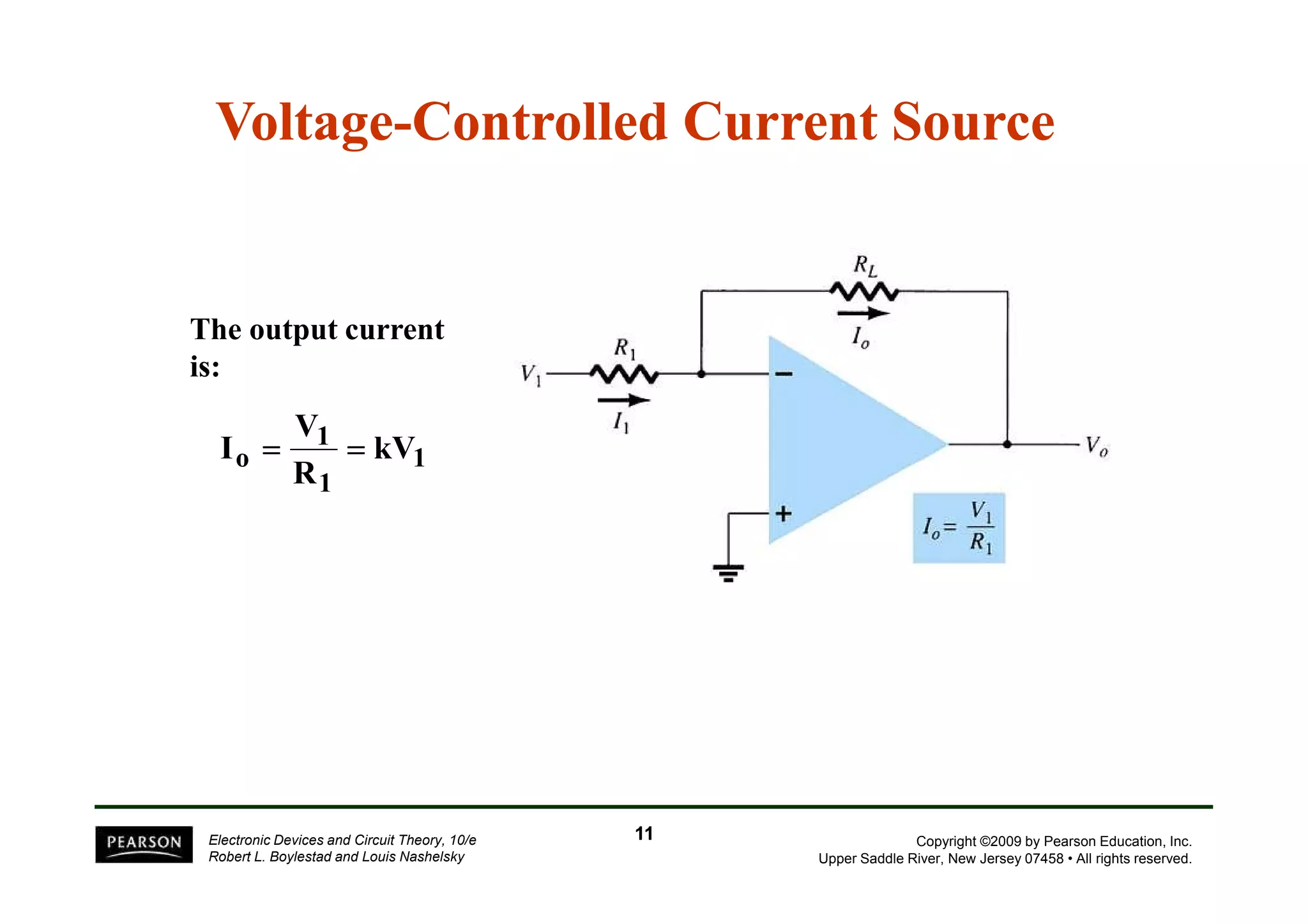
Voltage-Controlled Current Source 
The output current 
is: 
1 
V 
1 
I = = 
o kV 
R 
Copyright ©2009 by Pearson Education, Inc. 
Upper Saddle River, New Jersey 07458 • All rights reserved. 
1 
Electronic Devices and Circuit Theory, 10/e 
Robert L. Boylestad and Louis Nashelsky 
11
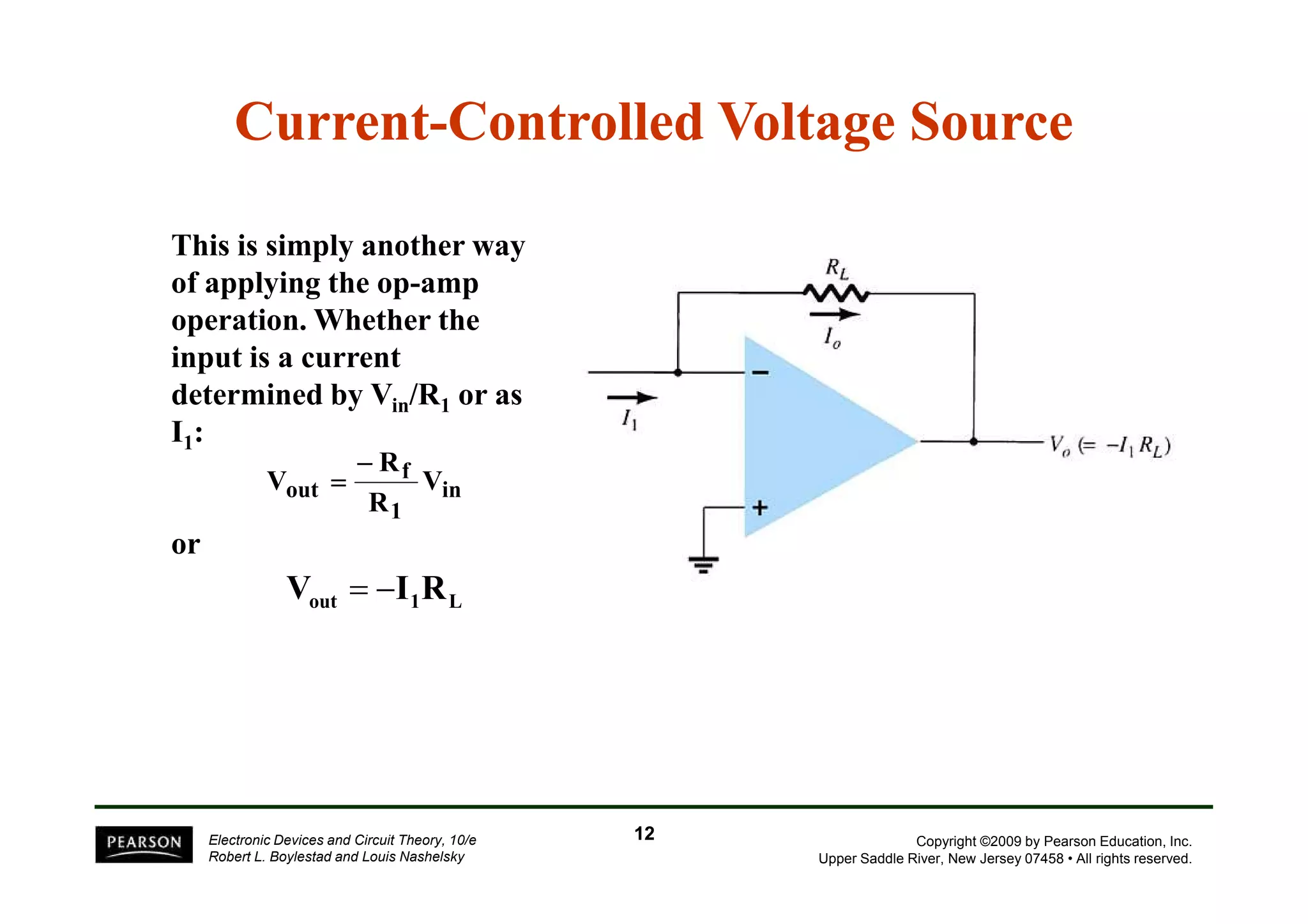
Current-Controlled Voltage Source 
This is simply another way 
of applying the op-amp 
operation. Whether the 
input is a current 
determined by Vin/R1 or as 
I1: 
− 
Rf 
= 
Copyright ©2009 by Pearson Education, Inc. 
Upper Saddle River, New Jersey 07458 • All rights reserved. 
f 
R 
out V 
Electronic Devices and Circuit Theory, 10/e 
Robert L. Boylestad and Louis Nashelsky 
or 
in 
1 
R 
V 
12 
out 1 L V = −I R
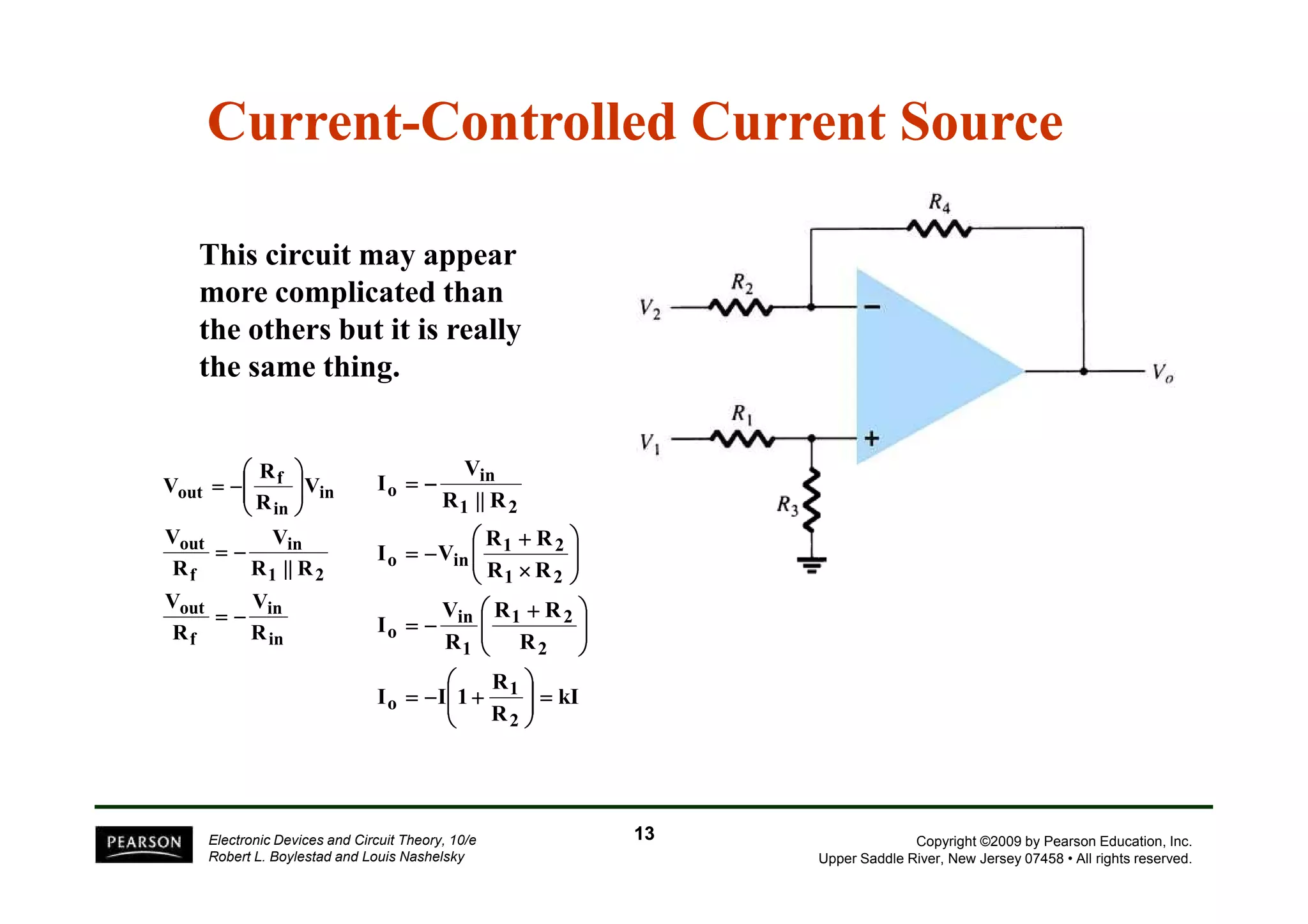
Current-Controlled Current Source 
This circuit may appear 
more complicated than 
the others but it is really 
the same thing. 
 
R 
 
V 
Copyright ©2009 by Pearson Education, Inc. 
Upper Saddle River, New Jersey 07458 • All rights reserved. 
f 
V 
V 
in 
in 
in 
= − 
R || R 
V 
I 
1 2 
 
in 
 
= − 
Electronic Devices and Circuit Theory, 10/e 
Robert L. Boylestad and Louis Nashelsky 
V 
out 
V 
out 
f 
1 2 
f 
in 
in 
out 
R 
R 
R || R 
R 
V 
R 
V 
= − 
  
 
 
  
 
 
= − 
R + 
R 
1 2 
 + 
R R 
 
1 2 
kI 
R 
R 
I I 1 
R 
R 
I 
R R 
I V 
1 
2 
o 
2 
1 
o 
1 2 
o in 
in 
o 
 
=   
 
 
  
 
 
= − + 
 
  
 
 
  
 
 
= − 
  
 
 
  
 
 
× 
= − 
13
Instrumentation Circuits 
Some examples of instrumentation circuits using op-amps: 
• Display driver 
• Instrumentation amplifier 
Copyright ©2009 by Pearson Education, Inc. 
Upper Saddle River, New Jersey 07458 • All rights reserved. 
Electronic Devices and Circuit Theory, 10/e 
Robert L. Boylestad and Louis Nashelsky 
14
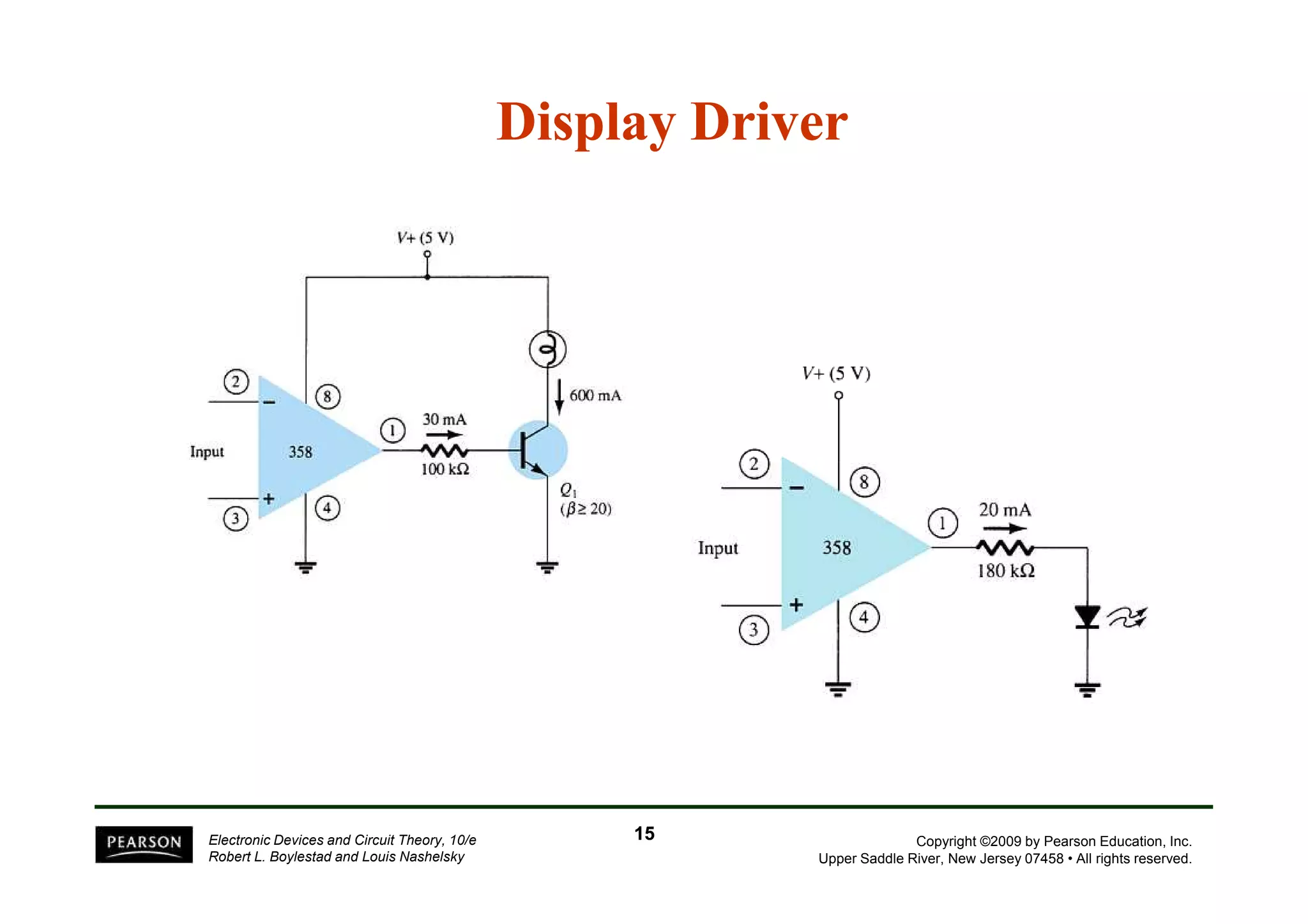
Display Driver 
Copyright ©2009 by Pearson Education, Inc. 
Upper Saddle River, New Jersey 07458 • All rights reserved. 
Electronic Devices and Circuit Theory, 10/e 
Robert L. Boylestad and Louis Nashelsky 
15
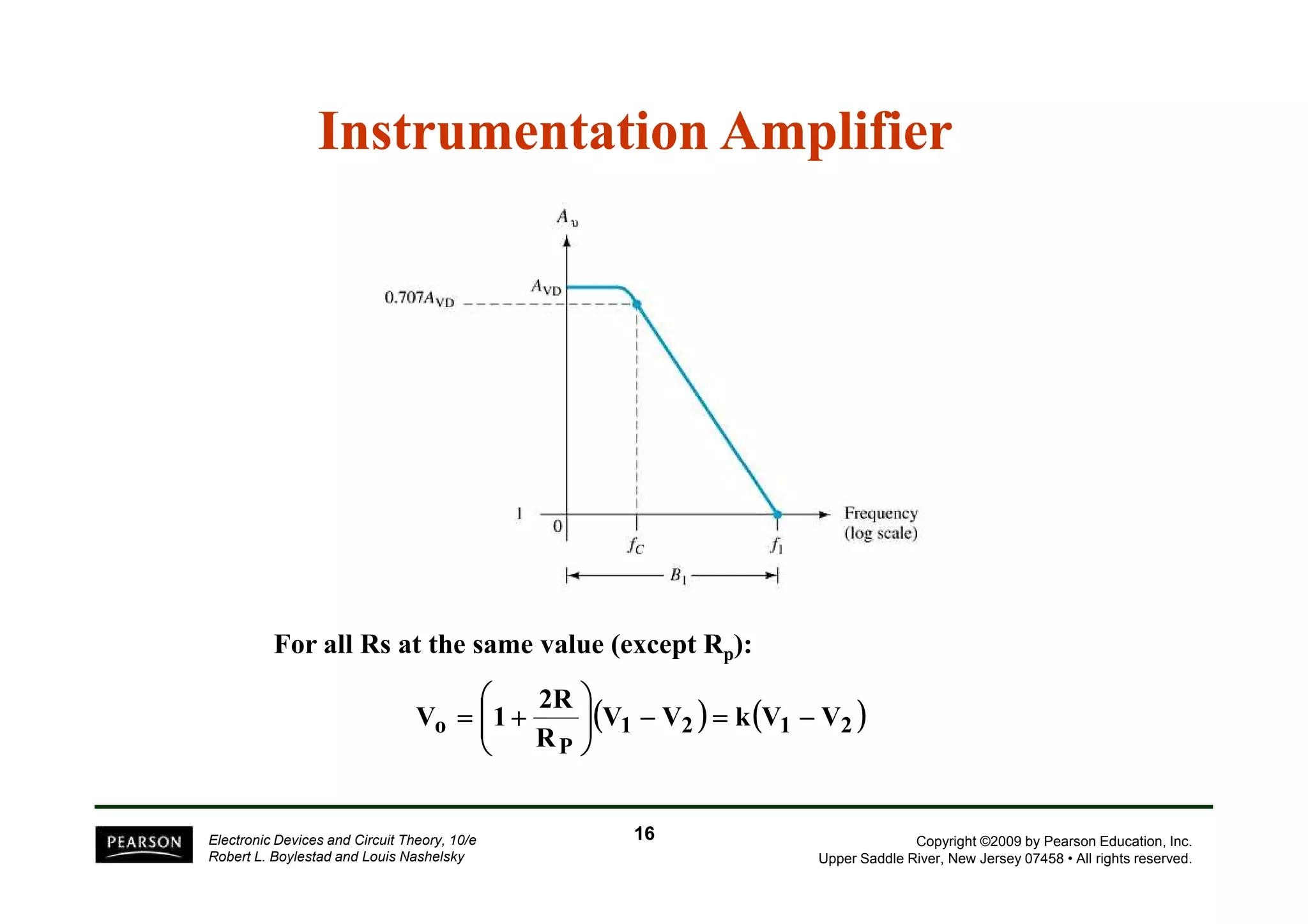
Instrumentation Amplifier 
Copyright ©2009 by Pearson Education, Inc. 
2R 
 
 
= + 
1 V − = −   
o V V k V V 
Upper Saddle River, New Jersey 07458 • All rights reserved. 
For all Rs at the same value (except Rp): 
Electronic Devices and Circuit Theory, 10/e 
Robert L. Boylestad and Louis Nashelsky 
( 1 2 ) ( 1 2 ) 
P 
R 
 
 
  
 
 
16
Active Filters 
Adding capacitors to op-amp circuits provides external control of the 
cutoff frequencies. The op-amp active filter provides controllable 
cutoff frequencies and controllable gain. 
• Low-pass filter 
• High-pass filter 
• Bandpass filter 
Copyright ©2009 by Pearson Education, Inc. 
Upper Saddle River, New Jersey 07458 • All rights reserved. 
Electronic Devices and Circuit Theory, 10/e 
Robert L. Boylestad and Louis Nashelsky 
17
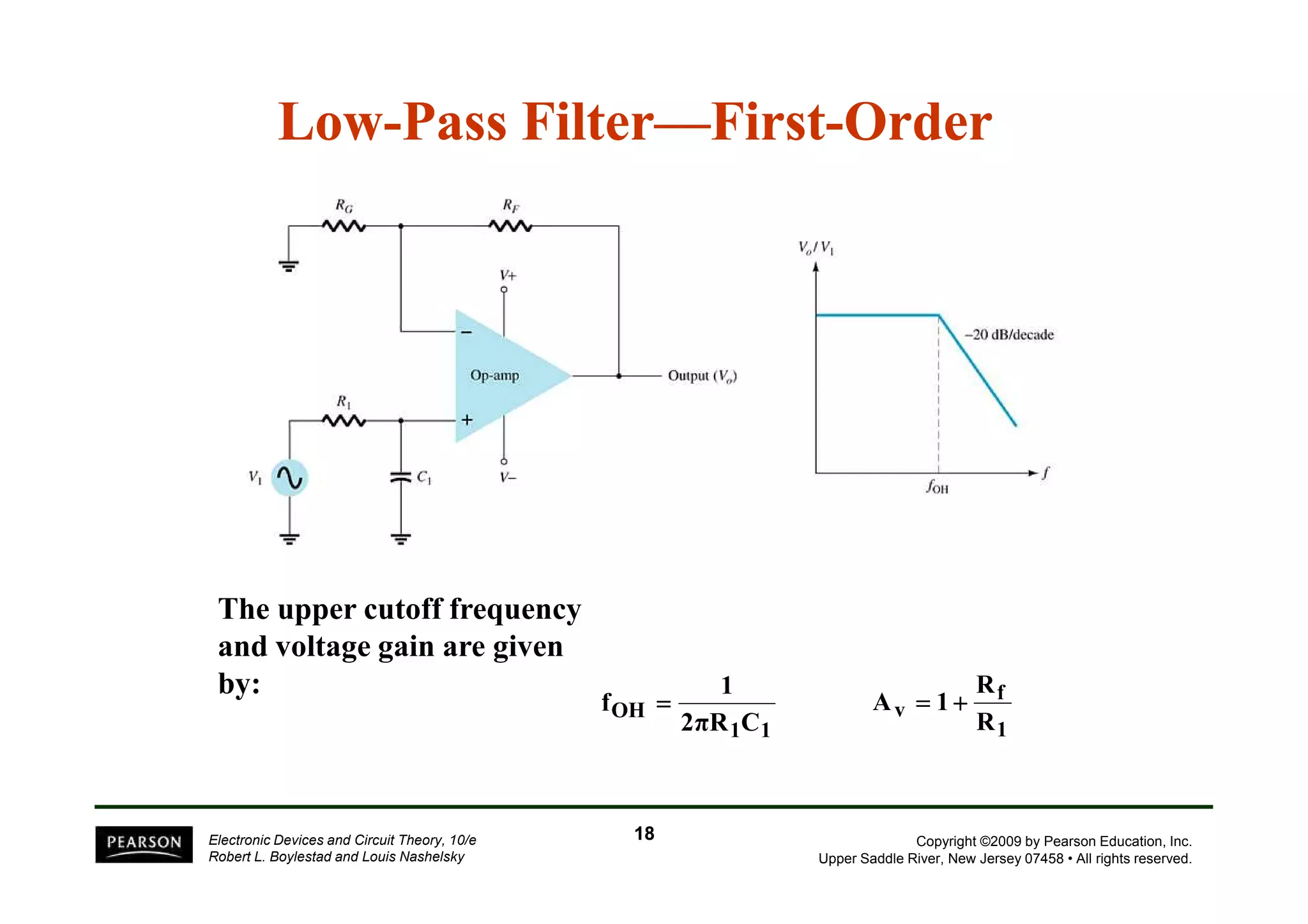
Low-Pass Filter——First-Order 
f 
R 
A = 1 + 
Copyright ©2009 by Pearson Education, Inc. 
Upper Saddle River, New Jersey 07458 • All rights reserved. 
Electronic Devices and Circuit Theory, 10/e 
Robert L. Boylestad and Louis Nashelsky 
1 
OH R C 2π 
1 1 
f = 
1 
v R 
The upper cutoff frequency 
and voltage gain are given 
by: 
18
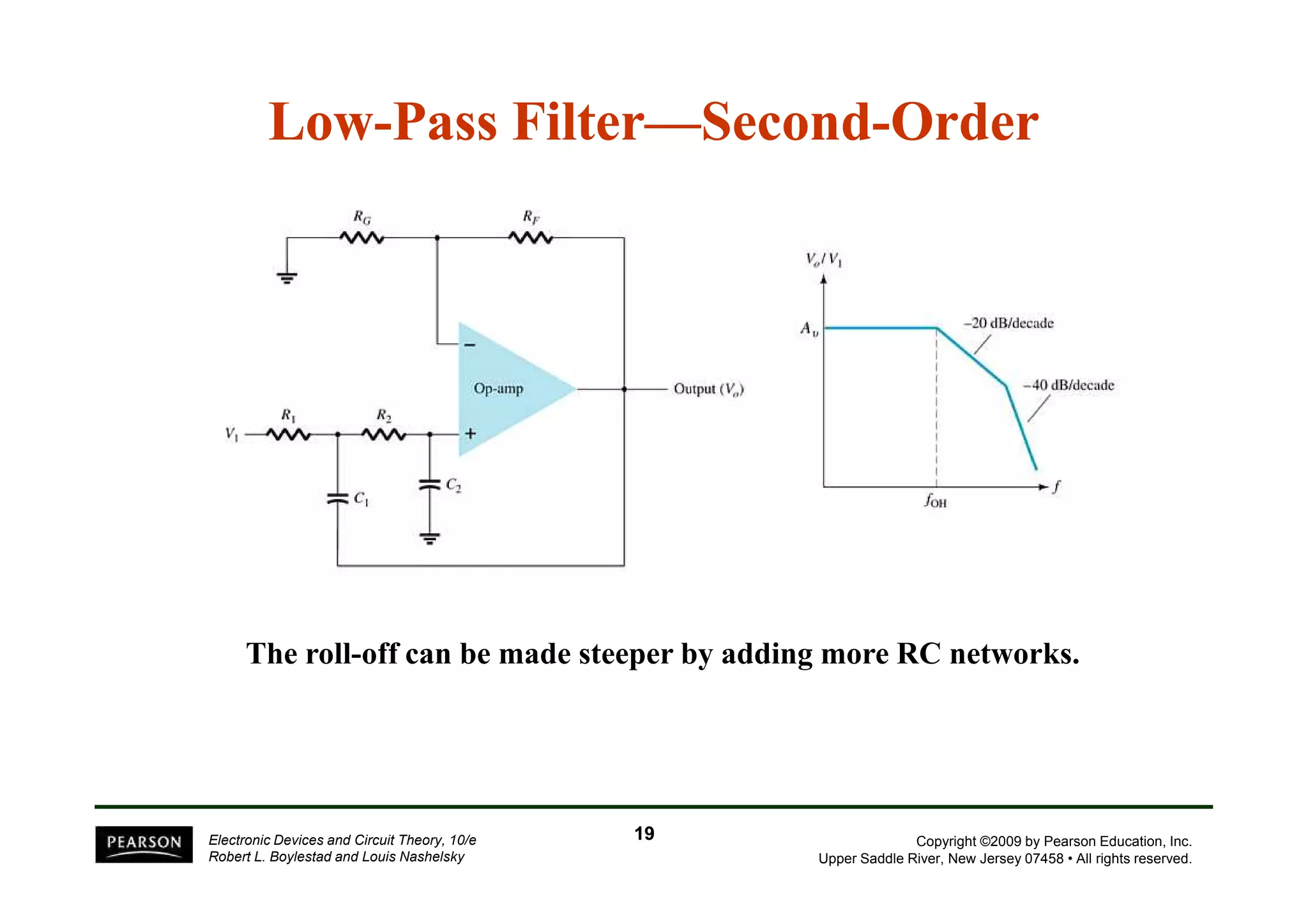
Low-Pass Filter——Second-Order 
The roll-off can be made steeper by adding more RC networks. 
Copyright ©2009 by Pearson Education, Inc. 
Upper Saddle River, New Jersey 07458 • All rights reserved. 
Electronic Devices and Circuit Theory, 10/e 
Robert L. Boylestad and Louis Nashelsky 
19
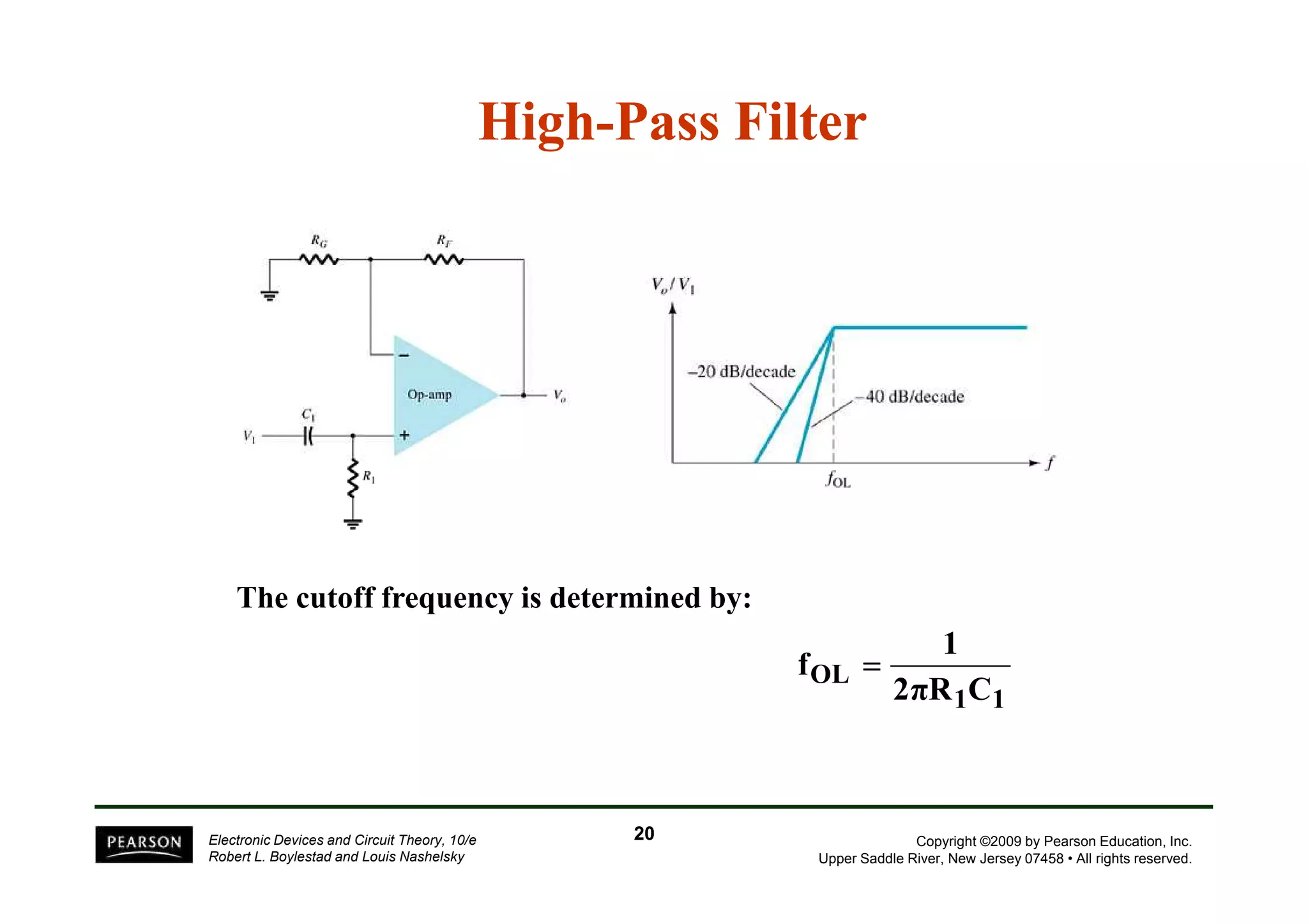
High-Pass Filter 
1 
OL R C 2π 
Copyright ©2009 by Pearson Education, Inc. 
Upper Saddle River, New Jersey 07458 • All rights reserved. 
Electronic Devices and Circuit Theory, 10/e 
Robert L. Boylestad and Louis Nashelsky 
1 1 
f = 
The cutoff frequency is determined by: 
20
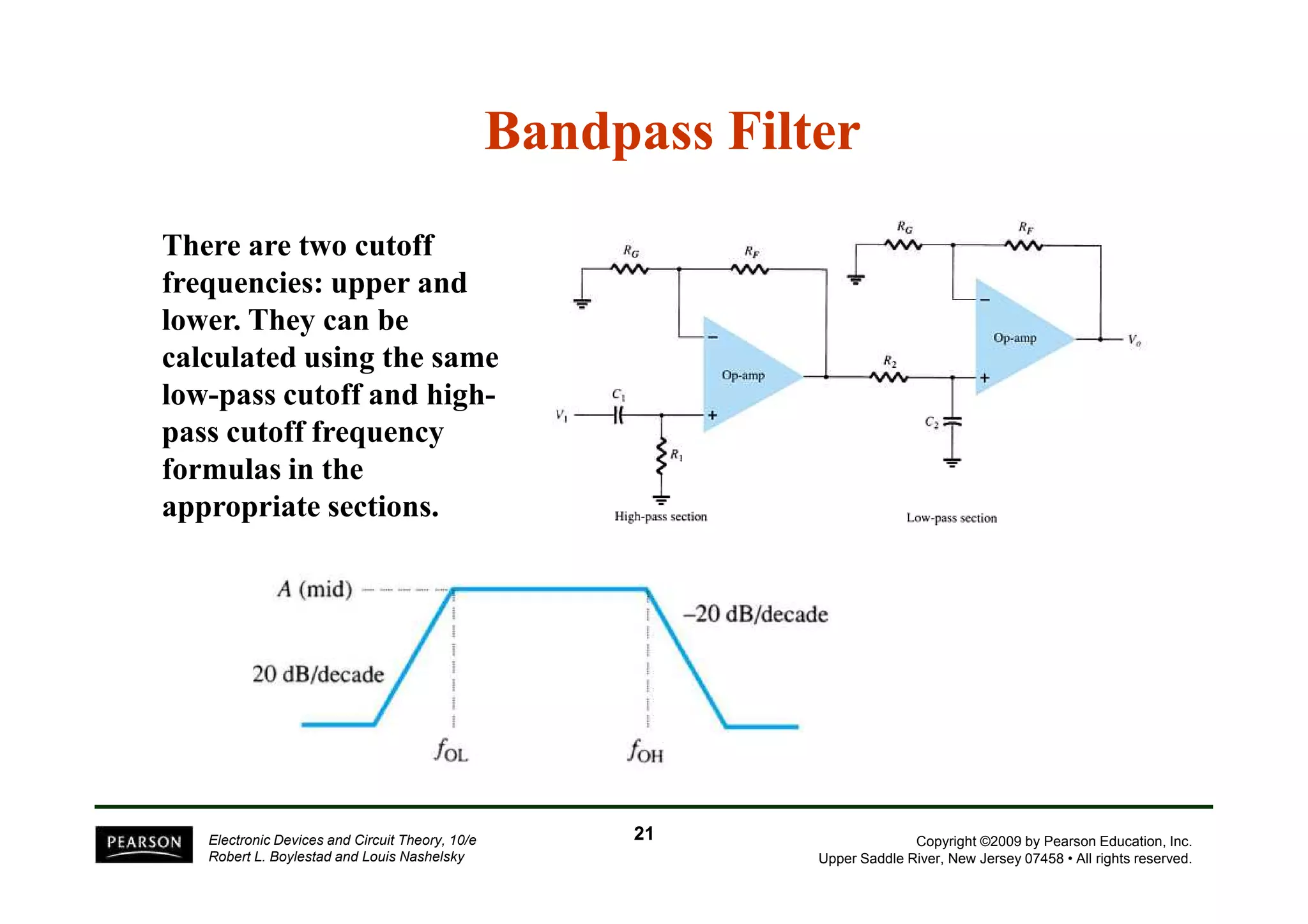
Bandpass Filter 
There are two cutoff 
frequencies: upper and 
lower. They can be 
calculated using the same 
low-pass cutoff and high-pass 
cutoff frequency 
formulas in the 
Copyright ©2009 by Pearson Education, Inc. 
Upper Saddle River, New Jersey 07458 • All rights reserved. 
appropriate sections. 
Electronic Devices and Circuit Theory, 10/e 
Robert L. Boylestad and Louis Nashelsky 
21

Electronic devices-and-circuit-theory-10th-ed-boylestad-chapter-11

  • 1.
    Chapter 11 Op-AmpApplications
  • 2.
    Op-Amp Applications Constant-gainmultiplier Voltage summing Voltage buffer Controlled sources Instrumentation circuits Active filters Copyright ©2009 by Pearson Education, Inc. Upper Saddle River, New Jersey 07458 • All rights reserved. Electronic Devices and Circuit Theory, 10/e Robert L. Boylestad and Louis Nashelsky 2
  • 3.
    Constant-Gain Amplifier InvertingVersion Copyright ©2009 by Pearson Education, Inc. Upper Saddle River, New Jersey 07458 • All rights reserved. Electronic Devices and Circuit Theory, 10/e Robert L. Boylestad and Louis Nashelsky more…… 3
  • 4.
    Constant-Gain Amplifier NoninvertingVersion Copyright ©2009 by Pearson Education, Inc. Upper Saddle River, New Jersey 07458 • All rights reserved. Electronic Devices and Circuit Theory, 10/e Robert L. Boylestad and Louis Nashelsky 4
  • 5.
    Multiple-Stage Gains Thetotal gain (3-stages) is given by: A = A A A1 2 3 or  Copyright ©2009 by Pearson Education, Inc. −  R A 1 f f Upper Saddle River, New Jersey 07458 • All rights reserved. Electronic Devices and Circuit Theory, 10/e Robert L. Boylestad and Louis Nashelsky R 5     −     = +   R3 R R2 R f 1
  • 6.
    Voltage Summing    The output is the sum of individual signals times the gain:    R = − f + f V + f V R V R V Copyright ©2009 by Pearson Education, Inc. Upper Saddle River, New Jersey 07458 • All rights reserved.   Electronic Devices and Circuit Theory, 10/e Robert L. Boylestad and Louis Nashelsky [Formula 14.3]     3 3 2 2 1 1 o R R R 6
  • 7.
    Voltage Buffer Anyamplifier with no gain or loss is called a unity gain amplifier. The advantages of using a unity gain amplifier: • Very high input impedance • Very low output impedance Copyright ©2009 by Pearson Education, Inc. Upper Saddle River, New Jersey 07458 • All rights reserved. Realistically these circuits are designed using equal resistors (R1 = Rf) to avoid problems with offset voltages. Electronic Devices and Circuit Theory, 10/e Robert L. Boylestad and Louis Nashelsky 7
  • 8.
    Controlled Sources Voltage-controlledvoltage source Voltage-controlled current source Current-controlled voltage source Current-controlled current source Copyright ©2009 by Pearson Education, Inc. Upper Saddle River, New Jersey 07458 • All rights reserved. Electronic Devices and Circuit Theory, 10/e Robert L. Boylestad and Louis Nashelsky 8
  • 9.
    Voltage-Controlled Voltage Source The output voltage is the gain times the input voltage. What makes an op-amp different from other amplifiers is its impedance Noninverting Amplifier Version Copyright ©2009 by Pearson Education, Inc. Upper Saddle River, New Jersey 07458 • All rights reserved. characteristics and gain calculations that depend solely on external resistors. Electronic Devices and Circuit Theory, 10/e Robert L. Boylestad and Louis Nashelsky more…… 9
  • 10.
    Voltage-Controlled Voltage Source The output voltage is the gain times the input voltage. What makes an op-amp different from other amplifiers is its impedance Inverting Amplifier Version Copyright ©2009 by Pearson Education, Inc. Upper Saddle River, New Jersey 07458 • All rights reserved. characteristics and gain calculations that depend solely on external resistors. Electronic Devices and Circuit Theory, 10/e Robert L. Boylestad and Louis Nashelsky 10
  • 11.
    Voltage-Controlled Current Source The output current is: 1 V 1 I = = o kV R Copyright ©2009 by Pearson Education, Inc. Upper Saddle River, New Jersey 07458 • All rights reserved. 1 Electronic Devices and Circuit Theory, 10/e Robert L. Boylestad and Louis Nashelsky 11
  • 12.
    Current-Controlled Voltage Source This is simply another way of applying the op-amp operation. Whether the input is a current determined by Vin/R1 or as I1: − Rf = Copyright ©2009 by Pearson Education, Inc. Upper Saddle River, New Jersey 07458 • All rights reserved. f R out V Electronic Devices and Circuit Theory, 10/e Robert L. Boylestad and Louis Nashelsky or in 1 R V 12 out 1 L V = −I R
  • 13.
    Current-Controlled Current Source This circuit may appear more complicated than the others but it is really the same thing.  R  V Copyright ©2009 by Pearson Education, Inc. Upper Saddle River, New Jersey 07458 • All rights reserved. f V V in in in = − R || R V I 1 2  in  = − Electronic Devices and Circuit Theory, 10/e Robert L. Boylestad and Louis Nashelsky V out V out f 1 2 f in in out R R R || R R V R V = −         = − R + R 1 2  + R R  1 2 kI R R I I 1 R R I R R I V 1 2 o 2 1 o 1 2 o in in o  =         = − +          = −         × = − 13
  • 14.
    Instrumentation Circuits Someexamples of instrumentation circuits using op-amps: • Display driver • Instrumentation amplifier Copyright ©2009 by Pearson Education, Inc. Upper Saddle River, New Jersey 07458 • All rights reserved. Electronic Devices and Circuit Theory, 10/e Robert L. Boylestad and Louis Nashelsky 14
  • 15.
    Display Driver Copyright©2009 by Pearson Education, Inc. Upper Saddle River, New Jersey 07458 • All rights reserved. Electronic Devices and Circuit Theory, 10/e Robert L. Boylestad and Louis Nashelsky 15
  • 16.
    Instrumentation Amplifier Copyright©2009 by Pearson Education, Inc. 2R   = + 1 V − = −   o V V k V V Upper Saddle River, New Jersey 07458 • All rights reserved. For all Rs at the same value (except Rp): Electronic Devices and Circuit Theory, 10/e Robert L. Boylestad and Louis Nashelsky ( 1 2 ) ( 1 2 ) P R       16
  • 17.
    Active Filters Addingcapacitors to op-amp circuits provides external control of the cutoff frequencies. The op-amp active filter provides controllable cutoff frequencies and controllable gain. • Low-pass filter • High-pass filter • Bandpass filter Copyright ©2009 by Pearson Education, Inc. Upper Saddle River, New Jersey 07458 • All rights reserved. Electronic Devices and Circuit Theory, 10/e Robert L. Boylestad and Louis Nashelsky 17
  • 18.
    Low-Pass Filter——First-Order f R A = 1 + Copyright ©2009 by Pearson Education, Inc. Upper Saddle River, New Jersey 07458 • All rights reserved. Electronic Devices and Circuit Theory, 10/e Robert L. Boylestad and Louis Nashelsky 1 OH R C 2π 1 1 f = 1 v R The upper cutoff frequency and voltage gain are given by: 18
  • 19.
    Low-Pass Filter——Second-Order Theroll-off can be made steeper by adding more RC networks. Copyright ©2009 by Pearson Education, Inc. Upper Saddle River, New Jersey 07458 • All rights reserved. Electronic Devices and Circuit Theory, 10/e Robert L. Boylestad and Louis Nashelsky 19
  • 20.
    High-Pass Filter 1 OL R C 2π Copyright ©2009 by Pearson Education, Inc. Upper Saddle River, New Jersey 07458 • All rights reserved. Electronic Devices and Circuit Theory, 10/e Robert L. Boylestad and Louis Nashelsky 1 1 f = The cutoff frequency is determined by: 20
  • 21.
    Bandpass Filter Thereare two cutoff frequencies: upper and lower. They can be calculated using the same low-pass cutoff and high-pass cutoff frequency formulas in the Copyright ©2009 by Pearson Education, Inc. Upper Saddle River, New Jersey 07458 • All rights reserved. appropriate sections. Electronic Devices and Circuit Theory, 10/e Robert L. Boylestad and Louis Nashelsky 21