Chapter 17
11
p
pnpn and Other Devices
pnpnpnpn DevicesDevices
SCRSCR——siliconsilicon--controlled rectifiercontrolled rectifier
SCSSCS iliili ll d i hll d i hSCSSCS –– siliconsilicon--controlled switchcontrolled switch
GTOGTO –– gate turngate turn--off switchoff switch
LASCRLASCR –– lightlight--aActivated SCRaActivated SCR
Shockley diodeShockley diodeShockley diodeShockley diode
DiacDiac
TriacTriac
Copyright ©2009 by Pearson Education, Inc.
Upper Saddle River, New Jersey 07458 • All rights reserved.
Electronic Devices and Circuit Theory, 10/e
Robert L. Boylestad and Louis Nashelsky
22
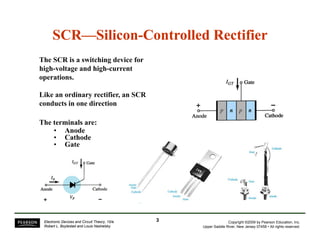
SCRSCR——SiliconSilicon--Controlled RectifierControlled Rectifier
The SCR is a switching device for
high-voltage and high-current
operationsoperations.
Like an ordinary rectifier, an SCR
conducts in one direction
The terminals are:
• Anode
• CathodeCathode
• Gate
Copyright ©2009 by Pearson Education, Inc.
Upper Saddle River, New Jersey 07458 • All rights reserved.
Electronic Devices and Circuit Theory, 10/e
Robert L. Boylestad and Louis Nashelsky
33
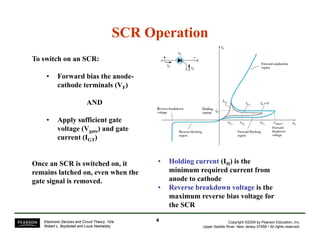
SCR OperationSCR Operation
To switch on an SCR:
• Forward bias the anode-• Forward bias the anode-
cathode terminals (VF)
AND
• Apply sufficient gate
voltage (Vgate) and gate
current (IGT)
Once an SCR is switched on, it
i l t h d h th
•• Holding currentHolding current (IH) is the
minimum required current from
current (IGT)
remains latched on, even when the
gate signal is removed.
minimum required current from
anode to cathode
•• Reverse breakdown voltageReverse breakdown voltage is the
maximum reverse bias voltage for
Copyright ©2009 by Pearson Education, Inc.
Upper Saddle River, New Jersey 07458 • All rights reserved.
Electronic Devices and Circuit Theory, 10/e
Robert L. Boylestad and Louis Nashelsky
the SCR
44
SCR OperationSCR Operation
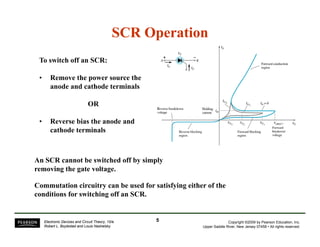
To switch off an SCR:
• Remove the power source the• Remove the power source the
anode and cathode terminals
OR
• Reverse bias the anode and
cathode terminals
An SCR cannot be switched off by simply
removing the gate voltage.removing the gate voltage.
Commutation circuitry can be used for satisfying either of the
conditions for switching off an SCR.
Copyright ©2009 by Pearson Education, Inc.
Upper Saddle River, New Jersey 07458 • All rights reserved.
Electronic Devices and Circuit Theory, 10/e
Robert L. Boylestad and Louis Nashelsky
55
SCR CommutationSCR Commutation
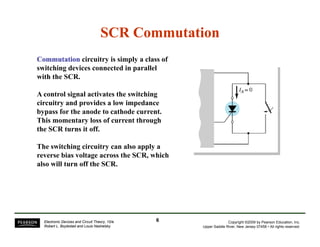
CommutationCommutation circuitry is simply a class of
switching devices connected in parallel
with the SCRwith the SCR.
A control signal activates the switching
circuitry and provides a low impedance
bypass for the anode to cathode current.
This momentary loss of current through
the SCR turns it off.
The switching circuitry can also apply a
reverse bias voltage across the SCR, which
also will turn off the SCR.
Copyright ©2009 by Pearson Education, Inc.
Upper Saddle River, New Jersey 07458 • All rights reserved.
Electronic Devices and Circuit Theory, 10/e
Robert L. Boylestad and Louis Nashelsky
66
SCR False TriggeringSCR False Triggering
An SCR can be forced to trigger conduction under several
conditions that must be avoided:conditions that must be avoided:
• Excessively high voltage from anode to
cathode
• High frequency signal from gate to
cathode
• High operating temperature
Copyright ©2009 by Pearson Education, Inc.
Upper Saddle River, New Jersey 07458 • All rights reserved.
Electronic Devices and Circuit Theory, 10/e
Robert L. Boylestad and Louis Nashelsky
77
SCR Phase ControlSCR Phase Control
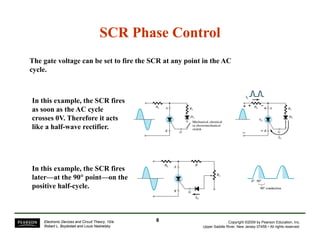
The gate voltage can be set to fire the SCR at any point in the AC
cycle.
In this example, the SCR fires
th AC las soon as the AC cycle
crosses 0V. Therefore it acts
like a half-wave rectifier.
In this example, the SCR firesIn this example, the SCR fires
later—at the 90° point—on the
positive half-cycle.
Copyright ©2009 by Pearson Education, Inc.
Upper Saddle River, New Jersey 07458 • All rights reserved.
Electronic Devices and Circuit Theory, 10/e
Robert L. Boylestad and Louis Nashelsky
88
SCR ApplicationsSCR Applications
In these applications the SCR gate circuit is used to
monitor a situation and trigger the SCR to turn onmonitor a situation and trigger the SCR to turn on
a portion of the circuit.
• Battery-charging regulatory g g g
• Temperature controller circuit
• Emergency-lighting system
Copyright ©2009 by Pearson Education, Inc.
Upper Saddle River, New Jersey 07458 • All rights reserved.
Electronic Devices and Circuit Theory, 10/e
Robert L. Boylestad and Louis Nashelsky
99
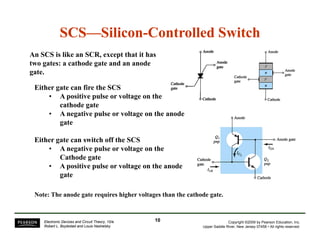
SCSSCS——SiliconSilicon--Controlled SwitchControlled Switch
An SCS is like an SCR, except that it has
two gates: a cathode gate and an anode
gate.
Either gate can fire the SCS
• A positive pulse or voltage on the
cathode gateg
• A negative pulse or voltage on the anode
gate
Either gate can switch off the SCSEither gate can switch off the SCS
• A negative pulse or voltage on the
Cathode gate
• A positive pulse or voltage on the anode
gate
Note: The anode gate requires higher voltages than the cathode gate.
Copyright ©2009 by Pearson Education, Inc.
Upper Saddle River, New Jersey 07458 • All rights reserved.
Electronic Devices and Circuit Theory, 10/e
Robert L. Boylestad and Louis Nashelsky
1010
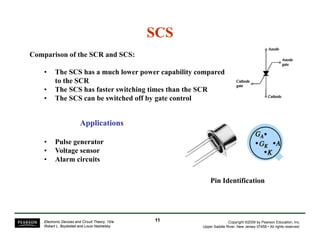
SCSSCS
Comparison of the SCR and SCS:
• The SCS has a much lower power capability compared
to the SCR
• The SCS has faster switching times than the SCR
• The SCS can be switched off by gate control
ApplicationsApplications
• Pulse generator
• Voltage sensor
• Alarm circuits
Pin Identification
Copyright ©2009 by Pearson Education, Inc.
Upper Saddle River, New Jersey 07458 • All rights reserved.
Electronic Devices and Circuit Theory, 10/e
Robert L. Boylestad and Louis Nashelsky
1111
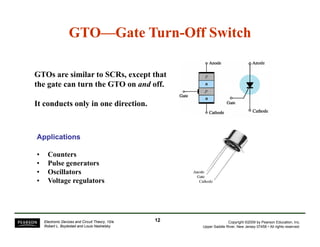
GTOGTO——Gate TurnGate Turn--Off SwitchOff Switch
GTOs are similar to SCRs, except thatGTOs are similar to SCRs, except that
the gate can turn the GTO on and off.
It conducts only in one direction.
ApplicationsApplicationsApplicationsApplications
• Counters
• Pulse generators
O ill t• Oscillators
• Voltage regulators
Copyright ©2009 by Pearson Education, Inc.
Upper Saddle River, New Jersey 07458 • All rights reserved.
Electronic Devices and Circuit Theory, 10/e
Robert L. Boylestad and Louis Nashelsky
1212
GTOGTO
Comparison of the GTO and SCS:
• GTO is a low power device• GTO is a low power device
• The gate signal necessary to fire the GTO is larger than the SCR gate signal.
• The gate signal necessary to turn the GTO off is similar to that of SCS
• The switching rate for turning the GTO off is much faster than the SCR
Copyright ©2009 by Pearson Education, Inc.
Upper Saddle River, New Jersey 07458 • All rights reserved.
Electronic Devices and Circuit Theory, 10/e
Robert L. Boylestad and Louis Nashelsky
1313
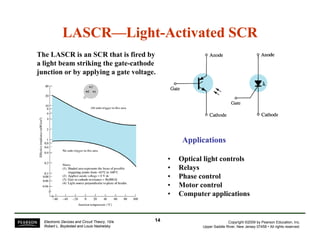
LASCRLASCR——LightLight--Activated SCRActivated SCR
The LASCR is an SCR that is fired by
a light beam striking the gate-cathode
junction or by applying a gate voltage.
ApplicationsApplicationsApplicationsApplications
• Optical light controls
• Relaysy
• Phase control
• Motor control
• Computer applications
Copyright ©2009 by Pearson Education, Inc.
Upper Saddle River, New Jersey 07458 • All rights reserved.
Electronic Devices and Circuit Theory, 10/e
Robert L. Boylestad and Louis Nashelsky
1414
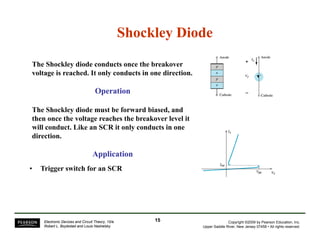
Shockley DiodeShockley Diode
The Shockley diode conducts once the breakover
voltage is reached. It only conducts in one direction.g y
OperationOperation
Th Sh kl di d t b f d bi d dThe Shockley diode must be forward biased, and
then once the voltage reaches the breakover level it
will conduct. Like an SCR it only conducts in one
direction.
ApplicationApplication
• Trigger switch for an SCRTrigger switch for an SCR
Copyright ©2009 by Pearson Education, Inc.
Upper Saddle River, New Jersey 07458 • All rights reserved.
Electronic Devices and Circuit Theory, 10/e
Robert L. Boylestad and Louis Nashelsky
1515
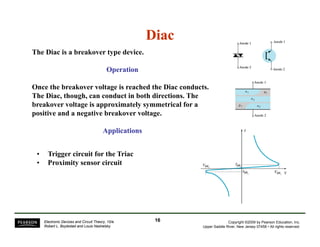
DiacDiac
The Diac is a breakover type device.
OperationOperation
Once the breakover voltage is reached the Diac conducts.
The Diac, though, can conduct in both directions. The
breakover voltage is approximately symmetrical for ag pp y y
positive and a negative breakover voltage.
ApplicationsApplications
• Trigger circuit for the Triac
• Proximity sensor circuit
Copyright ©2009 by Pearson Education, Inc.
Upper Saddle River, New Jersey 07458 • All rights reserved.
Electronic Devices and Circuit Theory, 10/e
Robert L. Boylestad and Louis Nashelsky
1616
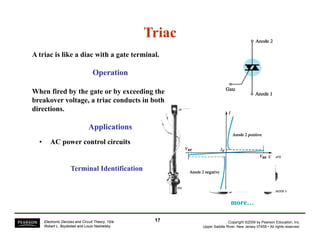
TriacTriac
A triac is like a diac with a gate terminal.
OperationOperationpp
When fired by the gate or by exceeding the
breakover voltage, a triac conducts in both
directionsdirections.
ApplicationsApplications
Terminal IdentificationTerminal Identification
• AC power control circuits
Terminal IdentificationTerminal Identification
moremore
Copyright ©2009 by Pearson Education, Inc.
Upper Saddle River, New Jersey 07458 • All rights reserved.
Electronic Devices and Circuit Theory, 10/e
Robert L. Boylestad and Louis Nashelsky
more…more…
1717
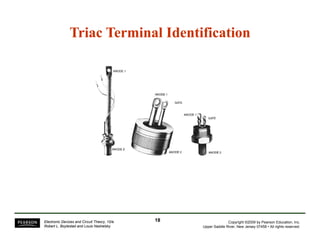
Triac Terminal IdentificationTriac Terminal Identification
Copyright ©2009 by Pearson Education, Inc.
Upper Saddle River, New Jersey 07458 • All rights reserved.
Electronic Devices and Circuit Theory, 10/e
Robert L. Boylestad and Louis Nashelsky
1818
The Unijunction Transistor (UJT)The Unijunction Transistor (UJT)
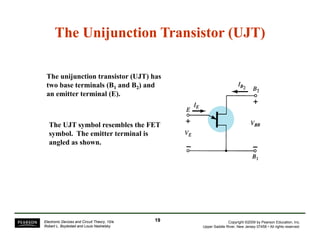
The unijunction transistor (UJT) hasThe unijunction transistor (UJT) has
two base terminals (B1 and B2) and
an emitter terminal (E).
The UJT symbol resembles the FET
symbol. The emitter terminal is
angled as shown.
Copyright ©2009 by Pearson Education, Inc.
Upper Saddle River, New Jersey 07458 • All rights reserved.
Electronic Devices and Circuit Theory, 10/e
Robert L. Boylestad and Louis Nashelsky
1919
UJT Equivalent CircuitUJT Equivalent Circuit
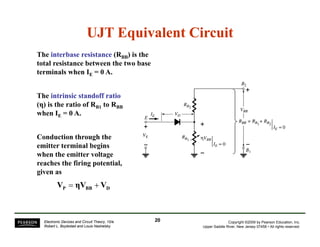
The interbase resistanceinterbase resistance (RBB) is the
total resistance between the two base
terminals when IE = 0 A.
The intrinsic standoff ratiointrinsic standoff ratio
(η) is the ratio of RB1 to RBB(η) B1 BB
when IE = 0 A.
Conduction through theConduction through the
emitter terminal begins
when the emitter voltage
reaches the firing potential,
igiven as
DBBP VηVV +=
Copyright ©2009 by Pearson Education, Inc.
Upper Saddle River, New Jersey 07458 • All rights reserved.
Electronic Devices and Circuit Theory, 10/e
Robert L. Boylestad and Louis Nashelsky
2020
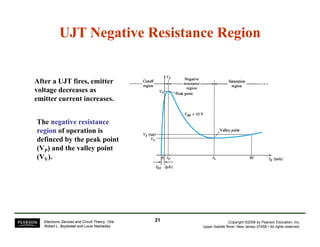
UJT Negative Resistance RegionUJT Negative Resistance Region
After a UJT fires, emitter
voltage decreases as
emitter current increases.
The negative resistancenegative resistance
regionregion of operation is
definced by the peak pointdefinced by the peak point
(VP) and the valley point
(VV).
Copyright ©2009 by Pearson Education, Inc.
Upper Saddle River, New Jersey 07458 • All rights reserved.
Electronic Devices and Circuit Theory, 10/e
Robert L. Boylestad and Louis Nashelsky
2121
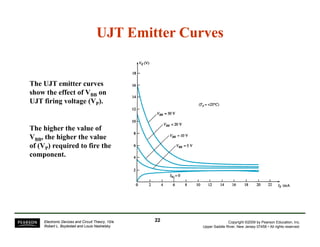
UJT Emitter CurvesUJT Emitter Curves
The UJT emitter curves
show the effect of VBB on
UJT firing voltage (VP).
The higher the value of
VBB, the higher the valueVBB, the higher the value
of (VP) required to fire the
component.
Copyright ©2009 by Pearson Education, Inc.
Upper Saddle River, New Jersey 07458 • All rights reserved.
Electronic Devices and Circuit Theory, 10/e
Robert L. Boylestad and Louis Nashelsky
2222
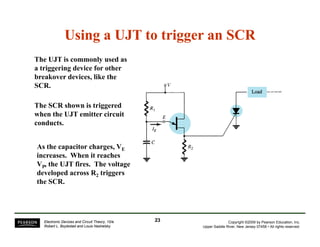
Using a UJT to trigger an SCRUsing a UJT to trigger an SCR
The UJT is commonly used as
a triggering device for other
breakover devices like thebreakover devices, like the
SCR.
The SCR shown is triggeredgg
when the UJT emitter circuit
conducts.
As the capacitor charges, VE
increases. When it reaches
VP, the UJT fires. The voltage
developed across R2 triggers
the SCR.
Copyright ©2009 by Pearson Education, Inc.
Upper Saddle River, New Jersey 07458 • All rights reserved.
Electronic Devices and Circuit Theory, 10/e
Robert L. Boylestad and Louis Nashelsky
2323
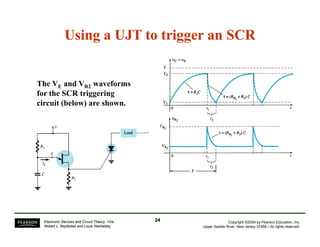
Using a UJT to trigger an SCRUsing a UJT to trigger an SCR
The VE and VR2 waveforms
for the SCR triggering
circuit (below) are shown.
Copyright ©2009 by Pearson Education, Inc.
Upper Saddle River, New Jersey 07458 • All rights reserved.
Electronic Devices and Circuit Theory, 10/e
Robert L. Boylestad and Louis Nashelsky
2424
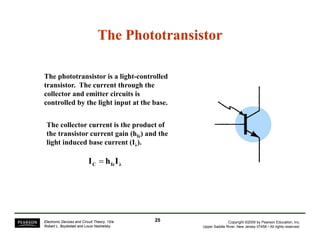
The PhototransistorThe Phototransistor
The phototransistor is a light-controlledThe phototransistor is a light-controlled
transistor. The current through the
collector and emitter circuits is
controlled by the light input at the base.
The collector current is the product of
the transistor current gain (hfe) and the
light induced base current (Iλ).
λfeC IhI =
Copyright ©2009 by Pearson Education, Inc.
Upper Saddle River, New Jersey 07458 • All rights reserved.
Electronic Devices and Circuit Theory, 10/e
Robert L. Boylestad and Louis Nashelsky
2525
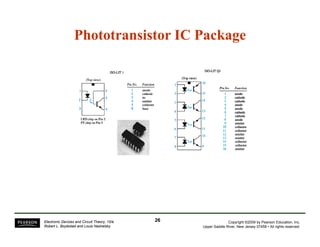
Phototransistor IC PackagePhototransistor IC Package
Copyright ©2009 by Pearson Education, Inc.
Upper Saddle River, New Jersey 07458 • All rights reserved.
Electronic Devices and Circuit Theory, 10/e
Robert L. Boylestad and Louis Nashelsky
2626
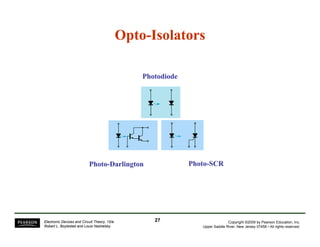
OptoOpto--IsolatorsIsolators
PhotodiodePhotodiodePhotodiodePhotodiode
PhotoPhoto--DarlingtonDarlington PhotoPhoto--SCRSCR
Copyright ©2009 by Pearson Education, Inc.
Upper Saddle River, New Jersey 07458 • All rights reserved.
Electronic Devices and Circuit Theory, 10/e
Robert L. Boylestad and Louis Nashelsky
2727
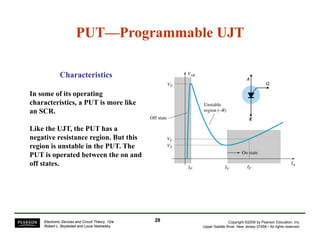
PUTPUT——Programmable UJTProgrammable UJT
CharacteristicsCharacteristicsCharacteristicsCharacteristics
In some of its operating
characteristics, a PUT is more like
an SCR.
Like the UJT, the PUT has a
negative resistance region. But thisnegative resistance region. But this
region is unstable in the PUT. The
PUT is operated between the on and
off states.
Copyright ©2009 by Pearson Education, Inc.
Upper Saddle River, New Jersey 07458 • All rights reserved.
Electronic Devices and Circuit Theory, 10/e
Robert L. Boylestad and Louis Nashelsky
2828
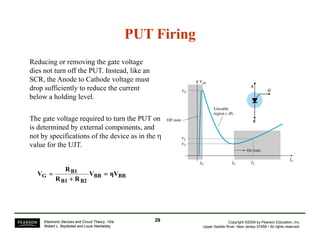
PUT FiringPUT Firing
Reducing or removing the gate voltage
dies not turn off the PUT. Instead, like an
SC h A d C h d lSCR, the Anode to Cathode voltage must
drop sufficiently to reduce the current
below a holding level.
The gate voltage required to turn the PUT on
is determined by external components, and
not by specifications of the device as in the ηy p η
value for the UJT.
B1R
BBBB
B2B1
B1
G ηVV
RR
R
V =
+
=
Copyright ©2009 by Pearson Education, Inc.
Upper Saddle River, New Jersey 07458 • All rights reserved.
Electronic Devices and Circuit Theory, 10/e
Robert L. Boylestad and Louis Nashelsky
2929

17 pnpn and other devices

  • 1.
  • 2.
    pnpnpnpn DevicesDevices SCRSCR——siliconsilicon--controlled rectifiercontrolledrectifier SCSSCS iliili ll d i hll d i hSCSSCS –– siliconsilicon--controlled switchcontrolled switch GTOGTO –– gate turngate turn--off switchoff switch LASCRLASCR –– lightlight--aActivated SCRaActivated SCR Shockley diodeShockley diodeShockley diodeShockley diode DiacDiac TriacTriac Copyright ©2009 by Pearson Education, Inc. Upper Saddle River, New Jersey 07458 • All rights reserved. Electronic Devices and Circuit Theory, 10/e Robert L. Boylestad and Louis Nashelsky 22
  • 3.
    SCRSCR——SiliconSilicon--Controlled RectifierControlled Rectifier TheSCR is a switching device for high-voltage and high-current operationsoperations. Like an ordinary rectifier, an SCR conducts in one direction The terminals are: • Anode • CathodeCathode • Gate Copyright ©2009 by Pearson Education, Inc. Upper Saddle River, New Jersey 07458 • All rights reserved. Electronic Devices and Circuit Theory, 10/e Robert L. Boylestad and Louis Nashelsky 33
  • 4.
    SCR OperationSCR Operation Toswitch on an SCR: • Forward bias the anode-• Forward bias the anode- cathode terminals (VF) AND • Apply sufficient gate voltage (Vgate) and gate current (IGT) Once an SCR is switched on, it i l t h d h th •• Holding currentHolding current (IH) is the minimum required current from current (IGT) remains latched on, even when the gate signal is removed. minimum required current from anode to cathode •• Reverse breakdown voltageReverse breakdown voltage is the maximum reverse bias voltage for Copyright ©2009 by Pearson Education, Inc. Upper Saddle River, New Jersey 07458 • All rights reserved. Electronic Devices and Circuit Theory, 10/e Robert L. Boylestad and Louis Nashelsky the SCR 44
  • 5.
    SCR OperationSCR Operation Toswitch off an SCR: • Remove the power source the• Remove the power source the anode and cathode terminals OR • Reverse bias the anode and cathode terminals An SCR cannot be switched off by simply removing the gate voltage.removing the gate voltage. Commutation circuitry can be used for satisfying either of the conditions for switching off an SCR. Copyright ©2009 by Pearson Education, Inc. Upper Saddle River, New Jersey 07458 • All rights reserved. Electronic Devices and Circuit Theory, 10/e Robert L. Boylestad and Louis Nashelsky 55
  • 6.
    SCR CommutationSCR Commutation CommutationCommutationcircuitry is simply a class of switching devices connected in parallel with the SCRwith the SCR. A control signal activates the switching circuitry and provides a low impedance bypass for the anode to cathode current. This momentary loss of current through the SCR turns it off. The switching circuitry can also apply a reverse bias voltage across the SCR, which also will turn off the SCR. Copyright ©2009 by Pearson Education, Inc. Upper Saddle River, New Jersey 07458 • All rights reserved. Electronic Devices and Circuit Theory, 10/e Robert L. Boylestad and Louis Nashelsky 66
  • 7.
    SCR False TriggeringSCRFalse Triggering An SCR can be forced to trigger conduction under several conditions that must be avoided:conditions that must be avoided: • Excessively high voltage from anode to cathode • High frequency signal from gate to cathode • High operating temperature Copyright ©2009 by Pearson Education, Inc. Upper Saddle River, New Jersey 07458 • All rights reserved. Electronic Devices and Circuit Theory, 10/e Robert L. Boylestad and Louis Nashelsky 77
  • 8.
    SCR Phase ControlSCRPhase Control The gate voltage can be set to fire the SCR at any point in the AC cycle. In this example, the SCR fires th AC las soon as the AC cycle crosses 0V. Therefore it acts like a half-wave rectifier. In this example, the SCR firesIn this example, the SCR fires later—at the 90° point—on the positive half-cycle. Copyright ©2009 by Pearson Education, Inc. Upper Saddle River, New Jersey 07458 • All rights reserved. Electronic Devices and Circuit Theory, 10/e Robert L. Boylestad and Louis Nashelsky 88
  • 9.
    SCR ApplicationsSCR Applications Inthese applications the SCR gate circuit is used to monitor a situation and trigger the SCR to turn onmonitor a situation and trigger the SCR to turn on a portion of the circuit. • Battery-charging regulatory g g g • Temperature controller circuit • Emergency-lighting system Copyright ©2009 by Pearson Education, Inc. Upper Saddle River, New Jersey 07458 • All rights reserved. Electronic Devices and Circuit Theory, 10/e Robert L. Boylestad and Louis Nashelsky 99
  • 10.
    SCSSCS——SiliconSilicon--Controlled SwitchControlled Switch AnSCS is like an SCR, except that it has two gates: a cathode gate and an anode gate. Either gate can fire the SCS • A positive pulse or voltage on the cathode gateg • A negative pulse or voltage on the anode gate Either gate can switch off the SCSEither gate can switch off the SCS • A negative pulse or voltage on the Cathode gate • A positive pulse or voltage on the anode gate Note: The anode gate requires higher voltages than the cathode gate. Copyright ©2009 by Pearson Education, Inc. Upper Saddle River, New Jersey 07458 • All rights reserved. Electronic Devices and Circuit Theory, 10/e Robert L. Boylestad and Louis Nashelsky 1010
  • 11.
    SCSSCS Comparison of theSCR and SCS: • The SCS has a much lower power capability compared to the SCR • The SCS has faster switching times than the SCR • The SCS can be switched off by gate control ApplicationsApplications • Pulse generator • Voltage sensor • Alarm circuits Pin Identification Copyright ©2009 by Pearson Education, Inc. Upper Saddle River, New Jersey 07458 • All rights reserved. Electronic Devices and Circuit Theory, 10/e Robert L. Boylestad and Louis Nashelsky 1111
  • 12.
    GTOGTO——Gate TurnGate Turn--OffSwitchOff Switch GTOs are similar to SCRs, except thatGTOs are similar to SCRs, except that the gate can turn the GTO on and off. It conducts only in one direction. ApplicationsApplicationsApplicationsApplications • Counters • Pulse generators O ill t• Oscillators • Voltage regulators Copyright ©2009 by Pearson Education, Inc. Upper Saddle River, New Jersey 07458 • All rights reserved. Electronic Devices and Circuit Theory, 10/e Robert L. Boylestad and Louis Nashelsky 1212
  • 13.
    GTOGTO Comparison of theGTO and SCS: • GTO is a low power device• GTO is a low power device • The gate signal necessary to fire the GTO is larger than the SCR gate signal. • The gate signal necessary to turn the GTO off is similar to that of SCS • The switching rate for turning the GTO off is much faster than the SCR Copyright ©2009 by Pearson Education, Inc. Upper Saddle River, New Jersey 07458 • All rights reserved. Electronic Devices and Circuit Theory, 10/e Robert L. Boylestad and Louis Nashelsky 1313
  • 14.
    LASCRLASCR——LightLight--Activated SCRActivated SCR TheLASCR is an SCR that is fired by a light beam striking the gate-cathode junction or by applying a gate voltage. ApplicationsApplicationsApplicationsApplications • Optical light controls • Relaysy • Phase control • Motor control • Computer applications Copyright ©2009 by Pearson Education, Inc. Upper Saddle River, New Jersey 07458 • All rights reserved. Electronic Devices and Circuit Theory, 10/e Robert L. Boylestad and Louis Nashelsky 1414
  • 15.
    Shockley DiodeShockley Diode TheShockley diode conducts once the breakover voltage is reached. It only conducts in one direction.g y OperationOperation Th Sh kl di d t b f d bi d dThe Shockley diode must be forward biased, and then once the voltage reaches the breakover level it will conduct. Like an SCR it only conducts in one direction. ApplicationApplication • Trigger switch for an SCRTrigger switch for an SCR Copyright ©2009 by Pearson Education, Inc. Upper Saddle River, New Jersey 07458 • All rights reserved. Electronic Devices and Circuit Theory, 10/e Robert L. Boylestad and Louis Nashelsky 1515
  • 16.
    DiacDiac The Diac isa breakover type device. OperationOperation Once the breakover voltage is reached the Diac conducts. The Diac, though, can conduct in both directions. The breakover voltage is approximately symmetrical for ag pp y y positive and a negative breakover voltage. ApplicationsApplications • Trigger circuit for the Triac • Proximity sensor circuit Copyright ©2009 by Pearson Education, Inc. Upper Saddle River, New Jersey 07458 • All rights reserved. Electronic Devices and Circuit Theory, 10/e Robert L. Boylestad and Louis Nashelsky 1616
  • 17.
    TriacTriac A triac islike a diac with a gate terminal. OperationOperationpp When fired by the gate or by exceeding the breakover voltage, a triac conducts in both directionsdirections. ApplicationsApplications Terminal IdentificationTerminal Identification • AC power control circuits Terminal IdentificationTerminal Identification moremore Copyright ©2009 by Pearson Education, Inc. Upper Saddle River, New Jersey 07458 • All rights reserved. Electronic Devices and Circuit Theory, 10/e Robert L. Boylestad and Louis Nashelsky more…more… 1717
  • 18.
    Triac Terminal IdentificationTriacTerminal Identification Copyright ©2009 by Pearson Education, Inc. Upper Saddle River, New Jersey 07458 • All rights reserved. Electronic Devices and Circuit Theory, 10/e Robert L. Boylestad and Louis Nashelsky 1818
  • 19.
    The Unijunction Transistor(UJT)The Unijunction Transistor (UJT) The unijunction transistor (UJT) hasThe unijunction transistor (UJT) has two base terminals (B1 and B2) and an emitter terminal (E). The UJT symbol resembles the FET symbol. The emitter terminal is angled as shown. Copyright ©2009 by Pearson Education, Inc. Upper Saddle River, New Jersey 07458 • All rights reserved. Electronic Devices and Circuit Theory, 10/e Robert L. Boylestad and Louis Nashelsky 1919
  • 20.
    UJT Equivalent CircuitUJTEquivalent Circuit The interbase resistanceinterbase resistance (RBB) is the total resistance between the two base terminals when IE = 0 A. The intrinsic standoff ratiointrinsic standoff ratio (η) is the ratio of RB1 to RBB(η) B1 BB when IE = 0 A. Conduction through theConduction through the emitter terminal begins when the emitter voltage reaches the firing potential, igiven as DBBP VηVV += Copyright ©2009 by Pearson Education, Inc. Upper Saddle River, New Jersey 07458 • All rights reserved. Electronic Devices and Circuit Theory, 10/e Robert L. Boylestad and Louis Nashelsky 2020
  • 21.
    UJT Negative ResistanceRegionUJT Negative Resistance Region After a UJT fires, emitter voltage decreases as emitter current increases. The negative resistancenegative resistance regionregion of operation is definced by the peak pointdefinced by the peak point (VP) and the valley point (VV). Copyright ©2009 by Pearson Education, Inc. Upper Saddle River, New Jersey 07458 • All rights reserved. Electronic Devices and Circuit Theory, 10/e Robert L. Boylestad and Louis Nashelsky 2121
  • 22.
    UJT Emitter CurvesUJTEmitter Curves The UJT emitter curves show the effect of VBB on UJT firing voltage (VP). The higher the value of VBB, the higher the valueVBB, the higher the value of (VP) required to fire the component. Copyright ©2009 by Pearson Education, Inc. Upper Saddle River, New Jersey 07458 • All rights reserved. Electronic Devices and Circuit Theory, 10/e Robert L. Boylestad and Louis Nashelsky 2222
  • 23.
    Using a UJTto trigger an SCRUsing a UJT to trigger an SCR The UJT is commonly used as a triggering device for other breakover devices like thebreakover devices, like the SCR. The SCR shown is triggeredgg when the UJT emitter circuit conducts. As the capacitor charges, VE increases. When it reaches VP, the UJT fires. The voltage developed across R2 triggers the SCR. Copyright ©2009 by Pearson Education, Inc. Upper Saddle River, New Jersey 07458 • All rights reserved. Electronic Devices and Circuit Theory, 10/e Robert L. Boylestad and Louis Nashelsky 2323
  • 24.
    Using a UJTto trigger an SCRUsing a UJT to trigger an SCR The VE and VR2 waveforms for the SCR triggering circuit (below) are shown. Copyright ©2009 by Pearson Education, Inc. Upper Saddle River, New Jersey 07458 • All rights reserved. Electronic Devices and Circuit Theory, 10/e Robert L. Boylestad and Louis Nashelsky 2424
  • 25.
    The PhototransistorThe Phototransistor Thephototransistor is a light-controlledThe phototransistor is a light-controlled transistor. The current through the collector and emitter circuits is controlled by the light input at the base. The collector current is the product of the transistor current gain (hfe) and the light induced base current (Iλ). λfeC IhI = Copyright ©2009 by Pearson Education, Inc. Upper Saddle River, New Jersey 07458 • All rights reserved. Electronic Devices and Circuit Theory, 10/e Robert L. Boylestad and Louis Nashelsky 2525
  • 26.
    Phototransistor IC PackagePhototransistorIC Package Copyright ©2009 by Pearson Education, Inc. Upper Saddle River, New Jersey 07458 • All rights reserved. Electronic Devices and Circuit Theory, 10/e Robert L. Boylestad and Louis Nashelsky 2626
  • 27.
    OptoOpto--IsolatorsIsolators PhotodiodePhotodiodePhotodiodePhotodiode PhotoPhoto--DarlingtonDarlington PhotoPhoto--SCRSCR Copyright ©2009by Pearson Education, Inc. Upper Saddle River, New Jersey 07458 • All rights reserved. Electronic Devices and Circuit Theory, 10/e Robert L. Boylestad and Louis Nashelsky 2727
  • 28.
    PUTPUT——Programmable UJTProgrammable UJT CharacteristicsCharacteristicsCharacteristicsCharacteristics Insome of its operating characteristics, a PUT is more like an SCR. Like the UJT, the PUT has a negative resistance region. But thisnegative resistance region. But this region is unstable in the PUT. The PUT is operated between the on and off states. Copyright ©2009 by Pearson Education, Inc. Upper Saddle River, New Jersey 07458 • All rights reserved. Electronic Devices and Circuit Theory, 10/e Robert L. Boylestad and Louis Nashelsky 2828
  • 29.
    PUT FiringPUT Firing Reducingor removing the gate voltage dies not turn off the PUT. Instead, like an SC h A d C h d lSCR, the Anode to Cathode voltage must drop sufficiently to reduce the current below a holding level. The gate voltage required to turn the PUT on is determined by external components, and not by specifications of the device as in the ηy p η value for the UJT. B1R BBBB B2B1 B1 G ηVV RR R V = + = Copyright ©2009 by Pearson Education, Inc. Upper Saddle River, New Jersey 07458 • All rights reserved. Electronic Devices and Circuit Theory, 10/e Robert L. Boylestad and Louis Nashelsky 2929