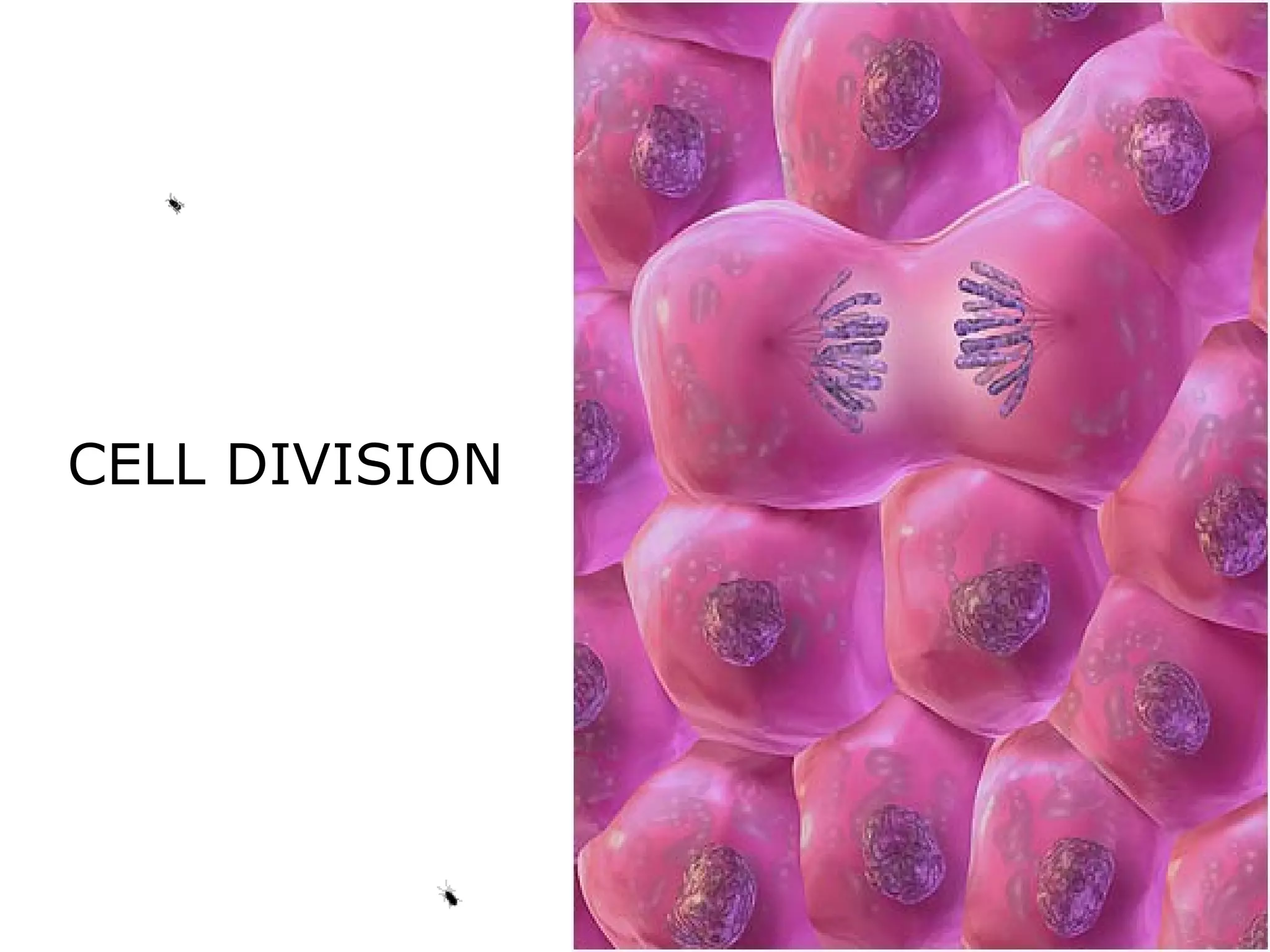
CELL DIVISION
CELL DIVISION


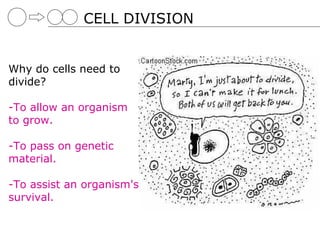
Why do cells need to
divide?

-To allow an organism
to grow.

-To pass on genetic
material.

-To assist an organism's
survival.
CELL DIVISION
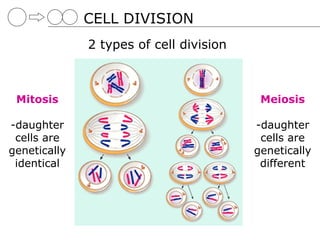
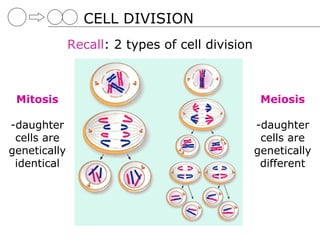
              2 types of cell division


 Mitosis                                  Meiosis

-daughter                                -daughter
 cells are                                cells are
genetically                              genetically
 identical                                different
CELL DIVISION
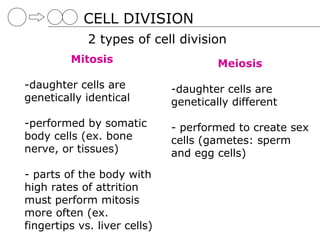
             2 types of cell division
         Mitosis                       Meiosis
-daughter cells are           -daughter cells are
genetically identical         genetically different
-performed by somatic         - performed to create sex
body cells (ex. bone          cells (gametes: sperm
nerve, or tissues)            and egg cells)
- parts of the body with
high rates of attrition
must perform mitosis
more often (ex.
fingertips vs. liver cells)
CELL DIVISION

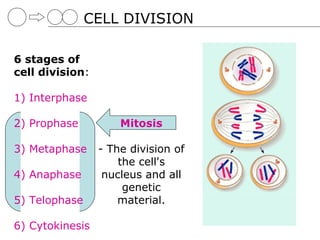
6 stages of
cell division:

1) Interphase

2) Prophase          Mitosis

3) Metaphase     - The division of
                     the cell's
4) Anaphase       nucleus and all
                      genetic
5) Telophase         material.

6) Cytokinesis
CELL DIVISION


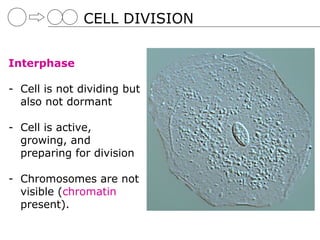
Interphase

- Cell is not dividing but
  also not dormant

- Cell is active,
  growing, and
  preparing for division

- Chromosomes are not
  visible (chromatin
  present).
CELL DIVISION

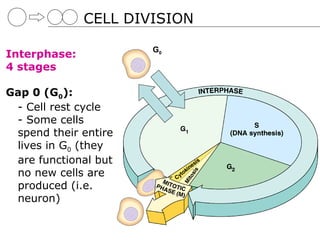
                      G0
Interphase:
4 stages

Gap 0 (G0):
 - Cell rest cycle
 - Some cells
 spend their entire
 lives in G0 (they
 are functional but
 no new cells are
 produced (i.e.
 neuron)
CELL DIVISION

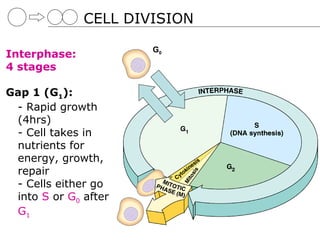
                      G0
Interphase:
4 stages

Gap 1 (G1):
 - Rapid growth
 (4hrs)
 - Cell takes in
 nutrients for
 energy, growth,
 repair
 - Cells either go
 into S or G0 after
 G1
CELL DIVISION

                          G0
Interphase:
4 stages

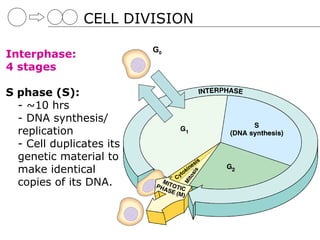
S phase (S):
  - ~10 hrs
  - DNA synthesis/
  replication
  - Cell duplicates its
  genetic material to
  make identical
  copies of its DNA.
CELL DIVISION

                        G0
Interphase:
4 stages

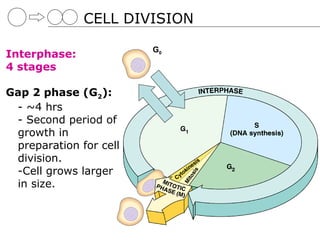
Gap 2 phase (G2):
 - ~4 hrs
 - Second period of
 growth in
 preparation for cell
 division.
 -Cell grows larger
 in size.
CELL DIVISION

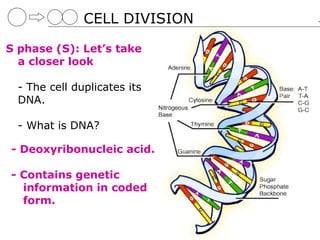
S phase (S): Let’s take
  a closer look

  - The cell duplicates its
  DNA.

  - What is DNA?

- Deoxyribonucleic acid.

- Contains genetic
  information in coded
  form.
CELL DIVISION


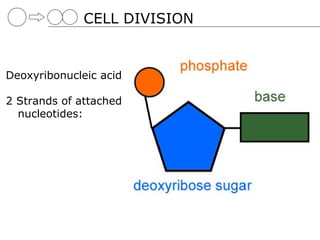
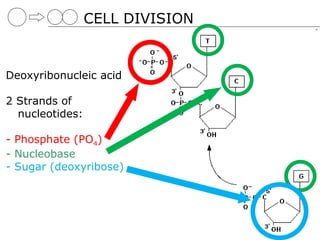
Deoxyribonucleic acid

2 Strands of attached
  nucleotides:
CELL DIVISION


Deoxyribonucleic acid

2 Strands of
  nucleotides:

- Phosphate (PO4)
- Nucleobase
- Sugar (deoxyribose)
CELL DIVISION


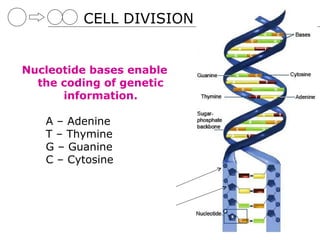
Nucleotide bases enable
  the coding of genetic
      information.

   A – Adenine
   T – Thymine
   G – Guanine
   C – Cytosine
CELL DIVISION

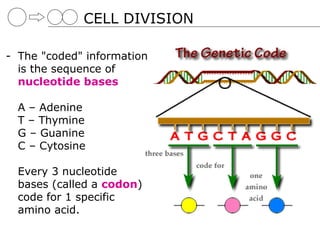
- The "coded" information
  is the sequence of
  nucleotide bases

  A – Adenine
  T – Thymine
  G – Guanine
  C – Cytosine

  Every 3 nucleotide
  bases (called a codon)
  code for 1 specific
  amino acid.
CELL DIVISION


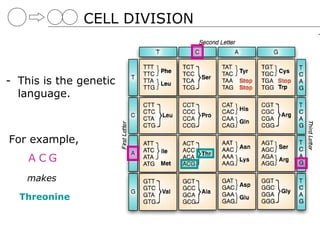
- This is the genetic
  language.


For example,
    A CG
    makes

  Threonine
CELL DIVISION

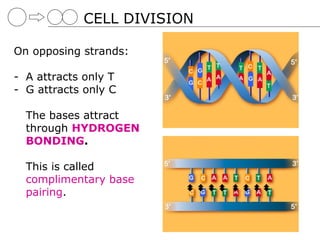
On opposing strands:

- A attracts only T
- G attracts only C

  The bases attract
  through HYDROGEN
  BONDING.

  This is called
  complimentary base
  pairing.
CELL DIVISION
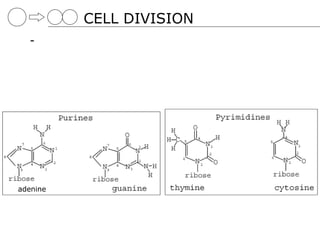
  -


adenine
CELL DIVISION
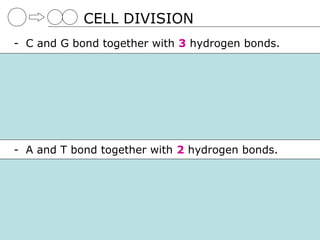
- C and G bond together with 3 hydrogen bonds.


- A and T bond together with 2 hydrogen bonds.
CELL DIVISION
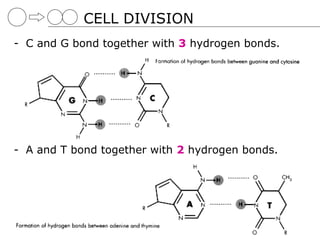
- C and G bond together with 3 hydrogen bonds.


- A and T bond together with 2 hydrogen bonds.
CELL DIVISION


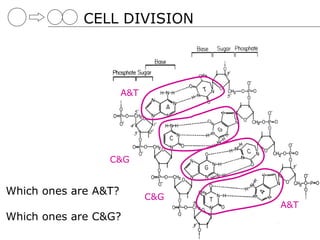
                      A&T


                 C&G


Which ones are A&T?         C&G
                                  A&T
Which ones are C&G?
CELL DIVISION

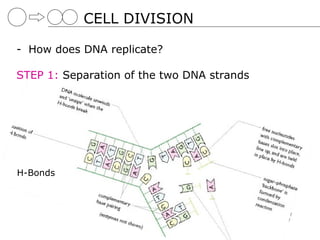
- How does DNA replicate?

STEP 1: Separation of the two DNA strands


H-Bonds
CELL DIVISION

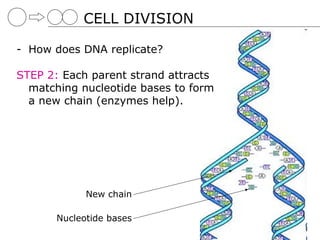
- How does DNA replicate?

STEP 2: Each parent strand attracts
  matching nucleotide bases to form
  a new chain (enzymes help).


             New chain

       Nucleotide bases
CELL DIVISION
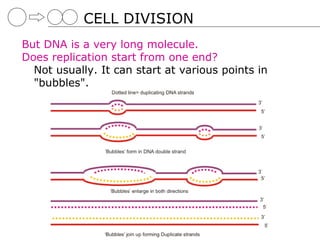
But DNA is a very long molecule.
Does replication start from one end?
  Not usually. It can start at various points in
  "bubbles".
CELL DIVISION


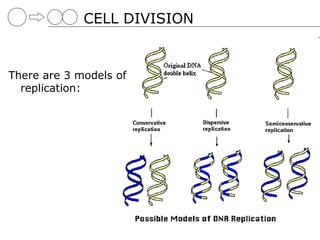
There are 3 models of
  replication:
CELL DIVISION

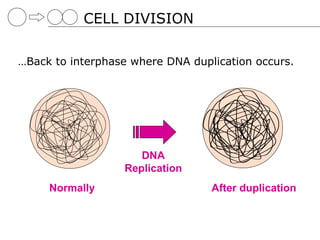
…Back to interphase where DNA duplication occurs.


                     DNA
                  Replication
     Normally                     After duplication
CELL DIVISION
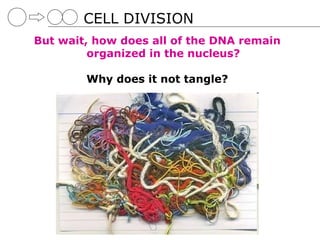
But wait, how does all of the DNA remain
         organized in the nucleus?

        Why does it not tangle?
CELL DIVISION
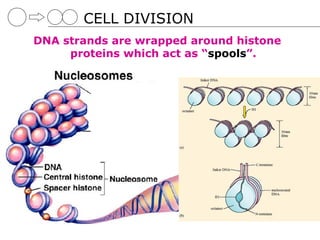
DNA strands are wrapped around histone
     proteins which act as “spools”.
CELL DIVISION
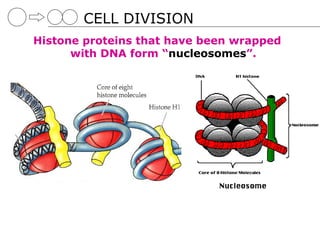
Histone proteins that have been wrapped
      with DNA form “nucleosomes”.
CELL DIVISION
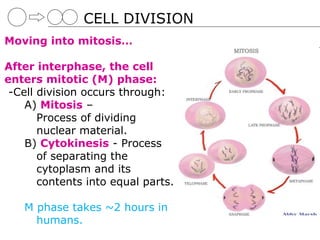
Moving into mitosis…

After interphase, the cell
enters mitotic (M) phase:
 -Cell division occurs through:
    A) Mitosis –
       Process of dividing
       nuclear material.
    B) Cytokinesis - Process
       of separating the
       cytoplasm and its
       contents into equal parts.

   M phase takes ~2 hours in
     humans.
CELL DIVISION
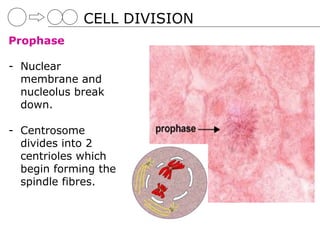
Prophase

- Nuclear
  membrane and
  nucleolus break
  down.

- Centrosome
  divides into 2
  centrioles which
  begin forming the
  spindle fibres.
CELL DIVISION
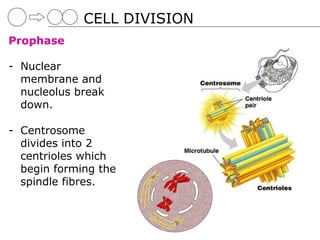
Prophase

- Nuclear
  membrane and
  nucleolus break
  down.

- Centrosome
  divides into 2
  centrioles which
  begin forming the
  spindle fibres.
CELL DIVISION
Prophase


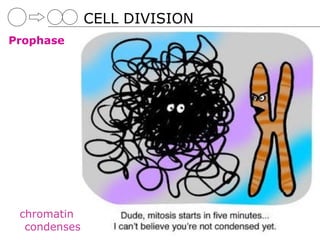
 chromatin
  condenses
CELL DIVISION
Prophase

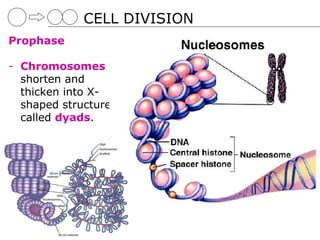
- Chromosomes
  shorten and
  thicken into X-
  shaped structures
  called dyads.
CELL DIVISION
Prophase

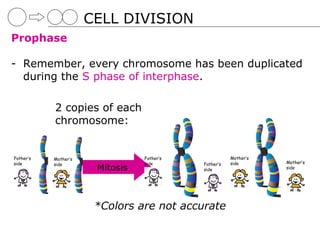
- Remember, every chromosome has been duplicated
  during the S phase of interphase.

           2 copies of each
           chromosome:


Father’s   Mother’s              Father’s              Mother’s
side       side                  side       Father’s   side       Mother’s
                       Mitosis              side                  side


                       *Colors are not accurate
CELL DIVISION
Prophase
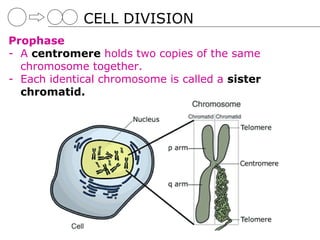
- A centromere holds two copies of the same
  chromosome together.
- Each identical chromosome is called a sister
  chromatid.
CELL DIVISION
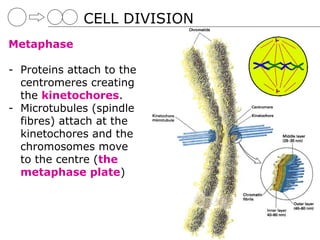
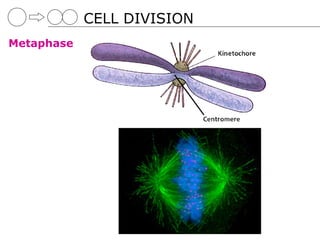
Metaphase

- Proteins attach to the
  centromeres creating
  the kinetochores.
- Microtubules (spindle
  fibres) attach at the
  kinetochores and the
  chromosomes move
  to the centre (the
  metaphase plate)
CELL DIVISION
Metaphase
CELL DIVISION
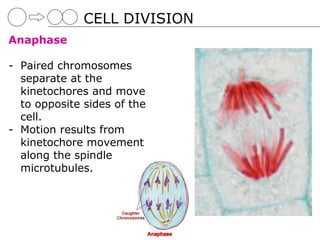
Anaphase

- Paired chromosomes
  separate at the
  kinetochores and move
  to opposite sides of the
  cell.
- Motion results from
  kinetochore movement
  along the spindle
  microtubules.
CELL DIVISION

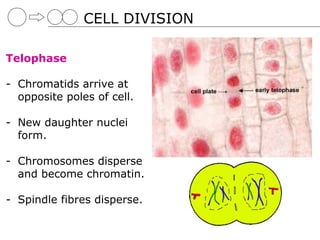
Telophase

- Chromatids arrive at
  opposite poles of cell.

- New daughter nuclei
  form.

- Chromosomes disperse
  and become chromatin.

- Spindle fibres disperse.
CELL DIVISION
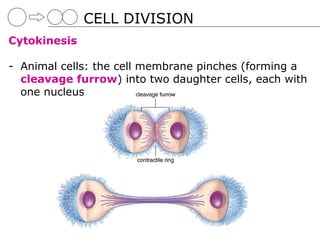
Cytokinesis

- Animal cells: the cell membrane pinches (forming a
  cleavage furrow) into two daughter cells, each with
  one nucleus
CELL DIVISION
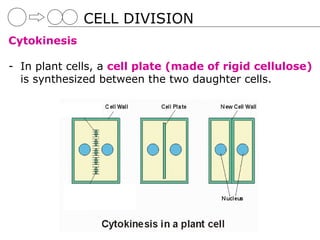
Cytokinesis

- In plant cells, a cell plate (made of rigid cellulose)
  is synthesized between the two daughter cells.
CELL DIVISION
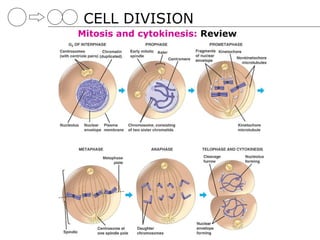
Mitosis and cytokinesis: Review
CELL DIVISION
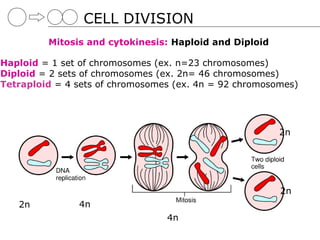
         Mitosis and cytokinesis: Haploid and Diploid

Haploid = 1 set of chromosomes (ex. n=23 chromosomes)
Diploid = 2 sets of chromosomes (ex. 2n= 46 chromosomes)
Tetraploid = 4 sets of chromosomes (ex. 4n = 92 chromosomes)


                                                        2n


                                                        2n
   2n          4n
                                 4n
CELL DIVISION
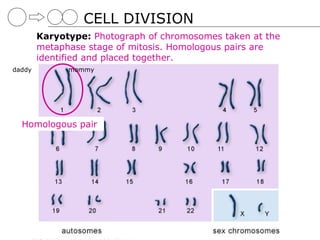
        Karyotype: Photograph of chromosomes taken at the
        metaphase stage of mitosis. Homologous pairs are
        identified and placed together.
daddy         mommy


  Homologous pair
CELL DIVISION
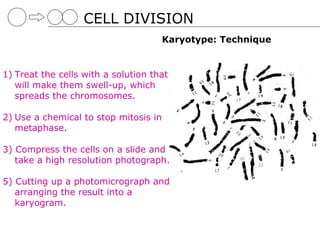
                                       Karyotype: Technique


1) Treat the cells with a solution that
   will make them swell-up, which
   spreads the chromosomes.

2) Use a chemical to stop mitosis in
   metaphase.

3) Compress the cells on a slide and
   take a high resolution photograph.

5) Cutting up a photomicrograph and
   arranging the result into a
   karyogram.
CELL DIVISION
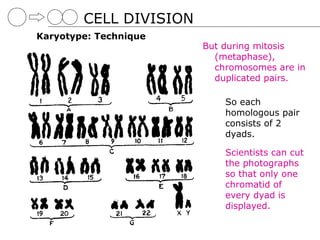
Karyotype: Technique
                        But during mitosis
                          (metaphase),
                          chromosomes are in
                          duplicated pairs.

                            So each
                            homologous pair
                            consists of 2
                            dyads.

                            Scientists can cut
                            the photographs
                            so that only one
                            chromatid of
                            every dyad is
                            displayed.
CELL DIVISION

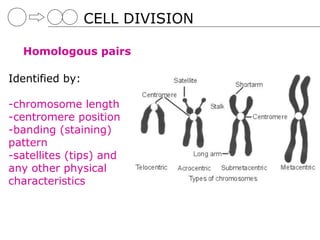
  Homologous pairs

Identified by:

-chromosome length
-centromere position
-banding (staining)
pattern
-satellites (tips) and
any other physical
characteristics
CELL DIVISION
              Recall: 2 types of cell division


 Mitosis                                          Meiosis

-daughter                                        -daughter
 cells are                                        cells are
genetically                                      genetically
 identical                                        different
CELL DIVISION


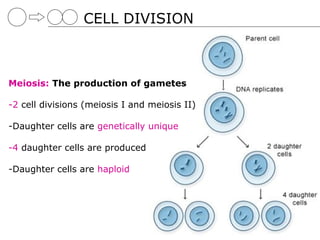
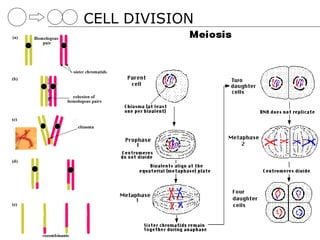
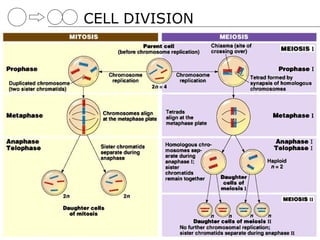
Meiosis: The production of gametes

-2 cell divisions (meiosis I and meiosis II)

-Daughter cells are genetically unique

-4 daughter cells are produced

-Daughter cells are haploid
CELL DIVISION
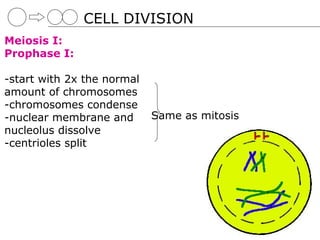
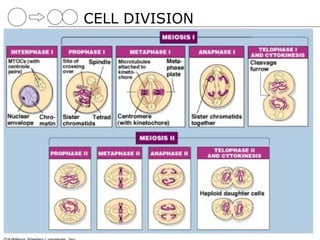
Meiosis I:
Prophase I:

-start with 2x the normal
amount of chromosomes
-chromosomes condense
-nuclear membrane and       Same as mitosis
nucleolus dissolve
-centrioles split
CELL DIVISION
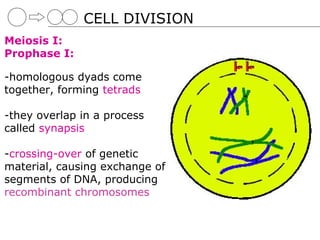
Meiosis I:
Prophase I:

-homologous dyads come
together, forming tetrads

-they overlap in a process
called synapsis

-crossing-over of genetic
material, causing exchange of
segments of DNA, producing
recombinant chromosomes
CELL DIVISION
Meiosis I:
Prophase I:

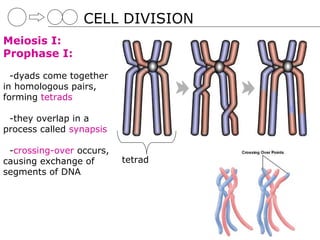
  -dyads come together
in homologous pairs,
forming tetrads

 -they overlap in a
process called synapsis

 -crossing-over occurs,
causing exchange of       tetrad
segments of DNA
CELL DIVISION

Meiosis I:
Prophase I:


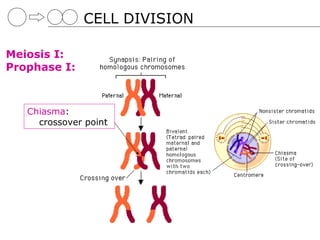
   Chiasma:
     crossover point
CELL DIVISION

Meiosis I:
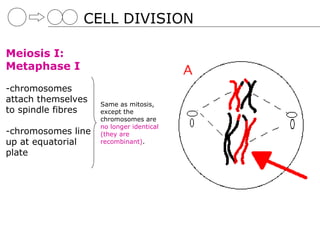
Metaphase I

-chromosomes
attach themselves   Same as mitosis,
to spindle fibres   except the
                    chromosomes are
                    no longer identical
-chromosomes line   (they are
up at equatorial    recombinant).
plate
CELL DIVISION

Meiosis I:
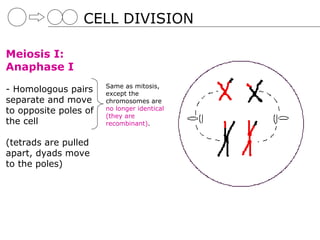
Anaphase I
                       Same as mitosis,
- Homologous pairs     except the
separate and move      chromosomes are
to opposite poles of   no longer identical
                       (they are
the cell               recombinant).


(tetrads are pulled
apart, dyads move
to the poles)
CELL DIVISION

Meiosis I:
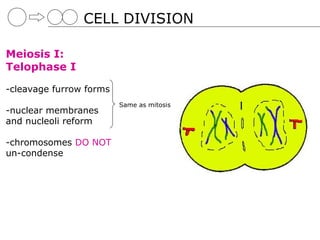
Telophase I

-cleavage furrow forms
                         Same as mitosis
-nuclear membranes
and nucleoli reform

-chromosomes DO NOT
un-condense
CELL DIVISION
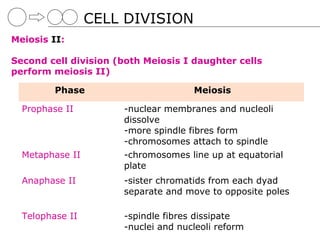
Meiosis II:

Second cell division (both Meiosis I daughter cells
perform meiosis II)

         Phase                       Meiosis

  Prophase II         -nuclear membranes and nucleoli
                      dissolve
                      -more spindle fibres form
                      -chromosomes attach to spindle
  Metaphase II        -chromosomes line up at equatorial
                      plate
  Anaphase II         -sister chromatids from each dyad
                      separate and move to opposite poles

  Telophase II        -spindle fibres dissipate
                      -nuclei and nucleoli reform
CELL DIVISION
CELL DIVISION
CELL DIVISION
CELL DIVISION
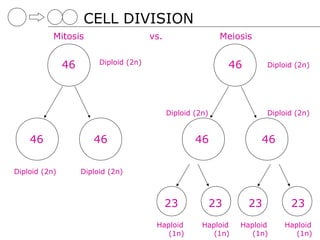
           Mitosis                      vs.                   Meiosis

                         Diploid (2n)
               46                                                 46        Diploid (2n)


                                              Diploid (2n)                  Diploid (2n)


    46                 46                             46                46

Diploid (2n)        Diploid (2n)


                                              23             23        23         23
                                         Haploid        Haploid    Haploid      Haploid
                                            (1n)           (1n)       (1n)         (1n)
CELL DIVISION
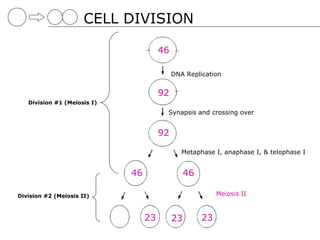
                             Maternal Chromosome A                       Paternal Chromosome A

                                                          46
                                                                  DNA Replication
                                                                 DNA Replication

                                                          92
                                                          92
                                                                         Sister chromatids


   Division #1 (Meiosis I)
                                                               Synapsis and crossing over
                                                               Synapsis and crossing over


                                                          92
                                                          92
                                                                         Metaphase I, anaphase I, & telophase I
                                                                        Metaphase I, anaphase I, & telophase I

                                              46                         46
                                              46                         46

Division #2 (Meiosis II)                                                                        Meiosis II


                                     23
                                                     23
                                                     23          23
                                                                 23                   23
                                                                                      23
CELL DIVISION
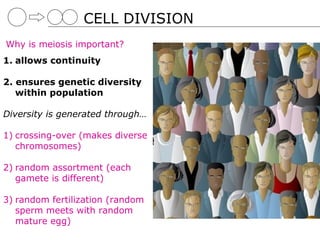
Why is meiosis important?
1. allows continuity

2. ensures genetic diversity
   within population

Diversity is generated through…

1) crossing-over (makes diverse
   chromosomes)

2) random assortment (each
   gamete is different)

3) random fertilization (random
   sperm meets with random
   mature egg)
CELL DIVISION
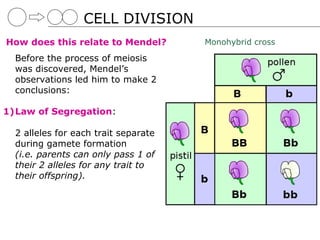
How does this relate to Mendel?       Monohybrid cross

  Before the process of meiosis
  was discovered, Mendel’s
  observations led him to make 2
  conclusions:

1)Law of Segregation:

  2 alleles for each trait separate
  during gamete formation
  (i.e. parents can only pass 1 of
  their 2 alleles for any trait to
  their offspring).
CELL DIVISION
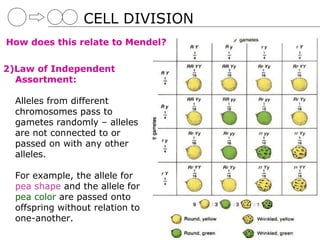
How does this relate to Mendel?


2)Law of Independent
  Assortment:

  Alleles from different
  chromosomes pass to
  gametes randomly – alleles
  are not connected to or
  passed on with any other
  alleles.

  For example, the allele for
  pea shape and the allele for
  pea color are passed onto
  offspring without relation to
  one-another.
CELL DIVISION
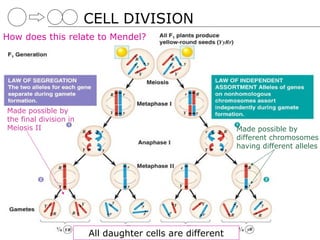
How does this relate to Mendel?


Made possible by
the final division in
Meiosis II                                                 Made possible by
                                                           different chromosomes
                                                           having different alleles


                        All daughter cells are different
CELL DIVISION
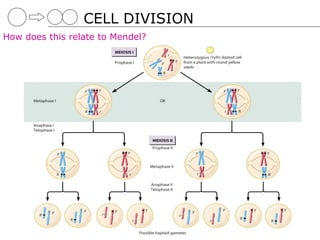
How does this relate to Mendel?
CELL DIVISION
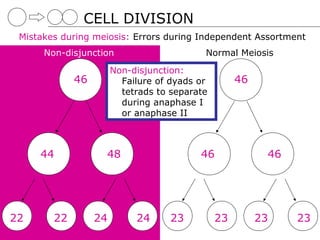
 Mistakes during meiosis: Errors during Independent Assortment
      Non-disjunction                      Normal Meiosis
                       Non-disjunction:
             46          Failure of dyads or        46
                         tetrads to separate
                         during anaphase I
                         or anaphase II


     44            48                     46              46


22      22        24        24      23         23        23    23
CELL DIVISION
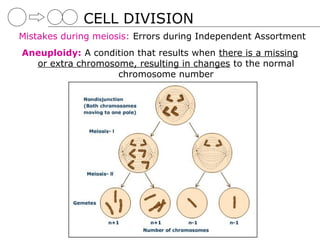
Mistakes during meiosis: Errors during Independent Assortment
Aneuploidy: A condition that results when there is a missing
  or extra chromosome, resulting in changes to the normal
                   chromosome number
CELL DIVISION

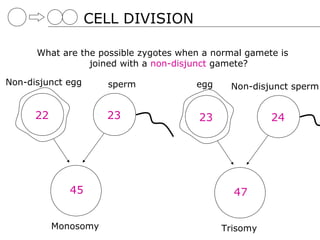
      What are the possible zygotes when a normal gamete is
                 joined with a non-disjunct gamete?

Non-disjunct egg      sperm            egg    Non-disjunct sperm


      22              23                23             24


              45                               47


           Monosomy                          Trisomy
CELL DIVISION
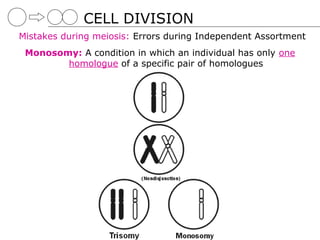
Mistakes during meiosis: Errors during Independent Assortment
 Monosomy: A condition in which an individual has only one
        homologue of a specific pair of homologues
CELL DIVISION
Mistakes during meiosis: Errors during Independent Assortment
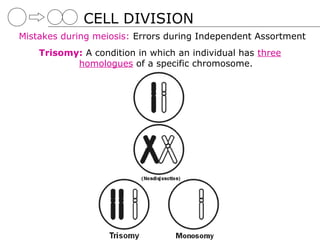
    Trisomy: A condition in which an individual has three
           homologues of a specific chromosome.
CELL DIVISION
Mistakes during meiosis: Errors during Independent Assortment
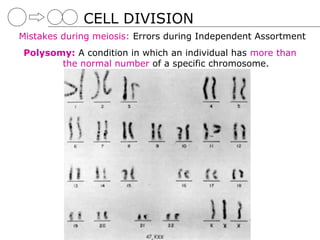
Polysomy: A condition in which an individual has more than
       the normal number of a specific chromosome.
CELL DIVISION
Mistakes during meiosis: Errors during Independent Assortment


Haploid (n): having one copy of an entire chromosome
  set (e.g. sex cells)

Diploid (2n): having two copies of an entire
  chromosome set (e.g. somatic cells)

Triploid (3n): having three copies of an entire
   chromosome set

Polyploidy: A condition in which an individual has three
  or more copies of an entire chromosome set
CELL DIVISION
  Mistakes during meiosis: Errors during Independent Assortment


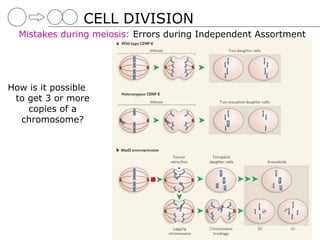
How is it possible
 to get 3 or more
    copies of a
  chromosome?
CELL DIVISION
Condition   Final # of    Affected     Characteristic
            chromosomes   chromosome
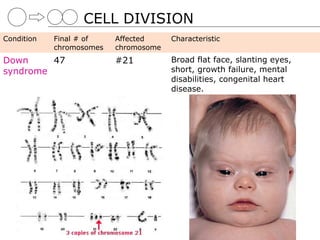
Down     47               #21          Broad flat face, slanting eyes,
syndrome                               short, growth failure, mental
                                       disabilities, congenital heart
                                       disease.
CELL DIVISION
Condition   Final # of    Affected        Characteristic
            chromosomes   chromosome
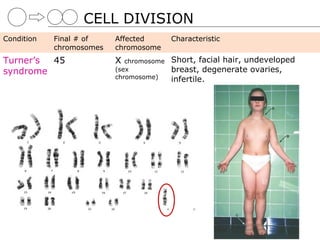
Turner’s 45               X  chromosome   Short, facial hair, undeveloped
syndrome                  (sex            breast, degenerate ovaries,
                          chromosome)     infertile.
CELL DIVISION
Condition       Final # of    Affected       Characteristic
                chromosomes   chromosome
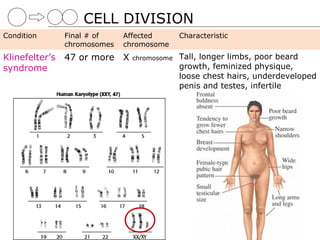
Klinefelter’s   47 or more X    chromosome   Tall, longer limbs, poor beard
syndrome                                     growth, feminized physique,
                                             loose chest hairs, underdeveloped
                                             penis and testes, infertile
CELL DIVISION
Condition   Final # of    Affected      Characteristic
            chromosomes   chromosome
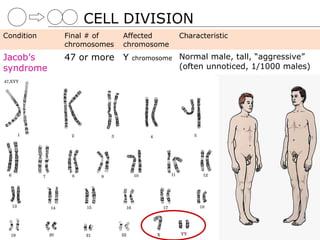
Jacob’s     47 or more Y   chromosome   Normal male, tall, “aggressive”
syndrome                                (often unnoticed, 1/1000 males)
CELL DIVISION
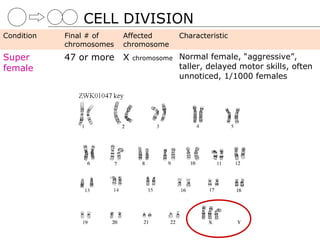
Condition   Final # of    Affected       Characteristic
            chromosomes   chromosome
Super       47 or more X    chromosome   Normal female, “aggressive”,
female                                   taller, delayed motor skills, often
                                         unnoticed, 1/1000 females

06 cell division

  • 1.
  • 2.
    CELL DIVISION Why docells need to divide? -To allow an organism to grow. -To pass on genetic material. -To assist an organism's survival.
  • 3.
    CELL DIVISION 2 types of cell division Mitosis Meiosis -daughter -daughter cells are cells are genetically genetically identical different
  • 4.
    CELL DIVISION 2 types of cell division Mitosis Meiosis -daughter cells are -daughter cells are genetically identical genetically different -performed by somatic - performed to create sex body cells (ex. bone cells (gametes: sperm nerve, or tissues) and egg cells) - parts of the body with high rates of attrition must perform mitosis more often (ex. fingertips vs. liver cells)
  • 5.
    CELL DIVISION 6 stagesof cell division: 1) Interphase 2) Prophase Mitosis 3) Metaphase - The division of the cell's 4) Anaphase nucleus and all genetic 5) Telophase material. 6) Cytokinesis
  • 6.
    CELL DIVISION Interphase - Cellis not dividing but also not dormant - Cell is active, growing, and preparing for division - Chromosomes are not visible (chromatin present).
  • 7.
    CELL DIVISION G0 Interphase: 4 stages Gap 0 (G0): - Cell rest cycle - Some cells spend their entire lives in G0 (they are functional but no new cells are produced (i.e. neuron)
  • 8.
    CELL DIVISION G0 Interphase: 4 stages Gap 1 (G1): - Rapid growth (4hrs) - Cell takes in nutrients for energy, growth, repair - Cells either go into S or G0 after G1
  • 9.
    CELL DIVISION G0 Interphase: 4 stages S phase (S): - ~10 hrs - DNA synthesis/ replication - Cell duplicates its genetic material to make identical copies of its DNA.
  • 10.
    CELL DIVISION G0 Interphase: 4 stages Gap 2 phase (G2): - ~4 hrs - Second period of growth in preparation for cell division. -Cell grows larger in size.
  • 11.
    CELL DIVISION S phase(S): Let’s take a closer look - The cell duplicates its DNA. - What is DNA? - Deoxyribonucleic acid. - Contains genetic information in coded form.
  • 12.
    CELL DIVISION Deoxyribonucleic acid 2Strands of attached nucleotides:
  • 13.
    CELL DIVISION Deoxyribonucleic acid 2Strands of nucleotides: - Phosphate (PO4) - Nucleobase - Sugar (deoxyribose)
  • 14.
    CELL DIVISION Nucleotide basesenable the coding of genetic information. A – Adenine T – Thymine G – Guanine C – Cytosine
  • 15.
    CELL DIVISION - The"coded" information is the sequence of nucleotide bases A – Adenine T – Thymine G – Guanine C – Cytosine Every 3 nucleotide bases (called a codon) code for 1 specific amino acid.
  • 16.
    CELL DIVISION - Thisis the genetic language. For example, A CG makes Threonine
  • 17.
    CELL DIVISION On opposingstrands: - A attracts only T - G attracts only C The bases attract through HYDROGEN BONDING. This is called complimentary base pairing.
  • 18.
    CELL DIVISION - adenine
  • 19.
    CELL DIVISION - Cand G bond together with 3 hydrogen bonds. - A and T bond together with 2 hydrogen bonds.
  • 20.
    CELL DIVISION - Cand G bond together with 3 hydrogen bonds. - A and T bond together with 2 hydrogen bonds.
  • 21.
    CELL DIVISION A&T C&G Which ones are A&T? C&G A&T Which ones are C&G?
  • 22.
    CELL DIVISION - Howdoes DNA replicate? STEP 1: Separation of the two DNA strands H-Bonds
  • 23.
    CELL DIVISION - Howdoes DNA replicate? STEP 2: Each parent strand attracts matching nucleotide bases to form a new chain (enzymes help). New chain Nucleotide bases
  • 24.
    CELL DIVISION But DNAis a very long molecule. Does replication start from one end? Not usually. It can start at various points in "bubbles".
  • 25.
    CELL DIVISION There are3 models of replication:
  • 26.
    CELL DIVISION …Back tointerphase where DNA duplication occurs. DNA Replication Normally After duplication
  • 27.
    CELL DIVISION But wait,how does all of the DNA remain organized in the nucleus? Why does it not tangle?
  • 28.
    CELL DIVISION DNA strandsare wrapped around histone proteins which act as “spools”.
  • 29.
    CELL DIVISION Histone proteinsthat have been wrapped with DNA form “nucleosomes”.
  • 30.
    CELL DIVISION Moving intomitosis… After interphase, the cell enters mitotic (M) phase: -Cell division occurs through: A) Mitosis – Process of dividing nuclear material. B) Cytokinesis - Process of separating the cytoplasm and its contents into equal parts. M phase takes ~2 hours in humans.
  • 31.
    CELL DIVISION Prophase - Nuclear membrane and nucleolus break down. - Centrosome divides into 2 centrioles which begin forming the spindle fibres.
  • 32.
    CELL DIVISION Prophase - Nuclear membrane and nucleolus break down. - Centrosome divides into 2 centrioles which begin forming the spindle fibres.
  • 33.
  • 34.
    CELL DIVISION Prophase - Chromosomes shorten and thicken into X- shaped structures called dyads.
  • 35.
    CELL DIVISION Prophase - Remember,every chromosome has been duplicated during the S phase of interphase. 2 copies of each chromosome: Father’s Mother’s Father’s Mother’s side side side Father’s side Mother’s Mitosis side side *Colors are not accurate
  • 36.
    CELL DIVISION Prophase - Acentromere holds two copies of the same chromosome together. - Each identical chromosome is called a sister chromatid.
  • 37.
    CELL DIVISION Metaphase - Proteinsattach to the centromeres creating the kinetochores. - Microtubules (spindle fibres) attach at the kinetochores and the chromosomes move to the centre (the metaphase plate)
  • 38.
  • 39.
    CELL DIVISION Anaphase - Pairedchromosomes separate at the kinetochores and move to opposite sides of the cell. - Motion results from kinetochore movement along the spindle microtubules.
  • 40.
    CELL DIVISION Telophase - Chromatidsarrive at opposite poles of cell. - New daughter nuclei form. - Chromosomes disperse and become chromatin. - Spindle fibres disperse.
  • 41.
    CELL DIVISION Cytokinesis - Animalcells: the cell membrane pinches (forming a cleavage furrow) into two daughter cells, each with one nucleus
  • 42.
    CELL DIVISION Cytokinesis - Inplant cells, a cell plate (made of rigid cellulose) is synthesized between the two daughter cells.
  • 43.
    CELL DIVISION Mitosis andcytokinesis: Review
  • 44.
    CELL DIVISION Mitosis and cytokinesis: Haploid and Diploid Haploid = 1 set of chromosomes (ex. n=23 chromosomes) Diploid = 2 sets of chromosomes (ex. 2n= 46 chromosomes) Tetraploid = 4 sets of chromosomes (ex. 4n = 92 chromosomes) 2n 2n 2n 4n 4n
  • 45.
    CELL DIVISION Karyotype: Photograph of chromosomes taken at the metaphase stage of mitosis. Homologous pairs are identified and placed together. daddy mommy Homologous pair
  • 46.
    CELL DIVISION Karyotype: Technique 1) Treat the cells with a solution that will make them swell-up, which spreads the chromosomes. 2) Use a chemical to stop mitosis in metaphase. 3) Compress the cells on a slide and take a high resolution photograph. 5) Cutting up a photomicrograph and arranging the result into a karyogram.
  • 47.
    CELL DIVISION Karyotype: Technique But during mitosis (metaphase), chromosomes are in duplicated pairs. So each homologous pair consists of 2 dyads. Scientists can cut the photographs so that only one chromatid of every dyad is displayed.
  • 48.
    CELL DIVISION Homologous pairs Identified by: -chromosome length -centromere position -banding (staining) pattern -satellites (tips) and any other physical characteristics
  • 49.
    CELL DIVISION Recall: 2 types of cell division Mitosis Meiosis -daughter -daughter cells are cells are genetically genetically identical different
  • 50.
    CELL DIVISION Meiosis: Theproduction of gametes -2 cell divisions (meiosis I and meiosis II) -Daughter cells are genetically unique -4 daughter cells are produced -Daughter cells are haploid
  • 51.
    CELL DIVISION Meiosis I: ProphaseI: -start with 2x the normal amount of chromosomes -chromosomes condense -nuclear membrane and Same as mitosis nucleolus dissolve -centrioles split
  • 52.
    CELL DIVISION Meiosis I: ProphaseI: -homologous dyads come together, forming tetrads -they overlap in a process called synapsis -crossing-over of genetic material, causing exchange of segments of DNA, producing recombinant chromosomes
  • 53.
    CELL DIVISION Meiosis I: ProphaseI: -dyads come together in homologous pairs, forming tetrads -they overlap in a process called synapsis -crossing-over occurs, causing exchange of tetrad segments of DNA
  • 54.
    CELL DIVISION Meiosis I: ProphaseI: Chiasma: crossover point
  • 55.
    CELL DIVISION Meiosis I: MetaphaseI -chromosomes attach themselves Same as mitosis, to spindle fibres except the chromosomes are no longer identical -chromosomes line (they are up at equatorial recombinant). plate
  • 56.
    CELL DIVISION Meiosis I: AnaphaseI Same as mitosis, - Homologous pairs except the separate and move chromosomes are to opposite poles of no longer identical (they are the cell recombinant). (tetrads are pulled apart, dyads move to the poles)
  • 57.
    CELL DIVISION Meiosis I: TelophaseI -cleavage furrow forms Same as mitosis -nuclear membranes and nucleoli reform -chromosomes DO NOT un-condense
  • 58.
    CELL DIVISION Meiosis II: Secondcell division (both Meiosis I daughter cells perform meiosis II) Phase Meiosis Prophase II -nuclear membranes and nucleoli dissolve -more spindle fibres form -chromosomes attach to spindle Metaphase II -chromosomes line up at equatorial plate Anaphase II -sister chromatids from each dyad separate and move to opposite poles Telophase II -spindle fibres dissipate -nuclei and nucleoli reform
  • 59.
  • 60.
  • 61.
  • 62.
    CELL DIVISION Mitosis vs. Meiosis Diploid (2n) 46 46 Diploid (2n) Diploid (2n) Diploid (2n) 46 46 46 46 Diploid (2n) Diploid (2n) 23 23 23 23 Haploid Haploid Haploid Haploid (1n) (1n) (1n) (1n)
  • 63.
    CELL DIVISION Maternal Chromosome A Paternal Chromosome A 46 DNA Replication DNA Replication 92 92 Sister chromatids Division #1 (Meiosis I) Synapsis and crossing over Synapsis and crossing over 92 92 Metaphase I, anaphase I, & telophase I Metaphase I, anaphase I, & telophase I 46 46 46 46 Division #2 (Meiosis II) Meiosis II 23 23 23 23 23 23 23
  • 64.
    CELL DIVISION Why ismeiosis important? 1. allows continuity 2. ensures genetic diversity within population Diversity is generated through… 1) crossing-over (makes diverse chromosomes) 2) random assortment (each gamete is different) 3) random fertilization (random sperm meets with random mature egg)
  • 65.
    CELL DIVISION How doesthis relate to Mendel? Monohybrid cross Before the process of meiosis was discovered, Mendel’s observations led him to make 2 conclusions: 1)Law of Segregation: 2 alleles for each trait separate during gamete formation (i.e. parents can only pass 1 of their 2 alleles for any trait to their offspring).
  • 66.
    CELL DIVISION How doesthis relate to Mendel? 2)Law of Independent Assortment: Alleles from different chromosomes pass to gametes randomly – alleles are not connected to or passed on with any other alleles. For example, the allele for pea shape and the allele for pea color are passed onto offspring without relation to one-another.
  • 67.
    CELL DIVISION How doesthis relate to Mendel? Made possible by the final division in Meiosis II Made possible by different chromosomes having different alleles All daughter cells are different
  • 68.
    CELL DIVISION How doesthis relate to Mendel?
  • 69.
    CELL DIVISION Mistakesduring meiosis: Errors during Independent Assortment Non-disjunction Normal Meiosis Non-disjunction: 46 Failure of dyads or 46 tetrads to separate during anaphase I or anaphase II 44 48 46 46 22 22 24 24 23 23 23 23
  • 70.
    CELL DIVISION Mistakes duringmeiosis: Errors during Independent Assortment Aneuploidy: A condition that results when there is a missing or extra chromosome, resulting in changes to the normal chromosome number
  • 71.
    CELL DIVISION What are the possible zygotes when a normal gamete is joined with a non-disjunct gamete? Non-disjunct egg sperm egg Non-disjunct sperm 22 23 23 24 45 47 Monosomy Trisomy
  • 72.
    CELL DIVISION Mistakes duringmeiosis: Errors during Independent Assortment Monosomy: A condition in which an individual has only one homologue of a specific pair of homologues
  • 73.
    CELL DIVISION Mistakes duringmeiosis: Errors during Independent Assortment Trisomy: A condition in which an individual has three homologues of a specific chromosome.
  • 74.
    CELL DIVISION Mistakes duringmeiosis: Errors during Independent Assortment Polysomy: A condition in which an individual has more than the normal number of a specific chromosome.
  • 75.
    CELL DIVISION Mistakes duringmeiosis: Errors during Independent Assortment Haploid (n): having one copy of an entire chromosome set (e.g. sex cells) Diploid (2n): having two copies of an entire chromosome set (e.g. somatic cells) Triploid (3n): having three copies of an entire chromosome set Polyploidy: A condition in which an individual has three or more copies of an entire chromosome set
  • 76.
    CELL DIVISION Mistakes during meiosis: Errors during Independent Assortment How is it possible to get 3 or more copies of a chromosome?
  • 77.
    CELL DIVISION Condition Final # of Affected Characteristic chromosomes chromosome Down 47 #21 Broad flat face, slanting eyes, syndrome short, growth failure, mental disabilities, congenital heart disease.
  • 78.
    CELL DIVISION Condition Final # of Affected Characteristic chromosomes chromosome Turner’s 45 X chromosome Short, facial hair, undeveloped syndrome (sex breast, degenerate ovaries, chromosome) infertile.
  • 79.
    CELL DIVISION Condition Final # of Affected Characteristic chromosomes chromosome Klinefelter’s 47 or more X chromosome Tall, longer limbs, poor beard syndrome growth, feminized physique, loose chest hairs, underdeveloped penis and testes, infertile
  • 80.
    CELL DIVISION Condition Final # of Affected Characteristic chromosomes chromosome Jacob’s 47 or more Y chromosome Normal male, tall, “aggressive” syndrome (often unnoticed, 1/1000 males)
  • 81.
    CELL DIVISION Condition Final # of Affected Characteristic chromosomes chromosome Super 47 or more X chromosome Normal female, “aggressive”, female taller, delayed motor skills, often unnoticed, 1/1000 females

Editor's Notes

  • #2 Hornets kill bees: http://www.youtube.com/watch?v=L54exo8JTUs&feature=fvwrel Hornets from Hell: http://www.youtube.com/watch?v=R5QxUR-mZVM
  • #24 http://www.youtube.com/watch?v=zdDkiRw1PdU&feature=related http://www.youtube.com/watch?v=cDlKrLJjRlY&feature=fvwrel  cartoon
  • #42 http://www.youtube.com/watch?v=VGV3fv-uZYI
  • #51 http://www.youtube.com/watch?v=GqwMDIDAkl8&feature=related