CELL REPRODUCTION
Outline Types of Cell Division Structure of Chromosomes  Cell Division in Prokaryotes Phases of cell cycle Interphase Mphase Cytokinesis Cell cycle-abnormalities
Cell Theory : all organisms consist of cells and arise from pre-existing cells Mitosis  is the process by which new cells are generated for body tissues during development, growth, and tissue repair. 2 cells are produced in one cycle of division Daughter cells have  ALL  of the genetic material of the parent cell Meiosis  is the process by which special cells called gametes are generated for reproduction. 4 cells are produced in two cycles of division Daughter cells have  HALF  the genetic material of the parent cell
SOMATIC Vs REPRODUCTIVE GAMETES (n) – EGGS (OVA) & SPERM - MEIOSIS (Somatic) OTHERS (2n) - MITOSIS NUCLEAR Vs CYTOPLASMIC DIVISION
The state in which there are two copies of each chromosome present is known as diploid (2n).   H Haploid (n)– only one copy of  a chromosome is  present All of the somatic cells in our bodies are  diploid cells The only cells in our bodies that are haploid  are  our gametes – eggs and sperm
Human somatic cells have 46 chromosomes   diploid number (2n) = 46 23 from mom - 23 from dad 22 pairs are autosomes –true homologous pairs 1 pair is not necessarily homologous - sex chromosomes females are XX males are XY – a non homologous  pair.
Meiosis –  form of cell division where there are two  successive rounds of cell division following  DNA replication  - produces haploid cells (n) - start with 46 double stranded chromosomes (2n) After 1 division  - 23 double stranded chromosomes (n) After 2nd division - 23 single stranded chromosomes (n)   - occurs in our germ cells  –  cells that produce our gametes   - egg and sperm
Cell division Mitosis
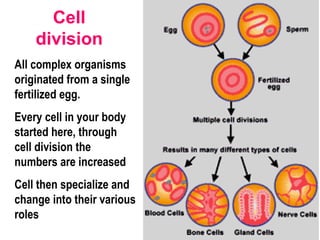
Cell division All complex organisms originated from a single fertilized egg. Every cell in your body started here, through cell division the numbers are increased Cell then specialize and change into their various roles
Mitosis   Mitosis is the process by which new body cell are produced for: Growth Replacing damaged or old cells.  This is a complex process  requiring different stages
Mitosis All daughter cells contain the  same genetic information  from the original parent cell from which it was copied. Every different type of cell in your body contains the  same  genes, but only some act to make the cells specialise – e.g. into nerve or muscle tissue.
BASIC GENETICS Each cell in the human body contains   two sets of 2 3  chromosomes   Mitosis  identically replicates  this information E ach cell  therefore  has the same  genetic material Reproductive cells only have one set  of chromosomes. These combine to  make a new person with different  genetic material to both parents
2 daughter cells identical to original Parent cell Chromosomes are copied and double in number Chromosomes now split
Reproduction presents a major problem for cells and organisms: (how can information be transmitted faithfully to progeny) I II III IV = one bit of genetic information
= one bit of genetic information The information transfer problem becomes more challenging as more bits of information are incorporated into the organism
One of life’s solutions to this challenge:  “Package” the  bits of information into single units called  chromosomes = one bit of genetic information
The   nucleus Nuclear membrane - double membrane Chromosomes/Chromatin- genetic material/DNA Gene - DNA segment Chromosome---   DNA ---   Gene
chromosomes Packaging of genetic material in  prokaryotes and eukaryotes prokaryote cell eukaryote cell
Structure of Chromosomes Chromosomes are composed of a complex of DNA and protein,  chromatin. DNA exists as a single, long, double-stranded fiber extending chromosome’s entire length. forms  nucleosome  every 200 nucleotides DNA coiled around histone proteins
C Chromosome basics . T The number of chromosomes present within the nucleus is a characteristic of the species.  Chromosomes of humans and most other  eukaryotic species occurs in pairs.   Members of a chromosome pair are known as homologues.
Mitosis/Cell division mitosis is the process of cell division in which one cell becomes two identical daughter cells development renewal  regeneration
The cell cycle  is the mechanism by which a cell duplicates its contents and then divides in two cell grows and duplicates its contents cell contents cell divides in two Each parental cell gives rise to two daughter cells on completion of each cell cycle parental cell daughter cell 1 daughter cell 2
Replication of chromosomes Replication is the process of duplicating a chromosome Occurs prior to division Replicated copies are  called sister chromatids Held together at centromere
 
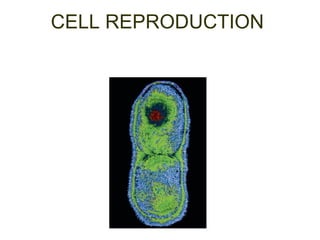
Binary Fission-prokaryotic cells
Cell Cycle
Prophase Metaphase Anaphase Telophase The Stages of  M itosis Interphase
REMEMBER! I nterphase P rophase M etaphase A naphase T elophase   (Individuals Please Make All The Cells) IPMAT
INTERPHASE After a cell has divided, the two  new cells begin the process again, the cell s   at this stage are  in   Interphase.
By late interphase, the chromosomes have been duplicated but are loosely packed. The centrosomes have been duplicated and begin to organize microtubules into an aster (“star”). Copyright © 2002 Pearson Education, Inc., publishing as Benjamin Cummings
 
PROPHASE The chromatin (decondensed   DNA) in the nucleus,  condenses  to form pairs of  chromosomes . The centrioles move to opposite  ends of the nucleus. As this is happening the nucleolus  begins to break down Nuclear membrane begins to break down
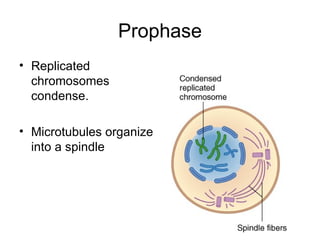
Prophase Replicated chromosomes condense. Microtubules organize into a spindle
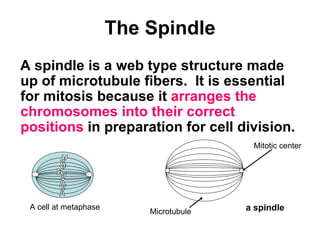
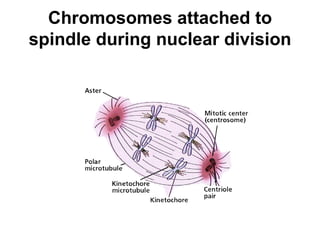
The Spindle A spindle  is a web type structure made up of microtubule fibers.  It is essential for mitosis because it  arranges the chromosomes into their correct positions  in preparation for cell division. Mitotic center Microtubule A cell at   metaphase a spindle
Chromosomes attached to spindle during nuclear division
METAPHASE The spindle becomes fully developed The  nuclear membrane has completely gone The  chromatid pairs  are aligned  along  the center of the  spindle (the EQUATOR)
The spindle fibers push the sister chromatids until they are all arranged at the  metaphase plate , an imaginary plane equidistant between the poles, defining metaphase. Copyright © 2002 Pearson Education, Inc., publishing as Benjamin Cummings
Anaphase Centromeres of sister chromatids separate Chromosomes move to opposite ends of the cell
At anaphase, the centromeres divide, separating the sister chromatids. Each is now pulled toward the pole to which it is attached by spindle fibers. By the end, the two  poles have equivalent  collections of  chromosomes.
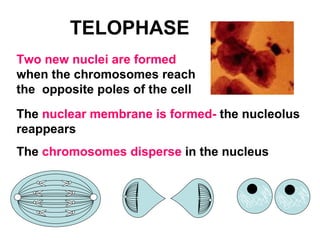
TELOPHASE Two new nuclei are formed  when  the chromosomes reach  the  opposite poles of the cell The  nuclear membrane is formed-  the nucleolus reappears The  chromosomes disperse  in the nucleus
Telophase Nuclear membranes form Spindle disappears Division of cytoplasm occurs (cytokinesis)
Copyright © 2002 Pearson Education, Inc., publishing as Benjamin Cummings
CYTOKINESIS Literally means,  division of the  cytoplasm M itosis is the splitting of the nucleus.  Cytokinesis is the splitting of cytoplasm
Cytokinesis Cleavage of cell into two halves animal cells constriction belt of actin filaments plant cells cell plate
Cytokinesis Cytoplasmic division  occurs after nuclear  division is complete.  Two cells are formed.
Cytokinesis  in animals A cleavage  furrow  forms that pinches the cell in two - the furrow represents a ring of actin and myosin filaments just under the plasma membrane.
Rat – epithelial cells
Mitosis – bone cell slides 1 2 3 4 5 Parent cell Chromosomes copied Copies separating 2 daughter cells Cells split
Cytokinesis  in plants A  cell plate  made up of cell-wall components gradually forms in the middle of the cell.
So what’s the difference in Plants? Plant cells do not have a centriole Plant cells do not pinch in half.  Cytoplasmic division is accomplished by a cell plate forming between 2 daughter cells
Plants
Cell Turnover –  The speed of mitosis One full cycle can vary between a  couple of minutes to days. For example s kin and epithelial cells have a rapid turnover in the human body  in order  to replace the ones constantly being worn away. C ells which make up organs such as the eye and the brain, need not multiply as often once they reach adult size.
Organs which need to produce new cells continuously have the  highest turnover . For example :- Bone marrow- producing replacement  blood cells The testes - producing  spermatogonia
Tumors Abnormalities  can sometimes occur in c ells which reproduce at a rapid rate,  this in turn may lead to the formation of  tumors. Tumors of any type should be considered serious. Although  benign tumors do   n o t usually cause  a  threat to a persons  life ,  they  can cause great inconvenience if not treated.
CANCER uncontrolled cellular mitotic divisions
Meiosis
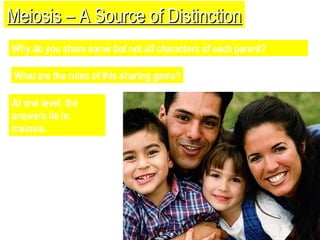
Meiosis – A Source of Distinction Why do you share some but not all characters of each parent?  What are the rules of this sharing game? At one level, the answers lie in meiosis.
Meiosis does two things - 1) Meiosis takes a cell with  two copies  of every chromosome (diploid) and makes cells with a  single copy  of every chromosome (haploid).  This is a good idea if you’re going to combine two cells to make a new organism. This trick is  accomplished by  halving  chromosome number.  In meiosis,  one diploid cells produces four haploid cells.
Why do we need meiosis? Meiosis is necessary to halve the number of chromosomes going into the sex cells Why halve the chromosomes in gametes? At fertilization the male and female sex cells will provide  ½ of the chromosomes  each – so the offspring has genes from both parents
2) Meiosis  scrambles  the specific forms of each gene that each sex cell (egg or sperm) receives.  This makes for a lot of  genetic diversity . This trick is accomplished through  independent assortment  and  crossing-over . Genetic diversity is important for the  evolution of populations and species .
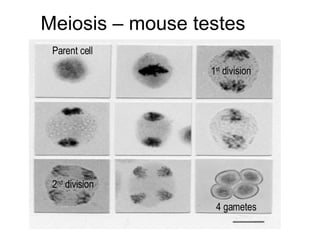
Meiosis Parent cell – chromosome pair Chromosomes copied 1 st  division - pairs split 2 nd  division – produces 4 gamete cells with ½ the original no. of chromosomes
Meiosis – mouse testes  Parent cell 4 gametes 1 st  division 2 nd  division
The Stages of Meiosis: aka: Reduction Division
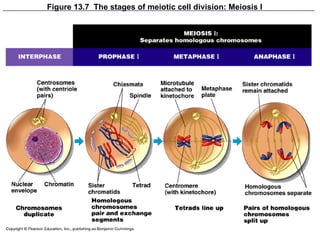
Meiosis I : Separates Homologous Chromosomes Interphase Each of the chromosomes replicate The result is two genetically identical sister chromatids which remain attached at their centromeres
Prophase I During this phase each pair of chromatids match up with their homologous pair and fasten together (synapsis) in a group of four called a tetrad. Extremely IMPORTANT!!! It is during this phase that crossing over can occur.  Crossing Over is the exchange of segments during synapsis.
Metaphase I The chromosomes line up at the equator attached by their centromeres to spindle fibers from centrioles. Still in homologous pairs
Anaphase I The spindle guides the movement of the chromosomes toward the poles Sister chromatids remain attached Move as a unit towards the same pole The homologous chromosome moves toward the opposite pole Contrasts mitosis – chromosomes appear as individuals instead of pairs (meiosis)
Telophase I This is the end of the first meiotic cell division.  The cytoplasm divides, forming two new daughter cells.  Each of the newly formed cells has half the number of the parent cell’s chromosomes, but each chromosome is ready for the second meiotic cell division
Cytokinesis Occurs simultaneously with telophase I Forms 2 daughter cells Plant cells – cell plate Animal cells – cleavage furrows NO FURTHER REPLICATION OF GENETIC MATERIAL PRIOR TO THE SECOND DIVISION OF MEIOSIS
Figure 13.7  The stages of meiotic cell division: Meiosis I
Meiosis II :  Separates sister chromatids Similar to mitosis THERE IS NO INTERPHASE II !
Prophase II Each of the daughter cells forms a spindle, and the double stranded chromosomes move toward the equator
Metaphase II The chromosomes are positioned on the metaphase plate in a mitosis-like fashion
Anaphase II The centromeres of sister chromatids finally separate The sister chromatids of each pair move toward opposite poles Now individual chromosomes
Telophase II and Cytokinesis Nuclei form at opposite poles of the cell and cytokinesis occurs After completion of cytokinesis there are four daughter cells  All are haploid (n)
Figure 13.7  The stages of meiotic cell division: Meiosis II
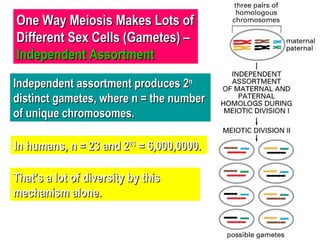
One Way Meiosis Makes Lots of Different Sex Cells (Gametes) –  Independent Assortment Independent assortment produces 2 n  distinct gametes, where n = the number of unique chromosomes.  That’s a lot of diversity by this mechanism alone. In humans, n = 23 and 2 23  = 6,000,0000.
 
Another Way Meiosis Makes Lots of Different Sex Cells – Crossing-Over Crossing-over multiplies the already huge number of different gamete types produced by independent assortment.
Mitosis vs. Meiosis
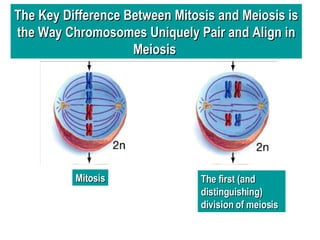
The Key Difference Between Mitosis and Meiosis is the Way Chromosomes Uniquely Pair and Align in Meiosis  Mitosis The first (and distinguishing) division of meiosis
Mitosis vs. Meiosis
Boy or Girl? The Y Chromosome “Decides” X chromosome Y chromosome
Boy or Girl? The Y Chromosome “Decides”
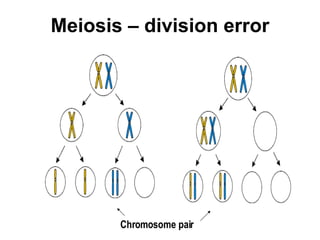
Meiosis – division error Chromosome pair
Meiosis error - fertilization Should the gamete with the chromosome pair be fertilized then the offspring will not be ‘normal’. In humans this often occurs with the 21 st  pair – producing a child with Downs Syndrome
21 trisomy – Downs Syndrome Can you see the extra 21 st  chromosome? Is this person male or female?

Mitosis

  • 1.
  • 2.
    Outline Types ofCell Division Structure of Chromosomes Cell Division in Prokaryotes Phases of cell cycle Interphase Mphase Cytokinesis Cell cycle-abnormalities
  • 3.
    Cell Theory :all organisms consist of cells and arise from pre-existing cells Mitosis is the process by which new cells are generated for body tissues during development, growth, and tissue repair. 2 cells are produced in one cycle of division Daughter cells have ALL of the genetic material of the parent cell Meiosis is the process by which special cells called gametes are generated for reproduction. 4 cells are produced in two cycles of division Daughter cells have HALF the genetic material of the parent cell
  • 4.
    SOMATIC Vs REPRODUCTIVEGAMETES (n) – EGGS (OVA) & SPERM - MEIOSIS (Somatic) OTHERS (2n) - MITOSIS NUCLEAR Vs CYTOPLASMIC DIVISION
  • 5.
    The state inwhich there are two copies of each chromosome present is known as diploid (2n).   H Haploid (n)– only one copy of a chromosome is present All of the somatic cells in our bodies are diploid cells The only cells in our bodies that are haploid are our gametes – eggs and sperm
  • 6.
    Human somatic cellshave 46 chromosomes diploid number (2n) = 46 23 from mom - 23 from dad 22 pairs are autosomes –true homologous pairs 1 pair is not necessarily homologous - sex chromosomes females are XX males are XY – a non homologous pair.
  • 7.
    Meiosis – form of cell division where there are two successive rounds of cell division following DNA replication - produces haploid cells (n) - start with 46 double stranded chromosomes (2n) After 1 division - 23 double stranded chromosomes (n) After 2nd division - 23 single stranded chromosomes (n)   - occurs in our germ cells – cells that produce our gametes - egg and sperm
  • 8.
  • 9.
    Cell division Allcomplex organisms originated from a single fertilized egg. Every cell in your body started here, through cell division the numbers are increased Cell then specialize and change into their various roles
  • 10.
    Mitosis Mitosis is the process by which new body cell are produced for: Growth Replacing damaged or old cells. This is a complex process requiring different stages
  • 11.
    Mitosis All daughtercells contain the same genetic information from the original parent cell from which it was copied. Every different type of cell in your body contains the same genes, but only some act to make the cells specialise – e.g. into nerve or muscle tissue.
  • 12.
    BASIC GENETICS Eachcell in the human body contains two sets of 2 3 chromosomes Mitosis identically replicates this information E ach cell therefore has the same genetic material Reproductive cells only have one set of chromosomes. These combine to make a new person with different genetic material to both parents
  • 13.
    2 daughter cellsidentical to original Parent cell Chromosomes are copied and double in number Chromosomes now split
  • 14.
    Reproduction presents amajor problem for cells and organisms: (how can information be transmitted faithfully to progeny) I II III IV = one bit of genetic information
  • 15.
    = one bitof genetic information The information transfer problem becomes more challenging as more bits of information are incorporated into the organism
  • 16.
    One of life’ssolutions to this challenge: “Package” the bits of information into single units called chromosomes = one bit of genetic information
  • 17.
    The nucleus Nuclear membrane - double membrane Chromosomes/Chromatin- genetic material/DNA Gene - DNA segment Chromosome---  DNA ---  Gene
  • 18.
    chromosomes Packaging ofgenetic material in prokaryotes and eukaryotes prokaryote cell eukaryote cell
  • 19.
    Structure of ChromosomesChromosomes are composed of a complex of DNA and protein, chromatin. DNA exists as a single, long, double-stranded fiber extending chromosome’s entire length. forms nucleosome every 200 nucleotides DNA coiled around histone proteins
  • 20.
    C Chromosome basics. T The number of chromosomes present within the nucleus is a characteristic of the species. Chromosomes of humans and most other eukaryotic species occurs in pairs. Members of a chromosome pair are known as homologues.
  • 21.
    Mitosis/Cell division mitosisis the process of cell division in which one cell becomes two identical daughter cells development renewal regeneration
  • 22.
    The cell cycle is the mechanism by which a cell duplicates its contents and then divides in two cell grows and duplicates its contents cell contents cell divides in two Each parental cell gives rise to two daughter cells on completion of each cell cycle parental cell daughter cell 1 daughter cell 2
  • 23.
    Replication of chromosomesReplication is the process of duplicating a chromosome Occurs prior to division Replicated copies are called sister chromatids Held together at centromere
  • 24.
  • 25.
  • 26.
  • 27.
    Prophase Metaphase AnaphaseTelophase The Stages of M itosis Interphase
  • 28.
    REMEMBER! I nterphaseP rophase M etaphase A naphase T elophase (Individuals Please Make All The Cells) IPMAT
  • 29.
    INTERPHASE After acell has divided, the two new cells begin the process again, the cell s at this stage are in Interphase.
  • 30.
    By late interphase,the chromosomes have been duplicated but are loosely packed. The centrosomes have been duplicated and begin to organize microtubules into an aster (“star”). Copyright © 2002 Pearson Education, Inc., publishing as Benjamin Cummings
  • 31.
  • 32.
    PROPHASE The chromatin(decondensed DNA) in the nucleus, condenses to form pairs of chromosomes . The centrioles move to opposite ends of the nucleus. As this is happening the nucleolus begins to break down Nuclear membrane begins to break down
  • 33.
    Prophase Replicated chromosomescondense. Microtubules organize into a spindle
  • 34.
    The Spindle Aspindle is a web type structure made up of microtubule fibers. It is essential for mitosis because it arranges the chromosomes into their correct positions in preparation for cell division. Mitotic center Microtubule A cell at metaphase a spindle
  • 35.
    Chromosomes attached tospindle during nuclear division
  • 36.
    METAPHASE The spindlebecomes fully developed The nuclear membrane has completely gone The chromatid pairs are aligned along the center of the spindle (the EQUATOR)
  • 37.
    The spindle fiberspush the sister chromatids until they are all arranged at the metaphase plate , an imaginary plane equidistant between the poles, defining metaphase. Copyright © 2002 Pearson Education, Inc., publishing as Benjamin Cummings
  • 38.
    Anaphase Centromeres ofsister chromatids separate Chromosomes move to opposite ends of the cell
  • 39.
    At anaphase, thecentromeres divide, separating the sister chromatids. Each is now pulled toward the pole to which it is attached by spindle fibers. By the end, the two poles have equivalent collections of chromosomes.
  • 40.
    TELOPHASE Two newnuclei are formed when the chromosomes reach the opposite poles of the cell The nuclear membrane is formed- the nucleolus reappears The chromosomes disperse in the nucleus
  • 41.
    Telophase Nuclear membranesform Spindle disappears Division of cytoplasm occurs (cytokinesis)
  • 42.
    Copyright © 2002Pearson Education, Inc., publishing as Benjamin Cummings
  • 43.
    Copyright © 2002Pearson Education, Inc., publishing as Benjamin Cummings
  • 44.
    CYTOKINESIS Literally means, division of the cytoplasm M itosis is the splitting of the nucleus. Cytokinesis is the splitting of cytoplasm
  • 45.
    Cytokinesis Cleavage ofcell into two halves animal cells constriction belt of actin filaments plant cells cell plate
  • 46.
    Cytokinesis Cytoplasmic division occurs after nuclear division is complete. Two cells are formed.
  • 47.
    Cytokinesis inanimals A cleavage furrow forms that pinches the cell in two - the furrow represents a ring of actin and myosin filaments just under the plasma membrane.
  • 48.
  • 49.
    Mitosis – bonecell slides 1 2 3 4 5 Parent cell Chromosomes copied Copies separating 2 daughter cells Cells split
  • 50.
    Cytokinesis inplants A cell plate made up of cell-wall components gradually forms in the middle of the cell.
  • 51.
    So what’s thedifference in Plants? Plant cells do not have a centriole Plant cells do not pinch in half. Cytoplasmic division is accomplished by a cell plate forming between 2 daughter cells
  • 52.
  • 53.
    Cell Turnover – The speed of mitosis One full cycle can vary between a couple of minutes to days. For example s kin and epithelial cells have a rapid turnover in the human body in order to replace the ones constantly being worn away. C ells which make up organs such as the eye and the brain, need not multiply as often once they reach adult size.
  • 54.
    Organs which needto produce new cells continuously have the highest turnover . For example :- Bone marrow- producing replacement blood cells The testes - producing spermatogonia
  • 55.
    Tumors Abnormalities can sometimes occur in c ells which reproduce at a rapid rate, this in turn may lead to the formation of tumors. Tumors of any type should be considered serious. Although benign tumors do n o t usually cause a threat to a persons life , they can cause great inconvenience if not treated.
  • 56.
  • 57.
  • 58.
    Meiosis – ASource of Distinction Why do you share some but not all characters of each parent? What are the rules of this sharing game? At one level, the answers lie in meiosis.
  • 59.
    Meiosis does twothings - 1) Meiosis takes a cell with two copies of every chromosome (diploid) and makes cells with a single copy of every chromosome (haploid). This is a good idea if you’re going to combine two cells to make a new organism. This trick is accomplished by halving chromosome number. In meiosis, one diploid cells produces four haploid cells.
  • 60.
    Why do weneed meiosis? Meiosis is necessary to halve the number of chromosomes going into the sex cells Why halve the chromosomes in gametes? At fertilization the male and female sex cells will provide ½ of the chromosomes each – so the offspring has genes from both parents
  • 61.
    2) Meiosis scrambles the specific forms of each gene that each sex cell (egg or sperm) receives. This makes for a lot of genetic diversity . This trick is accomplished through independent assortment and crossing-over . Genetic diversity is important for the evolution of populations and species .
  • 62.
    Meiosis Parent cell– chromosome pair Chromosomes copied 1 st division - pairs split 2 nd division – produces 4 gamete cells with ½ the original no. of chromosomes
  • 63.
    Meiosis – mousetestes Parent cell 4 gametes 1 st division 2 nd division
  • 64.
    The Stages ofMeiosis: aka: Reduction Division
  • 65.
    Meiosis I :Separates Homologous Chromosomes Interphase Each of the chromosomes replicate The result is two genetically identical sister chromatids which remain attached at their centromeres
  • 66.
    Prophase I Duringthis phase each pair of chromatids match up with their homologous pair and fasten together (synapsis) in a group of four called a tetrad. Extremely IMPORTANT!!! It is during this phase that crossing over can occur. Crossing Over is the exchange of segments during synapsis.
  • 67.
    Metaphase I Thechromosomes line up at the equator attached by their centromeres to spindle fibers from centrioles. Still in homologous pairs
  • 68.
    Anaphase I Thespindle guides the movement of the chromosomes toward the poles Sister chromatids remain attached Move as a unit towards the same pole The homologous chromosome moves toward the opposite pole Contrasts mitosis – chromosomes appear as individuals instead of pairs (meiosis)
  • 69.
    Telophase I Thisis the end of the first meiotic cell division. The cytoplasm divides, forming two new daughter cells. Each of the newly formed cells has half the number of the parent cell’s chromosomes, but each chromosome is ready for the second meiotic cell division
  • 70.
    Cytokinesis Occurs simultaneouslywith telophase I Forms 2 daughter cells Plant cells – cell plate Animal cells – cleavage furrows NO FURTHER REPLICATION OF GENETIC MATERIAL PRIOR TO THE SECOND DIVISION OF MEIOSIS
  • 71.
    Figure 13.7 The stages of meiotic cell division: Meiosis I
  • 72.
    Meiosis II : Separates sister chromatids Similar to mitosis THERE IS NO INTERPHASE II !
  • 73.
    Prophase II Eachof the daughter cells forms a spindle, and the double stranded chromosomes move toward the equator
  • 74.
    Metaphase II Thechromosomes are positioned on the metaphase plate in a mitosis-like fashion
  • 75.
    Anaphase II Thecentromeres of sister chromatids finally separate The sister chromatids of each pair move toward opposite poles Now individual chromosomes
  • 76.
    Telophase II andCytokinesis Nuclei form at opposite poles of the cell and cytokinesis occurs After completion of cytokinesis there are four daughter cells All are haploid (n)
  • 77.
    Figure 13.7 The stages of meiotic cell division: Meiosis II
  • 78.
    One Way MeiosisMakes Lots of Different Sex Cells (Gametes) – Independent Assortment Independent assortment produces 2 n distinct gametes, where n = the number of unique chromosomes. That’s a lot of diversity by this mechanism alone. In humans, n = 23 and 2 23 = 6,000,0000.
  • 79.
  • 80.
    Another Way MeiosisMakes Lots of Different Sex Cells – Crossing-Over Crossing-over multiplies the already huge number of different gamete types produced by independent assortment.
  • 81.
  • 82.
    The Key DifferenceBetween Mitosis and Meiosis is the Way Chromosomes Uniquely Pair and Align in Meiosis Mitosis The first (and distinguishing) division of meiosis
  • 83.
  • 84.
    Boy or Girl?The Y Chromosome “Decides” X chromosome Y chromosome
  • 85.
    Boy or Girl?The Y Chromosome “Decides”
  • 86.
    Meiosis – divisionerror Chromosome pair
  • 87.
    Meiosis error -fertilization Should the gamete with the chromosome pair be fertilized then the offspring will not be ‘normal’. In humans this often occurs with the 21 st pair – producing a child with Downs Syndrome
  • 88.
    21 trisomy –Downs Syndrome Can you see the extra 21 st chromosome? Is this person male or female?