1
Cellular
Division
by Hridoy
copyright cmassengale
2
Cell Division
All cells are derived from pre-
existing cells
New cells are produced for
growth and to replace damaged or
old cells
Differs in prokaryotes (bacteria)
and eukaryotes (protists, fungi,
plants, & animals)
copyright cmassengale
3
Keeping Cells Identical
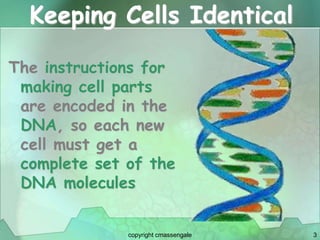
The instructions for
making cell parts
are encoded in the
DNA, so each new
cell must get a
complete set of the
DNA molecules
copyright cmassengale
4
DNA Replication
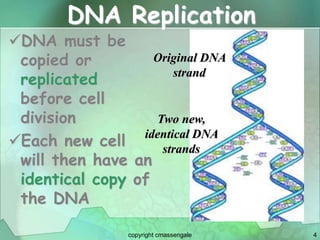
DNA must be
copied or
replicated
before cell
division
Each new cell
will then have an
identical copy of
the DNA
Original DNA
strand
Two new,
identical DNA
strands
copyright cmassengale
5
Identical Daughter Cells
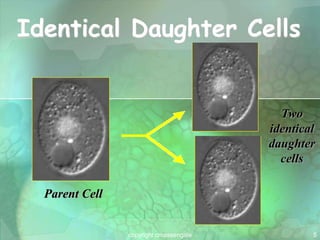
Parent Cell
Two
identical
daughter
cells
copyright cmassengale
6
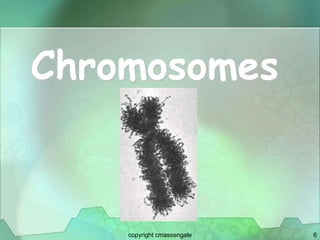
Chromosomes
copyright cmassengale
7
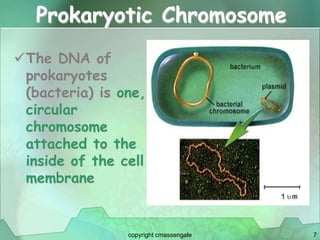
Prokaryotic Chromosome
The DNA of
prokaryotes
(bacteria) is one,
circular
chromosome
attached to the
inside of the cell
membrane
copyright cmassengale
8
Eukaryotic Chromosomes
All eukaryotic cells store genetic
information in chromosomes
Most eukaryotes have between 10 and
50 chromosomes in their body cells
Human body cells have 46 chromosomes
or 23 identical pairs
copyright cmassengale
9
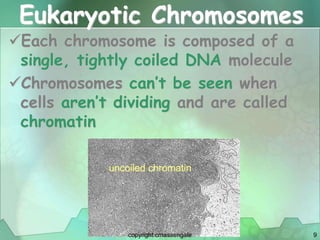
Eukaryotic Chromosomes
Each chromosome is composed of a
single, tightly coiled DNA molecule
Chromosomes can’t be seen when
cells aren’t dividing and are called
chromatin
copyright cmassengale
10
Compacting DNA into
Chromosomes
DNA is
tightly
coiled
around
proteins
called
histones
copyright cmassengale
11
Chromosomes in Dividing Cells
Duplicated
chromosomes are
called
chromatids &
are held
together by the
centromere
Called Sister Chromatidscopyright cmassengale
12
Karyotype
A picture of the
chromosomes from
a human cell
arranged in pairs by
size
First 22 pairs are
called autosomes
Last pair are the
sex chromosomes
XX female or XY
male
copyright cmassengale
13
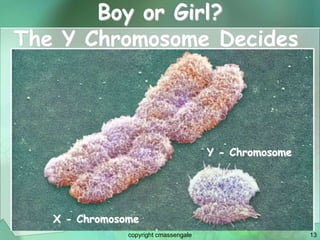
Boy or Girl?
Y - Chromosome
X - Chromosome
The Y Chromosome Decides
copyright cmassengale
14
Cell Reproduction
copyright cmassengale
15
Types of Cell Reproduction
Asexual reproduction involves a
single cell dividing to make 2 new,
identical daughter cells
Mitosis & binary fission are
examples of asexual reproduction
Sexual reproduction involves two
cells (egg & sperm) joining to make a
new cell (zygote) that is NOT
identical to the original cells
Meiosis is an example
copyright cmassengale
16
Cell Division in
Prokaryotes
copyright cmassengale
17
Cell Division in Prokaryotes
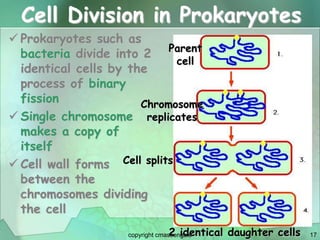
 Prokaryotes such as
bacteria divide into 2
identical cells by the
process of binary
fission
 Single chromosome
makes a copy of
itself
 Cell wall forms
between the
chromosomes dividing
the cell
Parent
cell
2 identical daughter cells
Chromosome
replicates
Cell splits
copyright cmassengale
18
Prokaryotic Cell
Undergoing Binary Fission
copyright cmassengale
19
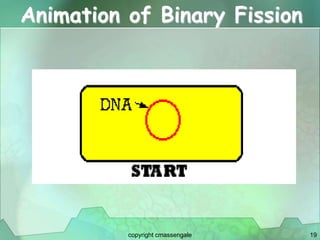
Animation of Binary Fission
copyright cmassengale
20
The Cell
Cycle
copyright cmassengale
21
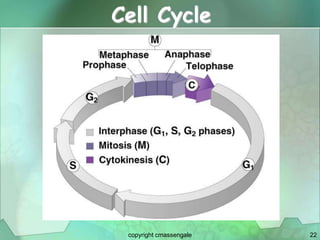
Five Phases of the Cell Cycle
G1 - primary growth phase
S – synthesis; DNA replicated
G2 - secondary growth phase
collectively these 3 stages are
called interphase
M - mitosis
C - cytokinesis
copyright cmassengale
22
Cell Cycle
copyright cmassengale
23
Interphase - G1 Stage
1st growth stage after cell
division
Cells mature by making more
cytoplasm & organelles
Cell carries on its normal
metabolic activities
copyright cmassengale
24
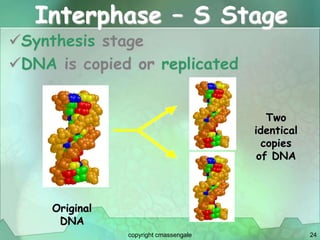
Interphase – S Stage
Synthesis stage
DNA is copied or replicated
Two
identical
copies
of DNA
Original
DNA
copyright cmassengale
25
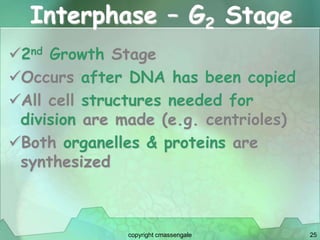
Interphase – G2 Stage
2nd Growth Stage
Occurs after DNA has been copied
All cell structures needed for
division are made (e.g. centrioles)
Both organelles & proteins are
synthesized
copyright cmassengale
26
What’s Happening in Interphase?
What the cell looks like
Animal Cell
What’s occurring
copyright cmassengale
27
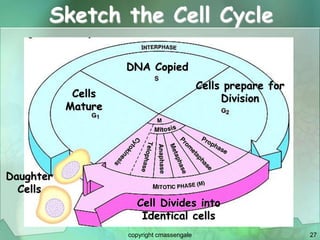
Sketch the Cell Cycle
Daughter
Cells
DNA Copied
Cells
Mature
Cells prepare for
Division
Cell Divides into
Identical cells
copyright cmassengale
28
Mitosis
copyright cmassengale
29
Mitosis
Division of the
nucleus
Also called
karyokinesis
Only occurs in
eukaryotes
Has four stages
Doesn’t occur in
some cells such
as brain cells
copyright cmassengale
30
Four Mitotic Stages
Prophase
Metaphase
Anaphase
Telophase
copyright cmassengale
31
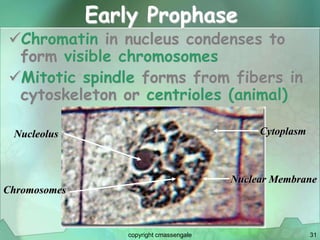
Early Prophase
Chromatin in nucleus condenses to
form visible chromosomes
Mitotic spindle forms from fibers in
cytoskeleton or centrioles (animal)
Chromosomes
Nucleolus Cytoplasm
Nuclear Membrane
copyright cmassengale
32
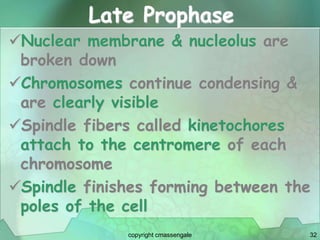
Late Prophase
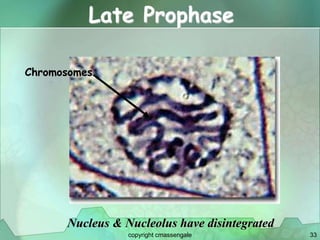
Nuclear membrane & nucleolus are
broken down
Chromosomes continue condensing &
are clearly visible
Spindle fibers called kinetochores
attach to the centromere of each
chromosome
Spindle finishes forming between the
poles of the cell
copyright cmassengale
33
Late Prophase
Nucleus & Nucleolus have disintegrated
Chromosomes
copyright cmassengale
34
Spindle Fiber attached to
Chromosome
Kinetochore Fiber
Chromosome
copyright cmassengale
35
Review of Prophase
What the cell
looks like
What’s happeningcopyright cmassengale
36
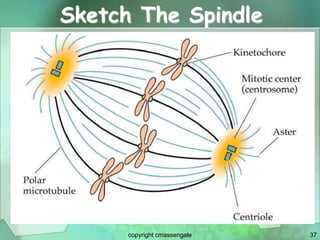
Spindle Fibers
The mitotic spindle form from the
microtubules in plants and centrioles
in animal cells
Polar fibers extend from one pole of
the cell to the opposite pole
Kinetochore fibers extend from the
pole to the centromere of the
chromosome to which they attach
Asters are short fibers radiating
from centrioles
copyright cmassengale
37
Sketch The Spindle
copyright cmassengale
38
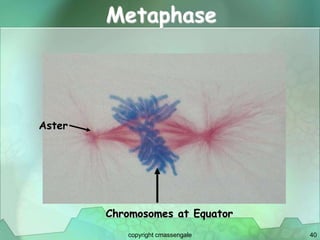
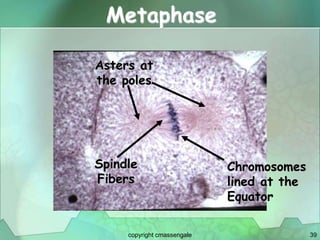
Metaphase
Chromosomes, attached to the
kinetochore fibers, move to the center
of the cell
Chromosomes are now lined up at the
equator
Pole of
the Cell
Equator of Cell
copyright cmassengale
39
Metaphase
Chromosomes
lined at the
Equator
Asters at
the poles
Spindle
Fibers
copyright cmassengale
40
Metaphase
Aster
Chromosomes at Equator
copyright cmassengale
41
Review of Metaphase
What the cell looks
like
What’s
occurring
copyright cmassengale
42
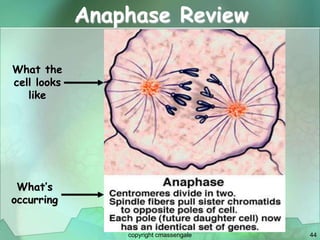
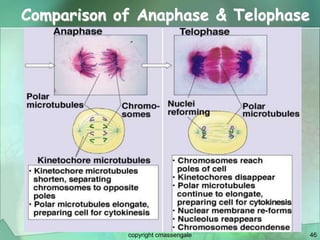
Anaphase
Occurs rapidly
Sister
chromatids are
pulled apart to
opposite poles
of the cell by
kinetochore
fibers
copyright cmassengale
43
Anaphase
Sister
Chromatids
being
separated
copyright cmassengale
44
Anaphase Review
What the
cell looks
like
What’s
occurring
copyright cmassengale
45
Telophase
Sister chromatids at opposite
poles
Spindle disassembles
Nuclear envelope forms around
each set of sister chromatids
Nucleolus reappears
CYTOKINESIS occurs
Chromosomes reappear as
chromatin
copyright cmassengale
46
Comparison of Anaphase & Telophase
copyright cmassengale
47
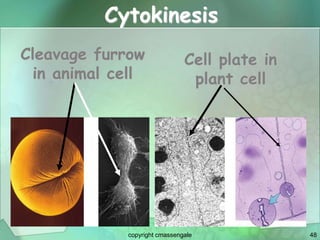
Cytokinesis
Means division of the cytoplasm
Division of cell into two,
identical halves called daughter
cells
In plant cells, cell plate forms
at the equator to divide cell
In animal cells, cleavage furrow
forms to split cell
copyright cmassengale
48
Cytokinesis
Cleavage furrow
in animal cell
Cell plate in
plant cell
copyright cmassengale
49
Mitotic Stages
copyright cmassengale
50
Daughter Cells of Mitosis
Have the same number of
chromosomes as each other and as
the parent cell from which they
were formed
Identical to each other, but smaller
than parent cell
Must grow in size to become mature
cells (G1 of Interphase)
copyright cmassengale
51
Identical Daughter Cells
Chromosome number the same, but cells
smaller than parent cell
What is
the 2n
or
diploid
number?
2
copyright cmassengale
52
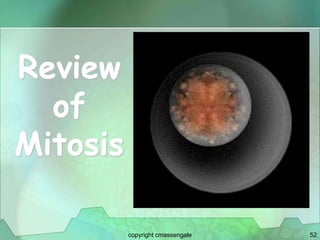
Review
of
Mitosis
copyright cmassengale
53
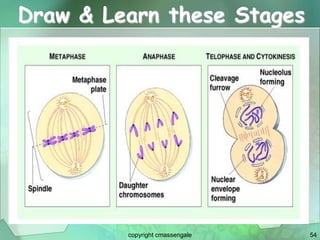
Draw & Learn these Stages
copyright cmassengale
54
Draw & Learn these Stages
copyright cmassengale
55
Interphase
Prophase
Metaphase
Anaphase
Telophase
Name the Mitotic Stages:
Name this?
Name this?
copyright cmassengale
56
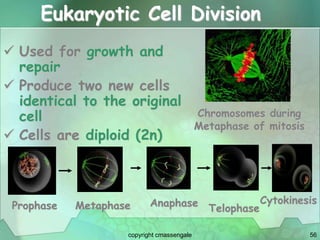
Eukaryotic Cell Division
 Used for growth and
repair
 Produce two new cells
identical to the original
cell
 Cells are diploid (2n)
Chromosomes during
Metaphase of mitosis
Prophase Metaphase Anaphase
Telophase
Cytokinesis
copyright cmassengale
57
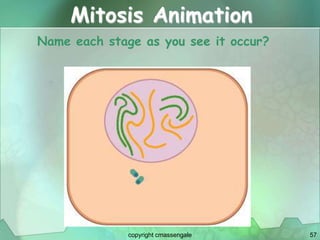
Mitosis Animation
Name each stage as you see it occur?
copyright cmassengale
58
Mitosis in Onion Root Tips
Do you see any stages of mitosis?
copyright cmassengale
59
Test Yourself
over Mitosis
copyright cmassengale
60
Mitosis Quiz
copyright cmassengale
61
Mitosis Quiz
copyright cmassengale
62
Name the Stages of Mitosis:
Interphase
Early prophase
Mid-Prophase
Late
Prophase
Metaphase
Late
Anaphase
Early Anaphase
Early
Telophase,
Begin
cytokinesis
Late telophase,
Advanced
cytokinesis
copyright cmassengale
63
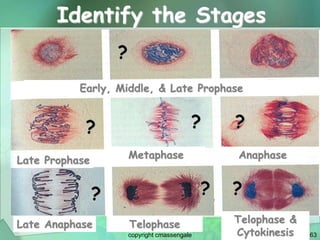
Identify the Stages
Early, Middle, & Late Prophase
Late Prophase
Metaphase Anaphase
Late Anaphase Telophase Telophase &
Cytokinesis
?
? ? ?
? ? ?
copyright cmassengale
64
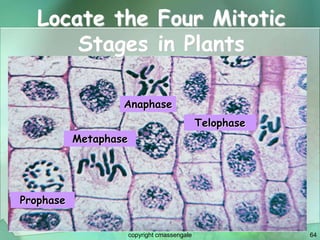
Locate the Four Mitotic
Stages in Plants
Metaphase
Prophase
Anaphase
Telophase
copyright cmassengale
65
Uncontrolled Mitosis
 If mitosis is not
controlled, unlimited
cell division occurs
causing cancerous
tumors
 Oncogenes are special
proteins that
increase the chance
that a normal cell
develops into a tumor
cell
Cancer cells
copyright cmassengale
66
Meiosis
Formation of Gametes
(Eggs & Sperm)
copyright cmassengale
67
Facts About Meiosis
Preceded by interphase which
includes chromosome replication
Two meiotic divisions --- Meiosis
I and Meiosis II
Called Reduction- division
Original cell is diploid (2n)
Four daughter cells produced that
are monoploid (1n)
copyright cmassengale
68
Facts About Meiosis
Daughter cells contain half the
number of chromosomes as the
original cell
Produces gametes (eggs & sperm)
Occurs in the testes in males
(Spermatogenesis)
Occurs in the ovaries in females
(Oogenesis)
copyright cmassengale
69
 Start with 46 double stranded
chromosomes (2n)
After 1 division - 23 double
stranded chromosomes (n)
After 2nd division - 23 single
stranded chromosomes (n)
 Occurs in our germ cells that
produce gametes
More Meiosis Facts
copyright cmassengale
70
Why Do we Need Meiosis?
It is the fundamental basis of
sexual reproduction
Two haploid (1n) gametes are
brought together through
fertilization to form a diploid
(2n) zygote
copyright cmassengale
71
Fertilization – “Putting it
all together”
1n =3
2n = 6
copyright cmassengale
72
Replication of Chromosomes
Replication is the
process of
duplicating a
chromosome
Occurs prior to
division
Replicated copies
are called sister
chromatids
Held together at
centromere
Occurs in
Interphase
copyright cmassengale
73
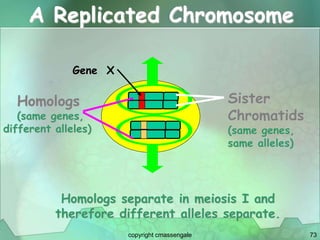
A Replicated Chromosome
Homologs
(same genes,
different alleles)
Sister
Chromatids
(same genes,
same alleles)
Gene X
Homologs separate in meiosis I and
therefore different alleles separate.
copyright cmassengale
74
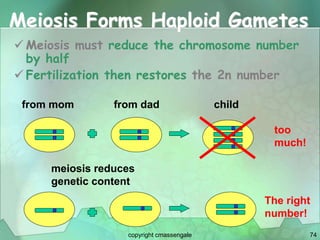
Meiosis Forms Haploid Gametes
 Meiosis must reduce the chromosome number
by half
 Fertilization then restores the 2n number
from mom from dad child
meiosis reduces
genetic content
too
much!
The right
number!
copyright cmassengale
75
Meiosis: Two Part Cell
Division
Homologs
separate
Sister
chromatids
separate
Diploid
Meiosis
I
Meiosis
II
Diploid
Haploid
copyright cmassengale
76
Meiosis I: Reduction Division
Nucleus Spindle
fibers Nuclear
envelopeEarly
Prophase I
(Chromosome
number
doubled)
Late
Prophase
I
Metaphase
I Anaphase
I
Telophase I
(diploid)
copyright cmassengale
77
Prophase I
Early prophase
Homologs pair.
Crossing over
occurs.
Late prophase
Chromosomes condense.
Spindle forms.
Nuclear envelope
fragments.
copyright cmassengale
78
Tetrads Form in Prophase I
Homologous chromosomes
(each with sister
chromatids)
Join to form a
TETRAD
Called Synapsis
copyright cmassengale
79
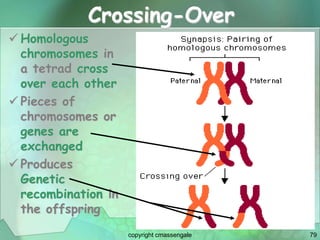
Crossing-Over
 Homologous
chromosomes in
a tetrad cross
over each other
 Pieces of
chromosomes or
genes are
exchanged
 Produces
Genetic
recombination in
the offspring
copyright cmassengale
80
Homologous Chromosomes
During Crossing-Over
copyright cmassengale
81
Crossing-over multiplies the already huge
number of different gamete types
produced by independent assortment
Crossing-Over
copyright cmassengale
82
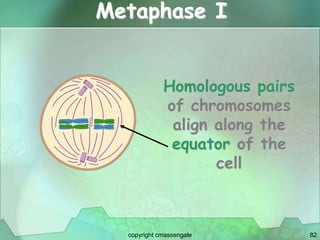
Metaphase I
Homologous pairs
of chromosomes
align along the
equator of the
cell
copyright cmassengale
83
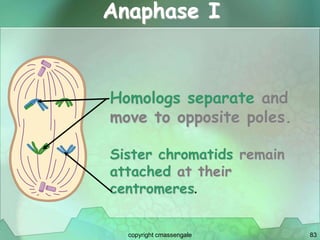
Anaphase I
Homologs separate and
move to opposite poles.
Sister chromatids remain
attached at their
centromeres.
copyright cmassengale
84
Telophase I
Nuclear envelopes
reassemble.
Spindle disappears.
Cytokinesis divides cell
into two.
copyright cmassengale
85
Meiosis II
Only one homolog of each
chromosome is present in
the cell.
Meiosis II produces gametes with
one copy of each chromosome and
thus one copy of each gene.
Sister chromatids carry
identical genetic
information.
Gene X
copyright cmassengale
86
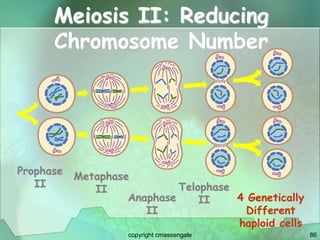
Meiosis II: Reducing
Chromosome Number
Prophase
II
Metaphase
II
Anaphase
II
Telophase
II 4 Genetically
Different
haploid cells
copyright cmassengale
87
Prophase II
Nuclear envelope
fragments.
Spindle forms.
copyright cmassengale
88
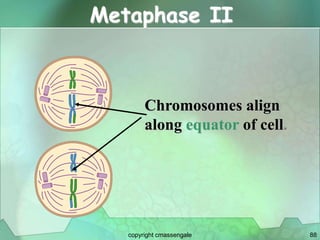
Metaphase II
Chromosomes align
along equator of cell.
copyright cmassengale
89
Anaphase II
Sister chromatids
separate and
move to opposite
poles.
Equator
Pole
copyright cmassengale
90
Telophase II
Nuclear envelope
assembles.
Chromosomes
decondense.
Spindle disappears.
Cytokinesis divides
cell into two.
copyright cmassengale
91
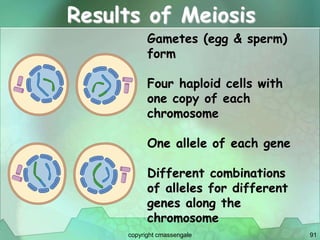
Results of Meiosis
Gametes (egg & sperm)
form
Four haploid cells with
one copy of each
chromosome
One allele of each gene
Different combinations
of alleles for different
genes along the
chromosome
copyright cmassengale
92
Meiosis Animation
copyright cmassengale
93
Gametogenesis
Oogenesis
or
Spermatogenesis
copyright cmassengale
94
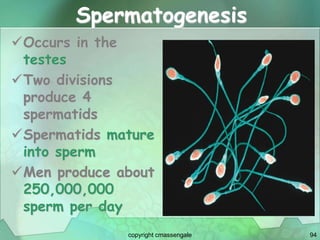
Spermatogenesis
Occurs in the
testes
Two divisions
produce 4
spermatids
Spermatids mature
into sperm
Men produce about
250,000,000
sperm per day
copyright cmassengale
95
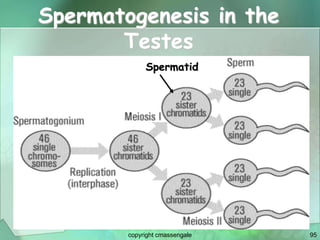
Spermatogenesis in the
Testes
Spermatid
copyright cmassengale
96
Spermatogenesis
copyright cmassengale
97
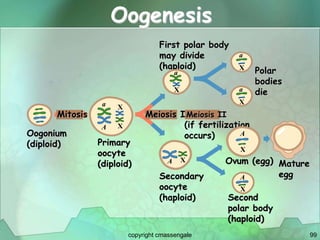
Oogenesis
Occurs in the ovaries
Two divisions produce 3 polar bodies
that die and 1 egg
Polar bodies die because of unequal
division of cytoplasm
Immature egg called oocyte
Starting at puberty, one oocyte
matures into an ovum (egg) every 28
days
copyright cmassengale
98
Oogenesis in the Ovaries
copyright cmassengale
99
Oogenesis
Oogonium
(diploid)
Mitosis
Primary
oocyte
(diploid)
Meiosis I
Secondary
oocyte
(haploid)
Meiosis II
(if fertilization
occurs)
First polar body
may divide
(haploid)
Polar
bodies
die
Ovum (egg)
Second
polar body
(haploid)
a
A
X
X
a
X
A X
a
X
a
X
Mature
egg
A
X
A
X
copyright cmassengale
100
Comparing
Mitosis and
Meiosis
copyright cmassengale
101
Mitosis Meiosis
Number of
divisions
1
2
Number of
daughter cells
2 4
Genetically
identical?
Yes No
Chromosome # Same as parent Half of parent
Where Somatic cells Germ cells
When Throughout life At sexual maturity
Role
Growth and
repair
Sexual reproduction
Comparison of Divisions
copyright cmassengale
102copyright cmassengale

Cell cycle & cell division