Nucleic Acid
Nucleotide
DNA
Nucleic acid

Most well known function:
 Informational macromolecule
 Store hereditary information
 The only molecules in existence that can
  produce identical copies of themselves
 2 types: DNA & RNA
Other Function

 Chemical energy (e.g. ATP)
 Combine with other groups to form enzymes (e.g.
  Coenzyme A comes from ADP)
 Signal molecule (e.g. cAMP)
 Evidence for evolution: more closely related species
  contain similar DNA sequences
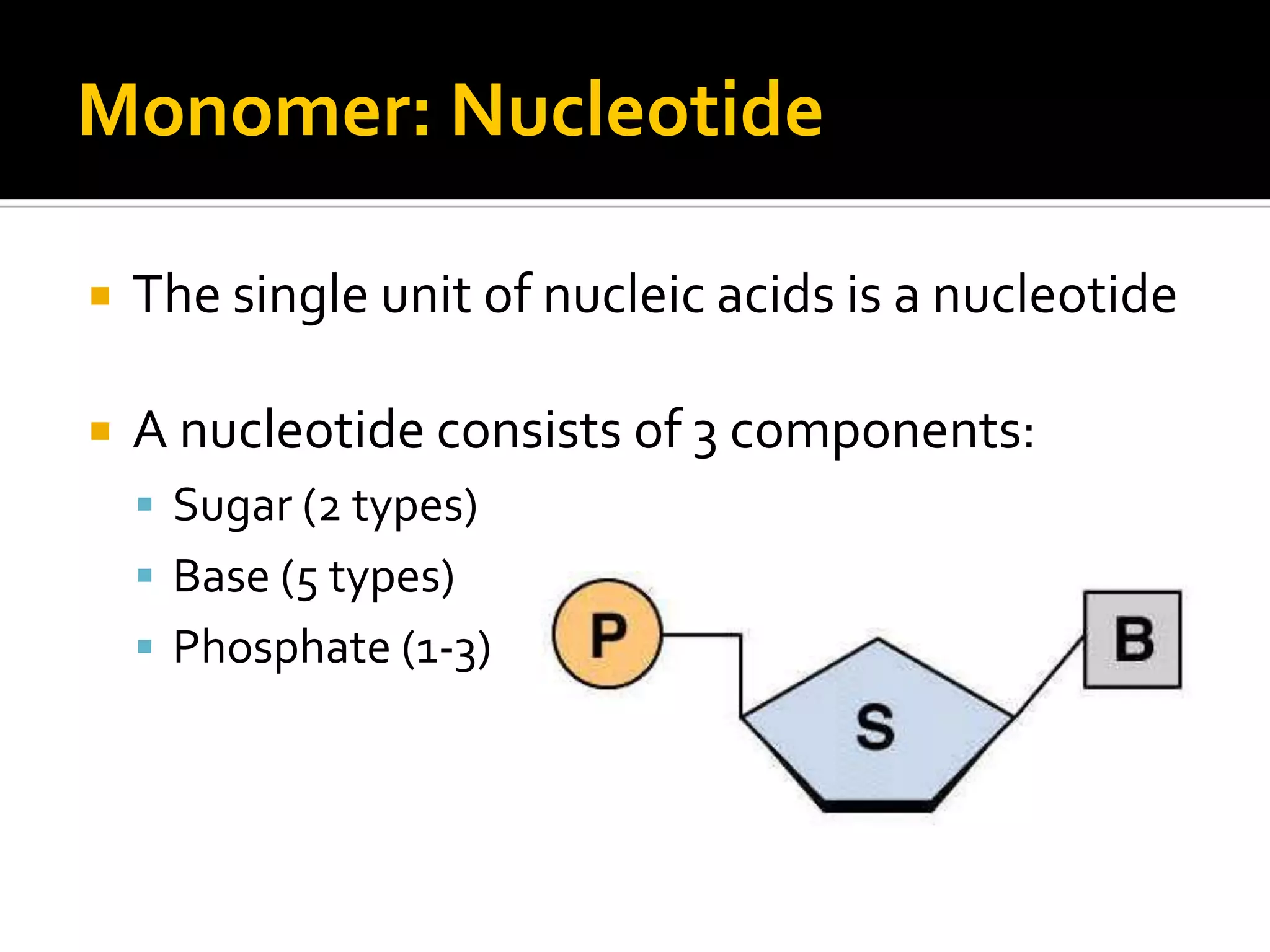
Monomer: Nucleotide

   The single unit of nucleic acids is a nucleotide

   A nucleotide consists of 3 components:
     Sugar (2 types)
     Base (5 types)
     Phosphate (1-3)
Pentose Sugar
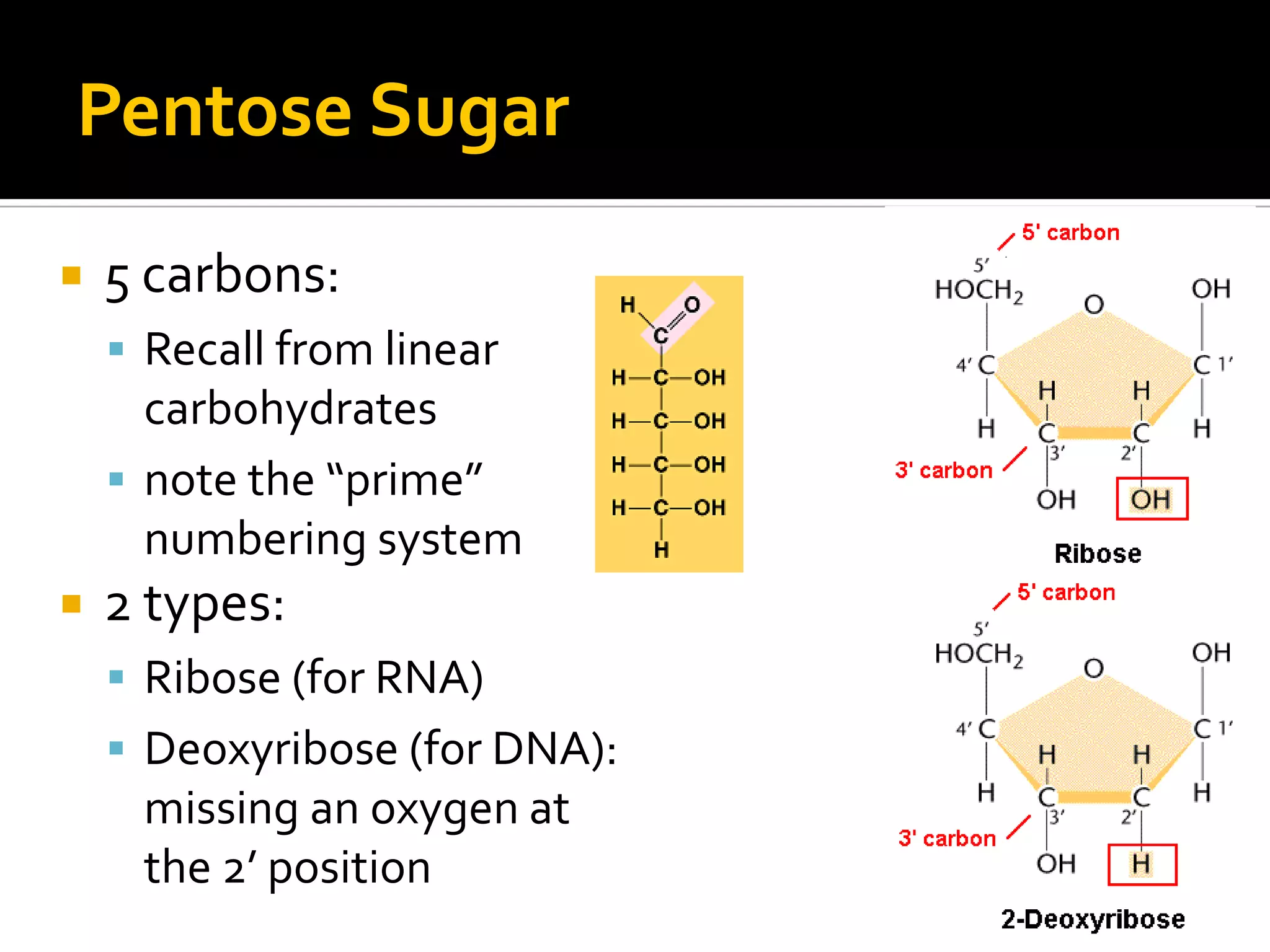
   5 carbons:
     Recall from linear
      carbohydrates
     note the “prime”
      numbering system
   2 types:
     Ribose (for RNA)
     Deoxyribose (for DNA):
     missing an oxygen at
     the 2’ position
Nitrogenous base

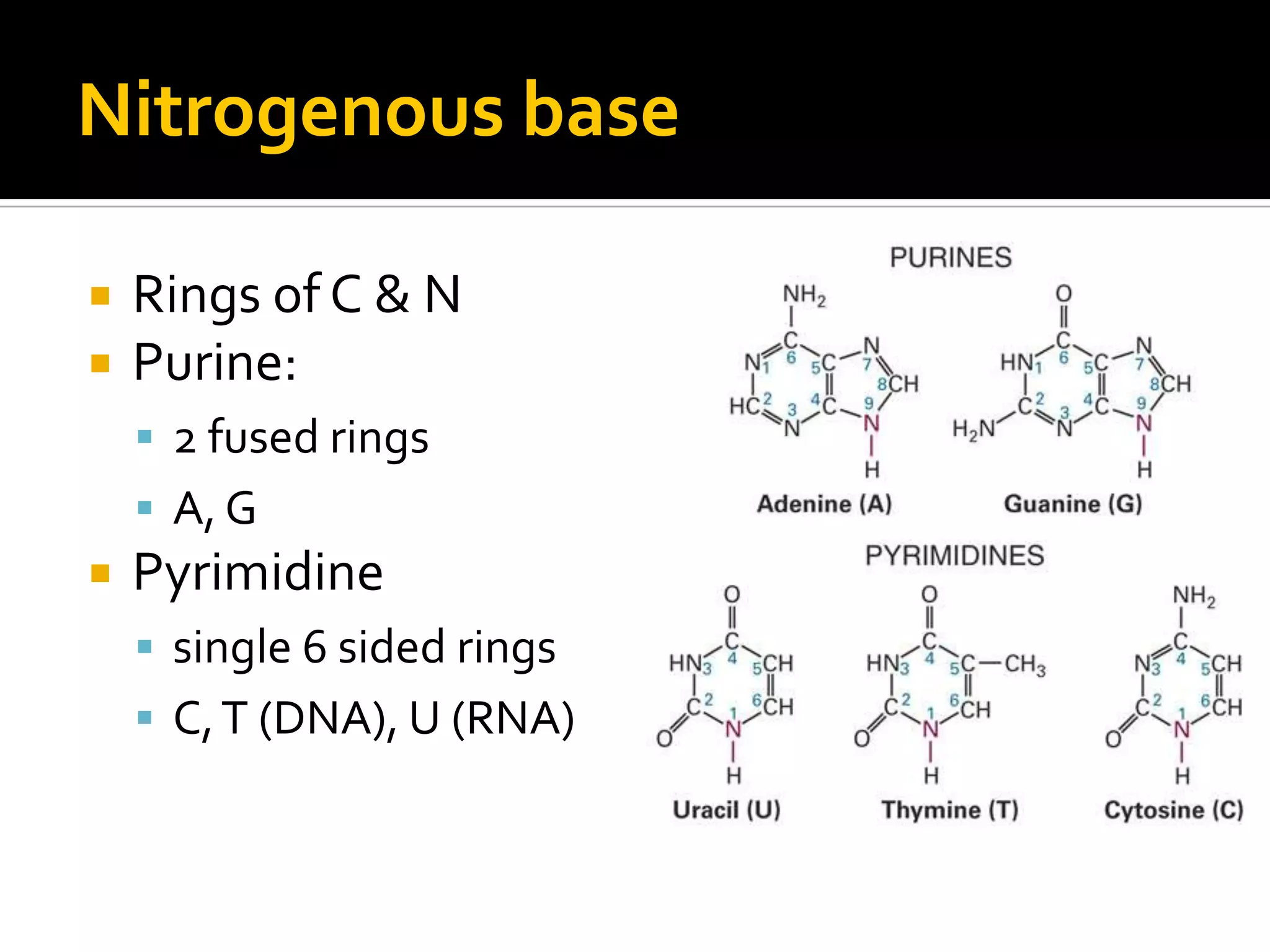
   Rings of C & N
   Purine:
     2 fused rings
     A, G
   Pyrimidine
     single 6 sided rings
     C, T (DNA), U (RNA)
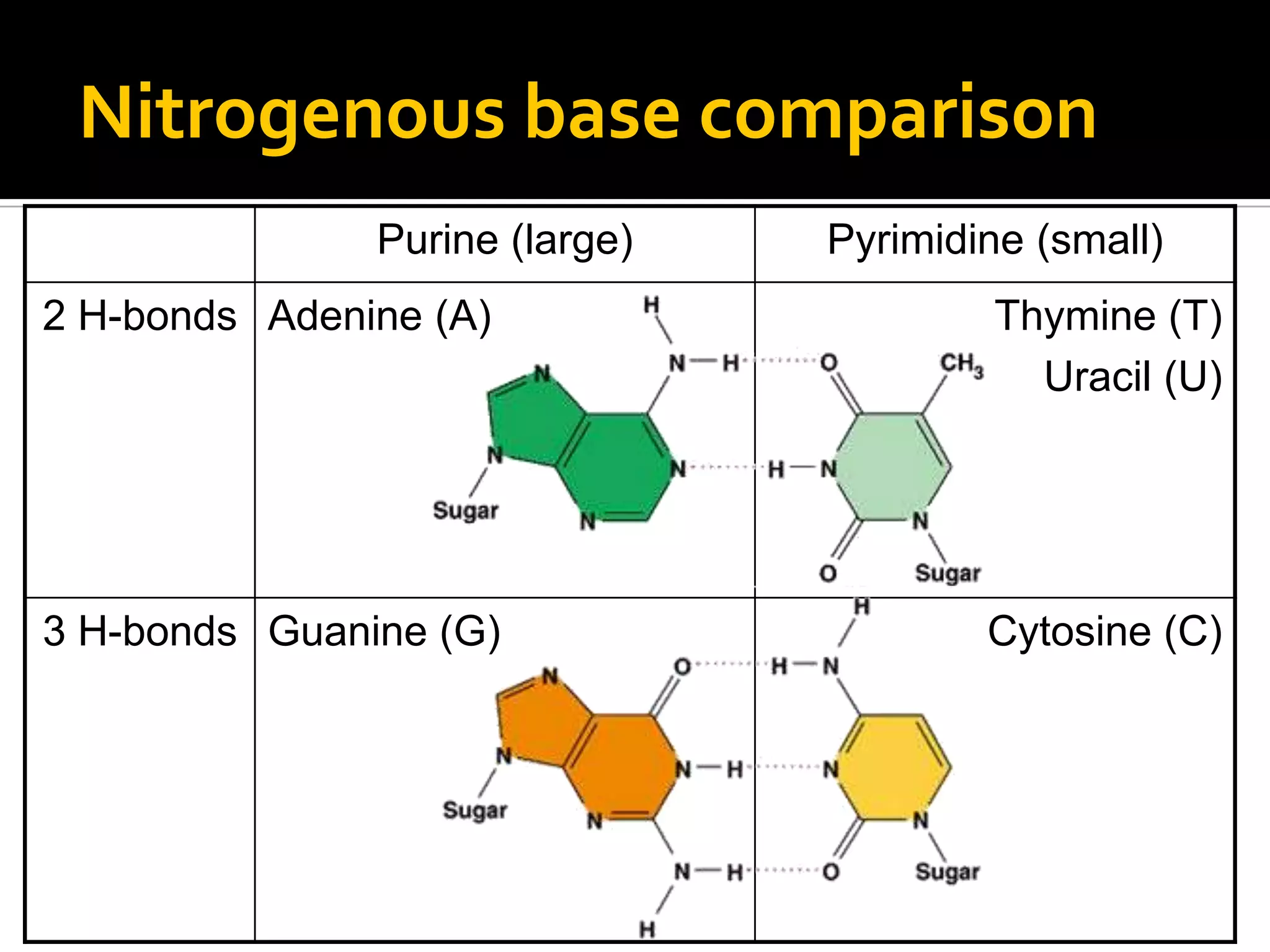
Nitrogenous base comparison
               Purine (large)   Pyrimidine (small)
2 H-bonds Adenine (A)                   Thymine (T)
                                          Uracil (U)


3 H-bonds Guanine (G)                   Cytosine (C)
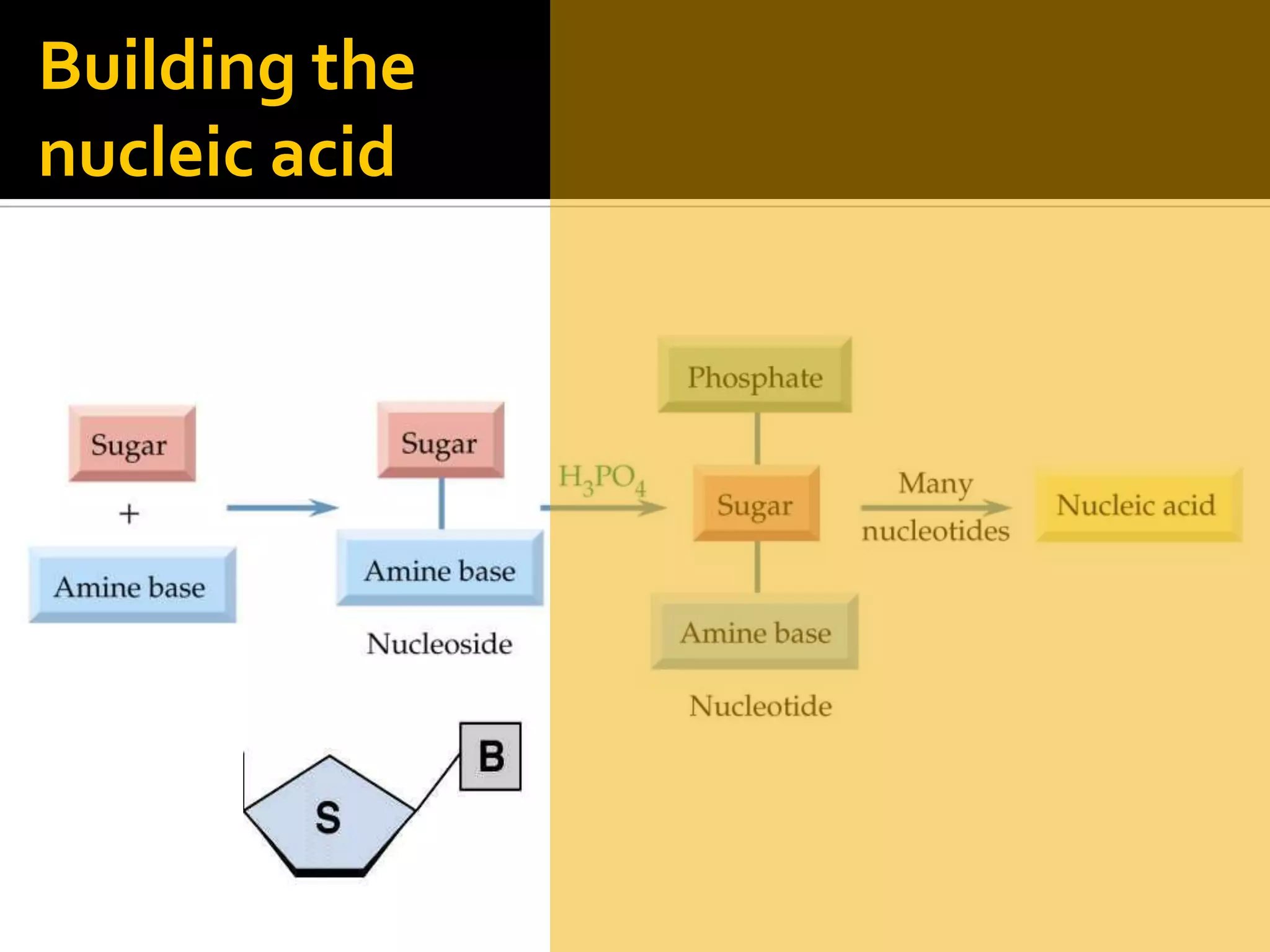
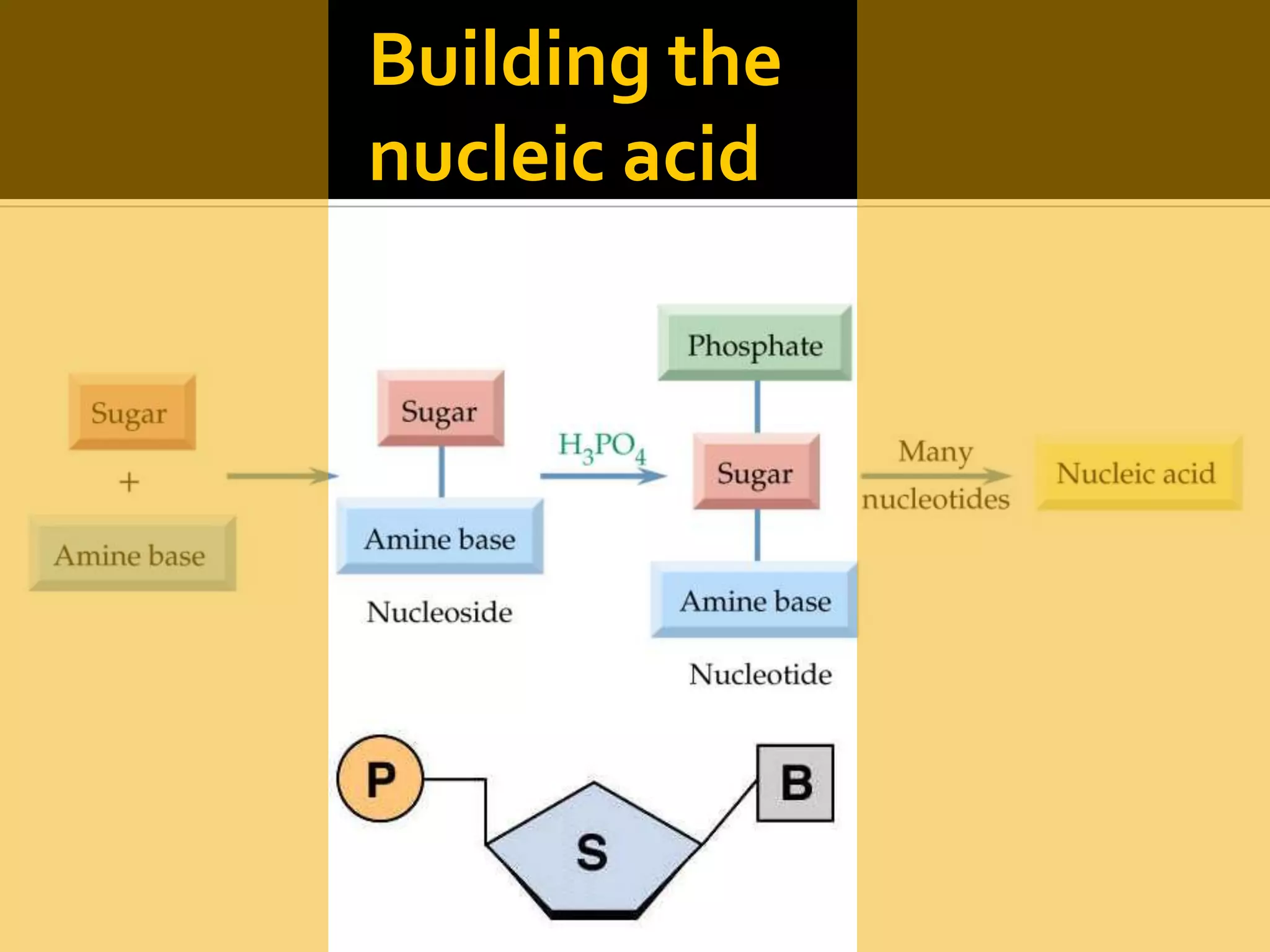
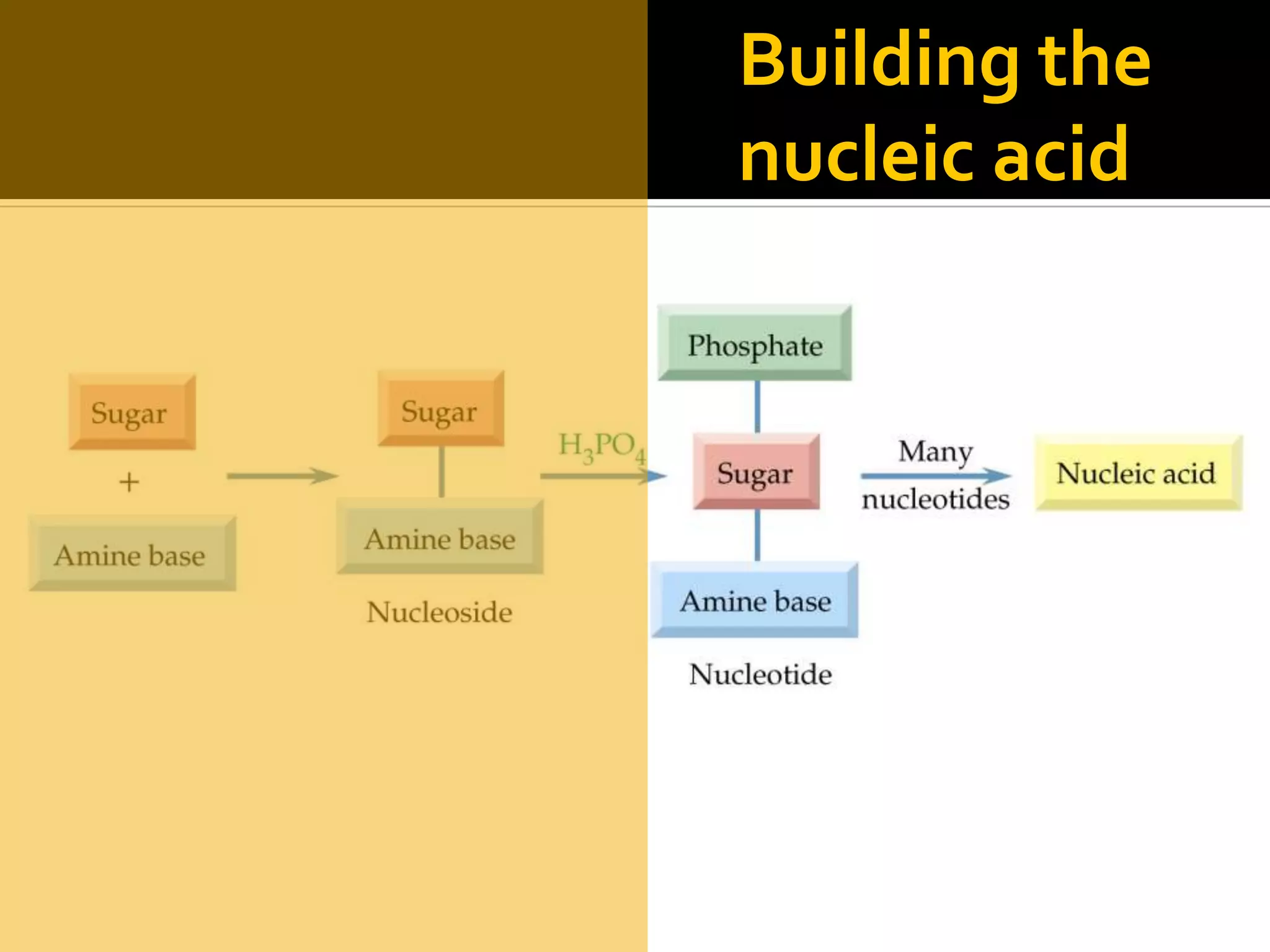
Building the
nucleic acid
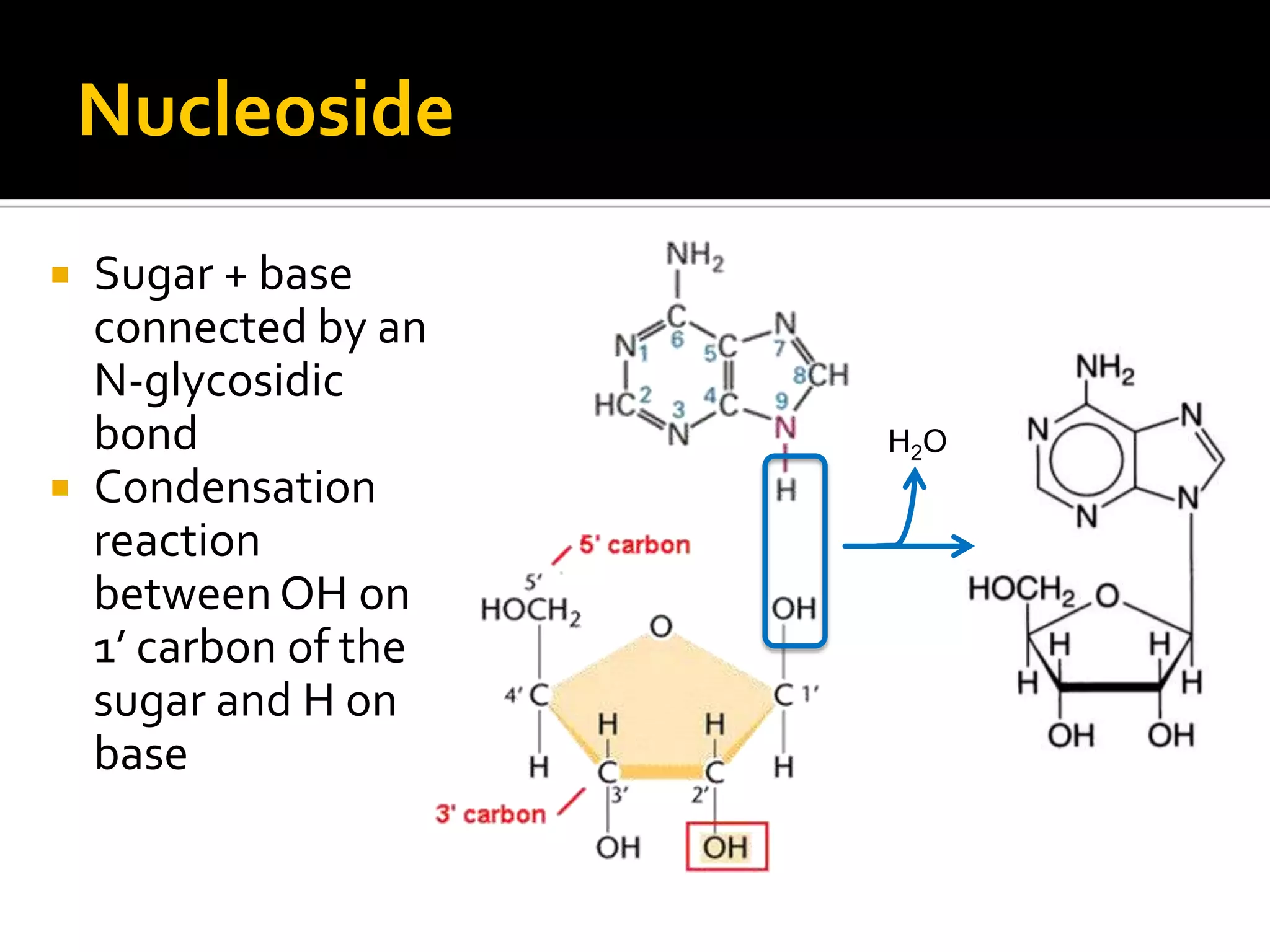
Nucleoside
 Sugar + base
  connected by an
  N-glycosidic
  bond               H2O
 Condensation
  reaction
  between OH on
  1’ carbon of the
  sugar and H on
  base
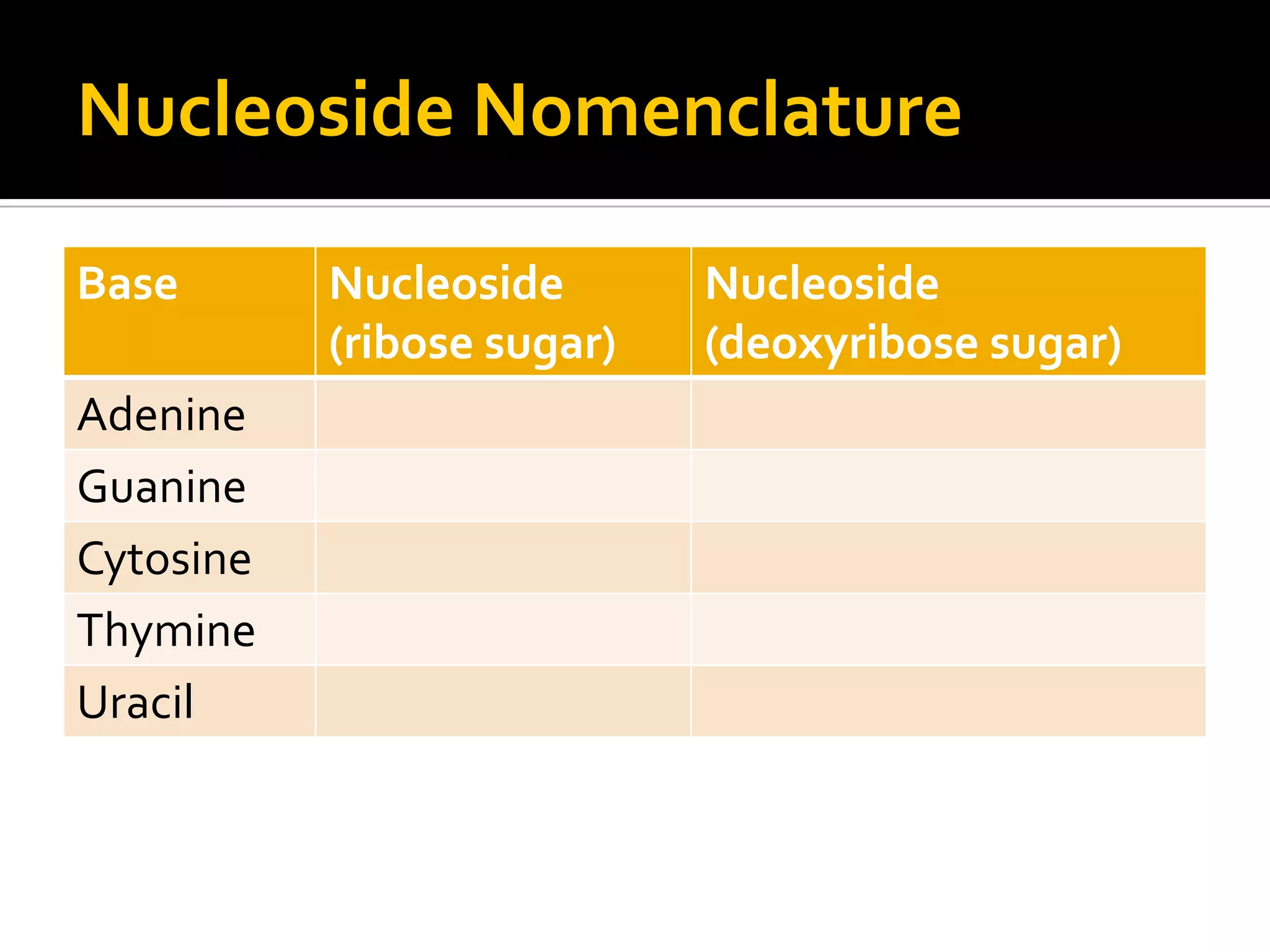
Nucleoside Nomenclature

Base       Nucleoside       Nucleoside
           (ribose sugar)   (deoxyribose sugar)
Adenine
Guanine
Cytosine
Thymine
Uracil
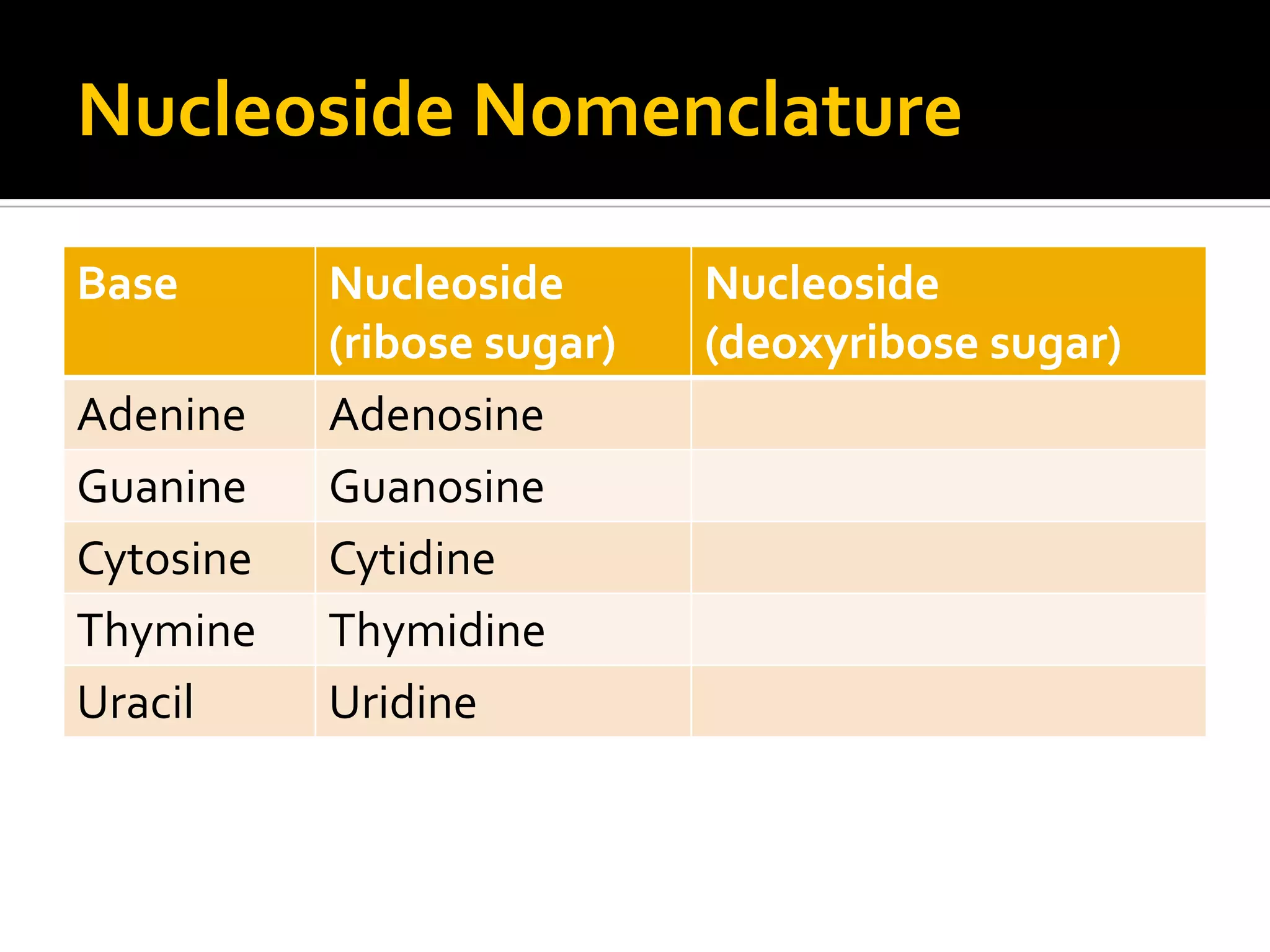
Nucleoside Nomenclature

Base       Nucleoside       Nucleoside
           (ribose sugar)   (deoxyribose sugar)
Adenine    Adenosine
Guanine    Guanosine
Cytosine   Cytidine
Thymine    Thymidine
Uracil     Uridine
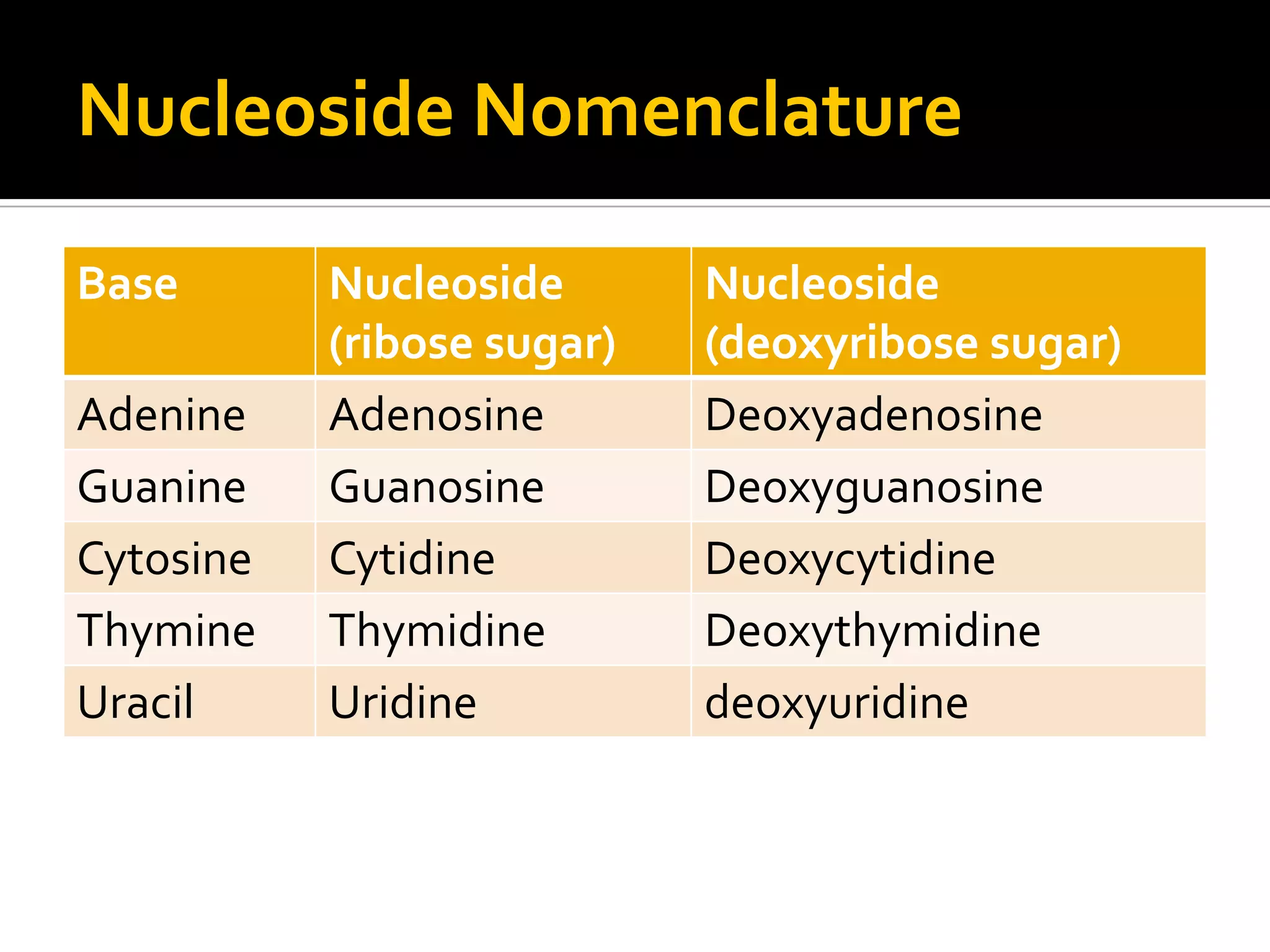
Nucleoside Nomenclature

Base       Nucleoside       Nucleoside
           (ribose sugar)   (deoxyribose sugar)
Adenine    Adenosine        Deoxyadenosine
Guanine    Guanosine        Deoxyguanosine
Cytosine   Cytidine         Deoxycytidine
Thymine    Thymidine        Deoxythymidine
Uracil     Uridine          deoxyuridine
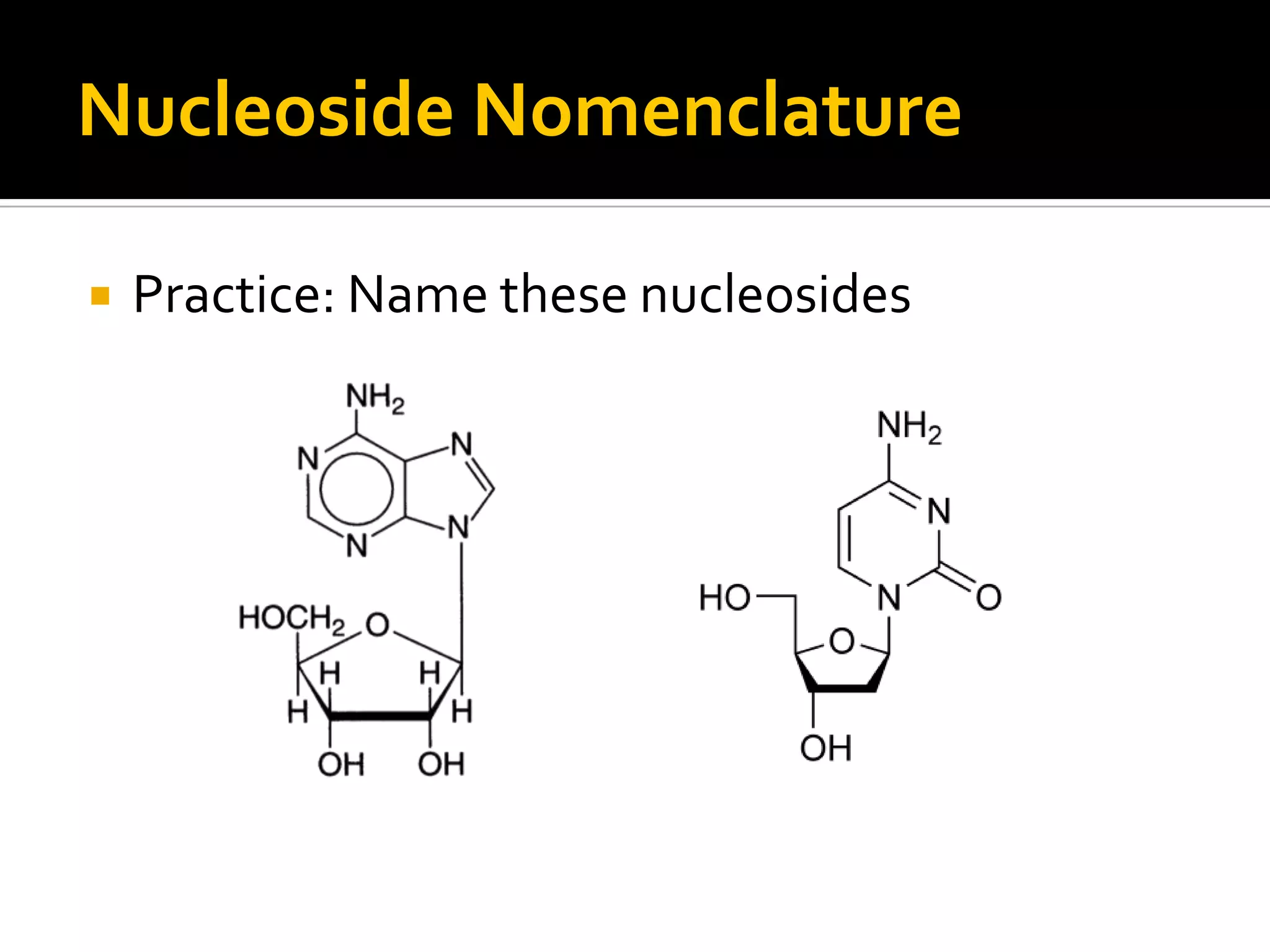
Nucleoside Nomenclature

   Practice: Name these nucleosides
Building the
nucleic acid
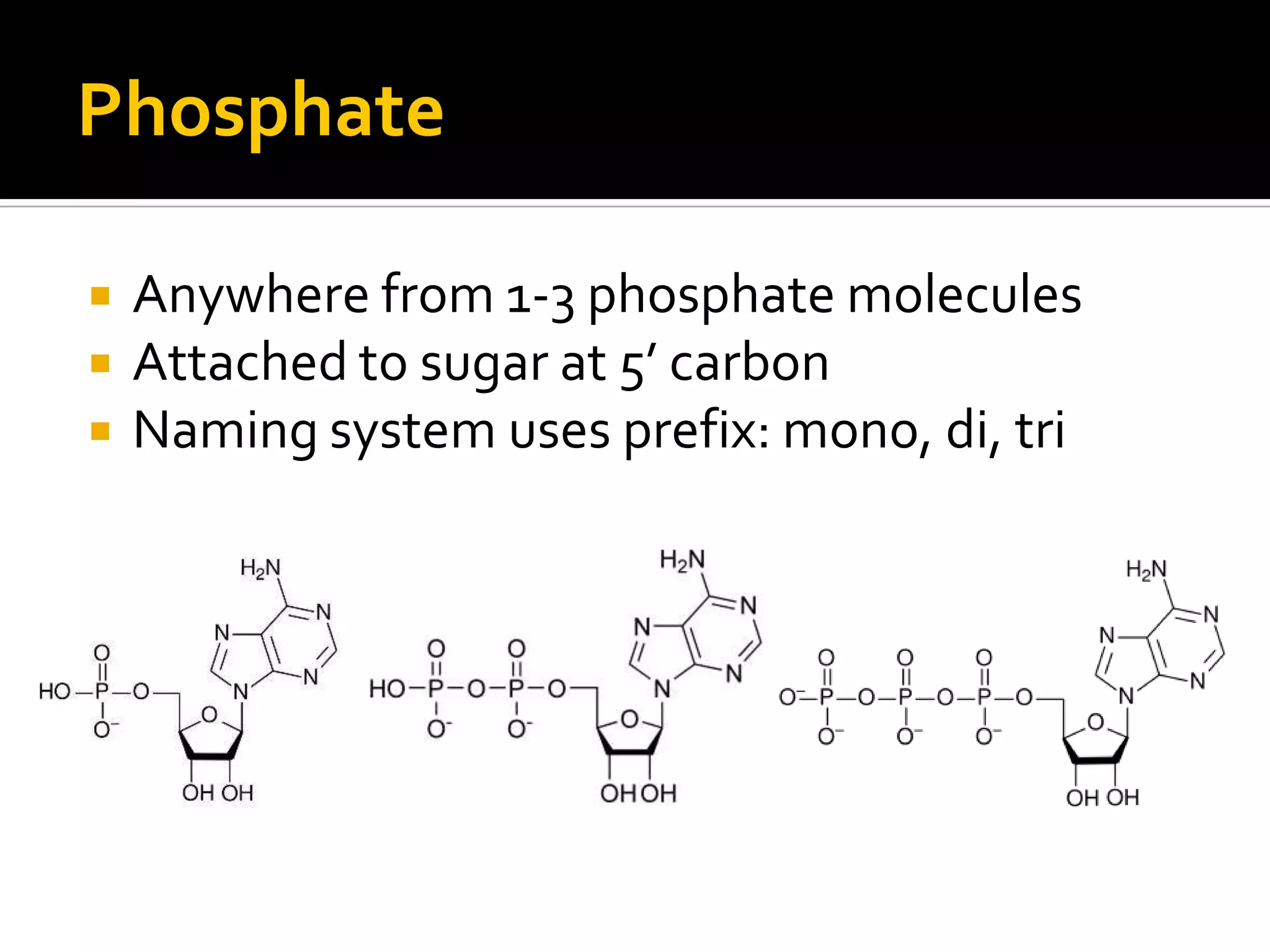
Phosphate

   Anywhere from 1-3 phosphate molecules
   Attached to sugar at 5’ carbon
   Naming system uses prefix: mono, di, tri
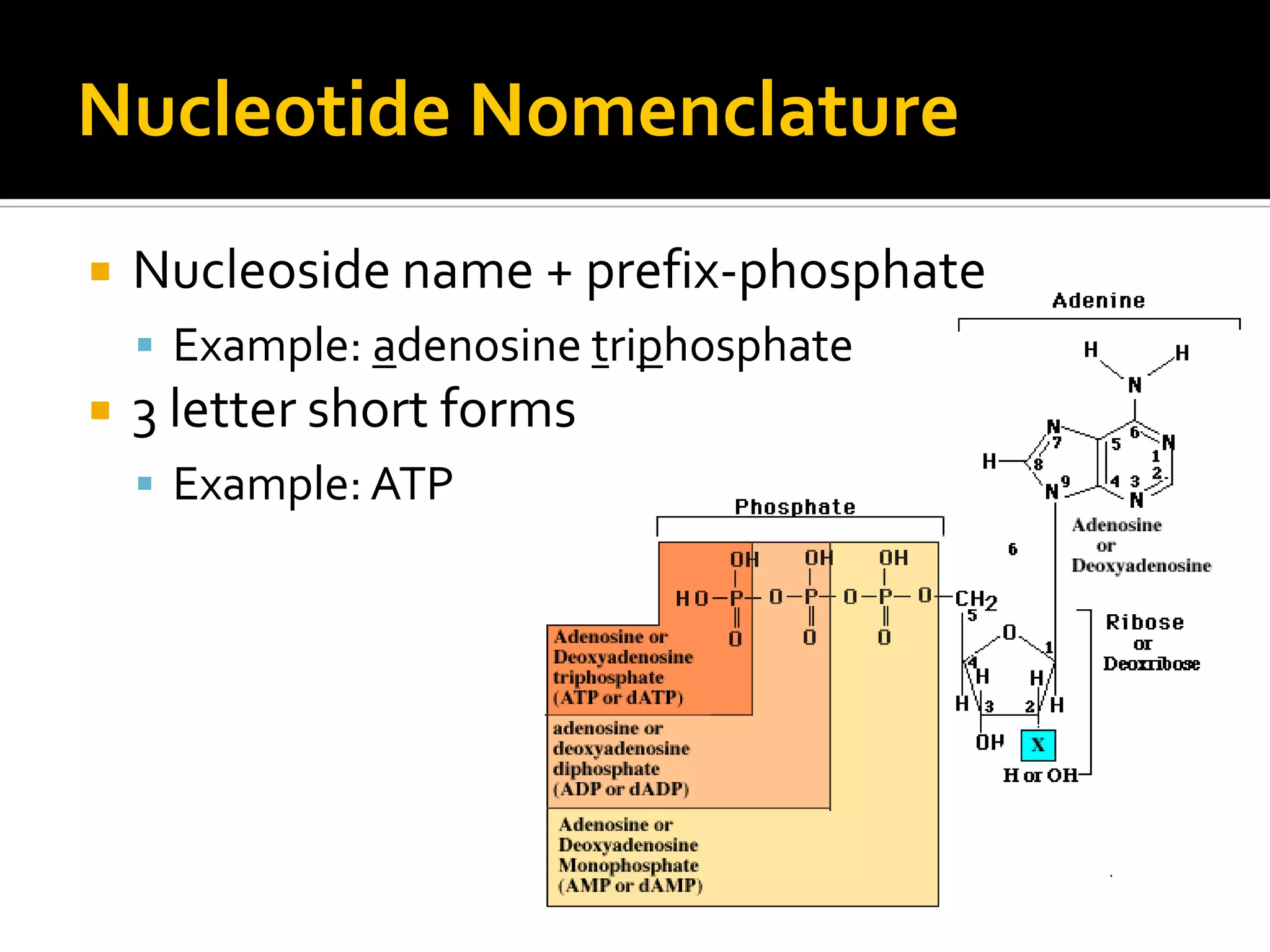
Nucleotide Nomenclature
   Nucleoside name + prefix-phosphate
     Example: adenosine triphosphate
   3 letter short forms
     Example: ATP
Nucleotide Nomenclature

   Practice: Write the full and 3 letter short form
    name for a nucleotide that has a pyrimidine
    base that forms 3 H-bonds, a ribose sugar and
    2 phosphate groups
   Practice: Write the full and 4 letter short form
    name for a nucleotide that has a purine base
    that forms 3 H-bonds, a deoxyribose sugar
    and 1 phosphate group
Building the
nucleic acid
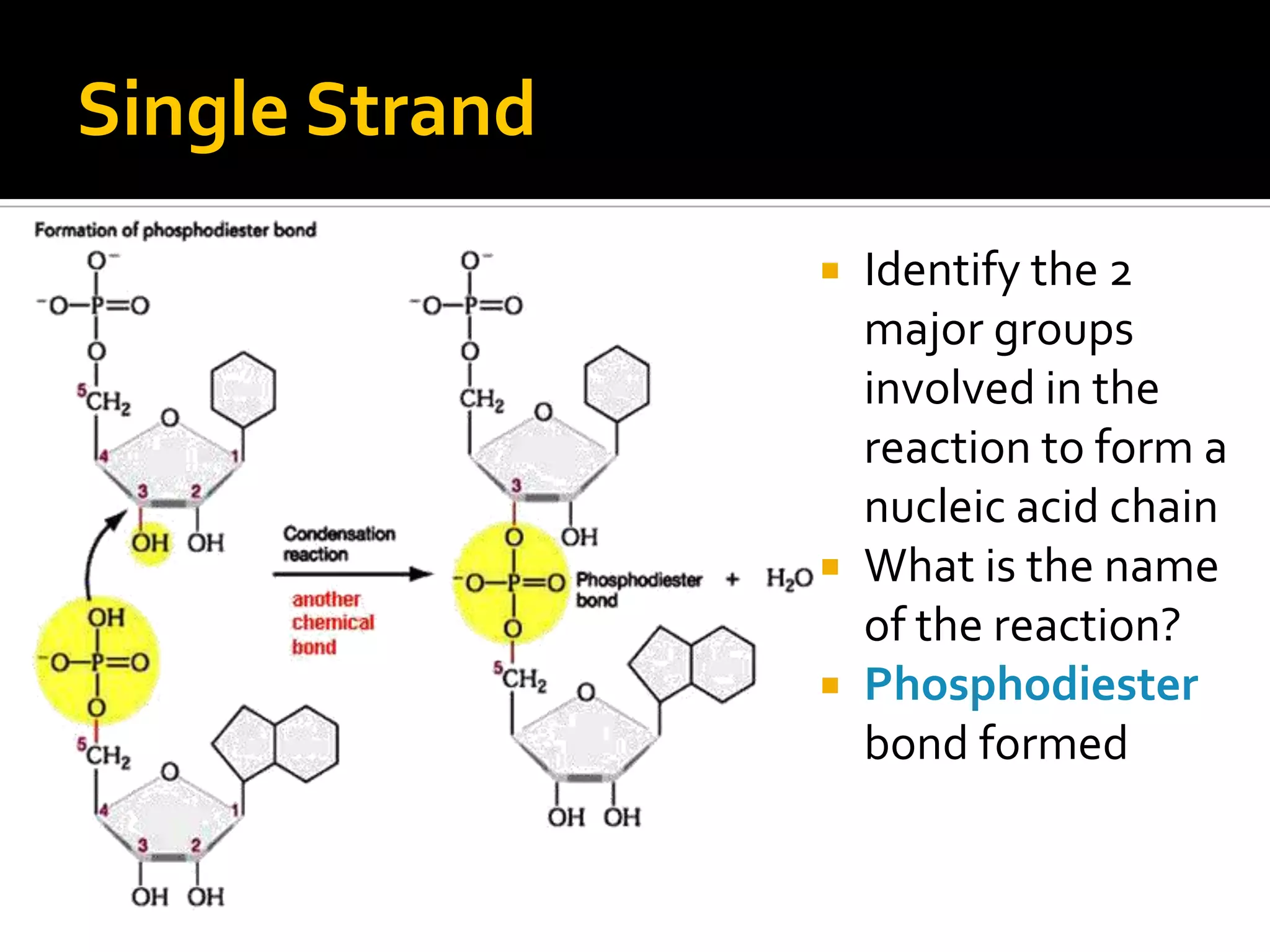
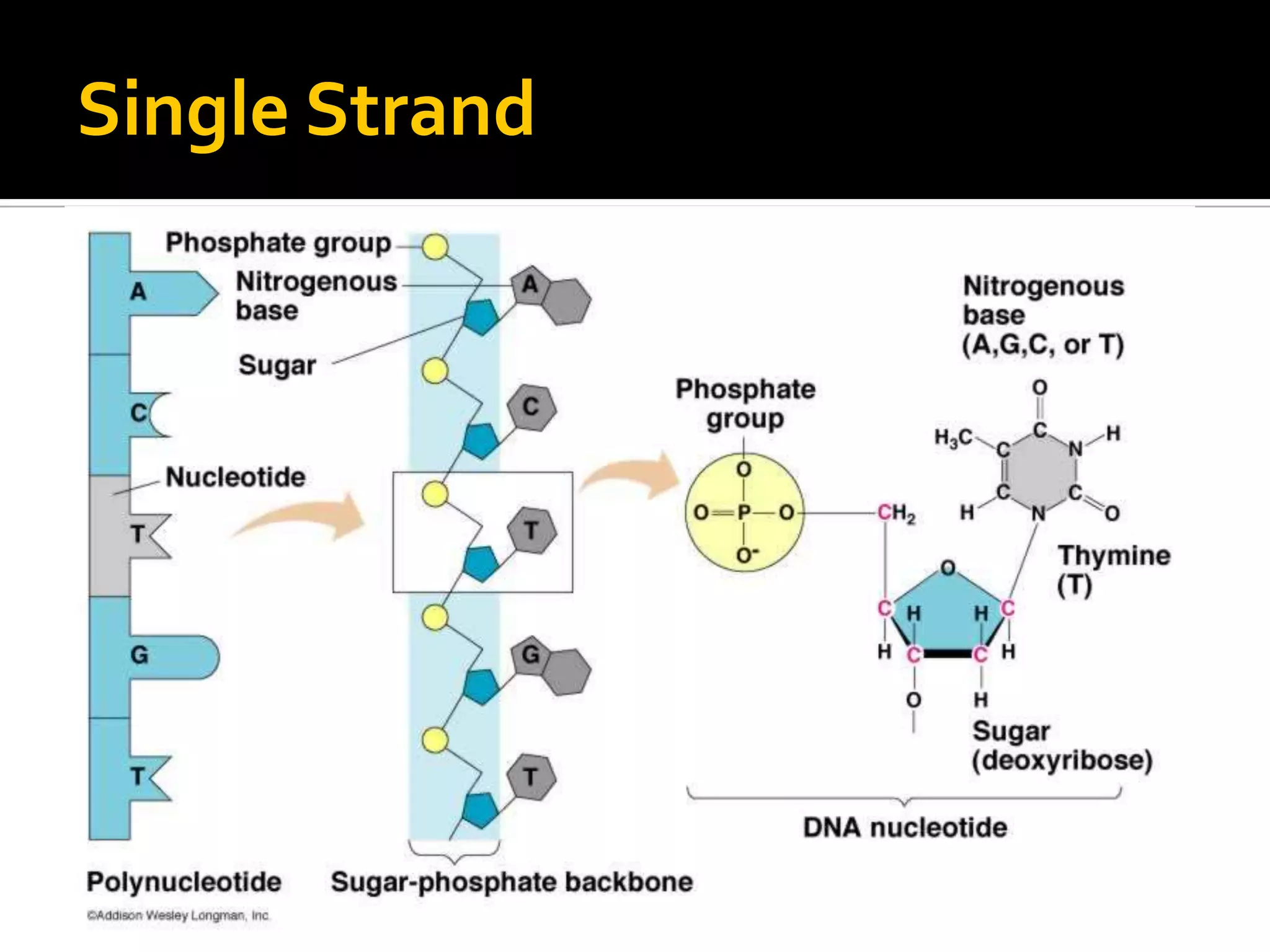
Single Strand
                 Identify the 2
                  major groups
                  involved in the
                  reaction to form a
                  nucleic acid chain
                 What is the name
                  of the reaction?
                 Phosphodiester
                  bond formed
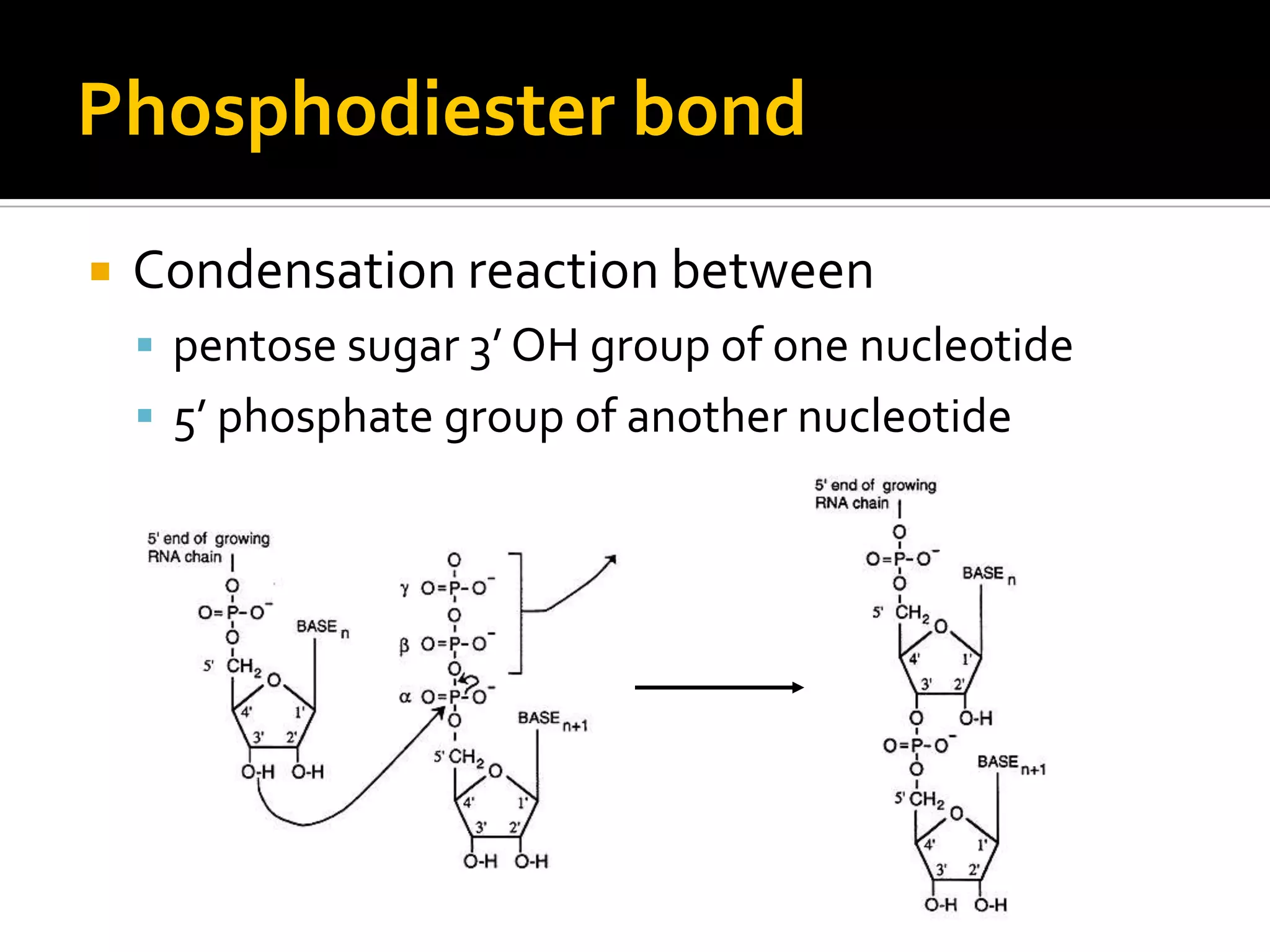
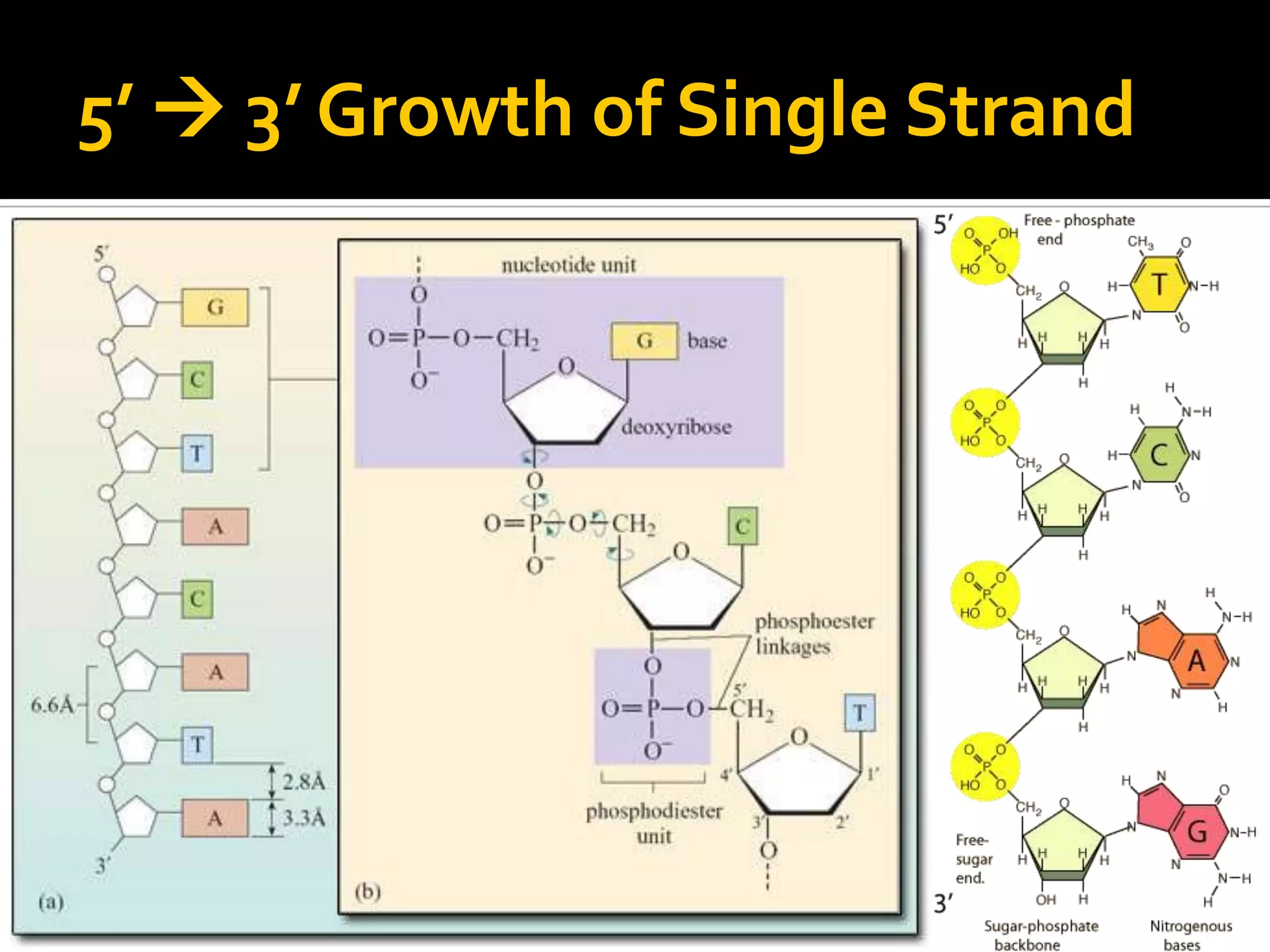
Phosphodiester bond
   Condensation reaction between
     pentose sugar 3’ OH group of one nucleotide
     5’ phosphate group of another nucleotide
Single Strand
5’  3’ Growth of Single Strand
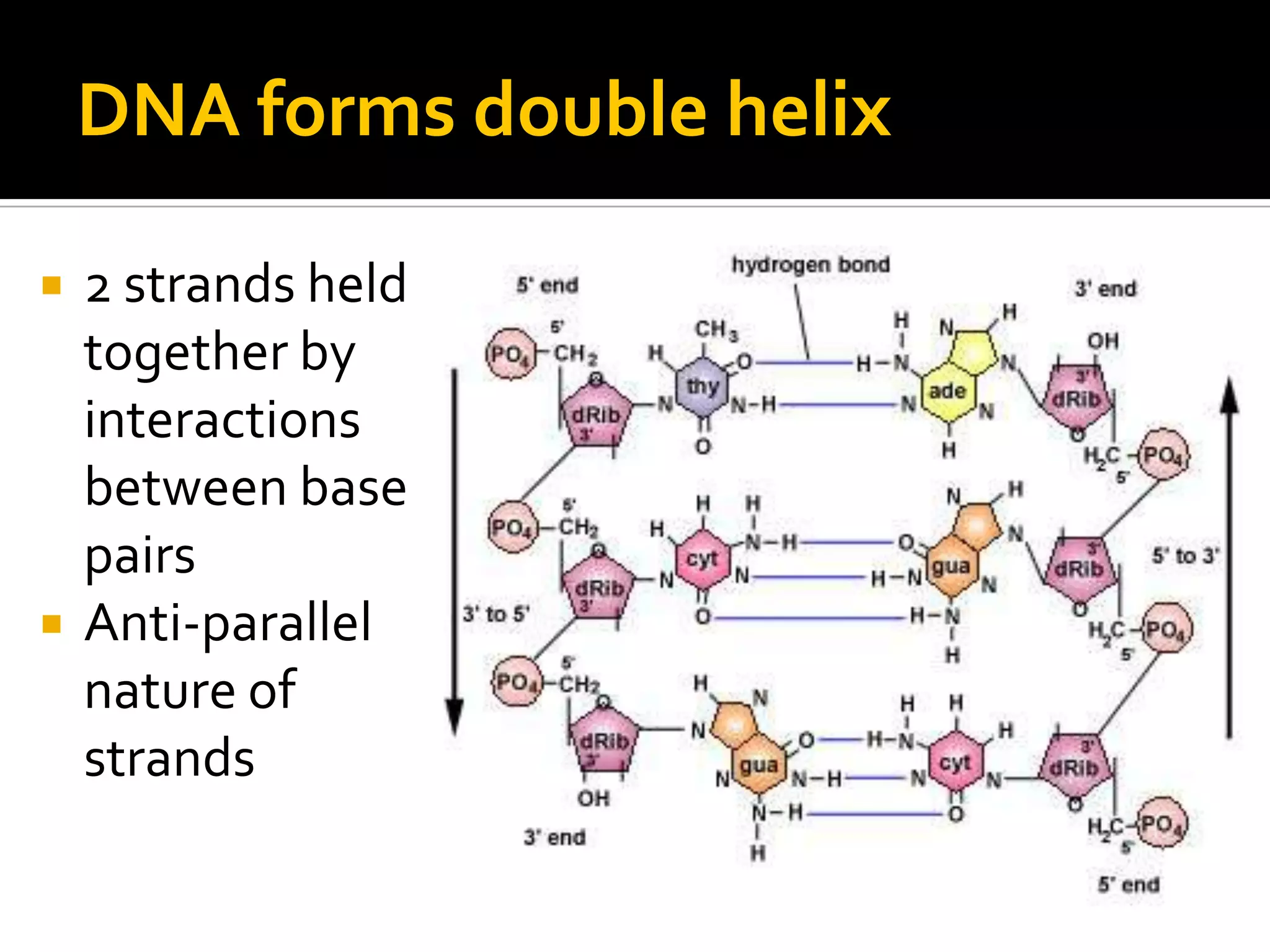
DNA forms double helix

   2 strands held
    together by
    interactions
    between base
    pairs
   Anti-parallel
    nature of
    strands
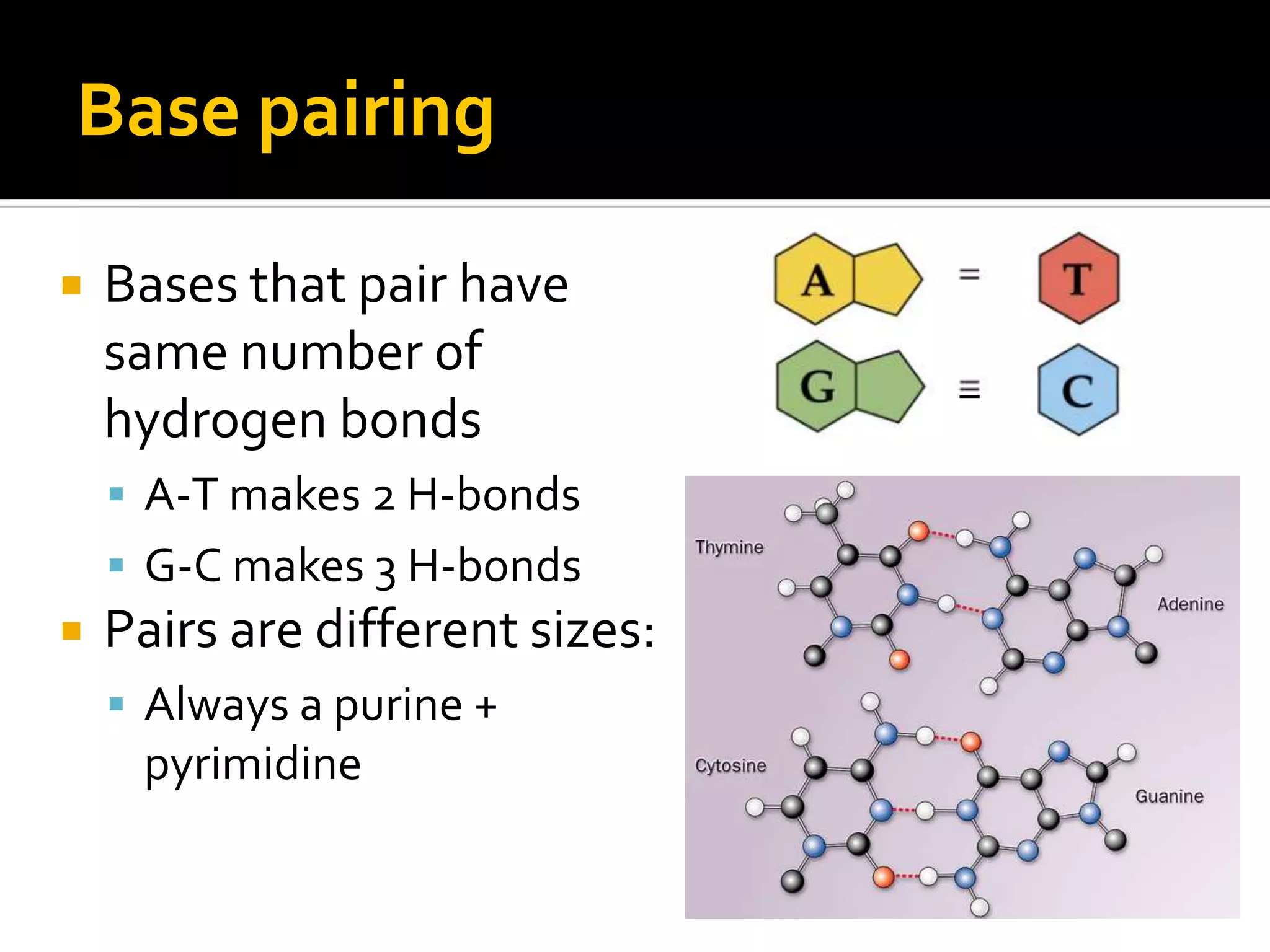
Base pairing

   Bases that pair have
    same number of
    hydrogen bonds
     A-T makes 2 H-bonds
     G-C makes 3 H-bonds
   Pairs are different sizes:
     Always a purine +
     pyrimidine
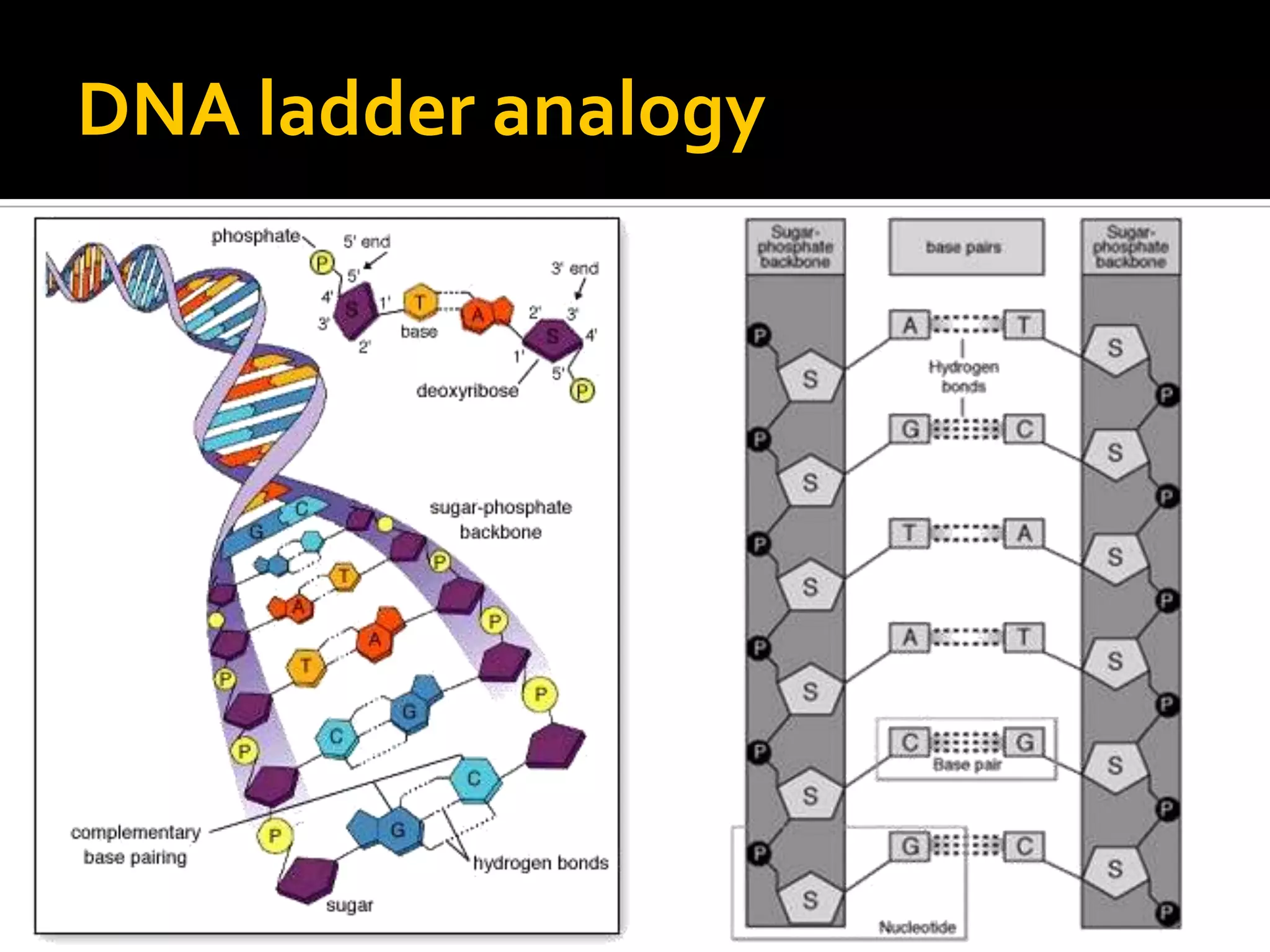
DNA ladder analogy
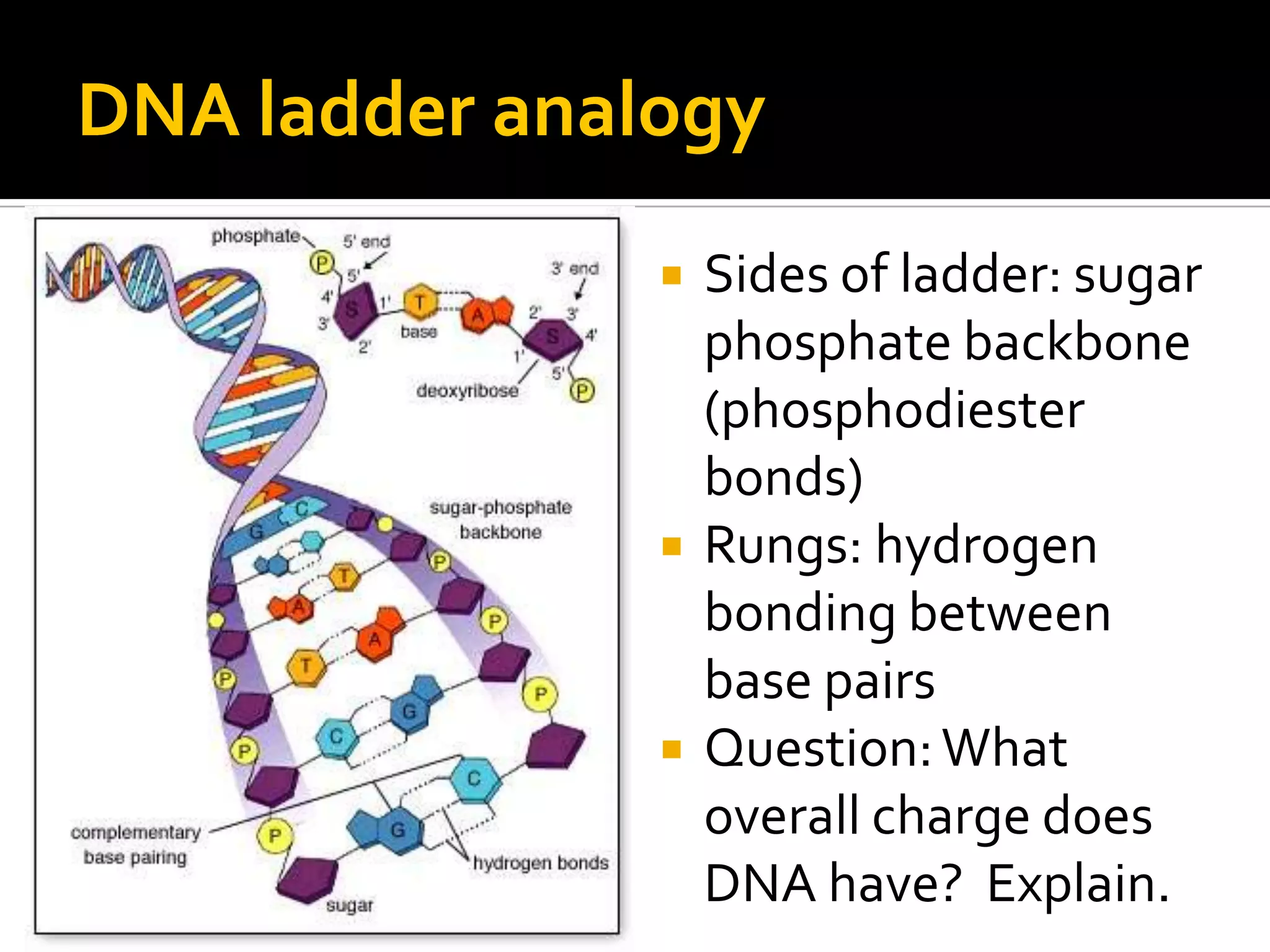
DNA ladder analogy
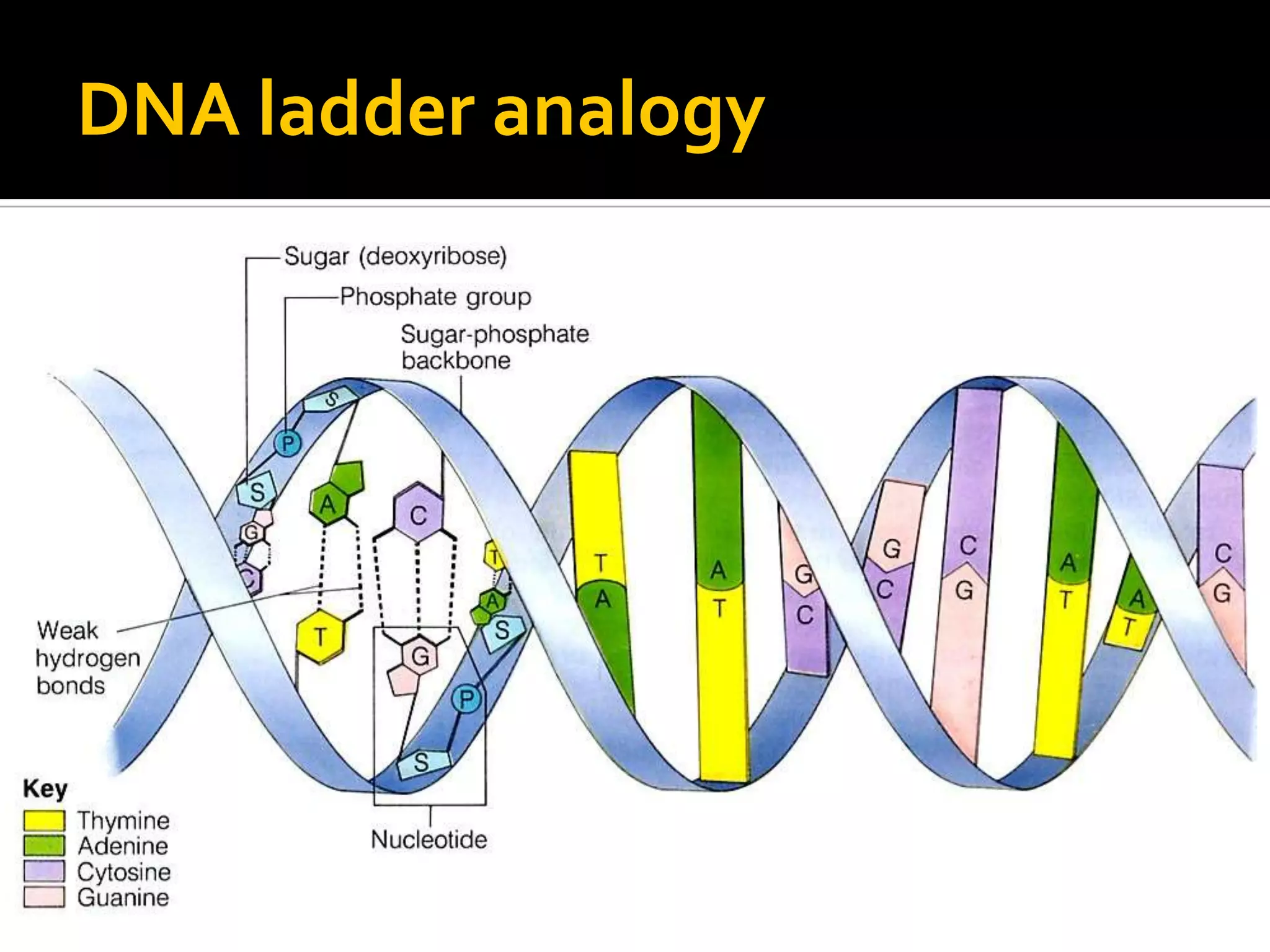
                  Sides of ladder: sugar
                   phosphate backbone
                   (phosphodiester
                   bonds)
                  Rungs: hydrogen
                   bonding between
                   base pairs
                  Question: What
                   overall charge does
                   DNA have? Explain.
DNA ladder analogy
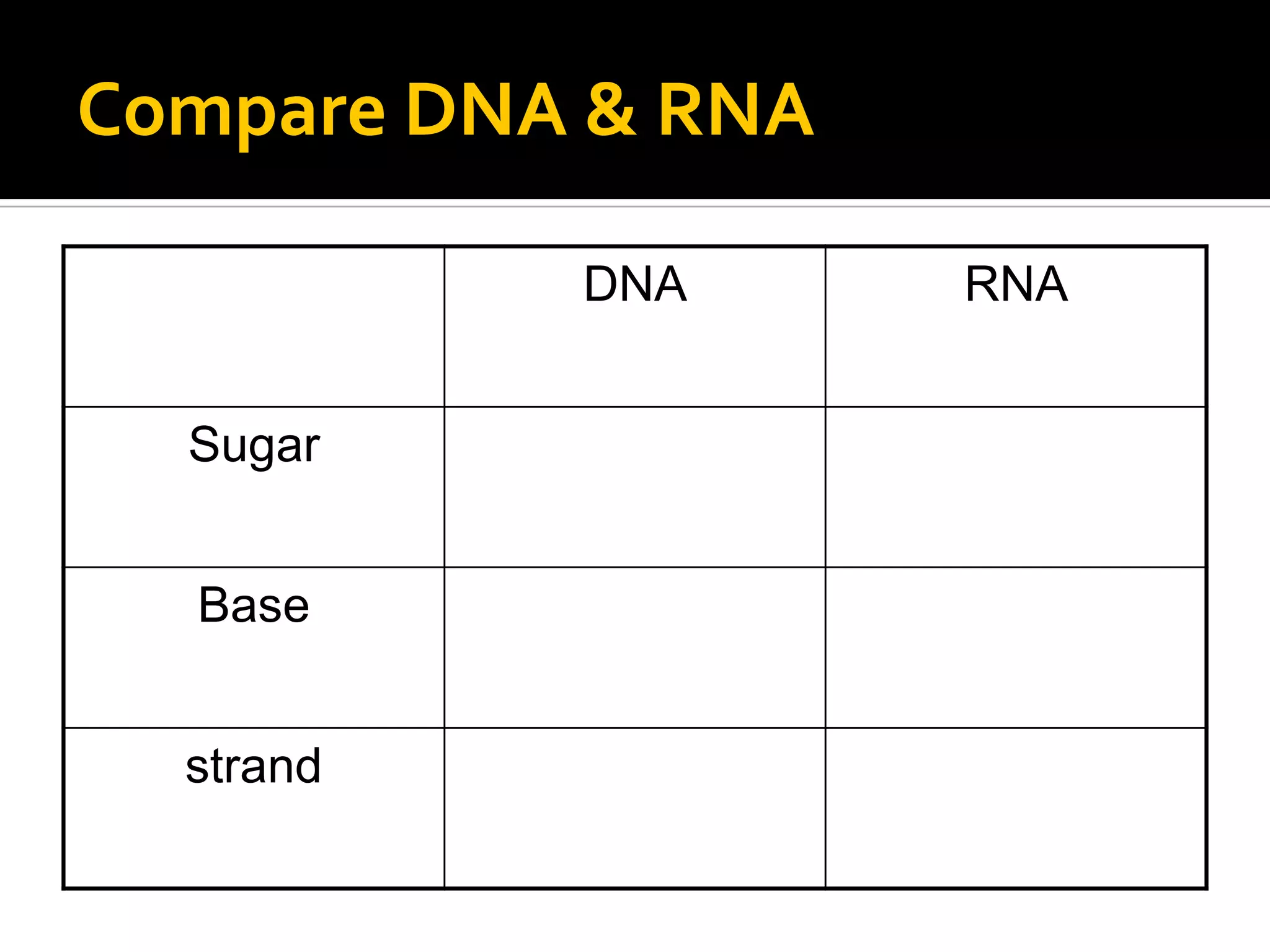
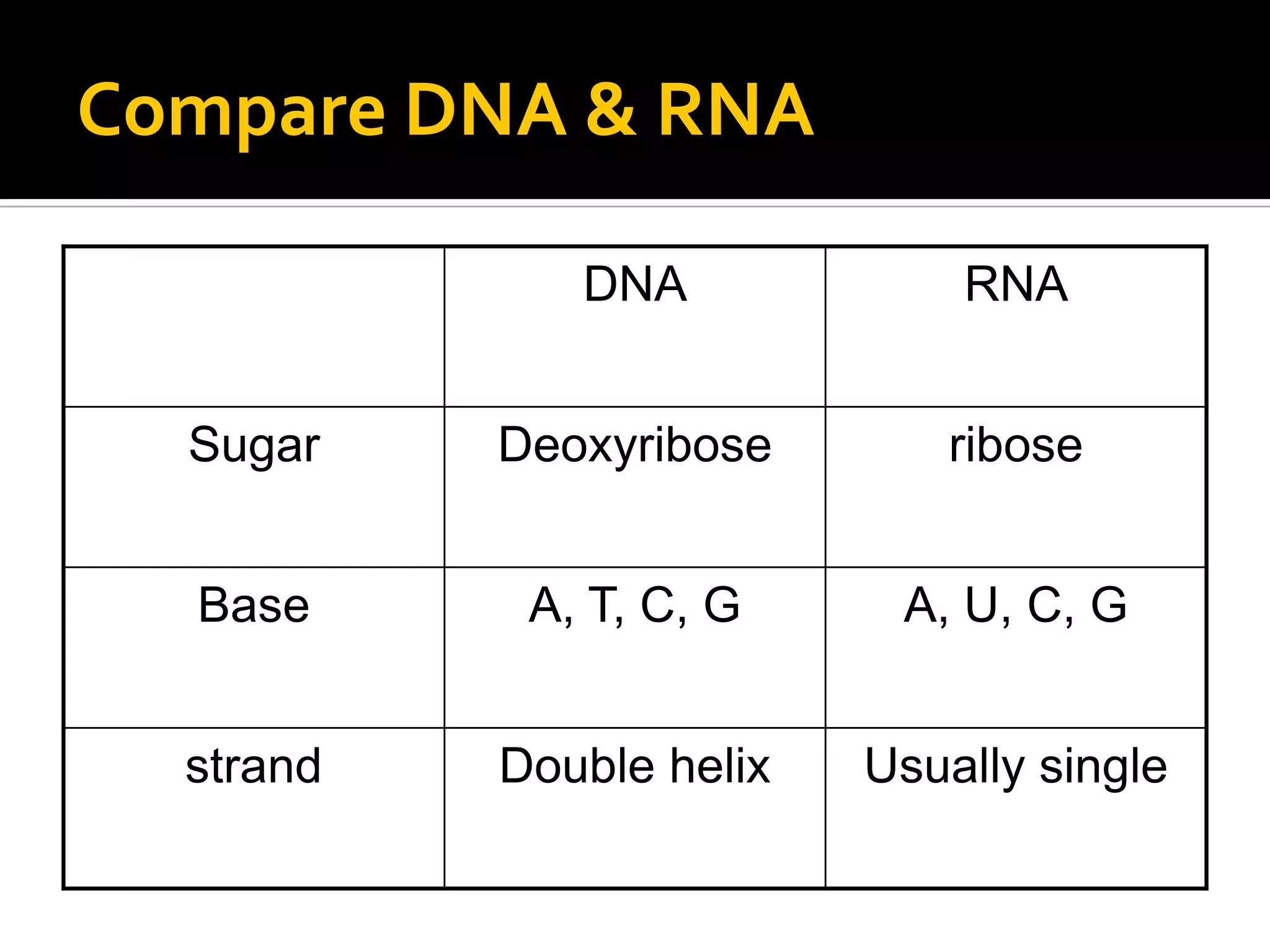
Compare DNA & RNA

           DNA      RNA


  Sugar


  Base


  strand
Compare DNA & RNA

              DNA             RNA


  Sugar    Deoxyribose       ribose


  Base      A, T, C, G     A, U, C, G


  strand   Double helix   Usually single

Macro mols nucleic acids

  • 1.
  • 2.
    Nucleic acid Most wellknown function:  Informational macromolecule  Store hereditary information  The only molecules in existence that can produce identical copies of themselves  2 types: DNA & RNA
  • 3.
    Other Function  Chemicalenergy (e.g. ATP)  Combine with other groups to form enzymes (e.g. Coenzyme A comes from ADP)  Signal molecule (e.g. cAMP)  Evidence for evolution: more closely related species contain similar DNA sequences
  • 4.
    Monomer: Nucleotide  The single unit of nucleic acids is a nucleotide  A nucleotide consists of 3 components:  Sugar (2 types)  Base (5 types)  Phosphate (1-3)
  • 5.
    Pentose Sugar  5 carbons:  Recall from linear carbohydrates  note the “prime” numbering system  2 types:  Ribose (for RNA)  Deoxyribose (for DNA): missing an oxygen at the 2’ position
  • 6.
    Nitrogenous base  Rings of C & N  Purine:  2 fused rings  A, G  Pyrimidine  single 6 sided rings  C, T (DNA), U (RNA)
  • 7.
    Nitrogenous base comparison Purine (large) Pyrimidine (small) 2 H-bonds Adenine (A) Thymine (T) Uracil (U) 3 H-bonds Guanine (G) Cytosine (C)
  • 8.
  • 9.
    Nucleoside  Sugar +base connected by an N-glycosidic bond H2O  Condensation reaction between OH on 1’ carbon of the sugar and H on base
  • 10.
    Nucleoside Nomenclature Base Nucleoside Nucleoside (ribose sugar) (deoxyribose sugar) Adenine Guanine Cytosine Thymine Uracil
  • 11.
    Nucleoside Nomenclature Base Nucleoside Nucleoside (ribose sugar) (deoxyribose sugar) Adenine Adenosine Guanine Guanosine Cytosine Cytidine Thymine Thymidine Uracil Uridine
  • 12.
    Nucleoside Nomenclature Base Nucleoside Nucleoside (ribose sugar) (deoxyribose sugar) Adenine Adenosine Deoxyadenosine Guanine Guanosine Deoxyguanosine Cytosine Cytidine Deoxycytidine Thymine Thymidine Deoxythymidine Uracil Uridine deoxyuridine
  • 13.
    Nucleoside Nomenclature  Practice: Name these nucleosides
  • 14.
  • 15.
    Phosphate  Anywhere from 1-3 phosphate molecules  Attached to sugar at 5’ carbon  Naming system uses prefix: mono, di, tri
  • 16.
    Nucleotide Nomenclature  Nucleoside name + prefix-phosphate  Example: adenosine triphosphate  3 letter short forms  Example: ATP
  • 17.
    Nucleotide Nomenclature  Practice: Write the full and 3 letter short form name for a nucleotide that has a pyrimidine base that forms 3 H-bonds, a ribose sugar and 2 phosphate groups  Practice: Write the full and 4 letter short form name for a nucleotide that has a purine base that forms 3 H-bonds, a deoxyribose sugar and 1 phosphate group
  • 18.
  • 19.
    Single Strand  Identify the 2 major groups involved in the reaction to form a nucleic acid chain  What is the name of the reaction?  Phosphodiester bond formed
  • 20.
    Phosphodiester bond  Condensation reaction between  pentose sugar 3’ OH group of one nucleotide  5’ phosphate group of another nucleotide
  • 21.
  • 22.
    5’  3’Growth of Single Strand
  • 23.
    DNA forms doublehelix  2 strands held together by interactions between base pairs  Anti-parallel nature of strands
  • 24.
    Base pairing  Bases that pair have same number of hydrogen bonds  A-T makes 2 H-bonds  G-C makes 3 H-bonds  Pairs are different sizes:  Always a purine + pyrimidine
  • 25.
  • 26.
    DNA ladder analogy  Sides of ladder: sugar phosphate backbone (phosphodiester bonds)  Rungs: hydrogen bonding between base pairs  Question: What overall charge does DNA have? Explain.
  • 27.
  • 28.
    Compare DNA &RNA DNA RNA Sugar Base strand
  • 29.
    Compare DNA &RNA DNA RNA Sugar Deoxyribose ribose Base A, T, C, G A, U, C, G strand Double helix Usually single