Types of Bonding
Intramolecular
Intermolecular
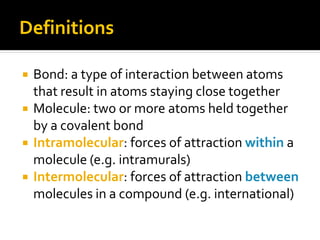
Definitions

   Bond: a type of interaction between atoms
    that result in atoms staying close together
   Molecule: two or more atoms held together
    by a covalent bond
   Intramolecular: forces of attraction within a
    molecule (e.g. intramurals)
   Intermolecular: forces of attraction between
    molecules in a compound (e.g. international)
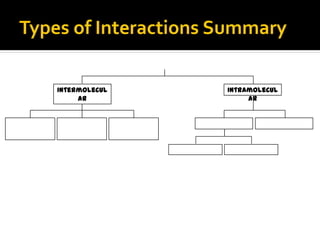
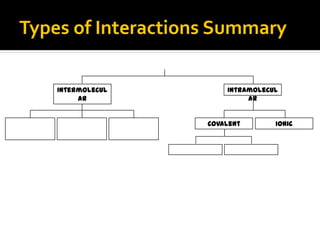
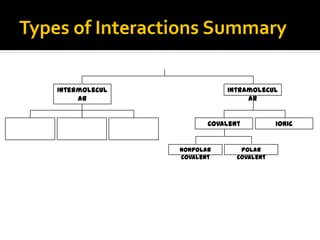
Types of Interactions Summary

    Intermolecul      Intramolecul
         ar                ar
Intramolecular Bonds

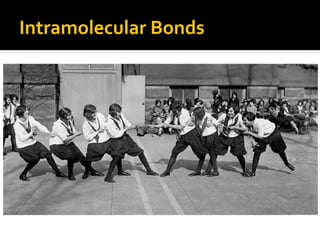
   Electronegativity: attraction of an atom for
    electrons
   Example of a very electronegative atom:
    oxygen
   When two atoms with different
    electronegativity get together…
Intramolecular Bonds
Intramolecular: Ionic

   If two atoms with very large differences in
    electronegativity get together, one of atom
    could take away an electron from the other
   Acceptor “stealer” of electron becomes
    negativity charged (anion = negative ion)
   Donor of electron becomes positively
    charged (cation = positive ion)
Intramolecular: Ionic

   Ionic bond forms from an attraction between
    an anion and cation
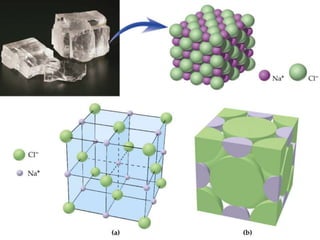
   Ionic compounds are formed by ionic bonds
   Salts are ionic compounds (e.g. Na+ + Cl- 
    NaCl)
   Salt crystals have a 3D lattice because of +/-
    attractions
Types of Interactions Summary

    Intermolecul        Intramolecul
         ar                  ar


                    Covalent       Ionic
Intramolecular: Covalent

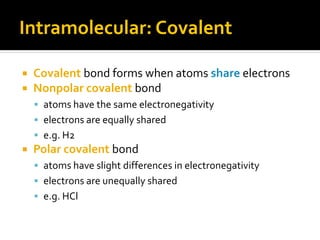
   Covalent bond forms when atoms share electrons
   Nonpolar covalent bond
     atoms have the same electronegativity
     electrons are equally shared
     e.g. H2
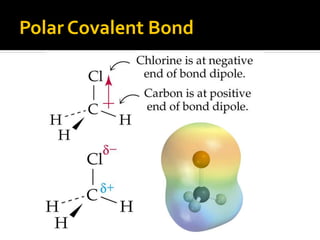
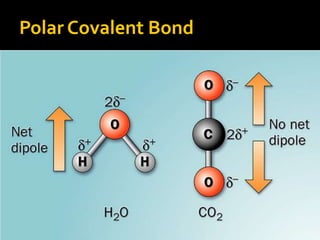
   Polar covalent bond
     atoms have slight differences in electronegativity
     electrons are unequally shared
     e.g. HCl
Polar Covalent Bond
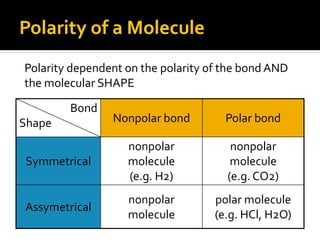
Polarity of a Molecule
Polarity dependent on the polarity of the bond AND
the molecular SHAPE

        Bond
Shape           Nonpolar bond         Polar bond

                   nonpolar            nonpolar
Symmetrical        molecule            molecule
                   (e.g. H2)          (e.g. CO2)
                   nonpolar         polar molecule
Assymetrical
                   molecule         (e.g. HCl, H2O)
Polar Covalent Bond
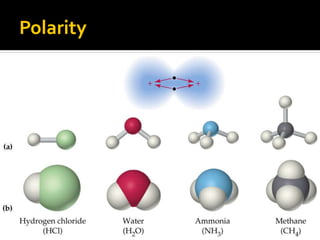
Polarity
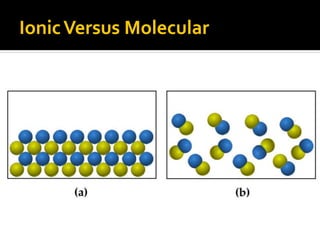
Ionic Versus Molecular
Types of Interactions Summary

    Intermolecul              Intramolecul
         ar                        ar


                          Covalent          Ionic


                   Nonpolar       Polar
                   Covalent      Covalent
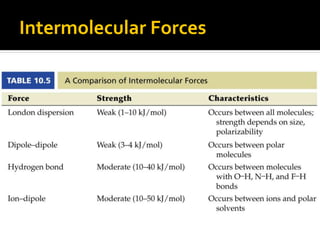
Intermolecular Forces
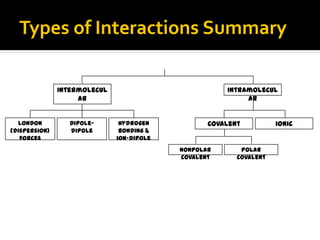
Types of Interactions Summary

               Intermolecul                           Intramolecul
                    ar                                     ar


  London         Dipole-       Hydrogen           Covalent          Ionic
(dispersion)     dipole        bonding &
   forces                     Ion-dipole
                                           Nonpolar       Polar
                                           Covalent      Covalent
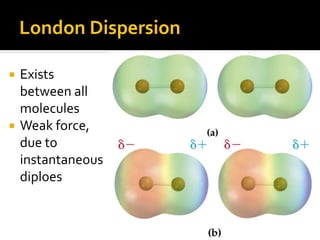
London Dispersion

   Exists
    between all
    molecules
   Weak force,
    due to
    instantaneous
    diploes
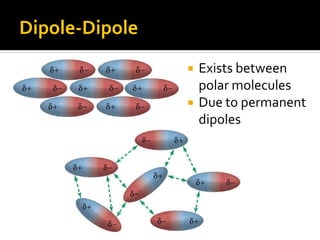
Dipole-Dipole
                   Exists between
                    polar molecules
                   Due to permanent
                    dipoles
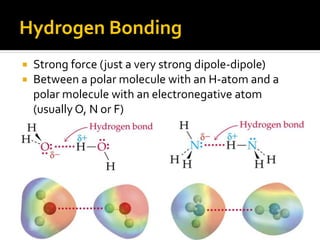
Hydrogen Bonding
   Strong force (just a very strong dipole-dipole)
   Between a polar molecule with an H-atom and a
    polar molecule with an electronegative atom
    (usually O, N or F)
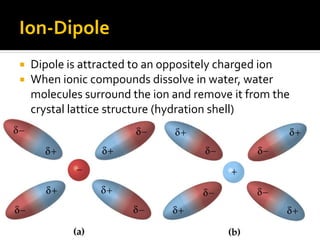
Ion-Dipole
                                       Ion-Dipole

   Dipole is attracted to an oppositely charged ion
   When ionic compounds dissolve in water, water
    molecules surround the ion and remove it from the
    crystal lattice structure (hydration shell)
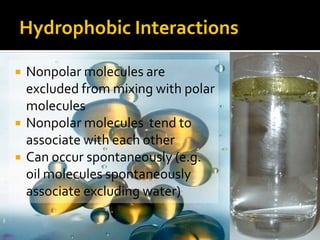
Hydrophobic Interactions

   Nonpolar molecules are
    excluded from mixing with polar
    molecules
   Nonpolar molecules tend to
    associate with each other
   Can occur spontaneously (e.g.
    oil molecules spontaneously
    associate excluding water)

Bonding lesson

  • 1.
  • 2.
    Definitions  Bond: a type of interaction between atoms that result in atoms staying close together  Molecule: two or more atoms held together by a covalent bond  Intramolecular: forces of attraction within a molecule (e.g. intramurals)  Intermolecular: forces of attraction between molecules in a compound (e.g. international)
  • 3.
    Types of InteractionsSummary Intermolecul Intramolecul ar ar
  • 4.
    Intramolecular Bonds  Electronegativity: attraction of an atom for electrons  Example of a very electronegative atom: oxygen  When two atoms with different electronegativity get together…
  • 5.
  • 6.
    Intramolecular: Ionic  If two atoms with very large differences in electronegativity get together, one of atom could take away an electron from the other  Acceptor “stealer” of electron becomes negativity charged (anion = negative ion)  Donor of electron becomes positively charged (cation = positive ion)
  • 7.
    Intramolecular: Ionic  Ionic bond forms from an attraction between an anion and cation  Ionic compounds are formed by ionic bonds  Salts are ionic compounds (e.g. Na+ + Cl-  NaCl)  Salt crystals have a 3D lattice because of +/- attractions
  • 9.
    Types of InteractionsSummary Intermolecul Intramolecul ar ar Covalent Ionic
  • 10.
    Intramolecular: Covalent  Covalent bond forms when atoms share electrons  Nonpolar covalent bond  atoms have the same electronegativity  electrons are equally shared  e.g. H2  Polar covalent bond  atoms have slight differences in electronegativity  electrons are unequally shared  e.g. HCl
  • 11.
  • 12.
    Polarity of aMolecule Polarity dependent on the polarity of the bond AND the molecular SHAPE Bond Shape Nonpolar bond Polar bond nonpolar nonpolar Symmetrical molecule molecule (e.g. H2) (e.g. CO2) nonpolar polar molecule Assymetrical molecule (e.g. HCl, H2O)
  • 13.
  • 14.
  • 15.
  • 16.
    Types of InteractionsSummary Intermolecul Intramolecul ar ar Covalent Ionic Nonpolar Polar Covalent Covalent
  • 17.
  • 18.
    Types of InteractionsSummary Intermolecul Intramolecul ar ar London Dipole- Hydrogen Covalent Ionic (dispersion) dipole bonding & forces Ion-dipole Nonpolar Polar Covalent Covalent
  • 19.
    London Dispersion  Exists between all molecules  Weak force, due to instantaneous diploes
  • 20.
    Dipole-Dipole  Exists between polar molecules  Due to permanent dipoles
  • 21.
    Hydrogen Bonding  Strong force (just a very strong dipole-dipole)  Between a polar molecule with an H-atom and a polar molecule with an electronegative atom (usually O, N or F)
  • 22.
    Ion-Dipole Ion-Dipole  Dipole is attracted to an oppositely charged ion  When ionic compounds dissolve in water, water molecules surround the ion and remove it from the crystal lattice structure (hydration shell)
  • 23.
    Hydrophobic Interactions  Nonpolar molecules are excluded from mixing with polar molecules  Nonpolar molecules tend to associate with each other  Can occur spontaneously (e.g. oil molecules spontaneously associate excluding water)