Evolution
History
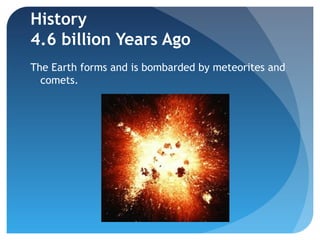
4.6 billion Years Ago
The Earth forms and is bombarded by meteorites and
  comets.
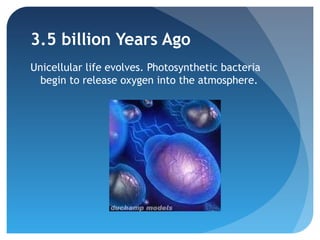
3.5 billion Years Ago
Unicellular life evolves. Photosynthetic bacteria
  begin to release oxygen into the atmosphere.
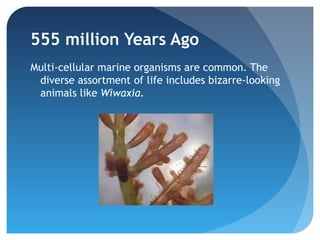
555 million Years Ago
Multi-cellular marine organisms are common. The
 diverse assortment of life includes bizarre-looking
 animals like Wiwaxia.
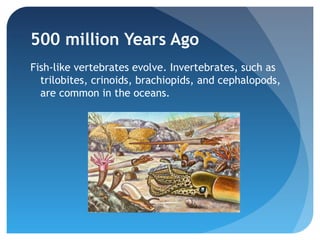
500 million Years Ago
Fish-like vertebrates evolve. Invertebrates, such as
  trilobites, crinoids, brachiopids, and cephalopods,
  are common in the oceans.
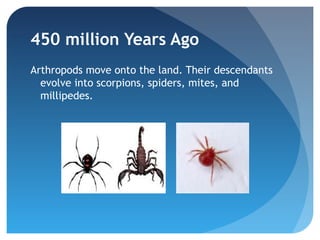
450 million Years Ago
Arthropods move onto the land. Their descendants
  evolve into scorpions, spiders, mites, and
  millipedes.
400 million Years Ago
http://www.youtube.com/watch?v=mneDhOtVEQw&feature=you

Megaladon Pre-historic Shark
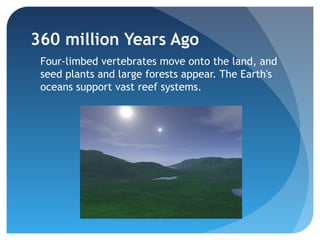
360 million Years Ago
 Four-limbed vertebrates move onto the land, and
 seed plants and large forests appear. The Earth's
 oceans support vast reef systems.
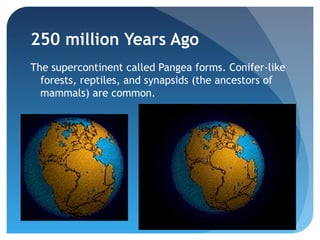
250 million Years Ago
The supercontinent called Pangea forms. Conifer-like
  forests, reptiles, and synapsids (the ancestors of
  mammals) are common.
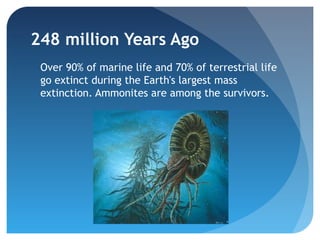
248 million Years Ago
 Over 90% of marine life and 70% of terrestrial life
 go extinct during the Earth's largest mass
 extinction. Ammonites are among the survivors.
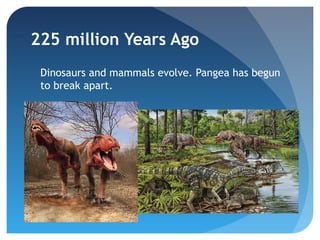
225 million Years Ago
 Dinosaurs and mammals evolve. Pangea has begun
 to break apart.
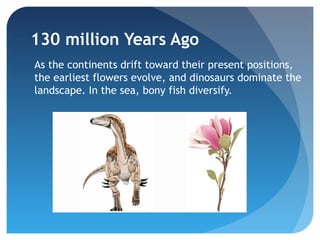
130 million Years Ago
As the continents drift toward their present positions,
the earliest flowers evolve, and dinosaurs dominate the
landscape. In the sea, bony fish diversify.
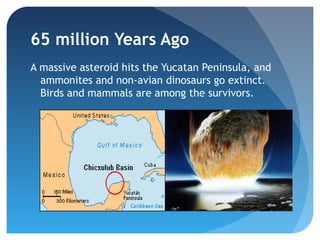
65 million Years Ago
A massive asteroid hits the Yucatan Peninsula, and
  ammonites and non-avian dinosaurs go extinct.
  Birds and mammals are among the survivors.
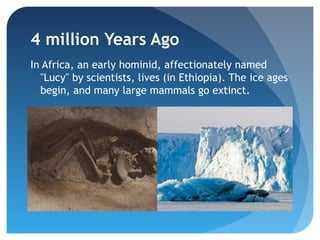
4 million Years Ago
In Africa, an early hominid, affectionately named
  "Lucy" by scientists, lives (in Ethiopia). The ice ages
  begin, and many large mammals go extinct.
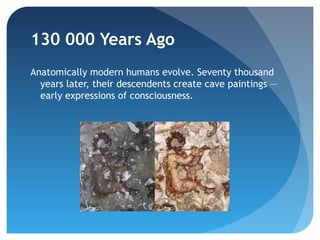
130 000 Years Ago
Anatomically modern humans evolve. Seventy thousand
  years later, their descendents create cave paintings —
  early expressions of consciousness.
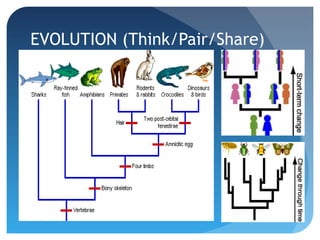
EVOLUTION (Think/Pair/Share)
Biological evolution is descent with modification.
  This encompasses small-scale evolution
  (changes in gene frequency in a population
  from one generation to the next) and large-
  scale evolution (the descent of different
  species from a common ancestor over many
  generations).


Evolution helps us to understand the history of
  life.
The Theory of Evolution
What is a theory? (Think/Pair/Share)
(Hint! Think of atomic or cell theories... Or
  the theory of relativity.)
Everyday: An educated guess


Scientific: An explanatory model that accounts for a
  body of facts that have been repeatedly confirmed.
  Theories provide a basis for explaining observations
  of the natural world and for making predictions.


Scientific theories are confirmed explanations of
  nature and are the most reliable, rigorous, and
  comprehensive form of scientific knowledge.

Intro to evolution

  • 1.
  • 2.
    History 4.6 billion YearsAgo The Earth forms and is bombarded by meteorites and comets.
  • 3.
    3.5 billion YearsAgo Unicellular life evolves. Photosynthetic bacteria begin to release oxygen into the atmosphere.
  • 4.
    555 million YearsAgo Multi-cellular marine organisms are common. The diverse assortment of life includes bizarre-looking animals like Wiwaxia.
  • 5.
    500 million YearsAgo Fish-like vertebrates evolve. Invertebrates, such as trilobites, crinoids, brachiopids, and cephalopods, are common in the oceans.
  • 6.
    450 million YearsAgo Arthropods move onto the land. Their descendants evolve into scorpions, spiders, mites, and millipedes.
  • 7.
    400 million YearsAgo http://www.youtube.com/watch?v=mneDhOtVEQw&feature=you Megaladon Pre-historic Shark
  • 8.
    360 million YearsAgo Four-limbed vertebrates move onto the land, and seed plants and large forests appear. The Earth's oceans support vast reef systems.
  • 9.
    250 million YearsAgo The supercontinent called Pangea forms. Conifer-like forests, reptiles, and synapsids (the ancestors of mammals) are common.
  • 10.
    248 million YearsAgo Over 90% of marine life and 70% of terrestrial life go extinct during the Earth's largest mass extinction. Ammonites are among the survivors.
  • 11.
    225 million YearsAgo Dinosaurs and mammals evolve. Pangea has begun to break apart.
  • 12.
    130 million YearsAgo As the continents drift toward their present positions, the earliest flowers evolve, and dinosaurs dominate the landscape. In the sea, bony fish diversify.
  • 13.
    65 million YearsAgo A massive asteroid hits the Yucatan Peninsula, and ammonites and non-avian dinosaurs go extinct. Birds and mammals are among the survivors.
  • 14.
    4 million YearsAgo In Africa, an early hominid, affectionately named "Lucy" by scientists, lives (in Ethiopia). The ice ages begin, and many large mammals go extinct.
  • 15.
    130 000 YearsAgo Anatomically modern humans evolve. Seventy thousand years later, their descendents create cave paintings — early expressions of consciousness.
  • 16.
  • 17.
    EVOLUTION (Think/Pair/Share) Biological evolutionis descent with modification. This encompasses small-scale evolution (changes in gene frequency in a population from one generation to the next) and large- scale evolution (the descent of different species from a common ancestor over many generations). Evolution helps us to understand the history of life.
  • 18.
    The Theory ofEvolution What is a theory? (Think/Pair/Share) (Hint! Think of atomic or cell theories... Or the theory of relativity.)
  • 19.
    Everyday: An educatedguess Scientific: An explanatory model that accounts for a body of facts that have been repeatedly confirmed. Theories provide a basis for explaining observations of the natural world and for making predictions. Scientific theories are confirmed explanations of nature and are the most reliable, rigorous, and comprehensive form of scientific knowledge.