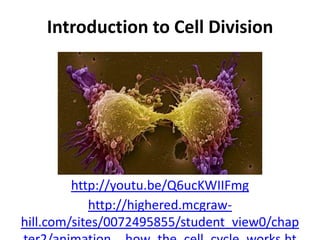
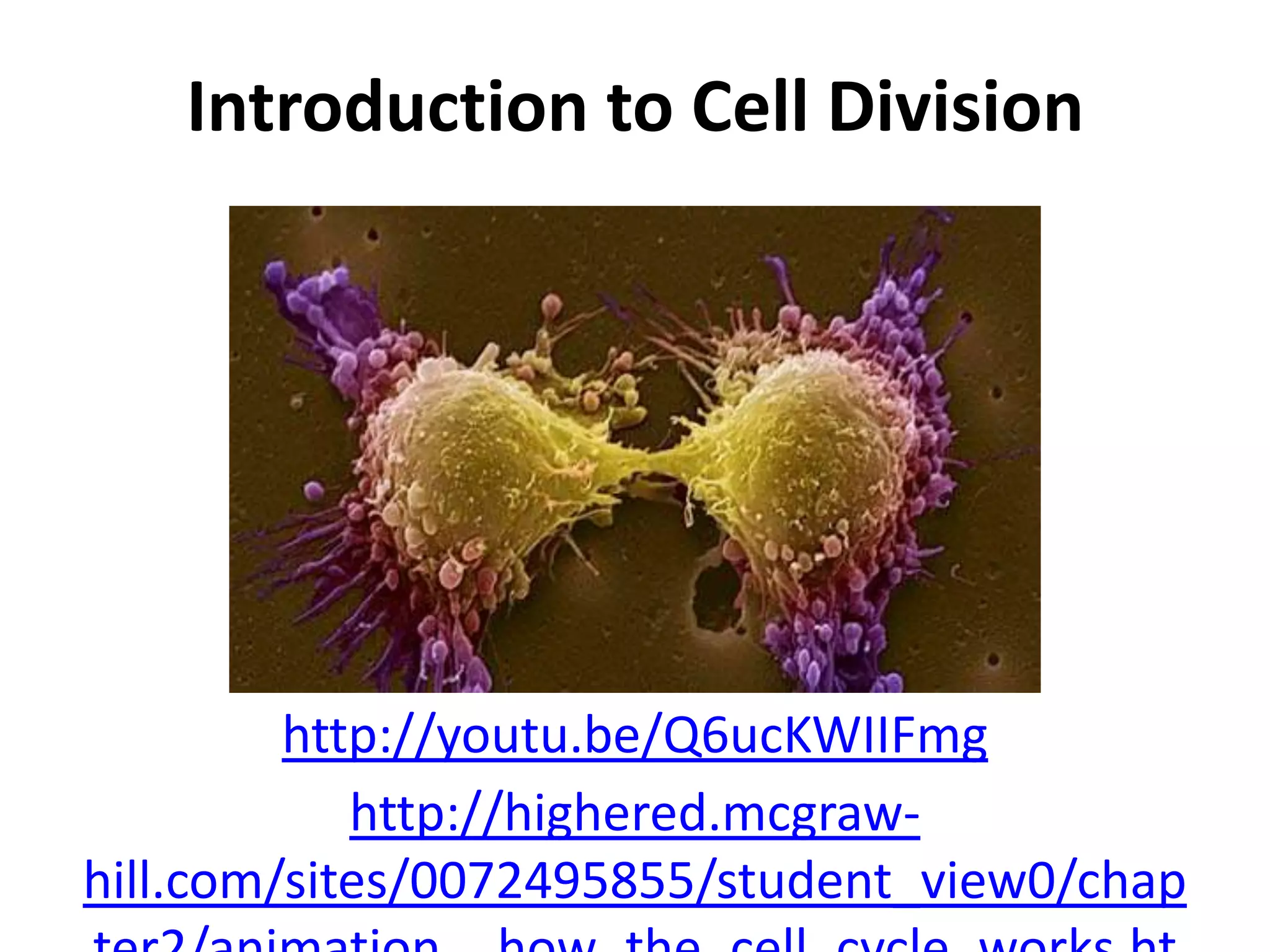
Introduction to Cell Division
http://youtu.be/Q6ucKWIIFmg
http://highered.mcgraw-
hill.com/sites/0072495855/student_view0/chap
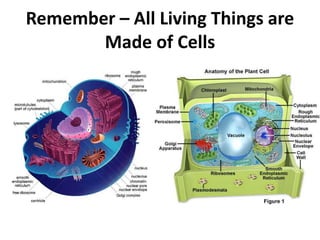
Remember – All Living Things are
Made of Cells
Why Are Cells Small?
• As cells get bigger, more of its cytoplasm is
located farther from the cell membrane.
• If a cell gets too big, it would take too long to
get materials into the cell and too long to get
waste out of the cell.
•
Cell Division
• All cells come from other living cells.
• You (and other living things) grow because
your cells get bigger and your number of cells
gets larger.
– A single cell divides into two cells.
– Two cells divide into four, etc.
• Cells must also divide because old cells die
and need new cells to replace them!
The Cell Cycle
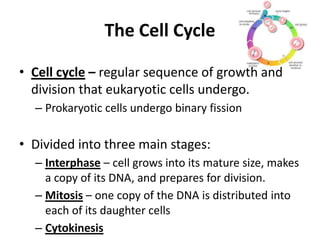
• Cell cycle – regular sequence of growth and
division that eukaryotic cells undergo.
– Prokaryotic cells undergo binary fission
• Divided into three main stages:
– Interphase – cell grows into its mature size, makes
a copy of its DNA, and prepares for division.
– Mitosis – one copy of the DNA is distributed into
each of its daughter cells
– Cytokinesis
Interphase
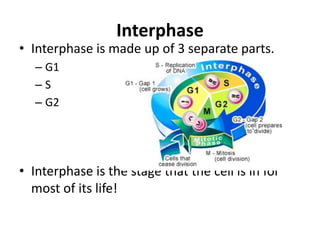
• Interphase is made up of 3 separate parts.
– G1
– S
– G2
• Interphase is the stage that the cell is in for
most of its life!
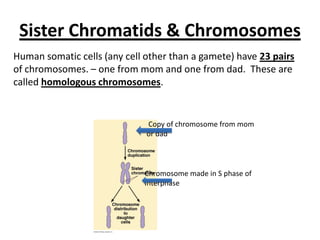
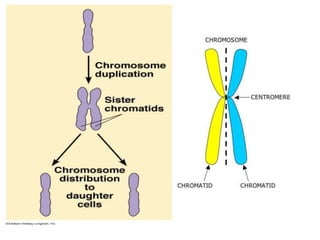
Sister Chromatids & Chromosomes
Copy of chromosome from mom
or dad
Chromosome made in S phase of
Interphase
Human somatic cells (any cell other than a gamete) have 23 pairs
of chromosomes. – one from mom and one from dad. These are
called homologous chromosomes.
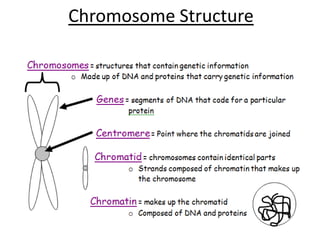
• The cell’s chromatin condenses into
chromosomes
• The chromosomes look like an “X”
– Each chromosome is made up of two identical
sister chromatids attached by a centromere
– This is “created” in S phase of
Chromosome Structure
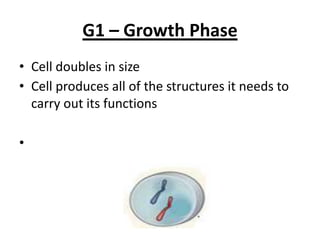
G1 – Growth Phase
• Cell doubles in size
• Cell produces all of the structures it needs to
carry out its functions
•
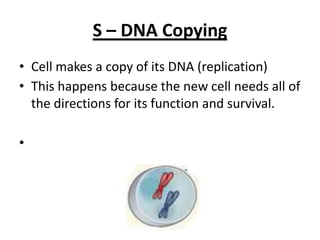
S – DNA Copying
• Cell makes a copy of its DNA (replication)
• This happens because the new cell needs all of
the directions for its function and survival.
•
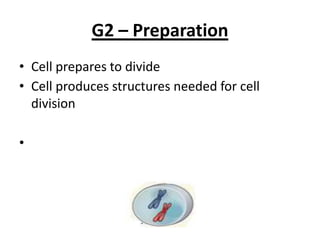
G2 – Preparation
• Cell prepares to divide
• Cell produces structures needed for cell
division
•
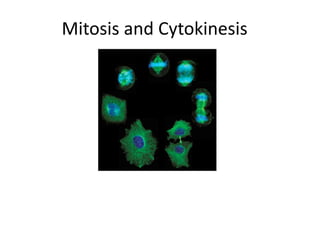
Mitosis and Cytokinesis
Mitosis
• During mitosis, the cells’ copied genetic
material separates and the cell prepares to
split into two cells
• This allows the cell’s genetic material to pass
into the new cells
–
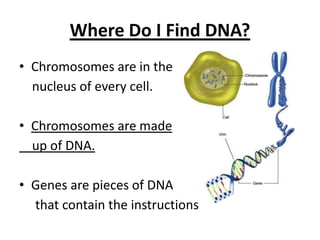
Where Do I Find DNA?
• Chromosomes are in the
nucleus of every cell.
• Chromosomes are made
up of DNA.
• Genes are pieces of DNA
that contain the instructions
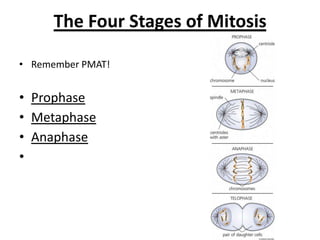
The Four Stages of Mitosis
• Remember PMAT!
• Prophase
• Metaphase
• Anaphase
•
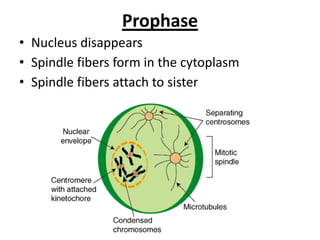
Prophase
• Nucleus disappears
• Spindle fibers form in the cytoplasm
• Spindle fibers attach to sister
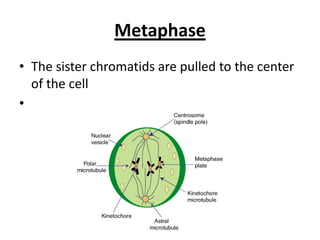
Metaphase
• The sister chromatids are pulled to the center
of the cell
•
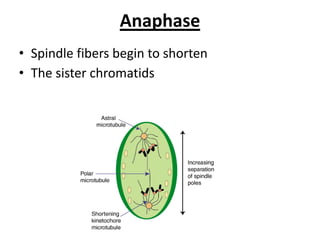
Anaphase
• Spindle fibers begin to shorten
• The sister chromatids
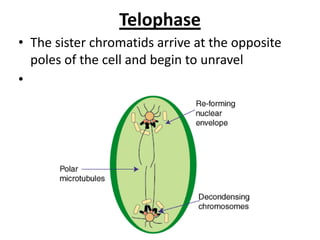
Telophase
• The sister chromatids arrive at the opposite
poles of the cell and begin to unravel
•
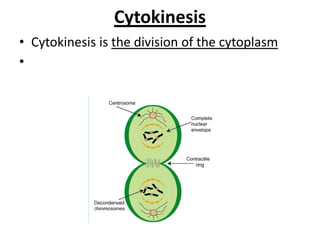
Cytokinesis
• Cytokinesis is the division of the cytoplasm
•
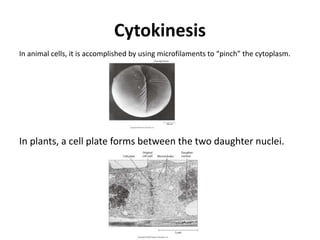
Cytokinesis
In plants, a cell plate forms between the two daughter nuclei.
In animal cells, it is accomplished by using microfilaments to “pinch” the cytoplasm.
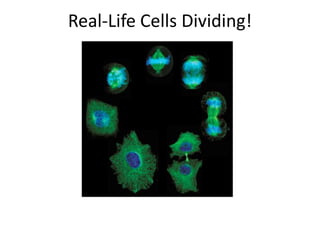
Real-Life Cells Dividing!
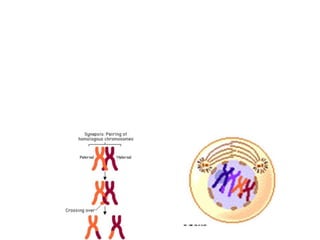
Prophase I
• Individual chromosomes first become visible
– homologous chromosomes become closely
associated in synapsis
– crossing over occurs
• Crossing over is a complex series of events in
which DNA segments are exchanged between
nonsister or sister chromatids.
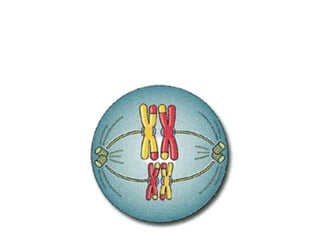
Metaphase I
• The homologous chromosomes line up in the
center of the cell and are still held together
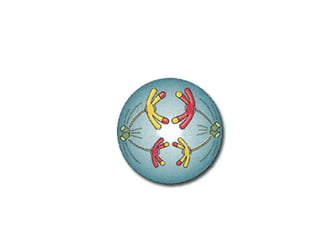
Anaphase I
• Spindle fibers shorten
• The homologous chromosomes are separated
(the sister chromatids are still paired)
• Independent assortment – random
chromosomes move to each pole; some may be
maternal and some may be paternal
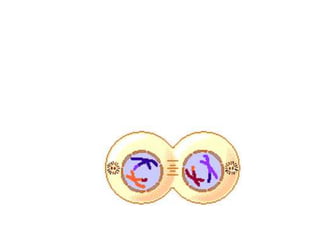
Telophase I
• The nuclear membrane reforms around each
daughter nucleus
• Each new cell now contains two sister
chromatids that are NOT identical due to
crossing over
At the end of Meiosis I…
• You have made 2 cells
• Each cell contains a haploid number of chromosomes – 1
copy of each chromosome
(for humans, each haploid cell has 23 chromosomes)
• No DNA replication occurs between Meiosis I and Meiosis
I
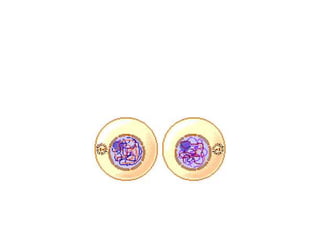
Prophase II
• Nuclear membrane breaks down again
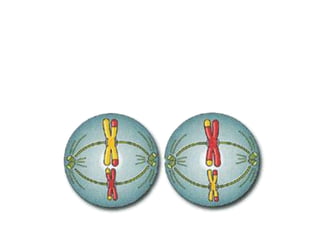
Metaphase II
• The chromosomes line up in the middle of the
cell.
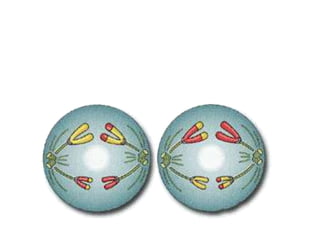
Anaphase II
• The spindle fibers shorten and the sister
chromatids move to opposite poles.
Telophase II
• Nuclear envelope re-forms around the four
sets of daughter chromosomes.
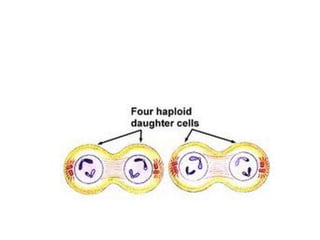
At the end of Meiosis II…
• At the end of Meiosis II, there are 4 haploid
cells. (only 1 copy of each chromosome)
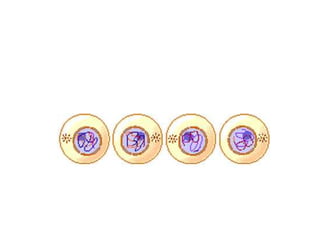
– (for humans, each haploid cell has 23
chromosomes)
• No two of these haploid cells are alike due to
crossing over.
– This is why you and your siblings are genetically
unique!
Meiosis Quick Check Questions:
1. What kinds of cells does mitosis produce?
2. How many chromosomes do human haploid
cells have?
3. What kinds of cells does meiosis produce?
4. How many cells are produced when one cell
goes through meiosis?
5. How many times are chromosomes
replicated during meiosis?
6. How do cells in meiosis get to be different?
7. If an organism’s somatic cells have 36
chromosomes, how many chromosomes do

5 10 cell division and cell cycle ppt

  • 1.
    Introduction to CellDivision http://youtu.be/Q6ucKWIIFmg http://highered.mcgraw- hill.com/sites/0072495855/student_view0/chap
  • 2.
    Remember – AllLiving Things are Made of Cells
  • 3.
    Why Are CellsSmall? • As cells get bigger, more of its cytoplasm is located farther from the cell membrane. • If a cell gets too big, it would take too long to get materials into the cell and too long to get waste out of the cell. •
  • 4.
    Cell Division • Allcells come from other living cells. • You (and other living things) grow because your cells get bigger and your number of cells gets larger. – A single cell divides into two cells. – Two cells divide into four, etc. • Cells must also divide because old cells die and need new cells to replace them!

  • 5.
    The Cell Cycle •Cell cycle – regular sequence of growth and division that eukaryotic cells undergo. – Prokaryotic cells undergo binary fission • Divided into three main stages: – Interphase – cell grows into its mature size, makes a copy of its DNA, and prepares for division. – Mitosis – one copy of the DNA is distributed into each of its daughter cells – Cytokinesis
  • 6.
    Interphase • Interphase ismade up of 3 separate parts. – G1 – S – G2 • Interphase is the stage that the cell is in for most of its life!
  • 7.
    Sister Chromatids &Chromosomes Copy of chromosome from mom or dad Chromosome made in S phase of Interphase Human somatic cells (any cell other than a gamete) have 23 pairs of chromosomes. – one from mom and one from dad. These are called homologous chromosomes.
  • 8.
    • The cell’schromatin condenses into chromosomes • The chromosomes look like an “X” – Each chromosome is made up of two identical sister chromatids attached by a centromere – This is “created” in S phase of
  • 9.
  • 10.
    G1 – GrowthPhase • Cell doubles in size • Cell produces all of the structures it needs to carry out its functions •
  • 11.
    S – DNACopying • Cell makes a copy of its DNA (replication) • This happens because the new cell needs all of the directions for its function and survival. •
  • 12.
    G2 – Preparation •Cell prepares to divide • Cell produces structures needed for cell division •
  • 13.
  • 14.
    Mitosis • During mitosis,the cells’ copied genetic material separates and the cell prepares to split into two cells • This allows the cell’s genetic material to pass into the new cells –
  • 15.
    Where Do IFind DNA? • Chromosomes are in the nucleus of every cell. • Chromosomes are made up of DNA. • Genes are pieces of DNA that contain the instructions
  • 16.
    The Four Stagesof Mitosis • Remember PMAT! • Prophase • Metaphase • Anaphase •
  • 17.
    Prophase • Nucleus disappears •Spindle fibers form in the cytoplasm • Spindle fibers attach to sister
  • 18.
    Metaphase • The sisterchromatids are pulled to the center of the cell •
  • 19.
    Anaphase • Spindle fibersbegin to shorten • The sister chromatids
  • 20.
    Telophase • The sisterchromatids arrive at the opposite poles of the cell and begin to unravel •
  • 21.
    Cytokinesis • Cytokinesis isthe division of the cytoplasm •
  • 22.
    Cytokinesis In plants, acell plate forms between the two daughter nuclei. In animal cells, it is accomplished by using microfilaments to “pinch” the cytoplasm.
  • 23.
  • 25.
    Prophase I • Individualchromosomes first become visible – homologous chromosomes become closely associated in synapsis – crossing over occurs • Crossing over is a complex series of events in which DNA segments are exchanged between nonsister or sister chromatids.
  • 26.
    Metaphase I • Thehomologous chromosomes line up in the center of the cell and are still held together
  • 27.
    Anaphase I • Spindlefibers shorten • The homologous chromosomes are separated (the sister chromatids are still paired) • Independent assortment – random chromosomes move to each pole; some may be maternal and some may be paternal
  • 28.
    Telophase I • Thenuclear membrane reforms around each daughter nucleus • Each new cell now contains two sister chromatids that are NOT identical due to crossing over
  • 29.
    At the endof Meiosis I… • You have made 2 cells • Each cell contains a haploid number of chromosomes – 1 copy of each chromosome (for humans, each haploid cell has 23 chromosomes) • No DNA replication occurs between Meiosis I and Meiosis I
  • 30.
    Prophase II • Nuclearmembrane breaks down again
  • 31.
    Metaphase II • Thechromosomes line up in the middle of the cell.
  • 32.
    Anaphase II • Thespindle fibers shorten and the sister chromatids move to opposite poles.
  • 33.
    Telophase II • Nuclearenvelope re-forms around the four sets of daughter chromosomes.
  • 34.
    At the endof Meiosis II… • At the end of Meiosis II, there are 4 haploid cells. (only 1 copy of each chromosome) – (for humans, each haploid cell has 23 chromosomes) • No two of these haploid cells are alike due to crossing over. – This is why you and your siblings are genetically unique!
  • 35.
    Meiosis Quick CheckQuestions: 1. What kinds of cells does mitosis produce? 2. How many chromosomes do human haploid cells have? 3. What kinds of cells does meiosis produce? 4. How many cells are produced when one cell goes through meiosis? 5. How many times are chromosomes replicated during meiosis? 6. How do cells in meiosis get to be different? 7. If an organism’s somatic cells have 36 chromosomes, how many chromosomes do