MENDELIAN GENETICS
   AND HUMANS
MENDELIAN GENETICS AND HUMANS
               Human Blood Groups


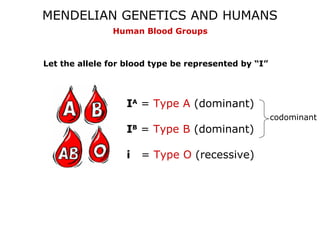
Let the allele for blood type be represented by “I”


                  IA = Type A (dominant)
                                                      codominant
                  IB = Type B (dominant)

                  i   = Type O (recessive)
MENDELIAN GENETICS AND HUMANS
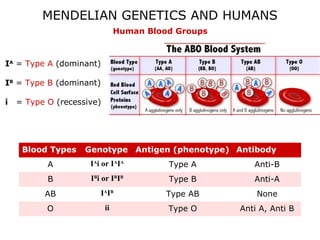
                                Human Blood Groups


IA = Type A (dominant)

IB = Type B (dominant)

i   = Type O (recessive)


     Blood Types    Genotype Antigen (phenotype) Antibody
           A         IAi or IAIA          Type A        Anti-B
           B         IBi or IBIB          Type B        Anti-A
          AB             IAIB             Type AB        None
           O               ii             Type O     Anti A, Anti B
MENDELIAN GENETICS AND HUMANS
                     Human Blood Groups

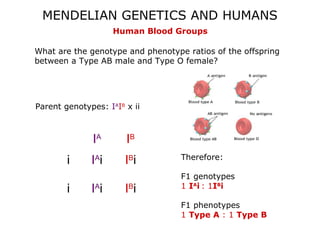
What are the genotype and phenotype ratios of the offspring
between a Type AB male and Type O female?


Parent genotypes: IAIB x ii


              IA       IB
                                   Therefore:
        i     I Ai     I Bi
                                   F1 genotypes
        i     I Ai     I Bi        1 IAi : 1IBi

                                   F1 phenotypes
                                   1 Type A : 1 Type B
MENDELIAN GENETICS AND HUMANS
                      Human Blood Groups

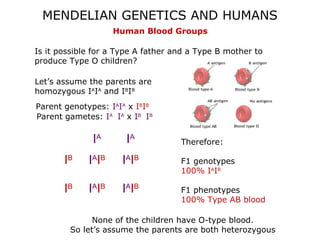
Is it possible for a Type A father and a Type B mother to
produce Type O children?

Let’s assume the parents are
homozygous IAIA and IBIB
Parent genotypes: IAIA x IBIB
Parent gametes: IA IA x IB IB

              IA        IA          Therefore:

       IB    I AI B    I AI B       F1 genotypes
                                    100% IAIB

       IB    I AI B    I AI B       F1 phenotypes
                                    100% Type AB blood

              None of the children have O-type blood.
        So let’s assume the parents are both heterozygous
MENDELIAN GENETICS AND HUMANS
                      Human Blood Groups

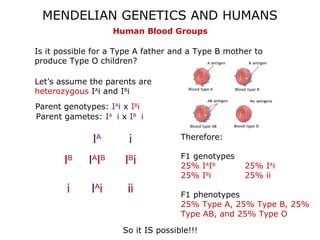
Is it possible for a Type A father and a Type B mother to
produce Type O children?

Let’s assume the parents are
heterozygous IAi and IBi
Parent genotypes: IAi x IBi
Parent gametes: IA i x IB i

              IA         i            Therefore:

                                      F1 genotypes
       IB    I AI B     I Bi          25% IAIB       25% IAi
                                      25% IBi        25% ii
        i     I Ai      ii            F1 phenotypes
                                      25% Type A, 25% Type B, 25%
                                      Type AB, and 25% Type O

                       So it IS possible!!!
MENDELIAN GENETICS AND HUMANS
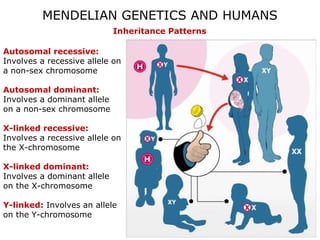
                             Inheritance Patterns

Autosomal recessive:
Involves a recessive allele on
a non-sex chromosome

Autosomal dominant:
Involves a dominant allele
on a non-sex chromosome

X-linked recessive:
Involves a recessive allele on
the X-chromosome

X-linked dominant:
Involves a dominant allele
on the X-chromosome

Y-linked: Involves an allele
on the Y-chromosome
MENDELIAN GENETICS AND HUMANS
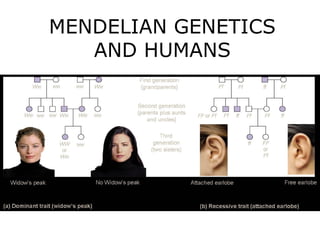
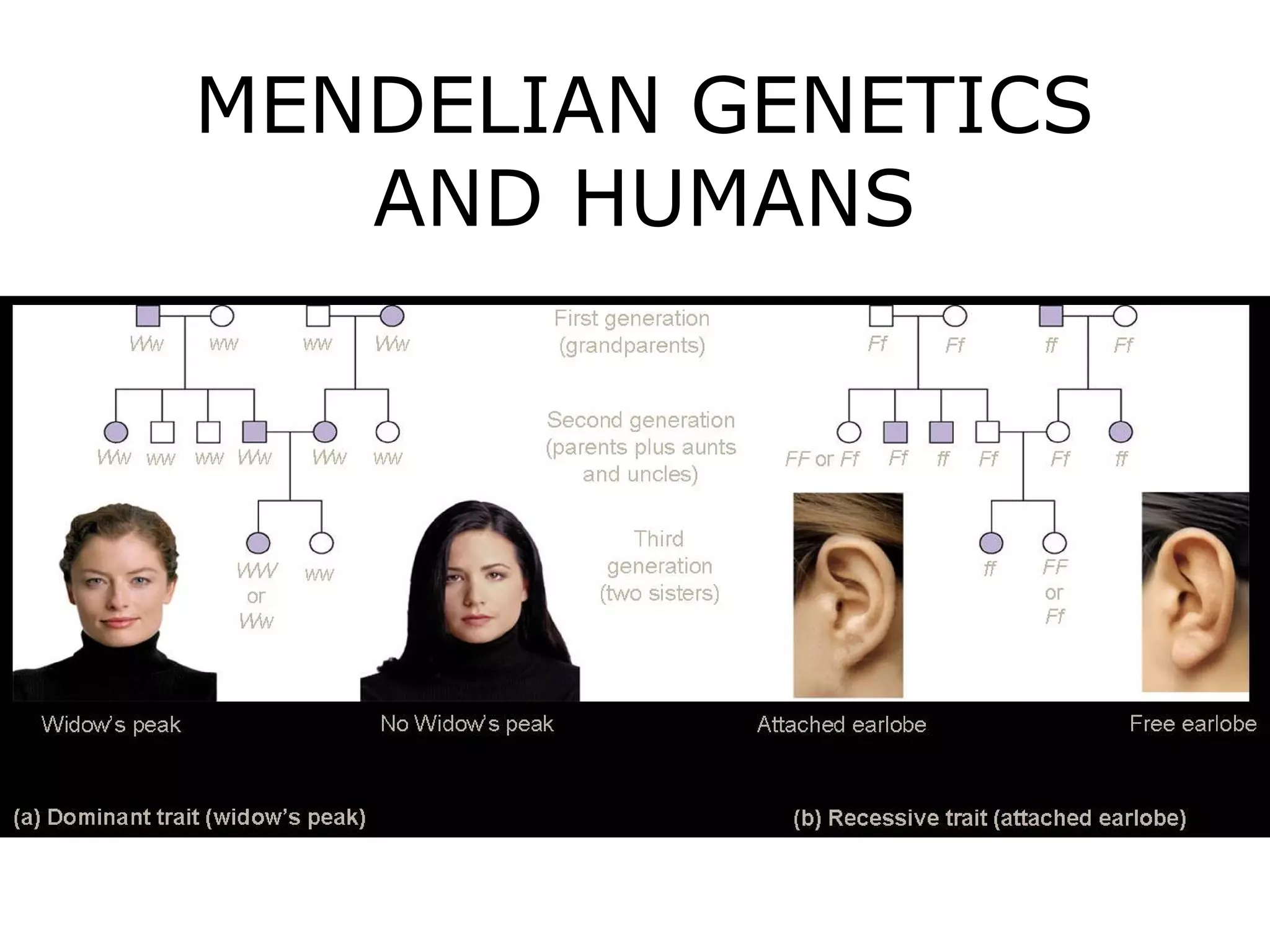
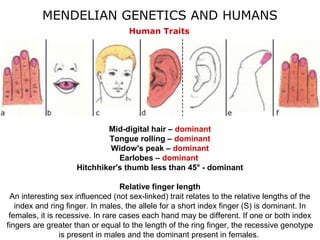
                                    Human Traits


                             Mid-digital hair – dominant
                             Tongue rolling – dominant
                              Widow's peak – dominant
                                Earlobes – dominant
                     Hitchhiker's thumb less than 45° - dominant

                                   Relative finger length
 An interesting sex influenced (not sex-linked) trait relates to the relative lengths of the
   index and ring finger. In males, the allele for a short index finger (S) is dominant. In
 females, it is recessive. In rare cases each hand may be different. If one or both index
fingers are greater than or equal to the length of the ring finger, the recessive genotype
                 is present in males and the dominant present in females.
MENDELIAN GENETICS AND HUMANS
                       Human genetic disorders

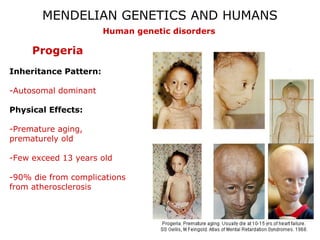
     Progeria
Inheritance Pattern:

-Autosomal dominant

Physical Effects:

-Premature aging,
prematurely old

-Few exceed 13 years old

-90% die from complications
from atherosclerosis
MENDELIAN GENETICS AND HUMANS
                       Human genetic disorders

 Huntington disease
Inheritance Pattern:

-Autosomal dominant

Physical Effects:

-Progressive brain disorder
causing uncontrolled
movements and loss of
cognition

-May live for 15-20 years after
onset of symptoms

-Trouble eating, swallowing,
talking, etc.
MENDELIAN GENETICS AND HUMANS
                       Human genetic disorders

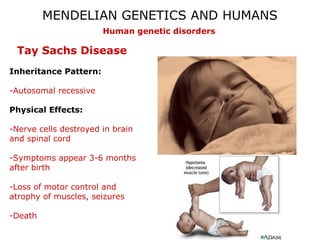
 Tay Sachs Disease
Inheritance Pattern:

-Autosomal recessive

Physical Effects:

-Nerve cells destroyed in brain
and spinal cord

-Symptoms appear 3-6 months
after birth

-Loss of motor control and
atrophy of muscles, seizures

-Death
MENDELIAN GENETICS AND HUMANS
                       Human genetic disorders

Phenylketonuria (PKU)
Inheritance Pattern:

-Autosomal recessive

Physical Effects:

-Permanent intellectual
disability, seizures

-Symptoms appear a few
months after birth

-May have a “musty” odour
MENDELIAN GENETICS AND HUMANS
                           Human genetic disorders

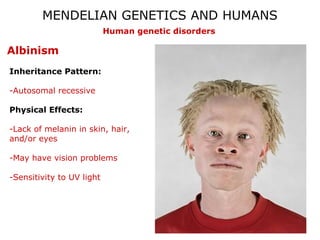
Albinism
Inheritance Pattern:

-Autosomal recessive

Physical Effects:

-Lack of melanin in skin, hair,
and/or eyes

-May have vision problems

-Sensitivity to UV light
MENDELIAN GENETICS AND HUMANS
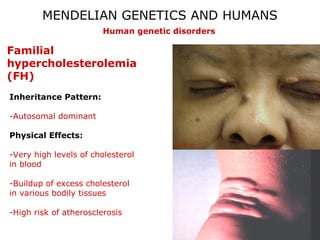
                        Human genetic disorders

Familial
hypercholesterolemia
(FH)
Inheritance Pattern:

-Autosomal dominant

Physical Effects:

-Very high levels of cholesterol
in blood

-Buildup of excess cholesterol
in various bodily tissues

-High risk of atherosclerosis
MENDELIAN GENETICS AND HUMANS
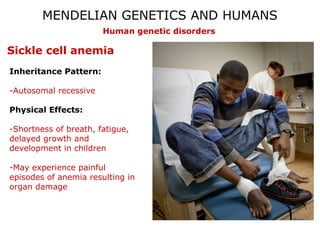
                       Human genetic disorders

Sickle cell anemia
Inheritance Pattern:

-Autosomal recessive

Physical Effects:

-Shortness of breath, fatigue,
delayed growth and
development in children

-May experience painful
episodes of anemia resulting in
organ damage
MENDELIAN GENETICS AND HUMANS
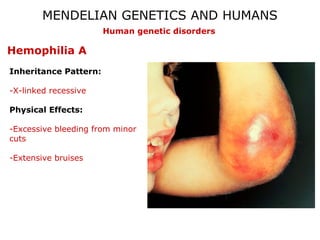
                       Human genetic disorders

Hemophilia A
Inheritance Pattern:

-X-linked recessive

Physical Effects:

-Excessive bleeding from minor
cuts

-Extensive bruises
MENDELIAN GENETICS AND HUMANS
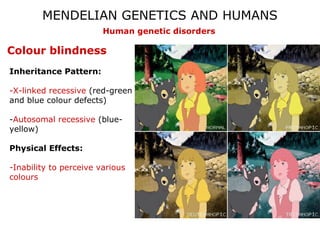
                        Human genetic disorders

Colour blindness
Inheritance Pattern:

-X-linked recessive (red-green
and blue colour defects)

-Autosomal recessive (blue-
yellow)

Physical Effects:

-Inability to perceive various
colours
MENDELIAN GENETICS AND HUMANS
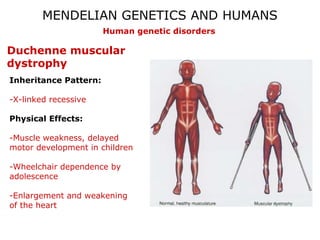
                       Human genetic disorders

Duchenne muscular
dystrophy
Inheritance Pattern:

-X-linked recessive

Physical Effects:

-Muscle weakness, delayed
motor development in children

-Wheelchair dependence by
adolescence

-Enlargement and weakening
of the heart

05 mendelian genetics and humans

  • 1.
  • 2.
    MENDELIAN GENETICS ANDHUMANS Human Blood Groups Let the allele for blood type be represented by “I” IA = Type A (dominant) codominant IB = Type B (dominant) i = Type O (recessive)
  • 3.
    MENDELIAN GENETICS ANDHUMANS Human Blood Groups IA = Type A (dominant) IB = Type B (dominant) i = Type O (recessive) Blood Types Genotype Antigen (phenotype) Antibody A IAi or IAIA Type A Anti-B B IBi or IBIB Type B Anti-A AB IAIB Type AB None O ii Type O Anti A, Anti B
  • 4.
    MENDELIAN GENETICS ANDHUMANS Human Blood Groups What are the genotype and phenotype ratios of the offspring between a Type AB male and Type O female? Parent genotypes: IAIB x ii IA IB Therefore: i I Ai I Bi F1 genotypes i I Ai I Bi 1 IAi : 1IBi F1 phenotypes 1 Type A : 1 Type B
  • 5.
    MENDELIAN GENETICS ANDHUMANS Human Blood Groups Is it possible for a Type A father and a Type B mother to produce Type O children? Let’s assume the parents are homozygous IAIA and IBIB Parent genotypes: IAIA x IBIB Parent gametes: IA IA x IB IB IA IA Therefore: IB I AI B I AI B F1 genotypes 100% IAIB IB I AI B I AI B F1 phenotypes 100% Type AB blood None of the children have O-type blood. So let’s assume the parents are both heterozygous
  • 6.
    MENDELIAN GENETICS ANDHUMANS Human Blood Groups Is it possible for a Type A father and a Type B mother to produce Type O children? Let’s assume the parents are heterozygous IAi and IBi Parent genotypes: IAi x IBi Parent gametes: IA i x IB i IA i Therefore: F1 genotypes IB I AI B I Bi 25% IAIB 25% IAi 25% IBi 25% ii i I Ai ii F1 phenotypes 25% Type A, 25% Type B, 25% Type AB, and 25% Type O So it IS possible!!!
  • 7.
    MENDELIAN GENETICS ANDHUMANS Inheritance Patterns Autosomal recessive: Involves a recessive allele on a non-sex chromosome Autosomal dominant: Involves a dominant allele on a non-sex chromosome X-linked recessive: Involves a recessive allele on the X-chromosome X-linked dominant: Involves a dominant allele on the X-chromosome Y-linked: Involves an allele on the Y-chromosome
  • 8.
    MENDELIAN GENETICS ANDHUMANS Human Traits Mid-digital hair – dominant Tongue rolling – dominant Widow's peak – dominant Earlobes – dominant Hitchhiker's thumb less than 45° - dominant Relative finger length An interesting sex influenced (not sex-linked) trait relates to the relative lengths of the index and ring finger. In males, the allele for a short index finger (S) is dominant. In females, it is recessive. In rare cases each hand may be different. If one or both index fingers are greater than or equal to the length of the ring finger, the recessive genotype is present in males and the dominant present in females.
  • 9.
    MENDELIAN GENETICS ANDHUMANS Human genetic disorders Progeria Inheritance Pattern: -Autosomal dominant Physical Effects: -Premature aging, prematurely old -Few exceed 13 years old -90% die from complications from atherosclerosis
  • 10.
    MENDELIAN GENETICS ANDHUMANS Human genetic disorders Huntington disease Inheritance Pattern: -Autosomal dominant Physical Effects: -Progressive brain disorder causing uncontrolled movements and loss of cognition -May live for 15-20 years after onset of symptoms -Trouble eating, swallowing, talking, etc.
  • 11.
    MENDELIAN GENETICS ANDHUMANS Human genetic disorders Tay Sachs Disease Inheritance Pattern: -Autosomal recessive Physical Effects: -Nerve cells destroyed in brain and spinal cord -Symptoms appear 3-6 months after birth -Loss of motor control and atrophy of muscles, seizures -Death
  • 12.
    MENDELIAN GENETICS ANDHUMANS Human genetic disorders Phenylketonuria (PKU) Inheritance Pattern: -Autosomal recessive Physical Effects: -Permanent intellectual disability, seizures -Symptoms appear a few months after birth -May have a “musty” odour
  • 13.
    MENDELIAN GENETICS ANDHUMANS Human genetic disorders Albinism Inheritance Pattern: -Autosomal recessive Physical Effects: -Lack of melanin in skin, hair, and/or eyes -May have vision problems -Sensitivity to UV light
  • 14.
    MENDELIAN GENETICS ANDHUMANS Human genetic disorders Familial hypercholesterolemia (FH) Inheritance Pattern: -Autosomal dominant Physical Effects: -Very high levels of cholesterol in blood -Buildup of excess cholesterol in various bodily tissues -High risk of atherosclerosis
  • 15.
    MENDELIAN GENETICS ANDHUMANS Human genetic disorders Sickle cell anemia Inheritance Pattern: -Autosomal recessive Physical Effects: -Shortness of breath, fatigue, delayed growth and development in children -May experience painful episodes of anemia resulting in organ damage
  • 16.
    MENDELIAN GENETICS ANDHUMANS Human genetic disorders Hemophilia A Inheritance Pattern: -X-linked recessive Physical Effects: -Excessive bleeding from minor cuts -Extensive bruises
  • 17.
    MENDELIAN GENETICS ANDHUMANS Human genetic disorders Colour blindness Inheritance Pattern: -X-linked recessive (red-green and blue colour defects) -Autosomal recessive (blue- yellow) Physical Effects: -Inability to perceive various colours
  • 18.
    MENDELIAN GENETICS ANDHUMANS Human genetic disorders Duchenne muscular dystrophy Inheritance Pattern: -X-linked recessive Physical Effects: -Muscle weakness, delayed motor development in children -Wheelchair dependence by adolescence -Enlargement and weakening of the heart

Editor's Notes

  • #3 http://www.nobelprize.org/educational/medicine/bloodtypinggame/game/index.html
  • #4 Antigens = agglutinogens