Isomers
Structural, Geometric, Enantiomer
Isomers

   Compounds that have the same molecular
    formula but difference structure and different
    properties
   3 types:
     Structural isomers
     Geometric isomers
     Enantiomers
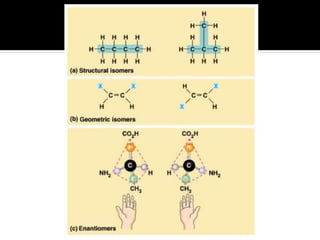
Structural Isomer

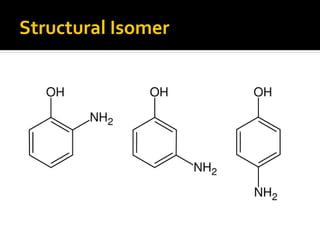
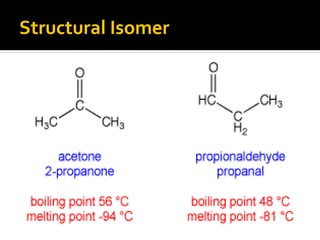
   same KIND and AMOUNT of atoms
    (molecular formula) but the atoms have
    different connectivity
   Structural isomers usually have different
    physical and chemical properties
Structural Isomer
Structural Isomer
Structural Isomer
Structural Isomer
Structural Isomer

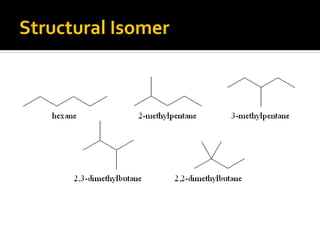
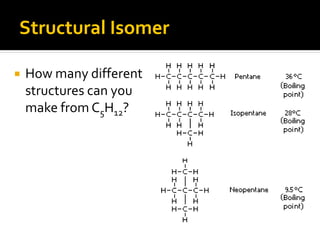
   How many different
    structures can you
    make from C5H12?
Geometric Isomers

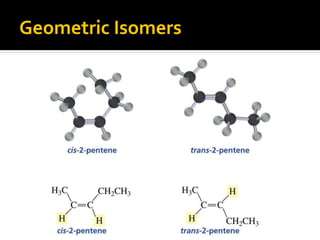
   SAME molecular formula and the SAME
    connectivity but different spatial
    arrangements
   Due to inflexibility of a bond, usually either:
     double bonds (cis and trans formation)
     bonds that can’t rotate (i.e. in a ring formation)
Geometric Isomers
Geometric Isomer


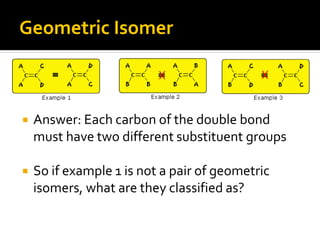
   Why is example 1 not a pair of geometric
    isomers?

   Hint: Look at example 2 & 3 and compare to example 1.
    What is the minimum requirement for a pair of molecules to
    be considered geometric isomers?
Geometric Isomer


   Answer: Each carbon of the double bond
    must have two different substituent groups

   So if example 1 is not a pair of geometric
    isomers, what are they classified as?
Geometric Isomer

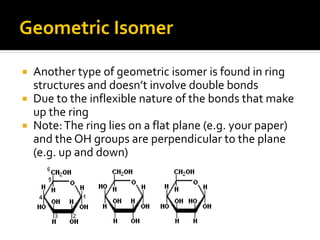
 Another type of geometric isomer is found in ring
  structures and doesn’t involve double bonds
 Due to the inflexible nature of the bonds that make
  up the ring
 Note: The ring lies on a flat plane (e.g. your paper)
  and the OH groups are perpendicular to the plane
  (e.g. up and down)
Enantiomer

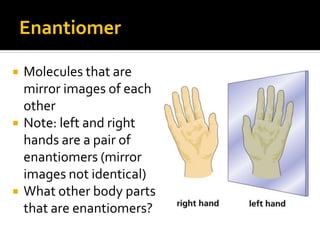
   Molecules that are
    mirror images of each
    other
   Note: left and right
    hands are a pair of
    enantiomers (mirror
    images not identical)
   What other body parts
    that are enantiomers?
Enantiomer

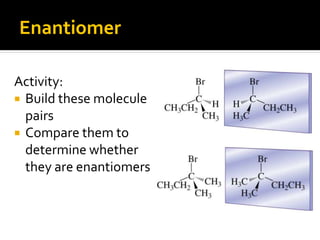
Activity:
 Build these molecule
  pairs
 Compare them to
  determine whether
  they are enantiomers
Enantiomer
Enantiomer

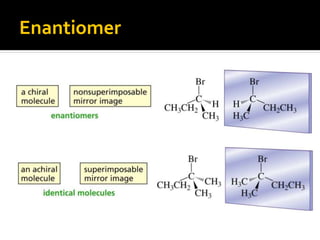
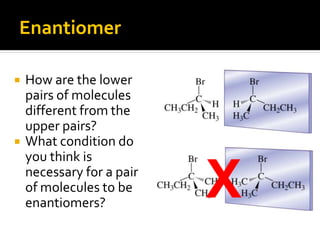
   How are the lower
    pairs of molecules
    different from the
    upper pairs?
   What condition do
    you think is
    necessary for a pair
    of molecules to be
    enantiomers?
                           X
Enantiomer

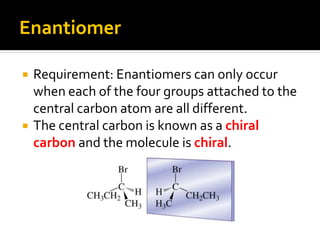
   Requirement: Enantiomers can only occur
    when each of the four groups attached to the
    central carbon atom are all different.
   The central carbon is known as a chiral
    carbon and the molecule is chiral.
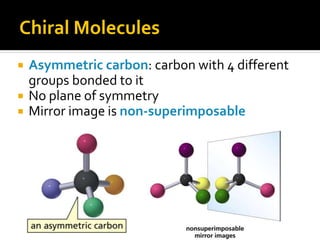
Chiral Molecules
   Asymmetric carbon: carbon with 4 different
    groups bonded to it
   No plane of symmetry
   Mirror image is non-superimposable
Achiral Molecule

   lacks chiral properties
   has a plane of symmetry
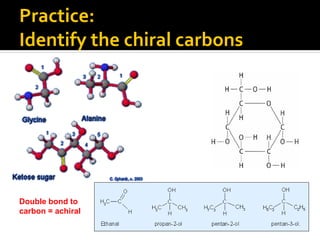
Practice:
Identify the chiral carbons


Double bond to
carbon = achiral
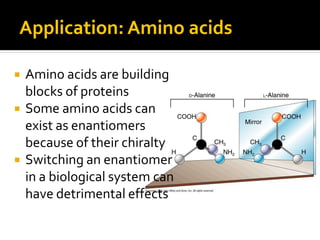
Application: Amino acids

   Amino acids are building
    blocks of proteins
   Some amino acids can
    exist as enantiomers
    because of their chiralty
   Switching an enantiomer
    in a biological system can
    have detrimental effects
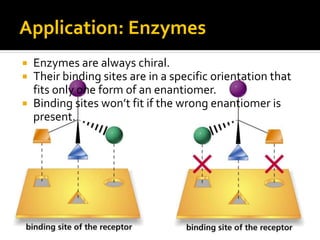
Application: Enzymes
 Enzymes are always chiral.
 Their binding sites are in a specific orientation that
  fits only one form of an enantiomer.
 Binding sites won’t fit if the wrong enantiomer is
  present.
Racemic mixture

   A mixture that contains equal quantities of
    both enantiomers
   Enantiomers can interconvert in vivo
Racemic mixture

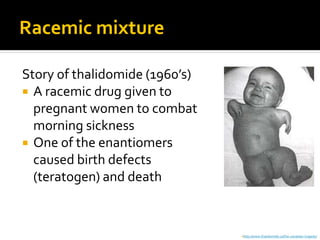
Story of thalidomide (1960’s)
 A racemic drug given to
  pregnant women to combat
  morning sickness
 One of the enantiomers
  caused birth defects
  (teratogen) and death


                                http://www.thalidomide.ca/the-canadian-tragedy/
Racemic mixture

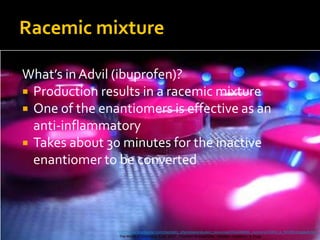
What’s in Advil (ibuprofen)?
 Production results in a racemic mixture
 One of the enantiomers is effective as an
  anti-inflammatory
 Takes about 30 minutes for the inactive
  enantiomer to be converted


                http://www.brookscole.com/chemistry_d/templates/student_resources/0534389996_mcmurry/CHEM_A_WORK/chapter9.htm
                The World of Chemistry, 4 ed. 2007. Thomson Brooks/Cole. Joesten, Castellion, & Hogg.
Steps to identifying isomers

   Do the molecules have the same
    chemical formula?
     If the formula is different, they are NOT
      isomers but completely different molecules
   Are the molecules identical?
     If they are, they are NOT isomers.
   Are all the atoms connected in the same
    way to other atoms?
     If not, they are STRUCTURAL isomers
 Look for an inflexible bond (double bond
  or ring) for geometric isomers
 Look for mirror images for enantiomers
                               http://2.bp.blogspot.com/_K91FA3B4cpM/SJ_NUmBWWGI/AAAAAAAAACY/UzL8H8Q4oag/s400/ist2_1744503_frustration.jpg
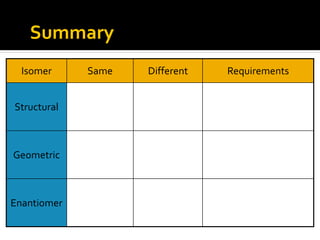
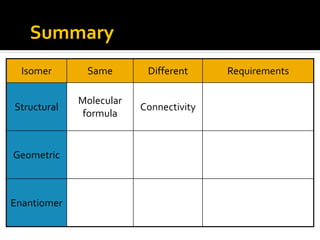
Summary
  Isomer     Same   Different   Requirements


Structural


Geometric


Enantiomer
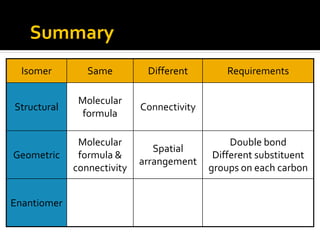
Summary
  Isomer      Same        Different     Requirements

             Molecular
Structural               Connectivity
              formula


Geometric


Enantiomer
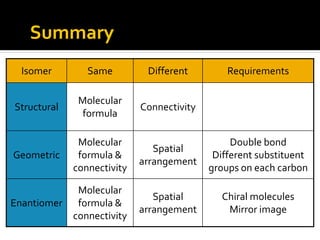
Summary
  Isomer        Same         Different         Requirements

              Molecular
Structural                  Connectivity
               formula

              Molecular                         Double bond
                               Spatial
Geometric     formula &                     Different substituent
                            arrangement
             connectivity                  groups on each carbon


Enantiomer
Summary
  Isomer        Same         Different         Requirements

              Molecular
Structural                  Connectivity
               formula

              Molecular                         Double bond
                               Spatial
Geometric     formula &                     Different substituent
                            arrangement
             connectivity                  groups on each carbon

            Molecular
                               Spatial       Chiral molecules
Enantiomer formula &
                            arrangement       Mirror image
           connectivity
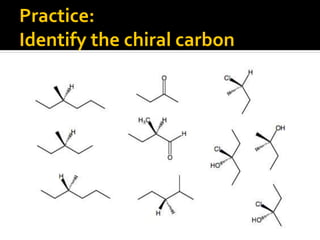
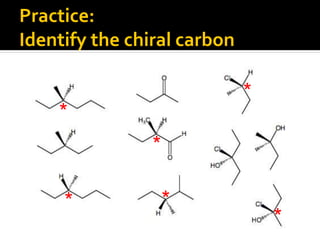
Practice:
Identify the chiral carbon
Practice:
Identify the chiral carbon

                             *
    *
                *

     *              *
                                 *
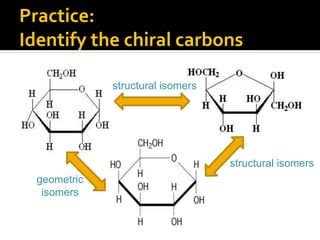
Practice:
Identify the chiral carbons

              structural isomers


                                   structural isomers
  geometric
   isomers
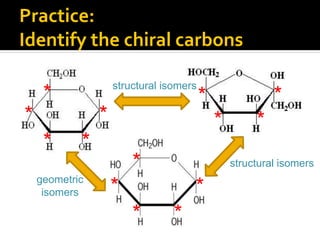
Practice:
Identify the chiral carbons

                    structural isomers
     *                                   *                *
*               *                            *        *
     *      *
                        *                        structural isomers
    geometric
     isomers        *                *
                        *        *

Isomers lesson

  • 1.
  • 2.
    Isomers  Compounds that have the same molecular formula but difference structure and different properties  3 types:  Structural isomers  Geometric isomers  Enantiomers
  • 4.
    Structural Isomer  same KIND and AMOUNT of atoms (molecular formula) but the atoms have different connectivity  Structural isomers usually have different physical and chemical properties
  • 5.
  • 6.
  • 7.
  • 8.
  • 9.
    Structural Isomer  How many different structures can you make from C5H12?
  • 10.
    Geometric Isomers  SAME molecular formula and the SAME connectivity but different spatial arrangements  Due to inflexibility of a bond, usually either:  double bonds (cis and trans formation)  bonds that can’t rotate (i.e. in a ring formation)
  • 11.
  • 12.
    Geometric Isomer  Why is example 1 not a pair of geometric isomers?  Hint: Look at example 2 & 3 and compare to example 1. What is the minimum requirement for a pair of molecules to be considered geometric isomers?
  • 13.
    Geometric Isomer  Answer: Each carbon of the double bond must have two different substituent groups  So if example 1 is not a pair of geometric isomers, what are they classified as?
  • 14.
    Geometric Isomer  Anothertype of geometric isomer is found in ring structures and doesn’t involve double bonds  Due to the inflexible nature of the bonds that make up the ring  Note: The ring lies on a flat plane (e.g. your paper) and the OH groups are perpendicular to the plane (e.g. up and down)
  • 15.
    Enantiomer  Molecules that are mirror images of each other  Note: left and right hands are a pair of enantiomers (mirror images not identical)  What other body parts that are enantiomers?
  • 16.
    Enantiomer Activity:  Build thesemolecule pairs  Compare them to determine whether they are enantiomers
  • 17.
  • 18.
    Enantiomer  How are the lower pairs of molecules different from the upper pairs?  What condition do you think is necessary for a pair of molecules to be enantiomers? X
  • 19.
    Enantiomer  Requirement: Enantiomers can only occur when each of the four groups attached to the central carbon atom are all different.  The central carbon is known as a chiral carbon and the molecule is chiral.
  • 20.
    Chiral Molecules  Asymmetric carbon: carbon with 4 different groups bonded to it  No plane of symmetry  Mirror image is non-superimposable
  • 21.
    Achiral Molecule  lacks chiral properties  has a plane of symmetry
  • 22.
    Practice: Identify the chiralcarbons Double bond to carbon = achiral
  • 23.
    Application: Amino acids  Amino acids are building blocks of proteins  Some amino acids can exist as enantiomers because of their chiralty  Switching an enantiomer in a biological system can have detrimental effects
  • 24.
    Application: Enzymes  Enzymesare always chiral.  Their binding sites are in a specific orientation that fits only one form of an enantiomer.  Binding sites won’t fit if the wrong enantiomer is present.
  • 25.
    Racemic mixture  A mixture that contains equal quantities of both enantiomers  Enantiomers can interconvert in vivo
  • 26.
    Racemic mixture Story ofthalidomide (1960’s)  A racemic drug given to pregnant women to combat morning sickness  One of the enantiomers caused birth defects (teratogen) and death http://www.thalidomide.ca/the-canadian-tragedy/
  • 27.
    Racemic mixture What’s inAdvil (ibuprofen)?  Production results in a racemic mixture  One of the enantiomers is effective as an anti-inflammatory  Takes about 30 minutes for the inactive enantiomer to be converted http://www.brookscole.com/chemistry_d/templates/student_resources/0534389996_mcmurry/CHEM_A_WORK/chapter9.htm The World of Chemistry, 4 ed. 2007. Thomson Brooks/Cole. Joesten, Castellion, & Hogg.
  • 28.
    Steps to identifyingisomers  Do the molecules have the same chemical formula?  If the formula is different, they are NOT isomers but completely different molecules  Are the molecules identical?  If they are, they are NOT isomers.  Are all the atoms connected in the same way to other atoms?  If not, they are STRUCTURAL isomers  Look for an inflexible bond (double bond or ring) for geometric isomers  Look for mirror images for enantiomers http://2.bp.blogspot.com/_K91FA3B4cpM/SJ_NUmBWWGI/AAAAAAAAACY/UzL8H8Q4oag/s400/ist2_1744503_frustration.jpg
  • 29.
    Summary Isomer Same Different Requirements Structural Geometric Enantiomer
  • 30.
    Summary Isomer Same Different Requirements Molecular Structural Connectivity formula Geometric Enantiomer
  • 31.
    Summary Isomer Same Different Requirements Molecular Structural Connectivity formula Molecular Double bond Spatial Geometric formula & Different substituent arrangement connectivity groups on each carbon Enantiomer
  • 32.
    Summary Isomer Same Different Requirements Molecular Structural Connectivity formula Molecular Double bond Spatial Geometric formula & Different substituent arrangement connectivity groups on each carbon Molecular Spatial Chiral molecules Enantiomer formula & arrangement Mirror image connectivity
  • 33.
  • 34.
  • 35.
    Practice: Identify the chiralcarbons structural isomers structural isomers geometric isomers
  • 36.
    Practice: Identify the chiralcarbons structural isomers * * * * * * * * * * structural isomers geometric isomers * * * *