Assignment
Biosystematics
Topic: Speciation
Submitted to: Dr. Iftikhar Ahmad
Submitted by: Mujahid Hussain
Roll Number: 12
Class: M.Phil
12/20/2016Roll Number (12) Mujahid Hussain (M.Phil Botany)
1
Speciation (INTRODUCTION)
• Process of development of new species.
• Commonly results from the development of barriers to gene flow.
• Different types of isolating mechanisms are responsible for the
development of barriers.
12/20/2016Roll Number (12) Mujahid Hussain (M.Phil Botany)
2
Speciation (ISOLATING MECHANISMS)
• Isolating mechanisms operate
1. before sexual fusion (Prezygotic mechanism)
2. after sexual fusion (Post-zygotic mechanism)
12/20/2016Roll Number (12) Mujahid Hussain (M.Phil Botany)
3
ISOLATING MECHANISMS
Prezygotic mechanisms further classified into
1. Pre-pollination mechanisms
2. Post-pollination mechanisms
12/20/2016Roll Number (12) Mujahid Hussain (M.Phil Botany)
4
ISOLATING MECHANISMS
• Pre-pollination mechanisms include
1. Geographical isolation
2. Ecological isolation
3. Seasonal isolation
4. Temporal isolation
5. Ethological isolation
6. Mechanical isolation
12/20/2016Roll Number (12) Mujahid Hussain (M.Phil Botany)
5
ISOLATING MECHANISMS
• Post-pollination mechanisms include
1. Gemetophytic isolation
2. Gametic isoation
12/20/2016Roll Number (12) Mujahid Hussain (M.Phil Botany)
6
ISOLATING MECHANISMS
• Postzygtic mechanisms include
1. Seed incompatibility
2. Hybrid inviability
3. F1 hybrid sterility
4. F2 hybrid inviability
5. F2 hybrid sterility
12/20/2016Roll Number (12) Mujahid Hussain (M.Phil Botany)
7
Pre-pollination mechamisms (Geographical isolation)
• Two species are separated geographically by a gap larger than
their pollen and seed dispersal.
• Example
• Platanu sorientais (Mediterranean region)
• Platanu occidentalis (North America)
• Both are well established species in their regions and readily
interbreed when brought into same area (vicarious species)
12/20/2016Roll Number (12) Mujahid Hussain (M.Phil Botany)
8
Pre-pollination mechamisms ( Ecological isolation)
• Two species occupy the same general area but occupy different
habitats
• Example
• Silene alba grows on light soils in open places
• Silene dioicaon grows on heavy soils in shade
12/20/2016Roll Number (12) Mujahid Hussain (M.Phil Botany)
9
Pre-pollination mechamisms (Seasonal isolation isolation)
• Two species occur in the same region but flower at different
seasons
• Example
• Sambucus racemose and Sambucus nigra flower nearly 7 weeks
apart
12/20/2016Roll Number (12) Mujahid Hussain (M.Phil Botany)
10
Pre-pollination mechanisms (Temporal isolation)
• Two species flower during the same period but during different
times of the day
• Example
• Agrostis tenuis flower in afternoon
• Agrosits stolonifera flowers in the morning
12/20/2016Roll Number (12) Mujahid Hussain (M.Phil Botany)
11
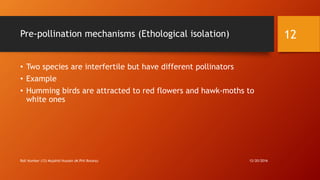
Pre-pollination mechanisms (Ethological isolation)
• Two species are interfertile but have different pollinators
• Example
• Humming birds are attracted to red flowers and hawk-moths to
white ones
12/20/2016Roll Number (12) Mujahid Hussain (M.Phil Botany)
12
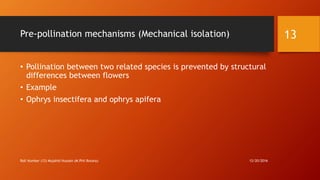
Pre-pollination mechanisms (Mechanical isolation)
• Pollination between two related species is prevented by structural
differences between flowers
• Example
• Ophrys insectifera and ophrys apifera
12/20/2016Roll Number (12) Mujahid Hussain (M.Phil Botany)
13
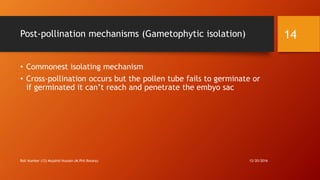
Post-pollination mechanisms (Gametophytic isolation)
• Commonest isolating mechanism
• Cross-pollination occurs but the pollen tube fails to germinate or
if germinated it can’t reach and penetrate the embyo sac
12/20/2016Roll Number (12) Mujahid Hussain (M.Phil Botany)
14
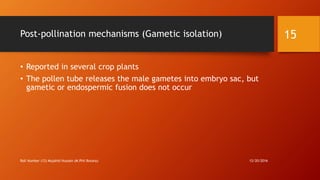
Post-pollination mechanisms (Gametic isolation)
• Reported in several crop plants
• The pollen tube releases the male gametes into embryo sac, but
gametic or endospermic fusion does not occur
12/20/2016Roll Number (12) Mujahid Hussain (M.Phil Botany)
15
Post-pollination mechanisms (Gametophytic isolation)
• This is the commonest isolating mechanism
• Where in cross-pollination occurs but
• the pollen tube fails to germinate or if
• germinated, it can’t reach and penetrate the embryo sac.
12/20/2016Roll Number (12) Mujahid Hussain (M.Phil Botany)
16
Postzygotic mechanisms (After sexual fusion)
1. Seed incompatibility
2. Hybrid inviability
3. F1 hybrid sterility
4. F2 hybrid inviability and sterility
12/20/2016Roll Number (12) Mujahid Hussain (M.Phil Botany)
17
Postzygotic mechanisms (Seed incompatibility)
• The zygote or even immature embryo is formed but fails to
develop and as such a mature seed is not formed.
• The phenomenonis commonly encountered in cross
• between Primula elatior andP. veris.
12/20/2016Roll Number (12) Mujahid Hussain (M.Phil Botany)
18
Postzygotic mechanisms (Hybrid inviability)
• Mature seed is formed and manages to germinate but the F1
hybrid dies before the flowering stage is reached.
• The phenomenon is commonly encountered in crosses between
Papaver dubium and P. rhoeas
12/20/2016Roll Number (12) Mujahid Hussain (M.Phil Botany)
19
Postzygotic mechanisms (F1 hybrid sterility: )
• F1 hybrids are fully viable and reach flowering stage but flowers
may abort or abortion may occur as late as F2 embryo formation,
• with the result that the F1 hybrid fails to produce viable seeds
12/20/2016Roll Number (12) Mujahid Hussain (M.Phil Botany)
20
Postzygotic mechanisms (F2 hybrid inviability or sterility)
• F2 hybrid dies much before reaching the flowering stage or fails to
produce seeds.
12/20/2016Roll Number (12) Mujahid Hussain (M.Phil Botany)
21
abrupt speciation or gradual speciation
New species may develop through the mechanism of
1. abrupt speciation
2. gradual speciation
12/20/2016Roll Number (12) Mujahid Hussain (M.Phil Botany)
22
abrupt speciation
• The phenomenon of abrupt speciation is commonly involves
sympatric populations of two different species and as such is also
• known as sympatric speciation.
12/20/2016Roll Number (12) Mujahid Hussain (M.Phil Botany)
23
abrupt speciation
• It is commonly the result of a sudden change in chromosome
number or structure, producing instantly an almost irreversible
barrier between populations and thus effectively
• isolating them.
12/20/2016Roll Number (12) Mujahid Hussain (M.Phil Botany)
24
gradual speciation
• This is a more common phenomenon in nature. It may involve
phyletic evolution
• one species might evolve into something different from its
ancestor over a period of time
• (phyletic speciation). Alternatively, a population belonging to a
single species
• Might differentiate into two evolutionary lines
• through divergent evolution (additive speciation)
12/20/2016Roll Number (12) Mujahid Hussain (M.Phil Botany)
25
Phyletic Speciation
• It is the sequential production of species within a single
evolutionary lineage.
• Species A might,over a period of time, change through species B
and C into species D without ever splitting.
• The new species produced in this manner are variously called
successional species, palaeospecies, and allochronic species.
• The species which have become extinct in the process are termed
taxonomic extinctions.
12/20/2016Roll Number (12) Mujahid Hussain (M.Phil Botany)
26
Additive Speciation
• Additive speciation is the commonest mode of speciation, which
adds to the diversity of living organisms.
• Mayr (1963) suggested the occurrence of reductive speciation,
where by two previously independent species fuse into a third,
new species, themselves becoming extinct.
• Hybridization likewise produces new species but this always leads
to an addition in the number of species.
12/20/2016Roll Number (12) Mujahid Hussain (M.Phil Botany)
27
Additive Speciation
• It is impossible to imagine that two evolutionary species can
actually fuse to produce a third species and themselves become
extinct.
• This may happen in a particular region, but not over the entire
range of these species
12/20/2016Roll Number (12) Mujahid Hussain (M.Phil Botany)
28
Additive Speciation
• The various modes of additive speciation are
1. Allopatric speciation
2. Allopatric introgressive speciation
3. Allo-parapatric speciation
4. Parapatric speciation
5. Stasipatric speciation
6. Sympatric speciation
12/20/2016Roll Number (12) Mujahid Hussain (M.Phil Botany)
29
Additive Speciation
• Additive speciation is the commonest mode of speciation, which
adds to the diversity of living organisms.
• Mayr (1963) suggested the occurrence of reductive speciation
• two previously independent species fuse into a third, new species,
themselves becoming extinct.
• Hybridization likewise produces new species but this always leads
to an addition in the number of species
12/20/2016Roll Number (12) Mujahid Hussain (M.Phil Botany)
30
Additive Speciation (Allopatric speciation)
• Lineage independence and consequent speciation result from
geographical separation of lineages
• may also result from the development of new
• species along the boundaries of a large central population.
12/20/2016Roll Number (12) Mujahid Hussain (M.Phil Botany)
31
Additive Speciation (Allopatric introgressive speciation)
• Although origin of species through hybridization is commonly
results from sympatric species
• examples of speciation involving two allopatric species, which had
contacts in the past,are also reported.
12/20/2016Roll Number (12) Mujahid Hussain (M.Phil Botany)
32
Additive Speciation (Allo-parapatric speciation)
• Such speciation occurs when two populations of an ancestral
species are separated, differentiate to a degree that is not
sufficient for lineage independence, and then develop lineage
independence during a period of parapatry (limited sympatry)
12/20/2016Roll Number (12) Mujahid Hussain (M.Phil Botany)
33
Additive Speciation (Allo-parapatric speciation)
• It differs from allopatric speciation in the sense that speciation is
completed after a period of sympatry and the process of attaining
lineage independence is potentially reversible because
• It is possible that two partly differentiated populations could form
a single evolutionary lineage
12/20/2016Roll Number (12) Mujahid Hussain (M.Phil Botany)
34
Additive Speciation (Parapatric speciation)
• This occurs when two populations of an ancestral species
differentiate despite the fact that no complete disjunction has
occurred.
• The daughter species may share a small fraction of their
respective ranges and interbreed within this narrow contact zone
and yet still differentiate
12/20/2016Roll Number (12) Mujahid Hussain (M.Phil Botany)
35
Additive Speciation (Stasipatric speciation)
• This is similar to parapatric speciation except that it results from
spontaneous chromosomal modifications.
• The resultant chromosome arrangement must be fully viable in the
homozygous state but of reduced viability in the heterozygous
state
12/20/2016Roll Number (12) Mujahid Hussain (M.Phil Botany)
36
Additive Speciation (Sympatric speciation)
• The process of ecological sympatric speciation is a slow one of
gradual speciation.
• The ecological differences in the habitats result in adaptive
• radiations in populations which gradually evolve into new species.
12/20/2016Roll Number (12) Mujahid Hussain (M.Phil Botany)
37

Speciation

  • 1.
    Assignment Biosystematics Topic: Speciation Submitted to:Dr. Iftikhar Ahmad Submitted by: Mujahid Hussain Roll Number: 12 Class: M.Phil 12/20/2016Roll Number (12) Mujahid Hussain (M.Phil Botany) 1
  • 2.
    Speciation (INTRODUCTION) • Processof development of new species. • Commonly results from the development of barriers to gene flow. • Different types of isolating mechanisms are responsible for the development of barriers. 12/20/2016Roll Number (12) Mujahid Hussain (M.Phil Botany) 2
  • 3.
    Speciation (ISOLATING MECHANISMS) •Isolating mechanisms operate 1. before sexual fusion (Prezygotic mechanism) 2. after sexual fusion (Post-zygotic mechanism) 12/20/2016Roll Number (12) Mujahid Hussain (M.Phil Botany) 3
  • 4.
    ISOLATING MECHANISMS Prezygotic mechanismsfurther classified into 1. Pre-pollination mechanisms 2. Post-pollination mechanisms 12/20/2016Roll Number (12) Mujahid Hussain (M.Phil Botany) 4
  • 5.
    ISOLATING MECHANISMS • Pre-pollinationmechanisms include 1. Geographical isolation 2. Ecological isolation 3. Seasonal isolation 4. Temporal isolation 5. Ethological isolation 6. Mechanical isolation 12/20/2016Roll Number (12) Mujahid Hussain (M.Phil Botany) 5
  • 6.
    ISOLATING MECHANISMS • Post-pollinationmechanisms include 1. Gemetophytic isolation 2. Gametic isoation 12/20/2016Roll Number (12) Mujahid Hussain (M.Phil Botany) 6
  • 7.
    ISOLATING MECHANISMS • Postzygticmechanisms include 1. Seed incompatibility 2. Hybrid inviability 3. F1 hybrid sterility 4. F2 hybrid inviability 5. F2 hybrid sterility 12/20/2016Roll Number (12) Mujahid Hussain (M.Phil Botany) 7
  • 8.
    Pre-pollination mechamisms (Geographicalisolation) • Two species are separated geographically by a gap larger than their pollen and seed dispersal. • Example • Platanu sorientais (Mediterranean region) • Platanu occidentalis (North America) • Both are well established species in their regions and readily interbreed when brought into same area (vicarious species) 12/20/2016Roll Number (12) Mujahid Hussain (M.Phil Botany) 8
  • 9.
    Pre-pollination mechamisms (Ecological isolation) • Two species occupy the same general area but occupy different habitats • Example • Silene alba grows on light soils in open places • Silene dioicaon grows on heavy soils in shade 12/20/2016Roll Number (12) Mujahid Hussain (M.Phil Botany) 9
  • 10.
    Pre-pollination mechamisms (Seasonalisolation isolation) • Two species occur in the same region but flower at different seasons • Example • Sambucus racemose and Sambucus nigra flower nearly 7 weeks apart 12/20/2016Roll Number (12) Mujahid Hussain (M.Phil Botany) 10
  • 11.
    Pre-pollination mechanisms (Temporalisolation) • Two species flower during the same period but during different times of the day • Example • Agrostis tenuis flower in afternoon • Agrosits stolonifera flowers in the morning 12/20/2016Roll Number (12) Mujahid Hussain (M.Phil Botany) 11
  • 12.
    Pre-pollination mechanisms (Ethologicalisolation) • Two species are interfertile but have different pollinators • Example • Humming birds are attracted to red flowers and hawk-moths to white ones 12/20/2016Roll Number (12) Mujahid Hussain (M.Phil Botany) 12
  • 13.
    Pre-pollination mechanisms (Mechanicalisolation) • Pollination between two related species is prevented by structural differences between flowers • Example • Ophrys insectifera and ophrys apifera 12/20/2016Roll Number (12) Mujahid Hussain (M.Phil Botany) 13
  • 14.
    Post-pollination mechanisms (Gametophyticisolation) • Commonest isolating mechanism • Cross-pollination occurs but the pollen tube fails to germinate or if germinated it can’t reach and penetrate the embyo sac 12/20/2016Roll Number (12) Mujahid Hussain (M.Phil Botany) 14
  • 15.
    Post-pollination mechanisms (Gameticisolation) • Reported in several crop plants • The pollen tube releases the male gametes into embryo sac, but gametic or endospermic fusion does not occur 12/20/2016Roll Number (12) Mujahid Hussain (M.Phil Botany) 15
  • 16.
    Post-pollination mechanisms (Gametophyticisolation) • This is the commonest isolating mechanism • Where in cross-pollination occurs but • the pollen tube fails to germinate or if • germinated, it can’t reach and penetrate the embryo sac. 12/20/2016Roll Number (12) Mujahid Hussain (M.Phil Botany) 16
  • 17.
    Postzygotic mechanisms (Aftersexual fusion) 1. Seed incompatibility 2. Hybrid inviability 3. F1 hybrid sterility 4. F2 hybrid inviability and sterility 12/20/2016Roll Number (12) Mujahid Hussain (M.Phil Botany) 17
  • 18.
    Postzygotic mechanisms (Seedincompatibility) • The zygote or even immature embryo is formed but fails to develop and as such a mature seed is not formed. • The phenomenonis commonly encountered in cross • between Primula elatior andP. veris. 12/20/2016Roll Number (12) Mujahid Hussain (M.Phil Botany) 18
  • 19.
    Postzygotic mechanisms (Hybridinviability) • Mature seed is formed and manages to germinate but the F1 hybrid dies before the flowering stage is reached. • The phenomenon is commonly encountered in crosses between Papaver dubium and P. rhoeas 12/20/2016Roll Number (12) Mujahid Hussain (M.Phil Botany) 19
  • 20.
    Postzygotic mechanisms (F1hybrid sterility: ) • F1 hybrids are fully viable and reach flowering stage but flowers may abort or abortion may occur as late as F2 embryo formation, • with the result that the F1 hybrid fails to produce viable seeds 12/20/2016Roll Number (12) Mujahid Hussain (M.Phil Botany) 20
  • 21.
    Postzygotic mechanisms (F2hybrid inviability or sterility) • F2 hybrid dies much before reaching the flowering stage or fails to produce seeds. 12/20/2016Roll Number (12) Mujahid Hussain (M.Phil Botany) 21
  • 22.
    abrupt speciation orgradual speciation New species may develop through the mechanism of 1. abrupt speciation 2. gradual speciation 12/20/2016Roll Number (12) Mujahid Hussain (M.Phil Botany) 22
  • 23.
    abrupt speciation • Thephenomenon of abrupt speciation is commonly involves sympatric populations of two different species and as such is also • known as sympatric speciation. 12/20/2016Roll Number (12) Mujahid Hussain (M.Phil Botany) 23
  • 24.
    abrupt speciation • Itis commonly the result of a sudden change in chromosome number or structure, producing instantly an almost irreversible barrier between populations and thus effectively • isolating them. 12/20/2016Roll Number (12) Mujahid Hussain (M.Phil Botany) 24
  • 25.
    gradual speciation • Thisis a more common phenomenon in nature. It may involve phyletic evolution • one species might evolve into something different from its ancestor over a period of time • (phyletic speciation). Alternatively, a population belonging to a single species • Might differentiate into two evolutionary lines • through divergent evolution (additive speciation) 12/20/2016Roll Number (12) Mujahid Hussain (M.Phil Botany) 25
  • 26.
    Phyletic Speciation • Itis the sequential production of species within a single evolutionary lineage. • Species A might,over a period of time, change through species B and C into species D without ever splitting. • The new species produced in this manner are variously called successional species, palaeospecies, and allochronic species. • The species which have become extinct in the process are termed taxonomic extinctions. 12/20/2016Roll Number (12) Mujahid Hussain (M.Phil Botany) 26
  • 27.
    Additive Speciation • Additivespeciation is the commonest mode of speciation, which adds to the diversity of living organisms. • Mayr (1963) suggested the occurrence of reductive speciation, where by two previously independent species fuse into a third, new species, themselves becoming extinct. • Hybridization likewise produces new species but this always leads to an addition in the number of species. 12/20/2016Roll Number (12) Mujahid Hussain (M.Phil Botany) 27
  • 28.
    Additive Speciation • Itis impossible to imagine that two evolutionary species can actually fuse to produce a third species and themselves become extinct. • This may happen in a particular region, but not over the entire range of these species 12/20/2016Roll Number (12) Mujahid Hussain (M.Phil Botany) 28
  • 29.
    Additive Speciation • Thevarious modes of additive speciation are 1. Allopatric speciation 2. Allopatric introgressive speciation 3. Allo-parapatric speciation 4. Parapatric speciation 5. Stasipatric speciation 6. Sympatric speciation 12/20/2016Roll Number (12) Mujahid Hussain (M.Phil Botany) 29
  • 30.
    Additive Speciation • Additivespeciation is the commonest mode of speciation, which adds to the diversity of living organisms. • Mayr (1963) suggested the occurrence of reductive speciation • two previously independent species fuse into a third, new species, themselves becoming extinct. • Hybridization likewise produces new species but this always leads to an addition in the number of species 12/20/2016Roll Number (12) Mujahid Hussain (M.Phil Botany) 30
  • 31.
    Additive Speciation (Allopatricspeciation) • Lineage independence and consequent speciation result from geographical separation of lineages • may also result from the development of new • species along the boundaries of a large central population. 12/20/2016Roll Number (12) Mujahid Hussain (M.Phil Botany) 31
  • 32.
    Additive Speciation (Allopatricintrogressive speciation) • Although origin of species through hybridization is commonly results from sympatric species • examples of speciation involving two allopatric species, which had contacts in the past,are also reported. 12/20/2016Roll Number (12) Mujahid Hussain (M.Phil Botany) 32
  • 33.
    Additive Speciation (Allo-parapatricspeciation) • Such speciation occurs when two populations of an ancestral species are separated, differentiate to a degree that is not sufficient for lineage independence, and then develop lineage independence during a period of parapatry (limited sympatry) 12/20/2016Roll Number (12) Mujahid Hussain (M.Phil Botany) 33
  • 34.
    Additive Speciation (Allo-parapatricspeciation) • It differs from allopatric speciation in the sense that speciation is completed after a period of sympatry and the process of attaining lineage independence is potentially reversible because • It is possible that two partly differentiated populations could form a single evolutionary lineage 12/20/2016Roll Number (12) Mujahid Hussain (M.Phil Botany) 34
  • 35.
    Additive Speciation (Parapatricspeciation) • This occurs when two populations of an ancestral species differentiate despite the fact that no complete disjunction has occurred. • The daughter species may share a small fraction of their respective ranges and interbreed within this narrow contact zone and yet still differentiate 12/20/2016Roll Number (12) Mujahid Hussain (M.Phil Botany) 35
  • 36.
    Additive Speciation (Stasipatricspeciation) • This is similar to parapatric speciation except that it results from spontaneous chromosomal modifications. • The resultant chromosome arrangement must be fully viable in the homozygous state but of reduced viability in the heterozygous state 12/20/2016Roll Number (12) Mujahid Hussain (M.Phil Botany) 36
  • 37.
    Additive Speciation (Sympatricspeciation) • The process of ecological sympatric speciation is a slow one of gradual speciation. • The ecological differences in the habitats result in adaptive • radiations in populations which gradually evolve into new species. 12/20/2016Roll Number (12) Mujahid Hussain (M.Phil Botany) 37