• Course code: zol-508
• Course title : principles of zoogeography
• Credit hours : 3(2-1)
• Teacher name: Tassanam naz
• Theory: Introduction and history of Zoogeography, Branches of
Zoogeography. Barriers to distribution and means of dispersal in
Marine, Freshwater and Terrestrial environment. Division of world
into various zoogeographical regions. Geographical limits, Physical,
climatic features and faunas of Holarctic (Palaearctic and Nearctic),
Oriental, Ethiopian, Australian, and Neotropical regions. Insular
fauna [continental islands {Recent (British Isles, Borneo, Java, Japan,
Formosa and Philippines, and Sri Lanka islands)}, {Ancient (New
Zealand and Madagascar Island)}]. [Oceanic Islands, (Azores,
Bermuda, Galapagos, St. Helena and Karakatau Island)], Wallace’s
line, Weber’s line and Wallacea. Continental drift theory and
discontinuous distribution of animals.
• Practicals: Identification and classification of various invertebrates
and vertebrates of Zoogeographical importance.
Topic #1.
Introduction and history of Zoogeography
• What is zoogeography?
• History of zoogeography.
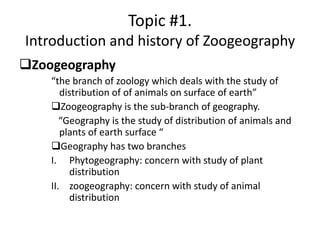
Topic #1.
Introduction and history of Zoogeography
Zoogeography
“the branch of zoology which deals with the study of
distribution of of animals on surface of earth”
Zoogeography is the sub-branch of geography.
“Geography is the study of distribution of animals and
plants of earth surface “
Geography has two branches
I. Phytogeography: concern with study of plant
distribution
II. zoogeography: concern with study of animal
distribution
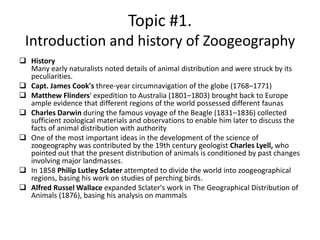
Topic #1.
Introduction and history of Zoogeography
 History
Many early naturalists noted details of animal distribution and were struck by its
peculiarities.
 Capt. James Cook's three-year circumnavigation of the globe (1768–1771)
 Matthew Flinders' expedition to Australia (1801–1803) brought back to Europe
ample evidence that different regions of the world possessed different faunas
 Charles Darwin during the famous voyage of the Beagle (1831–1836) collected
sufficient zoological materials and observations to enable him later to discuss the
facts of animal distribution with authority
 One of the most important ideas in the development of the science of
zoogeography was contributed by the 19th century geologist Charles Lyell, who
pointed out that the present distribution of animals is conditioned by past changes
involving major landmasses.
 In 1858 Philip Lutley Sclater attempted to divide the world into zoogeographical
regions, basing his work on studies of perching birds.
 Alfred Russel Wallace expanded Sclater's work in The Geographical Distribution of
Animals (1876), basing his analysis on mammals
Topic # 2
Branches of Zoogeography
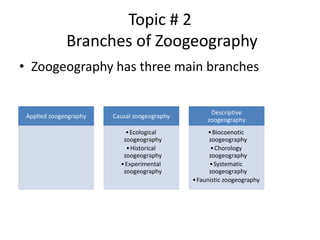
• Zoogeography has three main branches
Applied zoogeography Causal zoogeography
•Ecological
zoogeography
•Historical
zoogeography
•Experimental
zoogeography
Descriptive
zoogeography
•Biocoenotic
zoogeography
•Chorology
zoogeography
•Systematic
zoogeography
•Faunistic zoogeography
Topic # 2
Branches of Zoogeography
• 1. applied zoogeography
“ study of distribution of those
animals which are of medical importance “
Topic # 2
Branches of Zoogeography
• 2.causal zoogeography
“the study of causes that has bring the animal
distribution actually found in present days”
Causal zoogeography has 3 branches
I. Ecological zoogeography: study of biotic and a biotic
interactions that effect the animal distribution
II. Historical zoogeography: study and understanding of
origin, extinction and dispersal of a particular texon
III. Experimental zoogeography: study of the procedures
that have been used to study the origin , extinction
and dispersal of animals .
Topic # 2
Branches of Zoogeography
• 3. Descriptive zoogeography :
“ study of animals and their habitats “
It has 4 branches
I. Bioconotic zoogeography; study of geographical
distribution and dynamics of communities
II. Chorology zoogeography: study of geographical
ranges of animals
III. Faunisitic zoogeography: study of discovery of new
species and their distribution
IV. Systematic zoogeography: study of distribution of
large groups of animals

introduction to zoogeography

  • 3.
    • Course code:zol-508 • Course title : principles of zoogeography • Credit hours : 3(2-1) • Teacher name: Tassanam naz
  • 4.
    • Theory: Introductionand history of Zoogeography, Branches of Zoogeography. Barriers to distribution and means of dispersal in Marine, Freshwater and Terrestrial environment. Division of world into various zoogeographical regions. Geographical limits, Physical, climatic features and faunas of Holarctic (Palaearctic and Nearctic), Oriental, Ethiopian, Australian, and Neotropical regions. Insular fauna [continental islands {Recent (British Isles, Borneo, Java, Japan, Formosa and Philippines, and Sri Lanka islands)}, {Ancient (New Zealand and Madagascar Island)}]. [Oceanic Islands, (Azores, Bermuda, Galapagos, St. Helena and Karakatau Island)], Wallace’s line, Weber’s line and Wallacea. Continental drift theory and discontinuous distribution of animals. • Practicals: Identification and classification of various invertebrates and vertebrates of Zoogeographical importance.
  • 5.
    Topic #1. Introduction andhistory of Zoogeography • What is zoogeography? • History of zoogeography.
  • 6.
    Topic #1. Introduction andhistory of Zoogeography Zoogeography “the branch of zoology which deals with the study of distribution of of animals on surface of earth” Zoogeography is the sub-branch of geography. “Geography is the study of distribution of animals and plants of earth surface “ Geography has two branches I. Phytogeography: concern with study of plant distribution II. zoogeography: concern with study of animal distribution
  • 7.
    Topic #1. Introduction andhistory of Zoogeography  History Many early naturalists noted details of animal distribution and were struck by its peculiarities.  Capt. James Cook's three-year circumnavigation of the globe (1768–1771)  Matthew Flinders' expedition to Australia (1801–1803) brought back to Europe ample evidence that different regions of the world possessed different faunas  Charles Darwin during the famous voyage of the Beagle (1831–1836) collected sufficient zoological materials and observations to enable him later to discuss the facts of animal distribution with authority  One of the most important ideas in the development of the science of zoogeography was contributed by the 19th century geologist Charles Lyell, who pointed out that the present distribution of animals is conditioned by past changes involving major landmasses.  In 1858 Philip Lutley Sclater attempted to divide the world into zoogeographical regions, basing his work on studies of perching birds.  Alfred Russel Wallace expanded Sclater's work in The Geographical Distribution of Animals (1876), basing his analysis on mammals
  • 8.
    Topic # 2 Branchesof Zoogeography • Zoogeography has three main branches Applied zoogeography Causal zoogeography •Ecological zoogeography •Historical zoogeography •Experimental zoogeography Descriptive zoogeography •Biocoenotic zoogeography •Chorology zoogeography •Systematic zoogeography •Faunistic zoogeography
  • 9.
    Topic # 2 Branchesof Zoogeography • 1. applied zoogeography “ study of distribution of those animals which are of medical importance “
  • 10.
    Topic # 2 Branchesof Zoogeography • 2.causal zoogeography “the study of causes that has bring the animal distribution actually found in present days” Causal zoogeography has 3 branches I. Ecological zoogeography: study of biotic and a biotic interactions that effect the animal distribution II. Historical zoogeography: study and understanding of origin, extinction and dispersal of a particular texon III. Experimental zoogeography: study of the procedures that have been used to study the origin , extinction and dispersal of animals .
  • 11.
    Topic # 2 Branchesof Zoogeography • 3. Descriptive zoogeography : “ study of animals and their habitats “ It has 4 branches I. Bioconotic zoogeography; study of geographical distribution and dynamics of communities II. Chorology zoogeography: study of geographical ranges of animals III. Faunisitic zoogeography: study of discovery of new species and their distribution IV. Systematic zoogeography: study of distribution of large groups of animals