SYMPATRIC SPECIATION
RANGANAYAGI.S
II – BBT
21BT0048
INTRODUCTION
 Sympatric speciation, The evolution of reproduction
isolation without geographic barriers, remains highly
contentious
 Speciation process when two groups of identical
species lived in identical geographical area, They
evolve in such a way that they could no longer
interbreed, They are considered to be a different
species.
Sympatric speciation
 This is unique because it taked place with 2
subpopulation of same species are occupying the
same range. Eventhough the territory that organisms
live in same, They are able to split into 2 different
groups that become genetically different from one
another that they can no longer breed with each
other. When one group van no longer breed with
another, it is separate species
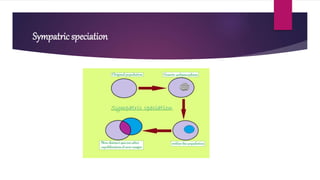
 Sympatric speciation (sym – together, patric – nature
land) Sympatric speciation is controversial. Some
scientists don’t believe it exist.
 Sympatric speciation occurs when there are no
physical barriers preventing any members of a
species from mating with another and all members
are in close proximity to one another.
 The reproduction isolation brings about sympatric
speciation.
Sympatric speciation
 The change in host preference, food preference or
habital preference.
 The partitioning of an essential but limiting resource.
 Instant speciation as a result of polyploidy
(particularly among plants, as in evolution of wheat)
 Most of sympatric speciation occurs due to
chromosomal change and non random mating
This can happen in variety of way.
They are
1. Due to mutation
2. Change in alleb frequency
3. Behaviour changes
4. Reproduction isolation
5. Preference changes
6. Seasonal reproduction
 Jerry coyne and H.Allen Qrr have developed 4 criteria
for inferring whether species have arisen
sympatrically, They are
1. Species ranges must overlap significantly
2. There must be complete speciation (i.e. The 2 species
cannot interbreed)
3. The species must be sister species (Most closely
related to each other) or monophyletie group, all
descendent species have to be included if there are
more than 2, not just some of them.
4. The history of species geography range and evolution
must make alloparty sum very unlikely, as allopatric
speciation is much more common than sympatric
speciation.
EXAMPLE:
 In Apple Maggot Files:
Sympatric speciation maybe occuring in the apple
maggot fly. Some maggot flies began to lay their eggs
on apple instead. Now there are 2 groups of apple
maggot flies. One that lays eggs on hawthorns and one
that lays egg on apples. Male look for mates on the
same type of fruit that they grew on and female lay
their eggs on same type of fruit that they grew up on.
Flies that are up on hawthorns will raise offspring on
hawthrons and flies that grew up on apples will raise
offspring on apples. This shows how speciation can
occur even when different subgroups of the same
species have the same geographic range.

IN BACTERIA
 Sympatric speciation is through to occur move often in nature
in bacteria, because bacteria can exchange genes with other
individuals that aren’t parent and offspring in a proters known
as horizontals gene transfer. Sympatric speciation has been
observed in bacteria and synechoccus species in bacteria in
bacterioplankton vibrio splendidus, among others. Subgroups
of species that are undergoing sympatric speciation will show
few difference. If some members are specialized for living in
certain environments evolve into a new species over time.
IN CICHLIDS
 Another example of sympatric speciation is found in 2
species of Midas cichlid fish (Amphilosphus species)
which live in lake Apoyo. Researches analyzed the
DNA appearance and biology of there 2 closely
related species. The 2 species, though overall very
similar, do have slight difference in appearance and
they cannot interbreed. The newer species evolved
relatively relently, but in terms, this means that it is
thought to have evolved less than 10,000 years ago.
OREA
 The divergence of “ resident “ and “ transient “ orea
form in the northeast pacific is an uncommon egs. Of
sympatric speciation living in the same water, oreas
avoid each other and do not interested. They are
different diets, voacal behavior and social structure.
They also attack different prey. A reduction in the
population occurs almost 200,000 years back which
not only reduces the size of population but also
affects gene variation. After that numerous ecotype
emerged.
EXAMPLE:
PAINTED FROGS
 The rosy perches
 Collared Inca Finch
 Common cuckoo Finch
 Aylesbury Duck
 Kangaroo Rats
 Sqapberry bugs
 Fire lilies
 Garden orchid
AMPHIBIANS
 Fish
 Bird
 Bird
 Birds
 Rodent
 Insect
 Plants
INFECTIOUS SPECIATION:
1. The bacterium wolbachia can cause
cytoplasmic incompatibility.
2. When infected male hosts (w+)
male with uninfected females (w-)
no viable offspring are produced.
3. Different strains of wolbachia are
incompatible.
POLYPOIDY
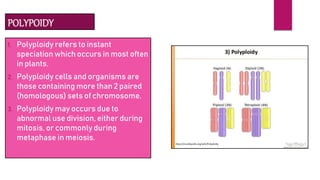
1. Polyploidy refers to instant
speciation which occurs in most often
in plants.
2. Polyploidy cells and organisms are
those containing more than 2 paired
(homologous) sets of chromosome.
3. Polyploidy may occurs due to
abnormal use division, either during
mitosis, or commonly during
metaphase in meiosis.
 The normal primore is diploid with 14 chromosomes.
2N=14
 In this species there was a total nondisjunction event
resulting in primroses that are tetraploid. 4N=28
 These primroses cannot successfully mate with the
diploid species
 There are 2 types of polploidy. They are
1. Autopolyploidy
2. Allopolyploidy
AUTOPOLYPLOIDY
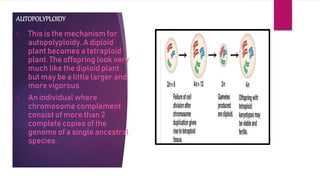
1. This is the mechanism for
autopolyploidy. A diploid
plant becomes a tetraploid
plant. The offspring look very
much like the diploid plant
but may be a little larger and
more vigorous
2. An individual where
chromosome complement
consist of more than 2
complete copies of the
genome of a single ancestral
species.
ALLOPOLYPLOIDY
1. Allopolyploidy are
polyploidys with
chromosome derived
from different species.
2. Precisely, it is present
result of multiplying the
chromosome number in
an F1 hybrid.
SYMPATRIC SPECIATION.pptx

SYMPATRIC SPECIATION.pptx

  • 1.
  • 2.
    INTRODUCTION  Sympatric speciation,The evolution of reproduction isolation without geographic barriers, remains highly contentious  Speciation process when two groups of identical species lived in identical geographical area, They evolve in such a way that they could no longer interbreed, They are considered to be a different species.
  • 3.
    Sympatric speciation  Thisis unique because it taked place with 2 subpopulation of same species are occupying the same range. Eventhough the territory that organisms live in same, They are able to split into 2 different groups that become genetically different from one another that they can no longer breed with each other. When one group van no longer breed with another, it is separate species
  • 4.
     Sympatric speciation(sym – together, patric – nature land) Sympatric speciation is controversial. Some scientists don’t believe it exist.  Sympatric speciation occurs when there are no physical barriers preventing any members of a species from mating with another and all members are in close proximity to one another.  The reproduction isolation brings about sympatric speciation.
  • 5.
  • 6.
     The changein host preference, food preference or habital preference.  The partitioning of an essential but limiting resource.  Instant speciation as a result of polyploidy (particularly among plants, as in evolution of wheat)  Most of sympatric speciation occurs due to chromosomal change and non random mating
  • 7.
    This can happenin variety of way. They are 1. Due to mutation 2. Change in alleb frequency 3. Behaviour changes 4. Reproduction isolation 5. Preference changes 6. Seasonal reproduction
  • 8.
     Jerry coyneand H.Allen Qrr have developed 4 criteria for inferring whether species have arisen sympatrically, They are 1. Species ranges must overlap significantly 2. There must be complete speciation (i.e. The 2 species cannot interbreed) 3. The species must be sister species (Most closely related to each other) or monophyletie group, all descendent species have to be included if there are more than 2, not just some of them. 4. The history of species geography range and evolution must make alloparty sum very unlikely, as allopatric speciation is much more common than sympatric speciation.
  • 9.
    EXAMPLE:  In AppleMaggot Files: Sympatric speciation maybe occuring in the apple maggot fly. Some maggot flies began to lay their eggs on apple instead. Now there are 2 groups of apple maggot flies. One that lays eggs on hawthorns and one that lays egg on apples. Male look for mates on the same type of fruit that they grew on and female lay their eggs on same type of fruit that they grew up on. Flies that are up on hawthorns will raise offspring on hawthrons and flies that grew up on apples will raise offspring on apples. This shows how speciation can occur even when different subgroups of the same species have the same geographic range. 
  • 10.
    IN BACTERIA  Sympatricspeciation is through to occur move often in nature in bacteria, because bacteria can exchange genes with other individuals that aren’t parent and offspring in a proters known as horizontals gene transfer. Sympatric speciation has been observed in bacteria and synechoccus species in bacteria in bacterioplankton vibrio splendidus, among others. Subgroups of species that are undergoing sympatric speciation will show few difference. If some members are specialized for living in certain environments evolve into a new species over time.
  • 11.
    IN CICHLIDS  Anotherexample of sympatric speciation is found in 2 species of Midas cichlid fish (Amphilosphus species) which live in lake Apoyo. Researches analyzed the DNA appearance and biology of there 2 closely related species. The 2 species, though overall very similar, do have slight difference in appearance and they cannot interbreed. The newer species evolved relatively relently, but in terms, this means that it is thought to have evolved less than 10,000 years ago.
  • 12.
    OREA  The divergenceof “ resident “ and “ transient “ orea form in the northeast pacific is an uncommon egs. Of sympatric speciation living in the same water, oreas avoid each other and do not interested. They are different diets, voacal behavior and social structure. They also attack different prey. A reduction in the population occurs almost 200,000 years back which not only reduces the size of population but also affects gene variation. After that numerous ecotype emerged.
  • 13.
    EXAMPLE: PAINTED FROGS  Therosy perches  Collared Inca Finch  Common cuckoo Finch  Aylesbury Duck  Kangaroo Rats  Sqapberry bugs  Fire lilies  Garden orchid AMPHIBIANS  Fish  Bird  Bird  Birds  Rodent  Insect  Plants
  • 14.
    INFECTIOUS SPECIATION: 1. Thebacterium wolbachia can cause cytoplasmic incompatibility. 2. When infected male hosts (w+) male with uninfected females (w-) no viable offspring are produced. 3. Different strains of wolbachia are incompatible.
  • 15.
    POLYPOIDY 1. Polyploidy refersto instant speciation which occurs in most often in plants. 2. Polyploidy cells and organisms are those containing more than 2 paired (homologous) sets of chromosome. 3. Polyploidy may occurs due to abnormal use division, either during mitosis, or commonly during metaphase in meiosis.
  • 16.
     The normalprimore is diploid with 14 chromosomes. 2N=14  In this species there was a total nondisjunction event resulting in primroses that are tetraploid. 4N=28  These primroses cannot successfully mate with the diploid species  There are 2 types of polploidy. They are 1. Autopolyploidy 2. Allopolyploidy
  • 17.
    AUTOPOLYPLOIDY 1. This isthe mechanism for autopolyploidy. A diploid plant becomes a tetraploid plant. The offspring look very much like the diploid plant but may be a little larger and more vigorous 2. An individual where chromosome complement consist of more than 2 complete copies of the genome of a single ancestral species.
  • 18.
    ALLOPOLYPLOIDY 1. Allopolyploidy are polyploidyswith chromosome derived from different species. 2. Precisely, it is present result of multiplying the chromosome number in an F1 hybrid.