 Zoological nomenclature is the system of
scientific names applied to taxonomic units
of animals (taxa,taxon) , known to occur in
nature ,whether living or extinct.
 -The term nomenclature comes from latin
words
 Nomen ------------ Names
 Calare ------------ to call
 And means literally to call by name
 Three important requisites should be kept in
mind before giving any name to a taxon.
 -Uniqueness – name should be unique
 -Universality – name should be name all over
the world
 -Stability – name should not be changed
 A set of rules for naming of animals and for
resolution of nomenclatural problems is called
the international code of zoological
nomenclature.
 After 1800 all the authors adapted Linnaean
system-change existing names if they had not
been correctly formed-result in nomenclatural
confusion
 -a need for definite rules or code arose
 The first set of rules were presented in the first
international congress of zoology in 1889.
 The code consists of three main parts
 The code proper
 Appendices – a section giving extra information at
the end of the book
 Glossory – a list of technical or special
words,especially those in the particular
text,explaining their meanings.
 Code proper
.Preamble –an introduction to a book or written
document
.90 articles grouped in 18 chapters
Each article is composed of one or more mandatory
provision which are followed by recommendations
and illustrative examples.
The use of recommendation is not mandatory
 changes occur in the basic concept of taxonomy
like
 - concept of taxa as population rather than type
 - the nature of type as name bearer
 -categorical status of infraspecific names
 The rules should be adjusted to the conceptual
development of taxonomy.
 Different needs in different groups---
 Parasitologist must make tentative assignment of
stages in the life cycle of parasites
 Paleontologist may form genera until the true
taxonomic status of the taxon is established
 This is the principle that the scientific name
of a species, and not of a taxon at any other
rank, is a combination of two names; the use
of a trinomen for the name of a subspecies
and of uninominal names for taxa above the
species group is in accord with this principle.
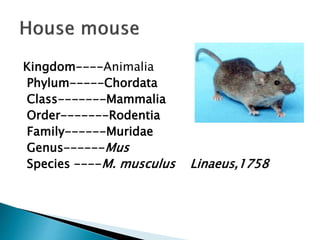
 Example house mouse
Kingdom----Animalia
Phylum-----Chordata
Class-------Mammalia
Order-------Rodentia
Family------Muridae
Genus------Mus
Species ----M. musculus Linaeus,1758
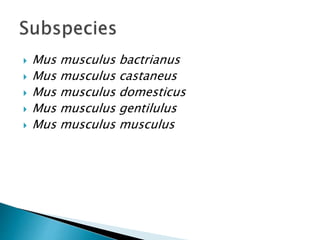
 Mus musculus bactrianus
 Mus musculus castaneus
 Mus musculus domesticus
 Mus musculus gentilulus
 Mus musculus musculus
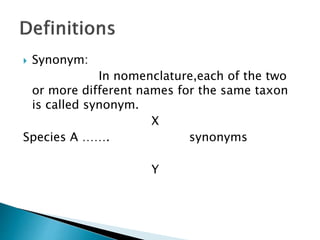
 Synonym:
In nomenclature,each of the two
or more different names for the same taxon
is called synonym.
X
Species A ……. synonyms
Y
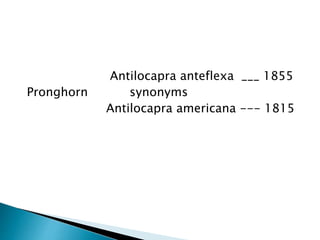
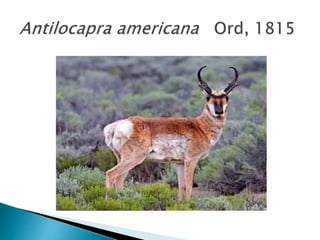
Antilocapra anteflexa ___ 1855
Pronghorn synonyms
Antilocapra americana --- 1815
 Homonym:
In nomenclature,one or two or
more identical but independently proposed
names for the same or different taxa are
called homonym.
X ------ 1818
Species A ---- ----- homonym
X ------ 1915
Species A ---- X ------ 1779
----- homonym
Species B ---- X ------ 1907
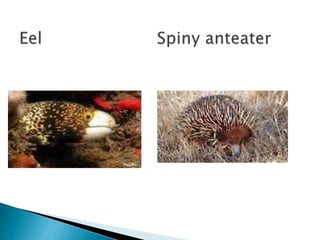
Moray eel --- Echidna ---1777
(Johan Reinhold forster)
Spiny anteater --- Echidna --- 1797
(George cuvier)
Another name for spiny anteater is Tachyglossa
 Principle of Priority is one of the guiding principles of
the International Code of Zoological Nomenclature,
defined by Article 23.
 It states that the correct formal scientific name for an
animal taxon, the name that is to be used, called the valid
name, is the oldest available name that applies to it.
 It is the most important principle that preserve stability of
zoological nomenclature.
 It was first formulated in 1842 by a committee appointed
by the British Association to consider the rules of
zoological nomenclature.
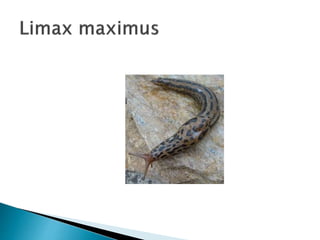
 Nunneley 1837 give a name Limax maculatus
to a species belonging to Gastropoda(slug),
Wiktor 2001 classified it as a junior synonym
of Limax maximus Linnæus 1758. Limax
maximus was established first, so Limax
maximus takes precedence over Limax
maculatus and must be used for the species.
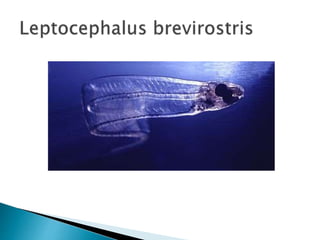
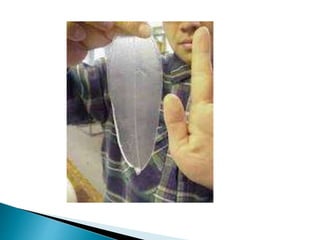
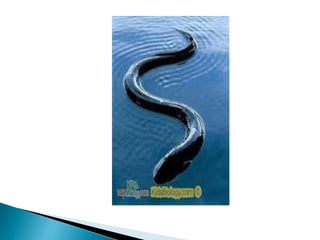
 In 1856, Johann Jakob Kaup published the
name Leptocephalus brevirostris for a new
species of eel. However, it was realized in
1893 that the organism described by Kaup
was in fact the juvenile form of the European
eel . The European eel was named Muraena
anguilla by Carolus Linnaeus in 1758.
So Muraena anguilla is the name to be used
for the species, and Leptocephalus
brevirostris must be considered as a junior
synonym and not be used. Today the
European eel is classified in the
genus Anguilla Garsault, 1764, so its
currently used name is Anguilla
anguilla (Linnaeus, 1758).
The Principle of the First Reviser deals with
situations that cannot be resolved by priority,
namely where there are two or more items that
have the same date of publication (or the same
year of publication when no details are known).
These items may be two or more different names
for the same taxon, two or more names with the
same spelling used for different taxa, two or
more different spellings of a particular name, etc.
In such cases the first subsequent author who
deals with the matter, makes a choice and
publishes the decision in the required manner,
the First Reviser, is to be followed. [Art. 24.2].
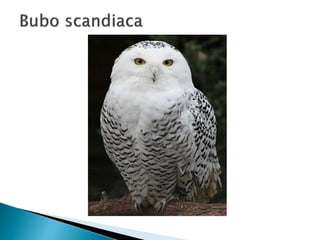
 Linnæus 1758 established Strix
scandiaca and Strix noctua (Aves), for which
he gave different descriptions and referred to
different types, but both taxa later turned out
to refer to the same species, the snowy owl.
Lönnberg 1931 acted as First Reviser, cited
both names and selected Strix scandiaca to
have precedence.
 This is the principle that each nominal taxon
in the family group or species group
has,actually or potentially , a name bearing
type fixed to provide the objective standard
of refrence by which the application of the
name is determined.
 This means that any named taxon would have
a name bearing type which allow the
objective application of that name.
 Any family group name must have a type
genus , any genus group have a type species
and species group name can (not must) have
one or more type specimens usually
deposited in a museum collection.
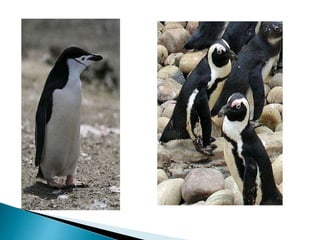
 1.Aptenodytes
 2.Pygoscelis
 3.Eudyptula
 4.Spheniscus -------- type specimen
 5.Megadyptes
 6.Eudyptes
 Holotype: If a nominal species is based on a
single specimen that specimen is called
holotype.
 Syntype:|If a new nominal species has no
holotype under the provision of code then all
the specimen are of equal value and are
called syntypes.
 Lectotype:one of a series of syntypes
which,subsequent to the publication of the
original description ,is selected and
designated through publication to serve as
“the type’.
 Paratype:After the holotype has been
labelled,each remaining specimens of the
type species should be conspiciously called
paratype.
 Neotype:A specimen selected as type
subsequent to the original description in
cases where the original types are known to
be destroyed or were suppressed by the
commission.
 The code applies to both living and extinct
animals.
 If a still living species was first named on the
basis of fossil material,that name is also valid
for the living species.
 If a generic name has been used for a fossil
animal,it cannot be used again for a different
genus of living animals.
 There are ,however separate codes for
botanical and bacteriological nomenclature.
 Key:
A tabulation of diagnosstic characters of
species ( or genera etc) in dichotomous
couplets facilitating rapid identification.

Zoologic al nomenclatures 5

  • 2.
     Zoological nomenclatureis the system of scientific names applied to taxonomic units of animals (taxa,taxon) , known to occur in nature ,whether living or extinct.  -The term nomenclature comes from latin words  Nomen ------------ Names  Calare ------------ to call  And means literally to call by name
  • 3.
     Three importantrequisites should be kept in mind before giving any name to a taxon.  -Uniqueness – name should be unique  -Universality – name should be name all over the world  -Stability – name should not be changed
  • 4.
     A setof rules for naming of animals and for resolution of nomenclatural problems is called the international code of zoological nomenclature.  After 1800 all the authors adapted Linnaean system-change existing names if they had not been correctly formed-result in nomenclatural confusion  -a need for definite rules or code arose  The first set of rules were presented in the first international congress of zoology in 1889.
  • 5.
     The codeconsists of three main parts  The code proper  Appendices – a section giving extra information at the end of the book  Glossory – a list of technical or special words,especially those in the particular text,explaining their meanings.  Code proper .Preamble –an introduction to a book or written document .90 articles grouped in 18 chapters Each article is composed of one or more mandatory provision which are followed by recommendations and illustrative examples. The use of recommendation is not mandatory
  • 6.
     changes occurin the basic concept of taxonomy like  - concept of taxa as population rather than type  - the nature of type as name bearer  -categorical status of infraspecific names  The rules should be adjusted to the conceptual development of taxonomy.  Different needs in different groups---  Parasitologist must make tentative assignment of stages in the life cycle of parasites  Paleontologist may form genera until the true taxonomic status of the taxon is established
  • 7.
     This isthe principle that the scientific name of a species, and not of a taxon at any other rank, is a combination of two names; the use of a trinomen for the name of a subspecies and of uninominal names for taxa above the species group is in accord with this principle.  Example house mouse
  • 8.
  • 9.
     Mus musculusbactrianus  Mus musculus castaneus  Mus musculus domesticus  Mus musculus gentilulus  Mus musculus musculus
  • 10.
     Synonym: In nomenclature,eachof the two or more different names for the same taxon is called synonym. X Species A ……. synonyms Y
  • 11.
    Antilocapra anteflexa ___1855 Pronghorn synonyms Antilocapra americana --- 1815
  • 13.
     Homonym: In nomenclature,oneor two or more identical but independently proposed names for the same or different taxa are called homonym. X ------ 1818 Species A ---- ----- homonym X ------ 1915 Species A ---- X ------ 1779 ----- homonym Species B ---- X ------ 1907
  • 14.
    Moray eel ---Echidna ---1777 (Johan Reinhold forster) Spiny anteater --- Echidna --- 1797 (George cuvier) Another name for spiny anteater is Tachyglossa
  • 16.
     Principle ofPriority is one of the guiding principles of the International Code of Zoological Nomenclature, defined by Article 23.  It states that the correct formal scientific name for an animal taxon, the name that is to be used, called the valid name, is the oldest available name that applies to it.  It is the most important principle that preserve stability of zoological nomenclature.  It was first formulated in 1842 by a committee appointed by the British Association to consider the rules of zoological nomenclature.
  • 17.
     Nunneley 1837give a name Limax maculatus to a species belonging to Gastropoda(slug), Wiktor 2001 classified it as a junior synonym of Limax maximus Linnæus 1758. Limax maximus was established first, so Limax maximus takes precedence over Limax maculatus and must be used for the species.
  • 19.
     In 1856,Johann Jakob Kaup published the name Leptocephalus brevirostris for a new species of eel. However, it was realized in 1893 that the organism described by Kaup was in fact the juvenile form of the European eel . The European eel was named Muraena anguilla by Carolus Linnaeus in 1758. So Muraena anguilla is the name to be used for the species, and Leptocephalus brevirostris must be considered as a junior synonym and not be used. Today the European eel is classified in the genus Anguilla Garsault, 1764, so its currently used name is Anguilla anguilla (Linnaeus, 1758).
  • 23.
    The Principle ofthe First Reviser deals with situations that cannot be resolved by priority, namely where there are two or more items that have the same date of publication (or the same year of publication when no details are known). These items may be two or more different names for the same taxon, two or more names with the same spelling used for different taxa, two or more different spellings of a particular name, etc. In such cases the first subsequent author who deals with the matter, makes a choice and publishes the decision in the required manner, the First Reviser, is to be followed. [Art. 24.2].
  • 24.
     Linnæus 1758established Strix scandiaca and Strix noctua (Aves), for which he gave different descriptions and referred to different types, but both taxa later turned out to refer to the same species, the snowy owl. Lönnberg 1931 acted as First Reviser, cited both names and selected Strix scandiaca to have precedence.
  • 26.
     This isthe principle that each nominal taxon in the family group or species group has,actually or potentially , a name bearing type fixed to provide the objective standard of refrence by which the application of the name is determined.  This means that any named taxon would have a name bearing type which allow the objective application of that name.
  • 27.
     Any familygroup name must have a type genus , any genus group have a type species and species group name can (not must) have one or more type specimens usually deposited in a museum collection.
  • 28.
     1.Aptenodytes  2.Pygoscelis 3.Eudyptula  4.Spheniscus -------- type specimen  5.Megadyptes  6.Eudyptes
  • 30.
     Holotype: Ifa nominal species is based on a single specimen that specimen is called holotype.  Syntype:|If a new nominal species has no holotype under the provision of code then all the specimen are of equal value and are called syntypes.  Lectotype:one of a series of syntypes which,subsequent to the publication of the original description ,is selected and designated through publication to serve as “the type’.
  • 31.
     Paratype:After theholotype has been labelled,each remaining specimens of the type species should be conspiciously called paratype.  Neotype:A specimen selected as type subsequent to the original description in cases where the original types are known to be destroyed or were suppressed by the commission.
  • 32.
     The codeapplies to both living and extinct animals.  If a still living species was first named on the basis of fossil material,that name is also valid for the living species.  If a generic name has been used for a fossil animal,it cannot be used again for a different genus of living animals.  There are ,however separate codes for botanical and bacteriological nomenclature.
  • 33.
     Key: A tabulationof diagnosstic characters of species ( or genera etc) in dichotomous couplets facilitating rapid identification.