Continental Drift & Plate TectonicsContinental Drift & Plate Tectonics
Continental Drift TheoryContinental Drift Theory
• First proposed by Alfred Wegener in 1912:
– 250 million years ago, all of the continents
were combined into one super-continent
called “Pangaea”
– The continents gradually drifted apart to
where they are today
• Wegner didn’t make up this theory out of
the blue – like all scientists, he based it on
evidence
Evidence SummaryEvidence Summary
• Geographic fit of South America and
Africa
• Fossils match across oceans
• Rock types and structures match across
oceans
• Ancient glacial features
Geographic FitGeographic Fit
• Continents look like
they could be part
of a giant jigsaw
puzzle
• Here’s how they moved apart
Fossils MatchFossils Match
• Plant and animal fossils found on the coastlines
of different continents
Fossil Fuel in AntarcticaFossil Fuel in Antarctica
• Tropical plant remains (coal deposits) found in
Antarctica
– this is evidence that Antarctica was once much warmer
and much closer to the equator, since tropical plants
don’t grow in Antarctica today
Rock Structures Match Across OceansRock Structures Match Across Oceans
• Same rock patterns found in South America,
India, Africa, Antarctica and Australia
Rock Structures Match Across OceansRock Structures Match Across Oceans
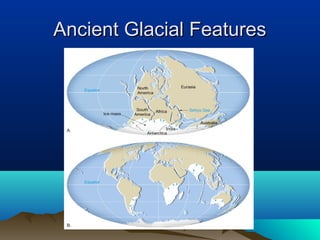
Ancient Glacial FeaturesAncient Glacial Features
• Glaciation in
Africa, South
America, India,
and Australia
during the same
time
Ancient Glacial FeaturesAncient Glacial Features
Evidence but no MethodEvidence but no Method
• While Wegener presented compelling
evidence, there was still no explanation for
HOW the continents drifted.
• The question remained: “If continents drift,
what is making them move?”
Sea Floor DiscoveriesSea Floor Discoveries
• WW II: Military Spending
• U.S. Navy mapped seafloor with sonar in
order to help ships and submarines
navigate.
• They expected to find that the ocean floor
was a vast, flat plain. What they found was
shocking.
Sea Floor DiscoveriesSea Floor Discoveries
• Instead of miles and miles of flat surface,
they found that the ocean floor had:
– oceanic ridges - submerged mountain ranges
– fracture zones - cracks perpendicular to ridge
– trenches - narrow, deep gashes
– seamounts - drowned undersea islands
Sea Floor DiscoveriesSea Floor Discoveries
• In addition, they discovered that the rocks of the
seafloor included only basalt, gabbro, and
serpentinite - no continental materials.
• This suggested that the sea floor was not simply
“covered up” continental crust, but was made of
different materials and at a different time
Sea Floor DiscoveriesSea Floor Discoveries
• Further study of these rocks led scientists
to even more surprising information:
• The sea floor’s youngest rocks were
located right at the ocean ridge – and as
you moved away from the ridge in either
direction, the rocks got progressively
older.
Sea Floor DiscoveriesSea Floor Discoveries
• What scientists discovered was that the sea floor was
being constantly “recycled.” The youngest rocks were
created from magma rising to the surface, hardening and
pushing aside the older rock.
• Scientists called this process “sea floor spreading.”
Sea Floor DiscoveriesSea Floor Discoveries
• So now we know:
– sea floor is being created at the mid-
ocean ridges
– sea floor is spreading
– the oldest ocean floor occurs at the
coastlines of continents…
• Why doesn’t the earth get
bigger? Where does the
ocean floor go? Why
doesn’t it get any older?
Sea Floor DiscoveriesSea Floor Discoveries
• The ocean floor is pushed against the
continental crust – and because it is
denser, it dives under the crust.
• This process is
called
subduction
Sea Floor DiscoveriesSea Floor Discoveries
http://www.youtube.com/watch?v=Zl89Owshdjo
The Rise of Plate TectonicsThe Rise of Plate Tectonics
• In the late 1950’s, the United States was
engaged in The Cold War with the Soviets
• To keep an eye on Soviet nuclear tests, the
U.S. military developed new, advanced
seismometers
• These seismometers were deployed in over 40
allied countries and were recording 24 hrs/day,
365 days/year
The Rise of Plate TectonicsThe Rise of Plate Tectonics
• Besides nuclear tests, the seismometers
recorded every moderate to large earthquake
on the planet.
• Scientists mapped the earthquake data and
found something they weren’t expecting:
– Armed with this high-precision earthquake data,
seismologists found that activity happens in narrow
bands.
The Rise of Plate TectonicsThe Rise of Plate Tectonics
• The discovery of these bands led scientists to
understand that the earth’s outer shell is broken
into thin, curved plates that move laterally atop
a weaker underlying layer.
• Think of it like a hard-boiled egg: you can put
cracks all over the shell of a hard-boiled egg,
but the egg is still “whole”
Types of Plate BoundariesTypes of Plate Boundaries
• The interaction of the plate edges with each other
can be classified as one of three main types of
boundaries:
• Convergent boundaries
• Divergent boundaries
• Transform boundaries
Types of Plate BoundariesTypes of Plate Boundaries
• Convergent: areas of plates that are moving
toward each other
– there are three sub-types of convergent boundaries:
• oceanic to continental
• continental to continental
• oceanic to oceanic
Types of Plate BoundariesTypes of Plate Boundaries
• Divergent: areas of plates that are moving away
from each other
Types of Plate BoundariesTypes of Plate Boundaries
• Transform: areas of plates that are sliding past
each other
Types of Plate BoundariesTypes of Plate Boundaries
• Here’s an animation of each type of plate boundary
Types of Plate BoundariesTypes of Plate Boundaries
http://www.youtube.com/watch?v=ho21AyKgD00
Review the FactsReview the Facts
Continental
Drift
Sea Floor Plate
Tectonics
1 pt1 pt
2 pt2 pt
3 pt3 pt
1 pt1 pt
2 pt2 pt
3 pt3 pt
1 pt1 pt
2 pt2 pt
3 pt3 pt
Go To Exit Slip
Continental Drift 1 ptContinental Drift 1 pt
• The scientist who first proposed the
theory of continental drift
Continental Drift 1 pt AnswerContinental Drift 1 pt Answer
• Who was Alfred Wegner?
Continental Drift 2 ptContinental Drift 2 pt
• fossils match across continents and
oceans, same rock patterns found on
five different continents, mountain
ranges match across the Atlantic
ocean
Continental Drift 2 pt AnswerContinental Drift 2 pt Answer
• What is some of the evidence
Wegner used to support his theory
that the continents were once joined?
Continental Drift 3 ptContinental Drift 3 pt
• Because he had no answer to the
question, “If the continents are
drifting, what mechanism is causing
them to move?”
Continental Drift 3 pt AnswerContinental Drift 3 pt Answer
• Why was Wegner’s theory of
continental drift widely ignored?
Sea Floor 1 ptSea Floor 1 pt
• ocean ridges, fracture zones, trenches,
seamounts
Sea Floor 1 pt AnswerSea Floor 1 pt Answer
• What did Harry Hess and the US Navy
discover when they mapped the sea floor
using sonar?
Sea Floor 2 ptSea Floor 2 pt
• The process of ocean crust “diving” under
other crust into the mantle
Sea Floor 2 pt AnswerSea Floor 2 pt Answer
• What is subduction?
Sea Floor 3 ptSea Floor 3 pt
• The process by which the newest ocean
floor is created at mid-ocean ridges,
pushing older crust outward
Sea Floor 3 pt AnswerSea Floor 3 pt Answer
• What is sea floor spreading?
Plate Tectonics 1 ptPlate Tectonics 1 pt
• What the earth’s outer shell is broken into
Plate Tectonics 1 pt AnswerPlate Tectonics 1 pt Answer
• What are plates?
Plate Tectonics 2 ptPlate Tectonics 2 pt
• Instrument deployed by US Military to spy
on soviet nuclear tests which also detected
medium-to-large earthquakes.
Plate Tectonics 2 pt AnswerPlate Tectonics 2 pt Answer
• What is a seismometer?
Plate Tectonics 3 ptPlate Tectonics 3 pt
• The three ways plate boundaries interact
Plate Tectonics 3 pt AnswerPlate Tectonics 3 pt Answer
• What are convergent, divergent, &
transform?
Review – Exit SlipReview – Exit Slip
• Choose what you believe to be the strongest piece of
evidence Wegner uncovered to support the idea of
continental drift and explain why you think it is the most
convincing.
• If new sea floor is constantly being created, why isn’t the
earth growing in size?
• How did earthquakes help scientists to understand the
structure of the earth’s crust?
• THE FINE PRINT
• © Jan Parker, 2010 – for purchaser’s classroom use only; please do not distribute. If other teachers in your school like what
they see, send them to my website http://www.thesciencevault.com or to my web store
http://www.teacherspayteachers.com/Store/Jan-Parker 
• If you put your classroom materials on a server for your students, please post this presentation in pdf form. Thanks!

Continental Drift Plate Tectonics

  • 1.
    Continental Drift &Plate TectonicsContinental Drift & Plate Tectonics
  • 2.
    Continental Drift TheoryContinentalDrift Theory • First proposed by Alfred Wegener in 1912: – 250 million years ago, all of the continents were combined into one super-continent called “Pangaea” – The continents gradually drifted apart to where they are today • Wegner didn’t make up this theory out of the blue – like all scientists, he based it on evidence
  • 3.
    Evidence SummaryEvidence Summary •Geographic fit of South America and Africa • Fossils match across oceans • Rock types and structures match across oceans • Ancient glacial features
  • 4.
    Geographic FitGeographic Fit •Continents look like they could be part of a giant jigsaw puzzle • Here’s how they moved apart
  • 5.
    Fossils MatchFossils Match •Plant and animal fossils found on the coastlines of different continents
  • 6.
    Fossil Fuel inAntarcticaFossil Fuel in Antarctica • Tropical plant remains (coal deposits) found in Antarctica – this is evidence that Antarctica was once much warmer and much closer to the equator, since tropical plants don’t grow in Antarctica today
  • 7.
    Rock Structures MatchAcross OceansRock Structures Match Across Oceans • Same rock patterns found in South America, India, Africa, Antarctica and Australia
  • 8.
    Rock Structures MatchAcross OceansRock Structures Match Across Oceans
  • 9.
    Ancient Glacial FeaturesAncientGlacial Features • Glaciation in Africa, South America, India, and Australia during the same time
  • 10.
  • 11.
    Evidence but noMethodEvidence but no Method • While Wegener presented compelling evidence, there was still no explanation for HOW the continents drifted. • The question remained: “If continents drift, what is making them move?”
  • 12.
    Sea Floor DiscoveriesSeaFloor Discoveries • WW II: Military Spending • U.S. Navy mapped seafloor with sonar in order to help ships and submarines navigate. • They expected to find that the ocean floor was a vast, flat plain. What they found was shocking.
  • 13.
    Sea Floor DiscoveriesSeaFloor Discoveries • Instead of miles and miles of flat surface, they found that the ocean floor had: – oceanic ridges - submerged mountain ranges – fracture zones - cracks perpendicular to ridge – trenches - narrow, deep gashes – seamounts - drowned undersea islands
  • 14.
    Sea Floor DiscoveriesSeaFloor Discoveries • In addition, they discovered that the rocks of the seafloor included only basalt, gabbro, and serpentinite - no continental materials. • This suggested that the sea floor was not simply “covered up” continental crust, but was made of different materials and at a different time
  • 15.
    Sea Floor DiscoveriesSeaFloor Discoveries • Further study of these rocks led scientists to even more surprising information: • The sea floor’s youngest rocks were located right at the ocean ridge – and as you moved away from the ridge in either direction, the rocks got progressively older.
  • 16.
    Sea Floor DiscoveriesSeaFloor Discoveries
  • 17.
    Sea Floor DiscoveriesSeaFloor Discoveries • What scientists discovered was that the sea floor was being constantly “recycled.” The youngest rocks were created from magma rising to the surface, hardening and pushing aside the older rock. • Scientists called this process “sea floor spreading.”
  • 18.
    Sea Floor DiscoveriesSeaFloor Discoveries • So now we know: – sea floor is being created at the mid- ocean ridges – sea floor is spreading – the oldest ocean floor occurs at the coastlines of continents… • Why doesn’t the earth get bigger? Where does the ocean floor go? Why doesn’t it get any older?
  • 19.
    Sea Floor DiscoveriesSeaFloor Discoveries • The ocean floor is pushed against the continental crust – and because it is denser, it dives under the crust. • This process is called subduction
  • 20.
    Sea Floor DiscoveriesSeaFloor Discoveries http://www.youtube.com/watch?v=Zl89Owshdjo
  • 21.
    The Rise ofPlate TectonicsThe Rise of Plate Tectonics • In the late 1950’s, the United States was engaged in The Cold War with the Soviets • To keep an eye on Soviet nuclear tests, the U.S. military developed new, advanced seismometers • These seismometers were deployed in over 40 allied countries and were recording 24 hrs/day, 365 days/year
  • 22.
    The Rise ofPlate TectonicsThe Rise of Plate Tectonics • Besides nuclear tests, the seismometers recorded every moderate to large earthquake on the planet. • Scientists mapped the earthquake data and found something they weren’t expecting: – Armed with this high-precision earthquake data, seismologists found that activity happens in narrow bands.
  • 23.
    The Rise ofPlate TectonicsThe Rise of Plate Tectonics
  • 24.
    The Rise ofPlate TectonicsThe Rise of Plate Tectonics • The discovery of these bands led scientists to understand that the earth’s outer shell is broken into thin, curved plates that move laterally atop a weaker underlying layer. • Think of it like a hard-boiled egg: you can put cracks all over the shell of a hard-boiled egg, but the egg is still “whole”
  • 25.
    Types of PlateBoundariesTypes of Plate Boundaries • The interaction of the plate edges with each other can be classified as one of three main types of boundaries: • Convergent boundaries • Divergent boundaries • Transform boundaries
  • 26.
    Types of PlateBoundariesTypes of Plate Boundaries • Convergent: areas of plates that are moving toward each other – there are three sub-types of convergent boundaries: • oceanic to continental • continental to continental • oceanic to oceanic
  • 27.
    Types of PlateBoundariesTypes of Plate Boundaries • Divergent: areas of plates that are moving away from each other
  • 28.
    Types of PlateBoundariesTypes of Plate Boundaries • Transform: areas of plates that are sliding past each other
  • 29.
    Types of PlateBoundariesTypes of Plate Boundaries • Here’s an animation of each type of plate boundary
  • 30.
    Types of PlateBoundariesTypes of Plate Boundaries
  • 31.
    Types of PlateBoundariesTypes of Plate Boundaries http://www.youtube.com/watch?v=ho21AyKgD00
  • 32.
    Review the FactsReviewthe Facts Continental Drift Sea Floor Plate Tectonics 1 pt1 pt 2 pt2 pt 3 pt3 pt 1 pt1 pt 2 pt2 pt 3 pt3 pt 1 pt1 pt 2 pt2 pt 3 pt3 pt Go To Exit Slip
  • 33.
    Continental Drift 1ptContinental Drift 1 pt • The scientist who first proposed the theory of continental drift
  • 34.
    Continental Drift 1pt AnswerContinental Drift 1 pt Answer • Who was Alfred Wegner?
  • 35.
    Continental Drift 2ptContinental Drift 2 pt • fossils match across continents and oceans, same rock patterns found on five different continents, mountain ranges match across the Atlantic ocean
  • 36.
    Continental Drift 2pt AnswerContinental Drift 2 pt Answer • What is some of the evidence Wegner used to support his theory that the continents were once joined?
  • 37.
    Continental Drift 3ptContinental Drift 3 pt • Because he had no answer to the question, “If the continents are drifting, what mechanism is causing them to move?”
  • 38.
    Continental Drift 3pt AnswerContinental Drift 3 pt Answer • Why was Wegner’s theory of continental drift widely ignored?
  • 39.
    Sea Floor 1ptSea Floor 1 pt • ocean ridges, fracture zones, trenches, seamounts
  • 40.
    Sea Floor 1pt AnswerSea Floor 1 pt Answer • What did Harry Hess and the US Navy discover when they mapped the sea floor using sonar?
  • 41.
    Sea Floor 2ptSea Floor 2 pt • The process of ocean crust “diving” under other crust into the mantle
  • 42.
    Sea Floor 2pt AnswerSea Floor 2 pt Answer • What is subduction?
  • 43.
    Sea Floor 3ptSea Floor 3 pt • The process by which the newest ocean floor is created at mid-ocean ridges, pushing older crust outward
  • 44.
    Sea Floor 3pt AnswerSea Floor 3 pt Answer • What is sea floor spreading?
  • 45.
    Plate Tectonics 1ptPlate Tectonics 1 pt • What the earth’s outer shell is broken into
  • 46.
    Plate Tectonics 1pt AnswerPlate Tectonics 1 pt Answer • What are plates?
  • 47.
    Plate Tectonics 2ptPlate Tectonics 2 pt • Instrument deployed by US Military to spy on soviet nuclear tests which also detected medium-to-large earthquakes.
  • 48.
    Plate Tectonics 2pt AnswerPlate Tectonics 2 pt Answer • What is a seismometer?
  • 49.
    Plate Tectonics 3ptPlate Tectonics 3 pt • The three ways plate boundaries interact
  • 50.
    Plate Tectonics 3pt AnswerPlate Tectonics 3 pt Answer • What are convergent, divergent, & transform?
  • 51.
    Review – ExitSlipReview – Exit Slip • Choose what you believe to be the strongest piece of evidence Wegner uncovered to support the idea of continental drift and explain why you think it is the most convincing. • If new sea floor is constantly being created, why isn’t the earth growing in size? • How did earthquakes help scientists to understand the structure of the earth’s crust?
  • 52.
    • THE FINEPRINT • © Jan Parker, 2010 – for purchaser’s classroom use only; please do not distribute. If other teachers in your school like what they see, send them to my website http://www.thesciencevault.com or to my web store http://www.teacherspayteachers.com/Store/Jan-Parker  • If you put your classroom materials on a server for your students, please post this presentation in pdf form. Thanks!