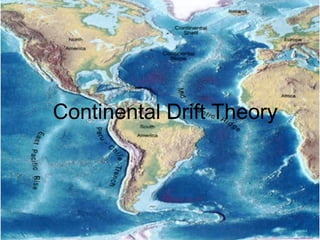
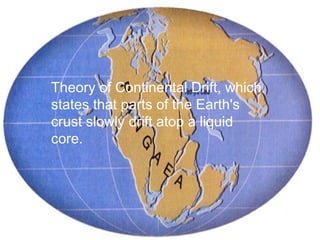
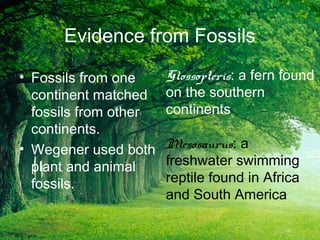
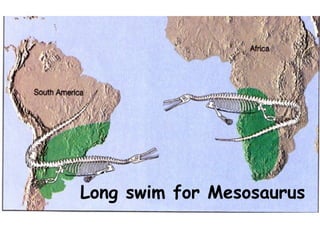
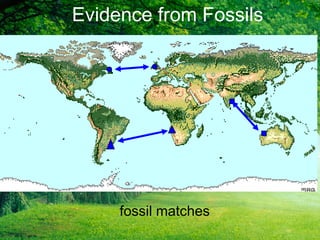
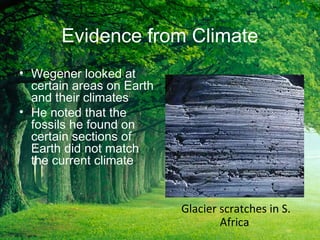
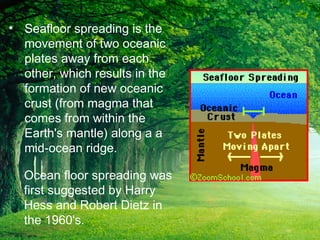
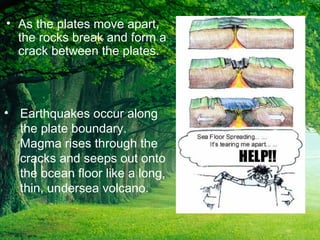
Alfred Wegener first proposed the theory of continental drift in 1910, suggesting that the continents were once joined together in a supercontinent called Pangaea. Wegener provided three lines of evidence to support his theory: the matching shapes of continental coastlines, matching fossil distributions across continents, and evidence that past climates did not match current continental positions. While his theory was initially rejected due to the lack of a mechanism, it was later supported by the discovery of seafloor spreading in the 1960s, which provided a process to explain how and why continents move over Earth's surface.












![谷歌留痕技术 [ 𝙩𝙤𝙥 𝟮𝟯𝟯. 𝙘 𝙤𝙢 ]](https://cdn.slidesharecdn.com/ss_thumbnails/top233-260130174328-3833018c-thumbnail.jpg?width=640&height=640&fit=bounds)


