Species
Biospecies
• An array of populations which are
actually or potentially interbreeding to
produce viable offspring, and which are
reproductively isolated from other such
arrays under natural conditions
Biospecies
• An array of populations which are
actually or potentially interbreeding to
produce viable offspring, and which are
reproductively isolated from other such
arrays under natural conditions
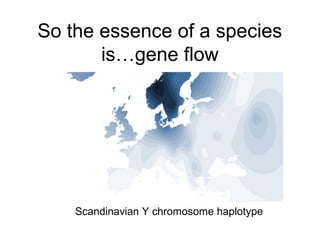
So the essence of a species
is…gene flow
Scandinavian Y chromosome haplotype
Biospecies
• An array of populations which are
actually or potentially interbreeding to
produce viable offspring, and which are
reproductively isolated from other such
arrays under natural conditions
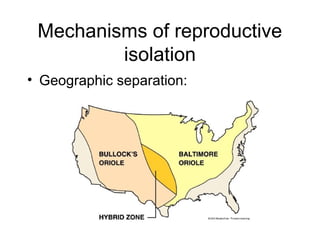
Mechanisms of reproductive
isolation
• Geographic separation:
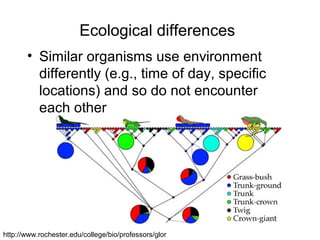
Ecological differences
• Similar organisms use environment
differently (e.g., time of day, specific
locations) and so do not encounter
each other
http://www.rochester.edu/college/bio/professors/glor
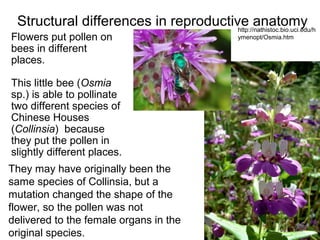
Structural differences in reproductive anatomy
Flowers put pollen on
bees in different
places.
This little bee (Osmia
sp.) is able to pollinate
two different species of
Chinese Houses
(Collinsia) because
they put the pollen in
slightly different places.
They may have originally been the
same species of Collinsia, but a
mutation changed the shape of the
flower, so the pollen was not
delivered to the female organs in the
original species.
http://nathistoc.bio.uci.edu/h
ymenopt/Osmia.htm
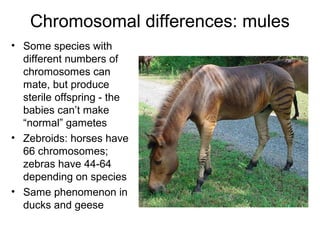
Chromosomal differences: mules
• Some species with
different numbers of
chromosomes can
mate, but produce
sterile offspring - the
babies can’t make
“normal” gametes
• Zebroids: horses have
66 chromosomes;
zebras have 44-64
depending on species
• Same phenomenon in
ducks and geese
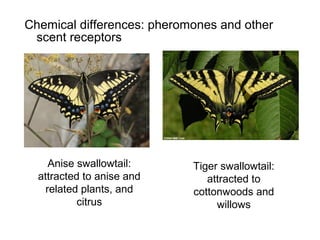
Chemical differences: pheromones and other
scent receptors
Anise swallowtail:
attracted to anise and
related plants, and
citrus
Tiger swallowtail:
attracted to
cottonwoods and
willows
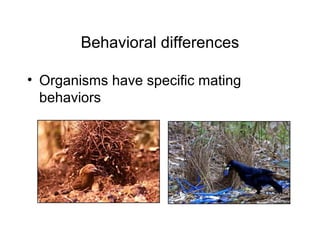
Behavioral differences
• Organisms have specific mating
behaviors
Biospecies
• An array of populations which are
actually or potentially interbreeding to
produce viable offspring, and which are
reproductively isolated from other such
arrays under natural conditions
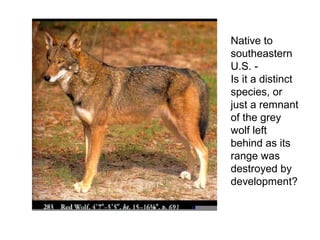
Native to
southeastern
U.S. -
Is it a distinct
species, or
just a remnant
of the grey
wolf left
behind as its
range was
destroyed by
development?
Biospecies
Challenges
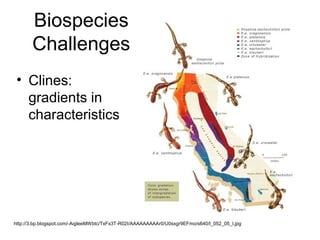
• Clines:
gradients in
characteristics
http://3.bp.blogspot.com/-AqjleeMWbtc/TxFx3T-R02I/AAAAAAAAAr0/U0sxgr9EFmo/s640/l_052_05_l.jpg
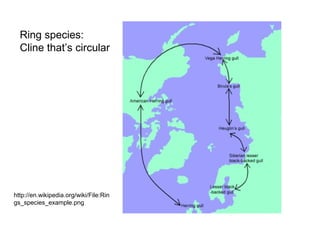
Ring species:
Cline that’s circular
http://en.wikipedia.org/wiki/File:Rin
gs_species_example.png
Morphospecies
• A diagnosable cluster of individuals
within which there is a pattern on
ancestry and descent, and beyond
which there is not
• In practice - critters that look alike
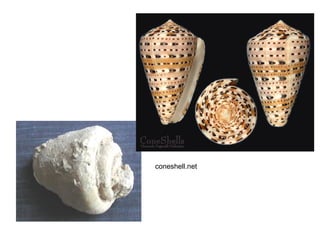
Applying morphospecies
concept to fossils
• No behavioral evidence left behind
• Lost morphological characters, e.g.
color
coneshell.net
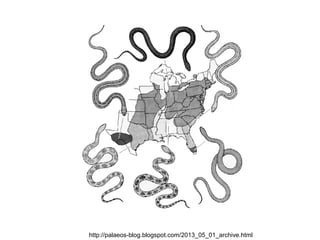
Applying morphospecies
• Distinguishing variation in species from
overlapping species
http://palaeos-blog.blogspot.com/2013_05_01_archive.html
Applying morphospecies
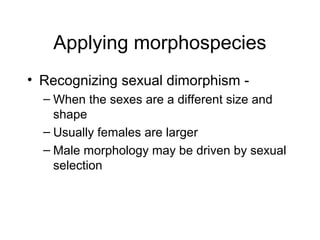
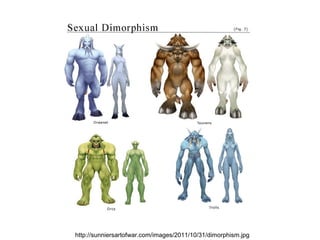
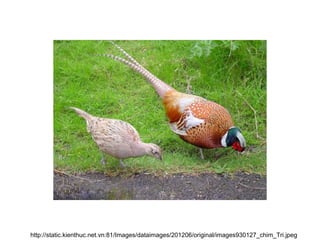
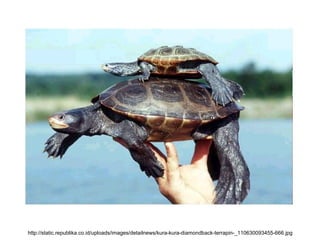
• Recognizing sexual dimorphism -
– When the sexes are a different size and
shape
– Usually females are larger
– Male morphology may be driven by sexual
selection
http://sunniersartofwar.com/images/2011/10/31/dimorphism.jpg
http://static.kienthuc.net.vn:81/Images/dataimages/201206/original/images930127_chim_Tri.jpeg
http://static.republika.co.id/uploads/images/detailnews/kura-kura-diamondback-terrapin-_110630093455-666.jpg
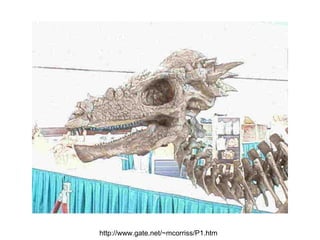
http://www.gate.net/~mcorriss/P1.htm
Applying morphospecies
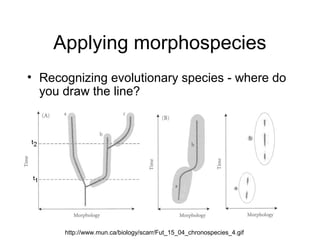
• Recognizing evolutionary species - where do
you draw the line?
http://www.mun.ca/biology/scarr/Fut_15_04_chronospecies_4.gif
Defining morphospecies
• Choosing the type
– Must be one specimen that defines the
species (holotype)
– Useful to have other specimens that
illustrate variation (paratypes)
Speciation
• When a population becomes
reproductively isolated and persists
• The speciation event is NOT typically a
product of natural selection, but some
kind of geographic or biologic accident
• After the event the species may diverge
by natural selection or other
mechanisms
Speciation Mechanisms
• Allopatric - geographic separation
– A population becomes separated
– No more gene flow to other populations -
poof, new biospecies on an operational
level
– Over time, the new population evolves in
its own direction
– When is it different enough to consider a
separate morphospecies?
Allopatric speciation
• How does the new species become
morphologically different from the
parent species?
– Natural selection
– Founder effect – NOT natural selection
– Genetic drift – NOT natural selection
Allopatric speciation
• Natural selection - the new species may
adapt differently to new environment or
with a different set of mutations
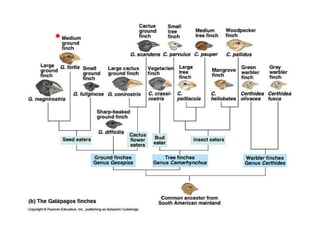
– E.g. Darwin’s finches -
– Different food plants on different islands
meant finches adapted differently
Allopatric Speciation
• Founder effect : The separated
population will have only a piece of the
total genetic variation of the species
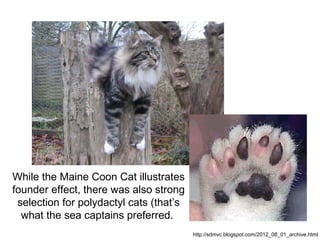
– The mutation for polydactyl cats apparently
arose in Southeast England. They were
carried to Maine as ship’s cats (for good
luck) and were the beginning of the Maine
Coon Cat.
While the Maine Coon Cat illustrates
founder effect, there was also strong
selection for polydactyl cats (that’s
what the sea captains preferred.
http://sdmvc.blogspot.com/2012_08_01_archive.html
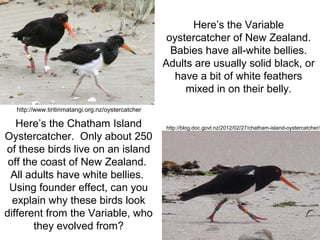
Here’s the Variable
oystercatcher of New Zealand.
Babies have all-white bellies.
Adults are usually solid black, or
have a bit of white feathers
mixed in on their belly.
Here’s the Chatham Island
Oystercatcher. Only about 250
of these birds live on an island
off the coast of New Zealand.
All adults have white bellies.
Using founder effect, can you
explain why these birds look
different from the Variable, who
they evolved from?
http://blog.doc.govt.nz/2012/02/27/chatham-island-oystercatcher/
http://www.tiritirimatangi.org.nz/oystercatcher
Allopatric speciation
• Genetic drift - over time the new
species accumulates neutral changes in
genes
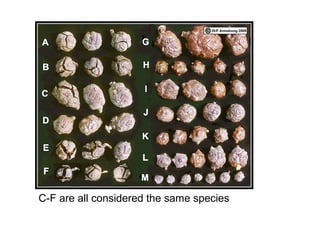
– E.g. accumulated changes in isolated
populations of cypress trees in the
Southwest
– Once solid forest, broken into patches as
the region’s climate became drier in the
post-glacial time.
– Cypresses were isolated from those in
other patches. Each patch accumulated its
own mutations.
C-F are all considered the same species
Sympatric speciation
• Occurs within a population, requires NO
geographic separation
• Can occur from changes in any of the
reproductive isolation mechanisms we
already talked about:
– Chromosomal, structural, ecological,
chemical, behavioral
Examples of sympatric
speciation
• Chromosomal: wheat
– Two diploid (paired chromosomes) wild
grasses hybridized to form a tetraploid
wheat (2 sets of paired chromosomes)
• Structural: Chinese Houses flower
• Chemical: anise swallowtail
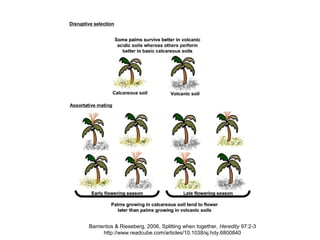
• Ecological: palms on Lord Howe Island
Barrientos & Rieseberg, 2006, Splitting when together, Heredity 97:2-3
http://www.readcube.com/articles/10.1038/sj.hdy.6800840
Examples of sympatric
speciation
• Chromosomal: wheat
– Formed by accidental duplication of
chromosomes
• Structural: Chinese Houses flower
• Chemical: anise swallowtail
• Ecological: palms on Lord Howe Island
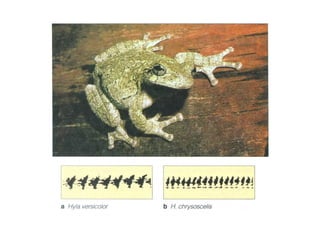
• Behavioral: frog songs
Tempo and Pattern of
Speciation
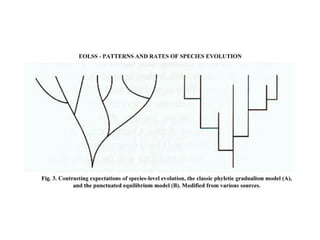
• Phyletic gradualism: gradual change
form one species to another
• Punctuated equilibrium: species arise
quickly, then stay the same over time
What does each imply about
evolution?
• Phyletic -
– Environments change
gradually on a geologic
time scale, driving
change in populations
– OR genetic drift is
responsible for much of
the morphologic change
in new species
• Punctuated:
– Environments change
quickly, then remain
stable
– OR geographic isolation
occurs quickly
– OR reproductive
isolation occurs quickly
and is accompanied by
rapid morphologic
change
So which pattern is “right”?
• Different kinds of organisms show
different kinds of patterns
• Some even show a hybrid - punctuated
gradualism
– Rapid speciation, followed by gradual
change over time
– Typical of single-celled organisms that rely
less on sexual reproduction

Shine 1

  • 1.
  • 2.
    Biospecies • An arrayof populations which are actually or potentially interbreeding to produce viable offspring, and which are reproductively isolated from other such arrays under natural conditions
  • 3.
    Biospecies • An arrayof populations which are actually or potentially interbreeding to produce viable offspring, and which are reproductively isolated from other such arrays under natural conditions
  • 4.
    So the essenceof a species is…gene flow Scandinavian Y chromosome haplotype
  • 5.
    Biospecies • An arrayof populations which are actually or potentially interbreeding to produce viable offspring, and which are reproductively isolated from other such arrays under natural conditions
  • 6.
  • 7.
    Ecological differences • Similarorganisms use environment differently (e.g., time of day, specific locations) and so do not encounter each other http://www.rochester.edu/college/bio/professors/glor
  • 8.
    Structural differences inreproductive anatomy Flowers put pollen on bees in different places. This little bee (Osmia sp.) is able to pollinate two different species of Chinese Houses (Collinsia) because they put the pollen in slightly different places. They may have originally been the same species of Collinsia, but a mutation changed the shape of the flower, so the pollen was not delivered to the female organs in the original species. http://nathistoc.bio.uci.edu/h ymenopt/Osmia.htm
  • 9.
    Chromosomal differences: mules •Some species with different numbers of chromosomes can mate, but produce sterile offspring - the babies can’t make “normal” gametes • Zebroids: horses have 66 chromosomes; zebras have 44-64 depending on species • Same phenomenon in ducks and geese
  • 10.
    Chemical differences: pheromonesand other scent receptors Anise swallowtail: attracted to anise and related plants, and citrus Tiger swallowtail: attracted to cottonwoods and willows
  • 11.
    Behavioral differences • Organismshave specific mating behaviors
  • 12.
    Biospecies • An arrayof populations which are actually or potentially interbreeding to produce viable offspring, and which are reproductively isolated from other such arrays under natural conditions
  • 13.
    Native to southeastern U.S. - Isit a distinct species, or just a remnant of the grey wolf left behind as its range was destroyed by development?
  • 14.
  • 15.
    Ring species: Cline that’scircular http://en.wikipedia.org/wiki/File:Rin gs_species_example.png
  • 16.
    Morphospecies • A diagnosablecluster of individuals within which there is a pattern on ancestry and descent, and beyond which there is not • In practice - critters that look alike
  • 17.
    Applying morphospecies concept tofossils • No behavioral evidence left behind • Lost morphological characters, e.g. color
  • 18.
  • 19.
    Applying morphospecies • Distinguishingvariation in species from overlapping species
  • 20.
  • 21.
    Applying morphospecies • Recognizingsexual dimorphism - – When the sexes are a different size and shape – Usually females are larger – Male morphology may be driven by sexual selection
  • 22.
  • 23.
  • 24.
  • 25.
  • 27.
    Applying morphospecies • Recognizingevolutionary species - where do you draw the line? http://www.mun.ca/biology/scarr/Fut_15_04_chronospecies_4.gif
  • 28.
    Defining morphospecies • Choosingthe type – Must be one specimen that defines the species (holotype) – Useful to have other specimens that illustrate variation (paratypes)
  • 29.
    Speciation • When apopulation becomes reproductively isolated and persists • The speciation event is NOT typically a product of natural selection, but some kind of geographic or biologic accident • After the event the species may diverge by natural selection or other mechanisms
  • 30.
    Speciation Mechanisms • Allopatric- geographic separation – A population becomes separated – No more gene flow to other populations - poof, new biospecies on an operational level – Over time, the new population evolves in its own direction – When is it different enough to consider a separate morphospecies?
  • 31.
    Allopatric speciation • Howdoes the new species become morphologically different from the parent species? – Natural selection – Founder effect – NOT natural selection – Genetic drift – NOT natural selection
  • 32.
    Allopatric speciation • Naturalselection - the new species may adapt differently to new environment or with a different set of mutations – E.g. Darwin’s finches - – Different food plants on different islands meant finches adapted differently
  • 34.
    Allopatric Speciation • Foundereffect : The separated population will have only a piece of the total genetic variation of the species – The mutation for polydactyl cats apparently arose in Southeast England. They were carried to Maine as ship’s cats (for good luck) and were the beginning of the Maine Coon Cat.
  • 35.
    While the MaineCoon Cat illustrates founder effect, there was also strong selection for polydactyl cats (that’s what the sea captains preferred. http://sdmvc.blogspot.com/2012_08_01_archive.html
  • 36.
    Here’s the Variable oystercatcherof New Zealand. Babies have all-white bellies. Adults are usually solid black, or have a bit of white feathers mixed in on their belly. Here’s the Chatham Island Oystercatcher. Only about 250 of these birds live on an island off the coast of New Zealand. All adults have white bellies. Using founder effect, can you explain why these birds look different from the Variable, who they evolved from? http://blog.doc.govt.nz/2012/02/27/chatham-island-oystercatcher/ http://www.tiritirimatangi.org.nz/oystercatcher
  • 37.
    Allopatric speciation • Geneticdrift - over time the new species accumulates neutral changes in genes – E.g. accumulated changes in isolated populations of cypress trees in the Southwest – Once solid forest, broken into patches as the region’s climate became drier in the post-glacial time. – Cypresses were isolated from those in other patches. Each patch accumulated its own mutations.
  • 38.
    C-F are allconsidered the same species
  • 39.
    Sympatric speciation • Occurswithin a population, requires NO geographic separation • Can occur from changes in any of the reproductive isolation mechanisms we already talked about: – Chromosomal, structural, ecological, chemical, behavioral
  • 40.
    Examples of sympatric speciation •Chromosomal: wheat – Two diploid (paired chromosomes) wild grasses hybridized to form a tetraploid wheat (2 sets of paired chromosomes) • Structural: Chinese Houses flower • Chemical: anise swallowtail • Ecological: palms on Lord Howe Island
  • 41.
    Barrientos & Rieseberg,2006, Splitting when together, Heredity 97:2-3 http://www.readcube.com/articles/10.1038/sj.hdy.6800840
  • 42.
    Examples of sympatric speciation •Chromosomal: wheat – Formed by accidental duplication of chromosomes • Structural: Chinese Houses flower • Chemical: anise swallowtail • Ecological: palms on Lord Howe Island • Behavioral: frog songs
  • 44.
    Tempo and Patternof Speciation • Phyletic gradualism: gradual change form one species to another • Punctuated equilibrium: species arise quickly, then stay the same over time
  • 46.
    What does eachimply about evolution? • Phyletic - – Environments change gradually on a geologic time scale, driving change in populations – OR genetic drift is responsible for much of the morphologic change in new species • Punctuated: – Environments change quickly, then remain stable – OR geographic isolation occurs quickly – OR reproductive isolation occurs quickly and is accompanied by rapid morphologic change
  • 47.
    So which patternis “right”? • Different kinds of organisms show different kinds of patterns • Some even show a hybrid - punctuated gradualism – Rapid speciation, followed by gradual change over time – Typical of single-celled organisms that rely less on sexual reproduction