TERM PAPER PRESENTATION
SPECIATION IN INSECTS
Submitted to :
Dr. P. Rajanikanth
Associate Professor
Dept. of Entomology
Submitted by:
G.Satish
RAM/2018-48
COURSE TITLE :INSECT ECOLOGY
COURSE NO :ENT-505
SPECIES
• Species is defined as the population of organisms which
possess high level of similarity that can be reflected by
means of an adaptation to the same niche or transfer of
genetic material from one individual to other.
• Species have been defined based on differences among
the individuals either genetically or morphologically or
ability to interbreed or a common lineage.
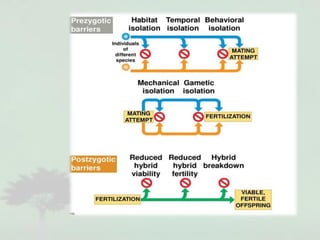
• However in all the cases development of barriers like
morphological ,behavioral or physiological including
genetic and cytoplasmic incompatibility lead to the
formation of new species by interbreeding.
Different concepts of species
• Ernst Mayr (1957) reviewed the works of others on species
and all these definitions given so far are broadly grouped into
three main concepts
• Typological species concept
• Nominalistic species concept
• Biological species concept
• Evolutionary species concept(Grant,1971)
Typological species concept
• This concept is based on a group of individuals of one type
sharing a list of traits which constitutea species.
• If two individuals appear sufficiently different, they are
different species.
• The species can be recognised by their essential characters
and these are expressed in their morphology.
• It is also called as the morphological species concept.
• Criticism :
• Individuals of same species shows some morphological
differences due to sexual dimorphism,age differences,
polymorphism.
Nominalistic species concept
• According to this concept, though nature produces individuals
but they are described by human beings.
• These are the mental concepts given by man to refer a great
no. of individuals collectively.
• Criticism :
• No biologist will agree that species are man made, when it is
established that they are products of evolution.
Biological species concept
• According to this, species are group of naturally or potentially
interbreeding organisms which are reproductively isolated
from other groups producing a fertile off spring.
• According to this species have 3 different functions
• It forms a reproductive community with genetic programme
of every individual ensuring intra specific reproduction
• It should form an ecological unit, since the individuals interact
as a unit with other species that share same environment.
• It should form a genetic unit consisting of large
intercommunicatinggene pool , categorise all individuals
belonging to the same species which can reproduce with each
other
Evolutionary species concept
• This concept explains how species forms a group of
individuals which share an ancestor or lineage that
maintains its integrity with respect to other lineages
through time and space.
• Simpson & Wiley defined species as lineages that
have their own evolutionary histories.
• Dr. Alfred E. Emerson attempted to combine the
biological species concept and evolutionary species
concept and defined true species as that which has
evolved or evolving , reproductively isolated and
genetically distinct groups of natural population.
Speciation
• Speciation is the evolutionary process by which
biological populations evolve to become distinct
species.
• The biologist Orator Fuller Cook coined the term
speciation in 1906.
• As per the biological concept, species is a group of
organisms that interbreed under natural conditions
and that are reproductively isolated from each other.
How do populationsbecome reproductively
isolated ?
• Selection and genetic drift causes gene mutations
and altered allele frequencies causes isolation within
species.
• To maintain as a single species, there must be gene
flow between populations.
• Mating between members of separated populations
allow mixing of alleles.
• In the absence of gene flow, mutations in different
populations will be independent.
• Allele frequencies change independently.
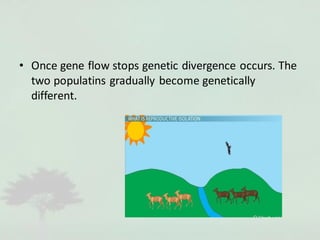
• Once gene flow stops genetic divergence occurs. The
two populatins gradually become genetically
different.
What properties of sexually reproducing
organisms leads to evolution of discrete species?
• Two explanationsexist :
• Ecological explanation
• Sexual isolation explanation
Ecological explanation :
• The ecological explanation states that ecological
niches are discrete and that clusters of different
species exploit different physical resources.
• Selection : A process in which environmental or
genetic influences determine which types of
organisms thrive better than others , regarded as a
factor in evolution.
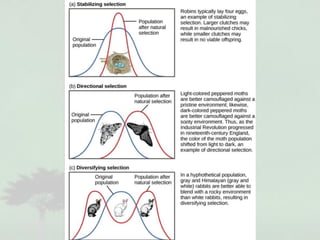
DIRECTIONAL SELECTION: a mode of natural selection in
which a single phenotype is favored, causing the allele
frequency to continuouslyshift in one direction
DISRUPTIVE SELECTION: (or diversifying selection) a
mode of natural selection in which extreme values for a
trait are favored over intermediate values
STABILIZING SELECTION: a type of natural selection in
which genetic diversity decreases as the population
stabilizes on a particular trait
value
Sexual isolation explanation
• The sexual isolation explanation states the
individuals of the same species will adapt to the
different environment.
• Over the time the number of differences will increase
and result in the formation of new species.
• Speciation in sexually reproducing organisms is based
on evolution of reproductive barriers for the gene
flow between populations.
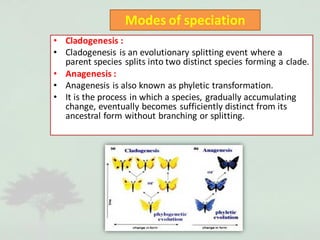
Modes of speciation
• Cladogenesis :
• Cladogenesis is an evolutionary splitting event where a
parent species splits into two distinct species forming a clade.
• Anagenesis :
• Anagenesis is also known as phyletic transformation.
• It is the process in which a species, gradually accumulating
change, eventually becomes sufficiently distinct from its
ancestral form without branching or splitting.
Types of speciation
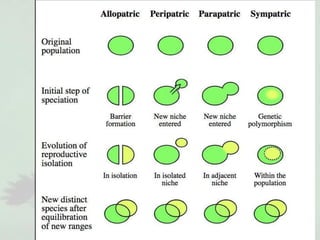
• Allopatric speciation
• Peripatric speciation
• Parapatric speciation
• Sympatric speciation
Allopatric speciation
• Allopatric speciation (from the Greek word ‘allos’
meaning other and ‘patris’ meaning fatherland.
• It is also referred to as geographic speciation
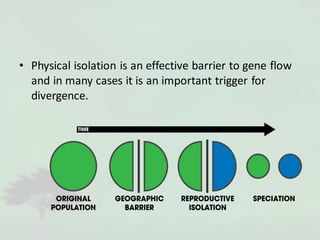
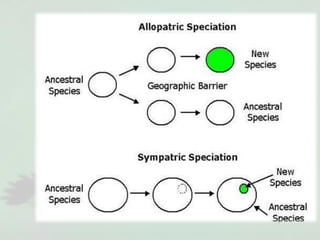
• In allopatric speciation populations are separated by
geographicalisolation.
• In allopatric speciation extrinsic factors - great distance
or a physical barrier prevents two or more groups from
mating.
• Various geographic changes can arise such as formation
of mountains , islands ,water bodies or glaciers.
• Physical isolation is an effective barrier to gene flow
and in many cases it is an important trigger for
divergence.
Peripatric speciation
• Peripatric speciation is a mode of speciation in which
a new species is formed from an isolated peripheral
population.
• Peripatric speciation resembles allopatric speciation.
• Nevertheless, the primary characteristic of peripatric
speciation proposes that one of the population is
much smaller than the other.
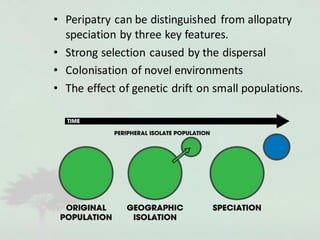
• Peripatry can be distinguished from allopatry
speciation by three key features.
• Strong selection caused by the dispersal
• Colonisation of novel environments
• The effect of genetic drift on small populations.
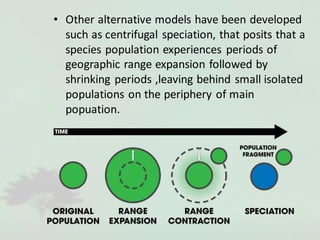
• Other alternative models have been developed
such as centrifugal speciation, that posits that a
species population experiences periods of
geographic range expansion followed by
shrinking periods ,leaving behind small isolated
populations on the periphery of main
popuation.
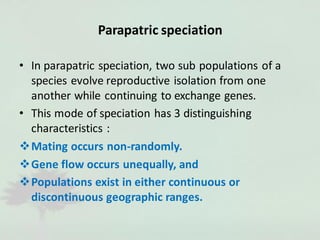
Parapatric speciation
• In parapatric speciation, two sub populations of a
species evolve reproductive isolation from one
another while continuing to exchange genes.
• This mode of speciation has 3 distinguishing
characteristics :
❖Mating occurs non-randomly.
❖Gene flow occurs unequally, and
❖Populations exist in either continuous or
discontinuous geographic ranges.
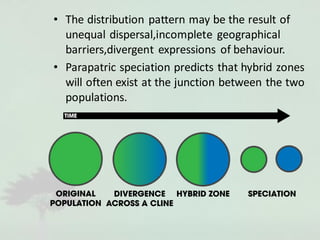
• The distribution pattern may be the result of
unequal dispersal,incomplete geographical
barriers,divergent expressions of behaviour.
• Parapatric speciation predicts that hybrid zones
will often exist at the junction between the two
populations.
Sympatric speciation
• Sympatry is derived from Greek word ‘sym’
means together and ‘patric’ means homeland.
• The term was invented by Poulton in 1904.
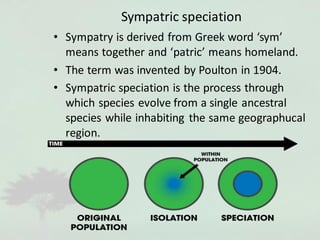
• Sympatric speciation is the process through
which species evolve from a single ancestral
species while inhabiting the same geographucal
region.
Mechanisms of speciation
I. Assortative mating
II. Reinforcement
III. Selection
IV. Sexual selection
V. Polyploidy
Assortative mating
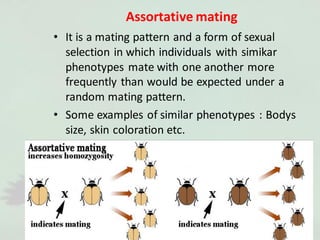
• It is a mating pattern and a form of sexual
selection in which individuals with simikar
phenotypes mate with one another more
frequently than would be expected under a
random mating pattern.
• Some examples of similar phenotypes : Bodys
size, skin coloration etc.
Reinforcement
• Reinforcement is a process of speciation where
pre-zygotic isolation is enhanced by natural
selection against hybrids between two
populations of a species.
• This idea was developed by Alfred Russel Wallace
& it is also known as Wallace effect.
Natural selection
• Charles Darwin popularised the term natural
selection.
• Natural selection is the differential survival and
reproduction of indviduals due to differences in
phenotype.
• It is a key mechanism of evolution, the change is in
heritable traits of a population over time.
• This occurs because random mutations arise in the
genome of an individual organism, and offspring can
inherit such mutations.
Sexual selection
• Sexual selection is a mode of natural selection where
members of one biological sex choose mates of the
other sex to mate with (intersexual selection), and
compete with members of same sex for access to
members of the opposite sex(intrasexual selection)
• These two forms of selection mean that some
individuals have better reproductive success than
others within a population either from being attractive
or preferringmore attractive partners to produce the
offspring.
Polyploidy
• Polyploid cells and organisms are those
containing more than two
paired(homologous) sets of chromosomes.
• Most species whose cells have nuclei in
diploid condition, meaning they have two sets
of chromosomes , one set inherited from
each parent.
• Polyploidy is found in some organisms and is
especially common in plants.
THANK YOU

Speciation in insects.

  • 1.
    TERM PAPER PRESENTATION SPECIATIONIN INSECTS Submitted to : Dr. P. Rajanikanth Associate Professor Dept. of Entomology Submitted by: G.Satish RAM/2018-48 COURSE TITLE :INSECT ECOLOGY COURSE NO :ENT-505
  • 2.
    SPECIES • Species isdefined as the population of organisms which possess high level of similarity that can be reflected by means of an adaptation to the same niche or transfer of genetic material from one individual to other. • Species have been defined based on differences among the individuals either genetically or morphologically or ability to interbreed or a common lineage. • However in all the cases development of barriers like morphological ,behavioral or physiological including genetic and cytoplasmic incompatibility lead to the formation of new species by interbreeding.
  • 3.
    Different concepts ofspecies • Ernst Mayr (1957) reviewed the works of others on species and all these definitions given so far are broadly grouped into three main concepts • Typological species concept • Nominalistic species concept • Biological species concept • Evolutionary species concept(Grant,1971)
  • 4.
    Typological species concept •This concept is based on a group of individuals of one type sharing a list of traits which constitutea species. • If two individuals appear sufficiently different, they are different species. • The species can be recognised by their essential characters and these are expressed in their morphology. • It is also called as the morphological species concept. • Criticism : • Individuals of same species shows some morphological differences due to sexual dimorphism,age differences, polymorphism.
  • 5.
    Nominalistic species concept •According to this concept, though nature produces individuals but they are described by human beings. • These are the mental concepts given by man to refer a great no. of individuals collectively. • Criticism : • No biologist will agree that species are man made, when it is established that they are products of evolution.
  • 6.
    Biological species concept •According to this, species are group of naturally or potentially interbreeding organisms which are reproductively isolated from other groups producing a fertile off spring. • According to this species have 3 different functions • It forms a reproductive community with genetic programme of every individual ensuring intra specific reproduction • It should form an ecological unit, since the individuals interact as a unit with other species that share same environment. • It should form a genetic unit consisting of large intercommunicatinggene pool , categorise all individuals belonging to the same species which can reproduce with each other
  • 7.
    Evolutionary species concept •This concept explains how species forms a group of individuals which share an ancestor or lineage that maintains its integrity with respect to other lineages through time and space. • Simpson & Wiley defined species as lineages that have their own evolutionary histories.
  • 8.
    • Dr. AlfredE. Emerson attempted to combine the biological species concept and evolutionary species concept and defined true species as that which has evolved or evolving , reproductively isolated and genetically distinct groups of natural population.
  • 9.
    Speciation • Speciation isthe evolutionary process by which biological populations evolve to become distinct species. • The biologist Orator Fuller Cook coined the term speciation in 1906. • As per the biological concept, species is a group of organisms that interbreed under natural conditions and that are reproductively isolated from each other.
  • 10.
    How do populationsbecomereproductively isolated ? • Selection and genetic drift causes gene mutations and altered allele frequencies causes isolation within species. • To maintain as a single species, there must be gene flow between populations. • Mating between members of separated populations allow mixing of alleles. • In the absence of gene flow, mutations in different populations will be independent. • Allele frequencies change independently.
  • 11.
    • Once geneflow stops genetic divergence occurs. The two populatins gradually become genetically different.
  • 12.
    What properties ofsexually reproducing organisms leads to evolution of discrete species? • Two explanationsexist : • Ecological explanation • Sexual isolation explanation
  • 13.
    Ecological explanation : •The ecological explanation states that ecological niches are discrete and that clusters of different species exploit different physical resources. • Selection : A process in which environmental or genetic influences determine which types of organisms thrive better than others , regarded as a factor in evolution.
  • 14.
    DIRECTIONAL SELECTION: amode of natural selection in which a single phenotype is favored, causing the allele frequency to continuouslyshift in one direction DISRUPTIVE SELECTION: (or diversifying selection) a mode of natural selection in which extreme values for a trait are favored over intermediate values STABILIZING SELECTION: a type of natural selection in which genetic diversity decreases as the population stabilizes on a particular trait value
  • 16.
    Sexual isolation explanation •The sexual isolation explanation states the individuals of the same species will adapt to the different environment. • Over the time the number of differences will increase and result in the formation of new species. • Speciation in sexually reproducing organisms is based on evolution of reproductive barriers for the gene flow between populations.
  • 18.
    Modes of speciation •Cladogenesis : • Cladogenesis is an evolutionary splitting event where a parent species splits into two distinct species forming a clade. • Anagenesis : • Anagenesis is also known as phyletic transformation. • It is the process in which a species, gradually accumulating change, eventually becomes sufficiently distinct from its ancestral form without branching or splitting.
  • 19.
    Types of speciation •Allopatric speciation • Peripatric speciation • Parapatric speciation • Sympatric speciation
  • 20.
    Allopatric speciation • Allopatricspeciation (from the Greek word ‘allos’ meaning other and ‘patris’ meaning fatherland. • It is also referred to as geographic speciation • In allopatric speciation populations are separated by geographicalisolation. • In allopatric speciation extrinsic factors - great distance or a physical barrier prevents two or more groups from mating. • Various geographic changes can arise such as formation of mountains , islands ,water bodies or glaciers.
  • 21.
    • Physical isolationis an effective barrier to gene flow and in many cases it is an important trigger for divergence.
  • 22.
    Peripatric speciation • Peripatricspeciation is a mode of speciation in which a new species is formed from an isolated peripheral population. • Peripatric speciation resembles allopatric speciation. • Nevertheless, the primary characteristic of peripatric speciation proposes that one of the population is much smaller than the other.
  • 23.
    • Peripatry canbe distinguished from allopatry speciation by three key features. • Strong selection caused by the dispersal • Colonisation of novel environments • The effect of genetic drift on small populations.
  • 24.
    • Other alternativemodels have been developed such as centrifugal speciation, that posits that a species population experiences periods of geographic range expansion followed by shrinking periods ,leaving behind small isolated populations on the periphery of main popuation.
  • 25.
    Parapatric speciation • Inparapatric speciation, two sub populations of a species evolve reproductive isolation from one another while continuing to exchange genes. • This mode of speciation has 3 distinguishing characteristics : ❖Mating occurs non-randomly. ❖Gene flow occurs unequally, and ❖Populations exist in either continuous or discontinuous geographic ranges.
  • 26.
    • The distributionpattern may be the result of unequal dispersal,incomplete geographical barriers,divergent expressions of behaviour. • Parapatric speciation predicts that hybrid zones will often exist at the junction between the two populations.
  • 27.
    Sympatric speciation • Sympatryis derived from Greek word ‘sym’ means together and ‘patric’ means homeland. • The term was invented by Poulton in 1904. • Sympatric speciation is the process through which species evolve from a single ancestral species while inhabiting the same geographucal region.
  • 30.
    Mechanisms of speciation I.Assortative mating II. Reinforcement III. Selection IV. Sexual selection V. Polyploidy
  • 31.
    Assortative mating • Itis a mating pattern and a form of sexual selection in which individuals with simikar phenotypes mate with one another more frequently than would be expected under a random mating pattern. • Some examples of similar phenotypes : Bodys size, skin coloration etc.
  • 32.
    Reinforcement • Reinforcement isa process of speciation where pre-zygotic isolation is enhanced by natural selection against hybrids between two populations of a species. • This idea was developed by Alfred Russel Wallace & it is also known as Wallace effect.
  • 33.
    Natural selection • CharlesDarwin popularised the term natural selection. • Natural selection is the differential survival and reproduction of indviduals due to differences in phenotype. • It is a key mechanism of evolution, the change is in heritable traits of a population over time. • This occurs because random mutations arise in the genome of an individual organism, and offspring can inherit such mutations.
  • 34.
    Sexual selection • Sexualselection is a mode of natural selection where members of one biological sex choose mates of the other sex to mate with (intersexual selection), and compete with members of same sex for access to members of the opposite sex(intrasexual selection) • These two forms of selection mean that some individuals have better reproductive success than others within a population either from being attractive or preferringmore attractive partners to produce the offspring.
  • 35.
    Polyploidy • Polyploid cellsand organisms are those containing more than two paired(homologous) sets of chromosomes. • Most species whose cells have nuclei in diploid condition, meaning they have two sets of chromosomes , one set inherited from each parent. • Polyploidy is found in some organisms and is especially common in plants.
  • 36.