Transsphenoidal Approaches:
Microscopic
Cranial,Craniofacial and skull base surgery Ch.16
Outline
• Introduction
• Surgical technique
• Complication
Introduction
• 1905 Frontal transcranial approach to the sella
Fedor Krause of Berlin
Sir Victor Horsley, Walter Dandy, and
Harvey Cushing
• 1907 First transsphenoidal approach
Schloffer,von Eiselsberg and Kocher
Require rhinotomy incision
• 1920 Endonasal and sublabial
• Hirsch and Halstead
Introduction
• 1927 transsphenoidal in favor of transcranial
Cushing
• 19xx use Fluoroscopy
Norman Dott, Gerard Guiot
Surgical technique
• General
• Patient Positioning and Surgical team positioning
• Patient preparation
• Adjunctive navigation
• Surgical approach
General
• Tumors of adenohypophyseal origin
– Pituitary adenoma
– Pituitary adenoma–neuronal choristoma (pituitary
adenoma–gangliocytoma)
– Pituitary carcinoma
• Tumors of neurohypophyseal origin
– Granular cell tumor
– Astrocytoma of posterior lobe or stalk, or both (rare)
– Chordoma
• Vascular lesions
– Saccular aneurysm (intracavernous carotid,supraclinoid
carotid, anterior communicating artery complex, basilar
artery tip)
– Cavernous angioma
General
• Tumors of nonpituitary origin
– Craniopharyngioma
– Germ-cell tumors
– Glioma (hypothalamic, optic nerve or chiasm,infundibulum)
– Meningioma
– Chordoma
• Cysts, hamartomas, and malformations
– Rathke’s cleft cyst
– Arachnoid cyst
– Epidermoid cyst
– Dermoid cyst
– Hypothalamic hamartoma
– Empty sella syndrome
General
• Metastatic tumors
– Carcinoma
– Plasmacytoma
– Lymphoma
– Leukemia
• Inflammatory conditions
– Pyogenic infection or abscess
– Granulomatous infections
– Mucocele
– Lymphocytic hypophysitis
– Sarcoidosis
– Langerhans cell histiocytosis
– Giant-cell granuloma
Patient positioning
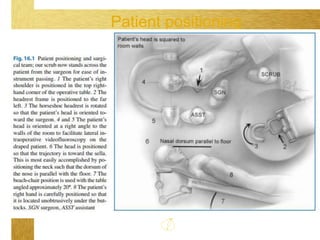
Patient positioning
• The patient’s right shoulder is positioned in the top
righthand corner of the operative table
• Mayfield hoareshoe head rest or rigid 3 point fixation
• The patient’s head is oriented at a right angle to the
walls of the room
• The head is positioned so that the trajectory is
toward the sella(dorsum sellae parallel with the floor)
• The patient’sright hand is carefully positioned so that
it is located unobtrusively under the buttocks
Patient preparation
• Face
– aqueous antiseptic solution
• Nare
– topical vasoconstrictors and inject local anesthetic solution
– oxymetolazine (Afrin) into the nose before induction and
then pack both nostrils with cotton pledgets soaked in 5%
cocaine inserted with bayonets through a nasal speculum,
and leave these in for 10–15!minutes
• Umbilical region
– small fat graft
• Antibiotic
• Cortisol support
Image guidance
• Image guidance
Surgical Approaches
• 1.The nasal phase, from initial sublabial or
endonasal incision to entry into the sphenoid sinus.
• 2. The sphenoid phase, from entry into the
sphenoid sinus to the sellar dura.
• 3. The sellar phase, from opening of the sellar dura
to lesion resection to establishment of hemostasis
and preparation for closure.
• 4. Reconstruction and closure phase.
Nasal phase
• Transnasal Submucosal Transseptal Approach
• Sublabial Submucosal Transseptal Approach
• Septal Displacement (“Septal Pushover”)
Transnasal Submucosal Transseptal Approach
• Right-sided hemitransfixion incision in the right
nostril with the columella retracted to the patient’s left
• Dissection of the right anterior nasal mucosal tunnel
away from the septum
• One side of the septum is exposed submucosally
with a combination of sharp and blunt dissection,
thereby creating the anterior tunnel
• The dissection continues posteriorly, elevating the
nasal mucosa away from the cartilaginous septum
back to the junction with the bony septum
•
Transnasal Submucosal Transseptal Approach
• A vertical incision is then made at this junction, and
bilateral posterior submucosal tunnels are created on
either side oft he perpendicular plate of the ethmoid
• The articulation of the cartilaginous septum with the
maxilla is then dissected free
• The inferior mucosal tunnel on the opposite side is
raised so that the cartilaginous septum can be
displaced laterally without creating inferior mucosal
tears
• A self-retaining nasal speculum can then be
introduced to straddle the perpendicular plate of the
ethmoid, exposing the face of the sphenoid sinus
Transnasal Submucosal Transseptal Approach
• Advantage
– broad septal mobilization
– wide surgical corridor
– strict fidelity to the midline
• Disadvantage
– Sinonasal complications
– postoperative discomfort
– rhinological complaints including alveolar numbness,
– anosmia, saddle nose deformity, and nasal septal
perforations
Sublabial Submucosal Transseptal Approach
• Transverse submucosal gingival sublabial incision
from canine to canine
• Dissection from the maxillary ridge and the anterior
nasal spine until the inferior aspect of the piriform
aperture is exposed
• Working from the lateral border medially, the two
inferior nasal tunnels are created by dissecting the
mucosa away from the superior surface of the hard
palate
• The caudal end of the nasal septum is carefully
dissected and a right anterior tunnel is created along
the right side of the nasal septum
Sublabial Submucosal Transseptal Approach
• With sharp dissection,the right anterior endonasal
submucosal tunnel and the right inferior tunnels are
connected
• the entire right side of the nasal septum is exposed
back to the perpendicular plate of the ethmoid
• Using firm, blunt dissection along the right side of the
base of the nasal septum
• the cartilaginous portion of the septum is
dislocated at its junction with the perpendicular plate
of the ethmoid and vomer and is reflected to the
left,and a left posterior mucosal tunnel is developed
along
• the left side of the bony septum. At this point it
should be possible to insert the transsphenoidal
retractor
• Advantage
– broad septal mobilization
– wide surgical corridor
• Disadvantage
– complex surgical anatomy
– potential complications of numbness
Sublabial Submucosal Transseptal Approach
a.Endonasal approach
b.Submucosal endonasal approach
c.Septal displacement approach
Septal Displacement (“Septal Pushover”)
transnasal septal displacement
Septal Displacement (“Septal Pushover”)
Sphenoid phase
• C-arm fluoroscopy confirm
• Forcep or punch to the vomer
• The mucosa in the sinus is resected with a cup
forceps to reduce bleeding and the risk of
postoperative mucocele
• Confirm position and trajectory
• Removing the sphenoid septations
• visualizing the carotid canals, the clivus, the
opticocarotid recesses when possible, and the
planum sphenoidale
Sphenoid phase
• Confirm trajectory and midline
• Chiesel or blunt nerve hook for sellar floor opening
• Widening with 1-2 mm Kerison punch
• Superior exposure to tuberculum sellae
Sellar phase
Sellar phase
• Ananatomical hazard
– cavernous sinuses and carotids laterally
– the intercavernous sinuses at the tuberculum superiorly and
the floor of the sella inferiorly
– The venous sinuses which may run between the two leaves
of sellar dura
• coagulating and opening the dura
– rectangular excision : large tumors (macroadenomas)
– cruciate or “x” type : small tumour
• Dura for pathology
• Subdural plane using blunt hook or small curette
Sellar phase
• The surgeon should remove the inferior and lateral
aspects of the tumor first, allowing suprasellar
extension to drop into the operative field
Reconstruction and closure phase.
• If CSF leak  fat graft from subumbilical incision
• 10% chloramphenicol solution, patted on a cotton
ball in order to incorporate a few wisps of cotton fiber
(which provoke a fibrotic reaction), and the fat is then
rolled in Avitene (Davol, Cranston, RI) hemostatic
collagen powder
• packed into the sellar cavity
Reconstruction and closure phase.
• The sellar floor is then reconstructed : bone from the
initial operative phase or artificial constructs such as
a MedPor (Porex, Neman, GA) tailored plate
• Blood and surgical debris are carefully suctioned
• from the sphenoid cavity and the nasopharynx prior
to closure
• no packing is necessary, the turbinates are then
medialized
Complication
Complication
• Hypothalamic injury
– Death, coma, DI, memory loss and disturbances of
vegetative functions (e.g., morbid obesity, uncontrollable
hunger or thirst, disturbances in temperature regulation)
• Visual damage
• Vascular complication
– The intracavernous portion of the carotid tends to be most
vulnerable, followed by other components of the circle of
Willis
– development of spasm or intraluminal thrombosis.
Intracranial hemorrhage, thrombotic stroke, embolic stroke,
and the development of false aneurysms or carotid-
cavernous fistulas
Complication
• Cerebrospinal fluid rhinorrhea
• Cavernous sinus injury
– The carotid artery and cranial nerve VI are most vulnerable
to such maneuvers; cranial nerves III and IV are damaged
less frequently
• Iatrogenic hypopituitarism
• Brainstem injury
• Nasal complication
– febrile sinusitis,Mucocele
– Inadequate hemostasis in the nasal portion of the procedure
may lead to superficial wound hemorrhage and swelling
– Loss of the sense of smell
• Complication associated with reoperation
Thank you

016 Transsphenoidal approch microscopic

  • 1.
  • 2.
    Outline • Introduction • Surgicaltechnique • Complication
  • 3.
    Introduction • 1905 Frontaltranscranial approach to the sella Fedor Krause of Berlin Sir Victor Horsley, Walter Dandy, and Harvey Cushing • 1907 First transsphenoidal approach Schloffer,von Eiselsberg and Kocher Require rhinotomy incision • 1920 Endonasal and sublabial • Hirsch and Halstead
  • 4.
    Introduction • 1927 transsphenoidalin favor of transcranial Cushing • 19xx use Fluoroscopy Norman Dott, Gerard Guiot
  • 5.
    Surgical technique • General •Patient Positioning and Surgical team positioning • Patient preparation • Adjunctive navigation • Surgical approach
  • 6.
    General • Tumors ofadenohypophyseal origin – Pituitary adenoma – Pituitary adenoma–neuronal choristoma (pituitary adenoma–gangliocytoma) – Pituitary carcinoma • Tumors of neurohypophyseal origin – Granular cell tumor – Astrocytoma of posterior lobe or stalk, or both (rare) – Chordoma • Vascular lesions – Saccular aneurysm (intracavernous carotid,supraclinoid carotid, anterior communicating artery complex, basilar artery tip) – Cavernous angioma
  • 7.
    General • Tumors ofnonpituitary origin – Craniopharyngioma – Germ-cell tumors – Glioma (hypothalamic, optic nerve or chiasm,infundibulum) – Meningioma – Chordoma • Cysts, hamartomas, and malformations – Rathke’s cleft cyst – Arachnoid cyst – Epidermoid cyst – Dermoid cyst – Hypothalamic hamartoma – Empty sella syndrome
  • 8.
    General • Metastatic tumors –Carcinoma – Plasmacytoma – Lymphoma – Leukemia • Inflammatory conditions – Pyogenic infection or abscess – Granulomatous infections – Mucocele – Lymphocytic hypophysitis – Sarcoidosis – Langerhans cell histiocytosis – Giant-cell granuloma
  • 9.
  • 10.
    Patient positioning • Thepatient’s right shoulder is positioned in the top righthand corner of the operative table • Mayfield hoareshoe head rest or rigid 3 point fixation • The patient’s head is oriented at a right angle to the walls of the room • The head is positioned so that the trajectory is toward the sella(dorsum sellae parallel with the floor) • The patient’sright hand is carefully positioned so that it is located unobtrusively under the buttocks
  • 11.
    Patient preparation • Face –aqueous antiseptic solution • Nare – topical vasoconstrictors and inject local anesthetic solution – oxymetolazine (Afrin) into the nose before induction and then pack both nostrils with cotton pledgets soaked in 5% cocaine inserted with bayonets through a nasal speculum, and leave these in for 10–15!minutes • Umbilical region – small fat graft • Antibiotic • Cortisol support
  • 12.
  • 13.
    Surgical Approaches • 1.Thenasal phase, from initial sublabial or endonasal incision to entry into the sphenoid sinus. • 2. The sphenoid phase, from entry into the sphenoid sinus to the sellar dura. • 3. The sellar phase, from opening of the sellar dura to lesion resection to establishment of hemostasis and preparation for closure. • 4. Reconstruction and closure phase.
  • 14.
    Nasal phase • TransnasalSubmucosal Transseptal Approach • Sublabial Submucosal Transseptal Approach • Septal Displacement (“Septal Pushover”)
  • 17.
  • 18.
    Transnasal Submucosal TransseptalApproach • Right-sided hemitransfixion incision in the right nostril with the columella retracted to the patient’s left • Dissection of the right anterior nasal mucosal tunnel away from the septum • One side of the septum is exposed submucosally with a combination of sharp and blunt dissection, thereby creating the anterior tunnel • The dissection continues posteriorly, elevating the nasal mucosa away from the cartilaginous septum back to the junction with the bony septum •
  • 19.
    Transnasal Submucosal TransseptalApproach • A vertical incision is then made at this junction, and bilateral posterior submucosal tunnels are created on either side oft he perpendicular plate of the ethmoid • The articulation of the cartilaginous septum with the maxilla is then dissected free • The inferior mucosal tunnel on the opposite side is raised so that the cartilaginous septum can be displaced laterally without creating inferior mucosal tears • A self-retaining nasal speculum can then be introduced to straddle the perpendicular plate of the ethmoid, exposing the face of the sphenoid sinus
  • 20.
    Transnasal Submucosal TransseptalApproach • Advantage – broad septal mobilization – wide surgical corridor – strict fidelity to the midline • Disadvantage – Sinonasal complications – postoperative discomfort – rhinological complaints including alveolar numbness, – anosmia, saddle nose deformity, and nasal septal perforations
  • 21.
  • 22.
    • Transverse submucosalgingival sublabial incision from canine to canine • Dissection from the maxillary ridge and the anterior nasal spine until the inferior aspect of the piriform aperture is exposed • Working from the lateral border medially, the two inferior nasal tunnels are created by dissecting the mucosa away from the superior surface of the hard palate • The caudal end of the nasal septum is carefully dissected and a right anterior tunnel is created along the right side of the nasal septum Sublabial Submucosal Transseptal Approach
  • 23.
    Sublabial Submucosal TransseptalApproach • With sharp dissection,the right anterior endonasal submucosal tunnel and the right inferior tunnels are connected • the entire right side of the nasal septum is exposed back to the perpendicular plate of the ethmoid • Using firm, blunt dissection along the right side of the base of the nasal septum • the cartilaginous portion of the septum is dislocated at its junction with the perpendicular plate of the ethmoid and vomer and is reflected to the left,and a left posterior mucosal tunnel is developed along • the left side of the bony septum. At this point it should be possible to insert the transsphenoidal retractor
  • 24.
    • Advantage – broadseptal mobilization – wide surgical corridor • Disadvantage – complex surgical anatomy – potential complications of numbness Sublabial Submucosal Transseptal Approach
  • 25.
    a.Endonasal approach b.Submucosal endonasalapproach c.Septal displacement approach
  • 26.
    Septal Displacement (“SeptalPushover”) transnasal septal displacement
  • 27.
  • 28.
    Sphenoid phase • C-armfluoroscopy confirm • Forcep or punch to the vomer • The mucosa in the sinus is resected with a cup forceps to reduce bleeding and the risk of postoperative mucocele • Confirm position and trajectory • Removing the sphenoid septations • visualizing the carotid canals, the clivus, the opticocarotid recesses when possible, and the planum sphenoidale
  • 29.
    Sphenoid phase • Confirmtrajectory and midline • Chiesel or blunt nerve hook for sellar floor opening • Widening with 1-2 mm Kerison punch • Superior exposure to tuberculum sellae
  • 30.
  • 31.
    Sellar phase • Ananatomicalhazard – cavernous sinuses and carotids laterally – the intercavernous sinuses at the tuberculum superiorly and the floor of the sella inferiorly – The venous sinuses which may run between the two leaves of sellar dura • coagulating and opening the dura – rectangular excision : large tumors (macroadenomas) – cruciate or “x” type : small tumour • Dura for pathology • Subdural plane using blunt hook or small curette
  • 32.
    Sellar phase • Thesurgeon should remove the inferior and lateral aspects of the tumor first, allowing suprasellar extension to drop into the operative field
  • 33.
    Reconstruction and closurephase. • If CSF leak  fat graft from subumbilical incision • 10% chloramphenicol solution, patted on a cotton ball in order to incorporate a few wisps of cotton fiber (which provoke a fibrotic reaction), and the fat is then rolled in Avitene (Davol, Cranston, RI) hemostatic collagen powder • packed into the sellar cavity
  • 34.
    Reconstruction and closurephase. • The sellar floor is then reconstructed : bone from the initial operative phase or artificial constructs such as a MedPor (Porex, Neman, GA) tailored plate • Blood and surgical debris are carefully suctioned • from the sphenoid cavity and the nasopharynx prior to closure • no packing is necessary, the turbinates are then medialized
  • 35.
  • 36.
    Complication • Hypothalamic injury –Death, coma, DI, memory loss and disturbances of vegetative functions (e.g., morbid obesity, uncontrollable hunger or thirst, disturbances in temperature regulation) • Visual damage • Vascular complication – The intracavernous portion of the carotid tends to be most vulnerable, followed by other components of the circle of Willis – development of spasm or intraluminal thrombosis. Intracranial hemorrhage, thrombotic stroke, embolic stroke, and the development of false aneurysms or carotid- cavernous fistulas
  • 37.
    Complication • Cerebrospinal fluidrhinorrhea • Cavernous sinus injury – The carotid artery and cranial nerve VI are most vulnerable to such maneuvers; cranial nerves III and IV are damaged less frequently • Iatrogenic hypopituitarism • Brainstem injury • Nasal complication – febrile sinusitis,Mucocele – Inadequate hemostasis in the nasal portion of the procedure may lead to superficial wound hemorrhage and swelling – Loss of the sense of smell • Complication associated with reoperation
  • 38.