Neurosurgery department, Vajira hospital
Evaluation and Management
Craniocervical Dissociation
Atlantoaxial Rotatory Subluxation
Transverse Ligament Injury
Chapter 313 and 314
YOUMANS Neurological Surgery sixth edition
Craniocervical Dissociation
Anatomy of craniovertebral junction
✤ Ligaments of craniovertebral junction (CVJ)
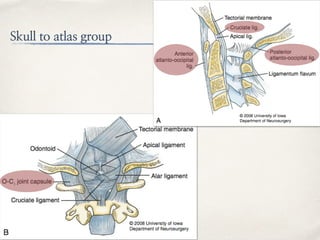
✤ Skull to atlas group
✤ Articular capsule ligaments
✤ Anterior and posterior atlanto-occipital ligament
✤ Lateral atlanto-occipital ligament
✤ Cruciate ligament
Skull to atlas group
Anatomy of craniovertebral junction
✤ Ligaments of craniovertebral junction (CVJ)
✤ Skull to axis group
✤ Alar ligament
✤ Tectorial membrane
✤ Apical dental ligament
✤ Ligamentum nuchae
Skull to axis group
Stability of CVJ
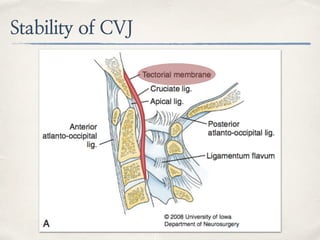
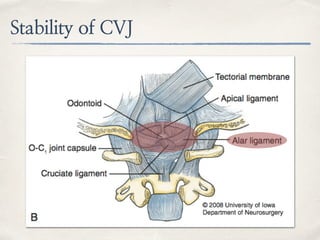
✤ Mainly from skull to axis group of ligaments
✤ Alar ligament
✤ Connect odontoid process to occipital condyles and lateral mass of atlas
✤ Control axial rotation of neck and limit lateral flexion and AP translation
✤ Tectorial membrane (continuation of PLL)
✤ Connect dorsal surface of odontoid process to ventral surface of foramen
magnum
✤ Limit hyperextension of neck
✤ Odontoid process to foramen magnum limits hyperflexion of neck
Stability of CVJ
Stability of CVJ
Mechanism of injury
✤ Mechanisms
✤ Hyperextension
✤ Hyperflexion
✤ Lateral flexion
✤ Combined forces
Mechanism of injury
✤ Most common is hyperextension combined with extreme lateral flexion
✤ Hyperextension cause rupture of tectorial membrane
✤ Extreme lateral flexion cause alar ligament injury
✤ Anterior dislocation of cranium to cervical spine
✤ Children are susceptibility to AOD because of
✤ Less stiffness of ligaments
✤ Larger head to body ratio
Clinical findings
✤ Most common causes are high-speed motor vehicles accident and
pedestrians injury
✤ Wide range of injury from dead to minor injury
✤ Brainstem injury
✤ Cranial nerve deficit
✤ Spinal cord injury
✤ Cervical nerve roots injury
✤ Anterior spinal a., vertebral a. or carotid a. injury
Clinical findings
✤ Steel rules of third at C1 spinal canal
✤ Odontoid process
✤ Spinal cord
✤ CSF space
✤ Cruciate paralysis
✤ Weakness of hands and arms with sparing of lower extremities
✤ True mechanism is still unknown but there are theories
✤ Selective damage to neural areas
✤ Injury to ventral corticospinal tracts
Radiology
✤ Assessment of lateral C-spine
plain film for AOD
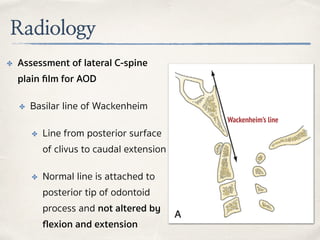
✤ Basilar line of Wackenheim
✤ Line from posterior surface
of clivus to caudal extension
✤ Normal line is attached to
posterior tip of odontoid
process and not altered by
flexion and extension
Wackenheim’s line
Radiology
✤ Assessment of lateral C-spine
plain film for AOD
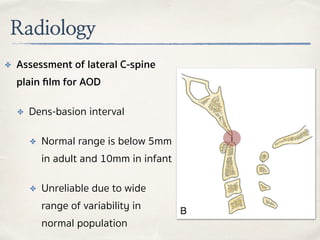
✤ Dens-basion interval
✤ Normal range is below 5mm
in adult and 10mm in infant
✤ Unreliable due to wide
range of variability in
normal population
Radiology
✤ Assessment of lateral C-spine
plain film for AOD
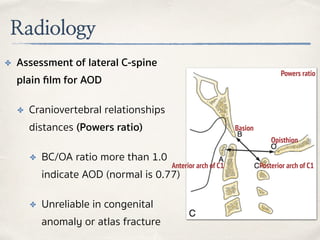
✤ Craniovertebral relationships
distances (Powers ratio)
✤ BC/OA ratio more than 1.0
indicate AOD (normal is 0.77)
✤ Unreliable in congenital
anomaly or atlas fracture
Basion
Posterior arch of C1
Opisthion
Anterior arch of C1
Powers ratio
Radiology
✤ Assessment of lateral C-spine plain film for
AOD
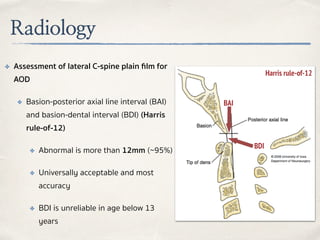
✤ Basion-posterior axial line interval (BAI)
and basion-dental interval (BDI) (Harris
rule-of-12)
✤ Abnormal is more than 12mm (~95%)
✤ Universally acceptable and most
accuracy
✤ BDI is unreliable in age below 13
years
BAI
BDI
Harris rule-of-12
Children atlantooccipital dissociation (AOD)
By Pang and colleagues
✤ Condylar-C1 interval (CCI)
✤ Distance between occipital condyle to lateral mass of C1
✤ Assess by CT scan
✤ Normal value is 1.28mm (sensitivity 100%)
PANG ET AL. NEUROSURGERY | VOLUME 61 | NUMBER 5 | NOVEMBER 2007
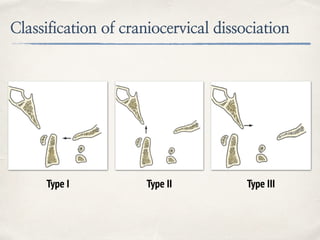
Classification of craniocervical dissociation
✤ Assess by lateral C-spine plain film or CT scan
✤ 3 types
✤ Type I : Anterior displacement of occiput to atlas
✤ Type II : Longitudinal distraction with seperation of
occiput to atlas
✤ Type III : Posterior displacement of occiput to atlas
Classification of craniocervical dissociation
Type I Type II Type III
Treatment considerations
✤ Emergency considerations
✤ Awareness of craniocervical dissociation
✤ Cardiopulmonary support
✤ Spinal immobilisation
✤ Surgical removal of hematoma at CVJ (rare condition)
if hematoma associated with neurological deficit
Treatment considerations
✤ Skull traction
✤ Recommended in patients of Type I and III dislocation with
neurological deficit
✤ Fluoroscopic-guided for applied traction is recommended
✤ Traction weight below 5 lb.
✤ If clinical improved >> decrease weight to 1-2 lb. or halo vest
applied
✤ Contraindication in Type II dislocation and rotatory subluxation
Treatment considerations
✤ Surgical management
✤ Posterior fusion of occiput to C2 is recommended in most
cases of AOD
✤ Main injury is ligaments and stability cannot maintain
after external fixation
✤ Should be done after medically stable
✤ Some surgeon recommended posterior fusion without skull
traction first
Atlantoaxial Rotatory Subluxation and
Transverse Ligament Injury
Anatomy and Biomechanics of
Atlantoaxial joint
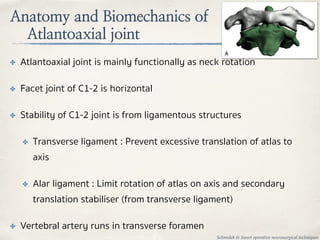
✤ Atlantoaxial joint is mainly functionally as neck rotation
✤ Facet joint of C1-2 is horizontal
✤ Stability of C1-2 joint is from ligamentous structures
✤ Transverse ligament : Prevent excessive translation of atlas to
axis
✤ Alar ligament : Limit rotation of atlas on axis and secondary
translation stabiliser (from transverse ligament)
✤ Vertebral artery runs in transverse foramen
Schmidek & Sweet operative neurosurgical techniques
Diagnosis
✤ Sign and symptom of AARS
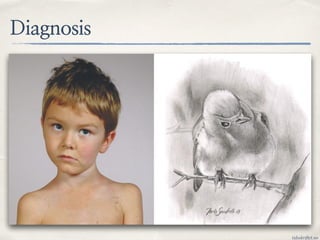
✤ “Cock-robin” position of neck : head tilted one side
and rotated to contralateral side with flexion of neck
✤ Occipital pain from compression of occipital nerve or
C2 nerve root
✤ Posterior fossa syndrome from stretching or kinking
of vertebral arteries
Diagnosis
tidsskriftet.no
Diagnosis
✤ Imaging
✤ Open-mouth plain film show
asymmetrical of lateral of
C1 to odontoid process
✤ Lateral plain film show
lateral mass of C1
projecting anterior to
odontoid process >> “wink”
sign
Diagnosis
✤ Imaging
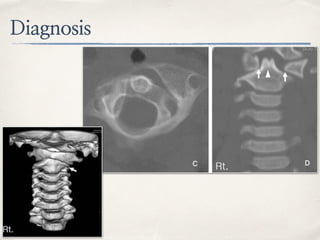
✤ Cervical spine CT is recommended for diagnosis of
AARS
✤ Contrast injection for evaluating of vertebral artery
✤ MRI can be used for evaluating of transverse ligament
and cord compression
Diagnosis
Classification system
✤ Fielding system (1977)
✤ Type I : Intact odontoid and transverse ligament with disrupt of alar
ligament
✤ Type II : Anterior translation of atlas on axis 3-5mm with disrupt of
transverse ligament
✤ Type III : Anterior translation of atlas on axis > 5mm with disrupt of
transverse ligament
✤ Type IV : Posterior displacement of atlas on axis and odontoid
process is injured
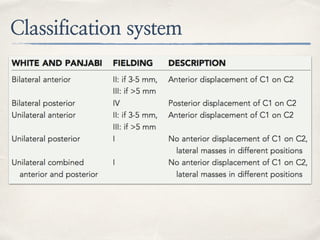
Classification system
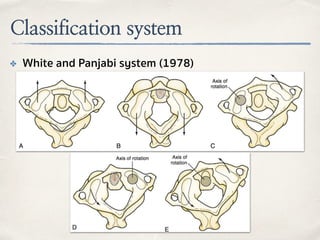
✤ White and Panjabi system (1978)
Classification system
Grisel’s Syndrome
✤ Nontraumatic atlantoaxial subluxation (rare condition)
✤ Caused by infection process or head and neck procedure
✤ Edema (inflammation process) and relaxation of ligamentous structures
✤ In children with Down’s syndrome and Klippel-Feil syndrome increase risk of
Grisel’s syndrome
✤ Management
✤ Reduction by cervical traction with muscle relaxant
✤ Antibiotic prophylaxis in high risk group
✤ Surgical fusion if failed conservative treatment
Management of AARS
✤ Conservative treatment
✤ Cervical traction by Gardner-Wells tong or halo ring with
conscious sedation
✤ Bone fracture must be ruled out before traction application
✤ Patient with minor ligamentous injury should be placed in
halo vest for 3 months
✤ Failure of conservative treatment or gross instability,
surgical fusion should be done
Management of AARS
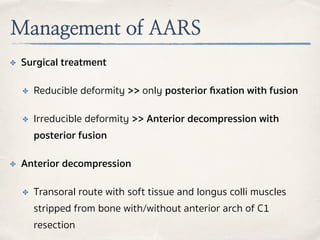
✤ Surgical treatment
✤ Reducible deformity >> only posterior fixation with fusion
✤ Irreducible deformity >> Anterior decompression with
posterior fusion
✤ Anterior decompression
✤ Transoral route with soft tissue and longus colli muscles
stripped from bone with/without anterior arch of C1
resection
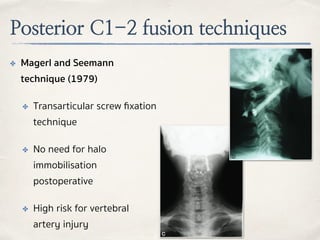
Posterior C1-2 fusion techniques
✤ Magerl and Seemann
technique (1979)
✤ Transarticular screw fixation
technique
✤ No need for halo
immobilisation
postoperative
✤ High risk for vertebral
artery injury
Posterior C1-2 fusion techniques
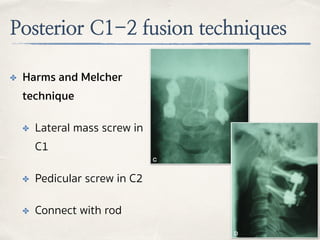
✤ Harms and Melcher
technique
✤ Lateral mass screw in
C1
✤ Pedicular screw in C2
✤ Connect with rod
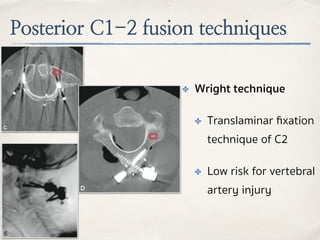
Posterior C1-2 fusion techniques
✤ Wright technique
✤ Translaminar fixation
technique of C2
✤ Low risk for vertebral
artery injury
C1
C2
313 AOD and 314 AARS

313 AOD and 314 AARS

  • 1.
    Neurosurgery department, Vajirahospital Evaluation and Management Craniocervical Dissociation Atlantoaxial Rotatory Subluxation Transverse Ligament Injury Chapter 313 and 314 YOUMANS Neurological Surgery sixth edition
  • 2.
  • 3.
    Anatomy of craniovertebraljunction ✤ Ligaments of craniovertebral junction (CVJ) ✤ Skull to atlas group ✤ Articular capsule ligaments ✤ Anterior and posterior atlanto-occipital ligament ✤ Lateral atlanto-occipital ligament ✤ Cruciate ligament
  • 4.
  • 5.
    Anatomy of craniovertebraljunction ✤ Ligaments of craniovertebral junction (CVJ) ✤ Skull to axis group ✤ Alar ligament ✤ Tectorial membrane ✤ Apical dental ligament ✤ Ligamentum nuchae
  • 6.
  • 7.
    Stability of CVJ ✤Mainly from skull to axis group of ligaments ✤ Alar ligament ✤ Connect odontoid process to occipital condyles and lateral mass of atlas ✤ Control axial rotation of neck and limit lateral flexion and AP translation ✤ Tectorial membrane (continuation of PLL) ✤ Connect dorsal surface of odontoid process to ventral surface of foramen magnum ✤ Limit hyperextension of neck ✤ Odontoid process to foramen magnum limits hyperflexion of neck
  • 8.
  • 9.
  • 10.
    Mechanism of injury ✤Mechanisms ✤ Hyperextension ✤ Hyperflexion ✤ Lateral flexion ✤ Combined forces
  • 11.
    Mechanism of injury ✤Most common is hyperextension combined with extreme lateral flexion ✤ Hyperextension cause rupture of tectorial membrane ✤ Extreme lateral flexion cause alar ligament injury ✤ Anterior dislocation of cranium to cervical spine ✤ Children are susceptibility to AOD because of ✤ Less stiffness of ligaments ✤ Larger head to body ratio
  • 12.
    Clinical findings ✤ Mostcommon causes are high-speed motor vehicles accident and pedestrians injury ✤ Wide range of injury from dead to minor injury ✤ Brainstem injury ✤ Cranial nerve deficit ✤ Spinal cord injury ✤ Cervical nerve roots injury ✤ Anterior spinal a., vertebral a. or carotid a. injury
  • 13.
    Clinical findings ✤ Steelrules of third at C1 spinal canal ✤ Odontoid process ✤ Spinal cord ✤ CSF space ✤ Cruciate paralysis ✤ Weakness of hands and arms with sparing of lower extremities ✤ True mechanism is still unknown but there are theories ✤ Selective damage to neural areas ✤ Injury to ventral corticospinal tracts
  • 14.
    Radiology ✤ Assessment oflateral C-spine plain film for AOD ✤ Basilar line of Wackenheim ✤ Line from posterior surface of clivus to caudal extension ✤ Normal line is attached to posterior tip of odontoid process and not altered by flexion and extension Wackenheim’s line
  • 15.
    Radiology ✤ Assessment oflateral C-spine plain film for AOD ✤ Dens-basion interval ✤ Normal range is below 5mm in adult and 10mm in infant ✤ Unreliable due to wide range of variability in normal population
  • 16.
    Radiology ✤ Assessment oflateral C-spine plain film for AOD ✤ Craniovertebral relationships distances (Powers ratio) ✤ BC/OA ratio more than 1.0 indicate AOD (normal is 0.77) ✤ Unreliable in congenital anomaly or atlas fracture Basion Posterior arch of C1 Opisthion Anterior arch of C1 Powers ratio
  • 17.
    Radiology ✤ Assessment oflateral C-spine plain film for AOD ✤ Basion-posterior axial line interval (BAI) and basion-dental interval (BDI) (Harris rule-of-12) ✤ Abnormal is more than 12mm (~95%) ✤ Universally acceptable and most accuracy ✤ BDI is unreliable in age below 13 years BAI BDI Harris rule-of-12
  • 18.
    Children atlantooccipital dissociation(AOD) By Pang and colleagues ✤ Condylar-C1 interval (CCI) ✤ Distance between occipital condyle to lateral mass of C1 ✤ Assess by CT scan ✤ Normal value is 1.28mm (sensitivity 100%) PANG ET AL. NEUROSURGERY | VOLUME 61 | NUMBER 5 | NOVEMBER 2007
  • 19.
    Classification of craniocervicaldissociation ✤ Assess by lateral C-spine plain film or CT scan ✤ 3 types ✤ Type I : Anterior displacement of occiput to atlas ✤ Type II : Longitudinal distraction with seperation of occiput to atlas ✤ Type III : Posterior displacement of occiput to atlas
  • 20.
    Classification of craniocervicaldissociation Type I Type II Type III
  • 21.
    Treatment considerations ✤ Emergencyconsiderations ✤ Awareness of craniocervical dissociation ✤ Cardiopulmonary support ✤ Spinal immobilisation ✤ Surgical removal of hematoma at CVJ (rare condition) if hematoma associated with neurological deficit
  • 22.
    Treatment considerations ✤ Skulltraction ✤ Recommended in patients of Type I and III dislocation with neurological deficit ✤ Fluoroscopic-guided for applied traction is recommended ✤ Traction weight below 5 lb. ✤ If clinical improved >> decrease weight to 1-2 lb. or halo vest applied ✤ Contraindication in Type II dislocation and rotatory subluxation
  • 23.
    Treatment considerations ✤ Surgicalmanagement ✤ Posterior fusion of occiput to C2 is recommended in most cases of AOD ✤ Main injury is ligaments and stability cannot maintain after external fixation ✤ Should be done after medically stable ✤ Some surgeon recommended posterior fusion without skull traction first
  • 25.
    Atlantoaxial Rotatory Subluxationand Transverse Ligament Injury
  • 26.
    Anatomy and Biomechanicsof Atlantoaxial joint ✤ Atlantoaxial joint is mainly functionally as neck rotation ✤ Facet joint of C1-2 is horizontal ✤ Stability of C1-2 joint is from ligamentous structures ✤ Transverse ligament : Prevent excessive translation of atlas to axis ✤ Alar ligament : Limit rotation of atlas on axis and secondary translation stabiliser (from transverse ligament) ✤ Vertebral artery runs in transverse foramen Schmidek & Sweet operative neurosurgical techniques
  • 27.
    Diagnosis ✤ Sign andsymptom of AARS ✤ “Cock-robin” position of neck : head tilted one side and rotated to contralateral side with flexion of neck ✤ Occipital pain from compression of occipital nerve or C2 nerve root ✤ Posterior fossa syndrome from stretching or kinking of vertebral arteries
  • 28.
  • 29.
    Diagnosis ✤ Imaging ✤ Open-mouthplain film show asymmetrical of lateral of C1 to odontoid process ✤ Lateral plain film show lateral mass of C1 projecting anterior to odontoid process >> “wink” sign
  • 30.
    Diagnosis ✤ Imaging ✤ Cervicalspine CT is recommended for diagnosis of AARS ✤ Contrast injection for evaluating of vertebral artery ✤ MRI can be used for evaluating of transverse ligament and cord compression
  • 31.
  • 32.
    Classification system ✤ Fieldingsystem (1977) ✤ Type I : Intact odontoid and transverse ligament with disrupt of alar ligament ✤ Type II : Anterior translation of atlas on axis 3-5mm with disrupt of transverse ligament ✤ Type III : Anterior translation of atlas on axis > 5mm with disrupt of transverse ligament ✤ Type IV : Posterior displacement of atlas on axis and odontoid process is injured
  • 33.
    Classification system ✤ Whiteand Panjabi system (1978)
  • 34.
  • 35.
    Grisel’s Syndrome ✤ Nontraumaticatlantoaxial subluxation (rare condition) ✤ Caused by infection process or head and neck procedure ✤ Edema (inflammation process) and relaxation of ligamentous structures ✤ In children with Down’s syndrome and Klippel-Feil syndrome increase risk of Grisel’s syndrome ✤ Management ✤ Reduction by cervical traction with muscle relaxant ✤ Antibiotic prophylaxis in high risk group ✤ Surgical fusion if failed conservative treatment
  • 36.
    Management of AARS ✤Conservative treatment ✤ Cervical traction by Gardner-Wells tong or halo ring with conscious sedation ✤ Bone fracture must be ruled out before traction application ✤ Patient with minor ligamentous injury should be placed in halo vest for 3 months ✤ Failure of conservative treatment or gross instability, surgical fusion should be done
  • 37.
    Management of AARS ✤Surgical treatment ✤ Reducible deformity >> only posterior fixation with fusion ✤ Irreducible deformity >> Anterior decompression with posterior fusion ✤ Anterior decompression ✤ Transoral route with soft tissue and longus colli muscles stripped from bone with/without anterior arch of C1 resection
  • 38.
    Posterior C1-2 fusiontechniques ✤ Magerl and Seemann technique (1979) ✤ Transarticular screw fixation technique ✤ No need for halo immobilisation postoperative ✤ High risk for vertebral artery injury
  • 39.
    Posterior C1-2 fusiontechniques ✤ Harms and Melcher technique ✤ Lateral mass screw in C1 ✤ Pedicular screw in C2 ✤ Connect with rod
  • 40.
    Posterior C1-2 fusiontechniques ✤ Wright technique ✤ Translaminar fixation technique of C2 ✤ Low risk for vertebral artery injury C1 C2