Anterior Communicating
Artery Aneurysms
Youmans,Neurological Surgery 6th chapter 368
Judy Huang and V. Germanwala n Rafael J. Tamargo
26/01/59
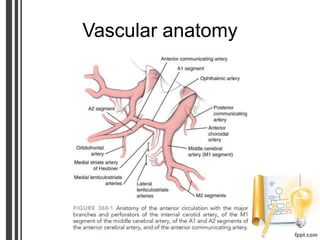
Vascular anatomy
Vascular anatomy
• A1 Segment
– Diameter : 0.9 - 4 mm., average 2.6 mm.
– Hypoplasia : <1.5 mm.
– 50%, difference in 0.5 mm. between them
– 85%, in the presence of an ACoA aneurysm
• Anterior Communicating Artery
– Diameter : about half of A1 segment, average 1.5 mm.
Vascular anatomy
• A2 Segment(pericallosal a.)
• Perforators of the A1 Segment, Anterior Communicating
Artery, and A2 Segment
– A1 : medial lenticulostriate a.,2-15 perforator
• supply the globus pallidus and medial portion of the putamen
– M1 : lateral lenticulostriate a.
• supply the lateral portion of the putamen and external
capsule
– ACoA perforator
Vascular anatomy
• Medial Striate Artery (Recurrent Artery of Heubner)
– Most important perforator from the proximal A2 segment
– A2 78%,A1 14%,ACoA 8%,Absent 2%
– Course : anterior to A1 60%,superior to the A1 40%
– Diameter : twice of A1, 23.4 mm.
– Supply :
• anterior striatum (caudate nucleus and putamen)
• a portion of the outer segment of the globus pallidus
• the anterior limb of the internal capsule
Vascular anatomy
• Medial Striate Artery (Recurrent Artery of
Heubner)
– Injury
• moderate paresis of the contralateral upper
extremity
• mild paresis of the contralateral face
• dysfunction of the tongue and palate
• If the dominant hemisphere is involved  an
expressive aphasia
Vascular anatomy
• Orbitofrontal artery differ from medial Striate
artery
• 5 mm from AcoA
• Diameter 0.9 mm.
• Course perpendicularly over the gyrus rectus
and across the olfactory tract
• Boundary of lamina terminalis cistern
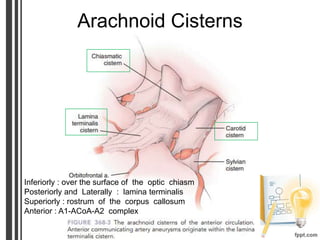
Arachnoid Cisterns
Inferiorly : over the surface of the optic chiasm
Posteriorly and Laterally : lamina terminalis
Superiorly : rostrum of the corpus callosum
Anterior : A1-ACoA-A2 complex
Arachnoid Cisterns
• Carotid cistern
– A1 segment originates within
– Supraclinoid ICA
• Chiasmatic cistern
– Optic nerves, optic chiasm, and infundibulum
– Not contain any major arteries
• Lamina terminalis cistern
– Paired A1 and proximal A2 segments,ACoA
– Medial striate arteries of Heubner
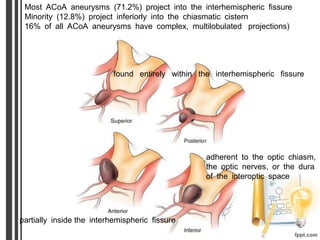
Most ACoA aneurysms (71.2%) project into the interhemispheric fissure
Minority (12.8%) project inferiorly into the chiasmatic cistern
16% of all ACoA aneurysms have complex, multilobulated projections)
found entirely within the interhemispheric fissure
partially inside the interhemispheric fissure
adherent to the optic chiasm,
the optic nerves, or the dura
of the interoptic space
Radiographic Presentation
of ACoA Aneurysms
• CT
– SAH
• only in the interhemispheric fissure
• thicker clot in the interhemispheric fissure
– Intraparenchymal hemorrhage in the region of the
gyrus rectus
• Angiography
– The highest false-negative rate of angiography of
any intracranial aneurysm
– Probably the balanced flow into the ACoA from the
paired A1 segments, which may prevent filling of the
aneurysm by the dye
Operative Technique for ACoA
and Proximal ACA Aneurysms
• Three anatomic features
– their bilateral anterograde arterial supply
– their deep,midline location
– their intimate relationship to 11 critical arteries
• Pair A1
• Pair A2
• 2 medial striate a of Heurner
• 2 orbitofrontal a.
• 2 frontopolar a.
• ACoA
Operative Technique for ACoA
and Proximal ACA Aneurysms
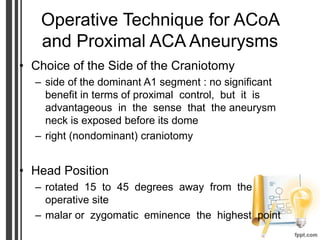
• Choice of the Side of the Craniotomy
– side of the dominant A1 segment : no significant
benefit in terms of proximal control, but it is
advantageous in the sense that the aneurysm
neck is exposed before its dome
– right (nondominant) craniotomy
• Head Position
– rotated 15 to 45 degrees away from the
operative site
– malar or zygomatic eminence the highest point
Operative Technique for ACoA
and Proximal ACA Aneurysms
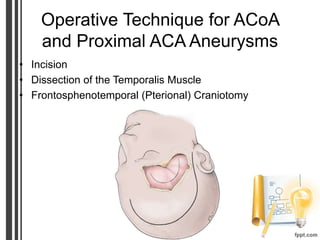
• Incision
• Dissection of the Temporalis Muscle
• Frontosphenotemporal (Pterional) Craniotomy
Operative Technique for ACoA
and Proximal ACA Aneurysms
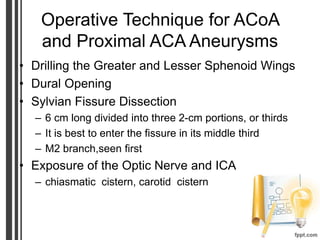
• Drilling the Greater and Lesser Sphenoid Wings
• Dural Opening
• Sylvian Fissure Dissection
– 6 cm long divided into three 2-cm portions, or thirds
– It is best to enter the fissure in its middle third
– M2 branch,seen first
• Exposure of the Optic Nerve and ICA
– chiasmatic cistern, carotid cistern
Operative Technique for ACoA
and Proximal ACA Aneurysms
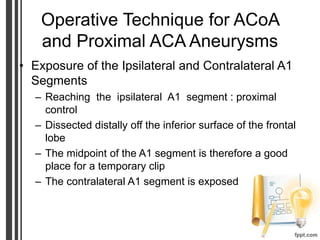
• Exposure of the Ipsilateral and Contralateral A1
Segments
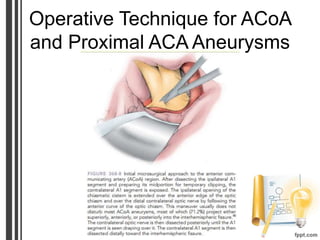
– Reaching the ipsilateral A1 segment : proximal
control
– Dissected distally off the inferior surface of the frontal
lobe
– The midpoint of the A1 segment is therefore a good
place for a temporary clip
– The contralateral A1 segment is exposed
Operative Technique for ACoA
and Proximal ACA Aneurysms
Operative Technique for ACoA
and Proximal ACA Aneurysms
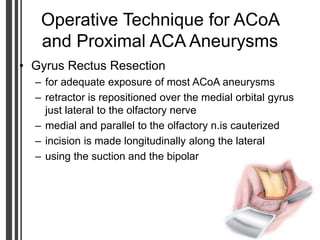
• Gyrus Rectus Resection
– for adequate exposure of most ACoA aneurysms
– retractor is repositioned over the medial orbital gyrus
just lateral to the olfactory nerve
– medial and parallel to the olfactory n.is cauterized
– incision is made longitudinally along the lateral
– using the suction and the bipolar
Operative Technique for ACoA
and Proximal ACA Aneurysms
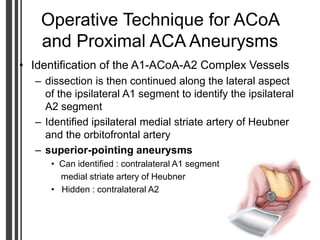
• Identification of the A1-ACoA-A2 Complex Vessels
– dissection is then continued along the lateral aspect
of the ipsilateral A1 segment to identify the ipsilateral
A2 segment
– Identified ipsilateral medial striate artery of Heubner
and the orbitofrontal artery
– superior-pointing aneurysms
• Can identified : contralateral A1 segment
medial striate artery of Heubner
• Hidden : contralateral A2
Operative Technique for ACoA
and Proximal ACA Aneurysms
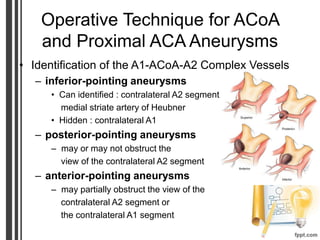
• Identification of the A1-ACoA-A2 Complex Vessels
– inferior-pointing aneurysms
• Can identified : contralateral A2 segment
medial striate artery of Heubner
• Hidden : contralateral A1
– posterior-pointing aneurysms
– may or may not obstruct the
view of the contralateral A2 segment
– anterior-pointing aneurysms
– may partially obstruct the view of the
contralateral A2 segment or
the contralateral A1 segment
Operative Technique for ACoA
and Proximal ACA Aneurysms
• Identification of the A1-ACoA-A2 Complex Vessels
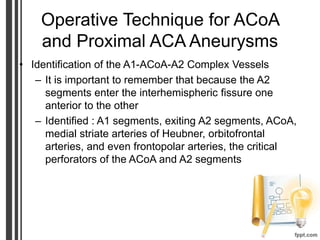
– It is important to remember that because the A2
segments enter the interhemispheric fissure one
anterior to the other
– Identified : A1 segments, exiting A2 segments, ACoA,
medial striate arteries of Heubner, orbitofrontal
arteries, and even frontopolar arteries, the critical
perforators of the ACoA and A2 segments
Operative Technique for ACoA
and Proximal ACA Aneurysms
• Dissection of the Aneurysm Neck
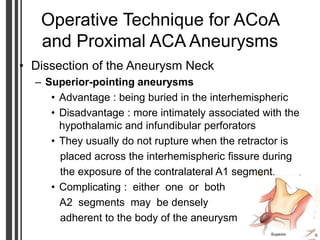
– Superior-pointing aneurysms
• Advantage : being buried in the interhemispheric
• Disadvantage : more intimately associated with the
hypothalamic and infundibular perforators
• They usually do not rupture when the retractor is
placed across the interhemispheric fissure during
the exposure of the contralateral A1 segment.
• Complicating : either one or both
A2 segments may be densely
adherent to the body of the aneurysm
Operative Technique for ACoA
and Proximal ACA Aneurysms
• Dissection of the Aneurysm Neck
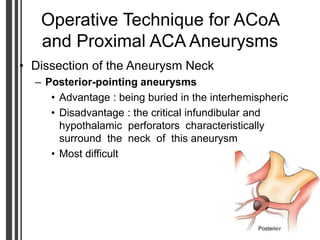
– Posterior-pointing aneurysms
• Advantage : being buried in the interhemispheric
• Disadvantage : the critical infundibular and
hypothalamic perforators characteristically
surround the neck of this aneurysm
• Most difficult
Operative Technique for ACoA
and Proximal ACA Aneurysms
• Dissection of the Aneurysm Neck
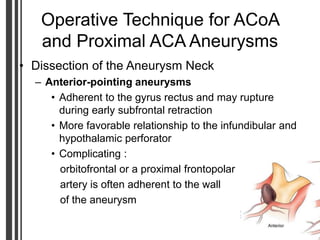
– Anterior-pointing aneurysms
• Adherent to the gyrus rectus and may rupture
during early subfrontal retraction
• More favorable relationship to the infundibular and
hypothalamic perforator
• Complicating :
orbitofrontal or a proximal frontopolar
artery is often adherent to the wall
of the aneurysm
Operative Technique for ACoA
and Proximal ACA Aneurysms
• Dissection of the Aneurysm Neck
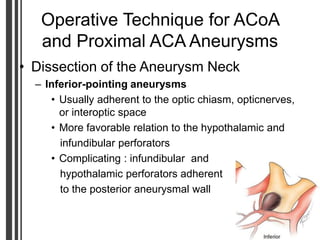
– Inferior-pointing aneurysms
• Usually adherent to the optic chiasm, opticnerves,
or interoptic space
• More favorable relation to the hypothalamic and
infundibular perforators
• Complicating : infundibular and
hypothalamic perforators adherent
to the posterior aneurysmal wall
Operative Technique for ACoA
and Proximal ACA Aneurysms
• Aneurysmoplasty
– rehydrate the sac with plenty of irrigation
– wax the tips of the bipolar forceps to prevent sticking
– reduce the bipolar current to as low as possible and
then increase it as necessary until it starts to shrink
the wall
Operative Technique for ACoA
and Proximal ACA Aneurysms
• No. 7 microdissector is gently passed into the
spaces where the clip blades will be inserted
• It is important to ensure
– that the entire neck is cleared
– there is not a secondary lobe of the aneurysm that
could be punctured with the clip blade. When
dissecting directly on the aneurysm
– sharp dissection with either an arachnoid knife or
microscissors is better than blunt dissection
Operative Technique for ACoA
and Proximal ACA Aneurysms
• Clip Selection and Application
– The length of the selected clip should be at least 1.5
times the diameter of the aneurysm neck
– a 10-mm neck requires at least a 15-mm clip
• Aspiration of the Dome
– the dome is punctured and aspirated with a 25-gauge
spinal needle attached to a short segment of
intravenous tubing and a 5-mL syringe filled with
saline
• Papaverine Application
Complications
• Clinical vasospasm
• Hyponatermia
– common in higher grade
– SIADH,CSW
• ACoA syndrome
– impaired memory, personality changes, and
confabulation
– result of a focal lesion in the basal forebrain
Anatomic And Morphologic Selection
Criteria For Endovascular Treatment
• Microsurgical and endovascular treatments,
both of which are safe and effective options
in properly selected patients
• Relative contraindication : absent A1 segment
• Clear visualization of the surrounding
vasculature and the neck and dome of the
aneurysm must be obtained
Anatomic And Morphologic Selection
Criteria For Endovascular Treatment
• The aneurysm neck and dome plays a
significant role in determining the success or
failure of an endovascular approach
• Higher rates of complete occlusion
– Smaller
– Anteriorly projecting ACoA aneurysms
• Higher rate of endovascular procedure–related
complications
– Posteriorly projecting ACoA aneurysms

368 ACoA aneurysm

  • 1.
    Anterior Communicating Artery Aneurysms Youmans,NeurologicalSurgery 6th chapter 368 Judy Huang and V. Germanwala n Rafael J. Tamargo 26/01/59
  • 2.
  • 3.
    Vascular anatomy • A1Segment – Diameter : 0.9 - 4 mm., average 2.6 mm. – Hypoplasia : <1.5 mm. – 50%, difference in 0.5 mm. between them – 85%, in the presence of an ACoA aneurysm • Anterior Communicating Artery – Diameter : about half of A1 segment, average 1.5 mm.
  • 4.
    Vascular anatomy • A2Segment(pericallosal a.) • Perforators of the A1 Segment, Anterior Communicating Artery, and A2 Segment – A1 : medial lenticulostriate a.,2-15 perforator • supply the globus pallidus and medial portion of the putamen – M1 : lateral lenticulostriate a. • supply the lateral portion of the putamen and external capsule – ACoA perforator
  • 5.
    Vascular anatomy • MedialStriate Artery (Recurrent Artery of Heubner) – Most important perforator from the proximal A2 segment – A2 78%,A1 14%,ACoA 8%,Absent 2% – Course : anterior to A1 60%,superior to the A1 40% – Diameter : twice of A1, 23.4 mm. – Supply : • anterior striatum (caudate nucleus and putamen) • a portion of the outer segment of the globus pallidus • the anterior limb of the internal capsule
  • 6.
    Vascular anatomy • MedialStriate Artery (Recurrent Artery of Heubner) – Injury • moderate paresis of the contralateral upper extremity • mild paresis of the contralateral face • dysfunction of the tongue and palate • If the dominant hemisphere is involved  an expressive aphasia
  • 7.
    Vascular anatomy • Orbitofrontalartery differ from medial Striate artery • 5 mm from AcoA • Diameter 0.9 mm. • Course perpendicularly over the gyrus rectus and across the olfactory tract • Boundary of lamina terminalis cistern
  • 8.
    Arachnoid Cisterns Inferiorly :over the surface of the optic chiasm Posteriorly and Laterally : lamina terminalis Superiorly : rostrum of the corpus callosum Anterior : A1-ACoA-A2 complex
  • 9.
    Arachnoid Cisterns • Carotidcistern – A1 segment originates within – Supraclinoid ICA • Chiasmatic cistern – Optic nerves, optic chiasm, and infundibulum – Not contain any major arteries • Lamina terminalis cistern – Paired A1 and proximal A2 segments,ACoA – Medial striate arteries of Heubner
  • 10.
    Most ACoA aneurysms(71.2%) project into the interhemispheric fissure Minority (12.8%) project inferiorly into the chiasmatic cistern 16% of all ACoA aneurysms have complex, multilobulated projections) found entirely within the interhemispheric fissure partially inside the interhemispheric fissure adherent to the optic chiasm, the optic nerves, or the dura of the interoptic space
  • 11.
    Radiographic Presentation of ACoAAneurysms • CT – SAH • only in the interhemispheric fissure • thicker clot in the interhemispheric fissure – Intraparenchymal hemorrhage in the region of the gyrus rectus • Angiography – The highest false-negative rate of angiography of any intracranial aneurysm – Probably the balanced flow into the ACoA from the paired A1 segments, which may prevent filling of the aneurysm by the dye
  • 12.
    Operative Technique forACoA and Proximal ACA Aneurysms • Three anatomic features – their bilateral anterograde arterial supply – their deep,midline location – their intimate relationship to 11 critical arteries • Pair A1 • Pair A2 • 2 medial striate a of Heurner • 2 orbitofrontal a. • 2 frontopolar a. • ACoA
  • 13.
    Operative Technique forACoA and Proximal ACA Aneurysms • Choice of the Side of the Craniotomy – side of the dominant A1 segment : no significant benefit in terms of proximal control, but it is advantageous in the sense that the aneurysm neck is exposed before its dome – right (nondominant) craniotomy • Head Position – rotated 15 to 45 degrees away from the operative site – malar or zygomatic eminence the highest point
  • 14.
    Operative Technique forACoA and Proximal ACA Aneurysms • Incision • Dissection of the Temporalis Muscle • Frontosphenotemporal (Pterional) Craniotomy
  • 15.
    Operative Technique forACoA and Proximal ACA Aneurysms • Drilling the Greater and Lesser Sphenoid Wings • Dural Opening • Sylvian Fissure Dissection – 6 cm long divided into three 2-cm portions, or thirds – It is best to enter the fissure in its middle third – M2 branch,seen first • Exposure of the Optic Nerve and ICA – chiasmatic cistern, carotid cistern
  • 16.
    Operative Technique forACoA and Proximal ACA Aneurysms • Exposure of the Ipsilateral and Contralateral A1 Segments – Reaching the ipsilateral A1 segment : proximal control – Dissected distally off the inferior surface of the frontal lobe – The midpoint of the A1 segment is therefore a good place for a temporary clip – The contralateral A1 segment is exposed
  • 17.
    Operative Technique forACoA and Proximal ACA Aneurysms
  • 18.
    Operative Technique forACoA and Proximal ACA Aneurysms • Gyrus Rectus Resection – for adequate exposure of most ACoA aneurysms – retractor is repositioned over the medial orbital gyrus just lateral to the olfactory nerve – medial and parallel to the olfactory n.is cauterized – incision is made longitudinally along the lateral – using the suction and the bipolar
  • 19.
    Operative Technique forACoA and Proximal ACA Aneurysms • Identification of the A1-ACoA-A2 Complex Vessels – dissection is then continued along the lateral aspect of the ipsilateral A1 segment to identify the ipsilateral A2 segment – Identified ipsilateral medial striate artery of Heubner and the orbitofrontal artery – superior-pointing aneurysms • Can identified : contralateral A1 segment medial striate artery of Heubner • Hidden : contralateral A2
  • 20.
    Operative Technique forACoA and Proximal ACA Aneurysms • Identification of the A1-ACoA-A2 Complex Vessels – inferior-pointing aneurysms • Can identified : contralateral A2 segment medial striate artery of Heubner • Hidden : contralateral A1 – posterior-pointing aneurysms – may or may not obstruct the view of the contralateral A2 segment – anterior-pointing aneurysms – may partially obstruct the view of the contralateral A2 segment or the contralateral A1 segment
  • 21.
    Operative Technique forACoA and Proximal ACA Aneurysms • Identification of the A1-ACoA-A2 Complex Vessels – It is important to remember that because the A2 segments enter the interhemispheric fissure one anterior to the other – Identified : A1 segments, exiting A2 segments, ACoA, medial striate arteries of Heubner, orbitofrontal arteries, and even frontopolar arteries, the critical perforators of the ACoA and A2 segments
  • 22.
    Operative Technique forACoA and Proximal ACA Aneurysms • Dissection of the Aneurysm Neck – Superior-pointing aneurysms • Advantage : being buried in the interhemispheric • Disadvantage : more intimately associated with the hypothalamic and infundibular perforators • They usually do not rupture when the retractor is placed across the interhemispheric fissure during the exposure of the contralateral A1 segment. • Complicating : either one or both A2 segments may be densely adherent to the body of the aneurysm
  • 23.
    Operative Technique forACoA and Proximal ACA Aneurysms • Dissection of the Aneurysm Neck – Posterior-pointing aneurysms • Advantage : being buried in the interhemispheric • Disadvantage : the critical infundibular and hypothalamic perforators characteristically surround the neck of this aneurysm • Most difficult
  • 24.
    Operative Technique forACoA and Proximal ACA Aneurysms • Dissection of the Aneurysm Neck – Anterior-pointing aneurysms • Adherent to the gyrus rectus and may rupture during early subfrontal retraction • More favorable relationship to the infundibular and hypothalamic perforator • Complicating : orbitofrontal or a proximal frontopolar artery is often adherent to the wall of the aneurysm
  • 25.
    Operative Technique forACoA and Proximal ACA Aneurysms • Dissection of the Aneurysm Neck – Inferior-pointing aneurysms • Usually adherent to the optic chiasm, opticnerves, or interoptic space • More favorable relation to the hypothalamic and infundibular perforators • Complicating : infundibular and hypothalamic perforators adherent to the posterior aneurysmal wall
  • 26.
    Operative Technique forACoA and Proximal ACA Aneurysms • Aneurysmoplasty – rehydrate the sac with plenty of irrigation – wax the tips of the bipolar forceps to prevent sticking – reduce the bipolar current to as low as possible and then increase it as necessary until it starts to shrink the wall
  • 27.
    Operative Technique forACoA and Proximal ACA Aneurysms • No. 7 microdissector is gently passed into the spaces where the clip blades will be inserted • It is important to ensure – that the entire neck is cleared – there is not a secondary lobe of the aneurysm that could be punctured with the clip blade. When dissecting directly on the aneurysm – sharp dissection with either an arachnoid knife or microscissors is better than blunt dissection
  • 28.
    Operative Technique forACoA and Proximal ACA Aneurysms • Clip Selection and Application – The length of the selected clip should be at least 1.5 times the diameter of the aneurysm neck – a 10-mm neck requires at least a 15-mm clip • Aspiration of the Dome – the dome is punctured and aspirated with a 25-gauge spinal needle attached to a short segment of intravenous tubing and a 5-mL syringe filled with saline • Papaverine Application
  • 29.
    Complications • Clinical vasospasm •Hyponatermia – common in higher grade – SIADH,CSW • ACoA syndrome – impaired memory, personality changes, and confabulation – result of a focal lesion in the basal forebrain
  • 30.
    Anatomic And MorphologicSelection Criteria For Endovascular Treatment • Microsurgical and endovascular treatments, both of which are safe and effective options in properly selected patients • Relative contraindication : absent A1 segment • Clear visualization of the surrounding vasculature and the neck and dome of the aneurysm must be obtained
  • 31.
    Anatomic And MorphologicSelection Criteria For Endovascular Treatment • The aneurysm neck and dome plays a significant role in determining the success or failure of an endovascular approach • Higher rates of complete occlusion – Smaller – Anteriorly projecting ACoA aneurysms • Higher rate of endovascular procedure–related complications – Posteriorly projecting ACoA aneurysms

Editor's Notes

  • #11 Subfrontal approach for superior and posterior ไม่เหมาะ กับ inferior point
  • #13 Pair A1,Pair A2, 2 medial striate a of heurner, 2 orbitofrontal a., 2 frontopolar a ,ACoA
  • #22 dramatic neurologic, endocrine, or cognitive deficits
  • #25 Coures opposite
  • #28 Blunt dissection of the aneurysm neck can result in wide tears that are then difficult to seal
  • #32 10, 4