Hadad-Bassagasteguy flap in reconstruction of skull base defects
after endonasal skull base surgery:how we do it
Dr. Chandra Veer Singh
Consultant,
Department Of Otorhinolaryngology
K.J.Somaiya Hospital ,Somaiya Ayurvihar Sion Mumbai
Introduction
• Hadad-Bassagasteguy flap a vascular pedicled flap of the nasal
septum mucoperiosteum and mucoperichondrium based on the
posterior septal artery branch of sphenopalatine artery,
• It is increasingly becoming a“workhorse”for the reconstruction
in extended endonasal skull base surgery. Endoscopic
endonasal repair of traumatic CSF leaks with the nasoseptal
flap has a success rate of approximately 95% .
Aim of study
• To study the clinical outcomes of Hadad-Bassagasteguy flap
(HBF) in endonasal reconstruction of anterior skull base
defects.
Material And Methods
• We prospectively analyzed the demographic data & the
outcome results particularly Post-operative CSF leak in 53
patients who underwent HBF in our hospital from February
2013 to June 2014. The early harvested flap was used to
reconstruct anterior skull base defects among patients with
high-flow on-table CSF leak. Post-operatively the patients were
analyzed for CSF leak & bleeding.
Inclusion criteria
1 Patients who were subjected to resection of skull base
pathologies with significant risk of having a cerebrospinal fluid
leak on pre-operative assessment.
2.Patients with traumatic high-flow CSF leaks with large skull
base defects that were repaired with a posterior nasal septal flap.
Exclusion criteria
1.Nasal septal injury due to trauma, previous surgery.
2.Tumors that infiltrate the nasal septum, pterygoid fossa, or the
anterior wall of sphenoid sinus.
3.Patients with less the 18 years of age.
Technique for harvesting Hadad-Bassagasteguy flap
• This is done bilaterally to facilitate bimanual technique, which
allows HB Flap to take on one side and reverse flap on other
side.
• The flap is designed according to the size and shape of the
anticipated defect.
• The nasal cavity is decongested with oxymetazoline (0.05%).
• The inferior, middle and superior turbinates are out-fractured to
allow the visualization of anterior wall of sphenoid.
Technique for harvesting Hadad-Bassagasteguy flap
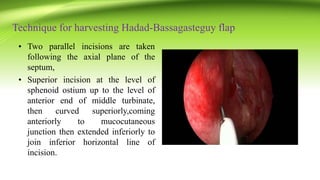
• Two parallel incisions are taken
following the axial plane of the
septum,
• Superior incision at the level of
sphenoid ostium up to the level of
anterior end of middle turbinate,
then curved superiorly,coming
anteriorly to mucocutaneous
junction then extended inferiorly to
join inferior horizontal line of
incision.
Technique for harvesting Hadad-Bassagasteguy flap
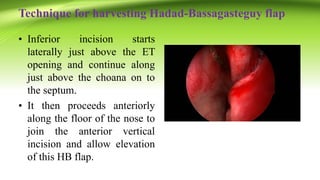
• Inferior incision starts
laterally just above the ET
opening and continue along
just above the choana on to
the septum.
• It then proceeds anteriorly
along the floor of the nose to
join the anterior vertical
incision and allow elevation
of this HB flap.
Technique for harvesting Hadad-Bassagasteguy flap
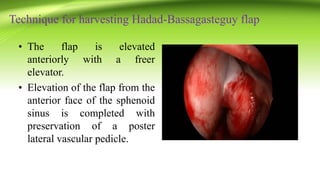
• The flap is elevated
anteriorly with a freer
elevator.
• Elevation of the flap from the
anterior face of the sphenoid
sinus is completed with
preservation of a poster
lateral vascular pedicle.
Technique for harvesting Hadad-Bassagasteguy flap
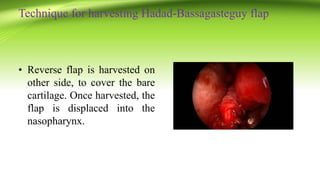
• Reverse flap is harvested on
other side, to cover the bare
cartilage. Once harvested, the
flap is displaced into the
nasopharynx.
Technique for harvesting Hadad-Bassagasteguy flap
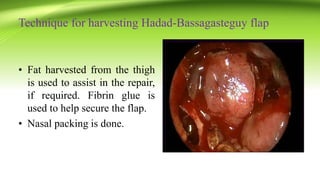
• Fat harvested from the thigh
is used to assist in the repair,
if required. Fibrin glue is
used to help secure the flap.
• Nasal packing is done.
Results:
• The study subjects were between 21-50 years of age (73.6%).
• The mean age of the study subjects was 41.8±13.8 years.
• Male / female ratio of the study sample was 1.2 with 29 males
and 24 females.
• Of the total 53 patients 46 (86.8%) has macro defects while 7
(13.2%) had micro defects.
• Non-secretary lesions were present in 60.4% (32/53) patients
while secretary were present in 39.6% (21/53) patients.
Result
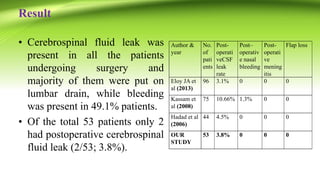
• Cerebrospinal fluid leak was
present in all the patients
undergoing surgery and
majority of them were put on
lumbar drain, while bleeding
was present in 49.1% patients.
• Of the total 53 patients only 2
had postoperative cerebrospinal
fluid leak (2/53; 3.8%).
Author &
year
No.
of
pati
ents
Post-
operati
veCSF
leak
rate
Post–
operativ
e nasal
bleeding
Post-
operati
ve
mening
itis
Flap loss
Eloy JA et
al (2013)
96 3.1% 0 0 0
Kassam et
al (2008)
75 10.66% 1.3% 0 0
Hadad et al
(2006)
44 4.5% 0 0 0
OUR
STUDY
53 3.8% 0 0 0
Conclusions:
• Use of HB posterior nasal septal flap for reconstruction of
anterior skull base among patients with high-flow intra-
operative CSF leak has a remarkable impact in preventing post-
operative CSF leak. Its applicability to wide patient-profiles
with respect to age, size of defect, diagnosis is making it a
versatile choice of reconstruction after endonasal anterior skull
base surgeries.

Hadad.bassagasteguy flap

  • 1.
    Hadad-Bassagasteguy flap inreconstruction of skull base defects after endonasal skull base surgery:how we do it Dr. Chandra Veer Singh Consultant, Department Of Otorhinolaryngology K.J.Somaiya Hospital ,Somaiya Ayurvihar Sion Mumbai
  • 2.
    Introduction • Hadad-Bassagasteguy flapa vascular pedicled flap of the nasal septum mucoperiosteum and mucoperichondrium based on the posterior septal artery branch of sphenopalatine artery, • It is increasingly becoming a“workhorse”for the reconstruction in extended endonasal skull base surgery. Endoscopic endonasal repair of traumatic CSF leaks with the nasoseptal flap has a success rate of approximately 95% .
  • 3.
    Aim of study •To study the clinical outcomes of Hadad-Bassagasteguy flap (HBF) in endonasal reconstruction of anterior skull base defects.
  • 4.
    Material And Methods •We prospectively analyzed the demographic data & the outcome results particularly Post-operative CSF leak in 53 patients who underwent HBF in our hospital from February 2013 to June 2014. The early harvested flap was used to reconstruct anterior skull base defects among patients with high-flow on-table CSF leak. Post-operatively the patients were analyzed for CSF leak & bleeding.
  • 5.
    Inclusion criteria 1 Patientswho were subjected to resection of skull base pathologies with significant risk of having a cerebrospinal fluid leak on pre-operative assessment. 2.Patients with traumatic high-flow CSF leaks with large skull base defects that were repaired with a posterior nasal septal flap. Exclusion criteria 1.Nasal septal injury due to trauma, previous surgery. 2.Tumors that infiltrate the nasal septum, pterygoid fossa, or the anterior wall of sphenoid sinus. 3.Patients with less the 18 years of age.
  • 6.
    Technique for harvestingHadad-Bassagasteguy flap • This is done bilaterally to facilitate bimanual technique, which allows HB Flap to take on one side and reverse flap on other side. • The flap is designed according to the size and shape of the anticipated defect. • The nasal cavity is decongested with oxymetazoline (0.05%). • The inferior, middle and superior turbinates are out-fractured to allow the visualization of anterior wall of sphenoid.
  • 7.
    Technique for harvestingHadad-Bassagasteguy flap • Two parallel incisions are taken following the axial plane of the septum, • Superior incision at the level of sphenoid ostium up to the level of anterior end of middle turbinate, then curved superiorly,coming anteriorly to mucocutaneous junction then extended inferiorly to join inferior horizontal line of incision.
  • 8.
    Technique for harvestingHadad-Bassagasteguy flap • Inferior incision starts laterally just above the ET opening and continue along just above the choana on to the septum. • It then proceeds anteriorly along the floor of the nose to join the anterior vertical incision and allow elevation of this HB flap.
  • 9.
    Technique for harvestingHadad-Bassagasteguy flap • The flap is elevated anteriorly with a freer elevator. • Elevation of the flap from the anterior face of the sphenoid sinus is completed with preservation of a poster lateral vascular pedicle.
  • 10.
    Technique for harvestingHadad-Bassagasteguy flap • Reverse flap is harvested on other side, to cover the bare cartilage. Once harvested, the flap is displaced into the nasopharynx.
  • 11.
    Technique for harvestingHadad-Bassagasteguy flap • Fat harvested from the thigh is used to assist in the repair, if required. Fibrin glue is used to help secure the flap. • Nasal packing is done.
  • 12.
    Results: • The studysubjects were between 21-50 years of age (73.6%). • The mean age of the study subjects was 41.8±13.8 years. • Male / female ratio of the study sample was 1.2 with 29 males and 24 females. • Of the total 53 patients 46 (86.8%) has macro defects while 7 (13.2%) had micro defects. • Non-secretary lesions were present in 60.4% (32/53) patients while secretary were present in 39.6% (21/53) patients.
  • 13.
    Result • Cerebrospinal fluidleak was present in all the patients undergoing surgery and majority of them were put on lumbar drain, while bleeding was present in 49.1% patients. • Of the total 53 patients only 2 had postoperative cerebrospinal fluid leak (2/53; 3.8%). Author & year No. of pati ents Post- operati veCSF leak rate Post– operativ e nasal bleeding Post- operati ve mening itis Flap loss Eloy JA et al (2013) 96 3.1% 0 0 0 Kassam et al (2008) 75 10.66% 1.3% 0 0 Hadad et al (2006) 44 4.5% 0 0 0 OUR STUDY 53 3.8% 0 0 0
  • 14.
    Conclusions: • Use ofHB posterior nasal septal flap for reconstruction of anterior skull base among patients with high-flow intra- operative CSF leak has a remarkable impact in preventing post- operative CSF leak. Its applicability to wide patient-profiles with respect to age, size of defect, diagnosis is making it a versatile choice of reconstruction after endonasal anterior skull base surgeries.