Anatomy of the nasal cavity andAnatomy of the nasal cavity and
endoscopic csf leak repairendoscopic csf leak repair
Dr. K SashankaDr. K Sashanka
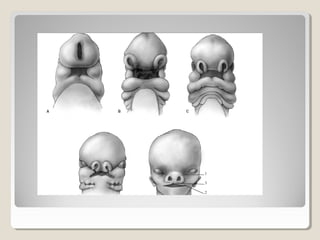
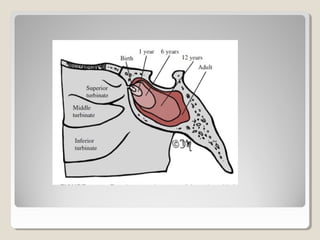
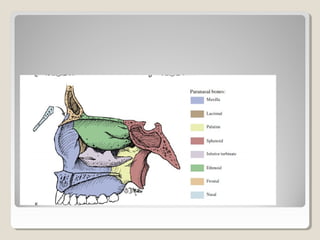
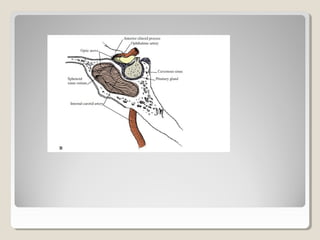
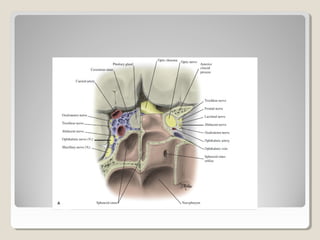
The development of the sphenoid sinus is
unique because of two factors:
 (1) It is the only sinus that does not arise
as an outpouching from the lateral nasal
wall .
(2) there is no primary pneumatization,
but rather a constriction of the developing
presphenoid recess followed by secondary
pneumatization.
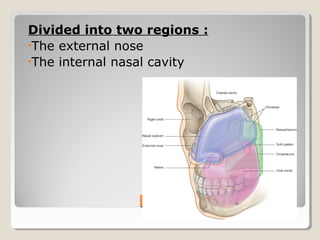
NoseNose
Divided into two regions :
•The external nose
•The internal nasal cavity
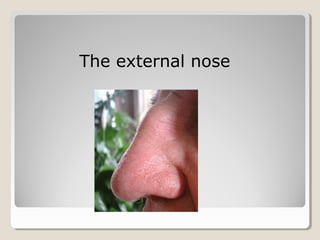
The external nose
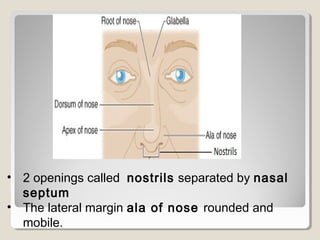
• 2 openings called nostrils separated by nasal
septum
• The lateral margin ala of nose rounded and
mobile.
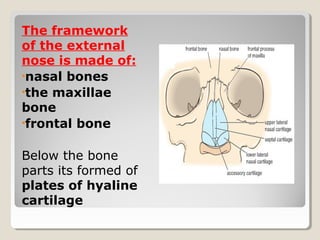
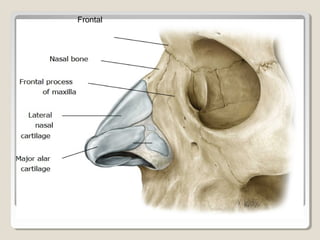
The framework
of the external
nose is made of:
•nasal bones
•the maxillae
bone
•frontal bone
Below the bone
parts its formed of
plates of hyaline
cartilage
Frontal
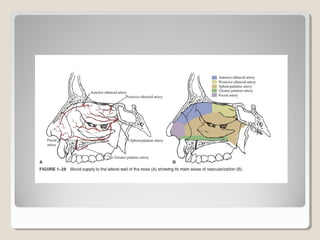
Blood supplyBlood supply
branches of ophthalmic a.
and the maxillary a.
skin of the ala and lower part of the
septum are supplied by branches of facial
artery.
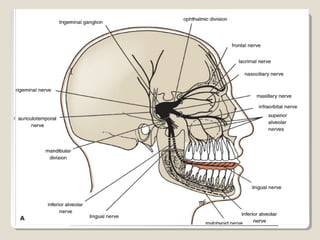
Nerve supplyNerve supply
The infratrochlear and external nasal
branches of the ophthalmic nerve (CN V).
Infraorbital branch of the maxillary nerve
(CN V).
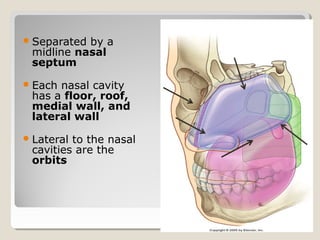
Separated by a
midline nasal
septum
Each nasal cavity
has a floor, roof,
medial wall, and
lateral wall
Lateral to the nasal
cavities are the
orbits
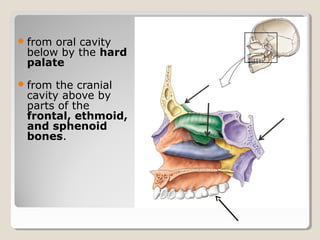
from oral cavity
below by the hard
palate
from the cranial
cavity above by
parts of the
frontal, ethmoid,
and sphenoid
bones.
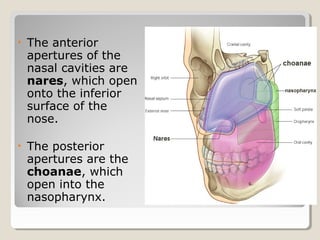
• The anterior
apertures of the
nasal cavities are
naresnares, which open
onto the inferior
surface of the
nose.
• The posterior
apertures are the
choanae, which
open into the
nasopharynx.
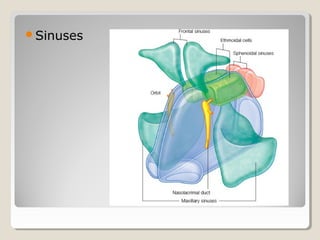
Sinuses
RegionsRegions
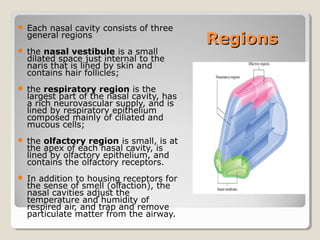
 Each nasal cavity consists of three
general regions
 the nasal vestibule is a small
dilated space just internal to the
naris that is lined by skin and
contains hair follicles;
 the respiratory region is the
largest part of the nasal cavity, has
a rich neurovascular supply, and is
lined by respiratory epithelium
composed mainly of ciliated and
mucous cells;
 the olfactory region is small, is at
the apex of each nasal cavity, is
lined by olfactory epithelium, and
contains the olfactory receptors.
 In addition to housing receptors for
the sense of smell (olfaction), the
nasal cavities adjust the
temperature and humidity of
respired air, and trap and remove
particulate matter from the airway.
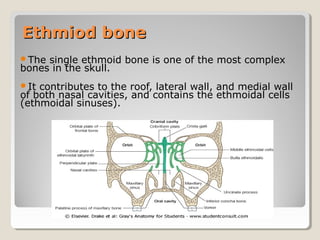
Ethmiod boneEthmiod bone
The single ethmoid bone is one of the most complex
bones in the skull.
It contributes to the roof, lateral wall, and medial wall
of both nasal cavities, and contains the ethmoidal cells
(ethmoidal sinuses).
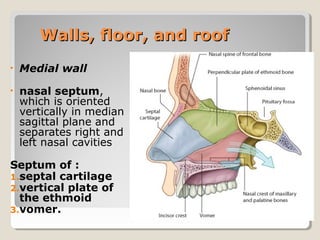
Walls, floor, and roofWalls, floor, and roof
• Medial wall
• nasal septum,
which is oriented
vertically in median
sagittal plane and
separates right and
left nasal cavities
Septum of :
1.septal cartilage
2.vertical plate of
the ethmoid
3.vomer.
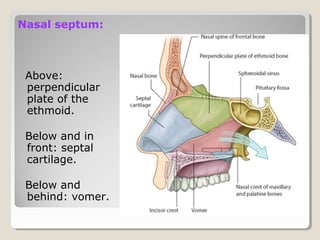
Nasal septum:
Above:
perpendicular
plate of the
ethmoid.
Below and in
front: septal
cartilage.
Below and
behind: vomer.
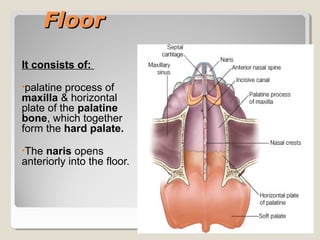
FloorFloor
It consists of:
•palatine process of
maxilla & horizontal
plate of the palatine
bone, which together
form the hard palate.
•The naris opens
anteriorly into the floor.
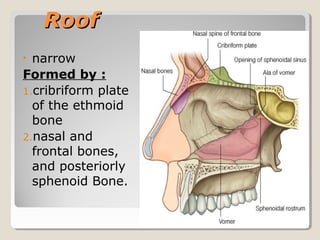
RoofRoof
• narrow
Formed by :
1.cribriform plate
of the ethmoid
bone
2.nasal and
frontal bones,
and posteriorly
sphenoid Bone.
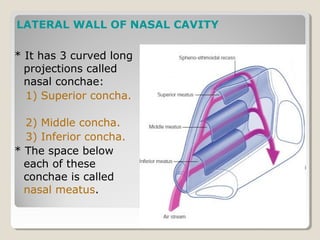
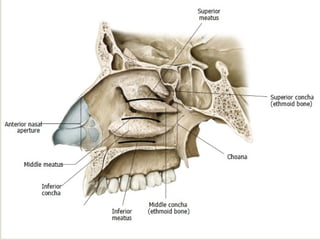
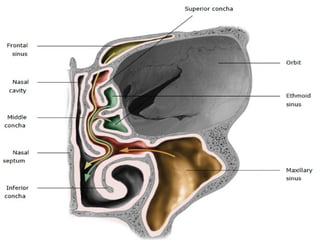
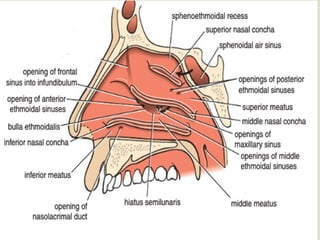
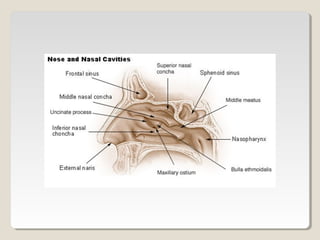
* It has 3 curved long
projections called
nasal conchae:
1) Superior concha.
2) Middle concha.
3) Inferior concha.
* The space below
each of these
conchae is called
nasal meatus.
LATERAL WALL OF NASAL CAVITY
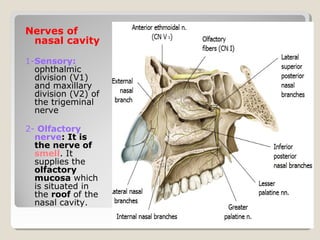
Nerves of
nasal cavity
1-Sensory:
ophthalmic
division (V1)
and maxillary
division (V2) of
the trigeminal
nerve
2- Olfactory
nerve: It is
the nerve of
smell. It
supplies the
olfactory
mucosa which
is situated in
the roof of the
nasal cavity.
PARANASALPARANASAL
AIR SINUSESAIR SINUSES
Functional importance:
They have the following functions:
* They make the skull lighter (filled with
air).
* They act as resonating chambers for the
voice.
They increase the surface area of the
nasal mucous membrane and thus help
warming the air before entering the lung.
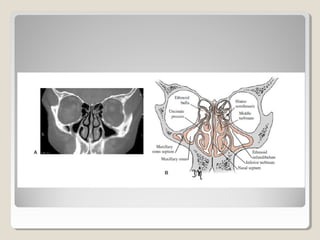
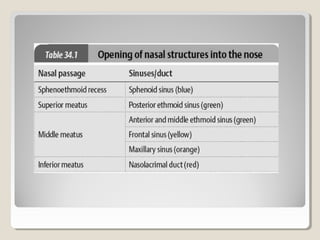
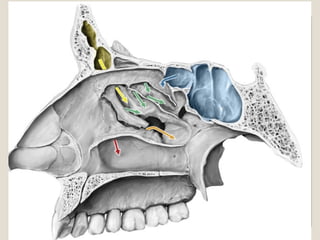
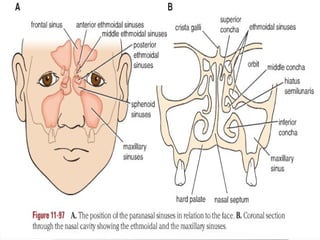
N.B.: All paranasal sinuses open into the middle meatus of the
nose except 2:
1) the sphenoidal sinus (into the spheno-ethmoidal recess).
2) the posterior ethmoidal sinus (into the superior
meatus).
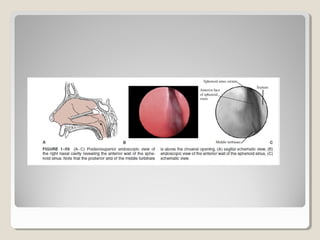
Sphenoid sinusSphenoid sinus
Endoscopic anatomyEndoscopic anatomy
Reservoir Sign
ability of a patient to produce CSF at will by positioning the head in a
certain way, is generally taken to be quite specific for a fistula
with pooling in the sphenoid sinus
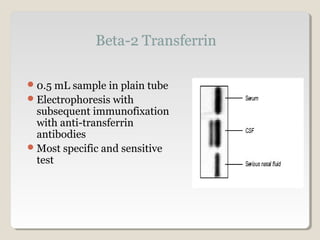
0.5 mL sample in plain tube
Electrophoresis with
subsequent immunofixation
with anti-transferrin
antibodies
Most specific and sensitive
test
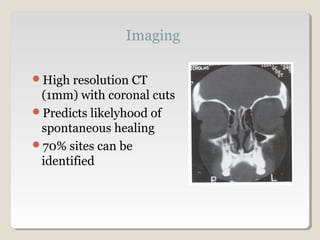
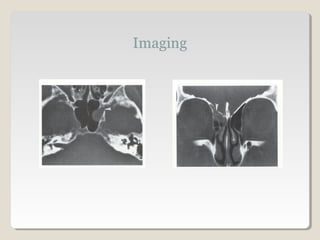
High resolution CT
(1mm) with coronal cuts
Predicts likelyhood of
spontaneous healing
70% sites can be
identified
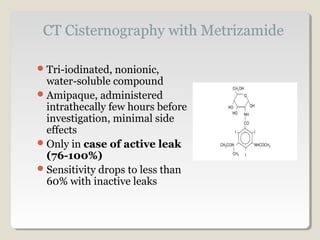
Tri-iodinated, nonionic,
water-soluble compound
Amipaque, administered
intrathecally few hours before
investigation, minimal side
effects
Only in case of active leak
(76-100%)
Sensitivity drops to less than
60% with inactive leaks
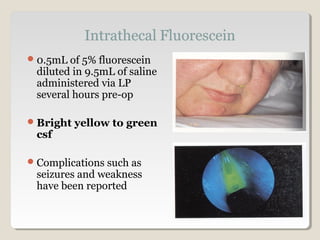
0.5mL of 5% fluorescein
diluted in 9.5mL of saline
administered via LP
several hours pre-op
Bright yellow to green
csf
Complications such as
seizures and weakness
have been reported
Use has fallen out of favor, but may still be useful in
suspected slow leaks
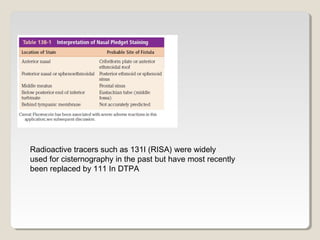
Pledgets in middle meatus and sphenoethmoidal recess
left in for 24 hours with intrathecal administration of
technetium-99
Can try control pledget in upper lip
Many false positives and negatives
Problems with systemic absorption of radioisotope
 Thus need impressively high counts for positive test
Contamination from neighboring pledgets minimizes
localization
Radioactive tracers such as 131I (RISA) were widely
used for cisternography in the past but have most recently
been replaced by 111 In DTPA
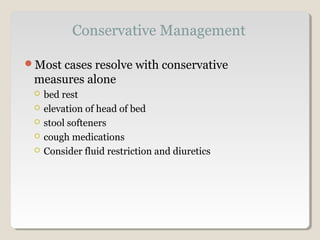
Most cases resolve with conservative
measures alone
 bed rest
 elevation of head of bed
 stool softeners
 cough medications
 Consider fluid restriction and diuretics
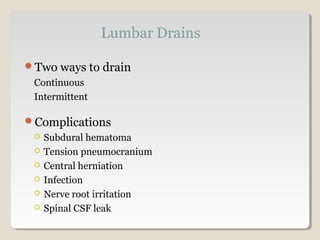
Two ways to drain
Continuous
Intermittent
Complications
 Subdural hematoma
 Tension pneumocranium
 Central herniation
 Infection
 Nerve root irritation
 Spinal CSF leak
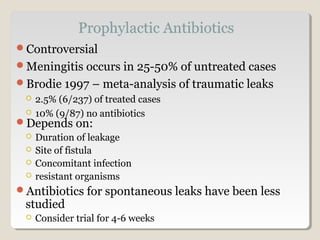
Controversial
Meningitis occurs in 25-50% of untreated cases
Brodie 1997 – meta-analysis of traumatic leaks
 2.5% (6/237) of treated cases
 10% (9/87) no antibiotics
Depends on:
 Duration of leakage
 Site of fistula
 Concomitant infection
 resistant organisms
Antibiotics for spontaneous leaks have been less
studied
 Consider trial for 4-6 weeks
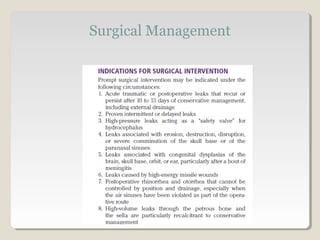
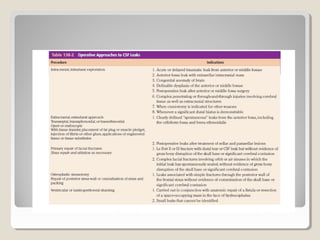
Surgical Management
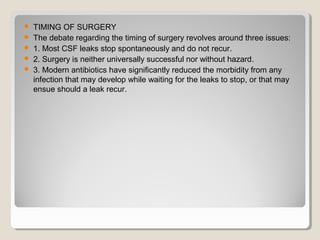
 TIMING OF SURGERY
 The debate regarding the timing of surgery revolves around three issues:
 1. Most CSF leaks stop spontaneously and do not recur.
 2. Surgery is neither universally successful nor without hazard.
 3. Modern antibiotics have significantly reduced the morbidity from any
infection that may develop while waiting for the leaks to stop, or that may
ensue should a leak recur.
Intracranial/Open
Direct visualization but,
 Increased morbidity
 extended operative time
 prolonged hospitalization
 risk of anosmia
Continued high incidence of post-op leak (10-
40%)
Thus initial approach usually
extracranial/endoscopic
Extracranial
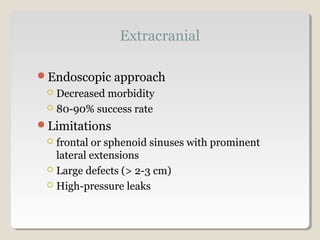
Endoscopic approach
 Decreased morbidity
 80-90% success rate
Limitations
 frontal or sphenoid sinuses with prominent
lateral extensions
 Large defects (> 2-3 cm)
 High-pressure leaks
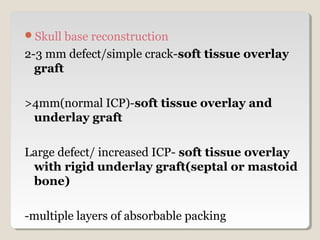
Skull base reconstruction
2-3 mm defect/simple crack-soft tissue overlay
graft
>4mm(normal ICP)-soft tissue overlay and
underlay graft
Large defect/ increased ICP- soft tissue overlay
with rigid underlay graft(septal or mastoid
bone)
-multiple layers of absorbable packing
Graft material
Soft tissue graft - autologous temporalis fascia
alloplastic collagen(Duragen)
cadaveric fascia
pericardium or dermis
Free mucosal grafts-septal/inferior turbinate
mucosa( thick mucosa)
Middle turbinate graft mucosa(thin mucosa)
Composite graft-turbinate bone and mucosa
Placement of mucosa as underlay or reversing
its orientation-meningitis/mucocele
Tissue adhesives
-fibrin sealant
-do not use thick layer
Packing
Gelfoam and surgicel
Postoperative issues
-Activity-strict bed rest
-avoid breath holding and valsalva maneuvers
-Bed position-head end elevated to 15-30 degrees
to decrease ICP
Acetazolamide-mainly in spontaneous leak with
raised ICP
Follow up
Endoscopic care-1-2 weeks
-conservative endoscopic debridement of
dependent sinuses
Conclusions
Traumatic vs. Atraumatic Leaks
Determine if there is a leak
Determine where the leak is
Consider conservative management, especially for
traumatic leaks
Immediate surgical repair for certain high risk leaks
Endoscopic repair initially
Consider intracranial repair for treatment failures and
other high risk leaks
ENDOSCOPIC EVOLUTION
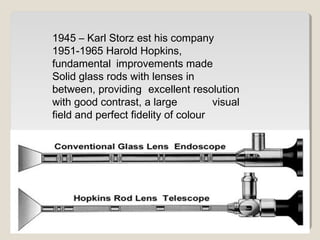
1945 – Karl Storz est his company
1951-1965 Harold Hopkins,
fundamental improvements made
Solid glass rods with lenses in
between, providing excellent resolution
with good contrast, a large visual
field and perfect fidelity of colour
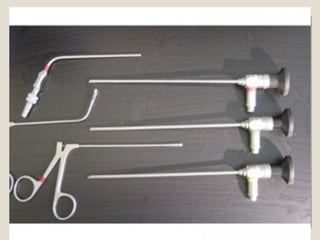
Light source
Cable
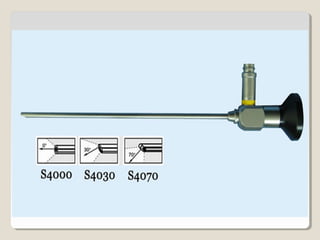
Endoscope [0 - 30 degree] , [wide angle] ,
[2.7 - 4 mm]
Suction tubes [straight - curved]
Forceps [forward - upward]
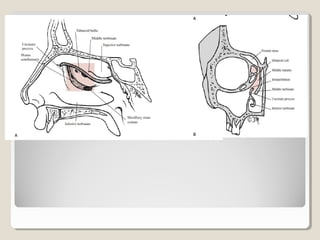
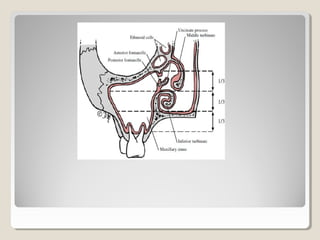
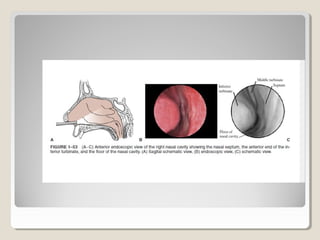
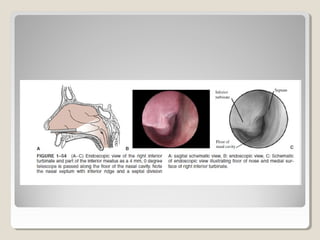
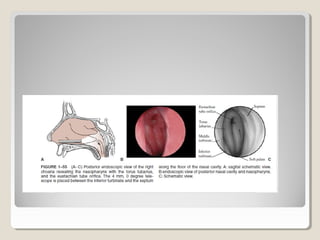
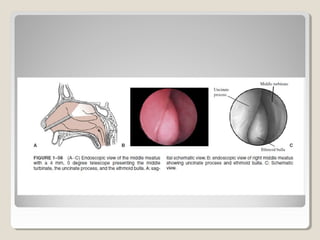
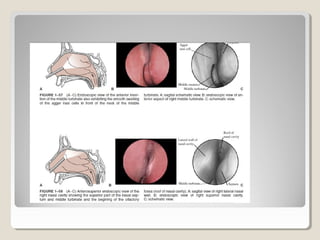
Endoscopic nasal anatomy

Endoscopic nasal anatomy

  • 1.
    Anatomy of thenasal cavity andAnatomy of the nasal cavity and endoscopic csf leak repairendoscopic csf leak repair Dr. K SashankaDr. K Sashanka
  • 5.
    The development ofthe sphenoid sinus is unique because of two factors:  (1) It is the only sinus that does not arise as an outpouching from the lateral nasal wall . (2) there is no primary pneumatization, but rather a constriction of the developing presphenoid recess followed by secondary pneumatization.
  • 6.
    NoseNose Divided into tworegions : •The external nose •The internal nasal cavity
  • 7.
  • 8.
    • 2 openingscalled nostrils separated by nasal septum • The lateral margin ala of nose rounded and mobile.
  • 9.
    The framework of theexternal nose is made of: •nasal bones •the maxillae bone •frontal bone Below the bone parts its formed of plates of hyaline cartilage
  • 10.
  • 11.
    Blood supplyBlood supply branchesof ophthalmic a. and the maxillary a. skin of the ala and lower part of the septum are supplied by branches of facial artery.
  • 12.
    Nerve supplyNerve supply Theinfratrochlear and external nasal branches of the ophthalmic nerve (CN V). Infraorbital branch of the maxillary nerve (CN V).
  • 14.
    Separated by a midlinenasal septum Each nasal cavity has a floor, roof, medial wall, and lateral wall Lateral to the nasal cavities are the orbits
  • 15.
    from oral cavity belowby the hard palate from the cranial cavity above by parts of the frontal, ethmoid, and sphenoid bones.
  • 16.
    • The anterior aperturesof the nasal cavities are naresnares, which open onto the inferior surface of the nose. • The posterior apertures are the choanae, which open into the nasopharynx.
  • 17.
  • 18.
    RegionsRegions  Each nasalcavity consists of three general regions  the nasal vestibule is a small dilated space just internal to the naris that is lined by skin and contains hair follicles;  the respiratory region is the largest part of the nasal cavity, has a rich neurovascular supply, and is lined by respiratory epithelium composed mainly of ciliated and mucous cells;  the olfactory region is small, is at the apex of each nasal cavity, is lined by olfactory epithelium, and contains the olfactory receptors.  In addition to housing receptors for the sense of smell (olfaction), the nasal cavities adjust the temperature and humidity of respired air, and trap and remove particulate matter from the airway.
  • 19.
    Ethmiod boneEthmiod bone Thesingle ethmoid bone is one of the most complex bones in the skull. It contributes to the roof, lateral wall, and medial wall of both nasal cavities, and contains the ethmoidal cells (ethmoidal sinuses).
  • 20.
    Walls, floor, androofWalls, floor, and roof • Medial wall • nasal septum, which is oriented vertically in median sagittal plane and separates right and left nasal cavities Septum of : 1.septal cartilage 2.vertical plate of the ethmoid 3.vomer.
  • 21.
    Nasal septum: Above: perpendicular plate ofthe ethmoid. Below and in front: septal cartilage. Below and behind: vomer.
  • 22.
    FloorFloor It consists of: •palatineprocess of maxilla & horizontal plate of the palatine bone, which together form the hard palate. •The naris opens anteriorly into the floor.
  • 23.
    RoofRoof • narrow Formed by: 1.cribriform plate of the ethmoid bone 2.nasal and frontal bones, and posteriorly sphenoid Bone.
  • 24.
    * It has3 curved long projections called nasal conchae: 1) Superior concha. 2) Middle concha. 3) Inferior concha. * The space below each of these conchae is called nasal meatus. LATERAL WALL OF NASAL CAVITY
  • 34.
    Nerves of nasal cavity 1-Sensory: ophthalmic division(V1) and maxillary division (V2) of the trigeminal nerve 2- Olfactory nerve: It is the nerve of smell. It supplies the olfactory mucosa which is situated in the roof of the nasal cavity.
  • 36.
  • 37.
    Functional importance: They havethe following functions: * They make the skull lighter (filled with air). * They act as resonating chambers for the voice. They increase the surface area of the nasal mucous membrane and thus help warming the air before entering the lung.
  • 38.
    N.B.: All paranasalsinuses open into the middle meatus of the nose except 2: 1) the sphenoidal sinus (into the spheno-ethmoidal recess). 2) the posterior ethmoidal sinus (into the superior meatus).
  • 40.
  • 43.
  • 53.
    Reservoir Sign ability ofa patient to produce CSF at will by positioning the head in a certain way, is generally taken to be quite specific for a fistula with pooling in the sphenoid sinus
  • 55.
    0.5 mL samplein plain tube Electrophoresis with subsequent immunofixation with anti-transferrin antibodies Most specific and sensitive test
  • 56.
    High resolution CT (1mm)with coronal cuts Predicts likelyhood of spontaneous healing 70% sites can be identified
  • 58.
    Tri-iodinated, nonionic, water-soluble compound Amipaque,administered intrathecally few hours before investigation, minimal side effects Only in case of active leak (76-100%) Sensitivity drops to less than 60% with inactive leaks
  • 59.
    0.5mL of 5%fluorescein diluted in 9.5mL of saline administered via LP several hours pre-op Bright yellow to green csf Complications such as seizures and weakness have been reported
  • 60.
    Use has fallenout of favor, but may still be useful in suspected slow leaks Pledgets in middle meatus and sphenoethmoidal recess left in for 24 hours with intrathecal administration of technetium-99 Can try control pledget in upper lip Many false positives and negatives Problems with systemic absorption of radioisotope  Thus need impressively high counts for positive test Contamination from neighboring pledgets minimizes localization
  • 61.
    Radioactive tracers suchas 131I (RISA) were widely used for cisternography in the past but have most recently been replaced by 111 In DTPA
  • 62.
    Most cases resolvewith conservative measures alone  bed rest  elevation of head of bed  stool softeners  cough medications  Consider fluid restriction and diuretics
  • 63.
    Two ways todrain Continuous Intermittent Complications  Subdural hematoma  Tension pneumocranium  Central herniation  Infection  Nerve root irritation  Spinal CSF leak
  • 64.
    Controversial Meningitis occurs in25-50% of untreated cases Brodie 1997 – meta-analysis of traumatic leaks  2.5% (6/237) of treated cases  10% (9/87) no antibiotics Depends on:  Duration of leakage  Site of fistula  Concomitant infection  resistant organisms Antibiotics for spontaneous leaks have been less studied  Consider trial for 4-6 weeks
  • 65.
  • 66.
     TIMING OFSURGERY  The debate regarding the timing of surgery revolves around three issues:  1. Most CSF leaks stop spontaneously and do not recur.  2. Surgery is neither universally successful nor without hazard.  3. Modern antibiotics have significantly reduced the morbidity from any infection that may develop while waiting for the leaks to stop, or that may ensue should a leak recur.
  • 68.
    Intracranial/Open Direct visualization but, Increased morbidity  extended operative time  prolonged hospitalization  risk of anosmia Continued high incidence of post-op leak (10- 40%) Thus initial approach usually extracranial/endoscopic
  • 69.
    Extracranial Endoscopic approach  Decreasedmorbidity  80-90% success rate Limitations  frontal or sphenoid sinuses with prominent lateral extensions  Large defects (> 2-3 cm)  High-pressure leaks
  • 71.
    Skull base reconstruction 2-3mm defect/simple crack-soft tissue overlay graft >4mm(normal ICP)-soft tissue overlay and underlay graft Large defect/ increased ICP- soft tissue overlay with rigid underlay graft(septal or mastoid bone) -multiple layers of absorbable packing
  • 73.
    Graft material Soft tissuegraft - autologous temporalis fascia alloplastic collagen(Duragen) cadaveric fascia pericardium or dermis
  • 74.
    Free mucosal grafts-septal/inferiorturbinate mucosa( thick mucosa) Middle turbinate graft mucosa(thin mucosa) Composite graft-turbinate bone and mucosa Placement of mucosa as underlay or reversing its orientation-meningitis/mucocele
  • 75.
    Tissue adhesives -fibrin sealant -donot use thick layer Packing Gelfoam and surgicel
  • 76.
    Postoperative issues -Activity-strict bedrest -avoid breath holding and valsalva maneuvers -Bed position-head end elevated to 15-30 degrees to decrease ICP Acetazolamide-mainly in spontaneous leak with raised ICP Follow up Endoscopic care-1-2 weeks -conservative endoscopic debridement of dependent sinuses
  • 77.
    Conclusions Traumatic vs. AtraumaticLeaks Determine if there is a leak Determine where the leak is Consider conservative management, especially for traumatic leaks Immediate surgical repair for certain high risk leaks Endoscopic repair initially Consider intracranial repair for treatment failures and other high risk leaks
  • 78.
  • 80.
    1945 – KarlStorz est his company 1951-1965 Harold Hopkins, fundamental improvements made Solid glass rods with lenses in between, providing excellent resolution with good contrast, a large visual field and perfect fidelity of colour
  • 83.
    Light source Cable Endoscope [0- 30 degree] , [wide angle] , [2.7 - 4 mm] Suction tubes [straight - curved] Forceps [forward - upward]