Guidance for Industry
Q2B Validation of Analytical
Procedures: Methodology
November 1996
ICH
Guidance for Industry
Q2B Validation of Analytical
Procedures: Methodology
Additional copies are available from:
the Drug Information Branch (HFD-210),
Center for Drug Evaluation and Research (CDER),
5600 Fishers Lane, Rockville, MD 20857 (Tel) 301-827-4573
http://www.fda.gov/cder/guidance/index.htm
or
Office of Communication,
Training, and Manufacturers Assistance (HFM-40)
Center for Biologics Evaluation and Research (CBER)
1401 Rockville Pike, Rockville, MD 20852-1448,
http://www.fda.gov/cber/guidelines.htm
(Fax) 888-CBERFAX or 301-827-3844
(Voice Information) 800-835-4709 or 301-827-1800
U.S. Department of Health and Human Services
Food and Drug Administration
Center for Drug Evaluation and Research (CDER)
Center for Biologics Evaluation and Research (CBER)
November 1996
ICH
Table of Contents
I. INTRODUCTION . . . . . . . . . . . . . . . . . . . . . . . . . . . . . . . . . . . . . . . . . . . . . . . . . . . . . 1
II. SPECIFICITY (1) . . . . . . . . . . . . . . . . . . . . . . . . . . . . . . . . . . . . . . . . . . . . . . . . . . . . . 2
A. Identification (1.1) . . . . . . . . . . . . . . . . . . . . . . . . . . . . . . . . . . . . . . . . . . . . . . . 2
B. Assay and Impurity Test(s) (1.2) . . . . . . . . . . . . . . . . . . . . . . . . . . . . . . . . . . . . . 2
III. LINEARITY (2) . . . . . . . . . . . . . . . . . . . . . . . . . . . . . . . . . . . . . . . . . . . . . . . . . . . . . . 3
IV. RANGE (3) . . . . . . . . . . . . . . . . . . . . . . . . . . . . . . . . . . . . . . . . . . . . . . . . . . . . . . . . . . 4
V. ACCURACY (4) . . . . . . . . . . . . . . . . . . . . . . . . . . . . . . . . . . . . . . . . . . . . . . . . . . . . . . 5
A. Assay (4.1) . . . . . . . . . . . . . . . . . . . . . . . . . . . . . . . . . . . . . . . . . . . . . . . . . . . . . 5
B. Impurities (Quantitation) (4.2) . . . . . . . . . . . . . . . . . . . . . . . . . . . . . . . . . . . . . . 6
C. Recommended Data (4.3) . . . . . . . . . . . . . . . . . . . . . . . . . . . . . . . . . . . . . . . . . . 6
VI. PRECISION (5) . . . . . . . . . . . . . . . . . . . . . . . . . . . . . . . . . . . . . . . . . . . . . . . . . . . . . . . 6
A. Repeatability (5.1) . . . . . . . . . . . . . . . . . . . . . . . . . . . . . . . . . . . . . . . . . . . . . . . 7
B. Intermediate Precision (5.2) . . . . . . . . . . . . . . . . . . . . . . . . . . . . . . . . . . . . . . . . 7
C. Reproducibility (5.3) . . . . . . . . . . . . . . . . . . . . . . . . . . . . . . . . . . . . . . . . . . . . . . 7
D. Recommended Data (5.4) . . . . . . . . . . . . . . . . . . . . . . . . . . . . . . . . . . . . . . . . . . 7
VII. DETECTION LIMIT (6) . . . . . . . . . . . . . . . . . . . . . . . . . . . . . . . . . . . . . . . . . . . . . . . . 7
A. Based on Visual Evaluation (6.1) . . . . . . . . . . . . . . . . . . . . . . . . . . . . . . . . . . . . 7
B. Based on Signal-to-Noise (6.2) . . . . . . . . . . . . . . . . . . . . . . . . . . . . . . . . . . . . . . 8
C. Based on the Standard Deviation of the Response and the Slope (6.3) . . . . . . . . 8
D. Recommended Data (6.4) . . . . . . . . . . . . . . . . . . . . . . . . . . . . . . . . . . . . . . . . . . 8
VIII. QUANTITATION LIMIT (7) . . . . . . . . . . . . . . . . . . . . . . . . . . . . . . . . . . . . . . . . . . . . 8
A. Based on Visual Evaluation (7.1) . . . . . . . . . . . . . . . . . . . . . . . . . . . . . . . . . . . . 9
B. Based on Signal-to-Noise (7.2) . . . . . . . . . . . . . . . . . . . . . . . . . . . . . . . . . . . . . . 9
C. Based on the Standard Deviation of the Response and the Slope (7.3) . . . . . . . . 9
D. Recommended Data (7.4) . . . . . . . . . . . . . . . . . . . . . . . . . . . . . . . . . . . . . . . . . 10
IX. ROBUSTNESS (8) . . . . . . . . . . . . . . . . . . . . . . . . . . . . . . . . . . . . . . . . . . . . . . . . . . . 10
X. SYSTEM SUITABILITY TESTING (9) . . . . . . . . . . . . . . . . . . . . . . . . . . . . . . . . . . . 10
i
GUIDANCE FOR INDUSTRY1
Q2B Validation of Analytical
Procedures: Methodology
I. INTRODUCTION
This document is complementary to the ICH guidance entitled Text on Validation of Analytical
Procedures (ICH Q2A), which presents a discussion of the characteristics that should be
considered during the validation of analytical procedures. Its purpose is to provide some
guidance and recommendations on how to consider the various validation characteristics for each
analytical procedure. In some cases (for example, demonstration of specificity), the overall
capabilities of a number of analytical procedures in combination may be investigated in order to
ensure the quality of the drug substance or drug product. In addition, the document provides an
indication of the data that should be presented in a new drug application.
All relevant data collected during validation and formulae used for calculating validation
characteristics should be submitted and discussed as appropriate.
Approaches other than those set forth in this guidance may be applicable and acceptable. It is the
responsibility of the applicant to choose the validation procedure and protocol most suitable for
their product. However, it is important to remember that the main objective of validation of an
analytical procedure is to demonstrate that the procedure is suitable for its intended purpose. Due
to their complex nature, analytical procedures for biological and biotechnological products in
some cases may be approached differently than in this document.
Well-characterized reference materials, with documented purity, should be used throughout the
validation study. The degree of purity necessary depends on the intended use.
In accordance with the parent document, and for the sake of clarity, this document considers the
various validation characteristics in distinct sections. The arrangement of these sections reflects
the process by which an analytical procedure may be developed and evaluated.
1
This guidance was developed within the Expert Working Group (Quality) of the InternationalConference on
Harmonisation ofTechnicalRequirements for Registration ofPharmaceuticals forHuman Use (ICH) and has been
subject to consultationby the regulatory parties,in accordancewith the ICH process. This document has been endorsed
by the ICH Steering Committee at Step 4 of the ICH process,November1996. At Step 4 of the process,the finaldraft is
recommended for adoption to theregulatorybodies ofthe European Union,Japan andthe United States. This guidance
was published in the Federal Register on May 19,1997 (62 FR 27464), and is applicable to drug and biological
products. This guidance represents the Agency’s currentthinking on the validationofanalyticalprocedures. It does not
create orconferany rights foror on any person and does not operate to bind FDA orthe public. An alternative approach
may be used ifsuch approachsatisfies the requirements ofthe applicable statute,regulations,orboth.
In practice, it is usually possible to design the experimental work such that the appropriate
validation characteristics can be considered simultaneously to provide a sound, overall knowledge
of the capabilities of the analytical procedure, for instance: Specificity, linearity, range, accuracy,
and precision.
II. SPECIFICITY (1)
An investigation of specificity should be conducted during the validation of identification tests, the
determination of impurities, and the assay. The procedures used to demonstrate specificity will
depend on the intended objective of the analytical procedure.
It is not always possible to demonstrate that an analytical procedure is specific for a particular
analyte (complete discrimination). In this case, a combination of two or more analytical
procedures is recommended to achieve the necessary level of discrimination.
A. Identification (1.1)
Suitable identification tests should be able to discriminate between compounds of closely
related structures which are likely to be present. The discrimination of a procedure may
be confirmed by obtaining positive results (perhaps by comparison with a known reference
material) from samples containing the analyte, coupled with negative results from samples
which do not contain the analyte. In addition, the identification test may be applied to
materials structurally similar to or closely related to the analyte to confirm that a positive
response is not obtained. The choice of such potentially interfering materials should be
based on sensible scientific judgment with a consideration of the interferences that could
occur.
B. Assay and Impurity Test(s) (1.2)
For chromatographic procedures, representative chromatograms should be used to
demonstrate specificity, and individual components should be appropriately labeled.
Similar considerations should be given to other separation techniques.
Critical separations in chromatography should be investigated at an appropriate level. For
critical separations, specificity can be demonstrated by the resolution of the two
components which elute closest to each other.
In cases where a nonspecific assay is used, other supporting analytical procedures should
be used to demonstrate overall specificity. For example, where a titration is adopted to
assay the drug substance for release, the combination of the assay and a suitable test for
impurities can be used.
2
The approach is similar for both assay and impurity tests:
1. Impurities are available (1.2.1)
For the assay, this should involve demonstration of the discrimination of the
analyte in the presence of impurities and/or excipients; practically, this can be done
by spiking pure substances (drug substance or drug product) with appropriate
levels of impurities and/or excipients and demonstrating that the assay result is
unaffected by the presence of these materials (by comparison with the assay result
obtained on unspiked samples). For the impurity test, the discrimination may be
established by spiking drug substance or drug product with appropriate levels of
impurities and demonstrating the separation of these impurities individually and/or
from other components in the sample matrix.
2. Impurities are not available (1.2.2)
If impurity or degradation product standards are unavailable, specificity may be
demonstrated by comparing the test results of samples containing impurities or
degradation products to a second well-characterized procedure, e.g.,
pharmacopoeial method or other validated analytical procedure (independent
procedure). As appropriate, this should include samples stored under relevant
stress conditions: Light, heat, humidity, acid/base hydrolysis, and oxidation.
• For the assay, the two results should be compared.
• For the impurity tests, the impurity profiles should be compared.
Peak purity tests may be useful to show that the analyte chromatographic peak is
not attributable to more than one component (e.g., diode array, mass
spectrometry).
III. LINEARITY (2)
A linear relationship should be evaluated across the range (see section 3) of the analytical
procedure. It may be demonstrated directly on the drug substance (by dilution of a standard stock
solution) and/or separate weighings of synthetic mixtures of the drug product components, using
the proposed procedure. The latter aspect can be studied during investigation of the range.
Linearity should be evaluated by visual inspection of a plot of signals as a function of analyte
concentration or content. If there is a linear relationship, test results should be evaluated by
appropriate statistical methods, for example, by calculation of a regression line by the method of
least squares. In some cases, to obtain linearity between assays and sample concentrations, the
test data may have to be subjected to a mathematical transformation prior to the regression
3
analysis. Data from the regression line itself may be helpful to provide mathematical estimates of
the degree of linearity.
The correlation coefficient, y-intercept, slope of the regression line, and residual sum of squares
should be submitted. A plot of the data should be included. In addition, an analysis of the
deviation of the actual data points from the regression line may also be helpful for evaluating
linearity.
Some analytical procedures, such as immunoassays, do not demonstrate linearity after any
transformation. In this case, the analytical response should be described by an appropriate
function of the concentration (amount) of an analyte in a sample.
For the establishment of linearity, a minimum of five concentrations is recommended. Other
approaches should be justified.
IV. RANGE (3)
The specified range is normally derived from linearity studies and depends on the intended
application of the procedure. It is established by confirming that the analytical procedure provides
an acceptable degree of linearity, accuracy, and precision when applied to samples containing
amounts of analyte within or at the extremes of the specified range of the analytical procedure.
The following minimum specified ranges should be considered.
• For the assay of a drug substance or a finished (drug) product: Normally from 80
to 120 percent of the test concentration;
• For content uniformity: Covering a minimum of 70 to 130 percent of the test
concentration, unless a wider, more appropriate range, based on the nature of the
dosage form (e.g., metered dose inhalers), is justified;
• For dissolution testing: +/-20 percent over the specified range; e.g., if the
specifications for a controlled released product cover a region from 20 percent,
after 1 hour, up to 90 percent, after 24 hours, the validated range would be 0-110
percent of the label claim;
• For the determination of an impurity: From the reporting level of an impurity2
to
120 percent of the specification;
2
See sections on "ReportingImpurity Content ofBatches"ofthe corresponding ICHQ3A guidance entitled
"Impurities in New Drug Substances"(61FR 372; January 4, 1996) and ICH Q3B draft guidance "Impurities in New
Drug Products" (61FR 11268; March 19, 1996).
4
• For impurities known to be unusually potent or to produce toxic or unexpected
pharmacological effects, the detection/quantitation limit should be commensurate
with the level at which the impurities must be controlled.
Note: For validation of impurity test procedures carried out during development,
it may be necessary to consider the range around a suggested (probable) limit;
• If assay and purity are performed together as one test and only a 100 percent
standard is used, linearity should cover the range from the reporting level of the
impurities3
to 120 percent of the assay specification.
V. ACCURACY (4)
Accuracy should be established across the specified range of the analytical procedure.
A. Assay (4.1)
1. Drug substance (4.1.1)
Several methods of determining accuracy are available.
(a) Application of an analytical procedure to an analyte of known purity (e.g.,
reference material);
(b) Comparison of the results of the proposed analytical procedure with those of a
second well-characterized procedure, the accuracy of which is stated and/or
defined (independent procedure, see section 1.2.);
(c) Accuracy may be inferred once precision, linearity, and specificity have been
established.
2. Drug product (4.1.2)
Several methods for determining accuracy are available.
(a) Application of the analytical procedure to synthetic mixtures of the drug
product components to which known quantities of the drug substance to be
analyzed have been added;
(b) In cases where it is impossible to obtain samples of all drug product
components, it may be acceptable either to add known quantities of the analyte to
3
Ibid.
5
the drug product or to compare the results obtained from a second, well-
characterized procedure, the accuracy of which is stated and/or defined
(independent procedure, see section 1.2);
(c) Accuracy may be inferred once precision, linearity, and specificity have been
established.
B. Impurities (Quantitation) (4.2)
Accuracy should be assessed on samples (drug substance/drug product) spiked with
known amounts of impurities.
In cases where it is impossible to obtain samples of certain impurities and/or degradation
products, it is considered acceptable to compare results obtained by an independent
procedure (see section 1.2.). The response factor of the drug substance can be used.
It should be clear how the individual or total impurities are to be determined, e.g.,
weight/weight or area percent, in all cases with respect to the major analyte.
C. Recommended Data (4.3)
Accuracy should be assessed using a minimum of 9 determinations over a minimum of 3
concentration levels covering the specified range (e.g., 3 concentrations/3 replicates each
of the total analytical procedure).
Accuracy should be reported as percent recovery by the assay of known added amount of
analyte in the sample or as the difference between the mean and the accepted true value
together with the confidence intervals.
VI. PRECISION (5)
Validation of tests for assay and for quantitative determination of impurities includes an
investigation of precision.
A. Repeatability (5.1)
Repeatability should be assessed using:
(1) A minimum of 9 determinations covering the specified range for the procedure
(e.g., 3 concentrations/3 replicates each); or
(2) A minimum of 6 determinations at 100 percent of the test concentration.
6
B. Intermediate Precision (5.2)
The extent to which intermediate precision should be established depends on the
circumstances under which the procedure is intended to be used. The applicant should
establish the effects of random events on the precision of the analytical procedure. Typical
variations to be studied include days, analysts, equipment, etc. It is not necessary to study
these effects individually. The use of an experimental design (matrix) is encouraged.
C. Reproducibility (5.3)
Reproducibility is assessed by means of an interlaboratory trial. Reproducibility should be
considered in case of the standardization of an analytical procedure, for instance, for
inclusion of procedures in pharmacopoeias. These data are not part of the marketing
authorization dossier.
D. Recommended Data (5.4)
The standard deviation, relative standard deviation (coefficient of variation), and
confidence interval should be reported for each type of precision investigated.
VII. DETECTION LIMIT (6)
Several approaches for determining the detection limit are possible, depending on whether the
procedure is noninstrumental or instrumental. Approaches other than those listed below may be
acceptable.
A. Based on Visual Evaluation (6.1)
Visual evaluation may be used for noninstrumental methods but may also be used with
instrumental methods.
The detection limit is determined by the analysis of samples with known concentrations of
analyte and by establishing the minimum level at which the analyte can be reliably
detected.
B. Based on Signal-to-Noise (6.2)
This approach can only be applied to analytical procedures which exhibit baseline noise.
Determination of the signal-to-noise ratio is performed by comparing measured signals
from samples with known low concentrations of analyte with those of blank samples and
establishing the minimum concentration at which the analyte can be reliably detected. A
signal-to-noise ratio between 3 or 2:1 is generally considered acceptable for estimating the
detection limit.
7
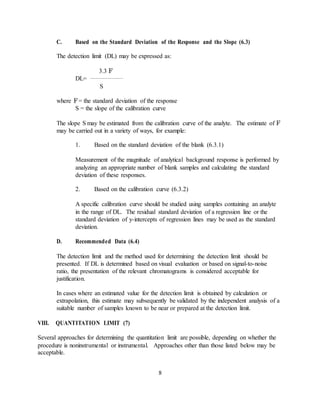
C. Based on the Standard Deviation of the Response and the Slope (6.3)
The detection limit (DL) may be expressed as:
3.3 F
DL= _________________
S
where F= the standard deviation of the response
S = the slope of the calibration curve
The slope S may be estimated from the calibration curve of the analyte. The estimate of F
may be carried out in a variety of ways, for example:
1. Based on the standard deviation of the blank (6.3.1)
Measurement of the magnitude of analytical background response is performed by
analyzing an appropriate number of blank samples and calculating the standard
deviation of these responses.
2. Based on the calibration curve (6.3.2)
A specific calibration curve should be studied using samples containing an analyte
in the range of DL. The residual standard deviation of a regression line or the
standard deviation of y-intercepts of regression lines may be used as the standard
deviation.
D. Recommended Data (6.4)
The detection limit and the method used for determining the detection limit should be
presented. If DL is determined based on visual evaluation or based on signal-to-noise
ratio, the presentation of the relevant chromatograms is considered acceptable for
justification.
In cases where an estimated value for the detection limit is obtained by calculation or
extrapolation, this estimate may subsequently be validated by the independent analysis of a
suitable number of samples known to be near or prepared at the detection limit.
VIII. QUANTITATION LIMIT (7)
Several approaches for determining the quantitation limit are possible, depending on whether the
procedure is noninstrumental or instrumental. Approaches other than those listed below may be
acceptable.
8
A. Based on Visual Evaluation (7.1)
Visual evaluation may be used for noninstrumental methods, but may also be used with
instrumental methods.
The quantitation limit is generally determined by the analysis of samples with known
concentrations of analyte and by establishing the minimum level at which the analyte can
be quantified with acceptable accuracy and precision.
B. Based on Signal-to-Noise (7.2)
This approach can only be applied to analytical procedures that exhibit baseline noise.
Determination of the signal-to-noise ratio is performed by comparing measured signals
from samples with known low concentrations of analyte with those of blank samples and
by establishing the minimum concentration at which the analyte can be reliably quantified.
A typical signal-to-noise ratio is 10:1.
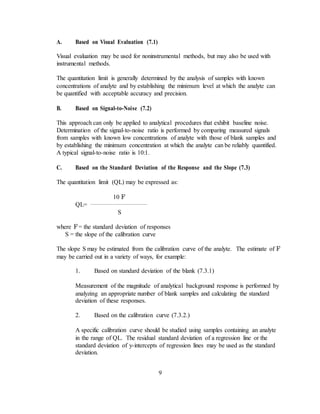
C. Based on the Standard Deviation of the Response and the Slope (7.3)
The quantitation limit (QL) may be expressed as:
10 F
QL= ______________________________
S
where F= the standard deviation of responses
S = the slope of the calibration curve
The slope S may be estimated from the calibration curve of the analyte. The estimate of F
may be carried out in a variety of ways, for example:
1. Based on standard deviation of the blank (7.3.1)
Measurement of the magnitude of analytical background response is performed by
analyzing an appropriate number of blank samples and calculating the standard
deviation of these responses.
2. Based on the calibration curve (7.3.2.)
A specific calibration curve should be studied using samples containing an analyte
in the range of QL. The residual standard deviation of a regression line or the
standard deviation of y-intercepts of regression lines may be used as the standard
deviation.
9
D. Recommended Data (7.4)
The quantitation limit and the method used for determining the quantitation limit should be
presented.
The limit should be subsequently validated by the analysis of a suitable number of samples
known to be near or prepared at the quantitation limit.
IX. ROBUSTNESS (8)
The evaluation of robustness should be considered during the development phase and depends on
the type of procedure under study. It should show the reliability of an analysis with respect to
deliberate variations in method parameters.
If measurements are susceptible to variations in analytical conditions, the analytical conditions
should be suitably controlled or a precautionary statement should be included in the procedure.
One consequence of the evaluation of robustness should be that a series of system suitability
parameters (e.g., resolution test) is established to ensure that the validity of the analytical
procedure is maintained whenever used.
Examples of typical variations are:
• Stability of analytical solutions
• Extraction time
In the case of liquid chromatography, examples of typical variations are:
• Influence of variations of pH in a mobile phase
• Influence of variations in mobile phase composition
• Different columns (different lots and/or suppliers)
• Temperature
• Flow rate
In the case of gas-chromatography, examples of typical variations are:
• Different columns (different lots and/or suppliers)
• Temperature
• Flow rate
X. SYSTEM SUITABILITY TESTING (9)
System suitability testing is an integral part of many analytical procedures. The tests are based on
the concept that the equipment, electronics, analytical operations, and samples to be analyzed
constitute an integral system that can be evaluated as such. System suitability test parameters to
be established for a particular procedure depend on the type of procedure being validated. See
pharmacopoeias for additional information.
10

Guidance for Industry Q2B Methodology

  • 1.
    Guidance for Industry Q2BValidation of Analytical Procedures: Methodology November 1996 ICH
  • 2.
    Guidance for Industry Q2BValidation of Analytical Procedures: Methodology Additional copies are available from: the Drug Information Branch (HFD-210), Center for Drug Evaluation and Research (CDER), 5600 Fishers Lane, Rockville, MD 20857 (Tel) 301-827-4573 http://www.fda.gov/cder/guidance/index.htm or Office of Communication, Training, and Manufacturers Assistance (HFM-40) Center for Biologics Evaluation and Research (CBER) 1401 Rockville Pike, Rockville, MD 20852-1448, http://www.fda.gov/cber/guidelines.htm (Fax) 888-CBERFAX or 301-827-3844 (Voice Information) 800-835-4709 or 301-827-1800 U.S. Department of Health and Human Services Food and Drug Administration Center for Drug Evaluation and Research (CDER) Center for Biologics Evaluation and Research (CBER) November 1996 ICH
  • 3.
    Table of Contents I.INTRODUCTION . . . . . . . . . . . . . . . . . . . . . . . . . . . . . . . . . . . . . . . . . . . . . . . . . . . . . 1 II. SPECIFICITY (1) . . . . . . . . . . . . . . . . . . . . . . . . . . . . . . . . . . . . . . . . . . . . . . . . . . . . . 2 A. Identification (1.1) . . . . . . . . . . . . . . . . . . . . . . . . . . . . . . . . . . . . . . . . . . . . . . . 2 B. Assay and Impurity Test(s) (1.2) . . . . . . . . . . . . . . . . . . . . . . . . . . . . . . . . . . . . . 2 III. LINEARITY (2) . . . . . . . . . . . . . . . . . . . . . . . . . . . . . . . . . . . . . . . . . . . . . . . . . . . . . . 3 IV. RANGE (3) . . . . . . . . . . . . . . . . . . . . . . . . . . . . . . . . . . . . . . . . . . . . . . . . . . . . . . . . . . 4 V. ACCURACY (4) . . . . . . . . . . . . . . . . . . . . . . . . . . . . . . . . . . . . . . . . . . . . . . . . . . . . . . 5 A. Assay (4.1) . . . . . . . . . . . . . . . . . . . . . . . . . . . . . . . . . . . . . . . . . . . . . . . . . . . . . 5 B. Impurities (Quantitation) (4.2) . . . . . . . . . . . . . . . . . . . . . . . . . . . . . . . . . . . . . . 6 C. Recommended Data (4.3) . . . . . . . . . . . . . . . . . . . . . . . . . . . . . . . . . . . . . . . . . . 6 VI. PRECISION (5) . . . . . . . . . . . . . . . . . . . . . . . . . . . . . . . . . . . . . . . . . . . . . . . . . . . . . . . 6 A. Repeatability (5.1) . . . . . . . . . . . . . . . . . . . . . . . . . . . . . . . . . . . . . . . . . . . . . . . 7 B. Intermediate Precision (5.2) . . . . . . . . . . . . . . . . . . . . . . . . . . . . . . . . . . . . . . . . 7 C. Reproducibility (5.3) . . . . . . . . . . . . . . . . . . . . . . . . . . . . . . . . . . . . . . . . . . . . . . 7 D. Recommended Data (5.4) . . . . . . . . . . . . . . . . . . . . . . . . . . . . . . . . . . . . . . . . . . 7 VII. DETECTION LIMIT (6) . . . . . . . . . . . . . . . . . . . . . . . . . . . . . . . . . . . . . . . . . . . . . . . . 7 A. Based on Visual Evaluation (6.1) . . . . . . . . . . . . . . . . . . . . . . . . . . . . . . . . . . . . 7 B. Based on Signal-to-Noise (6.2) . . . . . . . . . . . . . . . . . . . . . . . . . . . . . . . . . . . . . . 8 C. Based on the Standard Deviation of the Response and the Slope (6.3) . . . . . . . . 8 D. Recommended Data (6.4) . . . . . . . . . . . . . . . . . . . . . . . . . . . . . . . . . . . . . . . . . . 8 VIII. QUANTITATION LIMIT (7) . . . . . . . . . . . . . . . . . . . . . . . . . . . . . . . . . . . . . . . . . . . . 8 A. Based on Visual Evaluation (7.1) . . . . . . . . . . . . . . . . . . . . . . . . . . . . . . . . . . . . 9 B. Based on Signal-to-Noise (7.2) . . . . . . . . . . . . . . . . . . . . . . . . . . . . . . . . . . . . . . 9 C. Based on the Standard Deviation of the Response and the Slope (7.3) . . . . . . . . 9 D. Recommended Data (7.4) . . . . . . . . . . . . . . . . . . . . . . . . . . . . . . . . . . . . . . . . . 10 IX. ROBUSTNESS (8) . . . . . . . . . . . . . . . . . . . . . . . . . . . . . . . . . . . . . . . . . . . . . . . . . . . 10 X. SYSTEM SUITABILITY TESTING (9) . . . . . . . . . . . . . . . . . . . . . . . . . . . . . . . . . . . 10 i
  • 4.
    GUIDANCE FOR INDUSTRY1 Q2BValidation of Analytical Procedures: Methodology I. INTRODUCTION This document is complementary to the ICH guidance entitled Text on Validation of Analytical Procedures (ICH Q2A), which presents a discussion of the characteristics that should be considered during the validation of analytical procedures. Its purpose is to provide some guidance and recommendations on how to consider the various validation characteristics for each analytical procedure. In some cases (for example, demonstration of specificity), the overall capabilities of a number of analytical procedures in combination may be investigated in order to ensure the quality of the drug substance or drug product. In addition, the document provides an indication of the data that should be presented in a new drug application. All relevant data collected during validation and formulae used for calculating validation characteristics should be submitted and discussed as appropriate. Approaches other than those set forth in this guidance may be applicable and acceptable. It is the responsibility of the applicant to choose the validation procedure and protocol most suitable for their product. However, it is important to remember that the main objective of validation of an analytical procedure is to demonstrate that the procedure is suitable for its intended purpose. Due to their complex nature, analytical procedures for biological and biotechnological products in some cases may be approached differently than in this document. Well-characterized reference materials, with documented purity, should be used throughout the validation study. The degree of purity necessary depends on the intended use. In accordance with the parent document, and for the sake of clarity, this document considers the various validation characteristics in distinct sections. The arrangement of these sections reflects the process by which an analytical procedure may be developed and evaluated. 1 This guidance was developed within the Expert Working Group (Quality) of the InternationalConference on Harmonisation ofTechnicalRequirements for Registration ofPharmaceuticals forHuman Use (ICH) and has been subject to consultationby the regulatory parties,in accordancewith the ICH process. This document has been endorsed by the ICH Steering Committee at Step 4 of the ICH process,November1996. At Step 4 of the process,the finaldraft is recommended for adoption to theregulatorybodies ofthe European Union,Japan andthe United States. This guidance was published in the Federal Register on May 19,1997 (62 FR 27464), and is applicable to drug and biological products. This guidance represents the Agency’s currentthinking on the validationofanalyticalprocedures. It does not create orconferany rights foror on any person and does not operate to bind FDA orthe public. An alternative approach may be used ifsuch approachsatisfies the requirements ofthe applicable statute,regulations,orboth.
  • 5.
    In practice, itis usually possible to design the experimental work such that the appropriate validation characteristics can be considered simultaneously to provide a sound, overall knowledge of the capabilities of the analytical procedure, for instance: Specificity, linearity, range, accuracy, and precision. II. SPECIFICITY (1) An investigation of specificity should be conducted during the validation of identification tests, the determination of impurities, and the assay. The procedures used to demonstrate specificity will depend on the intended objective of the analytical procedure. It is not always possible to demonstrate that an analytical procedure is specific for a particular analyte (complete discrimination). In this case, a combination of two or more analytical procedures is recommended to achieve the necessary level of discrimination. A. Identification (1.1) Suitable identification tests should be able to discriminate between compounds of closely related structures which are likely to be present. The discrimination of a procedure may be confirmed by obtaining positive results (perhaps by comparison with a known reference material) from samples containing the analyte, coupled with negative results from samples which do not contain the analyte. In addition, the identification test may be applied to materials structurally similar to or closely related to the analyte to confirm that a positive response is not obtained. The choice of such potentially interfering materials should be based on sensible scientific judgment with a consideration of the interferences that could occur. B. Assay and Impurity Test(s) (1.2) For chromatographic procedures, representative chromatograms should be used to demonstrate specificity, and individual components should be appropriately labeled. Similar considerations should be given to other separation techniques. Critical separations in chromatography should be investigated at an appropriate level. For critical separations, specificity can be demonstrated by the resolution of the two components which elute closest to each other. In cases where a nonspecific assay is used, other supporting analytical procedures should be used to demonstrate overall specificity. For example, where a titration is adopted to assay the drug substance for release, the combination of the assay and a suitable test for impurities can be used. 2
  • 6.
    The approach issimilar for both assay and impurity tests: 1. Impurities are available (1.2.1) For the assay, this should involve demonstration of the discrimination of the analyte in the presence of impurities and/or excipients; practically, this can be done by spiking pure substances (drug substance or drug product) with appropriate levels of impurities and/or excipients and demonstrating that the assay result is unaffected by the presence of these materials (by comparison with the assay result obtained on unspiked samples). For the impurity test, the discrimination may be established by spiking drug substance or drug product with appropriate levels of impurities and demonstrating the separation of these impurities individually and/or from other components in the sample matrix. 2. Impurities are not available (1.2.2) If impurity or degradation product standards are unavailable, specificity may be demonstrated by comparing the test results of samples containing impurities or degradation products to a second well-characterized procedure, e.g., pharmacopoeial method or other validated analytical procedure (independent procedure). As appropriate, this should include samples stored under relevant stress conditions: Light, heat, humidity, acid/base hydrolysis, and oxidation. • For the assay, the two results should be compared. • For the impurity tests, the impurity profiles should be compared. Peak purity tests may be useful to show that the analyte chromatographic peak is not attributable to more than one component (e.g., diode array, mass spectrometry). III. LINEARITY (2) A linear relationship should be evaluated across the range (see section 3) of the analytical procedure. It may be demonstrated directly on the drug substance (by dilution of a standard stock solution) and/or separate weighings of synthetic mixtures of the drug product components, using the proposed procedure. The latter aspect can be studied during investigation of the range. Linearity should be evaluated by visual inspection of a plot of signals as a function of analyte concentration or content. If there is a linear relationship, test results should be evaluated by appropriate statistical methods, for example, by calculation of a regression line by the method of least squares. In some cases, to obtain linearity between assays and sample concentrations, the test data may have to be subjected to a mathematical transformation prior to the regression 3
  • 7.
    analysis. Data fromthe regression line itself may be helpful to provide mathematical estimates of the degree of linearity. The correlation coefficient, y-intercept, slope of the regression line, and residual sum of squares should be submitted. A plot of the data should be included. In addition, an analysis of the deviation of the actual data points from the regression line may also be helpful for evaluating linearity. Some analytical procedures, such as immunoassays, do not demonstrate linearity after any transformation. In this case, the analytical response should be described by an appropriate function of the concentration (amount) of an analyte in a sample. For the establishment of linearity, a minimum of five concentrations is recommended. Other approaches should be justified. IV. RANGE (3) The specified range is normally derived from linearity studies and depends on the intended application of the procedure. It is established by confirming that the analytical procedure provides an acceptable degree of linearity, accuracy, and precision when applied to samples containing amounts of analyte within or at the extremes of the specified range of the analytical procedure. The following minimum specified ranges should be considered. • For the assay of a drug substance or a finished (drug) product: Normally from 80 to 120 percent of the test concentration; • For content uniformity: Covering a minimum of 70 to 130 percent of the test concentration, unless a wider, more appropriate range, based on the nature of the dosage form (e.g., metered dose inhalers), is justified; • For dissolution testing: +/-20 percent over the specified range; e.g., if the specifications for a controlled released product cover a region from 20 percent, after 1 hour, up to 90 percent, after 24 hours, the validated range would be 0-110 percent of the label claim; • For the determination of an impurity: From the reporting level of an impurity2 to 120 percent of the specification; 2 See sections on "ReportingImpurity Content ofBatches"ofthe corresponding ICHQ3A guidance entitled "Impurities in New Drug Substances"(61FR 372; January 4, 1996) and ICH Q3B draft guidance "Impurities in New Drug Products" (61FR 11268; March 19, 1996). 4
  • 8.
    • For impuritiesknown to be unusually potent or to produce toxic or unexpected pharmacological effects, the detection/quantitation limit should be commensurate with the level at which the impurities must be controlled. Note: For validation of impurity test procedures carried out during development, it may be necessary to consider the range around a suggested (probable) limit; • If assay and purity are performed together as one test and only a 100 percent standard is used, linearity should cover the range from the reporting level of the impurities3 to 120 percent of the assay specification. V. ACCURACY (4) Accuracy should be established across the specified range of the analytical procedure. A. Assay (4.1) 1. Drug substance (4.1.1) Several methods of determining accuracy are available. (a) Application of an analytical procedure to an analyte of known purity (e.g., reference material); (b) Comparison of the results of the proposed analytical procedure with those of a second well-characterized procedure, the accuracy of which is stated and/or defined (independent procedure, see section 1.2.); (c) Accuracy may be inferred once precision, linearity, and specificity have been established. 2. Drug product (4.1.2) Several methods for determining accuracy are available. (a) Application of the analytical procedure to synthetic mixtures of the drug product components to which known quantities of the drug substance to be analyzed have been added; (b) In cases where it is impossible to obtain samples of all drug product components, it may be acceptable either to add known quantities of the analyte to 3 Ibid. 5
  • 9.
    the drug productor to compare the results obtained from a second, well- characterized procedure, the accuracy of which is stated and/or defined (independent procedure, see section 1.2); (c) Accuracy may be inferred once precision, linearity, and specificity have been established. B. Impurities (Quantitation) (4.2) Accuracy should be assessed on samples (drug substance/drug product) spiked with known amounts of impurities. In cases where it is impossible to obtain samples of certain impurities and/or degradation products, it is considered acceptable to compare results obtained by an independent procedure (see section 1.2.). The response factor of the drug substance can be used. It should be clear how the individual or total impurities are to be determined, e.g., weight/weight or area percent, in all cases with respect to the major analyte. C. Recommended Data (4.3) Accuracy should be assessed using a minimum of 9 determinations over a minimum of 3 concentration levels covering the specified range (e.g., 3 concentrations/3 replicates each of the total analytical procedure). Accuracy should be reported as percent recovery by the assay of known added amount of analyte in the sample or as the difference between the mean and the accepted true value together with the confidence intervals. VI. PRECISION (5) Validation of tests for assay and for quantitative determination of impurities includes an investigation of precision. A. Repeatability (5.1) Repeatability should be assessed using: (1) A minimum of 9 determinations covering the specified range for the procedure (e.g., 3 concentrations/3 replicates each); or (2) A minimum of 6 determinations at 100 percent of the test concentration. 6
  • 10.
    B. Intermediate Precision(5.2) The extent to which intermediate precision should be established depends on the circumstances under which the procedure is intended to be used. The applicant should establish the effects of random events on the precision of the analytical procedure. Typical variations to be studied include days, analysts, equipment, etc. It is not necessary to study these effects individually. The use of an experimental design (matrix) is encouraged. C. Reproducibility (5.3) Reproducibility is assessed by means of an interlaboratory trial. Reproducibility should be considered in case of the standardization of an analytical procedure, for instance, for inclusion of procedures in pharmacopoeias. These data are not part of the marketing authorization dossier. D. Recommended Data (5.4) The standard deviation, relative standard deviation (coefficient of variation), and confidence interval should be reported for each type of precision investigated. VII. DETECTION LIMIT (6) Several approaches for determining the detection limit are possible, depending on whether the procedure is noninstrumental or instrumental. Approaches other than those listed below may be acceptable. A. Based on Visual Evaluation (6.1) Visual evaluation may be used for noninstrumental methods but may also be used with instrumental methods. The detection limit is determined by the analysis of samples with known concentrations of analyte and by establishing the minimum level at which the analyte can be reliably detected. B. Based on Signal-to-Noise (6.2) This approach can only be applied to analytical procedures which exhibit baseline noise. Determination of the signal-to-noise ratio is performed by comparing measured signals from samples with known low concentrations of analyte with those of blank samples and establishing the minimum concentration at which the analyte can be reliably detected. A signal-to-noise ratio between 3 or 2:1 is generally considered acceptable for estimating the detection limit. 7
  • 11.
    C. Based onthe Standard Deviation of the Response and the Slope (6.3) The detection limit (DL) may be expressed as: 3.3 F DL= _________________ S where F= the standard deviation of the response S = the slope of the calibration curve The slope S may be estimated from the calibration curve of the analyte. The estimate of F may be carried out in a variety of ways, for example: 1. Based on the standard deviation of the blank (6.3.1) Measurement of the magnitude of analytical background response is performed by analyzing an appropriate number of blank samples and calculating the standard deviation of these responses. 2. Based on the calibration curve (6.3.2) A specific calibration curve should be studied using samples containing an analyte in the range of DL. The residual standard deviation of a regression line or the standard deviation of y-intercepts of regression lines may be used as the standard deviation. D. Recommended Data (6.4) The detection limit and the method used for determining the detection limit should be presented. If DL is determined based on visual evaluation or based on signal-to-noise ratio, the presentation of the relevant chromatograms is considered acceptable for justification. In cases where an estimated value for the detection limit is obtained by calculation or extrapolation, this estimate may subsequently be validated by the independent analysis of a suitable number of samples known to be near or prepared at the detection limit. VIII. QUANTITATION LIMIT (7) Several approaches for determining the quantitation limit are possible, depending on whether the procedure is noninstrumental or instrumental. Approaches other than those listed below may be acceptable. 8
  • 12.
    A. Based onVisual Evaluation (7.1) Visual evaluation may be used for noninstrumental methods, but may also be used with instrumental methods. The quantitation limit is generally determined by the analysis of samples with known concentrations of analyte and by establishing the minimum level at which the analyte can be quantified with acceptable accuracy and precision. B. Based on Signal-to-Noise (7.2) This approach can only be applied to analytical procedures that exhibit baseline noise. Determination of the signal-to-noise ratio is performed by comparing measured signals from samples with known low concentrations of analyte with those of blank samples and by establishing the minimum concentration at which the analyte can be reliably quantified. A typical signal-to-noise ratio is 10:1. C. Based on the Standard Deviation of the Response and the Slope (7.3) The quantitation limit (QL) may be expressed as: 10 F QL= ______________________________ S where F= the standard deviation of responses S = the slope of the calibration curve The slope S may be estimated from the calibration curve of the analyte. The estimate of F may be carried out in a variety of ways, for example: 1. Based on standard deviation of the blank (7.3.1) Measurement of the magnitude of analytical background response is performed by analyzing an appropriate number of blank samples and calculating the standard deviation of these responses. 2. Based on the calibration curve (7.3.2.) A specific calibration curve should be studied using samples containing an analyte in the range of QL. The residual standard deviation of a regression line or the standard deviation of y-intercepts of regression lines may be used as the standard deviation. 9
  • 13.
    D. Recommended Data(7.4) The quantitation limit and the method used for determining the quantitation limit should be presented. The limit should be subsequently validated by the analysis of a suitable number of samples known to be near or prepared at the quantitation limit. IX. ROBUSTNESS (8) The evaluation of robustness should be considered during the development phase and depends on the type of procedure under study. It should show the reliability of an analysis with respect to deliberate variations in method parameters. If measurements are susceptible to variations in analytical conditions, the analytical conditions should be suitably controlled or a precautionary statement should be included in the procedure. One consequence of the evaluation of robustness should be that a series of system suitability parameters (e.g., resolution test) is established to ensure that the validity of the analytical procedure is maintained whenever used. Examples of typical variations are: • Stability of analytical solutions • Extraction time In the case of liquid chromatography, examples of typical variations are: • Influence of variations of pH in a mobile phase • Influence of variations in mobile phase composition • Different columns (different lots and/or suppliers) • Temperature • Flow rate In the case of gas-chromatography, examples of typical variations are: • Different columns (different lots and/or suppliers) • Temperature • Flow rate X. SYSTEM SUITABILITY TESTING (9) System suitability testing is an integral part of many analytical procedures. The tests are based on the concept that the equipment, electronics, analytical operations, and samples to be analyzed constitute an integral system that can be evaluated as such. System suitability test parameters to be established for a particular procedure depend on the type of procedure being validated. See pharmacopoeias for additional information. 10