
Santosh Kumar Narla, Ph. D,
Formulation Regulatory Affairs,
santoshmph@yahoo.com
ICH Q3D listed out 24 elements that need to be evaluated by drug product
manufacturers, including mercury, lead, cadmium and arsenic.
Heavy Metals  Elemental Impurities
For more than century… qualitative estimation of elemental impurities by heavy
metals limit test in pharmaceutical products is going to replace/add with
quantitative estimation…
Source of elemental impurities could be from:
 residual catalysts added in synthesis
 may be present as impurities
 arising from processing equipment
 leaching from container/closure systems
 present in components of the drug product.
Elemental impurities have NO therapeutic benefit AND should be
controlled….
Thoughts?? Pls., Santosh Narla: santoshmph@yahoo.com 2
Thoughts?? Pls., Santosh Narla: santoshmph@yahoo.com
The "ICH Guideline for elemental impurities - Q3D"
………….. published on 19th December 2014 as Step 4 document.
It applies to new finished drug products (as defined in ICH Q6A and Q6B) and
new drug products containing existing drug substances.
EMA Implementation:
 For new marketing authorisation applications: June 2016
 For authorised medicinal products: December 2017
USP General Chapters:
 232 Elemental Impurities – limits: in drug products
 233 Elemental Impurities – procedures
 2232 Elemental Contaminants in Dietary Supplements
 Both chapters will be applicable as of January, 1st 2018.
3
Thoughts?? Pls., Santosh Narla: santoshmph@yahoo.com
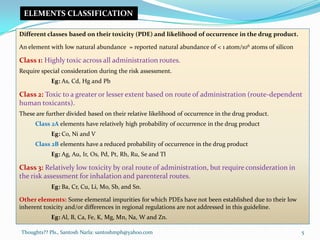
The guideline divided into following three parts:
1. The evaluation of the toxicity data for potential elemental impurities: Safety
Assessment
2. The establishment of PDEs for each element of toxicological concern
3. Application of a risk-based approach to control elemental impurities in drug
products.
Safety Assessment of Potential Elemental Impurities
Methods for establishing the Permitted Daily Exposure (PDE):
 Principles followed similar to ICH Q3C: Residual Solvents.
 Safety Assessment of Elemental Impurities for Oral, Parenteral and Inhalation Routes of
Administration are described in Q3D.
The factors considered ARE:
 The likely oxidation state of the element in the drug product;
 Human exposure and safety data when it provided applicable information;
 The most relevant animal study;
 Route of administration;
 The relevant endpoint(s).
4
Thoughts?? Pls., Santosh Narla: santoshmph@yahoo.com
Different classes based on their toxicity (PDE) and likelihood of occurrence in the drug product.
An element with low natural abundance = reported natural abundance of < 1 atom/106 atoms of silicon
Class 1: Highly toxic across all administration routes.
Require special consideration during the risk assessment.
Eg: As, Cd, Hg and Pb
Class 2: Toxic to a greater or lesser extent based on route of administration (route-dependent
human toxicants).
These are further divided based on their relative likelihood of occurrence in the drug product.
Class 2A elements have relatively high probability of occurrence in the drug product
Eg: Co, Ni and V
Class 2B elements have a reduced probability of occurrence in the drug product
Eg: Ag, Au, Ir, Os, Pd, Pt, Rh, Ru, Se and Tl
Class 3: Relatively low toxicity by oral route of administration, but require consideration in
the risk assessment for inhalation and parenteral routes.
Eg: Ba, Cr, Cu, Li, Mo, Sb, and Sn.
Other elements: Some elemental impurities for which PDEs have not been established due to their low
inherent toxicity and/or differences in regional regulations are not addressed in this guideline.
Eg: Al, B, Ca, Fe, K, Mg, Mn, Na, W and Zn.
ELEMENTS CLASSIFICATION
5
Thoughts?? Pls., Santosh Narla: santoshmph@yahoo.com
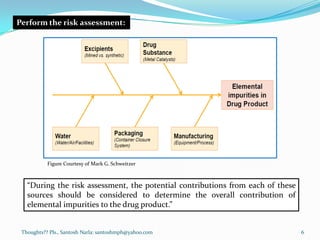
Perform the risk assessment:
“During the risk assessment, the potential contributions from each of these
sources should be considered to determine the overall contribution of
elemental impurities to the drug product.”
Figure Courtesy of Mark G. Schweitzer
6
Thoughts?? Pls., Santosh Narla: santoshmph@yahoo.com
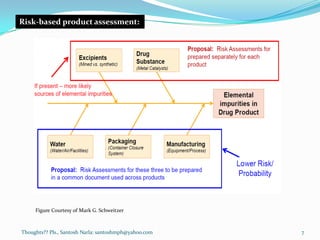
Risk-based product assessment:
Figure Courtesy of Mark G. Schweitzer
7
Thoughts?? Pls., Santosh Narla: santoshmph@yahoo.com
The risk assessment process can be described in three steps:
Identify known and potential sources of elemental impurities that may find
their way into the drug product.
Evaluate the observed or predicted level of the impurity and comparing with
the established PDE.
Data to support may be from:
 Prior knowledge;
 Published literature;
 Data generated from similar processes;
 Supplier information or data;
 Testing of the components of the drug product;
 Testing of the drug product.
Summarize and document the risk assessment: Develop, document and
implement a plan to limit the elemental impurities in the finished dosage form.
8
Thoughts?? Pls., Santosh Narla: santoshmph@yahoo.com
CONTROL OF ELEMENTAL IMPURITIES
To assure that elemental impurities do not exceed the PDEs.
Following approaches can be applied to CONTROL:
 Modification of the steps in the manufacturing process;
 Implementation of in-process or upstream controls;
 Establishment of specification limits for excipients or materials (e.g.,
synthetic intermediates);
 Establishment of specification limits for the drug substance;
 Establishment of specification limits for the drug product;
 Selection of appropriate container closure systems.
Following information to be provided in a regulatory submission:
 A summary of the risk assessment,
 and a description of the controls established to limit elemental impurities.
9
Thoughts?? Pls., Santosh Narla: santoshmph@yahoo.com
Converting Between PDEs and Concentration Limits:
PDEs, reported in micrograms per day (μg/day)  concentrations in drug products
Option 1: Common permitted concentration limits of elements across drug product components for
drug products with daily intakes of not more than 10 grams:
It is not intended to imply that all elements are present at the same concentration.
It assumes the daily intake of the drug product is 10 grams or less,
and that elemental impurities identified in the risk assessment are present in all components of the
drug product.
It calculates a common permissible target elemental concentration for each component in the drug.
This approach, for each target element, allows determination of a fixed common maximum
concentration in micrograms per gram in each component.
Option 2a: Common permitted concentration limits across drug product components for a drug
product with a specified daily intake:
It is similar to Option 1, except that the drug daily intake is not assumed to be 10 grams.
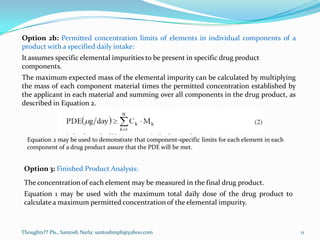
The common permitted concentration of each element is determined using Equation 1 and the actual
maximum daily intake.
10
Thoughts?? Pls., Santosh Narla: santoshmph@yahoo.com 11
Option 2b: Permitted concentration limits of elements in individual components of a
product with a specified daily intake:
It assumes specific elemental impurities to be present in specific drug product
components.
The maximum expected mass of the elemental impurity can be calculated by multiplying
the mass of each component material times the permitted concentration established by
the applicant in each material and summing over all components in the drug product, as
described in Equation 2.
Equation 2 may be used to demonstrate that component-specific limits for each element in each
component of a drug product assure that the PDE will be met.
Option 3: Finished Product Analysis:
The concentrationof each element may be measured in the final drug product.
Equation 1 may be used with the maximum total daily dose of the drug product to
calculatea maximum permitted concentration of the elemental impurity.
12
References:
ICH Harmonised Guideline: Guideline for Elemental Impurities: Q3D.

Ich q3 d elemental impurities

  • 1.
    Santosh Kumar Narla,Ph. D, Formulation Regulatory Affairs, santoshmph@yahoo.com
  • 2.
    ICH Q3D listedout 24 elements that need to be evaluated by drug product manufacturers, including mercury, lead, cadmium and arsenic. Heavy Metals  Elemental Impurities For more than century… qualitative estimation of elemental impurities by heavy metals limit test in pharmaceutical products is going to replace/add with quantitative estimation… Source of elemental impurities could be from:  residual catalysts added in synthesis  may be present as impurities  arising from processing equipment  leaching from container/closure systems  present in components of the drug product. Elemental impurities have NO therapeutic benefit AND should be controlled…. Thoughts?? Pls., Santosh Narla: santoshmph@yahoo.com 2
  • 3.
    Thoughts?? Pls., SantoshNarla: santoshmph@yahoo.com The "ICH Guideline for elemental impurities - Q3D" ………….. published on 19th December 2014 as Step 4 document. It applies to new finished drug products (as defined in ICH Q6A and Q6B) and new drug products containing existing drug substances. EMA Implementation:  For new marketing authorisation applications: June 2016  For authorised medicinal products: December 2017 USP General Chapters:  232 Elemental Impurities – limits: in drug products  233 Elemental Impurities – procedures  2232 Elemental Contaminants in Dietary Supplements  Both chapters will be applicable as of January, 1st 2018. 3
  • 4.
    Thoughts?? Pls., SantoshNarla: santoshmph@yahoo.com The guideline divided into following three parts: 1. The evaluation of the toxicity data for potential elemental impurities: Safety Assessment 2. The establishment of PDEs for each element of toxicological concern 3. Application of a risk-based approach to control elemental impurities in drug products. Safety Assessment of Potential Elemental Impurities Methods for establishing the Permitted Daily Exposure (PDE):  Principles followed similar to ICH Q3C: Residual Solvents.  Safety Assessment of Elemental Impurities for Oral, Parenteral and Inhalation Routes of Administration are described in Q3D. The factors considered ARE:  The likely oxidation state of the element in the drug product;  Human exposure and safety data when it provided applicable information;  The most relevant animal study;  Route of administration;  The relevant endpoint(s). 4
  • 5.
    Thoughts?? Pls., SantoshNarla: santoshmph@yahoo.com Different classes based on their toxicity (PDE) and likelihood of occurrence in the drug product. An element with low natural abundance = reported natural abundance of < 1 atom/106 atoms of silicon Class 1: Highly toxic across all administration routes. Require special consideration during the risk assessment. Eg: As, Cd, Hg and Pb Class 2: Toxic to a greater or lesser extent based on route of administration (route-dependent human toxicants). These are further divided based on their relative likelihood of occurrence in the drug product. Class 2A elements have relatively high probability of occurrence in the drug product Eg: Co, Ni and V Class 2B elements have a reduced probability of occurrence in the drug product Eg: Ag, Au, Ir, Os, Pd, Pt, Rh, Ru, Se and Tl Class 3: Relatively low toxicity by oral route of administration, but require consideration in the risk assessment for inhalation and parenteral routes. Eg: Ba, Cr, Cu, Li, Mo, Sb, and Sn. Other elements: Some elemental impurities for which PDEs have not been established due to their low inherent toxicity and/or differences in regional regulations are not addressed in this guideline. Eg: Al, B, Ca, Fe, K, Mg, Mn, Na, W and Zn. ELEMENTS CLASSIFICATION 5
  • 6.
    Thoughts?? Pls., SantoshNarla: santoshmph@yahoo.com Perform the risk assessment: “During the risk assessment, the potential contributions from each of these sources should be considered to determine the overall contribution of elemental impurities to the drug product.” Figure Courtesy of Mark G. Schweitzer 6
  • 7.
    Thoughts?? Pls., SantoshNarla: santoshmph@yahoo.com Risk-based product assessment: Figure Courtesy of Mark G. Schweitzer 7
  • 8.
    Thoughts?? Pls., SantoshNarla: santoshmph@yahoo.com The risk assessment process can be described in three steps: Identify known and potential sources of elemental impurities that may find their way into the drug product. Evaluate the observed or predicted level of the impurity and comparing with the established PDE. Data to support may be from:  Prior knowledge;  Published literature;  Data generated from similar processes;  Supplier information or data;  Testing of the components of the drug product;  Testing of the drug product. Summarize and document the risk assessment: Develop, document and implement a plan to limit the elemental impurities in the finished dosage form. 8
  • 9.
    Thoughts?? Pls., SantoshNarla: santoshmph@yahoo.com CONTROL OF ELEMENTAL IMPURITIES To assure that elemental impurities do not exceed the PDEs. Following approaches can be applied to CONTROL:  Modification of the steps in the manufacturing process;  Implementation of in-process or upstream controls;  Establishment of specification limits for excipients or materials (e.g., synthetic intermediates);  Establishment of specification limits for the drug substance;  Establishment of specification limits for the drug product;  Selection of appropriate container closure systems. Following information to be provided in a regulatory submission:  A summary of the risk assessment,  and a description of the controls established to limit elemental impurities. 9
  • 10.
    Thoughts?? Pls., SantoshNarla: santoshmph@yahoo.com Converting Between PDEs and Concentration Limits: PDEs, reported in micrograms per day (μg/day)  concentrations in drug products Option 1: Common permitted concentration limits of elements across drug product components for drug products with daily intakes of not more than 10 grams: It is not intended to imply that all elements are present at the same concentration. It assumes the daily intake of the drug product is 10 grams or less, and that elemental impurities identified in the risk assessment are present in all components of the drug product. It calculates a common permissible target elemental concentration for each component in the drug. This approach, for each target element, allows determination of a fixed common maximum concentration in micrograms per gram in each component. Option 2a: Common permitted concentration limits across drug product components for a drug product with a specified daily intake: It is similar to Option 1, except that the drug daily intake is not assumed to be 10 grams. The common permitted concentration of each element is determined using Equation 1 and the actual maximum daily intake. 10
  • 11.
    Thoughts?? Pls., SantoshNarla: santoshmph@yahoo.com 11 Option 2b: Permitted concentration limits of elements in individual components of a product with a specified daily intake: It assumes specific elemental impurities to be present in specific drug product components. The maximum expected mass of the elemental impurity can be calculated by multiplying the mass of each component material times the permitted concentration established by the applicant in each material and summing over all components in the drug product, as described in Equation 2. Equation 2 may be used to demonstrate that component-specific limits for each element in each component of a drug product assure that the PDE will be met. Option 3: Finished Product Analysis: The concentrationof each element may be measured in the final drug product. Equation 1 may be used with the maximum total daily dose of the drug product to calculatea maximum permitted concentration of the elemental impurity.
  • 12.
    12 References: ICH Harmonised Guideline:Guideline for Elemental Impurities: Q3D.