RIPER
AUTONOMOUS
NAAC &
NBA (UG)
SIRO- DSIR
Raghavendra Institute of Pharmaceutical Education and Research - Autonomous
K.R.Palli Cross, Chiyyedu, Anantapuramu, A. P- 515721 1
A Seminar as a part of curricular requirement
for I year M. Pharm II semister.
Presented by
Mr P.Venkatesh.
(Reg. No. 20L81S0714)
Department of Pharmaceutical Analysis
CLEANING METHOD
DEVELOPMENT
RIPER
AUTONOMOUS
NAAC &
NBA (UG)
SIRO- DSIR
Raghavendra Institute of Pharmaceutical Education and Research - Autonomous
K.R.Palli Cross, Chiyyedu, Anantapuramu, A. P- 515721 2
• Introduction
• Tips for cleaning method development
• Level of cleaning.
• Types of Cleaning agents.
• Mechanism of cleaning agent
• Sampling techniques
• Analytical method
• Establishment of acceptance limit
• Reference
RIPER
AUTONOMOUS
NAAC &
NBA (UG)
SIRO- DSIR
Raghavendra Institute of Pharmaceutical Education and Research - Autonomous
K.R.Palli Cross, Chiyyedu, Anantapuramu, A. P- 515721 3
Cleaning method development
• Cleaning method development is a continuous progress in
parallel with evaluation of drug
Method development consist of three main stages:
Feasibility- determine if the method will work with your sample.
Development- where optimised method.
Validation- where optimised method is validated.
Introduction
RIPER
AUTONOMOUS
NAAC &
NBA (UG)
SIRO- DSIR
Raghavendra Institute of Pharmaceutical Education and Research - Autonomous
K.R.Palli Cross, Chiyyedu, Anantapuramu, A. P- 515721 4
Tips for cleaning method
development
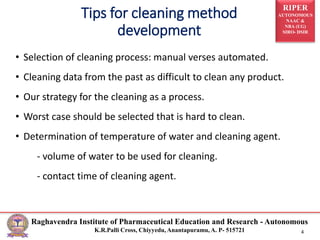
• Selection of cleaning process: manual verses automated.
• Cleaning data from the past as difficult to clean any product.
• Our strategy for the cleaning as a process.
• Worst case should be selected that is hard to clean.
• Determination of temperature of water and cleaning agent.
- volume of water to be used for cleaning.
- contact time of cleaning agent.
RIPER
AUTONOMOUS
NAAC &
NBA (UG)
SIRO- DSIR
Raghavendra Institute of Pharmaceutical Education and Research - Autonomous
K.R.Palli Cross, Chiyyedu, Anantapuramu, A. P- 515721 5
Continuation
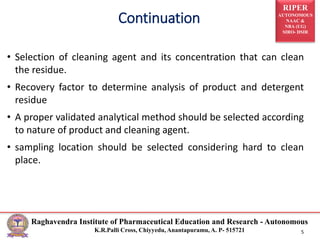
• Selection of cleaning agent and its concentration that can clean
the residue.
• Recovery factor to determine analysis of product and detergent
residue
• A proper validated analytical method should be selected according
to nature of product and cleaning agent.
• sampling location should be selected considering hard to clean
place.
RIPER
AUTONOMOUS
NAAC &
NBA (UG)
SIRO- DSIR
Raghavendra Institute of Pharmaceutical Education and Research - Autonomous
K.R.Palli Cross, Chiyyedu, Anantapuramu, A. P- 515721 6
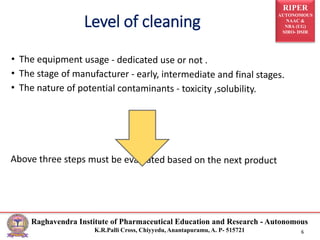
Level of cleaning
RIPER
AUTONOMOUS
NAAC &
NBA (UG)
SIRO- DSIR
Raghavendra Institute of Pharmaceutical Education and Research - Autonomous
K.R.Palli Cross, Chiyyedu, Anantapuramu, A. P- 515721 7
Continuation
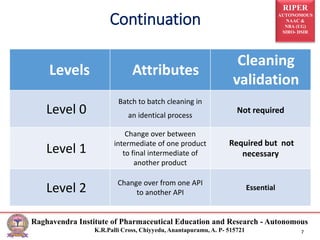
Levels Attributes
Cleaning
validation
Level 0
Batch to batch cleaning in
an identical process
Not required
Level 1
Change over between
intermediate of one product
to final intermediate of
another product
Required but not
necessary
Level 2 Change over from one API
to another API
Essential
RIPER
AUTONOMOUS
NAAC &
NBA (UG)
SIRO- DSIR
Raghavendra Institute of Pharmaceutical Education and Research - Autonomous
K.R.Palli Cross, Chiyyedu, Anantapuramu, A. P- 515721 8
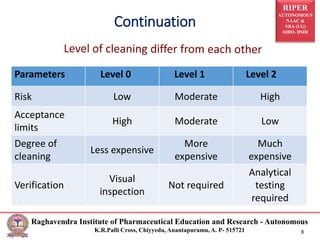
Continuation
Parameters Level 0 Level 1 Level 2
Risk Low Moderate High
Acceptance
limits
High Moderate Low
Degree of
cleaning
Less expensive
More
expensive
Much
expensive
Verification
Visual
inspection
Not required
Analytical
testing
required
RIPER
AUTONOMOUS
NAAC &
NBA (UG)
SIRO- DSIR
Raghavendra Institute of Pharmaceutical Education and Research - Autonomous
K.R.Palli Cross, Chiyyedu, Anantapuramu, A. P- 515721 9
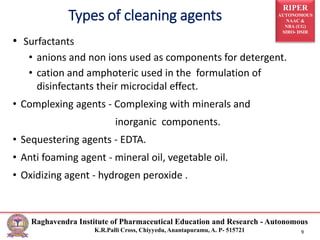
• Surfactants
• anions and non ions used as components for detergent.
• cation and amphoteric used in the formulation of
disinfectants their microcidal effect.
• Complexing agents - Complexing with minerals and
inorganic components.
• Sequestering agents - EDTA.
• Anti foaming agent - mineral oil, vegetable oil.
• Oxidizing agent - hydrogen peroxide .
Types of cleaning agents
RIPER
AUTONOMOUS
NAAC &
NBA (UG)
SIRO- DSIR
Raghavendra Institute of Pharmaceutical Education and Research - Autonomous
K.R.Palli Cross, Chiyyedu, Anantapuramu, A. P- 515721 10
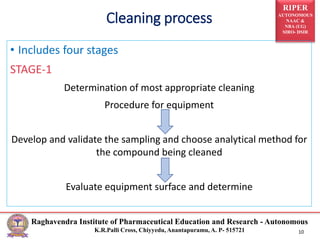
Cleaning process
• Includes four stages
STAGE-1
Determination of most appropriate cleaning
Procedure for equipment
Develop and validate the sampling and choose analytical method for
the compound being cleaned
Evaluate equipment surface and determine
RIPER
AUTONOMOUS
NAAC &
NBA (UG)
SIRO- DSIR
Raghavendra Institute of Pharmaceutical Education and Research - Autonomous
K.R.Palli Cross, Chiyyedu, Anantapuramu, A. P- 515721 11
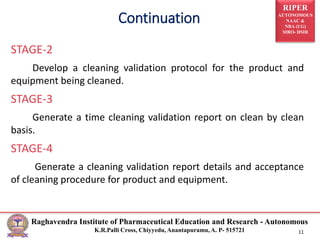
STAGE-2
Develop a cleaning validation protocol for the product and
equipment being cleaned.
STAGE-3
Generate a time cleaning validation report on clean by clean
basis.
STAGE-4
Generate a cleaning validation report details and acceptance
of cleaning procedure for product and equipment.
Continuation
RIPER
AUTONOMOUS
NAAC &
NBA (UG)
SIRO- DSIR
Raghavendra Institute of Pharmaceutical Education and Research - Autonomous
K.R.Palli Cross, Chiyyedu, Anantapuramu, A. P- 515721 12
Cleaning mechanism
RIPER
AUTONOMOUS
NAAC &
NBA (UG)
SIRO- DSIR
Raghavendra Institute of Pharmaceutical Education and Research - Autonomous
K.R.Palli Cross, Chiyyedu, Anantapuramu, A. P- 515721 13
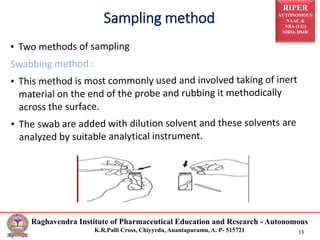
Sampling method
RIPER
AUTONOMOUS
NAAC &
NBA (UG)
SIRO- DSIR
Raghavendra Institute of Pharmaceutical Education and Research - Autonomous
K.R.Palli Cross, Chiyyedu, Anantapuramu, A. P- 515721 14
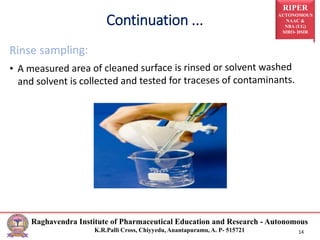
Continuation ...
RIPER
AUTONOMOUS
NAAC &
NBA (UG)
SIRO- DSIR
Raghavendra Institute of Pharmaceutical Education and Research - Autonomous
K.R.Palli Cross, Chiyyedu, Anantapuramu, A. P- 515721 15
• The analytical method should be validated before cleaning
validation is performed.
• The method chosen should detect residues and contaminants
specific for the substance should be analyzed
• Validation of analytical method should include
• Precision
• Linearity
• Accuracy
• Limit of detection
• Limit of quantification
• Ruggedness
• Robustness
Analytical method
RIPER
AUTONOMOUS
NAAC &
NBA (UG)
SIRO- DSIR
Raghavendra Institute of Pharmaceutical Education and Research - Autonomous
K.R.Palli Cross, Chiyyedu, Anantapuramu, A. P- 515721 16
• Method selected should be specific and sensitive.
Specific and non specific methods
• Specific methods -Detects unique compounds in the presence of
potential contaminants Eg:HPLC
• Non specific method -detects any compounds that produce
response Eg:pH and conductivity
• Other methods
• Thin layer chromatography: determination of surfactants.
• atomic absorption spectroscopy: determination of inorganic
contaminants
Continuation ...
RIPER
AUTONOMOUS
NAAC &
NBA (UG)
SIRO- DSIR
Raghavendra Institute of Pharmaceutical Education and Research - Autonomous
K.R.Palli Cross, Chiyyedu, Anantapuramu, A. P- 515721 17
• The acceptance limit established for contaminant level in the
sample should be practical, achievable and verifiable.
• NMT 10 ppm of any product will appear in another product.
• No quantity of residue should be visible on the equipment after
cleaning process are performed.
• For certain allergic ingredients the limit should be below limited of
detection.
Establishment of acceptance
Limits
RIPER
AUTONOMOUS
NAAC &
NBA (UG)
SIRO- DSIR
Raghavendra Institute of Pharmaceutical Education and Research - Autonomous
K.R.Palli Cross, Chiyyedu, Anantapuramu, A. P- 515721 18
1. S.W.Harder, "The validation of cleaning process, "Pharmaceutical
technology.8(5),29- 34 (1984)
2. J.A.smith, " A modified swabbing Techniques for validation of
detergent residue in clean in place system,"pharmaceutical
technology. 16(1),60-66(1992)
3. Mc cormick,P.Y and Cullen L.F., in pharmaceutical process
validation, 2 nd edition., 319-349(1993)
4. Richard Forsythe; Equal hold time for cleaning validation;
pharmatimes vol-4 no-6,june-2008
Reference
RIPER
AUTONOMOUS
NAAC &
NBA (UG)
SIRO- DSIR
Raghavendra Institute of Pharmaceutical Education and Research - Autonomous
K.R.Palli Cross, Chiyyedu, Anantapuramu, A. P- 515721 19

CLEANING METHOD DEVELOPMENT

  • 1.
    RIPER AUTONOMOUS NAAC & NBA (UG) SIRO-DSIR Raghavendra Institute of Pharmaceutical Education and Research - Autonomous K.R.Palli Cross, Chiyyedu, Anantapuramu, A. P- 515721 1 A Seminar as a part of curricular requirement for I year M. Pharm II semister. Presented by Mr P.Venkatesh. (Reg. No. 20L81S0714) Department of Pharmaceutical Analysis CLEANING METHOD DEVELOPMENT
  • 2.
    RIPER AUTONOMOUS NAAC & NBA (UG) SIRO-DSIR Raghavendra Institute of Pharmaceutical Education and Research - Autonomous K.R.Palli Cross, Chiyyedu, Anantapuramu, A. P- 515721 2 • Introduction • Tips for cleaning method development • Level of cleaning. • Types of Cleaning agents. • Mechanism of cleaning agent • Sampling techniques • Analytical method • Establishment of acceptance limit • Reference
  • 3.
    RIPER AUTONOMOUS NAAC & NBA (UG) SIRO-DSIR Raghavendra Institute of Pharmaceutical Education and Research - Autonomous K.R.Palli Cross, Chiyyedu, Anantapuramu, A. P- 515721 3 Cleaning method development • Cleaning method development is a continuous progress in parallel with evaluation of drug Method development consist of three main stages: Feasibility- determine if the method will work with your sample. Development- where optimised method. Validation- where optimised method is validated. Introduction
  • 4.
    RIPER AUTONOMOUS NAAC & NBA (UG) SIRO-DSIR Raghavendra Institute of Pharmaceutical Education and Research - Autonomous K.R.Palli Cross, Chiyyedu, Anantapuramu, A. P- 515721 4 Tips for cleaning method development • Selection of cleaning process: manual verses automated. • Cleaning data from the past as difficult to clean any product. • Our strategy for the cleaning as a process. • Worst case should be selected that is hard to clean. • Determination of temperature of water and cleaning agent. - volume of water to be used for cleaning. - contact time of cleaning agent.
  • 5.
    RIPER AUTONOMOUS NAAC & NBA (UG) SIRO-DSIR Raghavendra Institute of Pharmaceutical Education and Research - Autonomous K.R.Palli Cross, Chiyyedu, Anantapuramu, A. P- 515721 5 Continuation • Selection of cleaning agent and its concentration that can clean the residue. • Recovery factor to determine analysis of product and detergent residue • A proper validated analytical method should be selected according to nature of product and cleaning agent. • sampling location should be selected considering hard to clean place.
  • 6.
    RIPER AUTONOMOUS NAAC & NBA (UG) SIRO-DSIR Raghavendra Institute of Pharmaceutical Education and Research - Autonomous K.R.Palli Cross, Chiyyedu, Anantapuramu, A. P- 515721 6 Level of cleaning
  • 7.
    RIPER AUTONOMOUS NAAC & NBA (UG) SIRO-DSIR Raghavendra Institute of Pharmaceutical Education and Research - Autonomous K.R.Palli Cross, Chiyyedu, Anantapuramu, A. P- 515721 7 Continuation Levels Attributes Cleaning validation Level 0 Batch to batch cleaning in an identical process Not required Level 1 Change over between intermediate of one product to final intermediate of another product Required but not necessary Level 2 Change over from one API to another API Essential
  • 8.
    RIPER AUTONOMOUS NAAC & NBA (UG) SIRO-DSIR Raghavendra Institute of Pharmaceutical Education and Research - Autonomous K.R.Palli Cross, Chiyyedu, Anantapuramu, A. P- 515721 8 Continuation Parameters Level 0 Level 1 Level 2 Risk Low Moderate High Acceptance limits High Moderate Low Degree of cleaning Less expensive More expensive Much expensive Verification Visual inspection Not required Analytical testing required
  • 9.
    RIPER AUTONOMOUS NAAC & NBA (UG) SIRO-DSIR Raghavendra Institute of Pharmaceutical Education and Research - Autonomous K.R.Palli Cross, Chiyyedu, Anantapuramu, A. P- 515721 9 • Surfactants • anions and non ions used as components for detergent. • cation and amphoteric used in the formulation of disinfectants their microcidal effect. • Complexing agents - Complexing with minerals and inorganic components. • Sequestering agents - EDTA. • Anti foaming agent - mineral oil, vegetable oil. • Oxidizing agent - hydrogen peroxide . Types of cleaning agents
  • 10.
    RIPER AUTONOMOUS NAAC & NBA (UG) SIRO-DSIR Raghavendra Institute of Pharmaceutical Education and Research - Autonomous K.R.Palli Cross, Chiyyedu, Anantapuramu, A. P- 515721 10 Cleaning process • Includes four stages STAGE-1 Determination of most appropriate cleaning Procedure for equipment Develop and validate the sampling and choose analytical method for the compound being cleaned Evaluate equipment surface and determine
  • 11.
    RIPER AUTONOMOUS NAAC & NBA (UG) SIRO-DSIR Raghavendra Institute of Pharmaceutical Education and Research - Autonomous K.R.Palli Cross, Chiyyedu, Anantapuramu, A. P- 515721 11 STAGE-2 Develop a cleaning validation protocol for the product and equipment being cleaned. STAGE-3 Generate a time cleaning validation report on clean by clean basis. STAGE-4 Generate a cleaning validation report details and acceptance of cleaning procedure for product and equipment. Continuation
  • 12.
    RIPER AUTONOMOUS NAAC & NBA (UG) SIRO-DSIR Raghavendra Institute of Pharmaceutical Education and Research - Autonomous K.R.Palli Cross, Chiyyedu, Anantapuramu, A. P- 515721 12 Cleaning mechanism
  • 13.
    RIPER AUTONOMOUS NAAC & NBA (UG) SIRO-DSIR Raghavendra Institute of Pharmaceutical Education and Research - Autonomous K.R.Palli Cross, Chiyyedu, Anantapuramu, A. P- 515721 13 Sampling method
  • 14.
    RIPER AUTONOMOUS NAAC & NBA (UG) SIRO-DSIR Raghavendra Institute of Pharmaceutical Education and Research - Autonomous K.R.Palli Cross, Chiyyedu, Anantapuramu, A. P- 515721 14 Continuation ...
  • 15.
    RIPER AUTONOMOUS NAAC & NBA (UG) SIRO-DSIR Raghavendra Institute of Pharmaceutical Education and Research - Autonomous K.R.Palli Cross, Chiyyedu, Anantapuramu, A. P- 515721 15 • The analytical method should be validated before cleaning validation is performed. • The method chosen should detect residues and contaminants specific for the substance should be analyzed • Validation of analytical method should include • Precision • Linearity • Accuracy • Limit of detection • Limit of quantification • Ruggedness • Robustness Analytical method
  • 16.
    RIPER AUTONOMOUS NAAC & NBA (UG) SIRO-DSIR Raghavendra Institute of Pharmaceutical Education and Research - Autonomous K.R.Palli Cross, Chiyyedu, Anantapuramu, A. P- 515721 16 • Method selected should be specific and sensitive. Specific and non specific methods • Specific methods -Detects unique compounds in the presence of potential contaminants Eg:HPLC • Non specific method -detects any compounds that produce response Eg:pH and conductivity • Other methods • Thin layer chromatography: determination of surfactants. • atomic absorption spectroscopy: determination of inorganic contaminants Continuation ...
  • 17.
    RIPER AUTONOMOUS NAAC & NBA (UG) SIRO-DSIR Raghavendra Institute of Pharmaceutical Education and Research - Autonomous K.R.Palli Cross, Chiyyedu, Anantapuramu, A. P- 515721 17 • The acceptance limit established for contaminant level in the sample should be practical, achievable and verifiable. • NMT 10 ppm of any product will appear in another product. • No quantity of residue should be visible on the equipment after cleaning process are performed. • For certain allergic ingredients the limit should be below limited of detection. Establishment of acceptance Limits
  • 18.
    RIPER AUTONOMOUS NAAC & NBA (UG) SIRO-DSIR Raghavendra Institute of Pharmaceutical Education and Research - Autonomous K.R.Palli Cross, Chiyyedu, Anantapuramu, A. P- 515721 18 1. S.W.Harder, "The validation of cleaning process, "Pharmaceutical technology.8(5),29- 34 (1984) 2. J.A.smith, " A modified swabbing Techniques for validation of detergent residue in clean in place system,"pharmaceutical technology. 16(1),60-66(1992) 3. Mc cormick,P.Y and Cullen L.F., in pharmaceutical process validation, 2 nd edition., 319-349(1993) 4. Richard Forsythe; Equal hold time for cleaning validation; pharmatimes vol-4 no-6,june-2008 Reference
  • 19.
    RIPER AUTONOMOUS NAAC & NBA (UG) SIRO-DSIR Raghavendra Institute of Pharmaceutical Education and Research - Autonomous K.R.Palli Cross, Chiyyedu, Anantapuramu, A. P- 515721 19