TEE Quantification of Aortic Stenosis and Aortic RegurgitationDr PK Neema
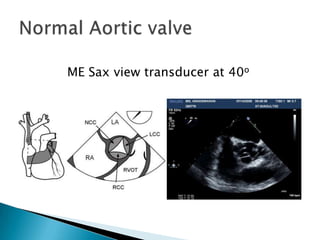
Normal Aortic valveME Sax view transducer at 40o
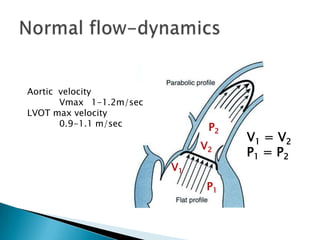
Normal flow-dynamicsAortic  velocity 	Vmax 	1-1.2m/secLVOT max velocity  	0.9-1.1 m/secP2V1 = V2P1 = P2V2V1P1
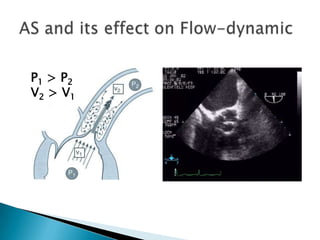
AS and its effect on Flow-dynamicP1 > P2V2 > V1
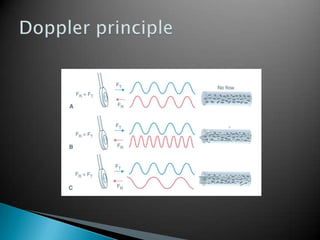
Doppler principle
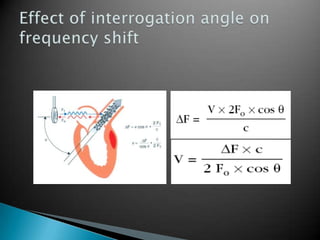
Effect of interrogation angle on frequency shift
Ultrasound beam should be parallel to the flow under studyThe ultrasound should intercept the center of the flow not the peripheryThe interrogation angle should be < 15oThe view optimal for the imaging may not be the optimal view for the Doppler study Essentials during Doppler study
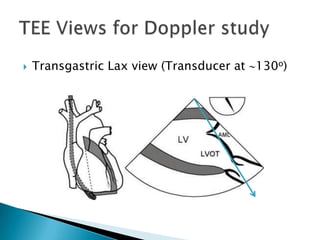
Transgastric Lax view (Transducer at 130o)TEE Views for Doppler study
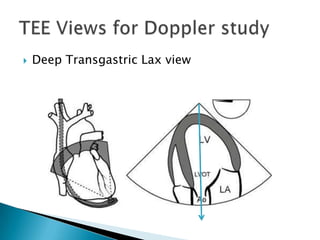
Deep Transgastric Lax viewTEE Views for Doppler study
Simplified Bernoulli equationContinuity equationMethods to quantify AS
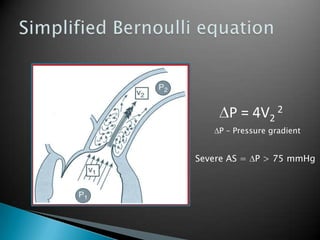
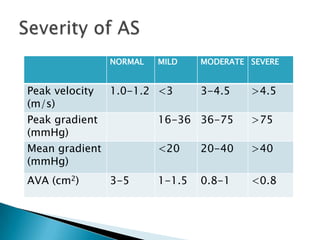
Simplified Bernoulli equationP = 4V2 2P – Pressure gradientSevere AS = P > 75 mmHg
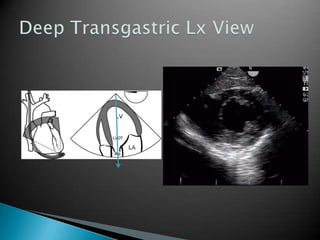
Deep Transgastric Lx View
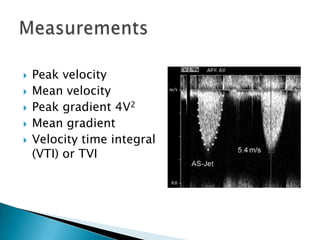
Peak velocityMean velocityPeak gradient 4V2Mean gradientVelocity time integral (VTI) or TVIMeasurements
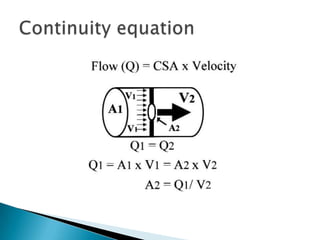
Continuity equation
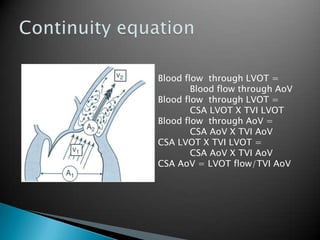
Continuity equationBlood flow  through LVOT = 	Blood flow through AoVBlood flow  through LVOT = 	CSA LVOT X TVI LVOTBlood flow  through AoV = 	CSA AoV X TVI AoVCSA LVOT X TVI LVOT = 	CSA AoV X TVI AoVCSA AoV = LVOT flow/TVI AoV
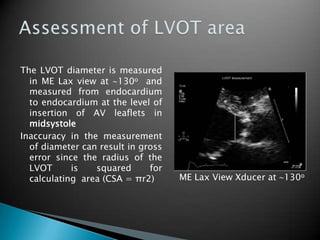
The LVOT diameter is measured in ME Lax view at 130o   and measured from endocardium to endocardium at the level of insertion of AV leaflets in midsystoleInaccuracy in the measurement of diameter can result in gross error since the radius of the LVOT is squared for calculating  area (CSA = πr2)Assessment of LVOT areaME Lax View Xducer at 130o
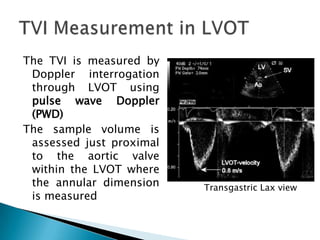
The TVI is measured by Doppler interrogation through LVOT using pulse wave Doppler (PWD) The sample volume is assessed just proximal to the aortic valve   within the LVOT where the annular dimension is measuredTVI Measurement in LVOT Transgastric Lax view
Severity of AS
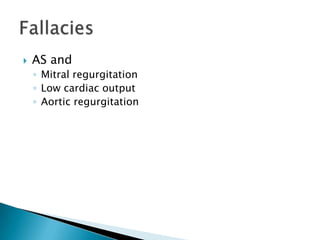
AS and Mitral regurgitationLow cardiac output Aortic regurgitationFallacies
The MR  jet can be mistaken for that of AS. How to avoid the MR jet?  The MR jet should be visualized during colour Doppler imaging and the MR jet path should be consciously avoided. How to confirm?The MR jet starts early with LV contraction, the AS jet starts later in systole. The MR jet starts in the early portion of QRS complex while AS jet starts in the mid or late portion of QRS complex. Determination is facilitated by recording the jets at a faster sweep speed (100 mm/s)AS and Mitral regurgitation (MR)
Gorlin formula (AVA = Cardiac output/ 44.3 (SEP) (HR) √mean gradientThe CO is an important determinant of valve area and a decrease in CO result in a decrease in the peak aortic gradient and the severity of AS Accordingly, one should assess LV function before ‘small gradients’ are reported as insignificant. Dobutamine stress test and dimensionless index are evaluated to assess AS severity in presence of low CO.AS and Low cardiac output
High CO, similar to low CO, result in over estimation of peak gradient and AS severity.The discrepancy is corrected by measuring the blood flow  velocity in the LVOT and applying a correction if the measured LVOT peak velocity exceeds 1.5 m/s. Peak gradient in presence of significant aortic regurgitation = 4 [(peak velocity)2 – (LVOT velocity)2]AS and Aortic regurgitation
Dobutamine (5-10 μg/kg/min) is infused  to increase  COAn increase in pressure gradient suggests severe valvular disease. No or borderline increase in pressure gradient suggest primary myocardial disease as the cause of low gradient and contraindicate valve replacement as the primary therapy; However, AS is a unique cardiovascular disease where patients with a low EF may normalize after valve replacement.Dobutamine stress test
LVOT and aortic TVI ratio or peak LVOT and aortic velocity ratio of 0.25 or less indicates critical AS. Useful in evaluation of patients with prosthetic aortic valves where measurement of aortic annular dimensions is not clear.Dimensionless index
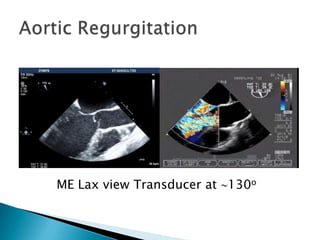
Aortic RegurgitationME Lax view Transducer at 130o
Based onColor flow Doppler (Jet width and jet area measurement)Continuity equationRegurgitant jet velocity assessmentAR quantification
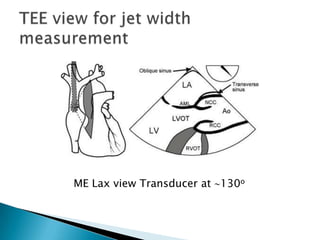
TEE view for jet width measurementME Lax view Transducer at 130o
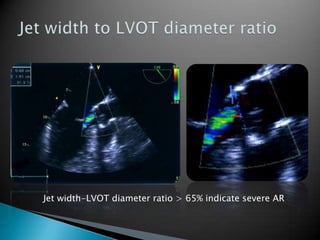
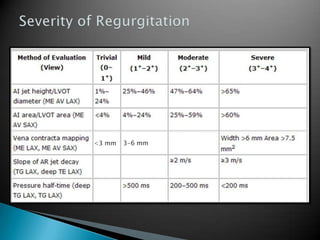
Jet width to LVOT diameter ratio Jet width-LVOT diameter ratio > 65% indicate severe AR
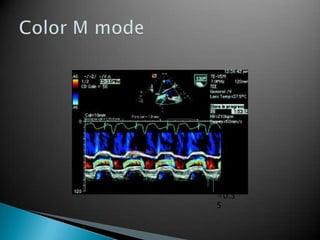
Color M mode75/214=0.35
LVOT ShadowingAortic prosthesisMitral prosthesisSite and shape of the orifice (Eccentric jet, multiple jet)Jet width limitations
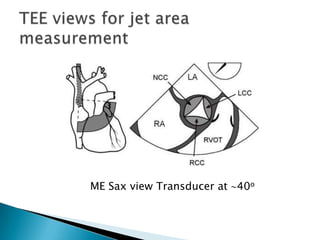
TEE views for jet area measurementME Sax view Transducer at 40o
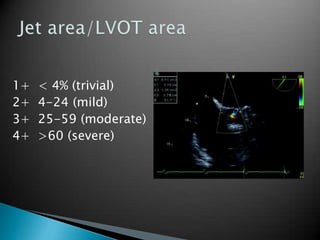
1+  < 4% (trivial)2+  4-24 (mild) 3+  25-59 (moderate) 4+  >60 (severe)Jet area/LVOT area
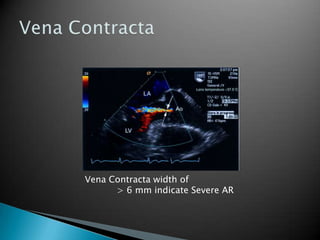
Vena ContractaVena Contracta width of	> 6 mm indicate Severe AR
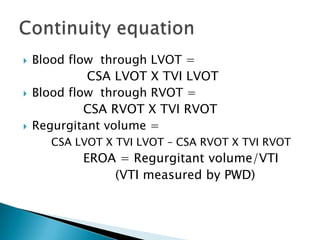
Blood flow  through LVOT = CSA LVOT X TVI LVOT Blood flow  through RVOT = CSA RVOT X TVI RVOTRegurgitant volume = CSA LVOT X TVI LVOT – CSA RVOT X TVI RVOT			EROA = Regurgitant volume/VTI				(VTI measured by PWD) Continuity equation
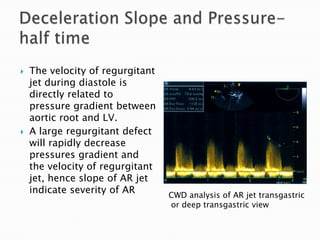
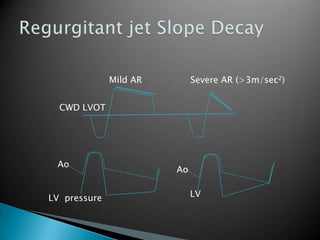
Deceleration Slope and Pressure-half timeThe velocity of regurgitant jet during diastole is directly related to pressure gradient between aortic root and LV.A large regurgitant defect will rapidly decrease pressures gradient and the velocity of regurgitant jet, hence slope of AR jet indicate severity of ARCWD analysis of AR jet transgastric or deep transgastric view
Regurgitant jet Slope DecayMild ARSevere AR (>3m/sec2)CWD LVOTAoAoLV  pressureLV
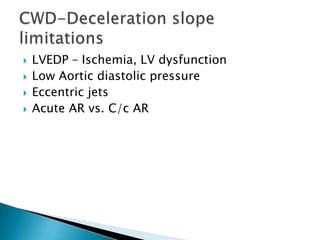
LVEDP – Ischemia, LV dysfunctionLow Aortic diastolic pressureEccentric jetsAcute AR vs. C/c ARCWD-Deceleration slope limitations
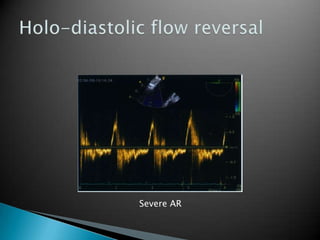
Holo-diastolic flow reversalSevere AR
Severity of Regurgitation3-6 mm<3 mm

Aortic valve assessment

  • 1.
    TEE Quantification ofAortic Stenosis and Aortic RegurgitationDr PK Neema
  • 2.
    Normal Aortic valveMESax view transducer at 40o
  • 3.
    Normal flow-dynamicsAortic velocity Vmax 1-1.2m/secLVOT max velocity 0.9-1.1 m/secP2V1 = V2P1 = P2V2V1P1
  • 4.
    AS and itseffect on Flow-dynamicP1 > P2V2 > V1
  • 5.
  • 6.
    Effect of interrogationangle on frequency shift
  • 7.
    Ultrasound beam shouldbe parallel to the flow under studyThe ultrasound should intercept the center of the flow not the peripheryThe interrogation angle should be < 15oThe view optimal for the imaging may not be the optimal view for the Doppler study Essentials during Doppler study
  • 8.
    Transgastric Lax view(Transducer at 130o)TEE Views for Doppler study
  • 9.
    Deep Transgastric LaxviewTEE Views for Doppler study
  • 10.
    Simplified Bernoulli equationContinuityequationMethods to quantify AS
  • 11.
    Simplified Bernoulli equationP= 4V2 2P – Pressure gradientSevere AS = P > 75 mmHg
  • 12.
  • 13.
    Peak velocityMean velocityPeakgradient 4V2Mean gradientVelocity time integral (VTI) or TVIMeasurements
  • 14.
  • 15.
    Continuity equationBlood flow through LVOT = Blood flow through AoVBlood flow through LVOT = CSA LVOT X TVI LVOTBlood flow through AoV = CSA AoV X TVI AoVCSA LVOT X TVI LVOT = CSA AoV X TVI AoVCSA AoV = LVOT flow/TVI AoV
  • 16.
    The LVOT diameteris measured in ME Lax view at 130o and measured from endocardium to endocardium at the level of insertion of AV leaflets in midsystoleInaccuracy in the measurement of diameter can result in gross error since the radius of the LVOT is squared for calculating area (CSA = πr2)Assessment of LVOT areaME Lax View Xducer at 130o
  • 17.
    The TVI ismeasured by Doppler interrogation through LVOT using pulse wave Doppler (PWD) The sample volume is assessed just proximal to the aortic valve within the LVOT where the annular dimension is measuredTVI Measurement in LVOT Transgastric Lax view
  • 18.
  • 19.
    AS and MitralregurgitationLow cardiac output Aortic regurgitationFallacies
  • 20.
    The MR jet can be mistaken for that of AS. How to avoid the MR jet? The MR jet should be visualized during colour Doppler imaging and the MR jet path should be consciously avoided. How to confirm?The MR jet starts early with LV contraction, the AS jet starts later in systole. The MR jet starts in the early portion of QRS complex while AS jet starts in the mid or late portion of QRS complex. Determination is facilitated by recording the jets at a faster sweep speed (100 mm/s)AS and Mitral regurgitation (MR)
  • 21.
    Gorlin formula (AVA= Cardiac output/ 44.3 (SEP) (HR) √mean gradientThe CO is an important determinant of valve area and a decrease in CO result in a decrease in the peak aortic gradient and the severity of AS Accordingly, one should assess LV function before ‘small gradients’ are reported as insignificant. Dobutamine stress test and dimensionless index are evaluated to assess AS severity in presence of low CO.AS and Low cardiac output
  • 22.
    High CO, similarto low CO, result in over estimation of peak gradient and AS severity.The discrepancy is corrected by measuring the blood flow velocity in the LVOT and applying a correction if the measured LVOT peak velocity exceeds 1.5 m/s. Peak gradient in presence of significant aortic regurgitation = 4 [(peak velocity)2 – (LVOT velocity)2]AS and Aortic regurgitation
  • 23.
    Dobutamine (5-10 μg/kg/min)is infused to increase COAn increase in pressure gradient suggests severe valvular disease. No or borderline increase in pressure gradient suggest primary myocardial disease as the cause of low gradient and contraindicate valve replacement as the primary therapy; However, AS is a unique cardiovascular disease where patients with a low EF may normalize after valve replacement.Dobutamine stress test
  • 24.
    LVOT and aorticTVI ratio or peak LVOT and aortic velocity ratio of 0.25 or less indicates critical AS. Useful in evaluation of patients with prosthetic aortic valves where measurement of aortic annular dimensions is not clear.Dimensionless index
  • 25.
    Aortic RegurgitationME Laxview Transducer at 130o
  • 26.
    Based onColor flowDoppler (Jet width and jet area measurement)Continuity equationRegurgitant jet velocity assessmentAR quantification
  • 27.
    TEE view forjet width measurementME Lax view Transducer at 130o
  • 28.
    Jet width toLVOT diameter ratio Jet width-LVOT diameter ratio > 65% indicate severe AR
  • 29.
  • 30.
    LVOT ShadowingAortic prosthesisMitralprosthesisSite and shape of the orifice (Eccentric jet, multiple jet)Jet width limitations
  • 31.
    TEE views forjet area measurementME Sax view Transducer at 40o
  • 32.
    1+ <4% (trivial)2+ 4-24 (mild) 3+ 25-59 (moderate) 4+ >60 (severe)Jet area/LVOT area
  • 33.
    Vena ContractaVena Contractawidth of > 6 mm indicate Severe AR
  • 34.
    Blood flow through LVOT = CSA LVOT X TVI LVOT Blood flow through RVOT = CSA RVOT X TVI RVOTRegurgitant volume = CSA LVOT X TVI LVOT – CSA RVOT X TVI RVOT EROA = Regurgitant volume/VTI (VTI measured by PWD) Continuity equation
  • 35.
    Deceleration Slope andPressure-half timeThe velocity of regurgitant jet during diastole is directly related to pressure gradient between aortic root and LV.A large regurgitant defect will rapidly decrease pressures gradient and the velocity of regurgitant jet, hence slope of AR jet indicate severity of ARCWD analysis of AR jet transgastric or deep transgastric view
  • 36.
    Regurgitant jet SlopeDecayMild ARSevere AR (>3m/sec2)CWD LVOTAoAoLV pressureLV
  • 37.
    LVEDP – Ischemia,LV dysfunctionLow Aortic diastolic pressureEccentric jetsAcute AR vs. C/c ARCWD-Deceleration slope limitations
  • 38.
  • 39.

Editor's Notes

  • #2 The intraoperative quantification of AS and AR isbased on doppler studytherefore one should know the Doppler principlesIn general patients are assessed preoperatively, however, if a patient undergoing OHS, particularly CABG, is found to have AS, one should know how to quantify the severity of AS since the issue of whether to replace a non-critically stenotic aortic valve is becoming increasingly important. The present guidelines support aortic valve replacement at the time of primary CABG in patients with at least moderate AS (AS; 1-1.5 cm2), even if asymptomatic, in view of its rapid progression. Therefore, perioperative physicians should be adept with the TEE evaluation and quantification techniques. Intraoperativeassessment of AR iscontroversial, therefore, itsassessmentshouldpreferablybedone in the preoperativeperiod
  • #3 2D echocardiography allows an evaluation of the valvular structure as well as the impact of the volume overload on the cardiac chambers. Calcifications, or vegetations can be readily assessed, which can give indirect clues as to the severity of regurgitation.
  • #5 The narrowing of the valve result in increase in the flow velocity; the Doppler study aim to measure flow velocity and derive parameters that indicate severity of AS. Modified Bernoulli equation and the continuity equation are used to estimate severity of AS
  • #6 When ultrasound waves are directed towards a moving objects, the frequency of the reflected ultrasounds is increased or decreased based on the velocity of the moving object ‘Doppler shift’
  • #7 Check from the book
  • #12 The velocity is maximum in the centre of the flow, for accurate measurement of the gradient it is essential that the center of the flow is studied
  • #16 The blood passing through LVOT and through the AV are equal
  • #26 The assessment of the severity of valvular insufficiency is complicated by the dramatic effects of even minor changes in ventricular preload and peripheral vascular resistance on Doppler indices of aortic regurgitation (AR). Acute increases in peripheral vascular resistance can increase the degree of valvular regurgitation by impeding peripheral run off. Conversely, vasodilation by reducing peripheral vascular resistance can decreaseseverity of valvular insufficiency both clinically and on Doppler evaluation of valvular insufficiency. The physical properties (compliance, elasticity, distensibility) of the aorta as well as of the left ventricle, the size of the regurgitant orifice, and the properties of the aortic valve are the other dynamic variables that further complicate intraoperative assessment. In fact, majority of the clinicians believe that the severity of the AR should be assessed preoperatively. In view of multiple factors influencing assessment of the severity of AR, the intraoperative assessment (if essential) should be based on integration of the results of all Doppler approaches. The criteria used to estimate the severity of AR
  • #35 The aortic regurgitant volume can be calculated by measuring the difference between LV and RV stroke volumes. The LV stroke volume is calculated by multiplying the cross sectional area of LVOT by the TVI of LVOT; the RV stroke volume is calculated in similar manner. Product of stroke volume by heart rate gives CO for each ventricle and the difference of the two is the regurgitant volume.