
Trigeminal Neuralgia
Abdullatif Sami Al Rashed
ENT Block 5.6
College of Medicine, KFU
Al-Ahsa, Saudi Arabia
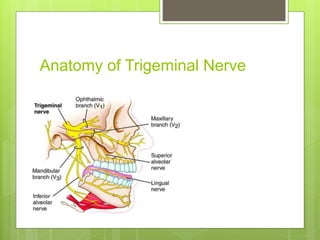
Anatomy of Trigeminal Nerve
Introduction
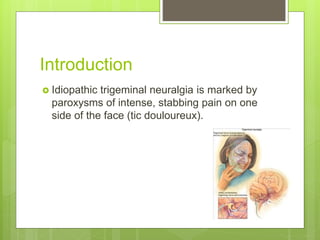
 Idiopathic trigeminal neuralgia is marked by
paroxysms of intense, stabbing pain on one
side of the face (tic douloureux).
Clinical Features
 recurrent episodes of sudden onset, excruciating
unilateral paroxysmal shooting “electric” pain in
trigeminal root territory (V3>V2>>V1)
 may have normal sensory exam
 pain lasts seconds/minutes over days/weeks; may
remit for weeks/months
 triggers:
 touching face, eating, talking, cold wind, shaving,
applying make-up
Etiology
 classic TN: idiopathic
 secondary TN: compression by tortuous blood
vessel (superior cerebellar artery),
cerebellopontine angle tumor (5%), MS (5%)
Epidemiology
 F>M; usually middle-aged and elderly
Diagnosis
 clinical diagnosis
 investigate for secondary causes, which are
more likely if bilateral TN or associated
sensory loss:
 MRI to rule out structural lesion, MS, or
vascular lesion
Treatment
 first line: carbamazepine or oxcarbazepine
 second line: baclofen or lamotrigine
 narcotics not generally recommended
 if medical treatment fails:
 Gasserian ganglion percutaneous technique,
 gamma knife,
 invasive percutaneous denervation
(radiofrequency/glycerol),
 percutaneous balloon microcompression,
 microvascular decompression
THANK YOU 

Trigeminal Neuralgia

  • 1.
    Trigeminal Neuralgia Abdullatif SamiAl Rashed ENT Block 5.6 College of Medicine, KFU Al-Ahsa, Saudi Arabia
  • 2.
  • 3.
    Introduction  Idiopathic trigeminalneuralgia is marked by paroxysms of intense, stabbing pain on one side of the face (tic douloureux).
  • 4.
    Clinical Features  recurrentepisodes of sudden onset, excruciating unilateral paroxysmal shooting “electric” pain in trigeminal root territory (V3>V2>>V1)  may have normal sensory exam  pain lasts seconds/minutes over days/weeks; may remit for weeks/months  triggers:  touching face, eating, talking, cold wind, shaving, applying make-up
  • 5.
    Etiology  classic TN:idiopathic  secondary TN: compression by tortuous blood vessel (superior cerebellar artery), cerebellopontine angle tumor (5%), MS (5%)
  • 6.
    Epidemiology  F>M; usuallymiddle-aged and elderly
  • 7.
    Diagnosis  clinical diagnosis investigate for secondary causes, which are more likely if bilateral TN or associated sensory loss:  MRI to rule out structural lesion, MS, or vascular lesion
  • 8.
    Treatment  first line:carbamazepine or oxcarbazepine  second line: baclofen or lamotrigine  narcotics not generally recommended  if medical treatment fails:  Gasserian ganglion percutaneous technique,  gamma knife,  invasive percutaneous denervation (radiofrequency/glycerol),  percutaneous balloon microcompression,  microvascular decompression
  • 10.