Aortic valve
stenosis
Aortic valve
regurge
Aortic valve disease
By
Prof. Hatem Abdel Rahman
MD cardiology
Dr. Mohamd Ashraf Ahmad
MD cardiology
Aortic Stenosis
Definition
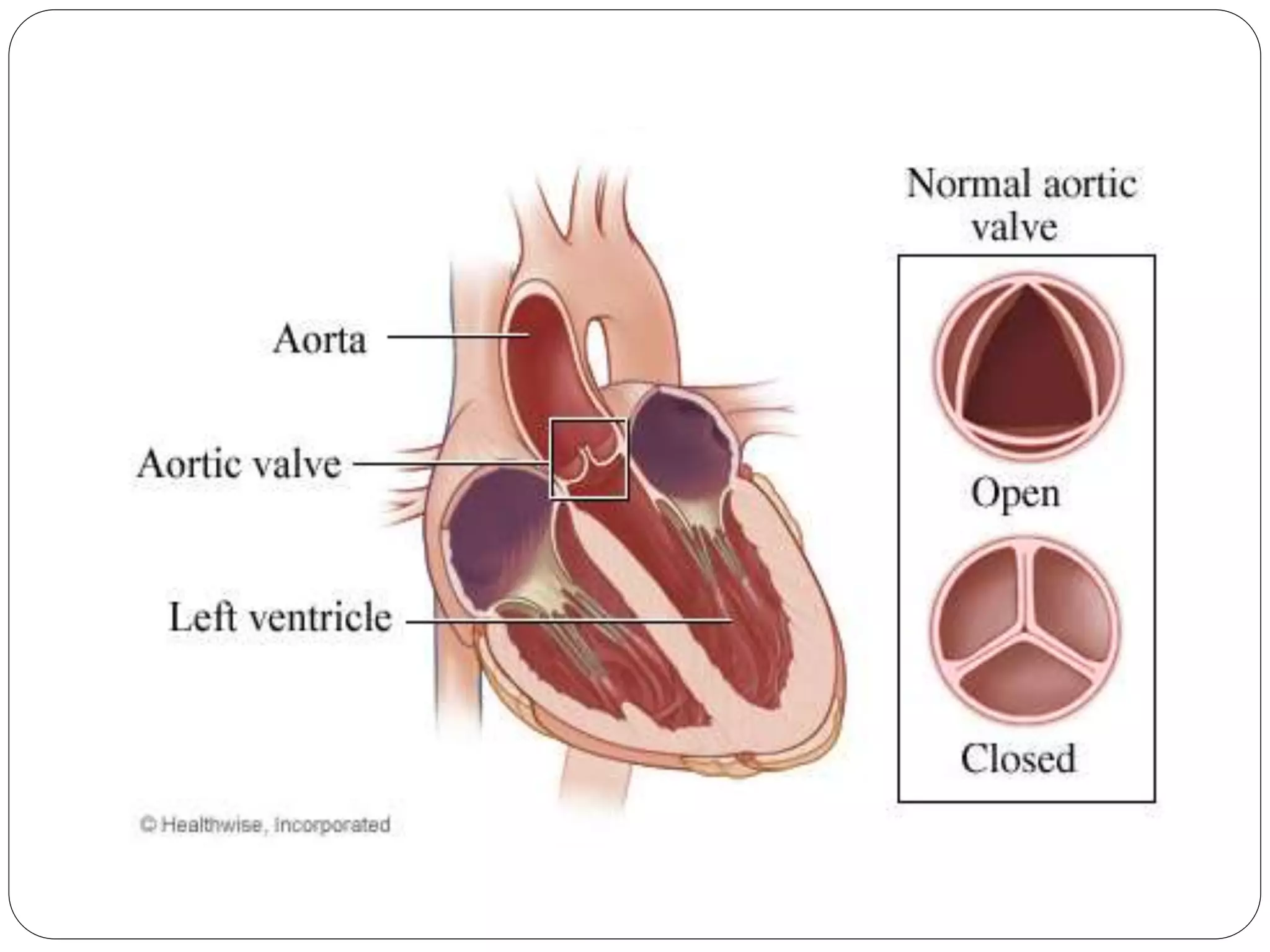
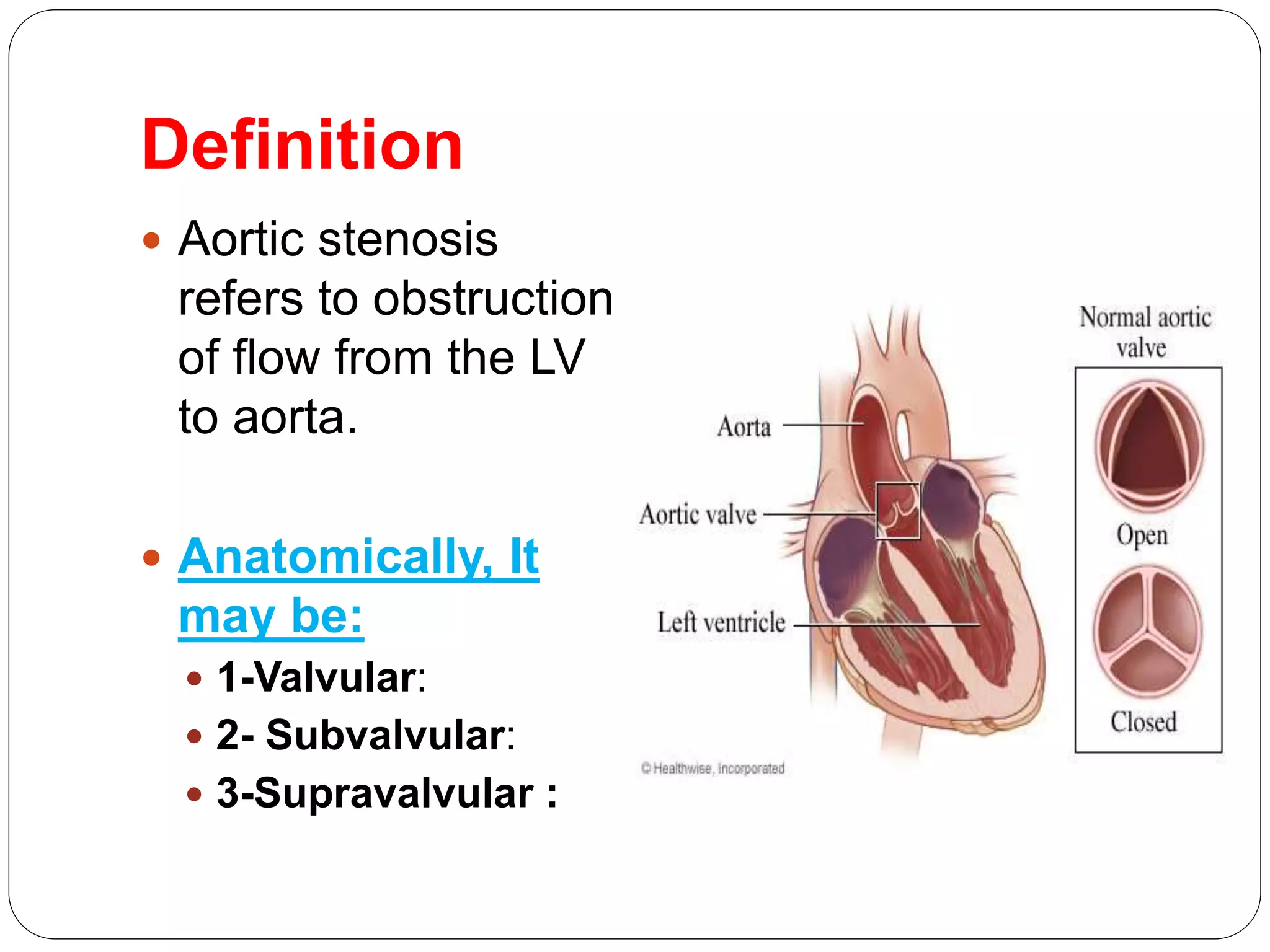
 Aortic stenosis
refers to obstruction
of flow from the LV
to aorta.
 Anatomically, It
may be:
 1-Valvular:
 2- Subvalvular:
 3-Supravalvular :
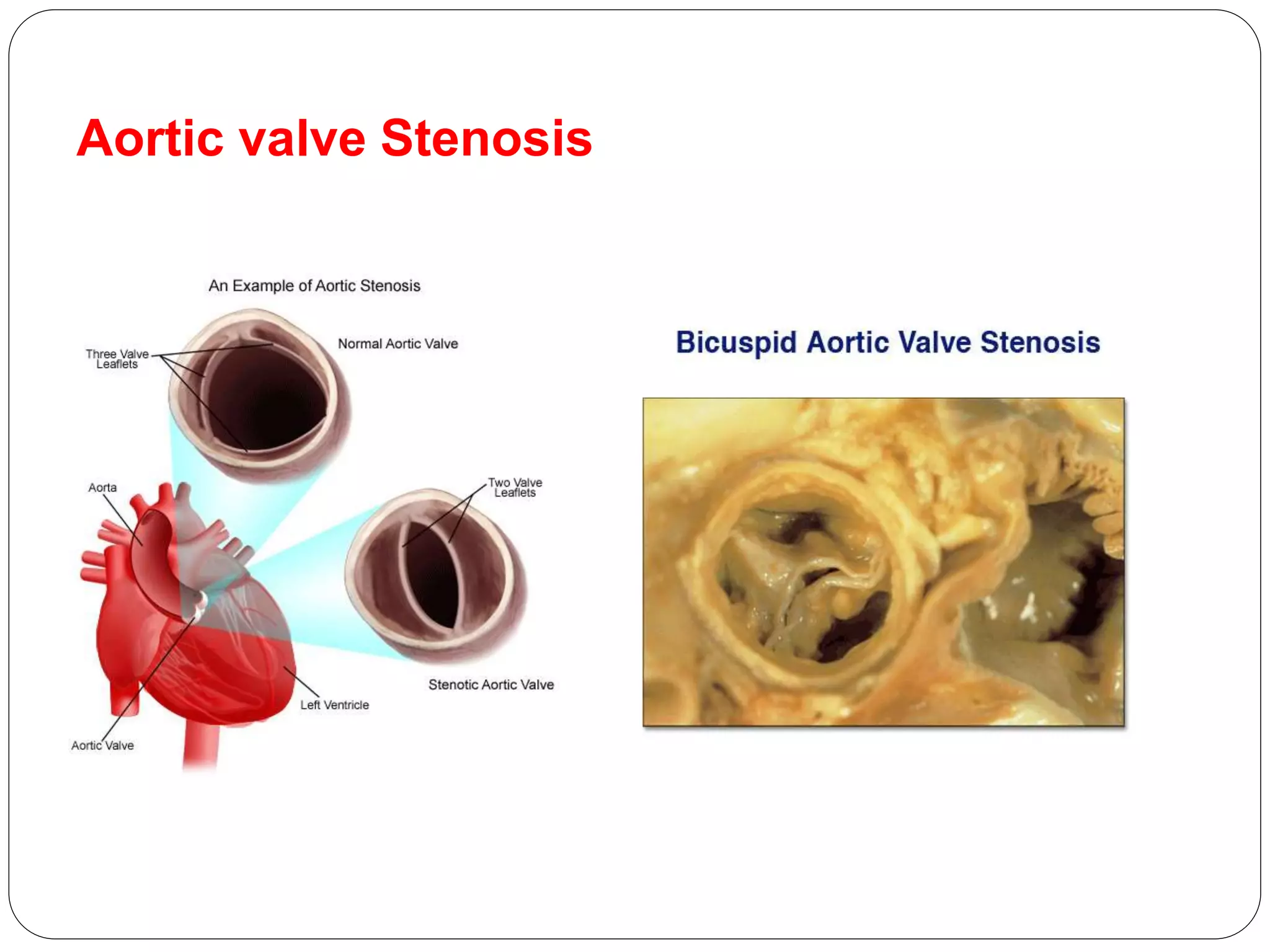
Aortic valve Stenosis
Etiologies
 Congenital 0-30 yrs
 Bicuspid 30-50 yrs
 Rheumatic 30-60 yrs
 Degenerative >60 yrs
Aortic valve Stenosis
Pathophysiology
 Valvular aortic stenosis results in chronic left
ventricular pressure overloading.
 Compensatory concentric LVH allows the
ventricle to maintain stroke volume with
increases in diastolic pressure, and patients
remain asymptomatic for many years.
 Later on, LVH causes either
 Diastolic dysfunction with the onset of
congestive symptoms
 Myocardial oxygen needs in excess of
supply with the onset of angina.
 Some patients might also experience
exertional syncope, probably reflecting
the inability to increase cardiac output
and maintain blood pressure in
response to vasodilation.
Clinical presentation
- Asymptomatic
- The classic symptoms of severe AS:
1- Angina.
2- Syncope.
3- Congestive heart failure.
4-Sudden cardiac death.
Aortic Stenosis
Natural history of aortic stenosis. At the onset of
symptoms (arrow), there is a rapid progression and
survival is severely limited
On examination :
 Delayed slow-rising carotid upstroke (pulsus
parvus et tardus).
 Sustained left ventricular apical impulse.
 Fourth heart sound.
 Harsh systolic murmur of aortic stenosis,
loudest at the base of the heart and radiating
to the carotids, is often but not always
prominent. Low output states, obesity, or
chronic lung disease may mask the findings.
 Other hallmarks of significant aortic valve
stenosis include a single (pulmonic)
component of the second heart sound.
Investigations
 ECG often shows changes of left ventricular
hypertrophy.
 The chest X ray occasionally shows heavy
calcification of the valve or ascending aortic
dilation.
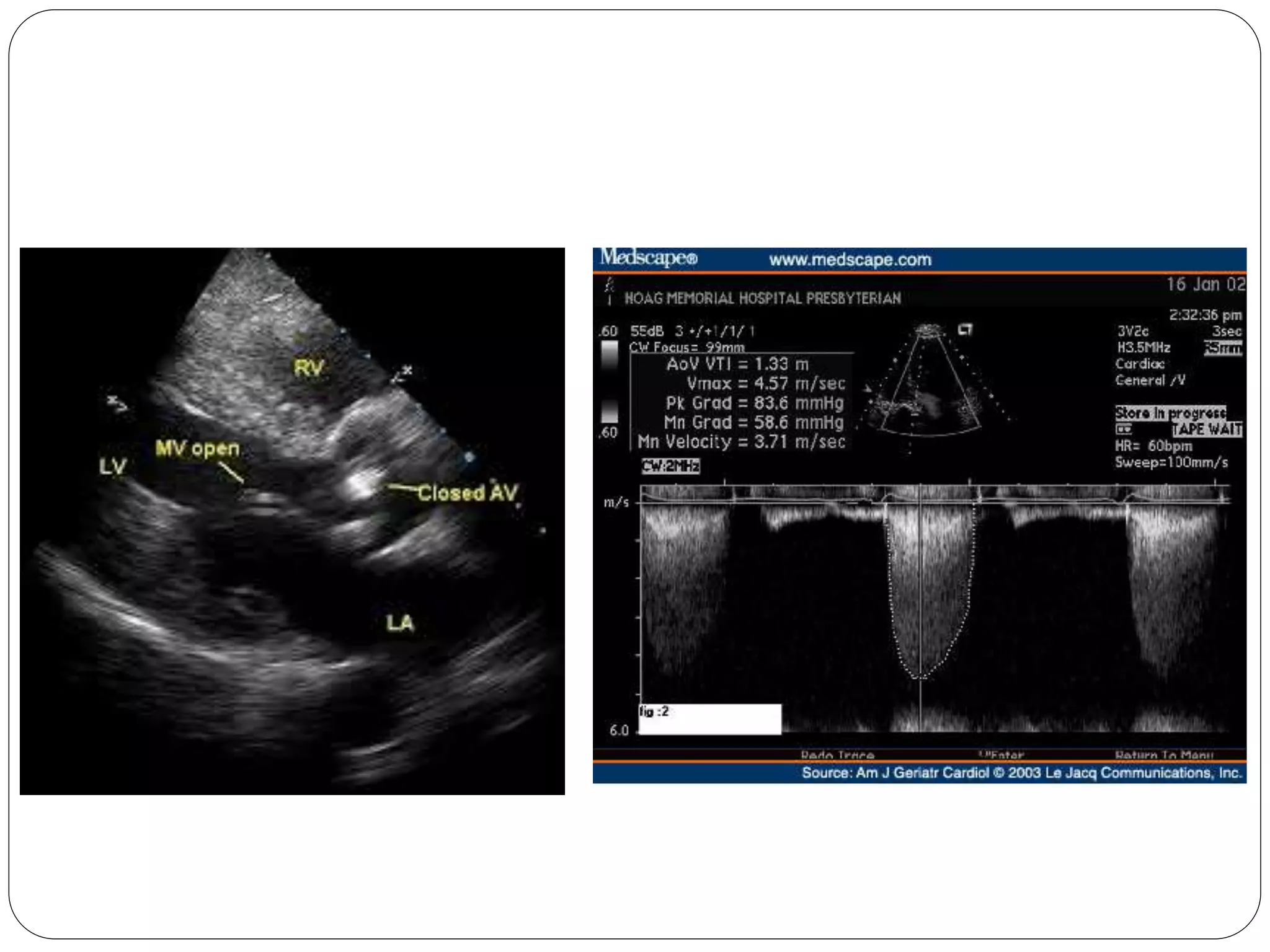
 Echocardiography:
Test of choice in the evaluation of patients
with suspected valvular disease.
It allows assessment of the valve anatomy as
well as of chamber size and ventricular
function.
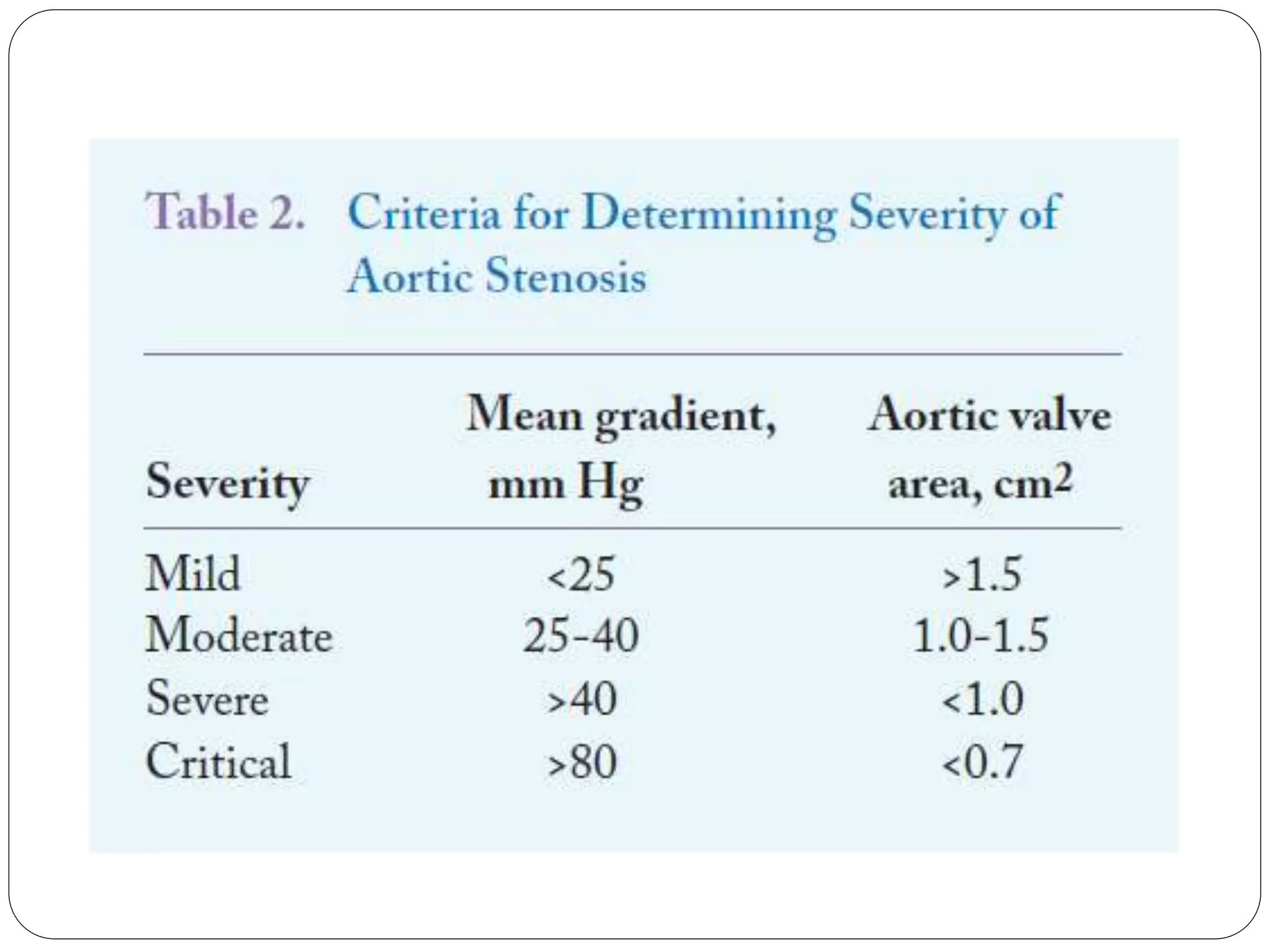
Doppler studies permit estimation of pressure
gradients and estimations of aortic valve area
.
 Stress ECG:
 Cardiac catheterization:
It is generally performed as preoperative
coronary angiography in men older than 35
years, women older than 45 years to exclude
coronary artery disease.
Treatment
 Medical:
 To date, no medical therapy exists for the treatment
of calcific aortic stenosis.
 Prophylaxis against recurrent rheumatic fever in
rheumatic patients.
 Antibiotic prophylaxis against infective endocarditis
in conditions associated with bacteraemia.
 Surgical:
 Aortic valve replacement
 Percutaneous:
TAVR
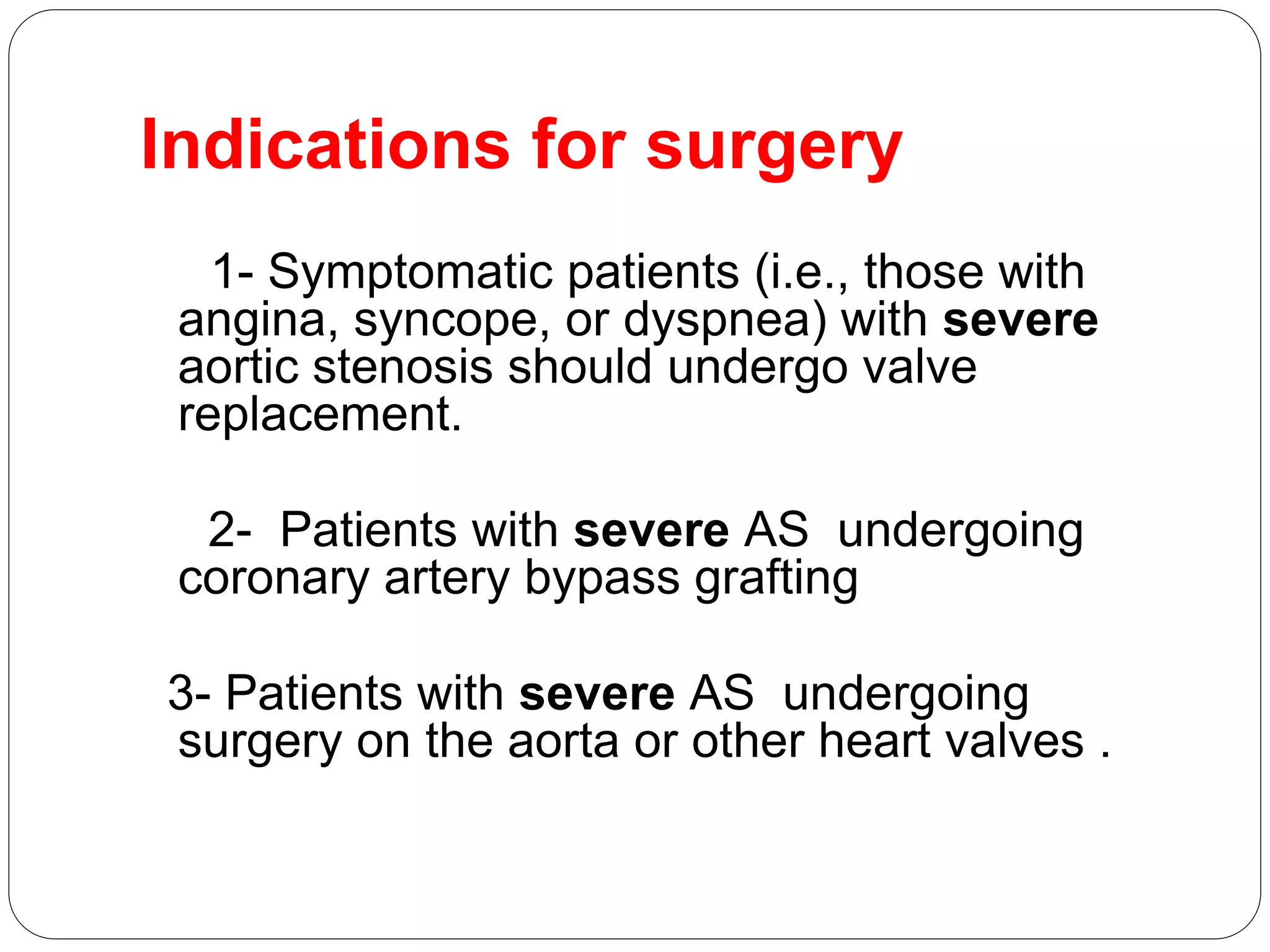
Indications for surgery
1- Symptomatic patients (i.e., those with
angina, syncope, or dyspnea) with severe
aortic stenosis should undergo valve
replacement.
2- Patients with severe AS undergoing
coronary artery bypass grafting
3- Patients with severe AS undergoing
surgery on the aorta or other heart valves .
3- Asymptomatic Patients with severe AS and
left ventricular ejection fractions less than
0.50.
4- Patients with moderate aortic stenosis
undergoing coronary artery bypass grafting or
surgery on the aorta or other heart valves
(Class IIa indication).
5- Aymptomatic patients with severe AS who
exhibit an abnormal response to exercise
(hypotension).
Aortic Regurgitation
 Etiology
 Physical Examination
 Assessing Severity
 Natural History
 Prognosis
 Timing of Surgery
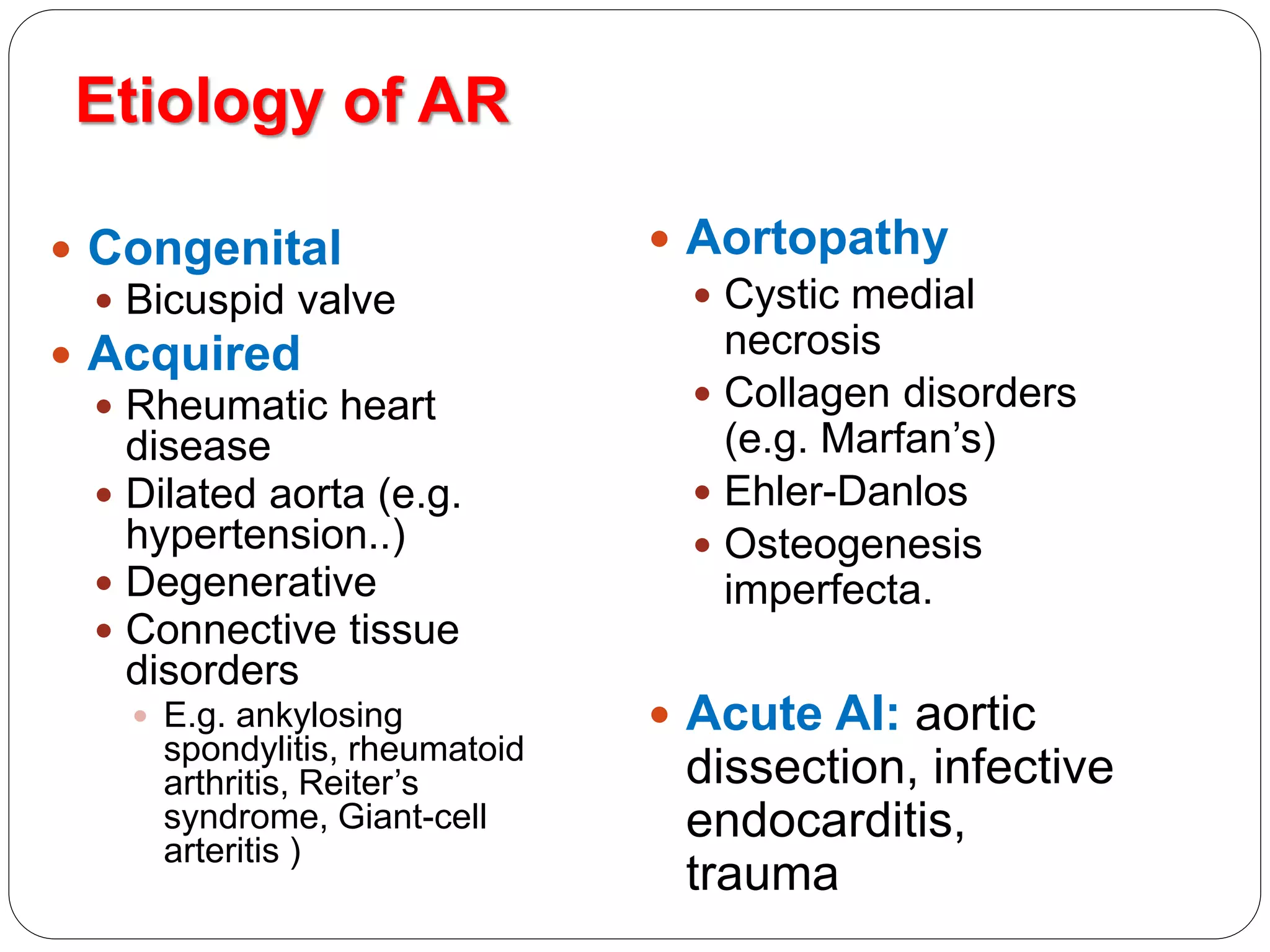
Etiology of AR
 Congenital
 Bicuspid valve
 Acquired
 Rheumatic heart
disease
 Dilated aorta (e.g.
hypertension..)
 Degenerative
 Connective tissue
disorders
 E.g. ankylosing
spondylitis, rheumatoid
arthritis, Reiter’s
syndrome, Giant-cell
arteritis )
 Aortopathy
 Cystic medial
necrosis
 Collagen disorders
(e.g. Marfan’s)
 Ehler-Danlos
 Osteogenesis
imperfecta.
 Acute AI: aortic
dissection, infective
endocarditis,
trauma
:Pathophysiology of AR
 Acute or subacute significant AR causes
the abrupt introduction of a large volume
of blood into a noncompliant LV, thus
increasing LV end-diastolic and
pulmonary venous pressures and
leading to acute dyspnea or pulmonary
edema.
 In chronic AR, compensatory LV changes
occur over time. The excess volume load
causes stretching and elongation of
myocardial fibers, which in turn increase
wall stress.
 When the ventricle can not dilate further,
diastolic pressure increases and results in
dyspnea, another sign of
decompensation.
Symptoms of AR
 Dyspnea, orthopnea, PND
 Palpitations.
 Chest pain.
 Nocturnal angina >> exertional angina
 ( diastolic aortic pressure and increased
LVEDP thus  coronary artery diastolic
flow).
 With extreme reductions in diastolic
pressures (e.g. < 40 mmHg) may see
angina
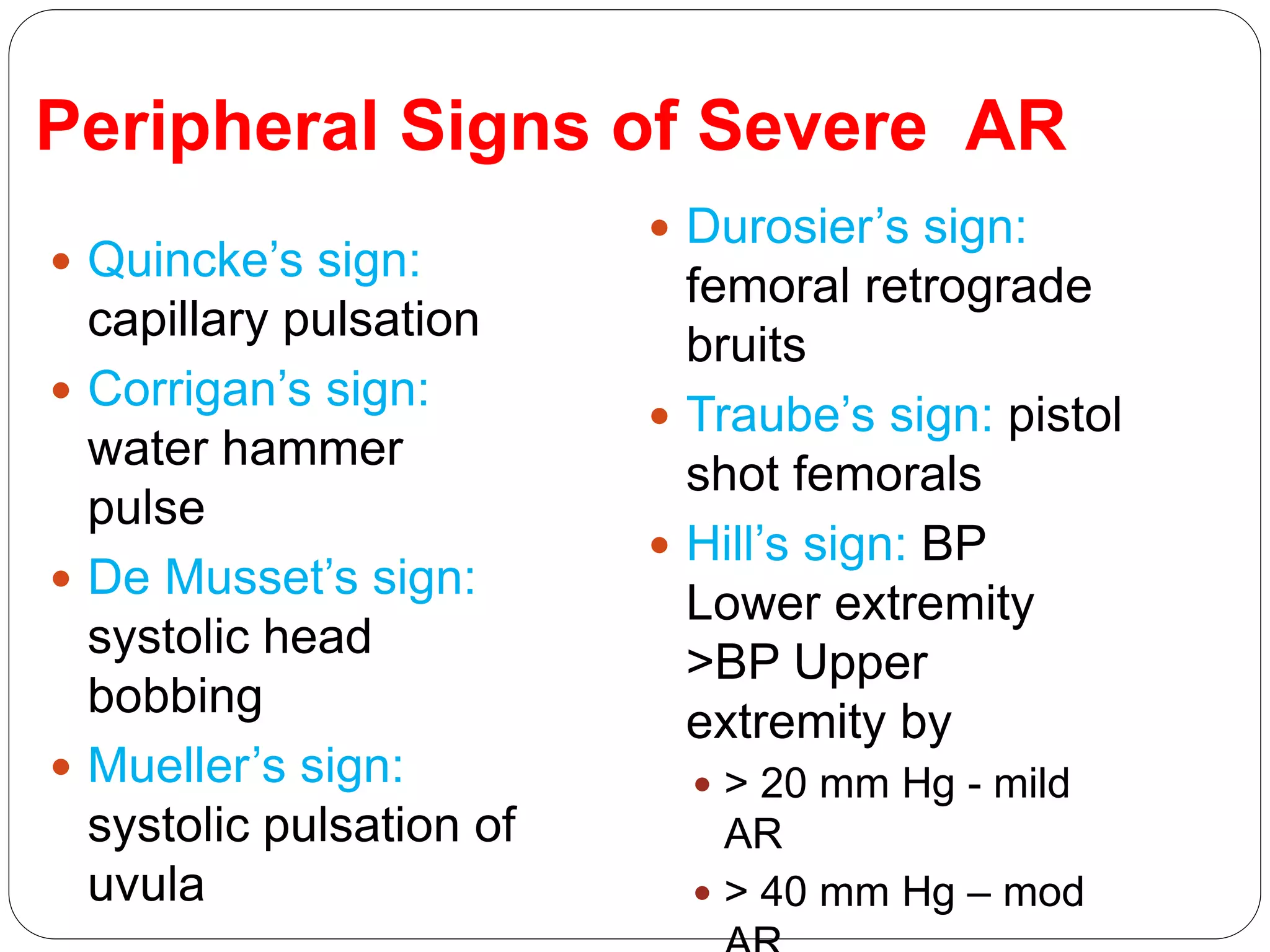
Peripheral Signs of Severe AR
 Quincke’s sign:
capillary pulsation
 Corrigan’s sign:
water hammer
pulse
 De Musset’s sign:
systolic head
bobbing
 Mueller’s sign:
systolic pulsation of
uvula
 Durosier’s sign:
femoral retrograde
bruits
 Traube’s sign: pistol
shot femorals
 Hill’s sign: BP
Lower extremity
>BP Upper
extremity by
 > 20 mm Hg - mild
AR
 > 40 mm Hg – mod
Cardiac Signs of Severe AR
 Apex:
 Displaced
 Hyper-dynamic
 Palpable S3
 Austin-Flint
murmur
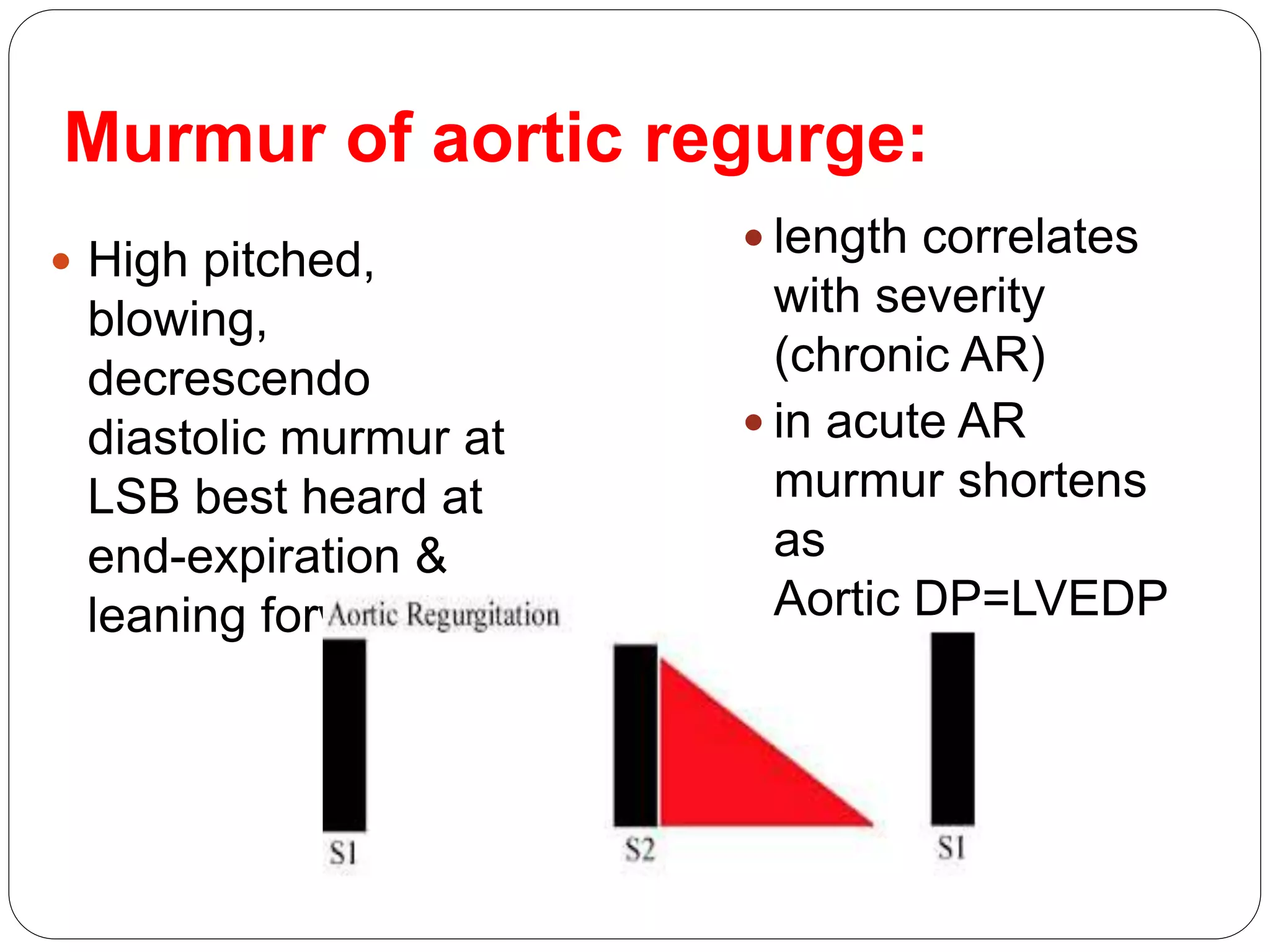
Murmur of aortic regurge:
 High pitched,
blowing,
decrescendo
diastolic murmur at
LSB best heard at
end-expiration &
leaning forward
 length correlates
with severity
(chronic AR)
 in acute AR
murmur shortens
as
Aortic DP=LVEDP
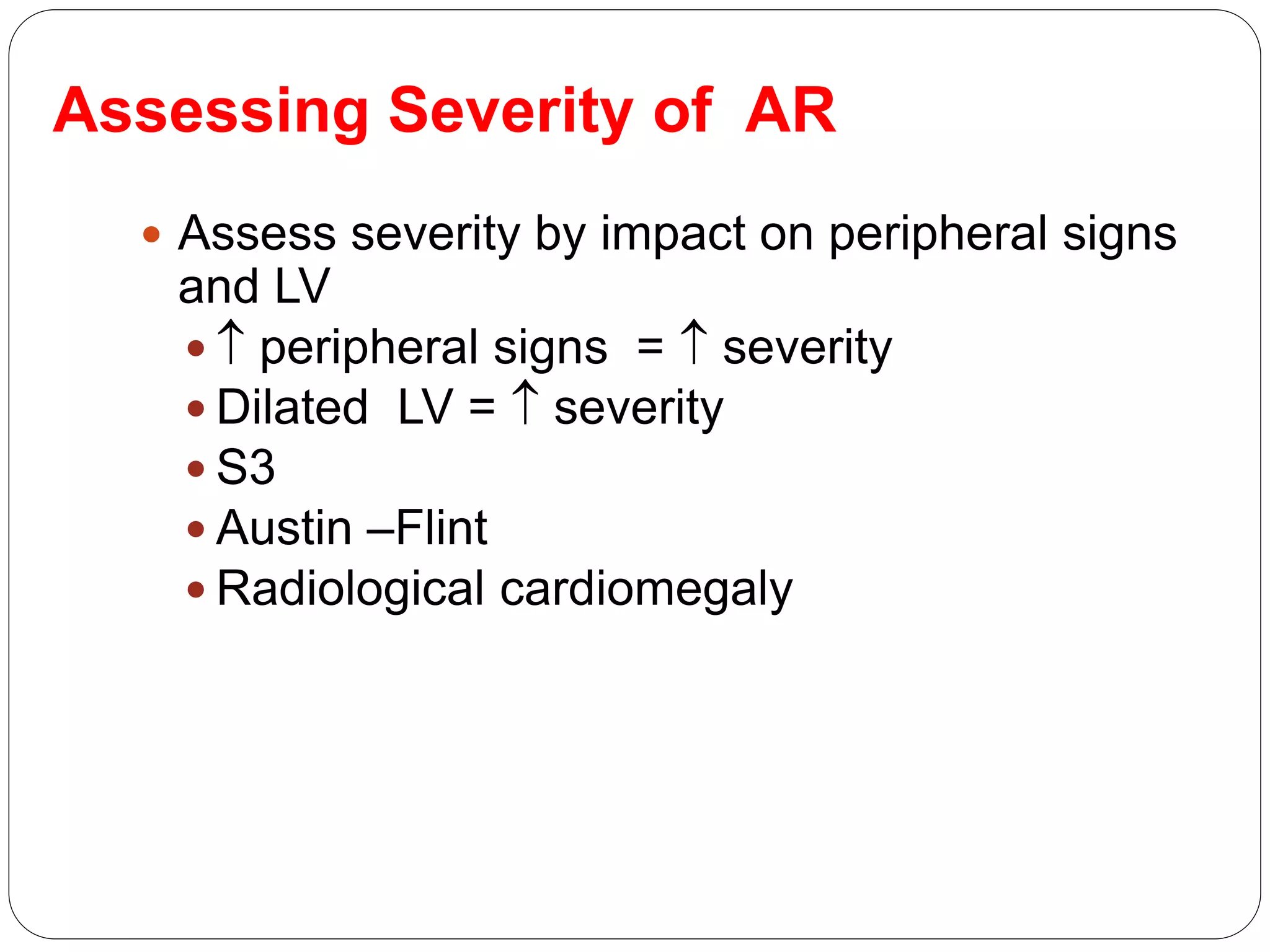
Assessing Severity of AR
 Assess severity by impact on peripheral signs
and LV
  peripheral signs =  severity
 Dilated LV =  severity
 S3
 Austin –Flint
 Radiological cardiomegaly
Investigations
 ECG
 Chest X ray
 Echocardiography
 Stress ECG
 Coronary angiography (preop.)
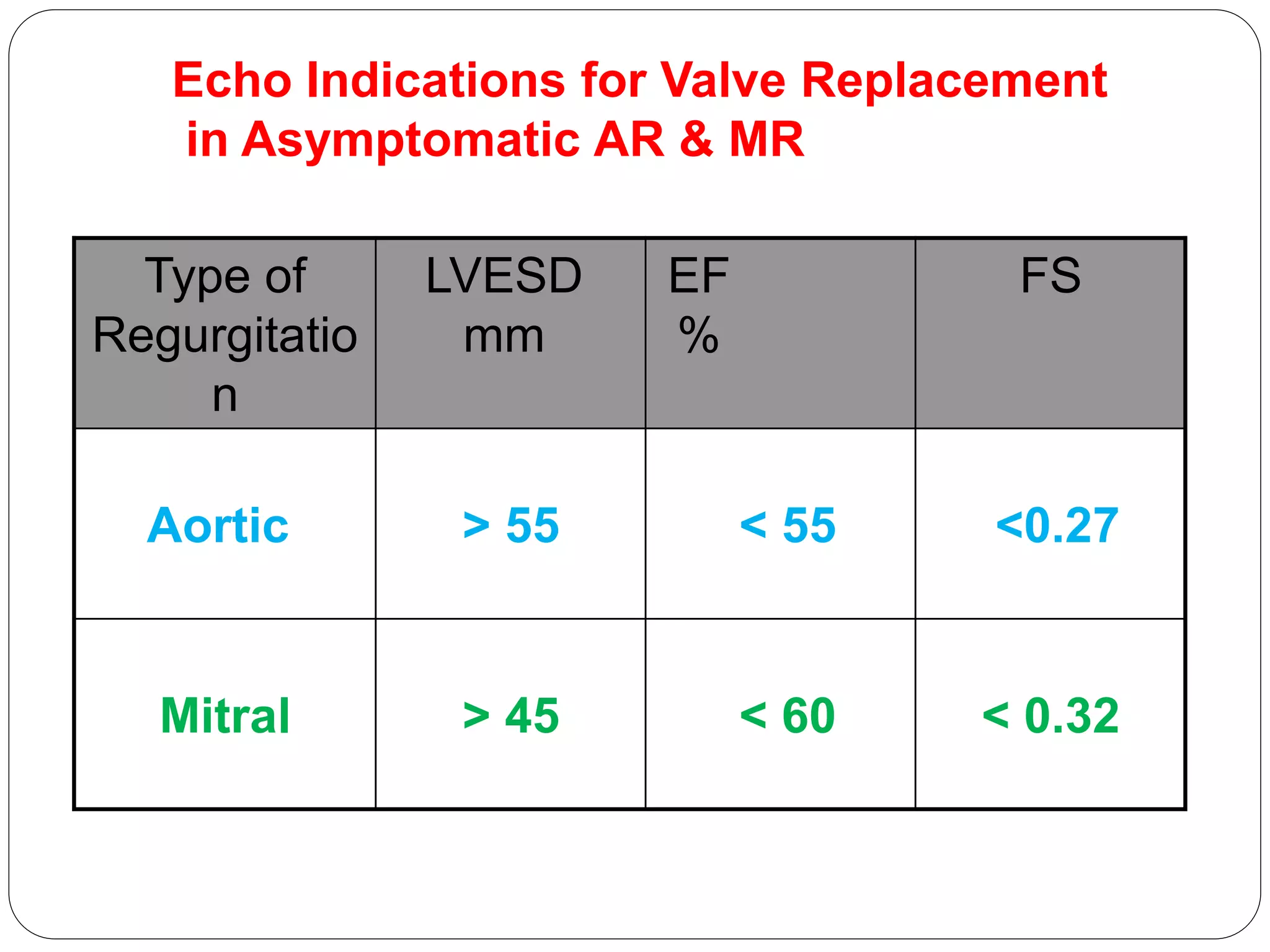
Echo Indications for Valve Replacement
in Asymptomatic AR & MR
Type of
Regurgitatio
n
LVESD
mm
EF
%
FS
Aortic > 55 < 55 <0.27
Mitral > 45 < 60 < 0.32
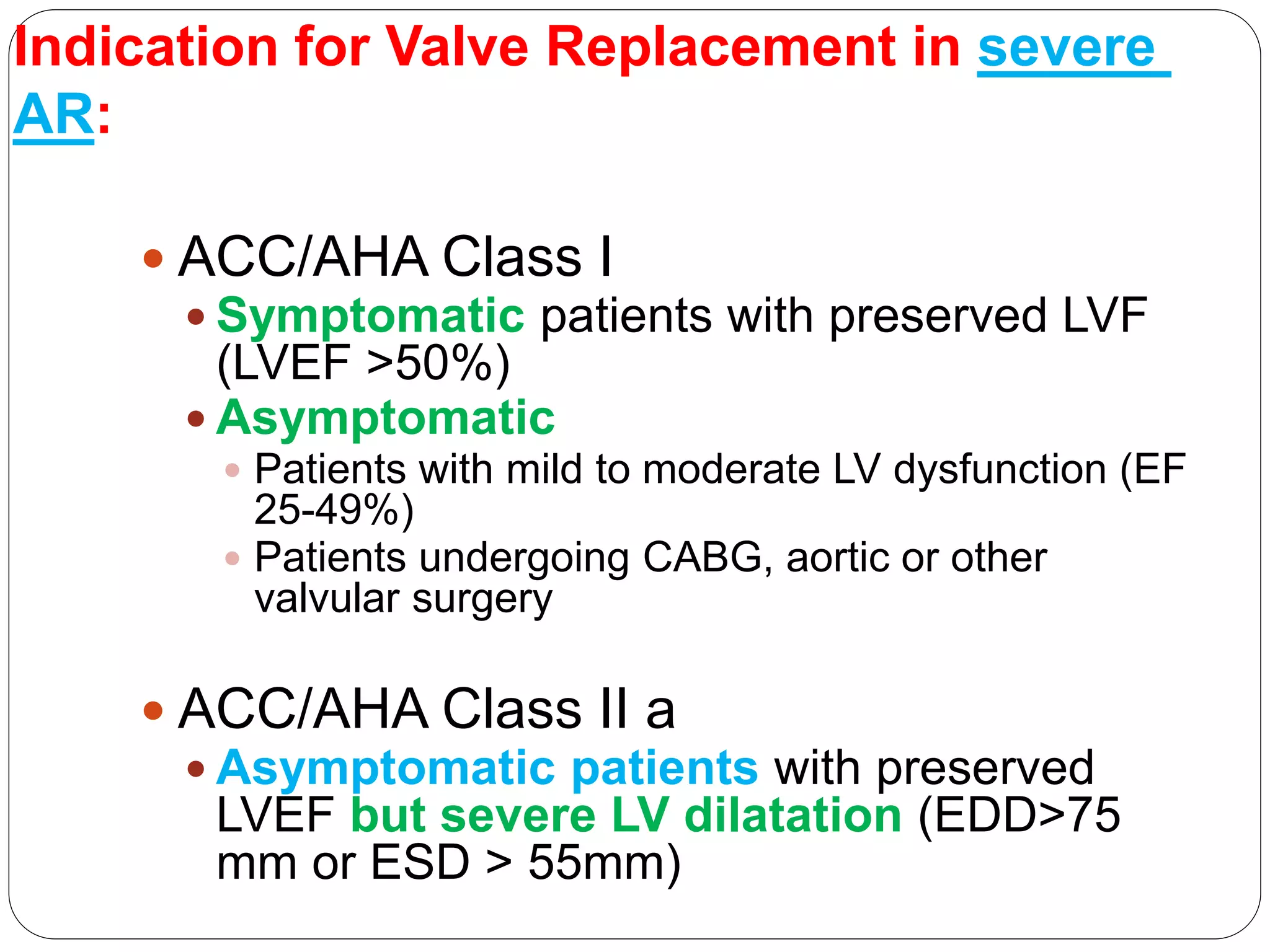
Indication for Valve Replacement in severe
AR:
 ACC/AHA Class I
 Symptomatic patients with preserved LVF
(LVEF >50%)
 Asymptomatic
 Patients with mild to moderate LV dysfunction (EF
25-49%)
 Patients undergoing CABG, aortic or other
valvular surgery
 ACC/AHA Class II a
 Asymptomatic patients with preserved
LVEF but severe LV dilatation (EDD>75
mm or ESD > 55mm)
Aortic valve disease

Aortic valve disease

  • 1.
  • 3.
    By Prof. Hatem AbdelRahman MD cardiology Dr. Mohamd Ashraf Ahmad MD cardiology Aortic Stenosis
  • 4.
    Definition  Aortic stenosis refersto obstruction of flow from the LV to aorta.  Anatomically, It may be:  1-Valvular:  2- Subvalvular:  3-Supravalvular :
  • 5.
    Aortic valve Stenosis Etiologies Congenital 0-30 yrs  Bicuspid 30-50 yrs  Rheumatic 30-60 yrs  Degenerative >60 yrs
  • 6.
  • 8.
    Pathophysiology  Valvular aorticstenosis results in chronic left ventricular pressure overloading.  Compensatory concentric LVH allows the ventricle to maintain stroke volume with increases in diastolic pressure, and patients remain asymptomatic for many years.
  • 9.
     Later on,LVH causes either  Diastolic dysfunction with the onset of congestive symptoms  Myocardial oxygen needs in excess of supply with the onset of angina.  Some patients might also experience exertional syncope, probably reflecting the inability to increase cardiac output and maintain blood pressure in response to vasodilation.
  • 10.
    Clinical presentation - Asymptomatic -The classic symptoms of severe AS: 1- Angina. 2- Syncope. 3- Congestive heart failure. 4-Sudden cardiac death.
  • 11.
  • 12.
    Natural history ofaortic stenosis. At the onset of symptoms (arrow), there is a rapid progression and survival is severely limited
  • 13.
    On examination : Delayed slow-rising carotid upstroke (pulsus parvus et tardus).  Sustained left ventricular apical impulse.  Fourth heart sound.  Harsh systolic murmur of aortic stenosis, loudest at the base of the heart and radiating to the carotids, is often but not always prominent. Low output states, obesity, or chronic lung disease may mask the findings.  Other hallmarks of significant aortic valve stenosis include a single (pulmonic) component of the second heart sound.
  • 15.
    Investigations  ECG oftenshows changes of left ventricular hypertrophy.  The chest X ray occasionally shows heavy calcification of the valve or ascending aortic dilation.  Echocardiography: Test of choice in the evaluation of patients with suspected valvular disease. It allows assessment of the valve anatomy as well as of chamber size and ventricular function. Doppler studies permit estimation of pressure gradients and estimations of aortic valve area .
  • 16.
     Stress ECG: Cardiac catheterization: It is generally performed as preoperative coronary angiography in men older than 35 years, women older than 45 years to exclude coronary artery disease.
  • 19.
    Treatment  Medical:  Todate, no medical therapy exists for the treatment of calcific aortic stenosis.  Prophylaxis against recurrent rheumatic fever in rheumatic patients.  Antibiotic prophylaxis against infective endocarditis in conditions associated with bacteraemia.  Surgical:  Aortic valve replacement  Percutaneous:
  • 21.
  • 22.
    Indications for surgery 1-Symptomatic patients (i.e., those with angina, syncope, or dyspnea) with severe aortic stenosis should undergo valve replacement. 2- Patients with severe AS undergoing coronary artery bypass grafting 3- Patients with severe AS undergoing surgery on the aorta or other heart valves .
  • 23.
    3- Asymptomatic Patientswith severe AS and left ventricular ejection fractions less than 0.50. 4- Patients with moderate aortic stenosis undergoing coronary artery bypass grafting or surgery on the aorta or other heart valves (Class IIa indication). 5- Aymptomatic patients with severe AS who exhibit an abnormal response to exercise (hypotension).
  • 25.
  • 27.
    Aortic Regurgitation  Etiology Physical Examination  Assessing Severity  Natural History  Prognosis  Timing of Surgery
  • 28.
    Etiology of AR Congenital  Bicuspid valve  Acquired  Rheumatic heart disease  Dilated aorta (e.g. hypertension..)  Degenerative  Connective tissue disorders  E.g. ankylosing spondylitis, rheumatoid arthritis, Reiter’s syndrome, Giant-cell arteritis )  Aortopathy  Cystic medial necrosis  Collagen disorders (e.g. Marfan’s)  Ehler-Danlos  Osteogenesis imperfecta.  Acute AI: aortic dissection, infective endocarditis, trauma
  • 29.
    :Pathophysiology of AR Acute or subacute significant AR causes the abrupt introduction of a large volume of blood into a noncompliant LV, thus increasing LV end-diastolic and pulmonary venous pressures and leading to acute dyspnea or pulmonary edema.
  • 30.
     In chronicAR, compensatory LV changes occur over time. The excess volume load causes stretching and elongation of myocardial fibers, which in turn increase wall stress.  When the ventricle can not dilate further, diastolic pressure increases and results in dyspnea, another sign of decompensation.
  • 31.
    Symptoms of AR Dyspnea, orthopnea, PND  Palpitations.  Chest pain.  Nocturnal angina >> exertional angina  ( diastolic aortic pressure and increased LVEDP thus  coronary artery diastolic flow).  With extreme reductions in diastolic pressures (e.g. < 40 mmHg) may see angina
  • 32.
    Peripheral Signs ofSevere AR  Quincke’s sign: capillary pulsation  Corrigan’s sign: water hammer pulse  De Musset’s sign: systolic head bobbing  Mueller’s sign: systolic pulsation of uvula  Durosier’s sign: femoral retrograde bruits  Traube’s sign: pistol shot femorals  Hill’s sign: BP Lower extremity >BP Upper extremity by  > 20 mm Hg - mild AR  > 40 mm Hg – mod
  • 33.
    Cardiac Signs ofSevere AR  Apex:  Displaced  Hyper-dynamic  Palpable S3  Austin-Flint murmur
  • 34.
    Murmur of aorticregurge:  High pitched, blowing, decrescendo diastolic murmur at LSB best heard at end-expiration & leaning forward  length correlates with severity (chronic AR)  in acute AR murmur shortens as Aortic DP=LVEDP
  • 35.
    Assessing Severity ofAR  Assess severity by impact on peripheral signs and LV   peripheral signs =  severity  Dilated LV =  severity  S3  Austin –Flint  Radiological cardiomegaly
  • 36.
    Investigations  ECG  ChestX ray  Echocardiography  Stress ECG  Coronary angiography (preop.)
  • 39.
    Echo Indications forValve Replacement in Asymptomatic AR & MR Type of Regurgitatio n LVESD mm EF % FS Aortic > 55 < 55 <0.27 Mitral > 45 < 60 < 0.32
  • 40.
    Indication for ValveReplacement in severe AR:  ACC/AHA Class I  Symptomatic patients with preserved LVF (LVEF >50%)  Asymptomatic  Patients with mild to moderate LV dysfunction (EF 25-49%)  Patients undergoing CABG, aortic or other valvular surgery  ACC/AHA Class II a  Asymptomatic patients with preserved LVEF but severe LV dilatation (EDD>75 mm or ESD > 55mm)