AORTIC STENOSIS
AORTIC STENOSIS
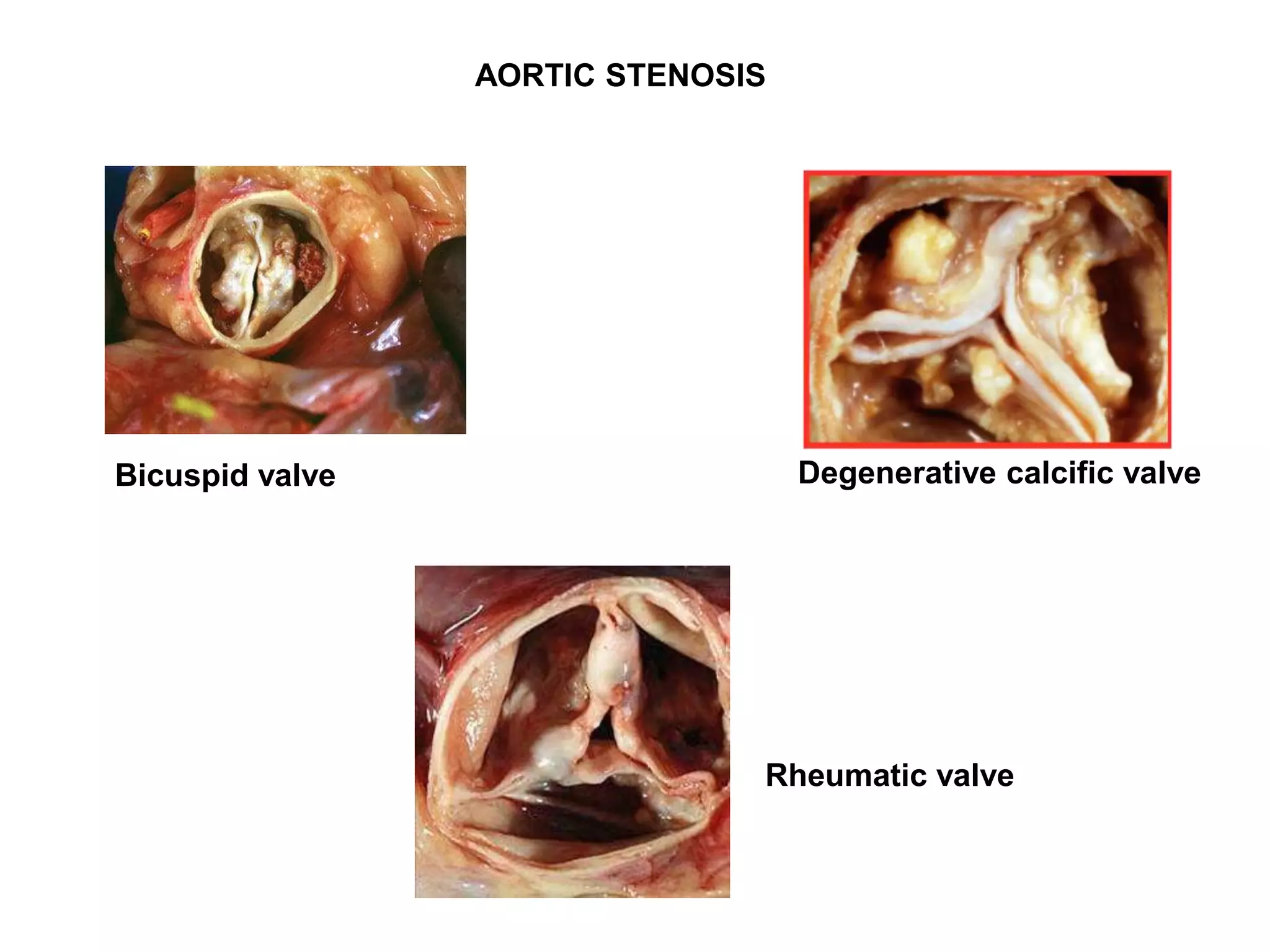
Bicuspid valve Degenerative calcific valve
Rheumatic valve
AORTIC STENOSIS
Valve area (cm2)
• normal - 3.0 – 4.0
• mild AS - 1.5 – 2.0
• moderate AS - 1.0 – 1.5
• severe AS - < 1.0
( < 0.6 cm2 / m2 )
• critical AS - < 0.75
( < 0.5 cm2 / m2 )
AORTIC STENOSIS
Rate of progression ( annual )
Area - decrease by 0.12 cm2
Jet velocity - increase by 0.32 m / sec
Mean gradient - increase by 7 mm Hg
AORTIC STENOSIS
Clinical
Remain asymptomatic for long
Severe AS
• exertional angina , syncope / presyncope
• dyspnea
• low volume, slow rising pulse – parvus et tardus
• narrow pulse pressure
• prominent A in JVP (Bernheim effect)
• heaving apex
• LV S4 , delayed A2
• long MSM with late peaking
• LV strain pattern in ECG
AORTIC STENOSIS
AORTIC STENOSIS
Geometric orifice area (GOA) … minimal area by planimetry
Effective orifice area (EOA) …. by continuity equation
corresponds to venacontracta
AORTIC STENOSIS
Hemodynamics
AORTIC STENOSIS
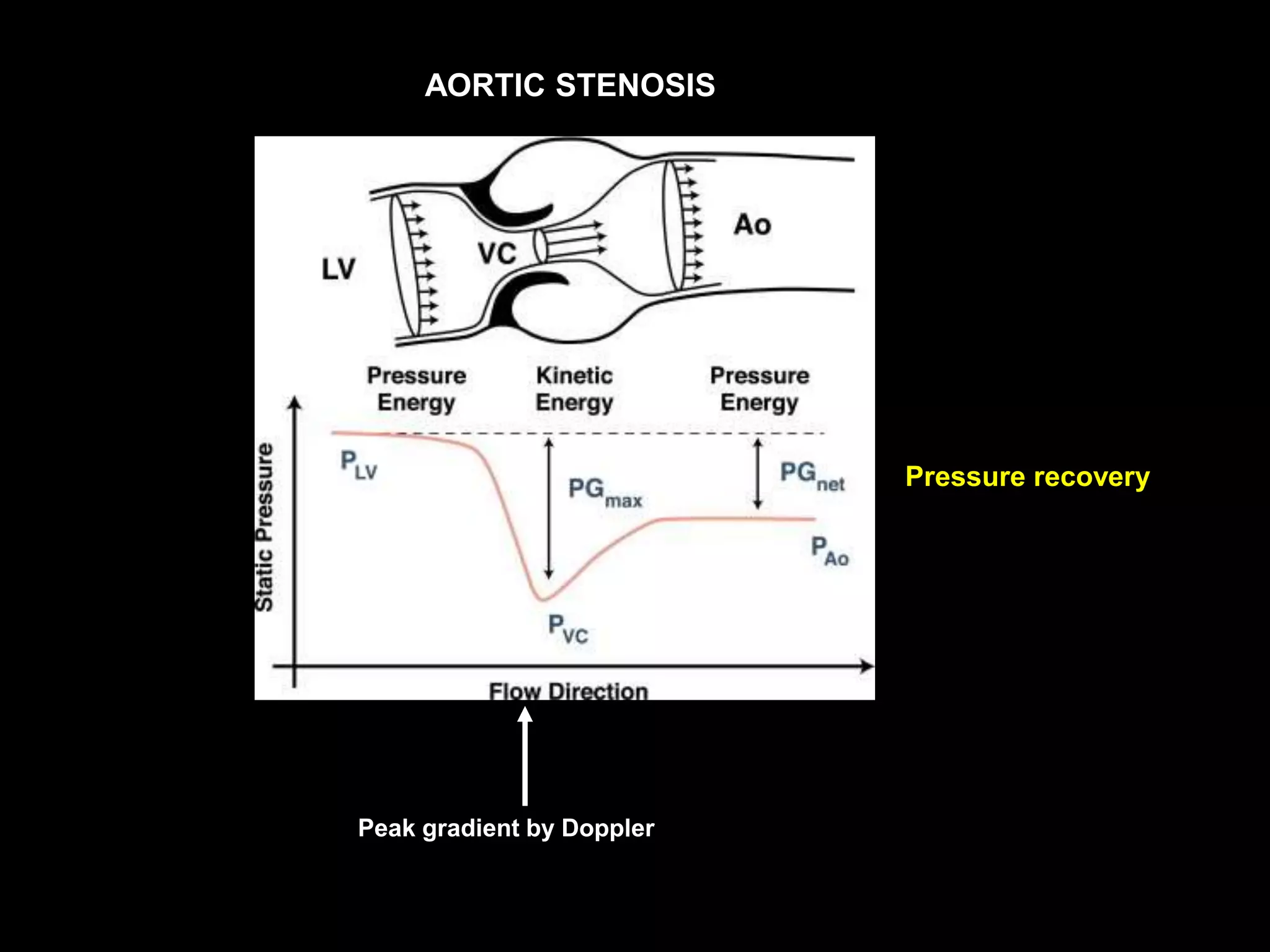
Peak gradient by Doppler
Pressure recovery
Mean gradient
Echo
Cath
AORTIC STENOSIS
Echocardiography
1. Anatomy - short & long axis views
(occasionally TEE / 3D)
2. LVOT diameter – midsystole ; at the site of measurement
of LVOT velocity measurement
parallel to AV
3. LVOT velocity - apical 4C / 5C ; V max / VTI
4. AS jet velocity (CW) – V max; peak and mean gr; VTI
5. SVI
6. DSE ( SOS)
AORTIC STENOSIS
Primary data
• AS jet velocity – V max
• mean gradient
• valve area
• flow .. SVI
Continuity equation
Planimetry .. TTE / TEE / 3D
Gradient …. Diagnostic value
Flow ………. Prognostic value
AORTIC STENOSIS
Continuity equation
Flow across LVOT and aortic valve is same
Flow = area x VTI
A LVOT x VTI LVOT = A AV x VTI AV
AAV = A LVOT x VTI LVOT A1 x V1_
VTI AV V2
AORTIC STENOSIS
Dimensionless valve index (velocity ratio)
Very simple method
Variable of area is taken away from the continuity equation
LVOT velocity
Aortic valve velocity
Value < 0.25 .. Severe AS
SEVERE AS
Mean gradient = 71 mm Hg
Dimensionless index = 0.5 / 5.5 = 0.1
V1 = 1. 5 m /sec
V 2 = 4 m / sec
DI = 1.5 / 4 = 0.375
AORTIC STENOSIS
Severity
Parameters sclerosis mild AS moderate severe
Vmax..m/sec < 2.5 2.6 – 2.9 3.0 – 3.9 ≥ 4.0
MPG mm Hg -- < 20 20 – 39 ≥ 40
AVA cm2 -- > 1.5 1.0 – 1.5 < 1.0
AVAI cm2 / m2 -- > 0.85 0.6 – 0.85 < 0.6
Dimensionless -- > 0.5 0.25 – 0.5 < 0.25
index
AORTIC STENOSIS
Global LV hemodynamic load
Valvuloarterial impedance ( Z va )
Valvular resistance + vascular resistance
Mean gradient SBP
Zva = SBP + mean gradient
Stroke volume index
> 4.5 … severe AS
AORTIC STENOSIS
Dobutamine stress echo
• change in mean gradient
• change in valve area
• change in SVI
• effort tolerance , symptoms
• BP response
• increase in mean gradient
Exercise test
in severe “asymptomatic” AS
BNP .. Limitations + ; > 500 pg / ml …poor prognosis
AORTIC STENOSIS
CT
• best method to assess annulus, aorta and calcium
• assess GOA
• assess coronaries
• severity of AS .. < 700 AU .. excludes severe AS
> 2000 AU .. severe AS
> 1650 .. optimal sensitivity & specificity
• evaluation of prosthetic valve
• planning TAVR
• assess myocardial fibrosis
CMR
AORTIC STENOSIS
Terminologies
Low flow low gradient severe AS
Paradoxical low flow AS
Pseudosevere AS
AORTIC STENOSIS
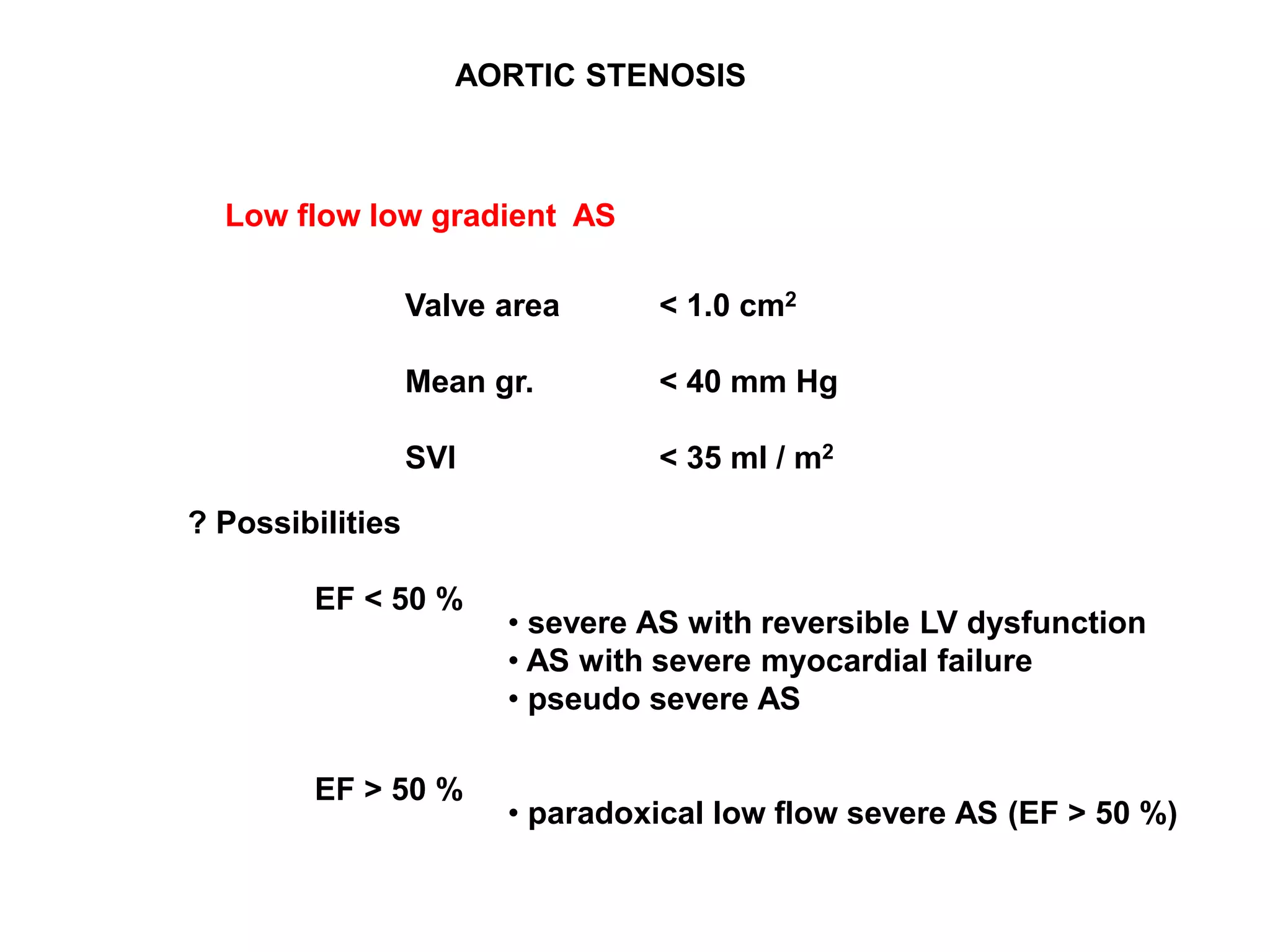
Low flow low gradient AS
Valve area < 1.0 cm2
Mean gr. < 40 mm Hg
SVI < 35 ml / m2
? Possibilities
EF < 50 %
EF > 50 %
• severe AS with reversible LV dysfunction
• AS with severe myocardial failure
• pseudo severe AS
• paradoxical low flow severe AS (EF > 50 %)
AORTIC STENOSIS
Physiologic discrepancies
V max > 4.0 m /sec
Mean gr. > 40 mm Hg
Valve area > 1.0 cm2
Valve area < 1.0 cm2 ; normal flow ; low gradient
Gradient under assessed due to hypertension
Prolonged LVET ; reduced flow rate > lower Vmax
Moderate AS ; small body size ; AVA index - > 0.6 cm2
associated AR
high output states
Large BSA … calculate AVAI
1.
2.
AORTIC STENOSIS
DSE
Valve area mean gr. SVI change assessment
(cm2) (mm Hg) ( %)
< 1.0 > 40 > 20 severe AS
myocardium OK
< 1.0 < 40 < 20 myocardial failure
↑ by > 0.3 no change > 20 pseudo severe AS
AORTIC STENOSIS
Paradoxical low flow severe AS
( Hachicha et al 2007)
1/3 rd of cases ; poor surgical outcome
Severe true AS … area < 1.0 cm2
Low flow … SVI < 35 ml / m2
Preserved EF .. > 50 %
1. Impaired LVEDV
2. Impaired LV longitudinal strain
• severe LVH
• AF , tachycardia
• MS , MR, PAH, TR
Stages of valvular AS
Stage type Vmax mean gr EF other data
(m/sec) (mm Hg)
A at risk of AS < 2 -- N --
(BAV)
B progressive AS 2.0 – 3.9 upto 39 N valve area > 1.0
C. Asymptomatic ≥ 4.0 ≥ 40 N ( C1) valve area < 1.0
severe AS
< 50 % (C2)
D Symptomatic
severe AS (valve area < 1.0)
D1 (high gr) ≥ 4.0 ≥ 40 N
D2 (low flow < 4.0 < 40 < 50 DSE .. gr > 40
low gr) SVI > 35
D3 (paradoxical < 4.0 < 40 > 50 DSE .. SVI < 35
low flow low gr)
AORTIC STENOSIS
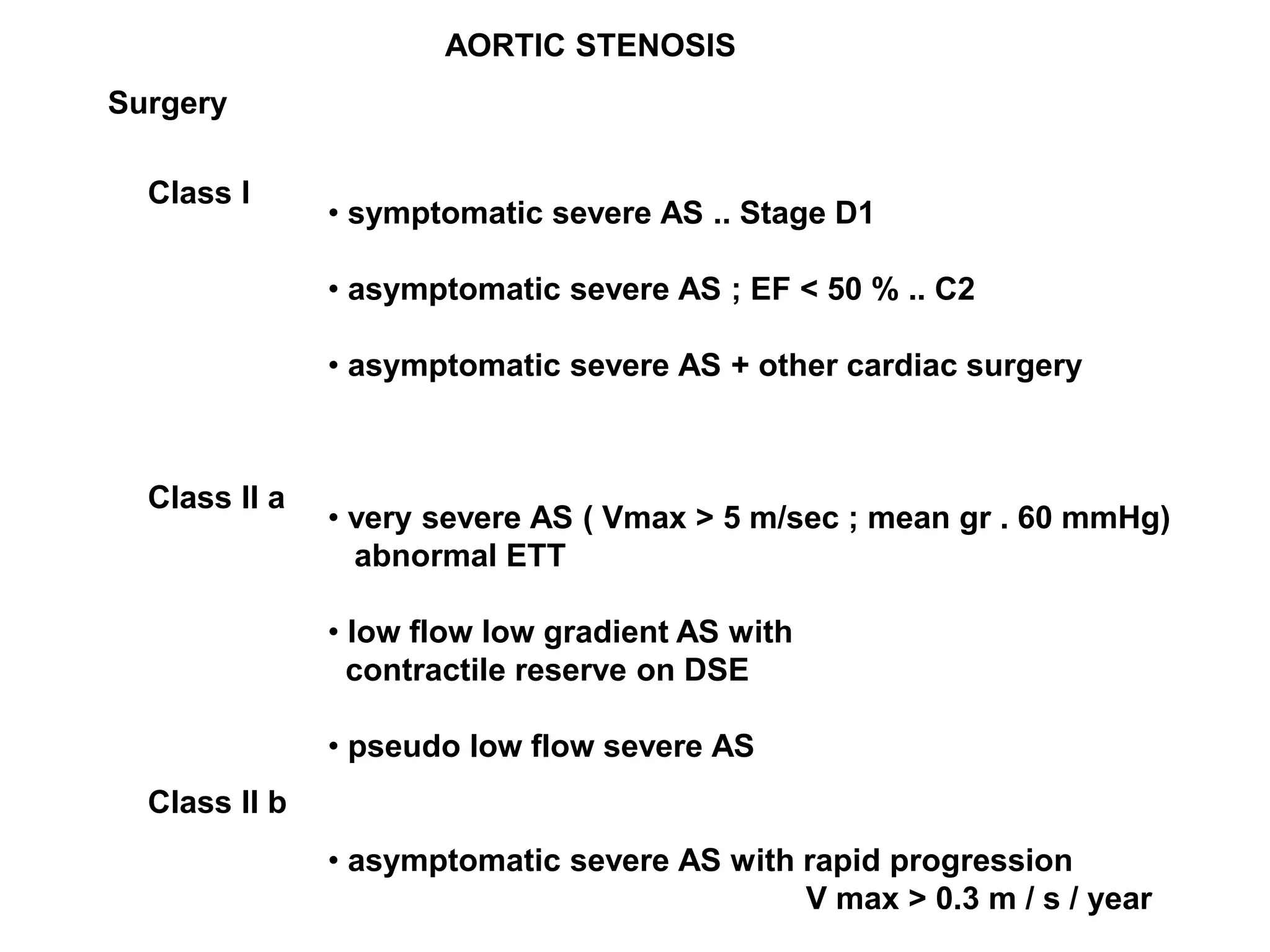
Surgery
Class I
Class II a
Class II b
• symptomatic severe AS .. Stage D1
• asymptomatic severe AS ; EF < 50 % .. C2
• asymptomatic severe AS + other cardiac surgery
• very severe AS ( Vmax > 5 m/sec ; mean gr . 60 mmHg)
abnormal ETT
• low flow low gradient AS with
contractile reserve on DSE
• pseudo low flow severe AS
• asymptomatic severe AS with rapid progression
V max > 0.3 m / s / year
AS .. (Vmax, mean gr., AVA, LVEF, SVI)
AVA < 1.0 < 1.0 < 1.0
Vmax > 4.0 < 4.0 < 4.0
MPG > 40 < 40 < 40
EF > 50 > 50 < 50
SVI > 35 < 35 < 35
Normal flow paradoxical low flow low flow low gr
high gr. Vs
pseudo severe AS
DSE
symptomatic symptomatic ? contractile reserve
present absent
AVR MPG > 40 AVA increase
AVA < 1.0 by > 0.3
OMT
pseudo severe AS

Aortic Stenosis.ppt

  • 2.
  • 3.
    AORTIC STENOSIS Bicuspid valveDegenerative calcific valve Rheumatic valve
  • 4.
    AORTIC STENOSIS Valve area(cm2) • normal - 3.0 – 4.0 • mild AS - 1.5 – 2.0 • moderate AS - 1.0 – 1.5 • severe AS - < 1.0 ( < 0.6 cm2 / m2 ) • critical AS - < 0.75 ( < 0.5 cm2 / m2 )
  • 5.
    AORTIC STENOSIS Rate ofprogression ( annual ) Area - decrease by 0.12 cm2 Jet velocity - increase by 0.32 m / sec Mean gradient - increase by 7 mm Hg
  • 6.
    AORTIC STENOSIS Clinical Remain asymptomaticfor long Severe AS • exertional angina , syncope / presyncope • dyspnea • low volume, slow rising pulse – parvus et tardus • narrow pulse pressure • prominent A in JVP (Bernheim effect) • heaving apex • LV S4 , delayed A2 • long MSM with late peaking • LV strain pattern in ECG
  • 7.
  • 8.
    AORTIC STENOSIS Geometric orificearea (GOA) … minimal area by planimetry Effective orifice area (EOA) …. by continuity equation corresponds to venacontracta
  • 9.
  • 10.
    AORTIC STENOSIS Peak gradientby Doppler Pressure recovery
  • 12.
  • 13.
    AORTIC STENOSIS Echocardiography 1. Anatomy- short & long axis views (occasionally TEE / 3D) 2. LVOT diameter – midsystole ; at the site of measurement of LVOT velocity measurement parallel to AV 3. LVOT velocity - apical 4C / 5C ; V max / VTI 4. AS jet velocity (CW) – V max; peak and mean gr; VTI 5. SVI 6. DSE ( SOS)
  • 14.
    AORTIC STENOSIS Primary data •AS jet velocity – V max • mean gradient • valve area • flow .. SVI Continuity equation Planimetry .. TTE / TEE / 3D Gradient …. Diagnostic value Flow ………. Prognostic value
  • 19.
    AORTIC STENOSIS Continuity equation Flowacross LVOT and aortic valve is same Flow = area x VTI A LVOT x VTI LVOT = A AV x VTI AV AAV = A LVOT x VTI LVOT A1 x V1_ VTI AV V2
  • 21.
    AORTIC STENOSIS Dimensionless valveindex (velocity ratio) Very simple method Variable of area is taken away from the continuity equation LVOT velocity Aortic valve velocity Value < 0.25 .. Severe AS
  • 22.
    SEVERE AS Mean gradient= 71 mm Hg Dimensionless index = 0.5 / 5.5 = 0.1
  • 23.
    V1 = 1.5 m /sec V 2 = 4 m / sec DI = 1.5 / 4 = 0.375
  • 24.
    AORTIC STENOSIS Severity Parameters sclerosismild AS moderate severe Vmax..m/sec < 2.5 2.6 – 2.9 3.0 – 3.9 ≥ 4.0 MPG mm Hg -- < 20 20 – 39 ≥ 40 AVA cm2 -- > 1.5 1.0 – 1.5 < 1.0 AVAI cm2 / m2 -- > 0.85 0.6 – 0.85 < 0.6 Dimensionless -- > 0.5 0.25 – 0.5 < 0.25 index
  • 25.
    AORTIC STENOSIS Global LVhemodynamic load Valvuloarterial impedance ( Z va ) Valvular resistance + vascular resistance Mean gradient SBP Zva = SBP + mean gradient Stroke volume index > 4.5 … severe AS
  • 26.
    AORTIC STENOSIS Dobutamine stressecho • change in mean gradient • change in valve area • change in SVI • effort tolerance , symptoms • BP response • increase in mean gradient Exercise test in severe “asymptomatic” AS BNP .. Limitations + ; > 500 pg / ml …poor prognosis
  • 27.
    AORTIC STENOSIS CT • bestmethod to assess annulus, aorta and calcium • assess GOA • assess coronaries • severity of AS .. < 700 AU .. excludes severe AS > 2000 AU .. severe AS > 1650 .. optimal sensitivity & specificity • evaluation of prosthetic valve • planning TAVR • assess myocardial fibrosis CMR
  • 29.
    AORTIC STENOSIS Terminologies Low flowlow gradient severe AS Paradoxical low flow AS Pseudosevere AS
  • 30.
    AORTIC STENOSIS Low flowlow gradient AS Valve area < 1.0 cm2 Mean gr. < 40 mm Hg SVI < 35 ml / m2 ? Possibilities EF < 50 % EF > 50 % • severe AS with reversible LV dysfunction • AS with severe myocardial failure • pseudo severe AS • paradoxical low flow severe AS (EF > 50 %)
  • 31.
    AORTIC STENOSIS Physiologic discrepancies Vmax > 4.0 m /sec Mean gr. > 40 mm Hg Valve area > 1.0 cm2 Valve area < 1.0 cm2 ; normal flow ; low gradient Gradient under assessed due to hypertension Prolonged LVET ; reduced flow rate > lower Vmax Moderate AS ; small body size ; AVA index - > 0.6 cm2 associated AR high output states Large BSA … calculate AVAI 1. 2.
  • 32.
    AORTIC STENOSIS DSE Valve areamean gr. SVI change assessment (cm2) (mm Hg) ( %) < 1.0 > 40 > 20 severe AS myocardium OK < 1.0 < 40 < 20 myocardial failure ↑ by > 0.3 no change > 20 pseudo severe AS
  • 33.
    AORTIC STENOSIS Paradoxical lowflow severe AS ( Hachicha et al 2007) 1/3 rd of cases ; poor surgical outcome Severe true AS … area < 1.0 cm2 Low flow … SVI < 35 ml / m2 Preserved EF .. > 50 % 1. Impaired LVEDV 2. Impaired LV longitudinal strain • severe LVH • AF , tachycardia • MS , MR, PAH, TR
  • 34.
    Stages of valvularAS Stage type Vmax mean gr EF other data (m/sec) (mm Hg) A at risk of AS < 2 -- N -- (BAV) B progressive AS 2.0 – 3.9 upto 39 N valve area > 1.0 C. Asymptomatic ≥ 4.0 ≥ 40 N ( C1) valve area < 1.0 severe AS < 50 % (C2) D Symptomatic severe AS (valve area < 1.0) D1 (high gr) ≥ 4.0 ≥ 40 N D2 (low flow < 4.0 < 40 < 50 DSE .. gr > 40 low gr) SVI > 35 D3 (paradoxical < 4.0 < 40 > 50 DSE .. SVI < 35 low flow low gr)
  • 35.
    AORTIC STENOSIS Surgery Class I ClassII a Class II b • symptomatic severe AS .. Stage D1 • asymptomatic severe AS ; EF < 50 % .. C2 • asymptomatic severe AS + other cardiac surgery • very severe AS ( Vmax > 5 m/sec ; mean gr . 60 mmHg) abnormal ETT • low flow low gradient AS with contractile reserve on DSE • pseudo low flow severe AS • asymptomatic severe AS with rapid progression V max > 0.3 m / s / year
  • 36.
    AS .. (Vmax,mean gr., AVA, LVEF, SVI) AVA < 1.0 < 1.0 < 1.0 Vmax > 4.0 < 4.0 < 4.0 MPG > 40 < 40 < 40 EF > 50 > 50 < 50 SVI > 35 < 35 < 35 Normal flow paradoxical low flow low flow low gr high gr. Vs pseudo severe AS DSE symptomatic symptomatic ? contractile reserve present absent AVR MPG > 40 AVA increase AVA < 1.0 by > 0.3 OMT pseudo severe AS