P type and N type semiconductors, taken
separately are of very limited use.

If we join a piece of P type material to a piece
of N type material such that the crystal
structure remains continuous at the boundary,,
….. A PN JUNCTION is formed
It can function as ….


     Rectifier ,
     Amplifier ,
     Switching
     And other operations in electronic circuits.
A PN junction cannot be produced by simply
 pushing two pieces together or by welding
 etc…. Because it gives rise to discontinuities
 across the crystal structure.

Special fabrication techniques are adopted to
 form a P N junction
What is a PN Junction?

A PN junction is a device formed by
 joining p-type ( doped with B, Al)
 with n-type (doped with P, As, Sb)
 semiconductors and separated by a thin
 junction is called PN Junction diode or
 junction diode.
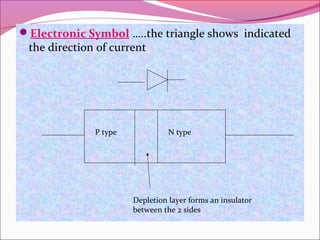
Electronic Symbol …..the triangle shows indicated
 the direction of current


              P type             N type


                       Depletion layer forms an insulator
                       between the 2 sides
 In PN junction diode, N is at right and P is at left.
Majority carriers
          N region -- electrons
          P region -- holes
Formation of depletion layer
NO external connections:
  the excess electrons in the N region cross the junction
  and combine with the excess holes in the P region.
N region loses its electrons ……becomes + vly charged
P region accepts the electrons ……becomes -vly charged

At one point , the migratory action is stopped.
An additional electrons from the N region are
 repelled by the net negative charge of the p region.

Similarly,
An additional holes from the P region are repelled by
   the net positive charge of the n region.
Net result
  a creation of a thin layer of each side of the junction
   ……….which is depleted (emptied) of mobile charge
   carriers…. This is known as DEPLETION LAYER
..Thickness is of the order of 10-6meter
The depletion layer contains no free and
 mobile charge carriers but only fixed and
 immobile ions.
Its width depends upon the doping level..


Heavy doped……..thin depletion layer
lightly doped……..thick depletion layer
POTENTIAL BARRIER
The electrons in the N region have to climb the potential
  hill in order to reach the P region

Electrons trying to cross from the N region to P region
  experience a retarding field of the battery and therefore
  repelled. Similarly for holes from P region.

Potential thus produced are called ..potential barrier


Ge..0.3 V    Si ..0.7V
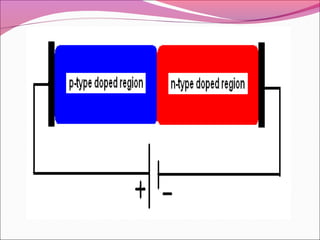
PN junction can basically work in two modes, (A
battery is connected to the diode )
  forward bias mode ( positive terminal
  connected to p-region and negative terminal
  connected to n region)


  reverse bias mode ( negative terminal
  connected to p-region and positive terminal
  connected to n region)
Forward biased PN junction


 It forces the majority charge carriers to move
 across the junction ….decreasing the width of
 the depletion layer.
Once the junction is crossed, a number of electrons
 and the holes will recombine .
For each hole in the P section that combines with an
 electron from the N section, a covalent bond breaks
 and an electron is liberatyed which enters the positive
 terminal

Thus creating an electron hole pair.


Current in the N region is carried by ….electrons
Current in the P region is carried by …. Holes.
Reverse biased pn junction
If the + of the battery is connected to the n-type and the –
 terminal to the p-type,


  the free electrons and free holes are
 attracted back towards the battery, hence
 back from the depletion layer, hence the
 depletion layer grows.

 Thus a reverse biased pn junction does not conduct current
Only the minority carriers cross
 the junction constituting very low
 reverse saturation current.

This current is of the order of
 micro ampere.
VOLTAGE –CURRENT (V-I)
CHARACTERISTICS OF PN JUNCTION
DIODE

The curve drawn between voltage across
 the junction along X axis and current
 through the circuits along the Y axis.

They describe the d.c behavior of the
 diode.
When it is in forward bias, no current
 flows until the barrier voltage (0.3 v
 for Ge) is overcome.

Then the curve has a linear rise and the
 current increases, with the increase in
 forward voltage like an ordinary
 conductor.
Above 3 v , the majority carriers passing
 the junction gain sufficient energy to
 knock out the valence electrons and raise
 them to the conduction band.

Therefore , the forward current
 increases sharply .
With reverse bias,
 potential barrier at the junction increased. …
 junction resistance increase…and prevents
 current flow.
However , the minority carriers are
 accelarated by the reverse voltage resulting a
 very small current (REVERSE CURRENT)
 ….in the order of micro amperes.
When revrese voltage is increased beyond
 a value ,called breakdown voltage,the
 reverse current increases sharply and
 the diode shows almost zero resistance .It is
 known as avalanche breakdown.

Reverse voltage above 25 v destroys the
 junction permanentaly.
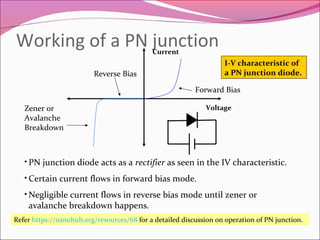
Working of a PN junction                    Current
                                                                   I-V characteristic of
                         Reverse Bias                              a PN junction diode.

                                                          Forward Bias

   Zener or                                                  Voltage
   Avalanche
   Breakdown


   • PN junction diode acts as a rectifier as seen in the IV characteristic.
   • Certain current flows in forward bias mode.
   • Negligible current flows in reverse bias mode until zener or
     avalanche breakdown happens.
Refer https://nanohub.org/resources/68 for a detailed discussion on operation of PN junction.
Thus the P N junction diode
 allows the electrons flow only
 when P is positive .

This property is used for the
 conversion of AC into DC ,Which
 is called rectification
Automatic switch
When the diode is forward bias ,the
 switch is CLOSED.

When it is reverse biased , it is OPEN
ADVANTAGES:
No filament is necessary


Occupies lesser space


Long life.
APPLICATIONS
….as rectifiers to convert AC into DC.

As an switch in computer circuits.

As detectors in radios to detect audio
 signals

As LED to emit different colours.

Pn junction diode

  • 2.
    P type andN type semiconductors, taken separately are of very limited use. If we join a piece of P type material to a piece of N type material such that the crystal structure remains continuous at the boundary,, ….. A PN JUNCTION is formed
  • 3.
    It can functionas …. Rectifier , Amplifier , Switching And other operations in electronic circuits.
  • 4.
    A PN junctioncannot be produced by simply pushing two pieces together or by welding etc…. Because it gives rise to discontinuities across the crystal structure. Special fabrication techniques are adopted to form a P N junction
  • 5.
    What is aPN Junction? A PN junction is a device formed by joining p-type ( doped with B, Al) with n-type (doped with P, As, Sb) semiconductors and separated by a thin junction is called PN Junction diode or junction diode.
  • 6.
    Electronic Symbol …..thetriangle shows indicated the direction of current P type N type Depletion layer forms an insulator between the 2 sides
  • 7.
     In PNjunction diode, N is at right and P is at left. Majority carriers N region -- electrons P region -- holes
  • 8.
    Formation of depletionlayer NO external connections: the excess electrons in the N region cross the junction and combine with the excess holes in the P region. N region loses its electrons ……becomes + vly charged P region accepts the electrons ……becomes -vly charged At one point , the migratory action is stopped.
  • 9.
    An additional electronsfrom the N region are repelled by the net negative charge of the p region. Similarly, An additional holes from the P region are repelled by the net positive charge of the n region. Net result a creation of a thin layer of each side of the junction ……….which is depleted (emptied) of mobile charge carriers…. This is known as DEPLETION LAYER ..Thickness is of the order of 10-6meter
  • 10.
    The depletion layercontains no free and mobile charge carriers but only fixed and immobile ions. Its width depends upon the doping level.. Heavy doped……..thin depletion layer lightly doped……..thick depletion layer
  • 11.
    POTENTIAL BARRIER The electronsin the N region have to climb the potential hill in order to reach the P region Electrons trying to cross from the N region to P region experience a retarding field of the battery and therefore repelled. Similarly for holes from P region. Potential thus produced are called ..potential barrier Ge..0.3 V Si ..0.7V
  • 13.
    PN junction canbasically work in two modes, (A battery is connected to the diode ) forward bias mode ( positive terminal connected to p-region and negative terminal connected to n region) reverse bias mode ( negative terminal connected to p-region and positive terminal connected to n region)
  • 14.
    Forward biased PNjunction  It forces the majority charge carriers to move across the junction ….decreasing the width of the depletion layer.
  • 15.
    Once the junctionis crossed, a number of electrons and the holes will recombine . For each hole in the P section that combines with an electron from the N section, a covalent bond breaks and an electron is liberatyed which enters the positive terminal Thus creating an electron hole pair. Current in the N region is carried by ….electrons Current in the P region is carried by …. Holes.
  • 16.
    Reverse biased pnjunction If the + of the battery is connected to the n-type and the – terminal to the p-type, the free electrons and free holes are attracted back towards the battery, hence back from the depletion layer, hence the depletion layer grows. Thus a reverse biased pn junction does not conduct current
  • 17.
    Only the minoritycarriers cross the junction constituting very low reverse saturation current. This current is of the order of micro ampere.
  • 18.
    VOLTAGE –CURRENT (V-I) CHARACTERISTICSOF PN JUNCTION DIODE The curve drawn between voltage across the junction along X axis and current through the circuits along the Y axis. They describe the d.c behavior of the diode.
  • 19.
    When it isin forward bias, no current flows until the barrier voltage (0.3 v for Ge) is overcome. Then the curve has a linear rise and the current increases, with the increase in forward voltage like an ordinary conductor.
  • 20.
    Above 3 v, the majority carriers passing the junction gain sufficient energy to knock out the valence electrons and raise them to the conduction band. Therefore , the forward current increases sharply .
  • 21.
    With reverse bias, potential barrier at the junction increased. … junction resistance increase…and prevents current flow. However , the minority carriers are accelarated by the reverse voltage resulting a very small current (REVERSE CURRENT) ….in the order of micro amperes.
  • 22.
    When revrese voltageis increased beyond a value ,called breakdown voltage,the reverse current increases sharply and the diode shows almost zero resistance .It is known as avalanche breakdown. Reverse voltage above 25 v destroys the junction permanentaly.
  • 23.
    Working of aPN junction Current I-V characteristic of Reverse Bias a PN junction diode. Forward Bias Zener or Voltage Avalanche Breakdown • PN junction diode acts as a rectifier as seen in the IV characteristic. • Certain current flows in forward bias mode. • Negligible current flows in reverse bias mode until zener or avalanche breakdown happens. Refer https://nanohub.org/resources/68 for a detailed discussion on operation of PN junction.
  • 24.
    Thus the PN junction diode allows the electrons flow only when P is positive . This property is used for the conversion of AC into DC ,Which is called rectification
  • 25.
    Automatic switch When thediode is forward bias ,the switch is CLOSED. When it is reverse biased , it is OPEN
  • 26.
    ADVANTAGES: No filament isnecessary Occupies lesser space Long life.
  • 27.
    APPLICATIONS ….as rectifiers toconvert AC into DC. As an switch in computer circuits. As detectors in radios to detect audio signals As LED to emit different colours.