Contact:
alamin999bd@gmail.com
+8801772773306
AL-AMIN
Jatiya Kabi Kazi Nazrul Islam University
Department of Electrical and Electronic Engineering
Semiconductor Physics
Metals(Conductors)
Insulators
Semiconductors
N-Type Semiconductors
P-Type Semiconductors
Intrinsic Semiconductors
Extrinsic semiconductors
Metals(Conductors):
• The materials which easily allow the
flow of electric current through them
are called as conductors. Metals such
as copper, silver, iron, aluminum etc.
are good conductors of electricity.
Metals(Conductors)
Insulators
The materials which does not allow the flow of electric
current through them are called as insulators.
Insulators are also called as poor conductors of
electricity.
Insulators
Semiconductors
The material which has electrical conductivity
between that of a conductor and an insulator is
called as semiconductor. Silicon, germanium and
graphite are some examples of semiconductors.
Semiconductors
N-Type Semiconductors
 In addition to replacing one of the lattice atoms with a Group
3 atom, we can also replace it by an atom with five valence
electrons, such as the Group 5 atoms arsenic (As) or
phosphorus (P). In this case, the impurity adds five valence
electrons to the lattice where it can only hold four. This means
that there is now one excess electron in the lattice (see figure
below). Because it donates an electron, a Group 5 impurity is
called a donor. Note that the material remains electrically
neutral.
N-Type Semiconductors
Donor impurities donate negatively charged electrons
to the lattice, so a semiconductor that has been doped
with a donor is called an n-type semiconductor; "n"
stands for negative. Free electrons outnumber holes in
an n-type material, so the electrons are the majority
carriers and holes are the minority carriers.
N-Type Semiconductors
In a pure (intrinsic) Si or Ge semiconductor, each nucleus uses
its four valence electrons to form four covalent bonds with its
neighbors (see figure below). Each ionic core, consisting of the
nucleus and non-valent electrons, has a net charge of +4, and is
surrounded by 4 valence electrons. Since there are no excess
electrons or holes In this case, the number of electrons and
holes present at any given time will always be equal.
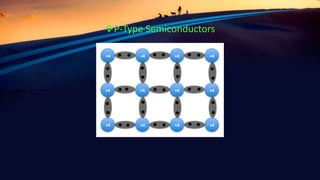
P-Type Semiconductors
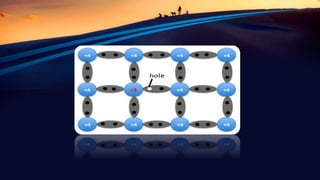
Now, if one of the atoms in the semiconductor lattice is
replaced by an element with three valence electrons, such
as a Group 3 element like Boron (B) or Gallium (Ga), the
electron-hole balance will be changed. This impurity will
only be able to contribute three valence electrons to the
lattice, therefore leaving one excess hole (see figure below).
Since holes will "accept" free electrons, a Group 3 impurity
is also called an acceptor.
P-Type Semiconductors
Because an acceptor donates excess holes, which are considered
to be positively charged, a semiconductor that has been doped
with an acceptor is called a p-type semiconductor; "p" stands for
positive. Notice that the material as a whole remains electrically
neutral. In a p-type semiconductor, current is largely carried by
the holes, which outnumber the free electrons. In this case, the
holes are the majority carriers, while the electrons are the
minority carriers.
P-Type Semiconductors
Intrinsic Semiconductors: An intrinsic semiconductor is made
up of a very pure semiconductor material i.e. it is the one
where the number of holes is equal to the number of electrons
in the conduction band
Extrinsic semiconductors:Extrinsic semiconductors are those
where a small amount of impurity has been added to the basic
intrinsic material. The phenomenon of adding an impurity to
the material is known as doping.
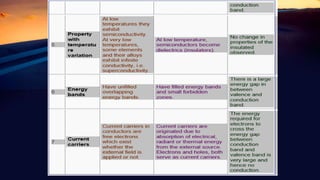
Metals,insulators &  semiconductors

Metals,insulators & semiconductors

  • 1.
    Contact: alamin999bd@gmail.com +8801772773306 AL-AMIN Jatiya Kabi KaziNazrul Islam University Department of Electrical and Electronic Engineering
  • 2.
  • 3.
    Metals(Conductors): • The materialswhich easily allow the flow of electric current through them are called as conductors. Metals such as copper, silver, iron, aluminum etc. are good conductors of electricity.
  • 4.
  • 5.
    Insulators The materials whichdoes not allow the flow of electric current through them are called as insulators. Insulators are also called as poor conductors of electricity.
  • 6.
  • 7.
    Semiconductors The material whichhas electrical conductivity between that of a conductor and an insulator is called as semiconductor. Silicon, germanium and graphite are some examples of semiconductors.
  • 8.
  • 11.
    N-Type Semiconductors  Inaddition to replacing one of the lattice atoms with a Group 3 atom, we can also replace it by an atom with five valence electrons, such as the Group 5 atoms arsenic (As) or phosphorus (P). In this case, the impurity adds five valence electrons to the lattice where it can only hold four. This means that there is now one excess electron in the lattice (see figure below). Because it donates an electron, a Group 5 impurity is called a donor. Note that the material remains electrically neutral.
  • 12.
  • 13.
    Donor impurities donatenegatively charged electrons to the lattice, so a semiconductor that has been doped with a donor is called an n-type semiconductor; "n" stands for negative. Free electrons outnumber holes in an n-type material, so the electrons are the majority carriers and holes are the minority carriers. N-Type Semiconductors
  • 14.
    In a pure(intrinsic) Si or Ge semiconductor, each nucleus uses its four valence electrons to form four covalent bonds with its neighbors (see figure below). Each ionic core, consisting of the nucleus and non-valent electrons, has a net charge of +4, and is surrounded by 4 valence electrons. Since there are no excess electrons or holes In this case, the number of electrons and holes present at any given time will always be equal. P-Type Semiconductors
  • 15.
  • 16.
    Now, if oneof the atoms in the semiconductor lattice is replaced by an element with three valence electrons, such as a Group 3 element like Boron (B) or Gallium (Ga), the electron-hole balance will be changed. This impurity will only be able to contribute three valence electrons to the lattice, therefore leaving one excess hole (see figure below). Since holes will "accept" free electrons, a Group 3 impurity is also called an acceptor. P-Type Semiconductors
  • 18.
    Because an acceptordonates excess holes, which are considered to be positively charged, a semiconductor that has been doped with an acceptor is called a p-type semiconductor; "p" stands for positive. Notice that the material as a whole remains electrically neutral. In a p-type semiconductor, current is largely carried by the holes, which outnumber the free electrons. In this case, the holes are the majority carriers, while the electrons are the minority carriers. P-Type Semiconductors
  • 21.
    Intrinsic Semiconductors: Anintrinsic semiconductor is made up of a very pure semiconductor material i.e. it is the one where the number of holes is equal to the number of electrons in the conduction band Extrinsic semiconductors:Extrinsic semiconductors are those where a small amount of impurity has been added to the basic intrinsic material. The phenomenon of adding an impurity to the material is known as doping.