Presented By:
NIDHI BARANWAL
MCA 3rd SEMESTER
University of Allahabad
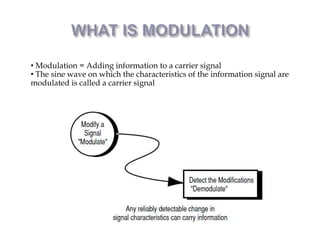
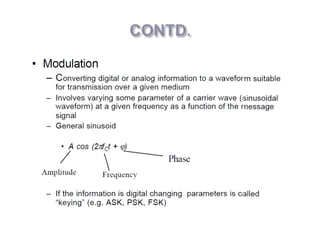
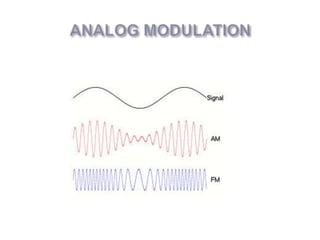
• Modulation = Adding information to a carrier signal
• The sine wave on which the characteristics of the information signal are
modulated is called a carrier signal
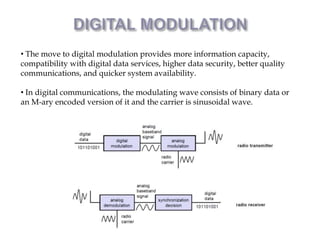
• The move to digital modulation provides more information capacity,
compatibility with digital data services, higher data security, better quality
communications, and quicker system availability.
• In digital communications, the modulating wave consists of binary data or
an M-ary encoded version of it and the carrier is sinusoidal wave.
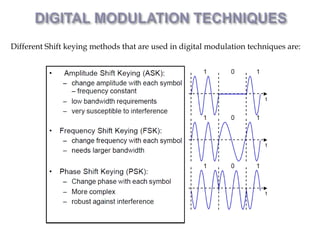
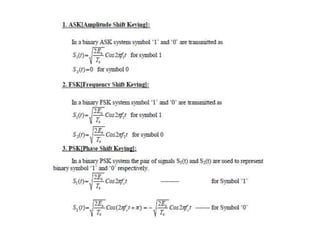
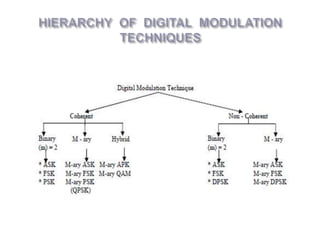
Different Shift keying methods that are used in digital modulation techniques are:
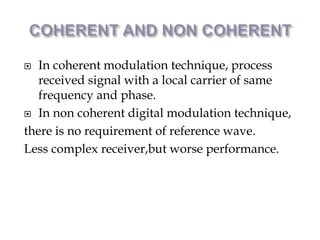
 In coherent modulation technique, process
received signal with a local carrier of same
frequency and phase.
 In non coherent digital modulation technique,
there is no requirement of reference wave.
Less complex receiver,but worse performance.
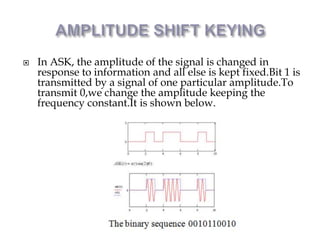
 In ASK, the amplitude of the signal is changed in
response to information and all else is kept fixed.Bit 1 is
transmitted by a signal of one particular amplitude.To
transmit 0,we change the amplitude keeping the
frequency constant.It is shown below.
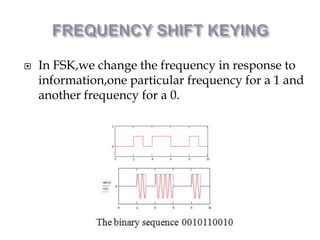
 In FSK,we change the frequency in response to
information,one particular frequency for a 1 and
another frequency for a 0.
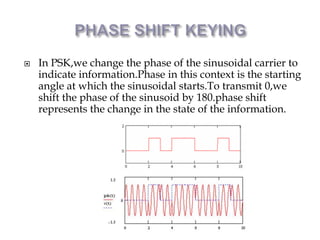
 In PSK,we change the phase of the sinusoidal carrier to
indicate information.Phase in this context is the starting
angle at which the sinusoidal starts.To transmit 0,we
shift the phase of the sinusoid by 180.phase shift
represents the change in the state of the information.
 Quadrature Phase Shift Keying (QPSK) can be
interpreted as two independent BPSK systems
(one on the I-channel and one on Q-channel),
and thus the same performance but twice the
bandwidth (spectrum) efficiency.
 QPSK has twice the bandwidth efficiency of
BPSK since 2 bits are transmitted in a single
modulation symbol
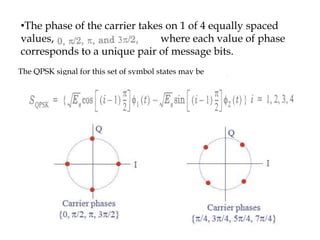
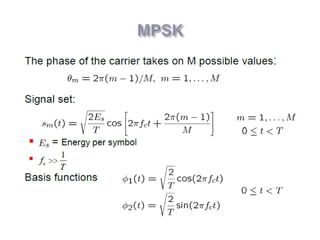
•The phase of the carrier takes on 1 of 4 equally spaced
values, where each value of phase
corresponds to a unique pair of message bits.
The QPSK signal for this set of symbol states may be
 In binary data transmission, send only one of two possible
signals during each bit interval Tb
 In M-ary data transmission, send one of M possible signals
during each signaling interval T
 In almost all applications, M = 2n and T = nTb, where n is an
integer
 Each of the M signals is called a symbol
 These signals are generated by changing the amplitude, phase,
frequency, or combined forms of a carrier in M discrete steps.
 Thus, we have: MASK MPSK MFSK MQAM
 DPSK is a non coherent form of phase shift
keying which avoids the need for a coherent
reference signal at the receiver.
ADVANTAGE:
• Non coherent receivers are easy and cheap to
build, hence widely used in wireless
communications.
• DPSK eliminates the need for a coherent
reference signal at the receiver by combining
two basic operations at the transmitter:
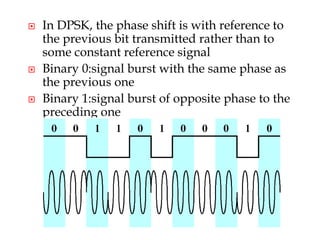
 In DPSK, the phase shift is with reference to
the previous bit transmitted rather than to
some constant reference signal
 Binary 0:signal burst with the same phase as
the previous one
 Binary 1:signal burst of opposite phase to the
preceding one
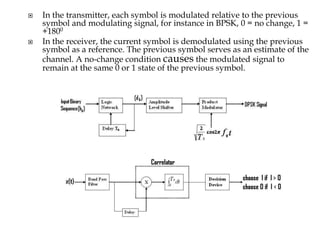
 In the transmitter, each symbol is modulated relative to the previous
symbol and modulating signal, for instance in BPSK, 0 = no change, 1 =
+1800
 In the receiver, the current symbol is demodulated using the previous
symbol as a reference. The previous symbol serves as an estimate of the
channel. A no-change condition causes the modulated signal to
remain at the same 0 or 1 state of the previous symbol.
• Power Efficiency
– Ability of a modulation technique to preserve the fidelity of
the digital message at low power levels
– Designer can increase noise immunity by increasing signal
power
– Power efficiency is a measure of how much signal power
should be increased to achieve a particular BER for a
given
modulation scheme
– Signal energy per bit / noise power spectral density
• Bandwidth Efficiency
– Ability to accomodate data within a limited bandwidth
– Tradeoff between data rate and pulse width
– Thruput data rate per hertz: R/B bps per Hz

Digital modulation technique

  • 1.
    Presented By: NIDHI BARANWAL MCA3rd SEMESTER University of Allahabad
  • 3.
    • Modulation =Adding information to a carrier signal • The sine wave on which the characteristics of the information signal are modulated is called a carrier signal
  • 6.
    • The moveto digital modulation provides more information capacity, compatibility with digital data services, higher data security, better quality communications, and quicker system availability. • In digital communications, the modulating wave consists of binary data or an M-ary encoded version of it and the carrier is sinusoidal wave.
  • 7.
    Different Shift keyingmethods that are used in digital modulation techniques are:
  • 10.
     In coherentmodulation technique, process received signal with a local carrier of same frequency and phase.  In non coherent digital modulation technique, there is no requirement of reference wave. Less complex receiver,but worse performance.
  • 11.
     In ASK,the amplitude of the signal is changed in response to information and all else is kept fixed.Bit 1 is transmitted by a signal of one particular amplitude.To transmit 0,we change the amplitude keeping the frequency constant.It is shown below.
  • 12.
     In FSK,wechange the frequency in response to information,one particular frequency for a 1 and another frequency for a 0.
  • 13.
     In PSK,wechange the phase of the sinusoidal carrier to indicate information.Phase in this context is the starting angle at which the sinusoidal starts.To transmit 0,we shift the phase of the sinusoid by 180.phase shift represents the change in the state of the information.
  • 14.
     Quadrature PhaseShift Keying (QPSK) can be interpreted as two independent BPSK systems (one on the I-channel and one on Q-channel), and thus the same performance but twice the bandwidth (spectrum) efficiency.  QPSK has twice the bandwidth efficiency of BPSK since 2 bits are transmitted in a single modulation symbol
  • 15.
    •The phase ofthe carrier takes on 1 of 4 equally spaced values, where each value of phase corresponds to a unique pair of message bits. The QPSK signal for this set of symbol states may be
  • 16.
     In binarydata transmission, send only one of two possible signals during each bit interval Tb  In M-ary data transmission, send one of M possible signals during each signaling interval T  In almost all applications, M = 2n and T = nTb, where n is an integer  Each of the M signals is called a symbol  These signals are generated by changing the amplitude, phase, frequency, or combined forms of a carrier in M discrete steps.  Thus, we have: MASK MPSK MFSK MQAM
  • 18.
     DPSK isa non coherent form of phase shift keying which avoids the need for a coherent reference signal at the receiver. ADVANTAGE: • Non coherent receivers are easy and cheap to build, hence widely used in wireless communications. • DPSK eliminates the need for a coherent reference signal at the receiver by combining two basic operations at the transmitter:
  • 19.
     In DPSK,the phase shift is with reference to the previous bit transmitted rather than to some constant reference signal  Binary 0:signal burst with the same phase as the previous one  Binary 1:signal burst of opposite phase to the preceding one
  • 20.
     In thetransmitter, each symbol is modulated relative to the previous symbol and modulating signal, for instance in BPSK, 0 = no change, 1 = +1800  In the receiver, the current symbol is demodulated using the previous symbol as a reference. The previous symbol serves as an estimate of the channel. A no-change condition causes the modulated signal to remain at the same 0 or 1 state of the previous symbol.
  • 21.
    • Power Efficiency –Ability of a modulation technique to preserve the fidelity of the digital message at low power levels – Designer can increase noise immunity by increasing signal power – Power efficiency is a measure of how much signal power should be increased to achieve a particular BER for a given modulation scheme – Signal energy per bit / noise power spectral density • Bandwidth Efficiency – Ability to accomodate data within a limited bandwidth – Tradeoff between data rate and pulse width – Thruput data rate per hertz: R/B bps per Hz