SCHRÖDINGER’S ATOMIC
       MODEL
SCHRÖDINGER’S ATOMIC MODEL


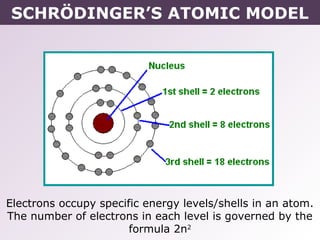
Electrons occupy specific energy levels/shells in an atom.
The number of electrons in each level is governed by the
                       formula 2n2
SCHRÖDINGER’S ATOMIC MODEL
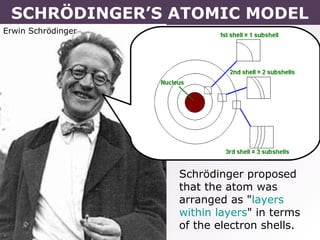
Erwin Schrödinger


                    Schrödinger proposed
                    that the atom was
                    arranged as "layers
                    within layers" in terms
                    of the electron shells.
SCHRÖDINGER’S ATOMIC MODEL
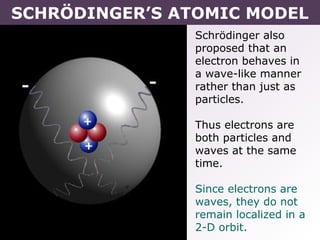
                Schrödinger also
                proposed that an
                electron behaves in
                a wave-like manner
                rather than just as
                particles.

                Thus electrons are
                both particles and
                waves at the same
                time.

                Since electrons are
                waves, they do not
                remain localized in a
                2-D orbit.
SCHRÖDINGER’S ATOMIC MODEL

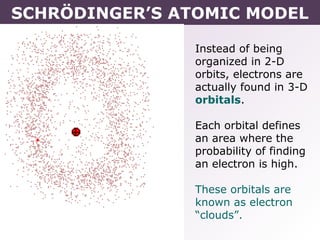
                Instead of being
                organized in 2-D
                orbits, electrons are
                actually found in 3-D
                orbitals.

                Each orbital defines
                an area where the
                probability of finding
                an electron is high.

                These orbitals are
                known as electron
                “clouds”.
SCHRÖDINGER’S ATOMIC MODEL
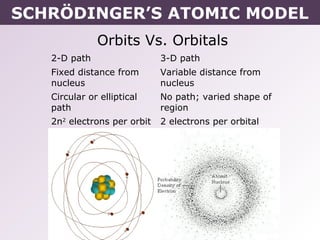
              Orbits Vs. Orbitals
   2-D path                  3-D path
   Fixed distance from       Variable distance from
   nucleus                   nucleus
   Circular or elliptical    No path; varied shape of
   path                      region
   2n2 electrons per orbit   2 electrons per orbital
SCHRÖDINGER’S ATOMIC MODEL
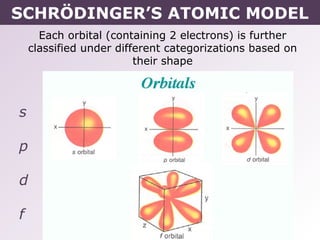
      Each orbital (containing 2 electrons) is further
    classified under different categorizations based on
                         their shape


s

p

d

f
SCHRÖDINGER’S ATOMIC MODEL
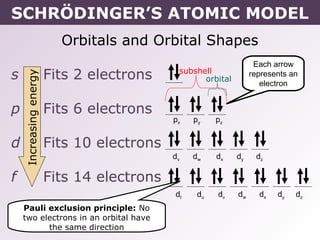
                          Orbitals and Orbital Shapes
                                                                   Each arrow
s                       Fits 2 electrons     subshell
    Increasing energy


                                                                  represents an
                                                   orbital
                                                                     electron


p                       Fits 6 electrons
                                            px   py    pz


d                       Fits 10 electrons
                                            dv   dw    dx    dy    dz

f                       Fits 14 electrons
                                            dt    du   dv    dw     dx   dy   dz
    Pauli exclusion principle: No
    two electrons in an orbital have
          the same direction
SCHRÖDINGER’S ATOMIC MODEL
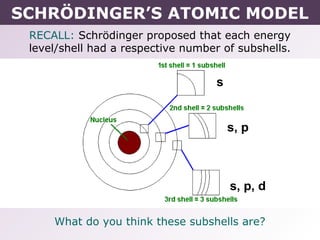
 RECALL: Schrödinger proposed that each energy
 level/shell had a respective number of subshells.


                                    s


                                        s, p


                                        s, p, d

     What do you think these subshells are?
SCHRÖDINGER’S ATOMIC MODEL
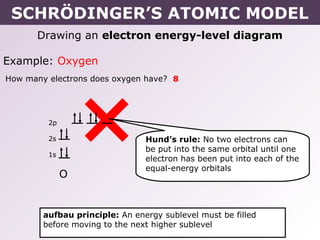
      Drawing an electron energy-level diagram

Example: Oxygen
How many electrons does oxygen have? 8


         2p

         2s                     Hund’s rule: No two electrons can
                                be put into the same orbital until one
         1s
                                electron has been put into each of the
                                equal-energy orbitals
              O


        aufbau principle: An energy sublevel must be filled
        before moving to the next higher sublevel
SCHRÖDINGER’S ATOMIC MODEL
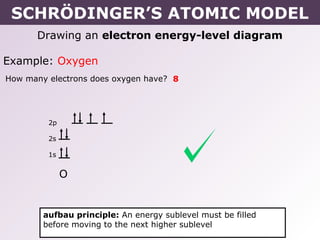
      Drawing an electron energy-level diagram

Example: Oxygen
How many electrons does oxygen have? 8


         2p

         2s

         1s


              O


        aufbau principle: An energy sublevel must be filled
        before moving to the next higher sublevel
SCHRÖDINGER’S ATOMIC MODEL
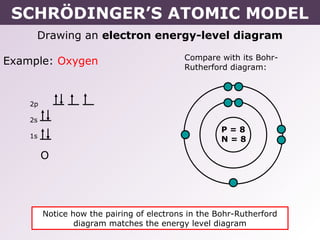
     Drawing an electron energy-level diagram

                                            Compare with its Bohr-
Example: Oxygen                             Rutherford diagram:


    2p

    2s
                                                     P=8
    1s
                                                     N=8

         O


         Notice how the pairing of electrons in the Bohr-Rutherford
                 diagram matches the energy level diagram
SCHRÖDINGER’S ATOMIC MODEL
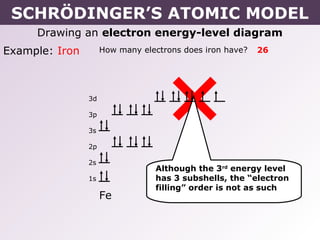
     Drawing an electron energy-level diagram
Example: Iron        How many electrons does iron have?   26


                3d

                3p

                3s

                2p

                2s
                                 Although the 3rd energy level
                1s               has 3 subshells, the “electron
                                 filling” order is not as such
                     Fe
SCHRÖDINGER’S ATOMIC MODEL
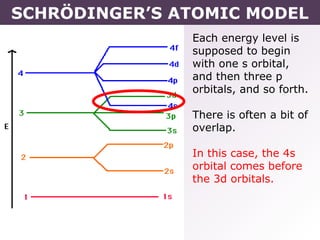
               Each energy level is
               supposed to begin
               with one s orbital,
               and then three p
               orbitals, and so forth.

               There is often a bit of
               overlap.

               In this case, the 4s
               orbital comes before
               the 3d orbitals.
SCHRÖDINGER’S ATOMIC MODEL


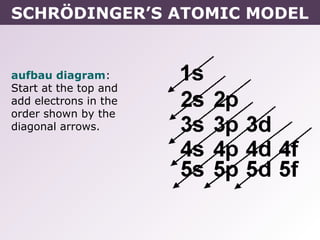
aufbau diagram:
Start at the top and
add electrons in the
order shown by the
diagonal arrows.
SCHRÖDINGER’S ATOMIC MODEL
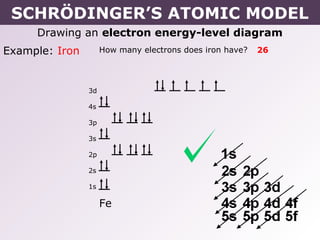
     Drawing an electron energy-level diagram
Example: Iron        How many electrons does iron have?   26


                3d

                4s

                3p

                3s

                2p

                2s

                1s

                     Fe
SCHRÖDINGER’S ATOMIC MODEL
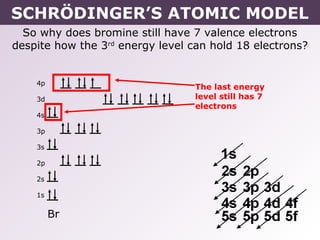
  So why does bromine still have 7 valence electrons
despite how the 3rd energy level can hold 18 electrons?


    4p
                                  The last energy
    3d                            level still has 7
                                  electrons
    4s

    3p

    3s

    2p

    2s

    1s


         Br
SCHRÖDINGER’S ATOMIC MODEL
     Drawing an electron energy-level diagram
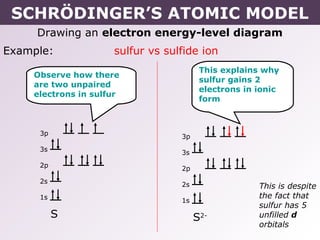
Example:             sulfur vs sulfide ion
                                        This explains why
    Observe how there
                                        sulfur gains 2
    are two unpaired
                                        electrons in ionic
    electrons in sulfur
                                        form


     3p                           3p
     3s                           3s
     2p                           2p
     2s                           2s                 This is despite
     1s                                              the fact that
                                  1s
                                                     sulfur has 5
          S                            S2-           unfilled d
                                                     orbitals
SCHRÖDINGER’S ATOMIC MODEL
          Drawing an electron energy-level diagram
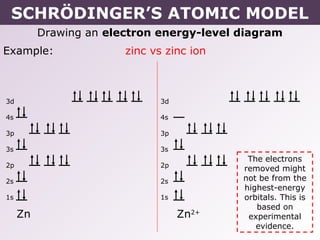
Example:                zinc vs zinc ion


3d                            3d

4s                            4s

3p                            3p

3s                            3s
                                            The electrons
2p                            2p
                                           removed might
2s                            2s           not be from the
                                           highest-energy
1s                            1s           orbitals. This is
                                              based on
     Zn                            Zn2+     experimental
                                              evidence.
SCHRÖDINGER’S ATOMIC MODEL
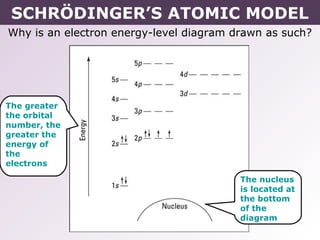
Why is an electron energy-level diagram drawn as such?


The greater
the orbital
number, the
greater the
energy of
the
electrons

                                         The nucleus
                                         is located at
                                         the bottom
                                         of the
                                         diagram
SCHRÖDINGER’S ATOMIC MODEL
                Writing Electron Configurations

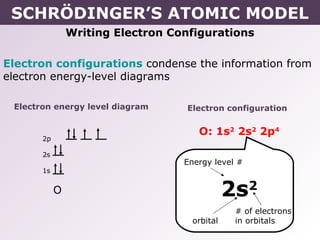
Electron configurations condense the information from
electron energy-level diagrams

 Electron energy level diagram      Electron configuration


                                      O: 1s2 2s2 2p4
       2p

       2s
                                   Energy level #
       1s


            O                                  2s   2
                                                # of electrons
                                     orbital    in orbitals
SCHRÖDINGER’S ATOMIC MODEL
          Writing Electron Configurations

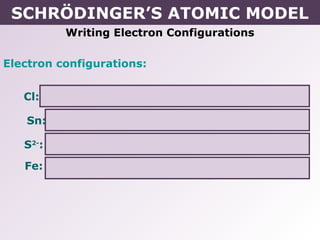
Electron configurations:


   Cl: 1s2 2s2 2p6 3s2 3p5

   Sn: 1s2 2s2 2p6 3s2 3p6 4s2 3d10 4p6 5s2 4d10 5p2

   S2-: 1s2 2s2 2p6 3s2 3p6

   Fe: 1s2 2s2 2p6 3s2 3p6 4s2 3d6
SCHRÖDINGER’S ATOMIC MODEL
             Writing Electron Configurations

Shorthand form of Electron configurations:
  Same configuration as Neon

   Cl: 1s2 2s2 2p6 3s2 3p5

   Cl: [Ne] 3s2 3p5

               Same configuration as krypton

    Sn: 1s2 2s2 2p6 3s2 3p6 4s2 3d10 4p6 5s2 4d10 5p2

   Sn: [Kr] 5s2 4d10 5p2

 In the shorthand version, the “core electrons” of an
 atom are represented by the preceding noble gas
SCHRÖDINGER’S ATOMIC MODEL
         Writing Electron Configurations

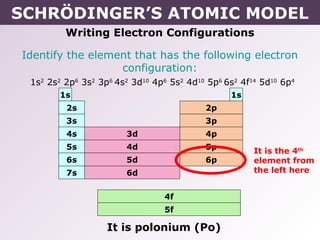
Identify the element that has the following electron
                  configuration:
 1s2 2s2 2p6 3s2 3p6 4s2 3d10 4p6 5s2 4d10 5p6 6s2 4f14 5d10 6p4
        1s                                      1s
         2s                               2p
         3s                               3p
         4s            3d                 4p
         5s            4d                 5p          It is the 4th
         6s            5d                 6p          element from
         7s            6d                             the left here


                                 4f
                                 5f

                   It is polonium (Po)
SCHRÖDINGER’S ATOMIC MODEL
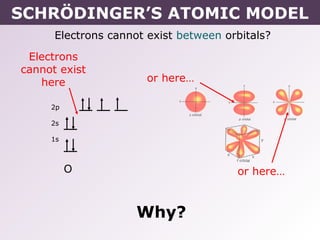
      Electrons cannot exist between orbitals?

 Electrons
cannot exist
   here                or here…

     2p

     2s

     1s


          O                            or here…


                     Why?
SCHRÖDINGER’S ATOMIC MODEL
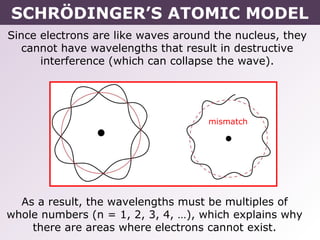
Since electrons are like waves around the nucleus, they
   cannot have wavelengths that result in destructive
      interference (which can collapse the wave).


                                    mismatch


  As a result, the wavelengths must be multiples of
whole numbers (n = 1, 2, 3, 4, …), which explains why
    there are areas where electrons cannot exist.
SCHRÖDINGER’S ATOMIC MODEL
 This causes electrons to be confined to certain
        probabilities around the nucleus.
Tang 02 schrödinger’s atomic model

  • 1.
  • 2.
    SCHRÖDINGER’S ATOMIC MODEL Electronsoccupy specific energy levels/shells in an atom. The number of electrons in each level is governed by the formula 2n2
  • 3.
    SCHRÖDINGER’S ATOMIC MODEL ErwinSchrödinger Schrödinger proposed that the atom was arranged as "layers within layers" in terms of the electron shells.
  • 4.
    SCHRÖDINGER’S ATOMIC MODEL Schrödinger also proposed that an electron behaves in a wave-like manner rather than just as particles. Thus electrons are both particles and waves at the same time. Since electrons are waves, they do not remain localized in a 2-D orbit.
  • 5.
    SCHRÖDINGER’S ATOMIC MODEL Instead of being organized in 2-D orbits, electrons are actually found in 3-D orbitals. Each orbital defines an area where the probability of finding an electron is high. These orbitals are known as electron “clouds”.
  • 6.
    SCHRÖDINGER’S ATOMIC MODEL Orbits Vs. Orbitals 2-D path 3-D path Fixed distance from Variable distance from nucleus nucleus Circular or elliptical No path; varied shape of path region 2n2 electrons per orbit 2 electrons per orbital
  • 7.
    SCHRÖDINGER’S ATOMIC MODEL Each orbital (containing 2 electrons) is further classified under different categorizations based on their shape s p d f
  • 8.
    SCHRÖDINGER’S ATOMIC MODEL Orbitals and Orbital Shapes Each arrow s Fits 2 electrons subshell Increasing energy represents an orbital electron p Fits 6 electrons px py pz d Fits 10 electrons dv dw dx dy dz f Fits 14 electrons dt du dv dw dx dy dz Pauli exclusion principle: No two electrons in an orbital have the same direction
  • 9.
    SCHRÖDINGER’S ATOMIC MODEL RECALL: Schrödinger proposed that each energy level/shell had a respective number of subshells. s s, p s, p, d What do you think these subshells are?
  • 10.
    SCHRÖDINGER’S ATOMIC MODEL Drawing an electron energy-level diagram Example: Oxygen How many electrons does oxygen have? 8 2p 2s Hund’s rule: No two electrons can be put into the same orbital until one 1s electron has been put into each of the equal-energy orbitals O aufbau principle: An energy sublevel must be filled before moving to the next higher sublevel
  • 11.
    SCHRÖDINGER’S ATOMIC MODEL Drawing an electron energy-level diagram Example: Oxygen How many electrons does oxygen have? 8 2p 2s 1s O aufbau principle: An energy sublevel must be filled before moving to the next higher sublevel
  • 12.
    SCHRÖDINGER’S ATOMIC MODEL Drawing an electron energy-level diagram Compare with its Bohr- Example: Oxygen Rutherford diagram: 2p 2s P=8 1s N=8 O Notice how the pairing of electrons in the Bohr-Rutherford diagram matches the energy level diagram
  • 13.
    SCHRÖDINGER’S ATOMIC MODEL Drawing an electron energy-level diagram Example: Iron How many electrons does iron have? 26 3d 3p 3s 2p 2s Although the 3rd energy level 1s has 3 subshells, the “electron filling” order is not as such Fe
  • 14.
    SCHRÖDINGER’S ATOMIC MODEL Each energy level is supposed to begin with one s orbital, and then three p orbitals, and so forth. There is often a bit of overlap. In this case, the 4s orbital comes before the 3d orbitals.
  • 15.
    SCHRÖDINGER’S ATOMIC MODEL aufbaudiagram: Start at the top and add electrons in the order shown by the diagonal arrows.
  • 16.
    SCHRÖDINGER’S ATOMIC MODEL Drawing an electron energy-level diagram Example: Iron How many electrons does iron have? 26 3d 4s 3p 3s 2p 2s 1s Fe
  • 17.
    SCHRÖDINGER’S ATOMIC MODEL So why does bromine still have 7 valence electrons despite how the 3rd energy level can hold 18 electrons? 4p The last energy 3d level still has 7 electrons 4s 3p 3s 2p 2s 1s Br
  • 18.
    SCHRÖDINGER’S ATOMIC MODEL Drawing an electron energy-level diagram Example: sulfur vs sulfide ion This explains why Observe how there sulfur gains 2 are two unpaired electrons in ionic electrons in sulfur form 3p 3p 3s 3s 2p 2p 2s 2s This is despite 1s the fact that 1s sulfur has 5 S S2- unfilled d orbitals
  • 19.
    SCHRÖDINGER’S ATOMIC MODEL Drawing an electron energy-level diagram Example: zinc vs zinc ion 3d 3d 4s 4s 3p 3p 3s 3s The electrons 2p 2p removed might 2s 2s not be from the highest-energy 1s 1s orbitals. This is based on Zn Zn2+ experimental evidence.
  • 20.
    SCHRÖDINGER’S ATOMIC MODEL Whyis an electron energy-level diagram drawn as such? The greater the orbital number, the greater the energy of the electrons The nucleus is located at the bottom of the diagram
  • 21.
    SCHRÖDINGER’S ATOMIC MODEL Writing Electron Configurations Electron configurations condense the information from electron energy-level diagrams Electron energy level diagram Electron configuration O: 1s2 2s2 2p4 2p 2s Energy level # 1s O 2s 2 # of electrons orbital in orbitals
  • 22.
    SCHRÖDINGER’S ATOMIC MODEL Writing Electron Configurations Electron configurations: Cl: 1s2 2s2 2p6 3s2 3p5 Sn: 1s2 2s2 2p6 3s2 3p6 4s2 3d10 4p6 5s2 4d10 5p2 S2-: 1s2 2s2 2p6 3s2 3p6 Fe: 1s2 2s2 2p6 3s2 3p6 4s2 3d6
  • 23.
    SCHRÖDINGER’S ATOMIC MODEL Writing Electron Configurations Shorthand form of Electron configurations: Same configuration as Neon Cl: 1s2 2s2 2p6 3s2 3p5 Cl: [Ne] 3s2 3p5 Same configuration as krypton Sn: 1s2 2s2 2p6 3s2 3p6 4s2 3d10 4p6 5s2 4d10 5p2 Sn: [Kr] 5s2 4d10 5p2 In the shorthand version, the “core electrons” of an atom are represented by the preceding noble gas
  • 24.
    SCHRÖDINGER’S ATOMIC MODEL Writing Electron Configurations Identify the element that has the following electron configuration: 1s2 2s2 2p6 3s2 3p6 4s2 3d10 4p6 5s2 4d10 5p6 6s2 4f14 5d10 6p4 1s 1s 2s 2p 3s 3p 4s 3d 4p 5s 4d 5p It is the 4th 6s 5d 6p element from 7s 6d the left here 4f 5f It is polonium (Po)
  • 25.
    SCHRÖDINGER’S ATOMIC MODEL Electrons cannot exist between orbitals? Electrons cannot exist here or here… 2p 2s 1s O or here… Why?
  • 26.
    SCHRÖDINGER’S ATOMIC MODEL Sinceelectrons are like waves around the nucleus, they cannot have wavelengths that result in destructive interference (which can collapse the wave). mismatch As a result, the wavelengths must be multiples of whole numbers (n = 1, 2, 3, 4, …), which explains why there are areas where electrons cannot exist.
  • 27.
    SCHRÖDINGER’S ATOMIC MODEL This causes electrons to be confined to certain probabilities around the nucleus.
Editor's Notes

  • #5 http://www.youtube.com/watch?v=DfPeprQ7oGc