Quantum Theory and the nature of the atom Lisa Allen Stonington High School
Waves: basic math C= speed of light  distance / time = 3.0 x 10 8  m/s    = wavelength or distance /wave That wavelength can be expressed in  any  unit, but to work with c, it must be in meters! V = frequency or Hertz, or waves/sec or just sec-1.  In physics, they use f instead. (This is another way to write 1/sec)
Overview So c=  v tells us that Distance =  distance   x  waves  Second   wave   second c =   x  v OR Speed  =  distance/time
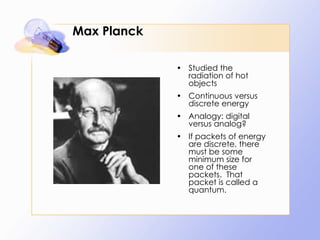
Max Planck Studied the radiation of hot objects Continuous versus discrete energy Analogy: digital versus analog? If packets of energy are discrete, there must be some minimum size for one of these packets.  That packet is called a quantum.
Quantum Leap, and other dumb misuses of the term in pop culture... If a quantum is the smallest possible size for a packet of energy, it must be small, right?  So why is a “Quantum Leap” huge? The term “Quantum physics” or “quantum mechanics” refers to the mathematical consequences of a quantized view of energy, and the specific math of the intensely tiny insides of atoms. The regular laws of physics don’t work very well on this tiny scale.  We will discuss why, but will not take on the killer math. (you’re welcome!)
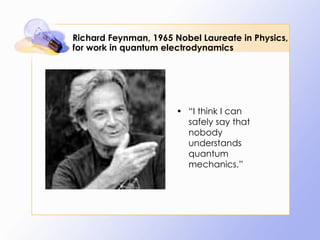
Richard Feynman, 1965 Nobel Laureate in Physics, for work in quantum electrodynamics “ I think I can safely say that nobody understands quantum mechanics.”
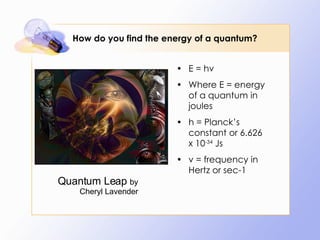
How do you find the energy of a quantum? E = hv Where E = energy of a quantum in joules h = Planck’s constant or 6.626 x 10 -34  Js v = frequency in Hertz or sec-1  Quantum Leap  by Cheryl Lavender
Try a few of these problems What is the wavelength of light with a frequency of 8 x 10 14  Hz? What color is that light? What is the frequency of red light? What is the energy of a quantum of green light? What color light has a quantum size of 4.97 x 10 -19  joules?
The Photoelectric Effect Blue light shines on metal, electrons come off.  Even a little blue light will do this. Red light shines on metal, nothing happens.  Line up a dozen red lights, still nothing. This undermines the wavelength theory.  Why?
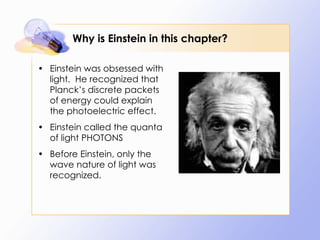
Why is Einstein in this chapter? Einstein was obsessed with light.  He recognized that Planck’s discrete packets of energy could explain the photoelectric effect. Einstein called the quanta of light PHOTONS Before Einstein, only the wave nature of light was recognized.
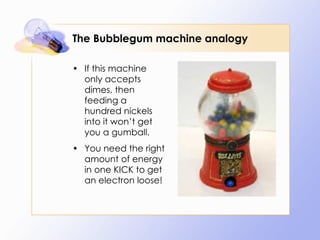
The Bubblegum machine analogy If this machine only accepts dimes, then feeding a hundred nickels into it won’t get you a gumball. You need the right amount of energy in one KICK to get an electron loose!
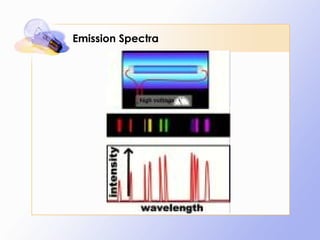
Emission Spectra
Demonstration Materials: Spectroscopes, exciter, gas tubes Compare sunlight through spectroscope with “naked eye” light Compare fluorescent light through spectroscope with sunlight through spectroscope Observe hydrogen gas tube with spectroscopes How does sunlight differ from hydrogen’s emission spectrum?
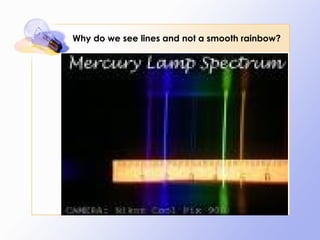
Why do we see lines and not a smooth rainbow?
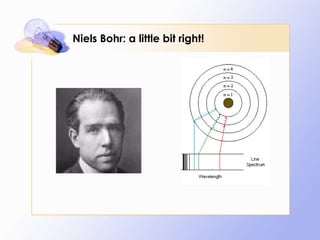
Niels Bohr: a little bit right!
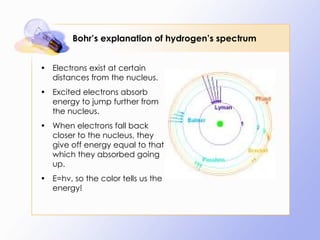
Bohr’s explanation of hydrogen’s spectrum Electrons exist at certain distances from the nucleus. Excited electrons absorb energy to jump further from the nucleus. When electrons fall back closer to the nucleus, they give off energy equal to that which they absorbed going up. E=hv, so the color tells us the energy!
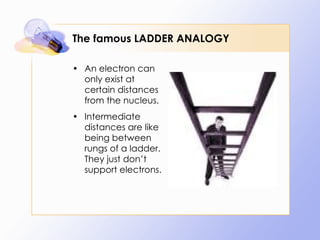
The famous LADDER ANALOGY An electron can only exist at certain distances from the nucleus. Intermediate distances are like being between rungs of a ladder.  They just don’t support electrons.
Why isn’t Bohr the final word on the subject? Atoms other than hydrogen have more than one electron.  Their spectra are more complicated. Some atoms have electrons whose ground state isn’t the first possible energy level. The chemical behavior of atoms didn’t substantiate this view completely
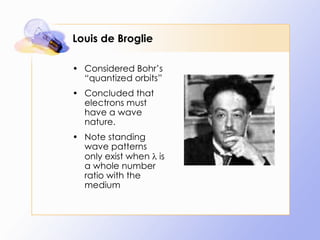
Louis de Broglie Considered Bohr’s “quantized orbits” Concluded that electrons must have a wave nature. Note standing wave patterns only exist when   is a whole number ratio with the medium
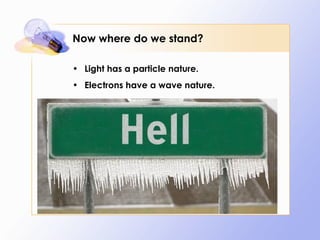
Now where do we stand? Light has a particle nature. Electrons have a wave nature.
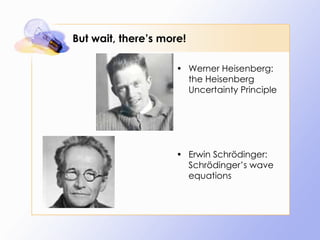
But wait, there’s more! Werner Heisenberg: the Heisenberg Uncertainty Principle Erwin Schrödinger: Schrödinger’s wave equations
The Dumb Heisenberg Joke... A cop stopped Heisenberg for speeding.  Heisenberg rolled down the window.  The cop asked him, “Do you know how fast you were going?” Heisenberg answered, “No, but I know where I am!”
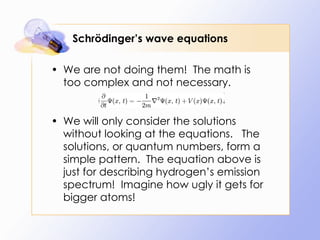
Schrödinger’s wave equations We are not doing them!  The math is too complex and not necessary. We will only consider the solutions without looking at the equations.  The solutions, or quantum numbers, form a simple pattern.  The equation above is just for describing hydrogen’s emission spectrum!  Imagine how ugly it gets for bigger atoms!

Quantum Theory

  • 1.
    Quantum Theory andthe nature of the atom Lisa Allen Stonington High School
  • 2.
    Waves: basic mathC= speed of light distance / time = 3.0 x 10 8 m/s  = wavelength or distance /wave That wavelength can be expressed in any unit, but to work with c, it must be in meters! V = frequency or Hertz, or waves/sec or just sec-1. In physics, they use f instead. (This is another way to write 1/sec)
  • 3.
    Overview So c= v tells us that Distance = distance x waves Second wave second c =  x v OR Speed = distance/time
  • 4.
    Max Planck Studiedthe radiation of hot objects Continuous versus discrete energy Analogy: digital versus analog? If packets of energy are discrete, there must be some minimum size for one of these packets. That packet is called a quantum.
  • 5.
    Quantum Leap, andother dumb misuses of the term in pop culture... If a quantum is the smallest possible size for a packet of energy, it must be small, right? So why is a “Quantum Leap” huge? The term “Quantum physics” or “quantum mechanics” refers to the mathematical consequences of a quantized view of energy, and the specific math of the intensely tiny insides of atoms. The regular laws of physics don’t work very well on this tiny scale. We will discuss why, but will not take on the killer math. (you’re welcome!)
  • 6.
    Richard Feynman, 1965Nobel Laureate in Physics, for work in quantum electrodynamics “ I think I can safely say that nobody understands quantum mechanics.”
  • 7.
    How do youfind the energy of a quantum? E = hv Where E = energy of a quantum in joules h = Planck’s constant or 6.626 x 10 -34 Js v = frequency in Hertz or sec-1 Quantum Leap by Cheryl Lavender
  • 8.
    Try a fewof these problems What is the wavelength of light with a frequency of 8 x 10 14 Hz? What color is that light? What is the frequency of red light? What is the energy of a quantum of green light? What color light has a quantum size of 4.97 x 10 -19 joules?
  • 9.
    The Photoelectric EffectBlue light shines on metal, electrons come off. Even a little blue light will do this. Red light shines on metal, nothing happens. Line up a dozen red lights, still nothing. This undermines the wavelength theory. Why?
  • 10.
    Why is Einsteinin this chapter? Einstein was obsessed with light. He recognized that Planck’s discrete packets of energy could explain the photoelectric effect. Einstein called the quanta of light PHOTONS Before Einstein, only the wave nature of light was recognized.
  • 11.
    The Bubblegum machineanalogy If this machine only accepts dimes, then feeding a hundred nickels into it won’t get you a gumball. You need the right amount of energy in one KICK to get an electron loose!
  • 12.
  • 13.
    Demonstration Materials: Spectroscopes,exciter, gas tubes Compare sunlight through spectroscope with “naked eye” light Compare fluorescent light through spectroscope with sunlight through spectroscope Observe hydrogen gas tube with spectroscopes How does sunlight differ from hydrogen’s emission spectrum?
  • 14.
    Why do wesee lines and not a smooth rainbow?
  • 15.
    Niels Bohr: alittle bit right!
  • 16.
    Bohr’s explanation ofhydrogen’s spectrum Electrons exist at certain distances from the nucleus. Excited electrons absorb energy to jump further from the nucleus. When electrons fall back closer to the nucleus, they give off energy equal to that which they absorbed going up. E=hv, so the color tells us the energy!
  • 17.
    The famous LADDERANALOGY An electron can only exist at certain distances from the nucleus. Intermediate distances are like being between rungs of a ladder. They just don’t support electrons.
  • 18.
    Why isn’t Bohrthe final word on the subject? Atoms other than hydrogen have more than one electron. Their spectra are more complicated. Some atoms have electrons whose ground state isn’t the first possible energy level. The chemical behavior of atoms didn’t substantiate this view completely
  • 19.
    Louis de BroglieConsidered Bohr’s “quantized orbits” Concluded that electrons must have a wave nature. Note standing wave patterns only exist when  is a whole number ratio with the medium
  • 20.
    Now where dowe stand? Light has a particle nature. Electrons have a wave nature.
  • 21.
    But wait, there’smore! Werner Heisenberg: the Heisenberg Uncertainty Principle Erwin Schrödinger: Schrödinger’s wave equations
  • 22.
    The Dumb HeisenbergJoke... A cop stopped Heisenberg for speeding. Heisenberg rolled down the window. The cop asked him, “Do you know how fast you were going?” Heisenberg answered, “No, but I know where I am!”
  • 23.
    Schrödinger’s wave equationsWe are not doing them! The math is too complex and not necessary. We will only consider the solutions without looking at the equations. The solutions, or quantum numbers, form a simple pattern. The equation above is just for describing hydrogen’s emission spectrum! Imagine how ugly it gets for bigger atoms!