Chapter 4 Electrons in Atoms
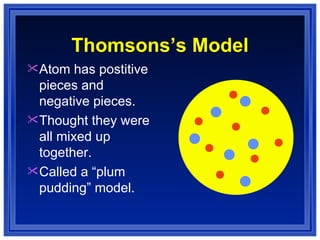
Thomsons’s Model Atom has postitive pieces and negative pieces. Thought they were all mixed up together. Called a “plum pudding” model.
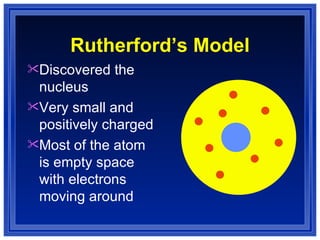
Rutherford’s Model Discovered the nucleus  Small dense and positive  Electrons moved around in Electron cloud Rutherford’s Model Discovered the nucleus  Very small and positively charged  Most of the atom is empty space with electrons moving around
Bohr’s Model 2, 8, 8, …thing Electrons are in “rings” or energy levels. Energy separates one level from another. Electrons can never be found in between two levels.
More details about energy levels.  All orbits are not sphere-shaped.  It can only tell us the probability of finding an electron a certain distance from the nucleus. The Modern Model  (the Quantum Mechanical Model)
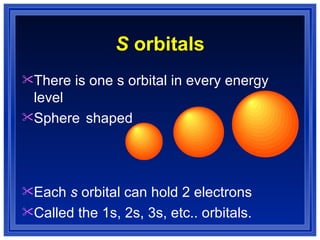
There is one s orbital in every energy level  Sphere shaped Each  s  orbital can hold 2 electrons  Called the 1s, 2s, 3s, etc.. orbitals. S  orbitals
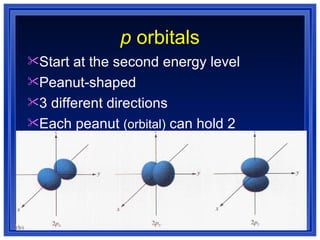
p  orbitals Start at the second energy level  Peanut-shaped  3 different directions  Each peanut  (orbital)  can hold 2 electrons
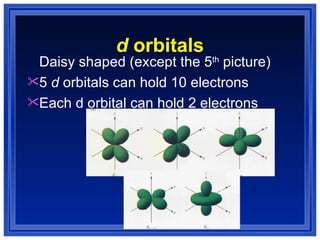
d  orbitals Daisy shaped (except the 5 th  picture) 5  d  orbitals can hold 10 electrons Each d orbital can hold 2 electrons
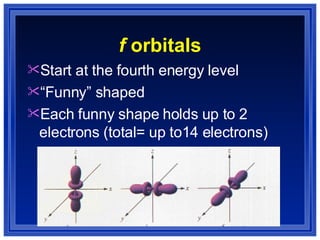
f  orbitals Start at the fourth energy level  “ Funny” shaped Each funny shape holds up to 2 electrons (total= up to14 electrons)
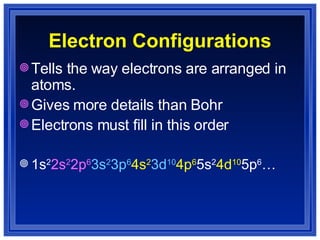
Electron Configurations Tells the way electrons are arranged in atoms.  Gives more details than Bohr Electrons must fill in this order 1s 2 2s 2 2p 6 3s 2 3p 6 4s 2 3d 10 4p 6 5s 2 4d 10 5p 6 …
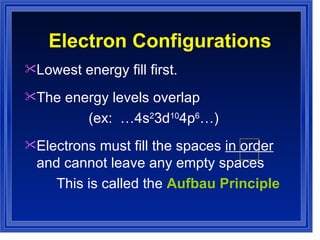
Electron Configurations Lowest energy fill first.  The energy levels overlap  (ex:  …4s 2 3d 10 4p 6 …) Electrons must fill the spaces  in order  and cannot leave any empty spaces This is called the  Aufbau Principle
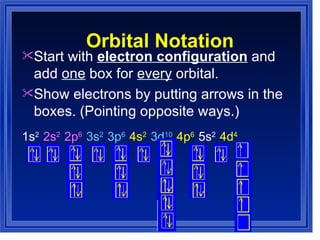
Orbital Notation Start with  electron configuration  and add  one  box for  every  orbital. Show electrons by putting arrows in the boxes. (Pointing opposite ways.) 1s 2  2s 2  2p 6  3s 2  3p 6  4s 2  3d 10  4p 6  5s 2  4d 4
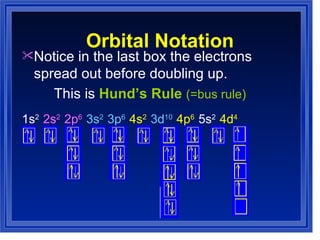
Orbital Notation Notice in the last box the electrons spread out before doubling up. This is  Hund’s Rule   (=bus rule) 1s 2  2s 2  2p 6  3s 2  3p 6  4s 2  3d 10  4p 6  5s 2  4d 4
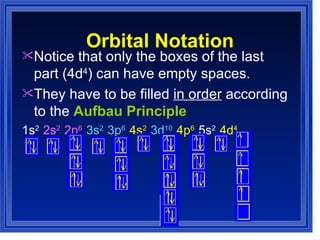
Orbital Notation Notice that only the boxes of the last part (4d 4 ) can have empty spaces. They have to be filled  in order  according to the  Aufbau Principle 1s 2  2s 2  2p 6  3s 2  3p 6  4s 2  3d 10  4p 6  5s 2  4d 4
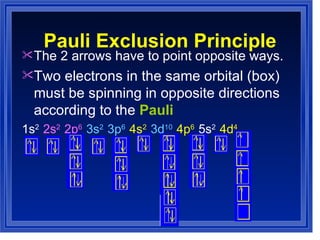
Pauli Exclusion Principle The 2 arrows have to point opposite ways. Two electrons in the same orbital (box) must be spinning in opposite directions according to the  Pauli 1s 2  2s 2  2p 6  3s 2  3p 6  4s 2  3d 10  4p 6  5s 2  4d 4

Chapter4 Powerpoint

  • 1.
  • 2.
    Thomsons’s Model Atomhas postitive pieces and negative pieces. Thought they were all mixed up together. Called a “plum pudding” model.
  • 3.
    Rutherford’s Model Discoveredthe nucleus Small dense and positive Electrons moved around in Electron cloud Rutherford’s Model Discovered the nucleus Very small and positively charged Most of the atom is empty space with electrons moving around
  • 4.
    Bohr’s Model 2,8, 8, …thing Electrons are in “rings” or energy levels. Energy separates one level from another. Electrons can never be found in between two levels.
  • 5.
    More details aboutenergy levels. All orbits are not sphere-shaped. It can only tell us the probability of finding an electron a certain distance from the nucleus. The Modern Model (the Quantum Mechanical Model)
  • 6.
    There is ones orbital in every energy level Sphere shaped Each s orbital can hold 2 electrons Called the 1s, 2s, 3s, etc.. orbitals. S orbitals
  • 7.
    p orbitalsStart at the second energy level Peanut-shaped 3 different directions Each peanut (orbital) can hold 2 electrons
  • 8.
    d orbitalsDaisy shaped (except the 5 th picture) 5 d orbitals can hold 10 electrons Each d orbital can hold 2 electrons
  • 9.
    f orbitalsStart at the fourth energy level “ Funny” shaped Each funny shape holds up to 2 electrons (total= up to14 electrons)
  • 10.
    Electron Configurations Tellsthe way electrons are arranged in atoms. Gives more details than Bohr Electrons must fill in this order 1s 2 2s 2 2p 6 3s 2 3p 6 4s 2 3d 10 4p 6 5s 2 4d 10 5p 6 …
  • 11.
    Electron Configurations Lowestenergy fill first. The energy levels overlap (ex: …4s 2 3d 10 4p 6 …) Electrons must fill the spaces in order and cannot leave any empty spaces This is called the Aufbau Principle
  • 12.
    Orbital Notation Startwith electron configuration and add one box for every orbital. Show electrons by putting arrows in the boxes. (Pointing opposite ways.) 1s 2 2s 2 2p 6 3s 2 3p 6 4s 2 3d 10 4p 6 5s 2 4d 4
  • 13.
    Orbital Notation Noticein the last box the electrons spread out before doubling up. This is Hund’s Rule (=bus rule) 1s 2 2s 2 2p 6 3s 2 3p 6 4s 2 3d 10 4p 6 5s 2 4d 4
  • 14.
    Orbital Notation Noticethat only the boxes of the last part (4d 4 ) can have empty spaces. They have to be filled in order according to the Aufbau Principle 1s 2 2s 2 2p 6 3s 2 3p 6 4s 2 3d 10 4p 6 5s 2 4d 4
  • 15.
    Pauli Exclusion PrincipleThe 2 arrows have to point opposite ways. Two electrons in the same orbital (box) must be spinning in opposite directions according to the Pauli 1s 2 2s 2 2p 6 3s 2 3p 6 4s 2 3d 10 4p 6 5s 2 4d 4