ATOMIC THEORYBY: Chesca Alba, Celine Bengzon, Rea Del Rio, Aitana Morales and Paula Santos
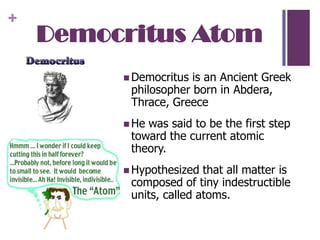
Democritus AtomDemocritus is an Ancient Greek philosopher born in Abdera, Thrace, GreeceHe was said to be the first step toward the current atomic theory.Hypothesized that all matter is composed of tiny indestructible units, called atoms.
His atomic theory contradicted the idea that matter can be infinitely divided.According to him, atoms cannot be divided forever.  In the long run, the object will become so small and invisible that you cannot divide it any further.He said that these indivisible invisible particles are ATOMS. The word atom means not to be cut or indivisible.
TAKE NOTE!He DID NOT MAKE THE ATOMIC THEORY. He just EXPANDED it. He learned this from the founder of the atomic theory, Leucippus.
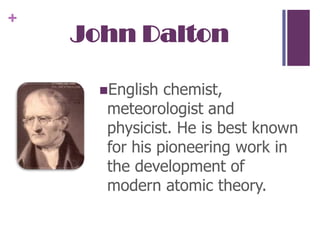
John Dalton English chemist, meteorologist and physicist. He is best known for his pioneering work in the development of modern atomic theory.
Dalton’s atomic theory stated that elements consisted of tiny particles called atoms. He said that the reason an element is pure is because all atoms of an element were identical and that in particular they had the same mass. He also said that the reason elements differed from one another was that atoms of each element were different from one another; in particular, they had different masses. He also said that compounds consisted of atoms of different elements combined together.
5 POINTS of Dalton’s TheoryAll matter consists of tiny particles called atoms. These are indivisible and indestructible.All atoms of a given element are identical in mass and properties.The atoms of a given element are different from those of any other element; the atoms of different elements can be distinguished from one another by their respective relative atomic weights.
Compounds are formed by a combination of two or more different kinds of atoms.Compounds are pure substances. They can’t be separated into elements by phase changes because the atoms of different elements are bonded to one another and are not easily separated from one another.A chemical reaction results to rearrangement of atoms.
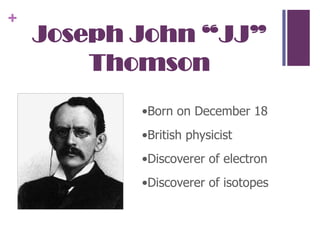
Joseph John “JJ” Thomson•Born on December 18•British physicist•Discoverer of electron•Discoverer of isotopes
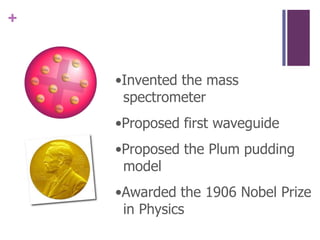
•Invented the mass spectrometer•Proposed first waveguide•Proposed the Plum pudding model•Awarded the 1906 Nobel Prize in Physics
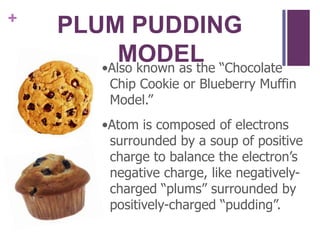
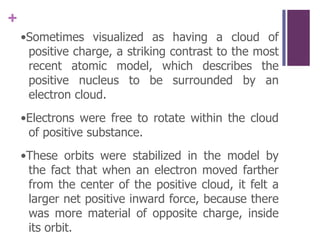
PLUM PUDDING      	MODEL•Also known as the “Chocolate Chip Cookie or Blueberry Muffin Model.”•Atom is composed of electrons surrounded by a soup of positive charge to balance the electron’s negative charge, like negatively-charged “plums” surrounded by positively-charged “pudding”.
•Sometimes visualized as having a cloud of positive charge, a striking contrast to the most recent atomic model, which describes the positive nucleus to be surrounded by an electron cloud.•Electrons were free to rotate within the cloud of positive substance.•These orbits were stabilized in the model by the fact that when an electron moved farther from the center of the positive cloud, it felt a larger net positive inward force, because there was more material of opposite charge, inside its orbit.
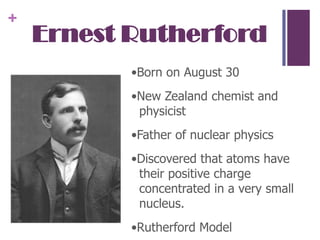
Ernest Rutherford•Born on August 30•New Zealand chemist and physicist •Father of nuclear physics•Discovered that atoms have their positive charge concentrated in a very small nucleus.•Rutherford Model
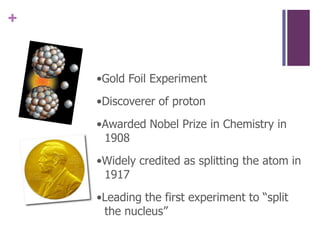
•Gold Foil Experiment•Discoverer of proton•Awarded Nobel Prize in Chemistry in 1908•Widely credited as splitting the atom in 1917•Leading the first experiment to “split the nucleus”
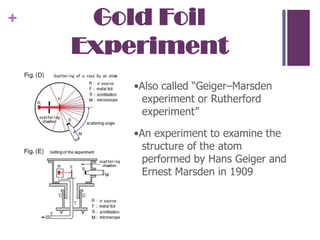
Gold Foil Experiment•Also called “Geiger–Marsden experiment or Rutherford experiment”•An experiment to examine the structure of the atom performed by Hans Geiger and Ernest Marsden in 1909
•The unexpected results of the experiment demonstrated for the first time the existence of the atomic nucleus, leading to the downfall of the plum pudding model of the atom, and the development of the Rutherford (or planetary) model.
A beam of alpha particles, generated by the radioactive decay of radium, was directed normally onto a sheet of very thin gold foil. The gold foil was surrounded by a circular sheet of zinc sulfide (ZnS) which was used as a detector: the ZnS sheet would light up when hit with alpha particles. Under the prevailing plum pudding model, the alpha particles should all have been deflected by, at most, a few degrees; measuring the pattern of scattered particles was expected to provide information about the distribution of charge within the atom. However they observed that a very small percentage of particles were deflected through angles much larger than 90 degrees.
Large amount of the atom’s charge and mass is instead concentrated into a very physically small, giving it a very high electric field.Outside of this “central charge”, he proposed that the atom was mostly empty space.
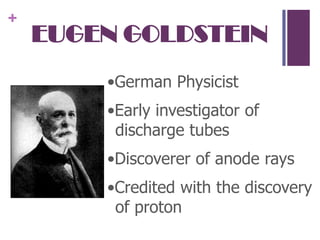
EUGEN GOLDSTEIN•German Physicist•Early investigator of discharge tubes•Discoverer of anode rays•Credited with the discovery of proton
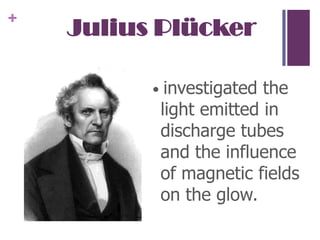
Julius Plücker• investigated the light emitted in discharge tubes and the influence of magnetic fields on the glow.
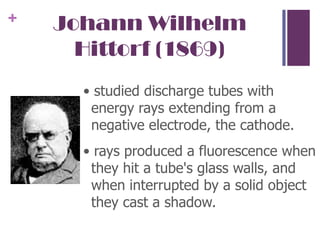
Johann Wilhelm Hittorf (1869)• studied discharge tubes with energy rays extending from a negative electrode, the cathode. • rays produced a fluorescence when they hit a tube's glass walls, and when interrupted by a solid object they cast a shadow.
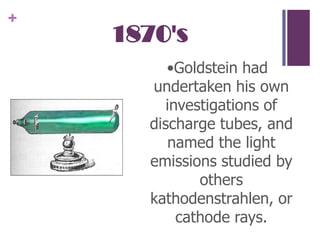
1870's•Goldstein had undertaken his own investigations of discharge tubes, and named the light emissions studied by others kathodenstrahlen, or cathode rays.
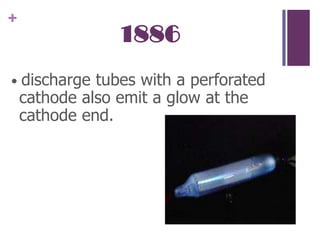
1886• discharge tubes with a perforated cathode also emit a glow at the cathode end.
Conclusion • In addition to the already-known cathode rays, later recognized as electrons moving from the negatively-charged cathode toward the positively-charged anode, there is another ray that travels in the opposite direction.
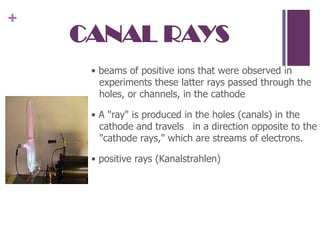
CANAL RAYS• beams of positive ions that were observed in experiments these latter rays passed through the holes, or channels, in the cathode• A "ray" is produced in the holes (canals) in the cathode and travels   in a direction opposite to the  "cathode rays," which are streams of electrons.• positive rays (Kanalstrahlen)
1907•a study of how this "ray" was deflected in a magnetic field, revealed that the particles making up the ray were not all the same mass.•The lightest ones, formed when there was some hydrogen gas in the tube, were calculated to be about 1837 times as massive as an electron. They were protons.
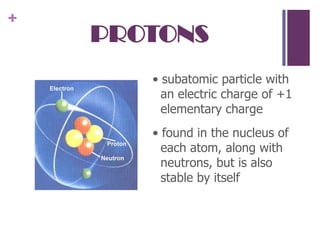
PROTONS• subatomic particle with an electric charge of +1 elementary charge• found in the nucleus of each atom, along with neutrons, but is also stable by itself
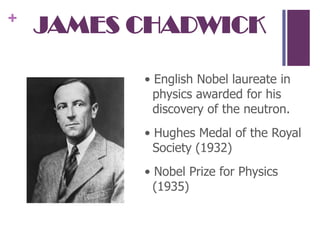
JAMES CHADWICK• English Nobel laureate in physics awarded for his discovery of the neutron.• Hughes Medal of the Royal Society (1932)• Nobel Prize for Physics (1935)
1932• Chadwick discovered a previously unknown particle in the atomic nucleus.• particle became known as electron because of lack of electric charge
• Unlike positively charged alpha particles (consist of two protons and two neutrons bound together into a particle identical to a helium nucleus), which are repelled by the electrical forces present in the nuclei of other atoms, neutrons do not need to overcome any Coulomb barrier and can therefore penetrate and split the nuclei of even the heaviest elements.
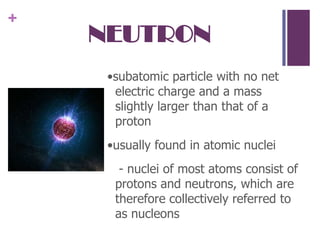
NEUTRON•subatomic particle with no net electric charge and a mass slightly larger than that of a proton•usually found in atomic nuclei   - nuclei of most atoms consist of protons and neutrons, which are therefore collectively referred to as nucleons
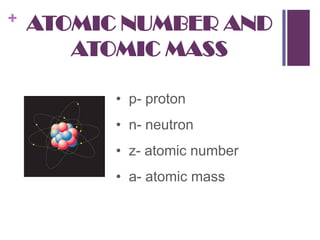
ATOMIC NUMBER AND ATOMIC MASS•  p- proton•  n- neutron•  z- atomic number•  a- atomic mass
Atomic number • the number of protons in the nucleus of an atom.Ex:H1	=   Hydrogen has one proton
Atomic Mass • the sum of the proton and neutron of an atomProton + neutron = atomic mass
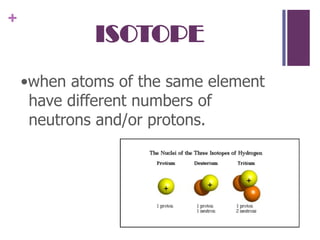
ISOTOPE•when atoms of the same element have different numbers of neutrons and/or protons.
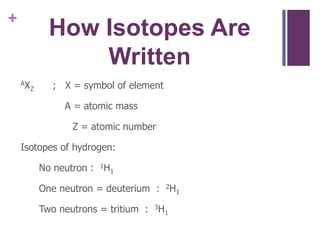
How Isotopes Are WrittenAXZ  	;   X = symbol of element      	    A = atomic mass    		                    Z = atomic numberIsotopes of hydrogen:      No neutron :  1H1      One neutron = deuterium  :  2H1      Two neutrons = tritium  :  3H1
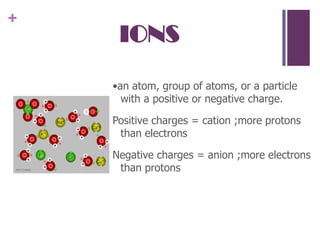
IONS•an atom, group of atoms, or a particle with a positive or negative charge. Positive charges = cation ;more protons than electronsNegative charges = anion ;more electrons than protons
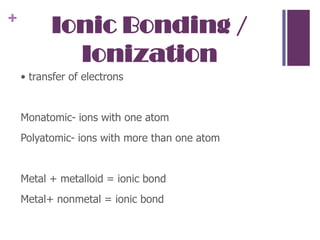
Ionic Bonding / Ionization• transfer of electrons Monatomic- ions with one atomPolyatomic- ions with more than one atomMetal + metalloid = ionic bondMetal+ nonmetal = ionic bond
Review• Neutrons are all identical to each other, just as protons are. • Atoms of a particular element must have the same number of protons but can have different numbers of neutrons. • When an atom does not have the same number of protons and neutrons, it is called an isotope.• Ion is an atom or molecule where the total number of electrons is not equal to the total number of protons, giving it a net positive or negative electrical charge.
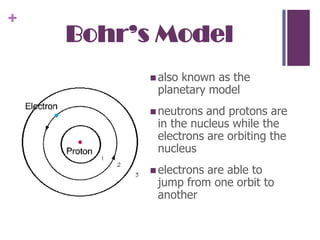
Bohr’s Modelalso known as the planetary modelneutrons and protons are in the nucleus while the electrons are orbiting the nucleuselectrons are able to jump from one orbit to another
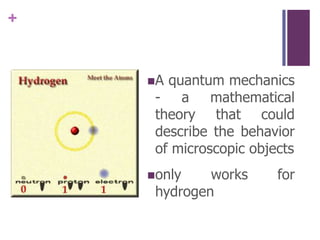
A quantum mechanics                                                                       - a mathematical theory that could describe the behavior of microscopic objectsonly works for hydrogen
Photonsalways in motionbundle of electromagnetic energycause of jumping electrons from one orbit to anotherAbsorbed=lower to higherLight=higher to lower
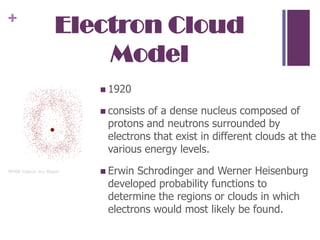
Electron Cloud Model1920consists of a dense nucleus composed of protons and neutrons surrounded by electrons that exist in different clouds at the various energy levels.Erwin Schrodinger and Werner Heisenburg developed probability functions to determine the regions or clouds in which electrons would most likely be found.
QUESTIONS
Question 1:What do you call an atom that does not have the same number of protons and neutrons?
Question 2:It is an ion with more electrons than protons.
Question 3What are protons?
Question 4What are electrons?
Question 5What is the main idea of the atomic theory of Democritus?
Question 6Draw the “Plum Pudding” model.
Question 7
Question 8
Question 9
Question 10

FINAL POWERPOINT PRESENTATION

  • 1.
    ATOMIC THEORYBY: ChescaAlba, Celine Bengzon, Rea Del Rio, Aitana Morales and Paula Santos
  • 2.
    Democritus AtomDemocritus isan Ancient Greek philosopher born in Abdera, Thrace, GreeceHe was said to be the first step toward the current atomic theory.Hypothesized that all matter is composed of tiny indestructible units, called atoms.
  • 3.
    His atomic theorycontradicted the idea that matter can be infinitely divided.According to him, atoms cannot be divided forever.  In the long run, the object will become so small and invisible that you cannot divide it any further.He said that these indivisible invisible particles are ATOMS. The word atom means not to be cut or indivisible.
  • 4.
    TAKE NOTE!He DIDNOT MAKE THE ATOMIC THEORY. He just EXPANDED it. He learned this from the founder of the atomic theory, Leucippus.
  • 5.
    John Dalton Englishchemist, meteorologist and physicist. He is best known for his pioneering work in the development of modern atomic theory.
  • 6.
    Dalton’s atomic theorystated that elements consisted of tiny particles called atoms. He said that the reason an element is pure is because all atoms of an element were identical and that in particular they had the same mass. He also said that the reason elements differed from one another was that atoms of each element were different from one another; in particular, they had different masses. He also said that compounds consisted of atoms of different elements combined together.
  • 7.
    5 POINTS ofDalton’s TheoryAll matter consists of tiny particles called atoms. These are indivisible and indestructible.All atoms of a given element are identical in mass and properties.The atoms of a given element are different from those of any other element; the atoms of different elements can be distinguished from one another by their respective relative atomic weights.
  • 8.
    Compounds are formedby a combination of two or more different kinds of atoms.Compounds are pure substances. They can’t be separated into elements by phase changes because the atoms of different elements are bonded to one another and are not easily separated from one another.A chemical reaction results to rearrangement of atoms.
  • 9.
    Joseph John “JJ”Thomson•Born on December 18•British physicist•Discoverer of electron•Discoverer of isotopes
  • 10.
    •Invented the massspectrometer•Proposed first waveguide•Proposed the Plum pudding model•Awarded the 1906 Nobel Prize in Physics
  • 11.
    PLUM PUDDING MODEL•Also known as the “Chocolate Chip Cookie or Blueberry Muffin Model.”•Atom is composed of electrons surrounded by a soup of positive charge to balance the electron’s negative charge, like negatively-charged “plums” surrounded by positively-charged “pudding”.
  • 12.
    •Sometimes visualized ashaving a cloud of positive charge, a striking contrast to the most recent atomic model, which describes the positive nucleus to be surrounded by an electron cloud.•Electrons were free to rotate within the cloud of positive substance.•These orbits were stabilized in the model by the fact that when an electron moved farther from the center of the positive cloud, it felt a larger net positive inward force, because there was more material of opposite charge, inside its orbit.
  • 13.
    Ernest Rutherford•Born onAugust 30•New Zealand chemist and physicist •Father of nuclear physics•Discovered that atoms have their positive charge concentrated in a very small nucleus.•Rutherford Model
  • 14.
    •Gold Foil Experiment•Discovererof proton•Awarded Nobel Prize in Chemistry in 1908•Widely credited as splitting the atom in 1917•Leading the first experiment to “split the nucleus”
  • 15.
    Gold Foil Experiment•Alsocalled “Geiger–Marsden experiment or Rutherford experiment”•An experiment to examine the structure of the atom performed by Hans Geiger and Ernest Marsden in 1909
  • 16.
    •The unexpected resultsof the experiment demonstrated for the first time the existence of the atomic nucleus, leading to the downfall of the plum pudding model of the atom, and the development of the Rutherford (or planetary) model.
  • 17.
    A beam ofalpha particles, generated by the radioactive decay of radium, was directed normally onto a sheet of very thin gold foil. The gold foil was surrounded by a circular sheet of zinc sulfide (ZnS) which was used as a detector: the ZnS sheet would light up when hit with alpha particles. Under the prevailing plum pudding model, the alpha particles should all have been deflected by, at most, a few degrees; measuring the pattern of scattered particles was expected to provide information about the distribution of charge within the atom. However they observed that a very small percentage of particles were deflected through angles much larger than 90 degrees.
  • 18.
    Large amount ofthe atom’s charge and mass is instead concentrated into a very physically small, giving it a very high electric field.Outside of this “central charge”, he proposed that the atom was mostly empty space.
  • 19.
    EUGEN GOLDSTEIN•German Physicist•Earlyinvestigator of discharge tubes•Discoverer of anode rays•Credited with the discovery of proton
  • 20.
    Julius Plücker• investigatedthe light emitted in discharge tubes and the influence of magnetic fields on the glow.
  • 21.
    Johann Wilhelm Hittorf(1869)• studied discharge tubes with energy rays extending from a negative electrode, the cathode. • rays produced a fluorescence when they hit a tube's glass walls, and when interrupted by a solid object they cast a shadow.
  • 22.
    1870's•Goldstein had undertakenhis own investigations of discharge tubes, and named the light emissions studied by others kathodenstrahlen, or cathode rays.
  • 23.
    1886• discharge tubeswith a perforated cathode also emit a glow at the cathode end.
  • 24.
    Conclusion • Inaddition to the already-known cathode rays, later recognized as electrons moving from the negatively-charged cathode toward the positively-charged anode, there is another ray that travels in the opposite direction.
  • 25.
    CANAL RAYS• beamsof positive ions that were observed in experiments these latter rays passed through the holes, or channels, in the cathode• A "ray" is produced in the holes (canals) in the cathode and travels in a direction opposite to the "cathode rays," which are streams of electrons.• positive rays (Kanalstrahlen)
  • 26.
    1907•a study ofhow this "ray" was deflected in a magnetic field, revealed that the particles making up the ray were not all the same mass.•The lightest ones, formed when there was some hydrogen gas in the tube, were calculated to be about 1837 times as massive as an electron. They were protons.
  • 27.
    PROTONS• subatomic particlewith an electric charge of +1 elementary charge• found in the nucleus of each atom, along with neutrons, but is also stable by itself
  • 28.
    JAMES CHADWICK• EnglishNobel laureate in physics awarded for his discovery of the neutron.• Hughes Medal of the Royal Society (1932)• Nobel Prize for Physics (1935)
  • 29.
    1932• Chadwick discovereda previously unknown particle in the atomic nucleus.• particle became known as electron because of lack of electric charge
  • 30.
    • Unlike positivelycharged alpha particles (consist of two protons and two neutrons bound together into a particle identical to a helium nucleus), which are repelled by the electrical forces present in the nuclei of other atoms, neutrons do not need to overcome any Coulomb barrier and can therefore penetrate and split the nuclei of even the heaviest elements.
  • 31.
    NEUTRON•subatomic particle withno net electric charge and a mass slightly larger than that of a proton•usually found in atomic nuclei - nuclei of most atoms consist of protons and neutrons, which are therefore collectively referred to as nucleons
  • 32.
    ATOMIC NUMBER ANDATOMIC MASS• p- proton• n- neutron• z- atomic number• a- atomic mass
  • 33.
    Atomic number •the number of protons in the nucleus of an atom.Ex:H1 = Hydrogen has one proton
  • 34.
    Atomic Mass •the sum of the proton and neutron of an atomProton + neutron = atomic mass
  • 35.
    ISOTOPE•when atoms ofthe same element have different numbers of neutrons and/or protons.
  • 36.
    How Isotopes AreWrittenAXZ ; X = symbol of element A = atomic mass Z = atomic numberIsotopes of hydrogen: No neutron : 1H1 One neutron = deuterium : 2H1 Two neutrons = tritium : 3H1
  • 37.
    IONS•an atom, groupof atoms, or a particle with a positive or negative charge. Positive charges = cation ;more protons than electronsNegative charges = anion ;more electrons than protons
  • 38.
    Ionic Bonding /Ionization• transfer of electrons Monatomic- ions with one atomPolyatomic- ions with more than one atomMetal + metalloid = ionic bondMetal+ nonmetal = ionic bond
  • 39.
    Review• Neutrons areall identical to each other, just as protons are. • Atoms of a particular element must have the same number of protons but can have different numbers of neutrons. • When an atom does not have the same number of protons and neutrons, it is called an isotope.• Ion is an atom or molecule where the total number of electrons is not equal to the total number of protons, giving it a net positive or negative electrical charge.
  • 40.
    Bohr’s Modelalso knownas the planetary modelneutrons and protons are in the nucleus while the electrons are orbiting the nucleuselectrons are able to jump from one orbit to another
  • 41.
    A quantum mechanics - a mathematical theory that could describe the behavior of microscopic objectsonly works for hydrogen
  • 42.
    Photonsalways in motionbundleof electromagnetic energycause of jumping electrons from one orbit to anotherAbsorbed=lower to higherLight=higher to lower
  • 43.
    Electron Cloud Model1920consistsof a dense nucleus composed of protons and neutrons surrounded by electrons that exist in different clouds at the various energy levels.Erwin Schrodinger and Werner Heisenburg developed probability functions to determine the regions or clouds in which electrons would most likely be found.
  • 44.
  • 45.
    Question 1:What doyou call an atom that does not have the same number of protons and neutrons?
  • 46.
    Question 2:It isan ion with more electrons than protons.
  • 47.
  • 48.
  • 49.
    Question 5What isthe main idea of the atomic theory of Democritus?
  • 50.
    Question 6Draw the“Plum Pudding” model.
  • 51.
  • 52.
  • 53.
  • 54.