What is the chance of finding an
electron in the nucleus?
QUANTUM MECHANICAL MODEL OF ATOM STATES
THAT:
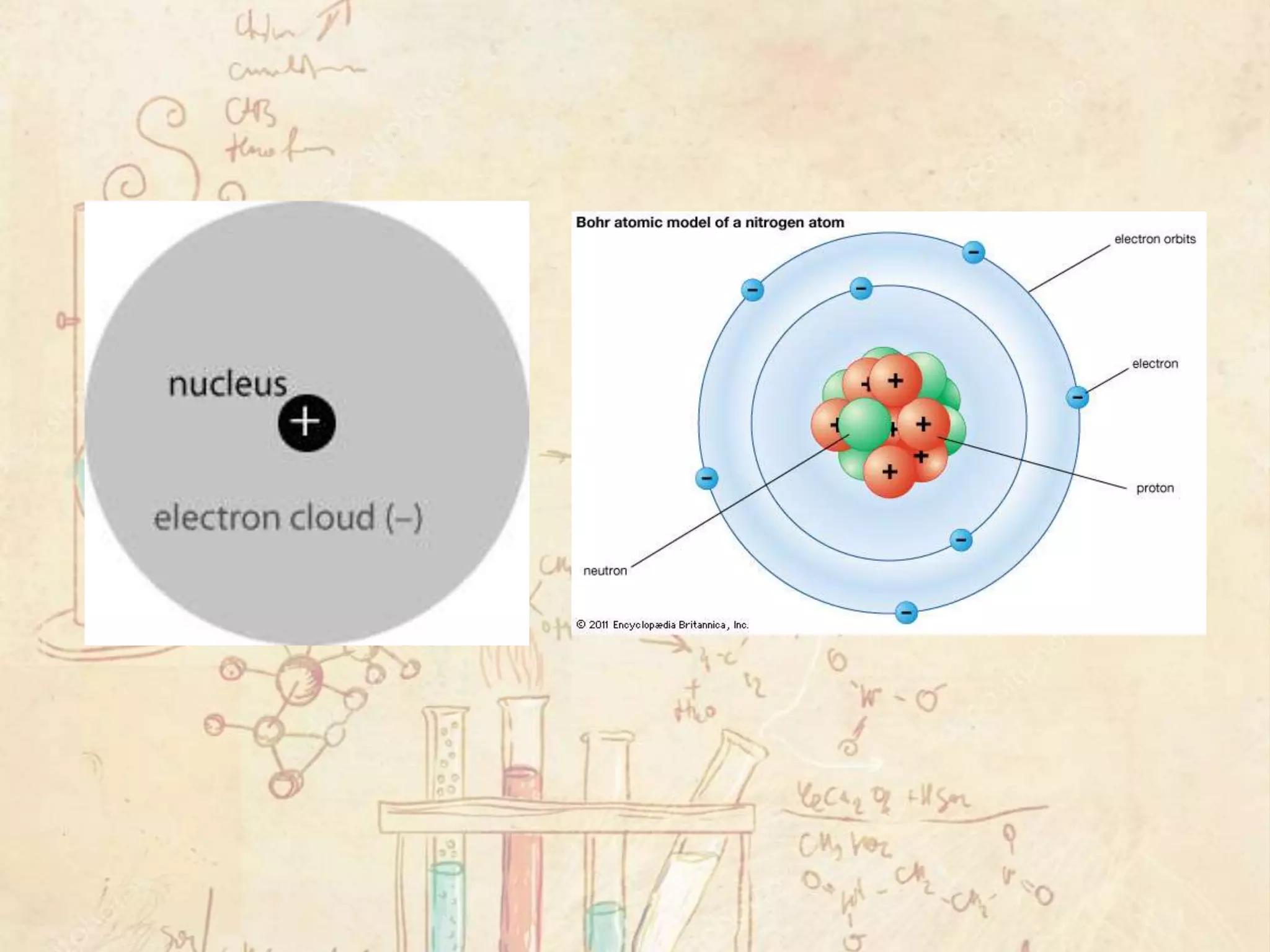
• Electrons are NOT in circular orbits around nucleus.
• Electrons are in a 3-D region around the nucleus called
atomic orbitals.
• The atomic orbital describes the probable location of the
electron.
Where does this model come from?
A quick history.
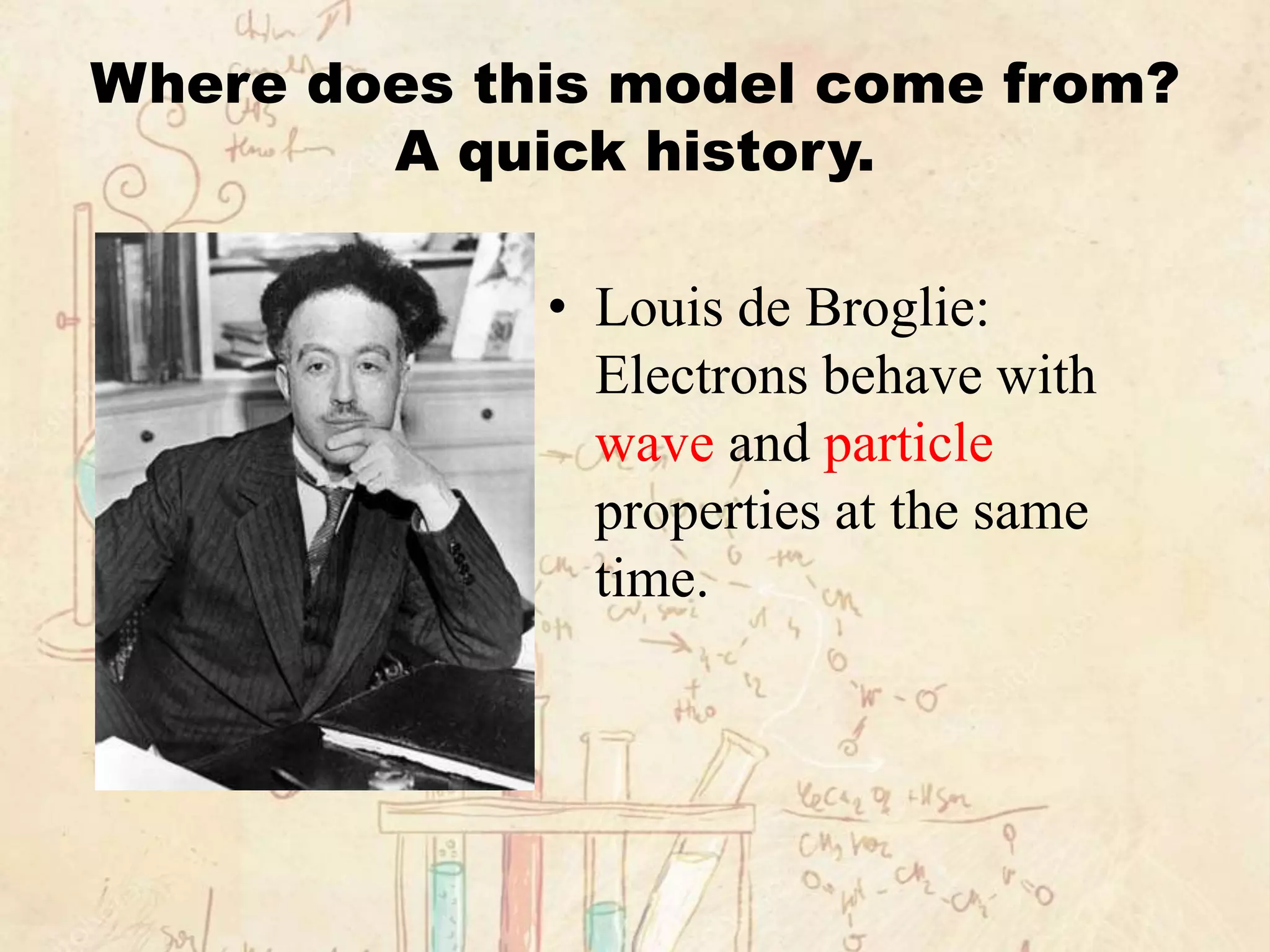
• Louis de Broglie:
Electrons behave with
wave and particle
properties at the same
time.
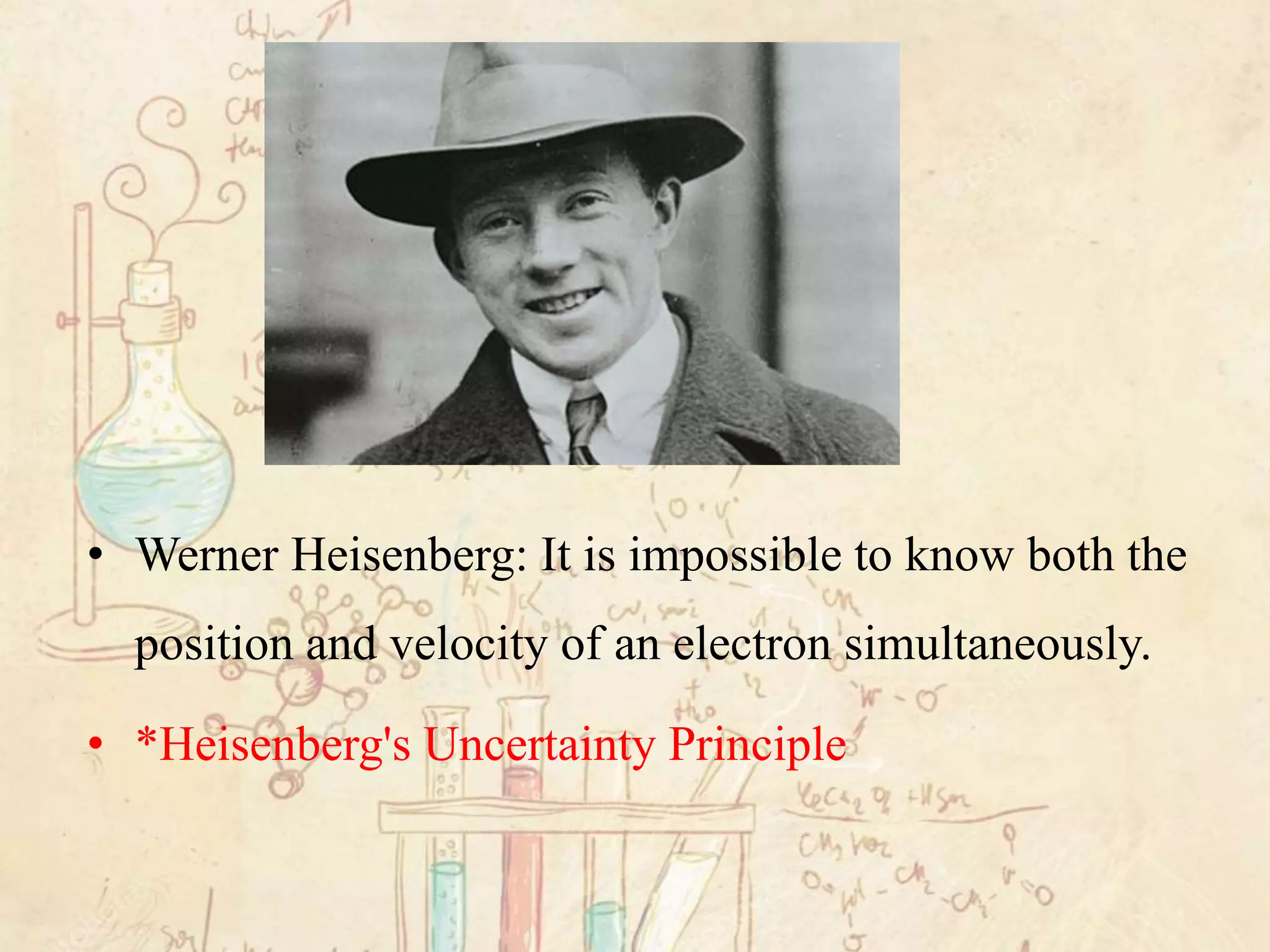
• Werner Heisenberg: It is impossible to know both the
position and velocity of an electron simultaneously.
• *Heisenberg's Uncertainty Principle
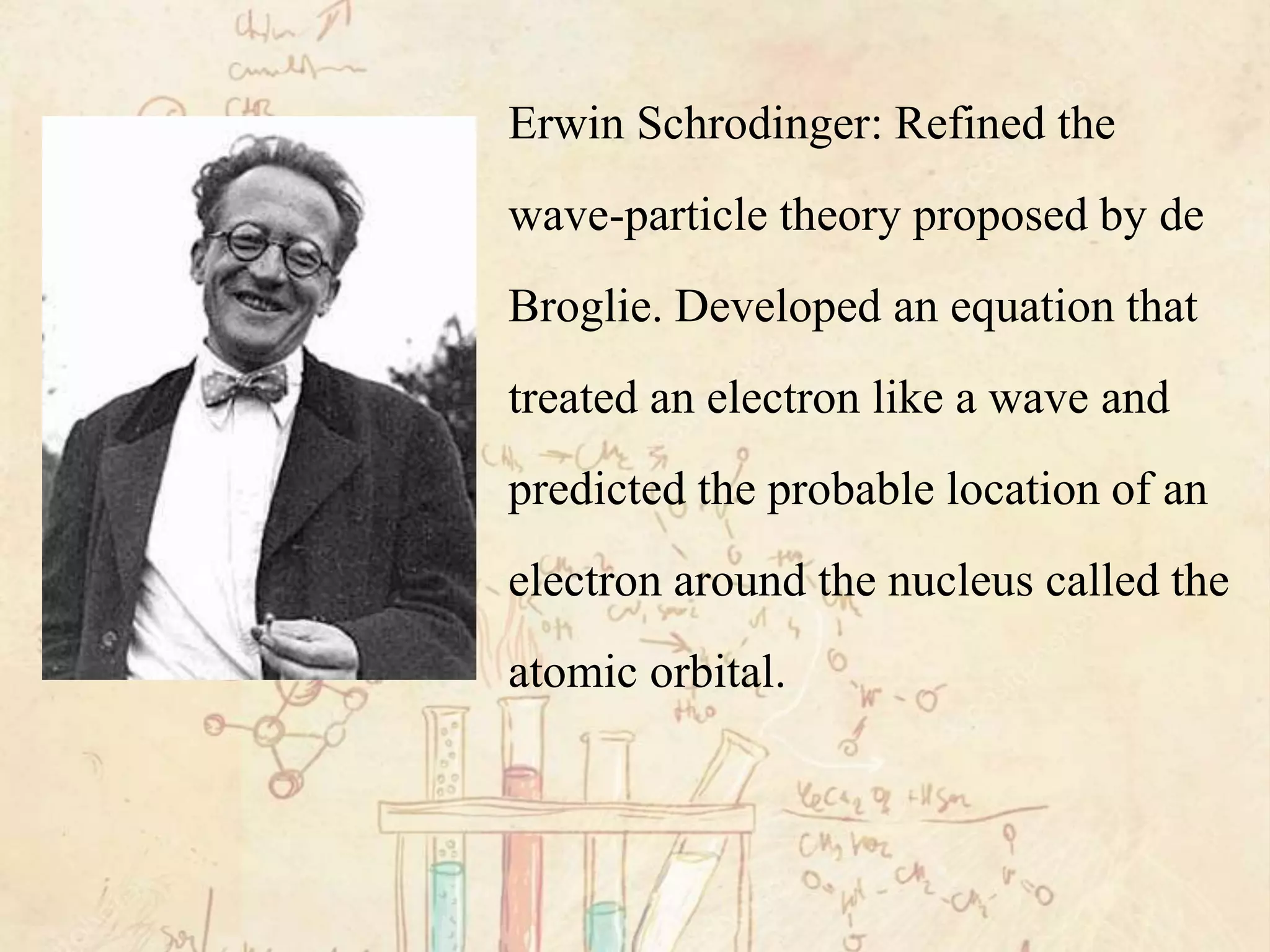
Erwin Schrodinger: Refined the
wave-particle theory proposed by de
Broglie. Developed an equation that
treated an electron like a wave and
predicted the probable location of an
electron around the nucleus called the
atomic orbital.
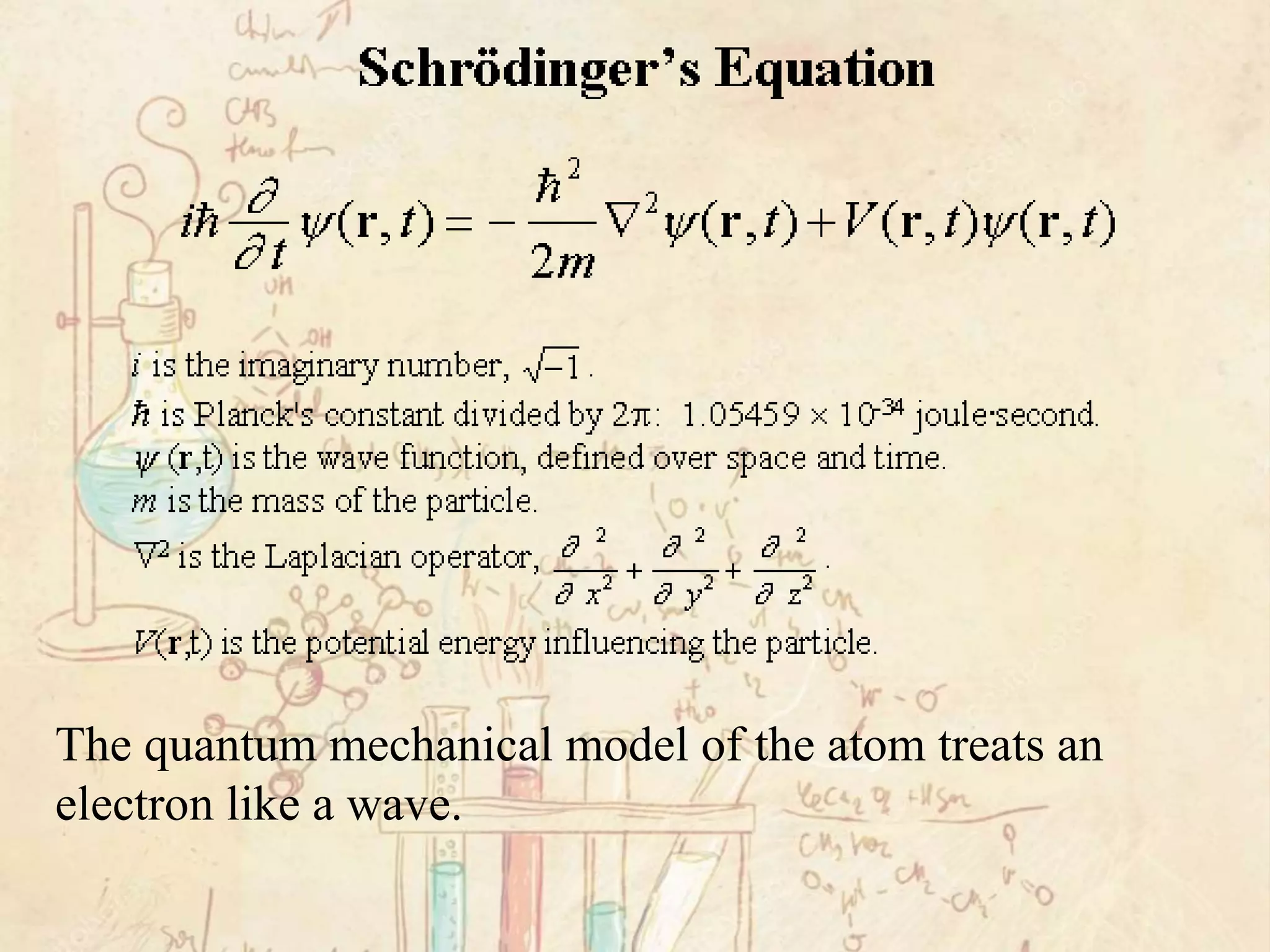
The quantum mechanical model of the atom treats an
electron like a wave.
The Quantum Mechanical Model
–The quantum model determines the
allowed energies an electron can
have and how likely it is to find the
electron in various locations around
the nucleus.
5.1
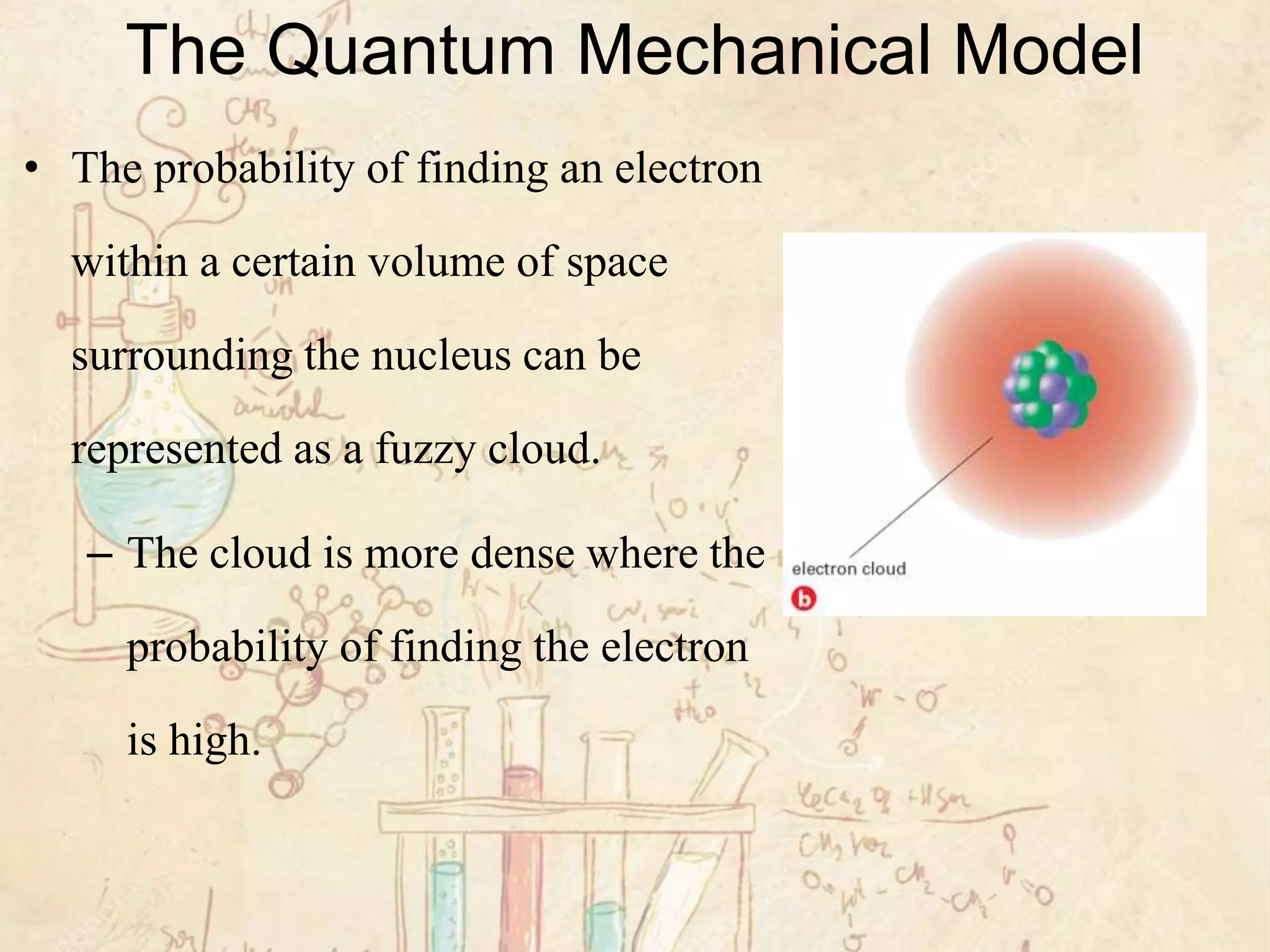
The Quantum Mechanical Model
• The probability of finding an electron
within a certain volume of space
surrounding the nucleus can be
represented as a fuzzy cloud.
– The cloud is more dense where the
probability of finding the electron
is high.
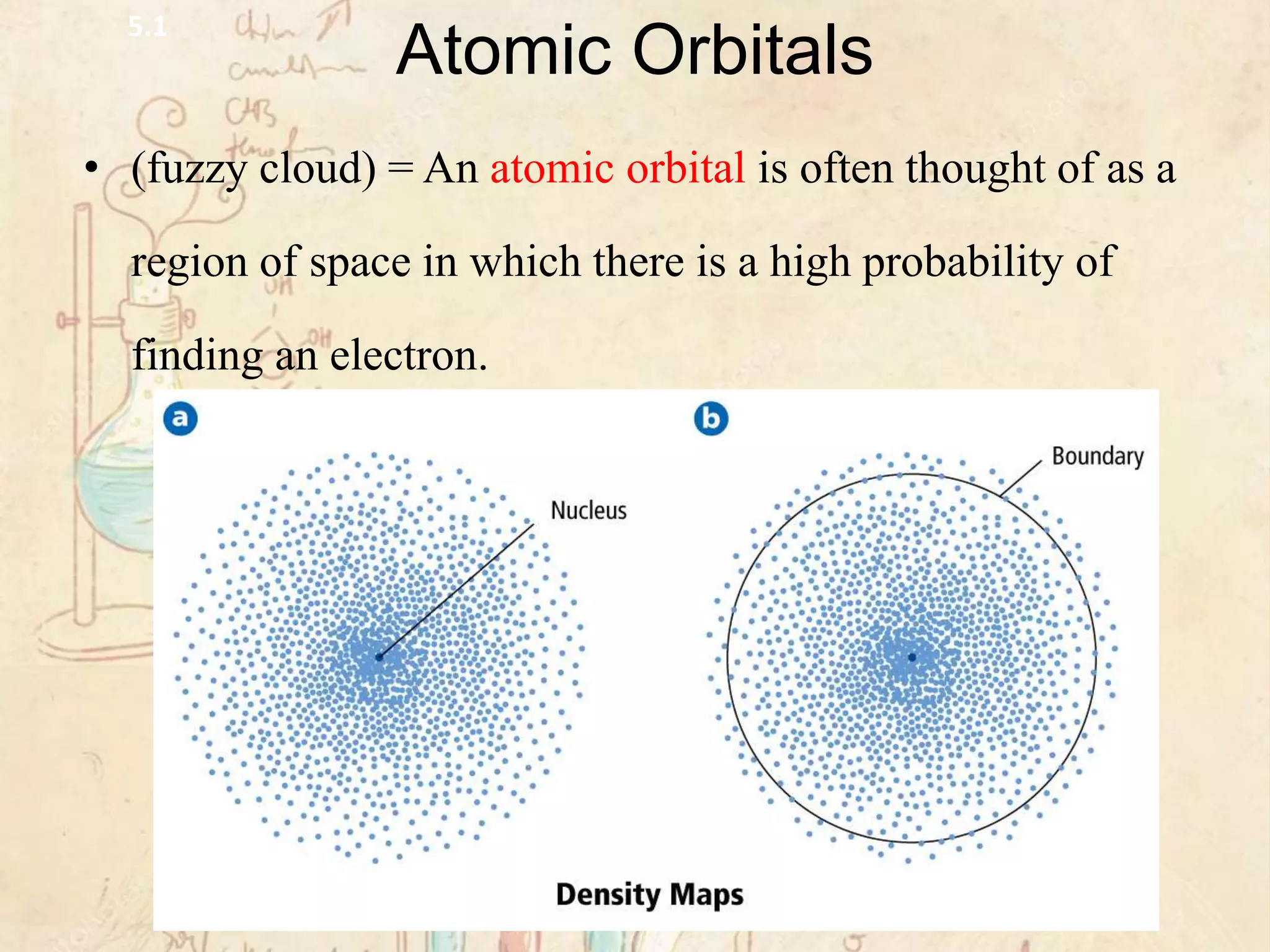
Atomic Orbitals
• (fuzzy cloud) = An atomic orbital is often thought of as a
region of space in which there is a high probability of
finding an electron.
5.1
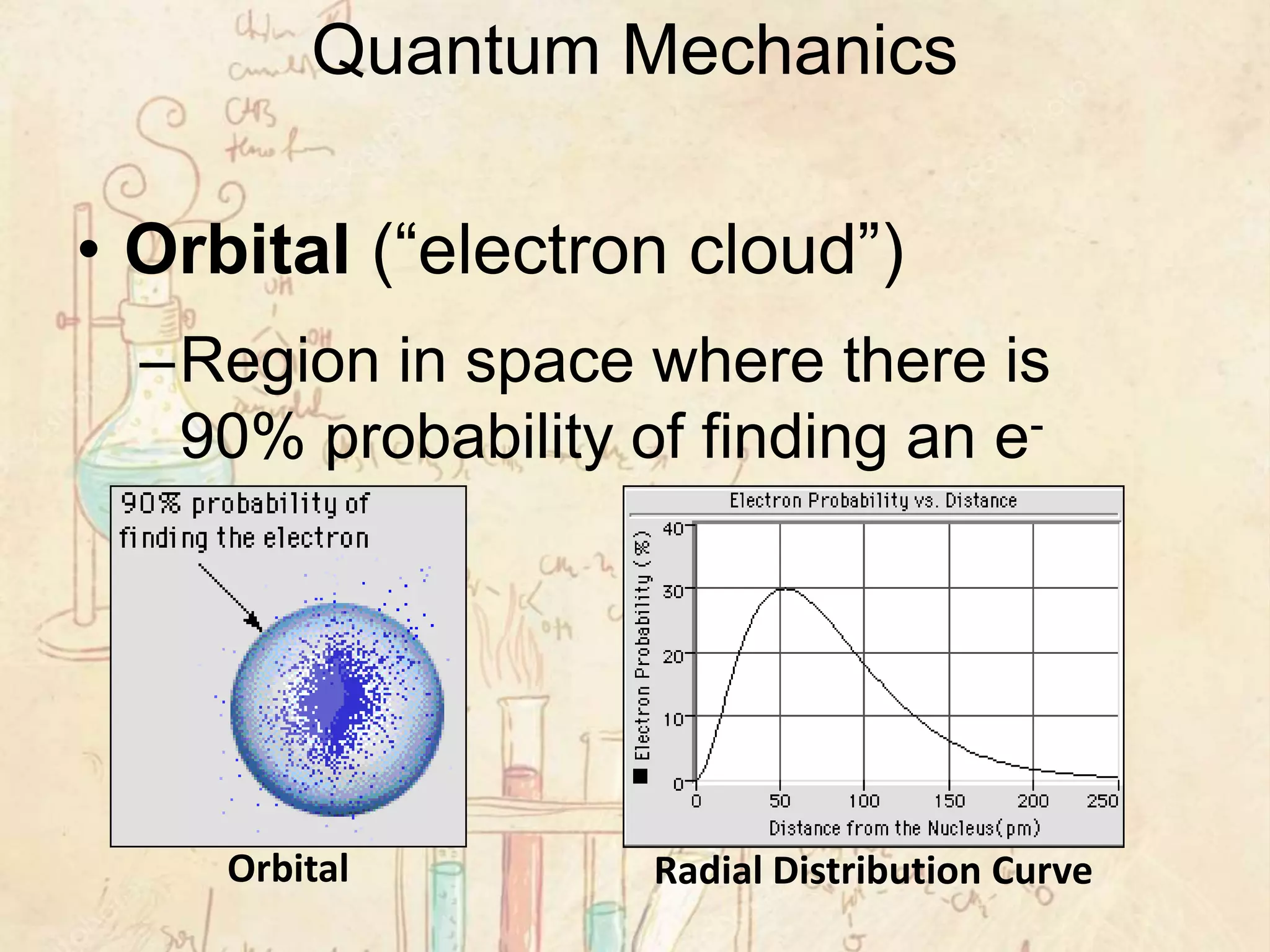
Quantum Mechanics
Radial Distribution CurveOrbital
• Orbital (“electron cloud”)
–Region in space where there is
90% probability of finding an e-
.Copyright © Houghton Mifflin
Company.All rights reserved.
Presentation of Lecture Outlines, 7–13
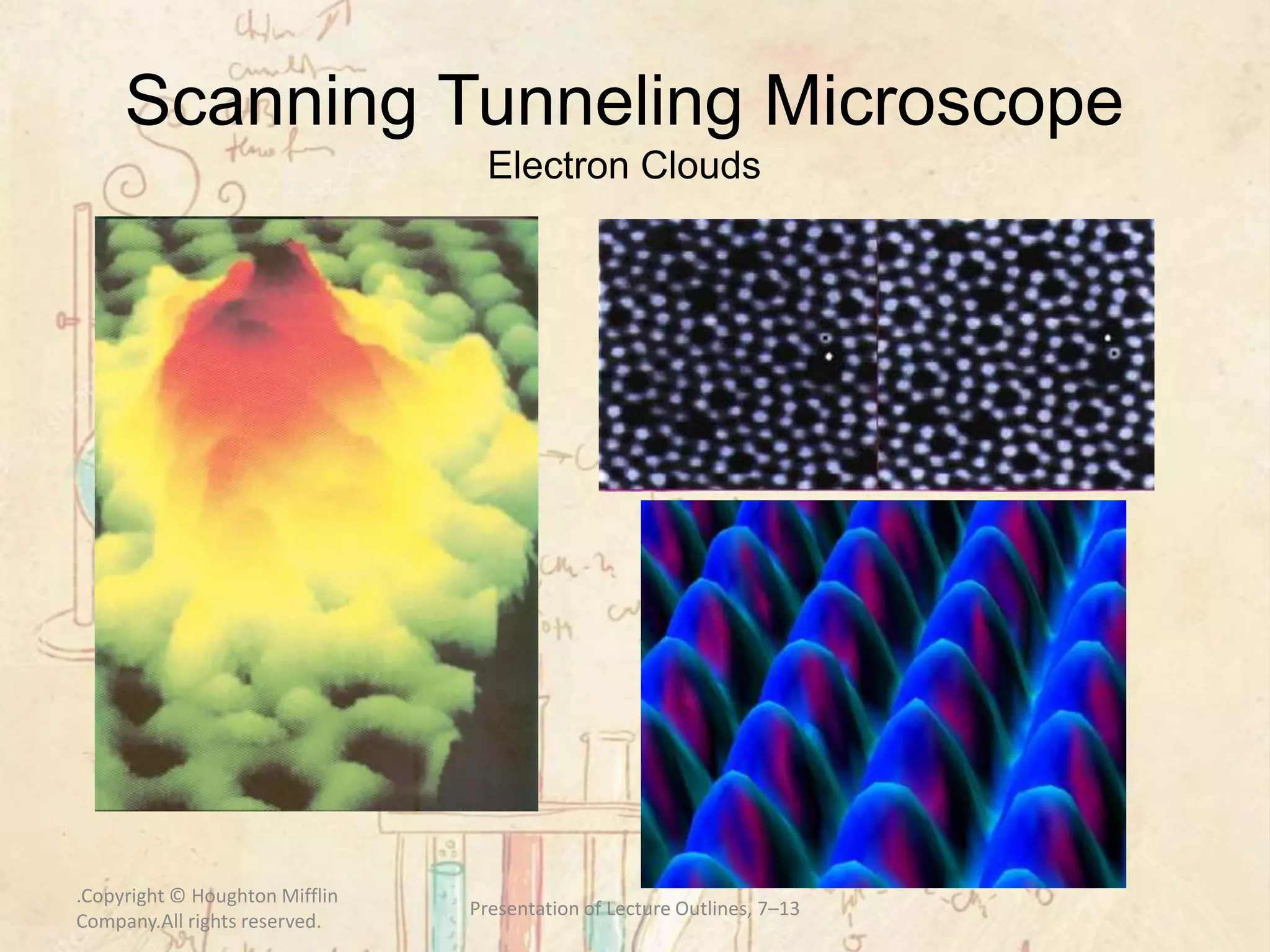
Scanning Tunneling Microscope
Electron Clouds
14
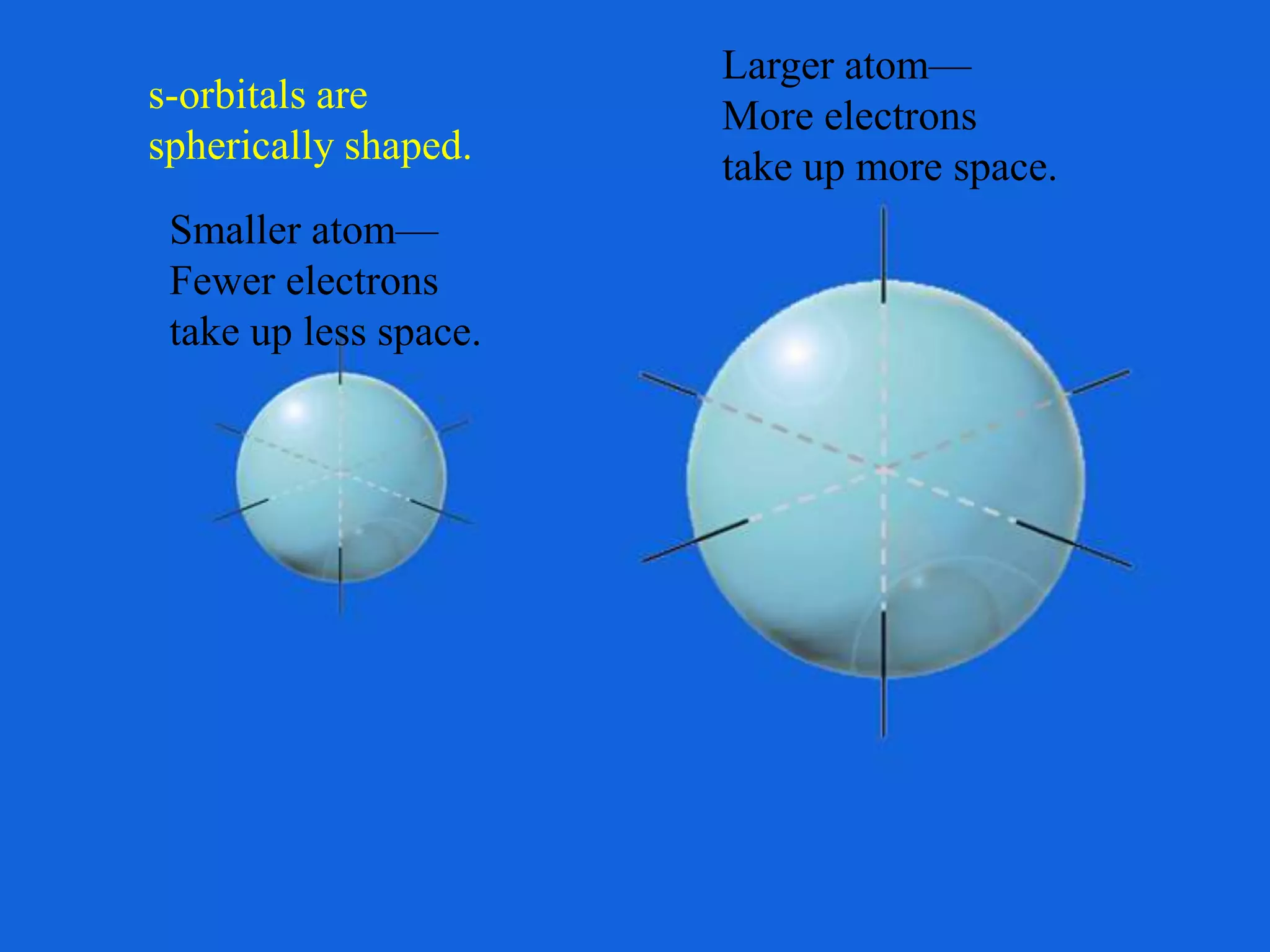
Smaller atom
Smaller atom—
Fewer electrons
take up less space.
Larger atom—
More electrons
take up more space.
s-orbitals are
spherically shaped.
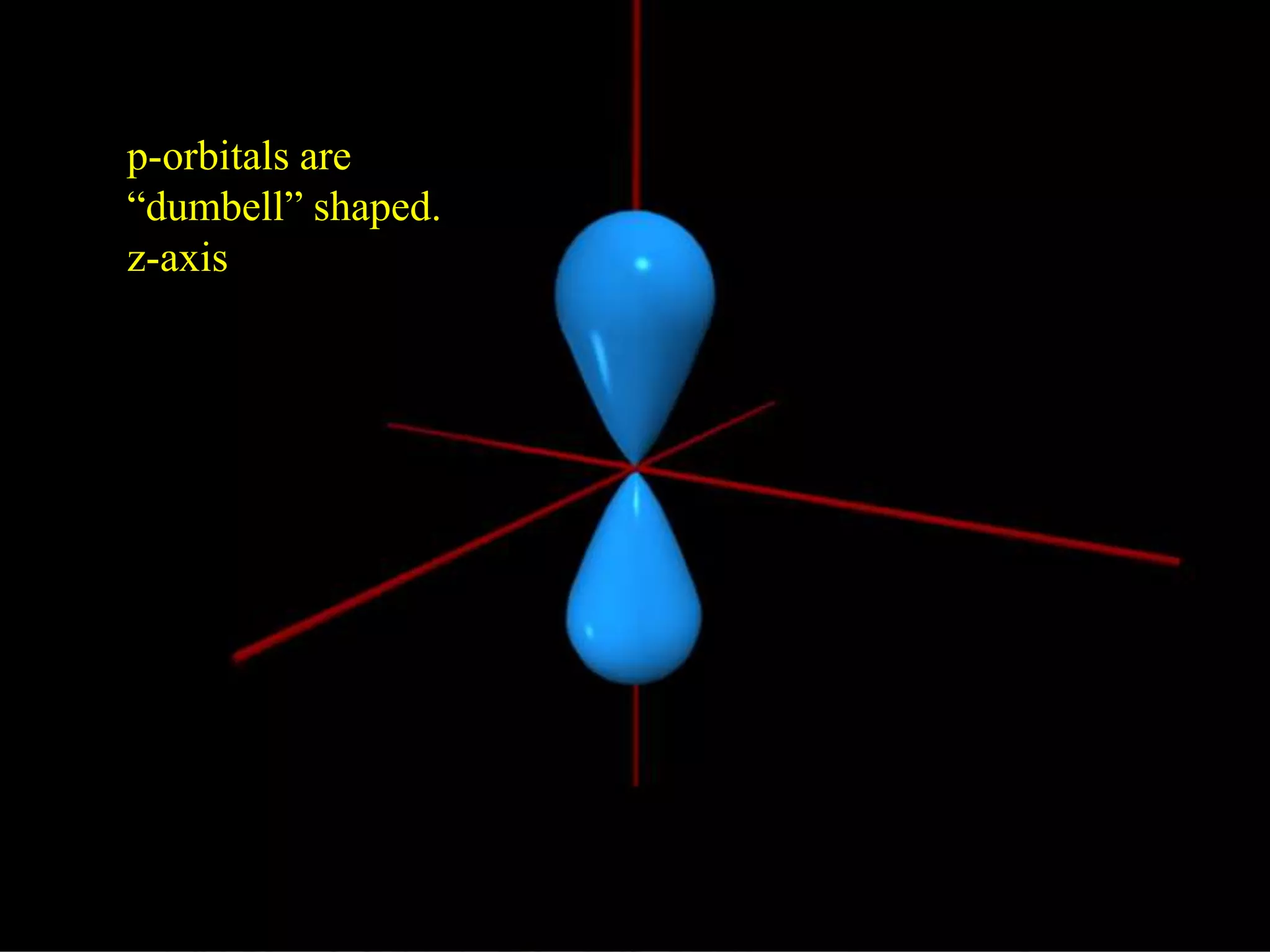
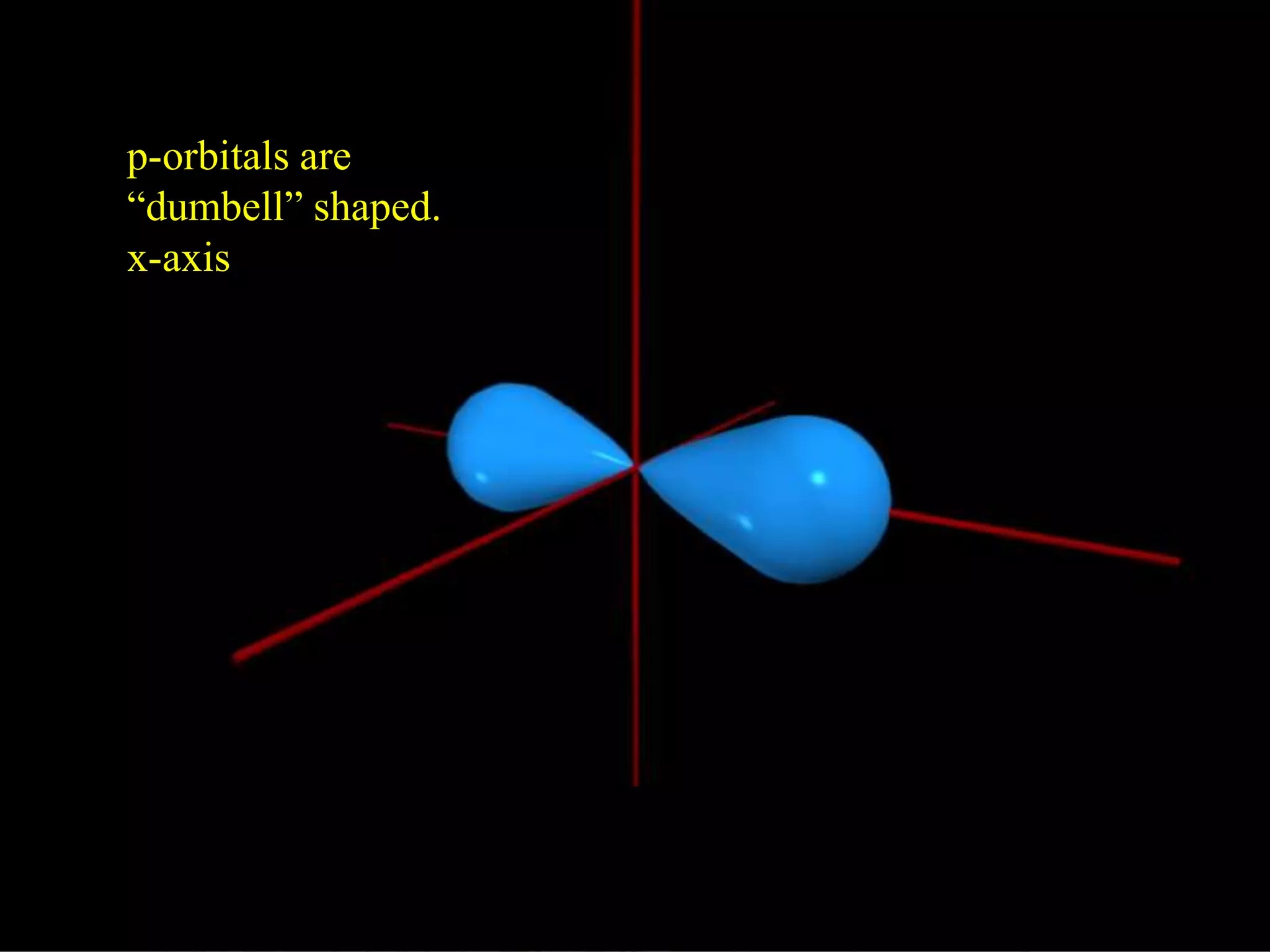
p-orbitals are
“dumbell” shaped.
z-axis
p-orbitals are
“dumbell” shaped.
x-axis
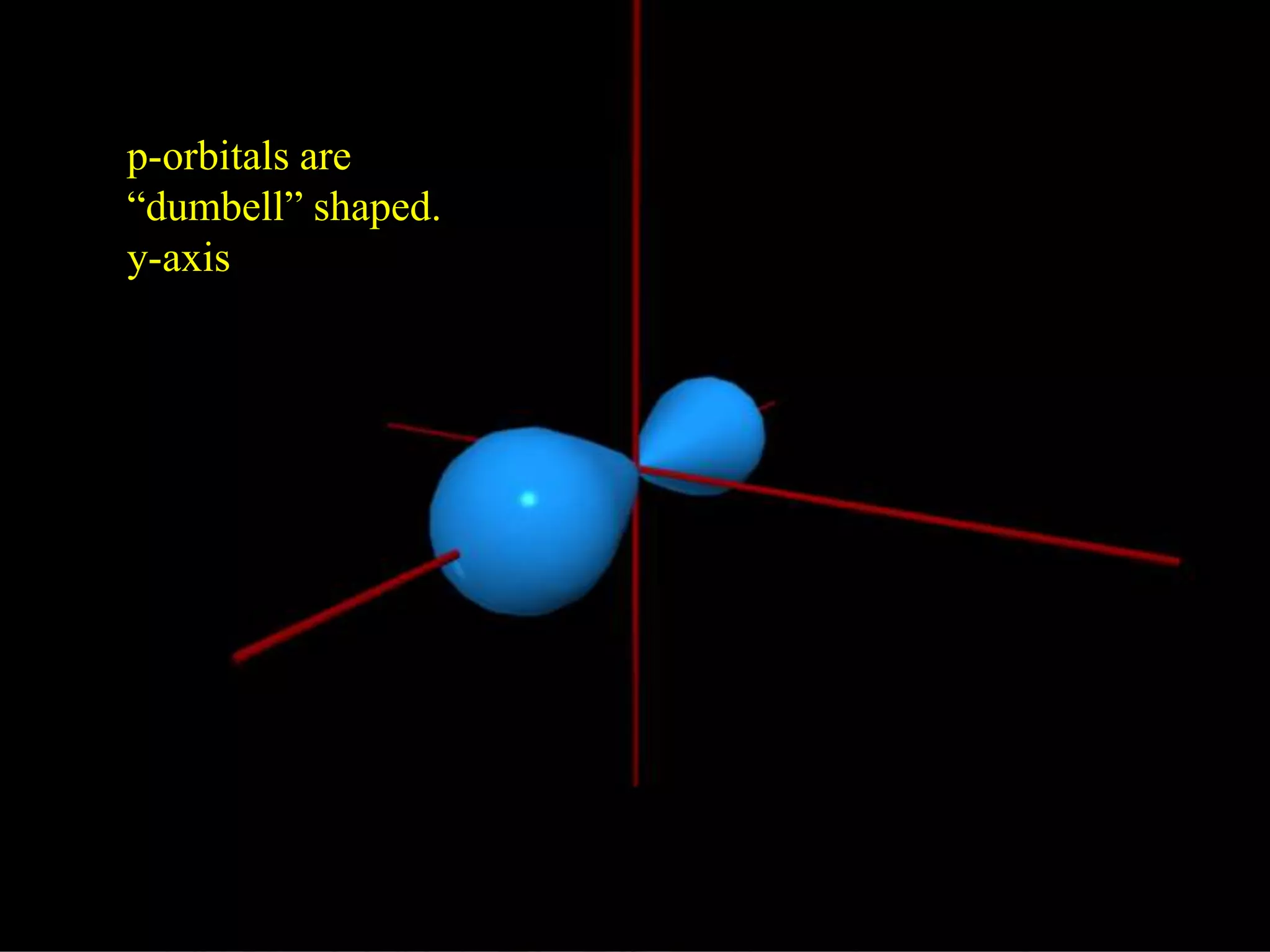
p-orbitals are
“dumbell” shaped.
y-axis
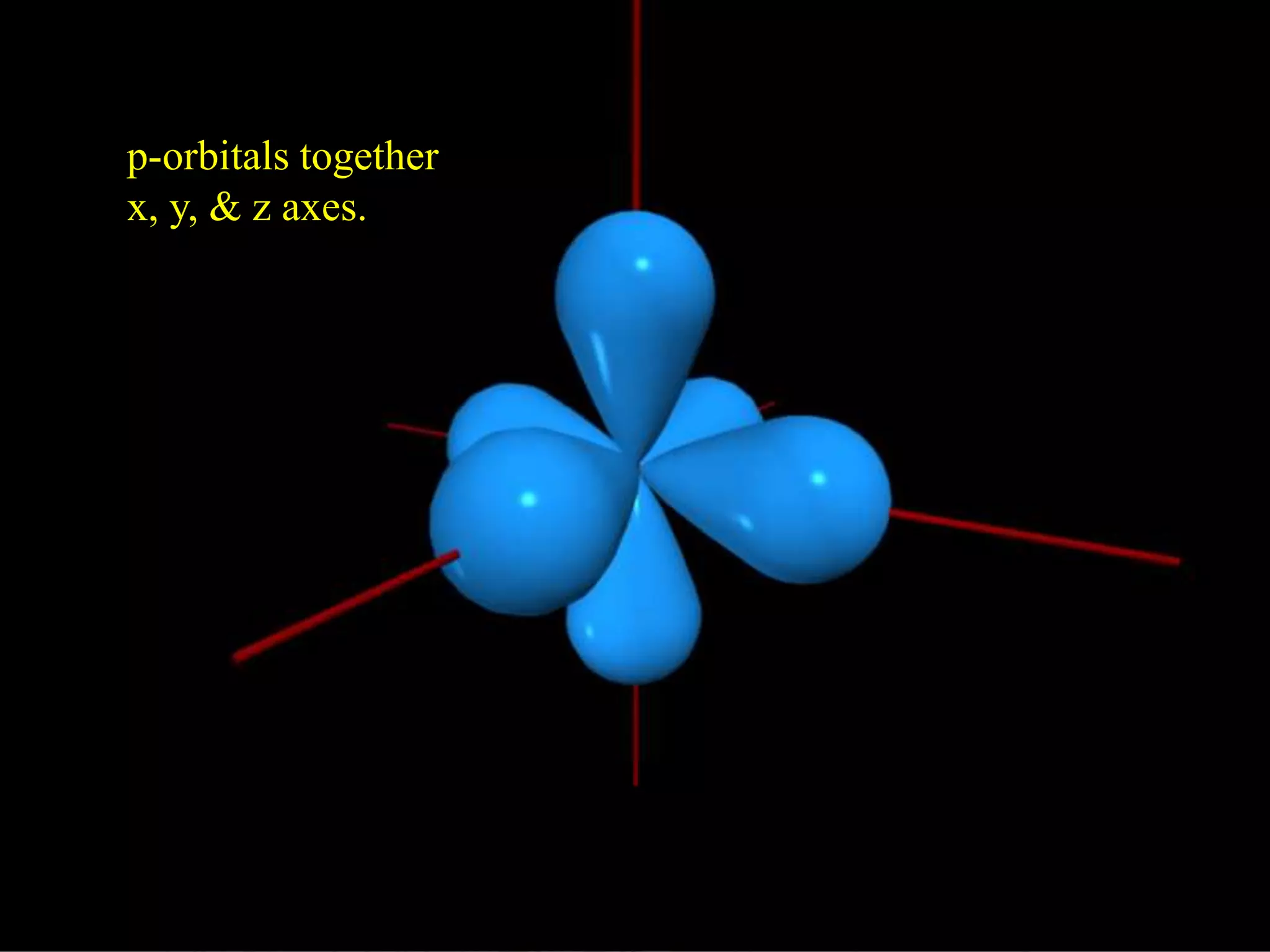
p-orbitals together
x, y, & z axes.
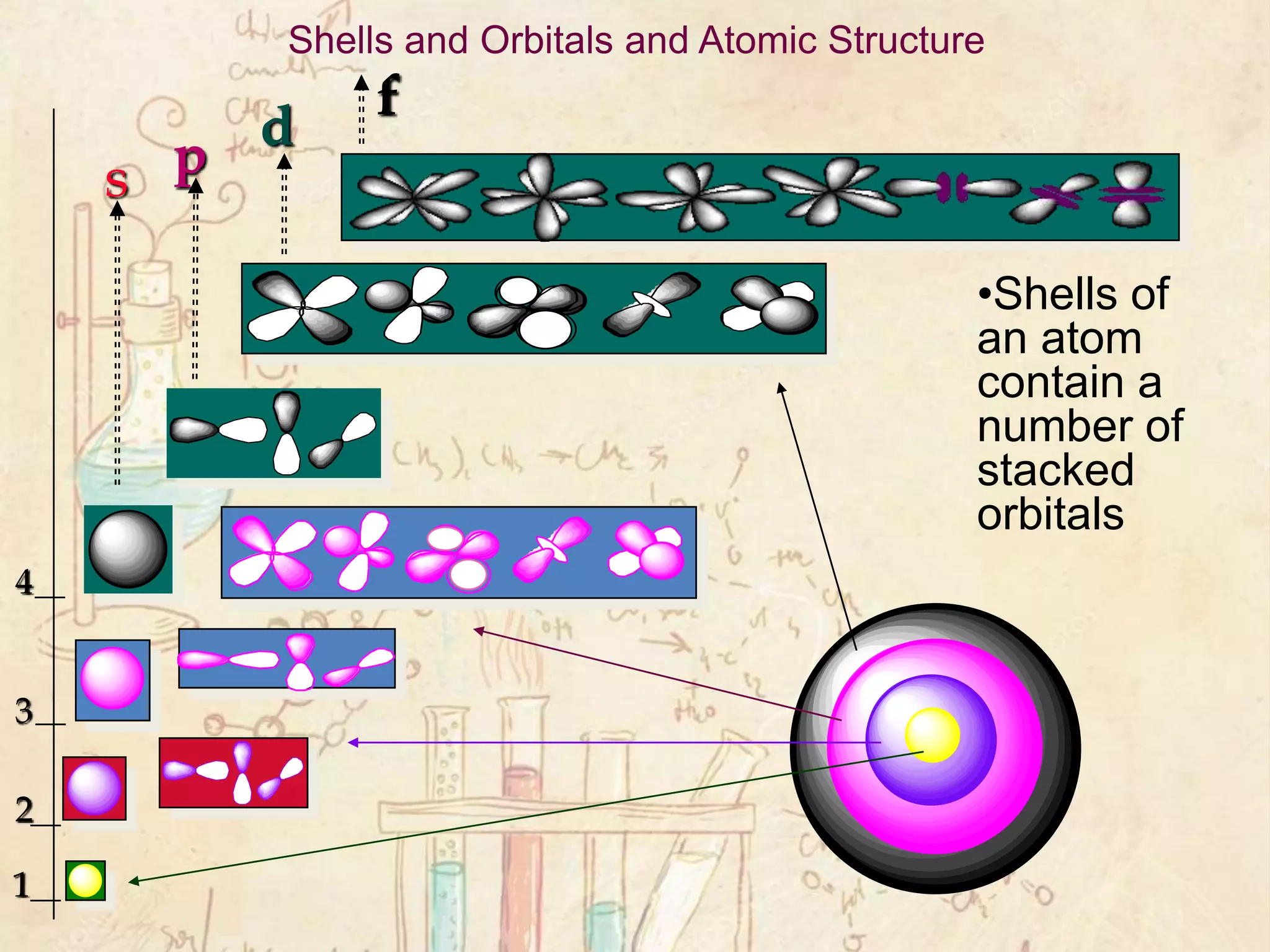
Shells and Orbitals and Atomic Structure
•Shells of
an atom
contain a
number of
stacked
orbitals
1
2
3
4
s p d
f
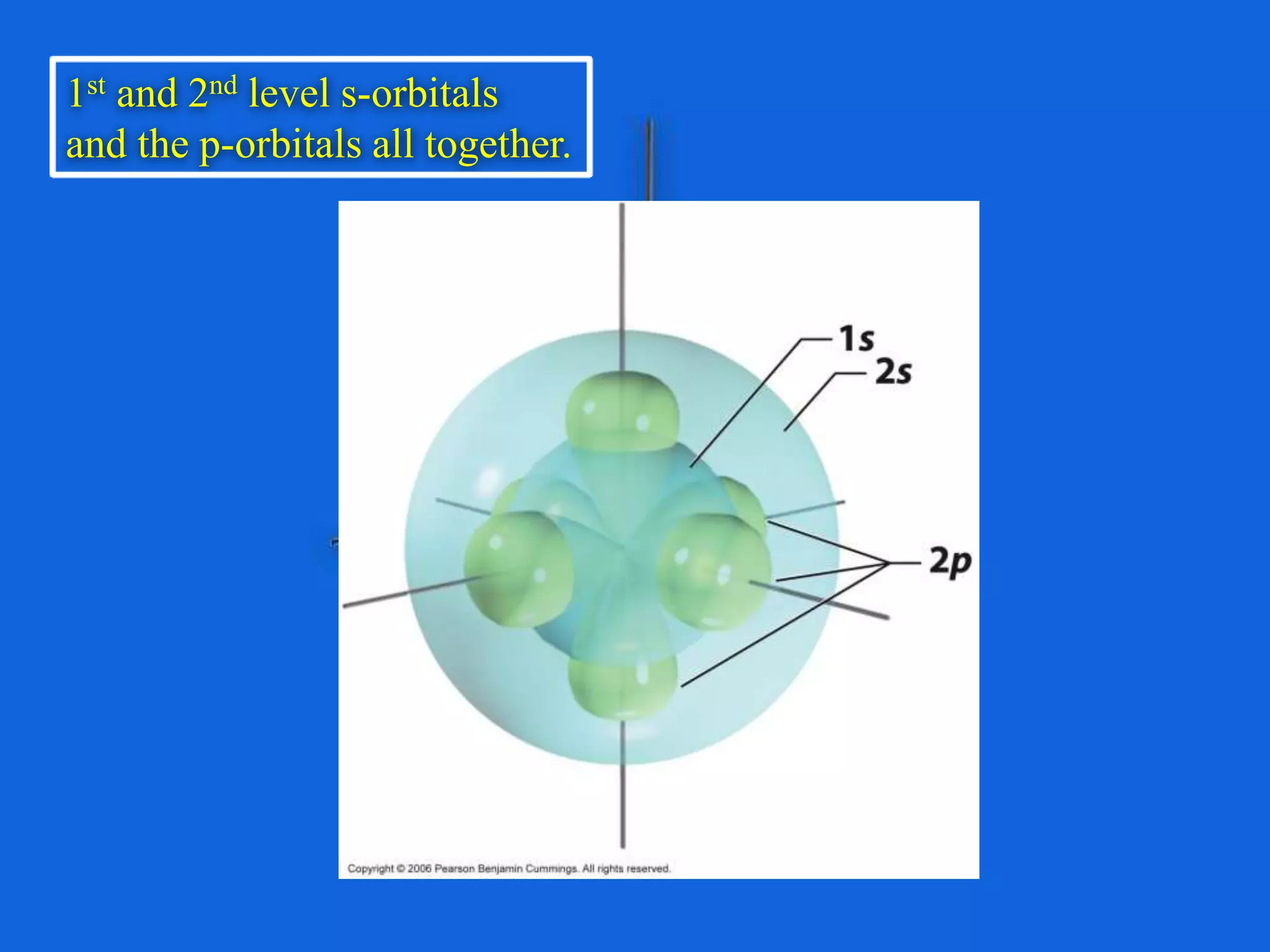
1st and 2nd level s-orbitals
and the p-orbitals all together.
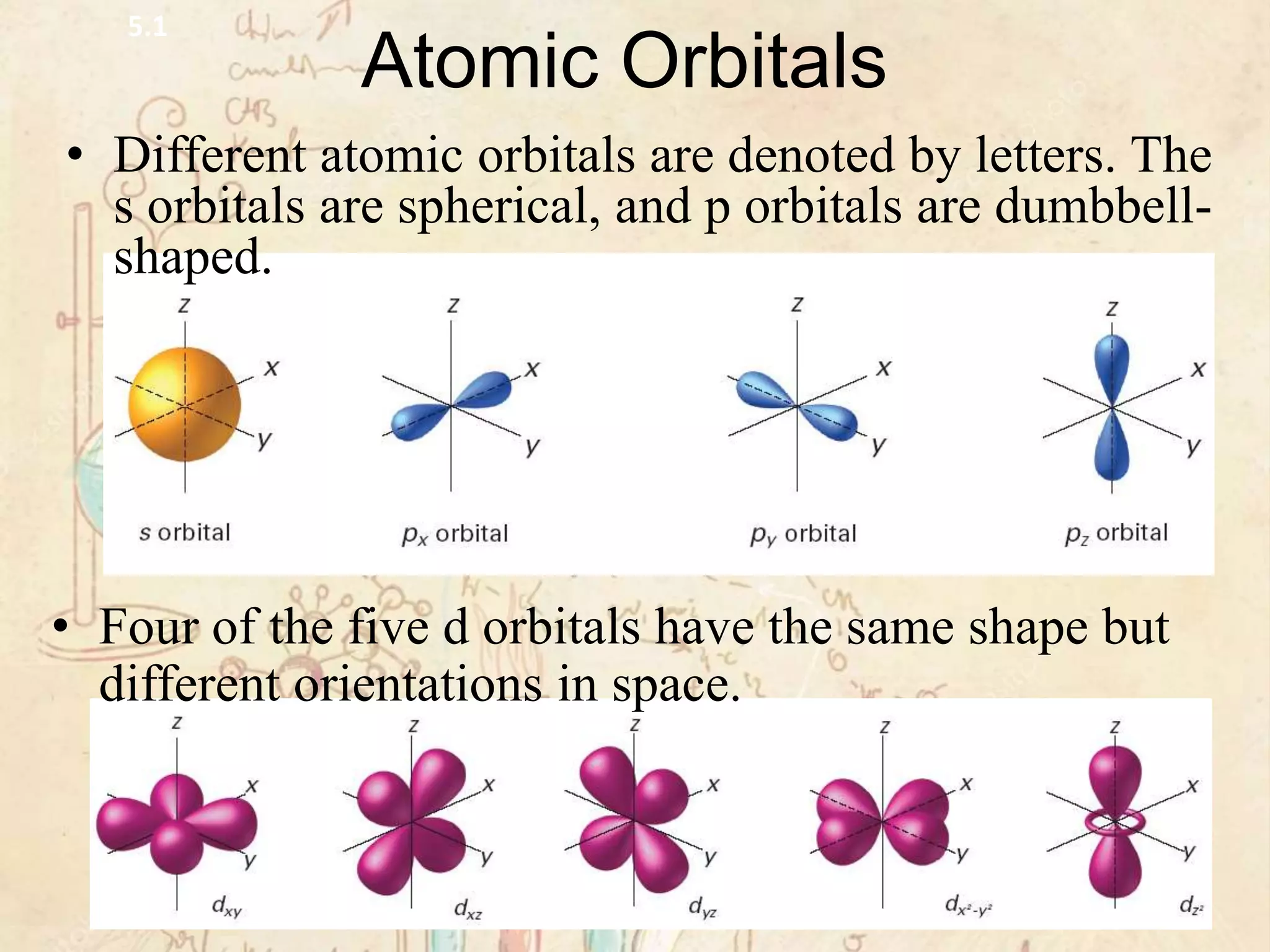
Atomic Orbitals
5.1
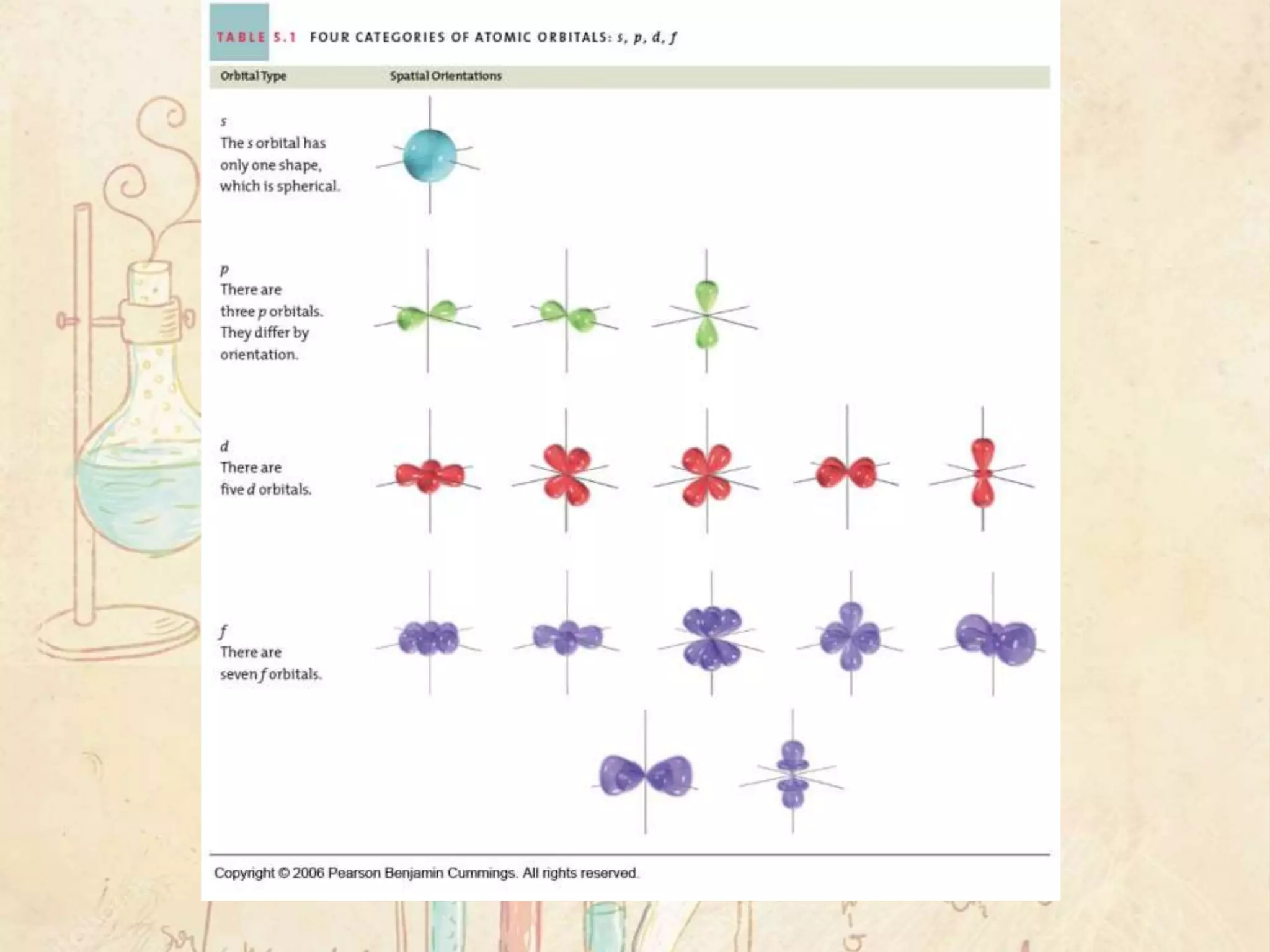
• Different atomic orbitals are denoted by letters. The
s orbitals are spherical, and p orbitals are dumbbell-
shaped.
• Four of the five d orbitals have the same shape but
different orientations in space.
.Copyright © Houghton Mifflin Company.All rights reserved. Presentation of Lecture Outlines, 7–24
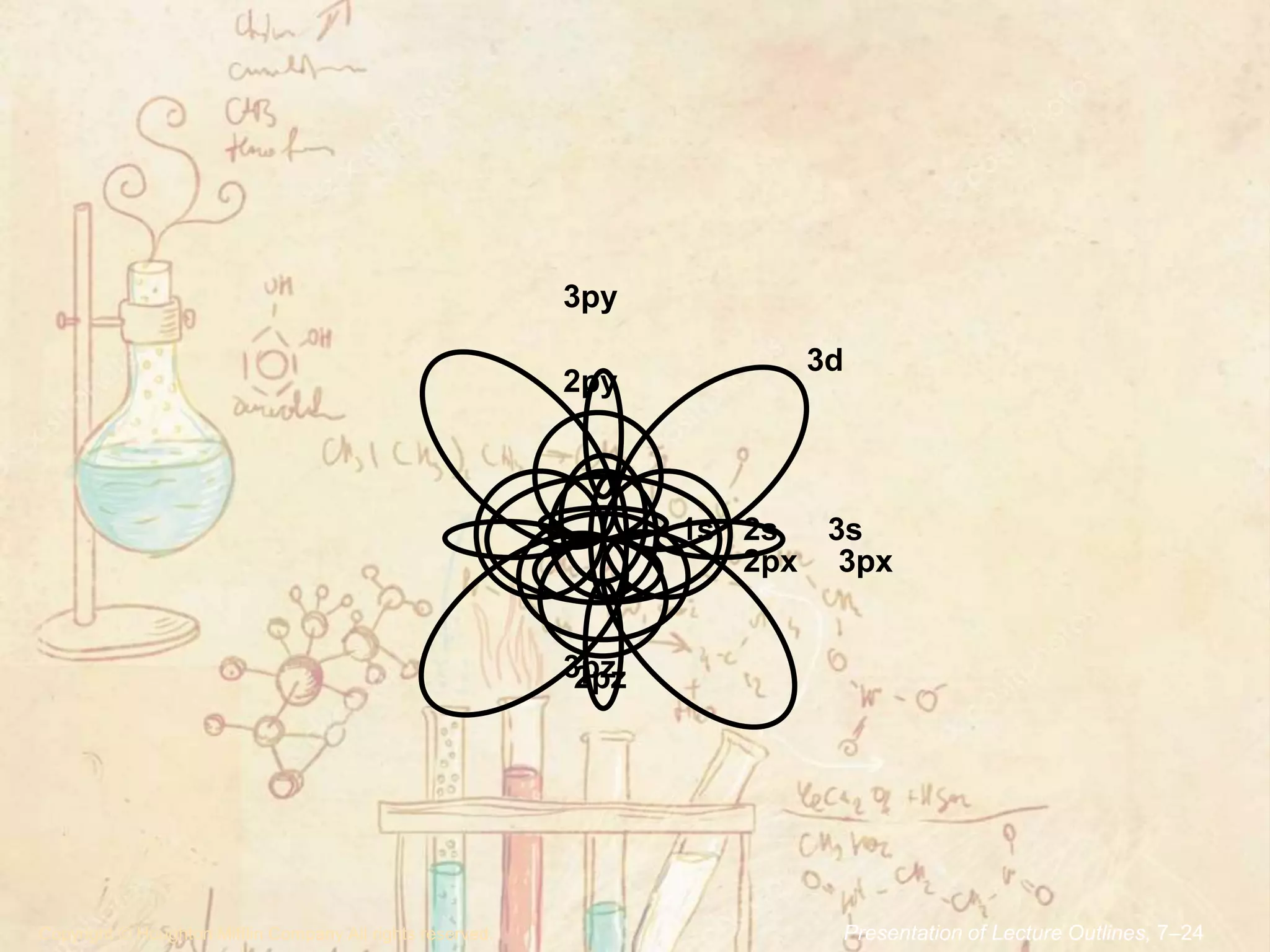
1s 3s2s
2px
3pz
3d
2py
2pz
3py
3px
Atomic Orbitals
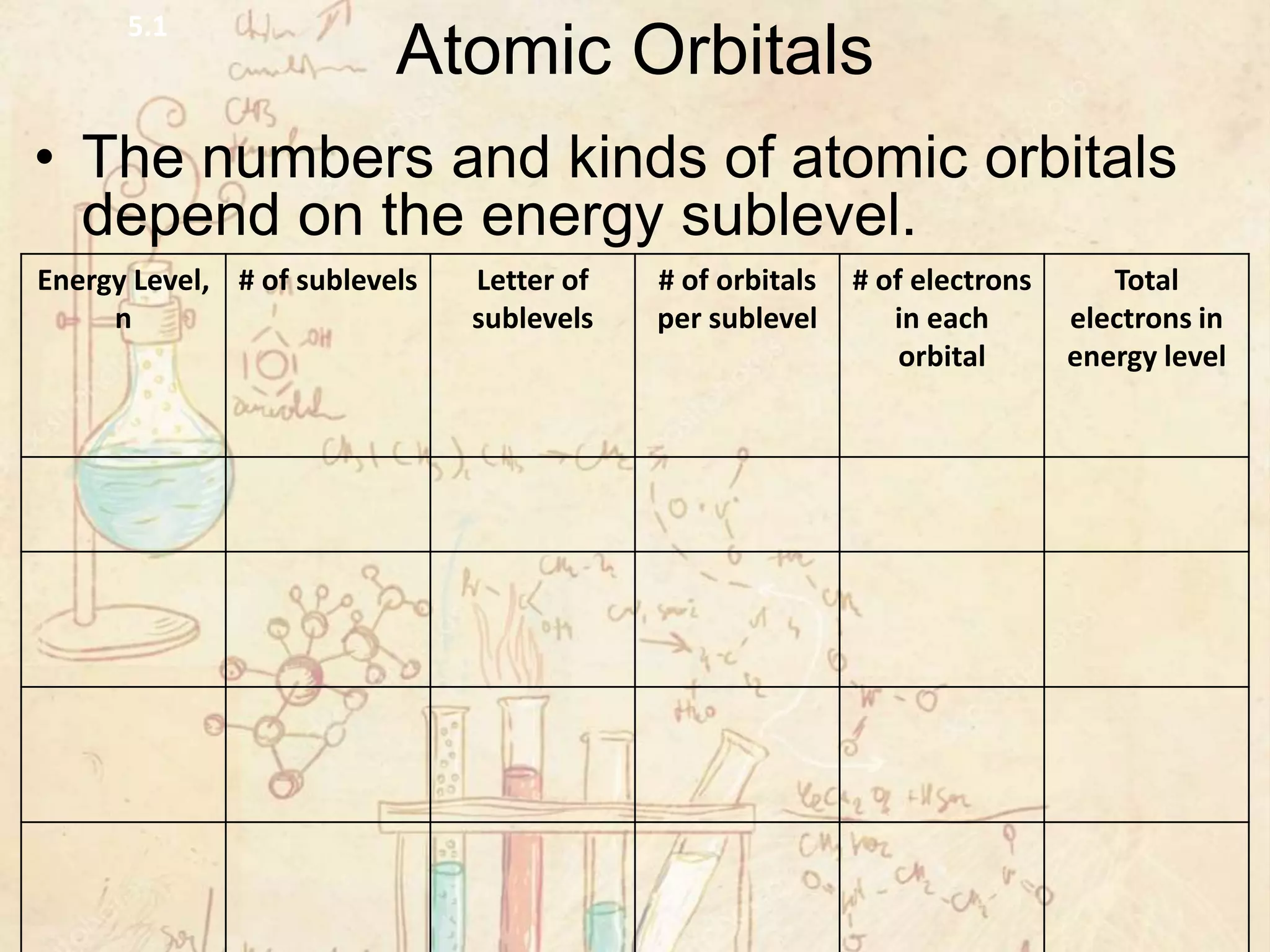
• The numbers and kinds of atomic orbitals
depend on the energy sublevel.
5.1
Energy Level,
n
# of sublevels Letter of
sublevels
# of orbitals
per sublevel
# of electrons
in each
orbital
Total
electrons in
energy level
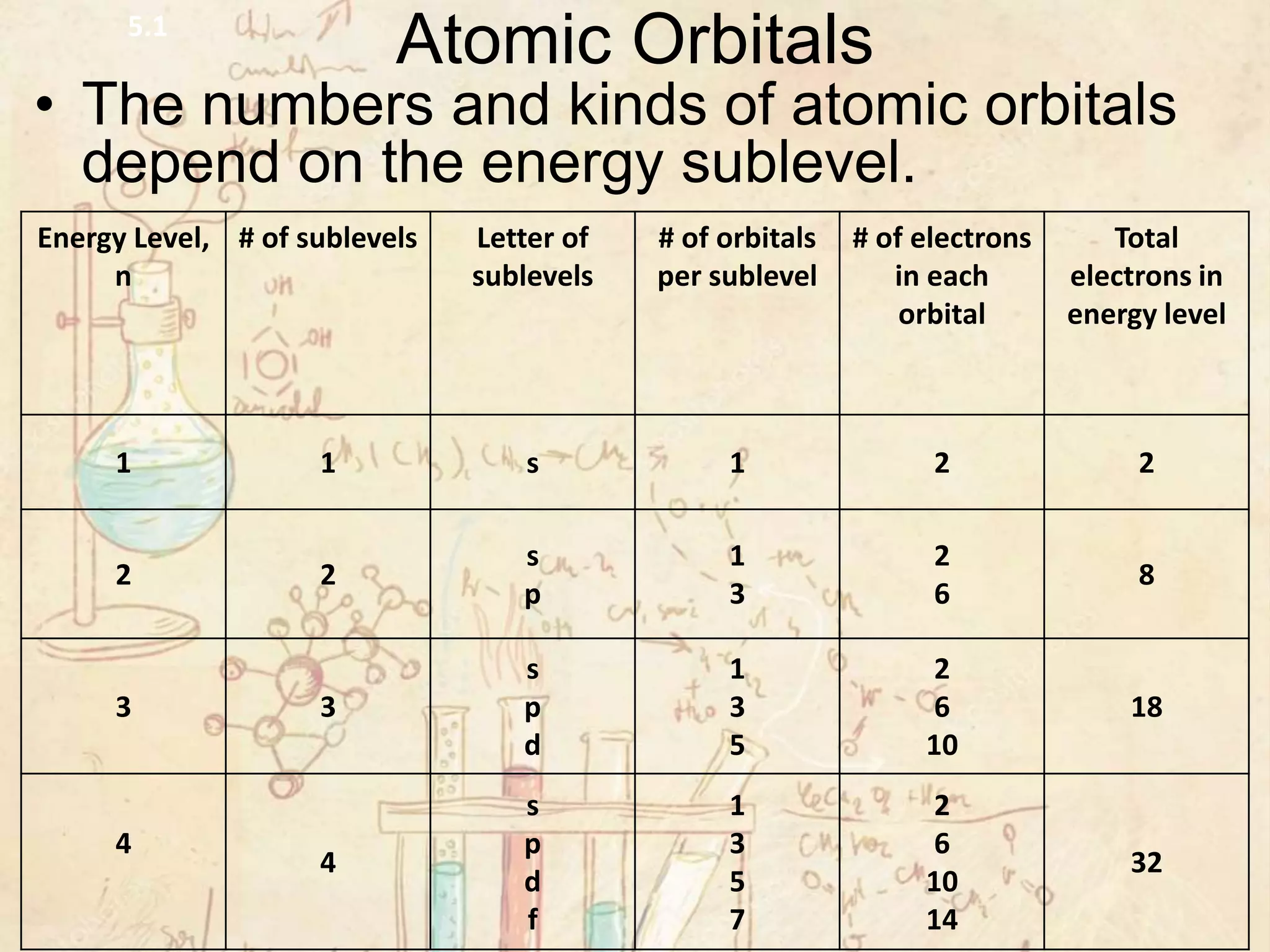
Atomic Orbitals
• The numbers and kinds of atomic orbitals
depend on the energy sublevel.
5.1
Energy Level,
n
# of sublevels Letter of
sublevels
# of orbitals
per sublevel
# of electrons
in each
orbital
Total
electrons in
energy level
1 1 s 1 2 2
2 2
s
p
1
3
2
6
8
3 3
s
p
d
1
3
5
2
6
10
18
4
4
s
p
d
f
1
3
5
7
2
6
10
14
32
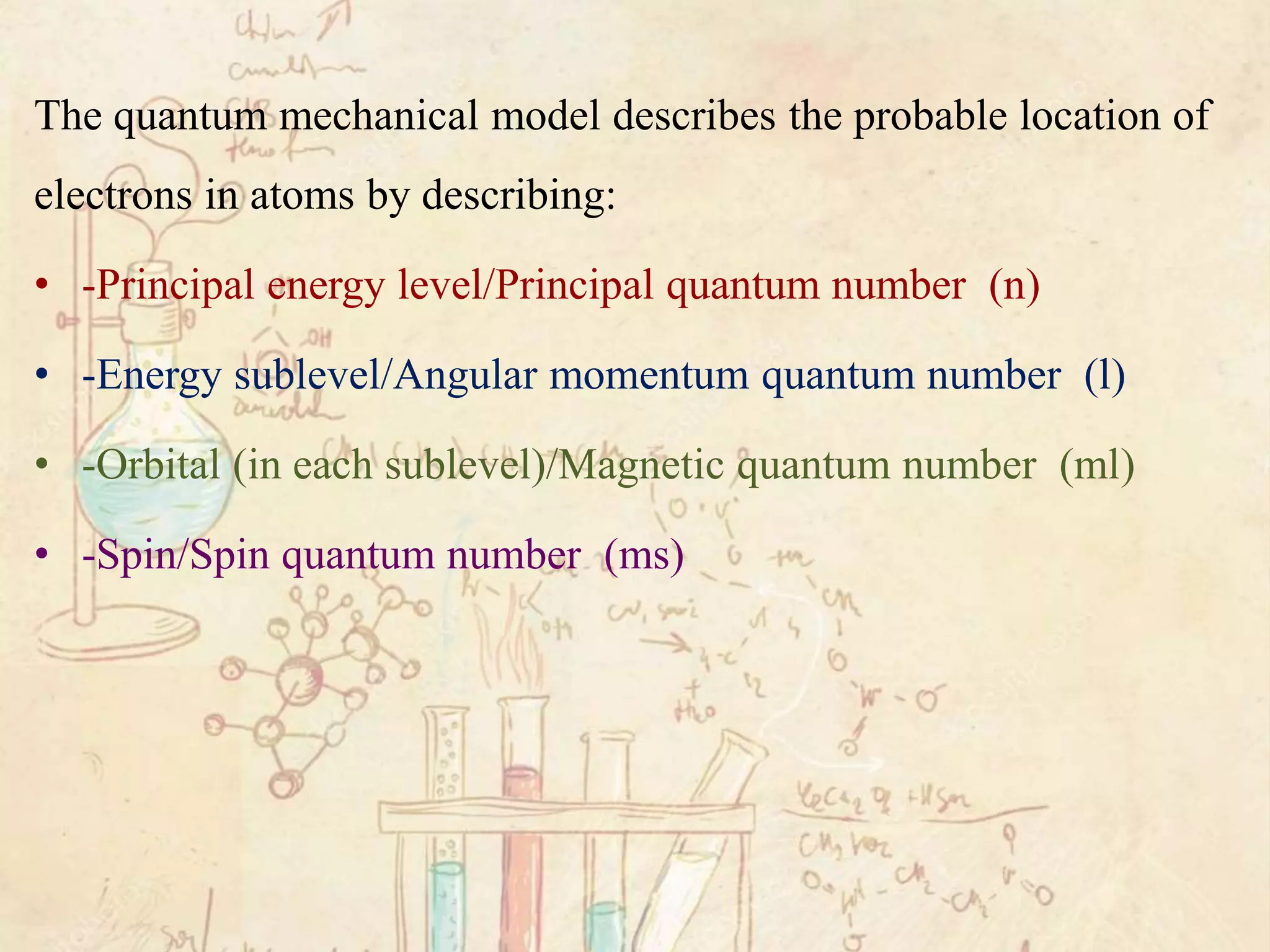
The quantum mechanical model describes the probable location of
electrons in atoms by describing:
• -Principal energy level/Principal quantum number (n)
• -Energy sublevel/Angular momentum quantum number (l)
• -Orbital (in each sublevel)/Magnetic quantum number (ml)
• -Spin/Spin quantum number (ms)
.Copyright © Houghton Mifflin Company.All rights reserved. Presentation of Lecture Outlines, 7–28
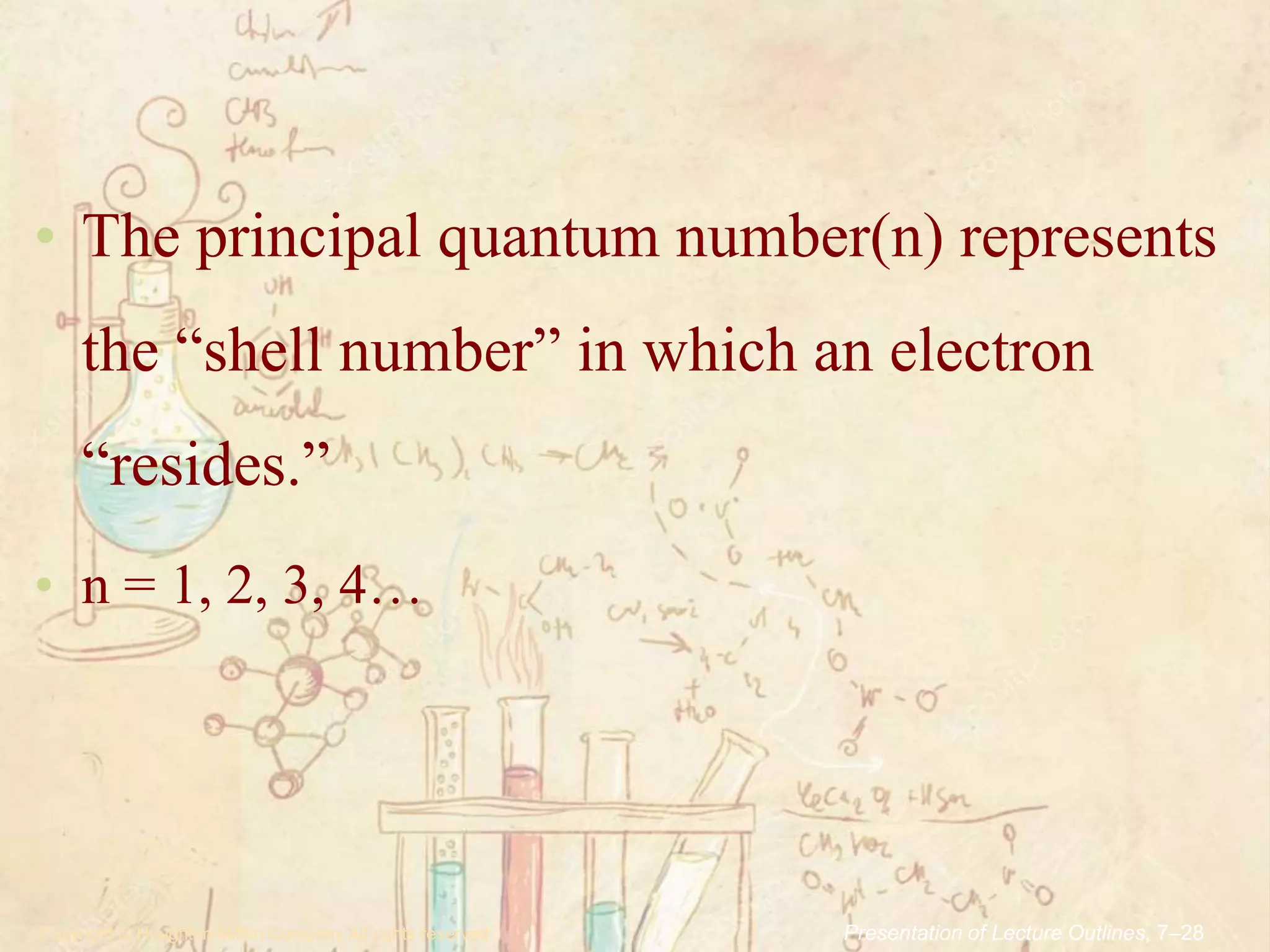
• The principal quantum number(n) represents
the “shell number” in which an electron
“resides.”
• n = 1, 2, 3, 4…
.Copyright © Houghton Mifflin Company.All rights reserved. Presentation of Lecture Outlines, 7–29
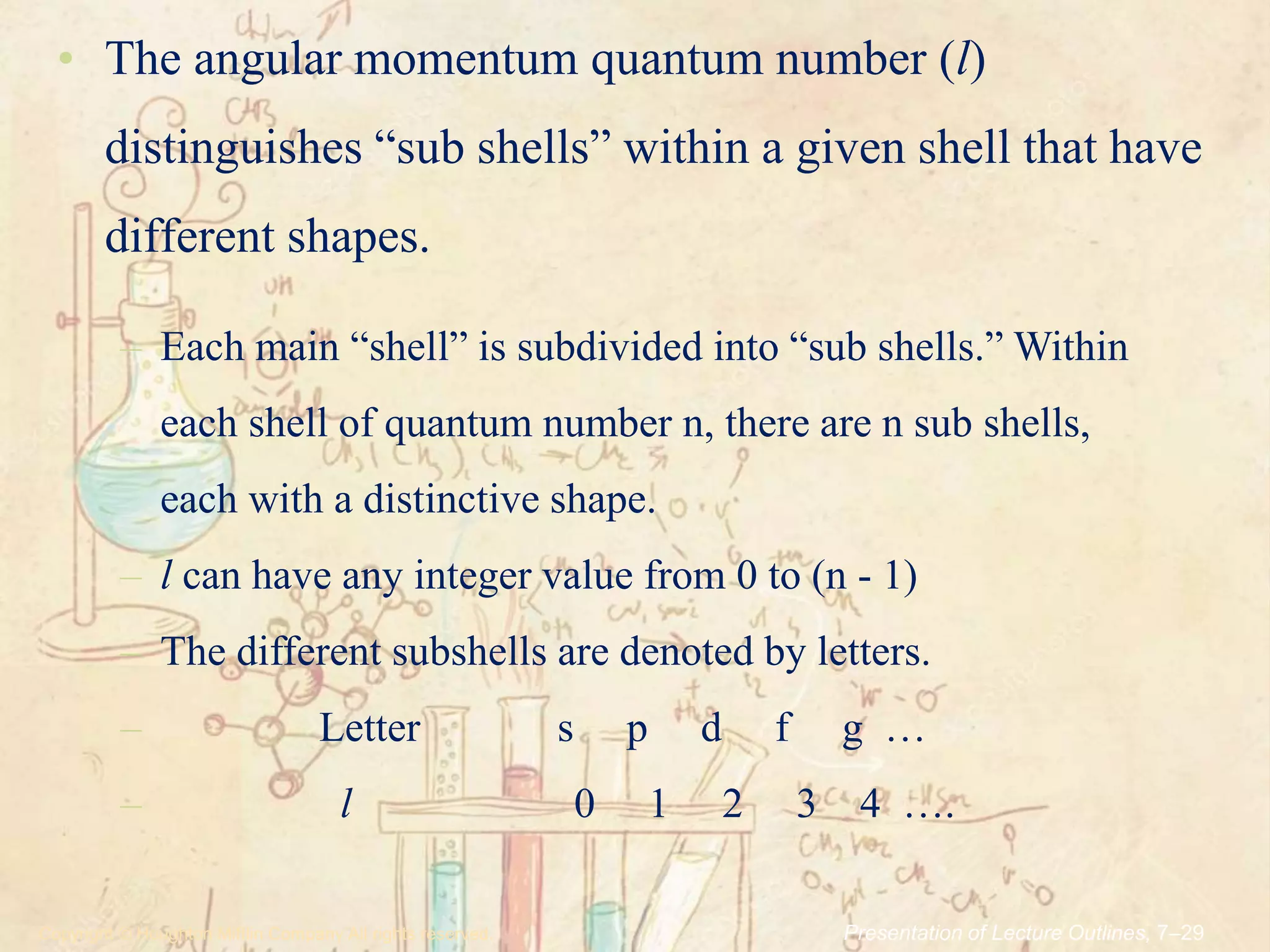
• The angular momentum quantum number (l)
distinguishes “sub shells” within a given shell that have
different shapes.
– Each main “shell” is subdivided into “sub shells.” Within
each shell of quantum number n, there are n sub shells,
each with a distinctive shape.
– l can have any integer value from 0 to (n - 1)
– The different subshells are denoted by letters.
– Letter s p d f g …
– l 0 1 2 3 4 ….
.Copyright © Houghton Mifflin Company.All rights reserved. Presentation of Lecture Outlines, 7–30
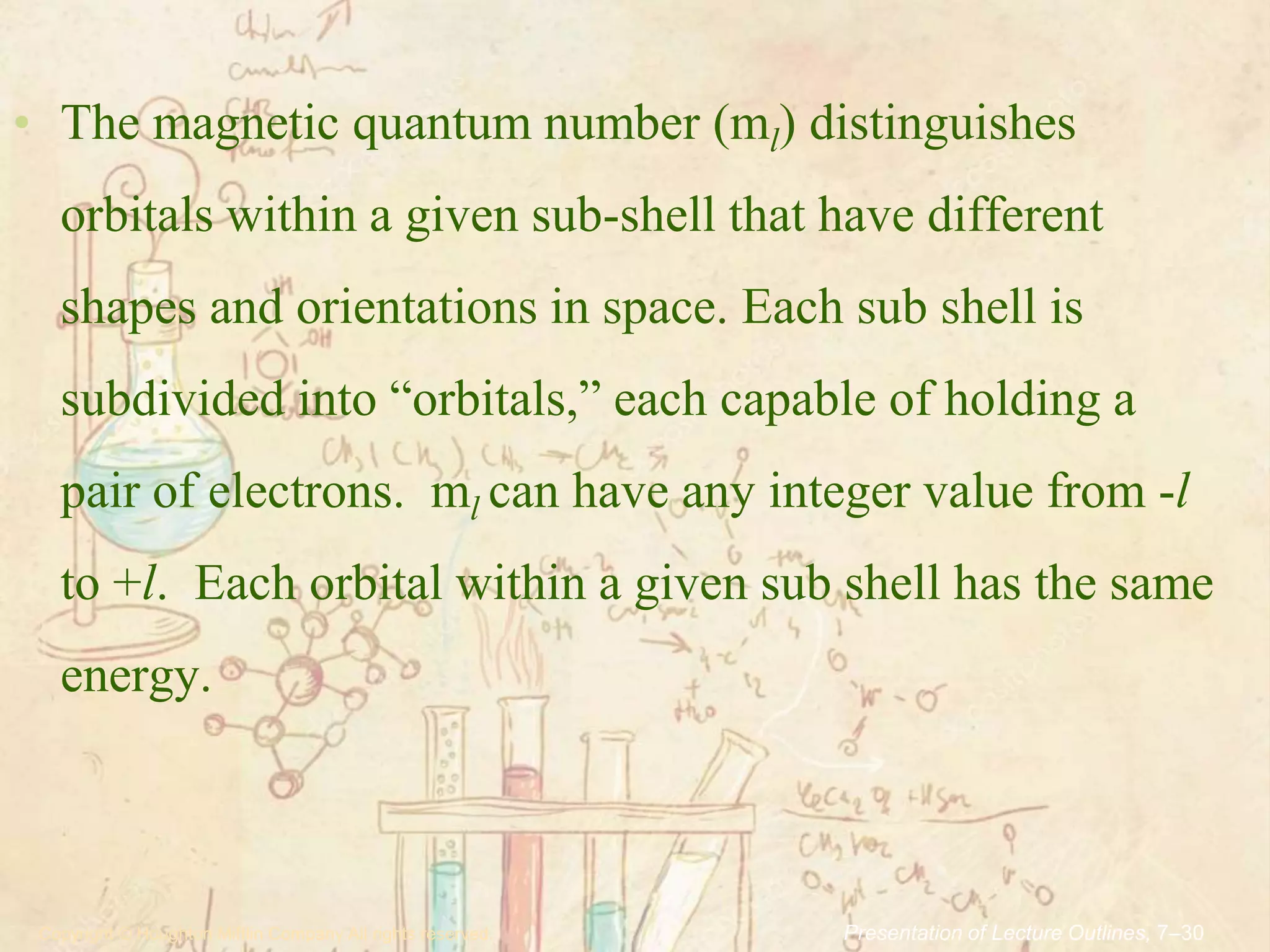
• The magnetic quantum number (ml) distinguishes
orbitals within a given sub-shell that have different
shapes and orientations in space. Each sub shell is
subdivided into “orbitals,” each capable of holding a
pair of electrons. ml can have any integer value from -l
to +l. Each orbital within a given sub shell has the same
energy.
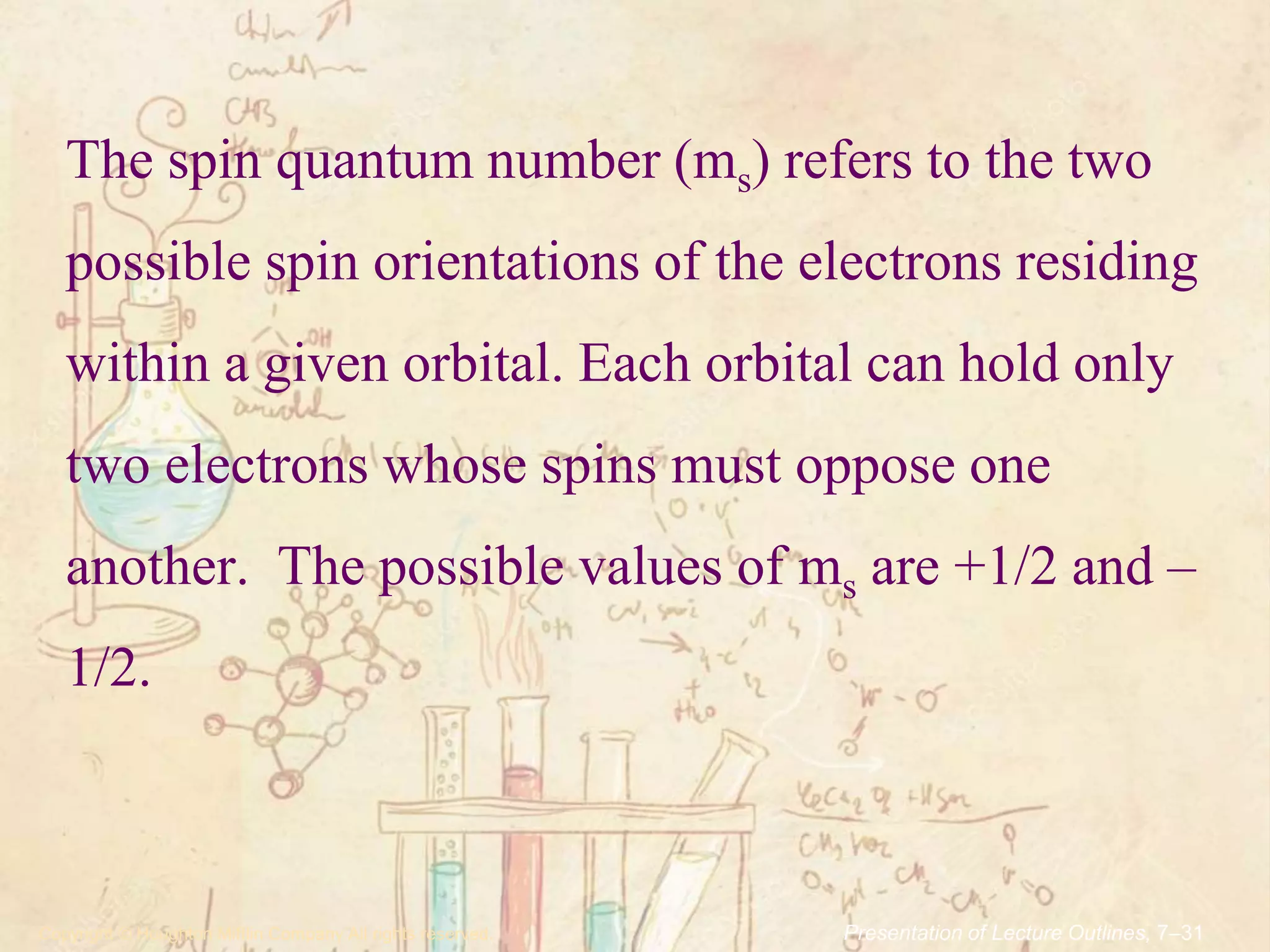
The spin quantum number (ms) refers to the two
possible spin orientations of the electrons residing
within a given orbital. Each orbital can hold only
two electrons whose spins must oppose one
another. The possible values of ms are +1/2 and –
1/2.
.Copyright © Houghton Mifflin Company.All rights reserved. Presentation of Lecture Outlines, 7–31
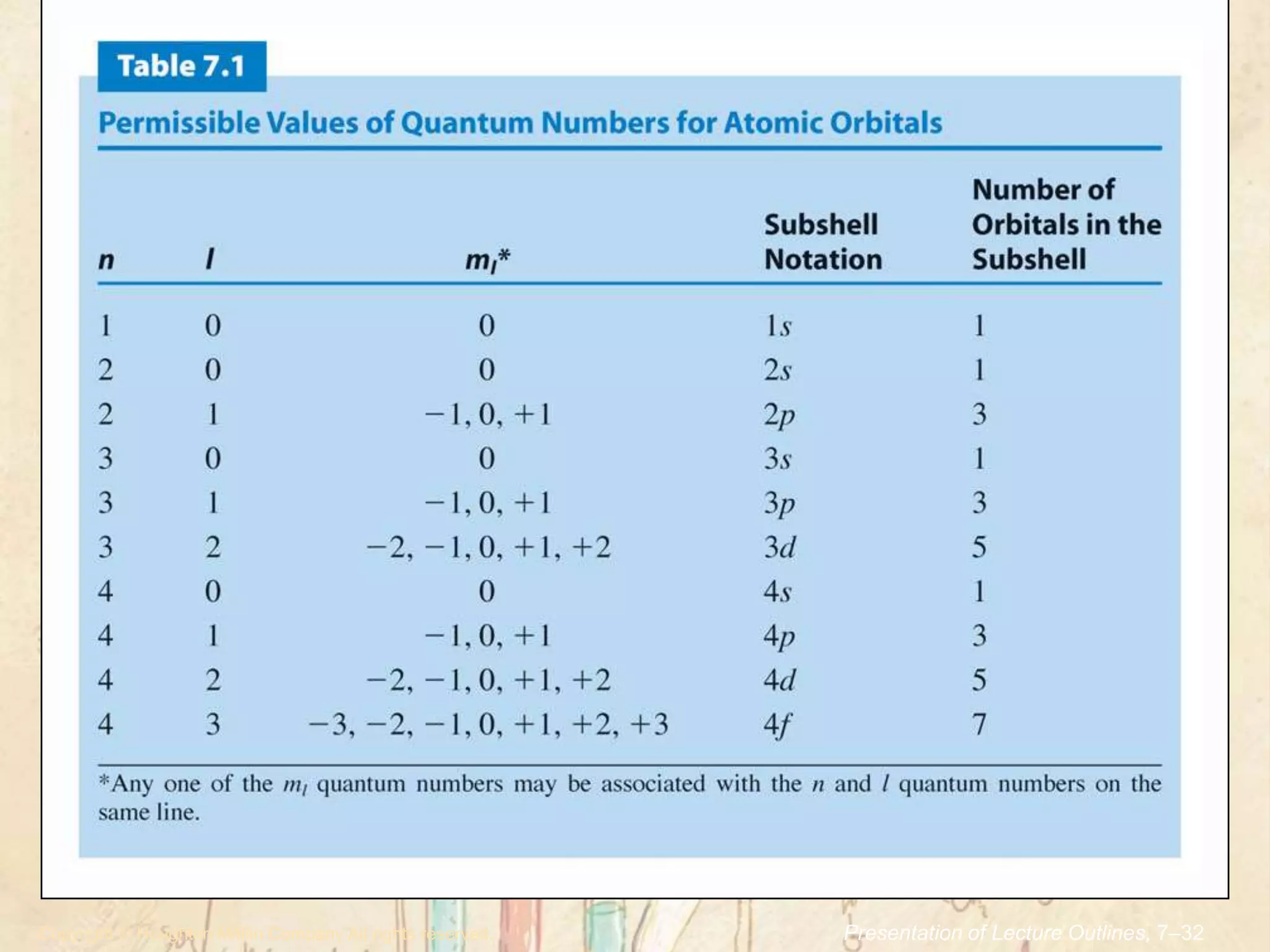
.Copyright © Houghton Mifflin Company.All rights reserved. Presentation of Lecture Outlines, 7–32
.Copyright © Houghton Mifflin Company.All rights reserved. Presentation of Lecture Outlines, 7–33
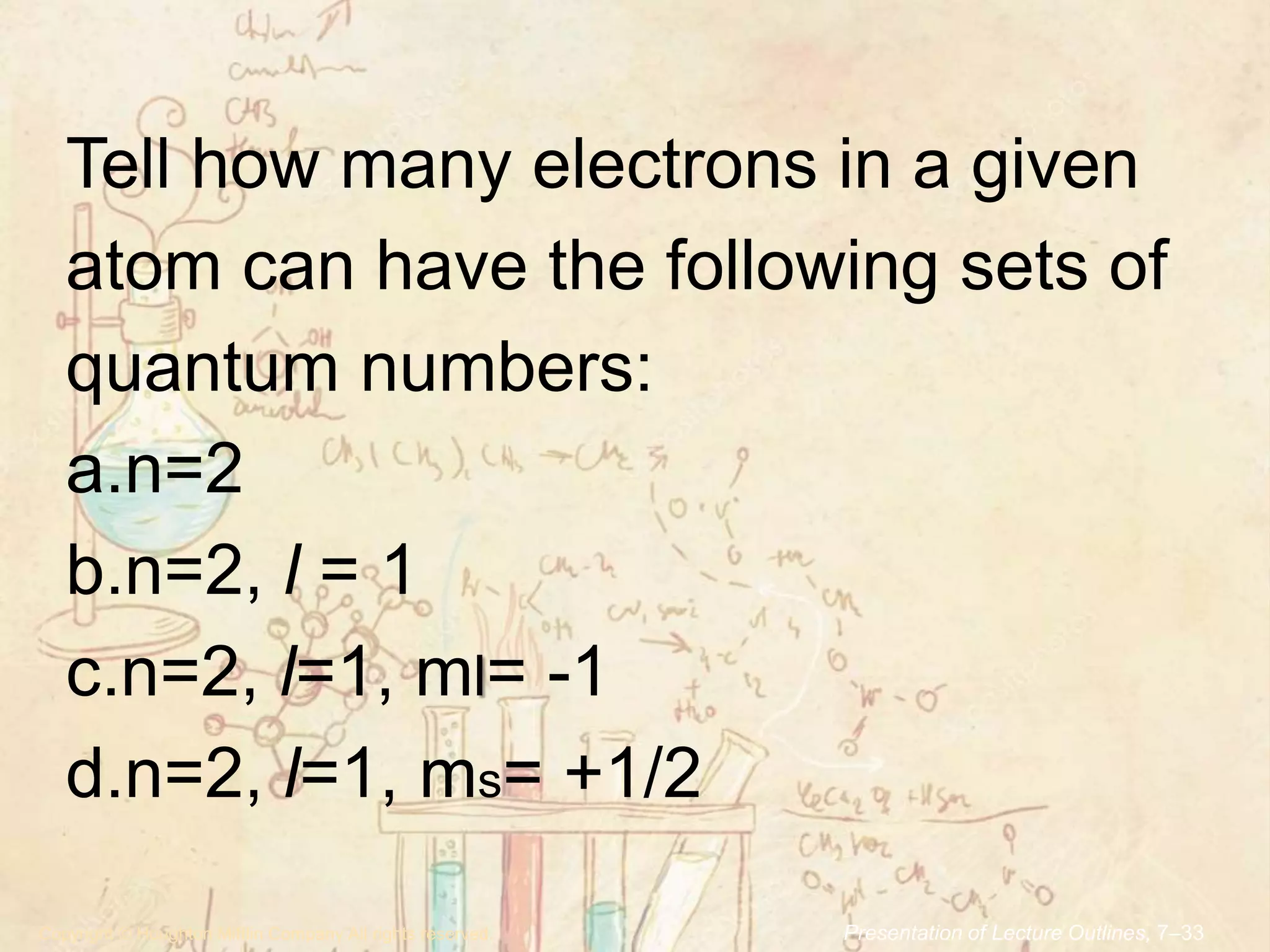
Tell how many electrons in a given
atom can have the following sets of
quantum numbers:
a.n=2
b.n=2, l = 1
c.n=2, l=1, ml= -1
d.n=2, l=1, ms= +1/2
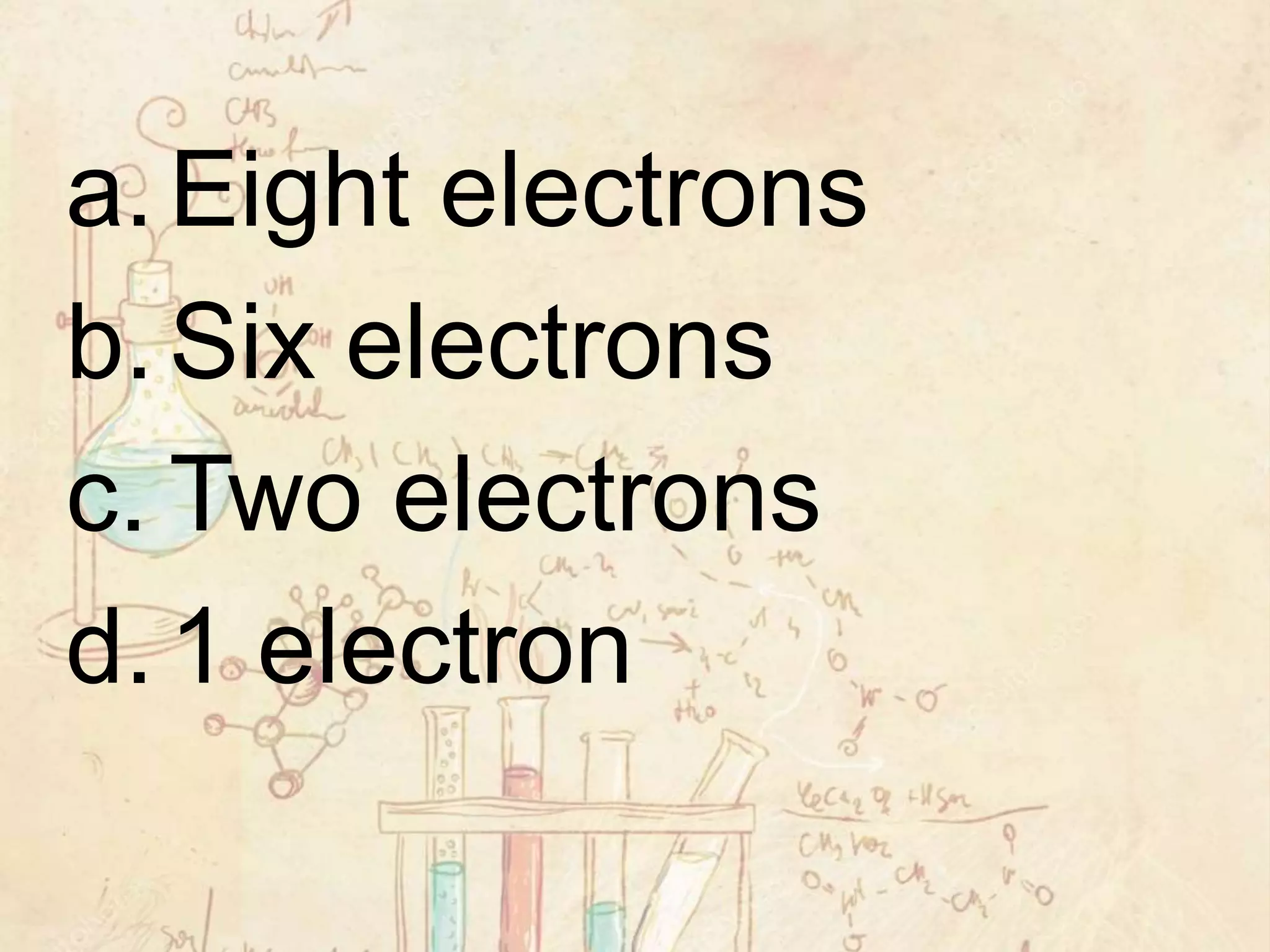
a.Eight electrons
b.Six electrons
c. Two electrons
d.1 electron
how is it likely to find the electron in
an atom by probability?
.Copyright © Houghton Mifflin Company.All rights reserved. Presentation of Lecture Outlines, 7–35
ASSESSMENT
.Copyright © Houghton Mifflin Company.All rights reserved. Presentation of Lecture Outlines, 7–36
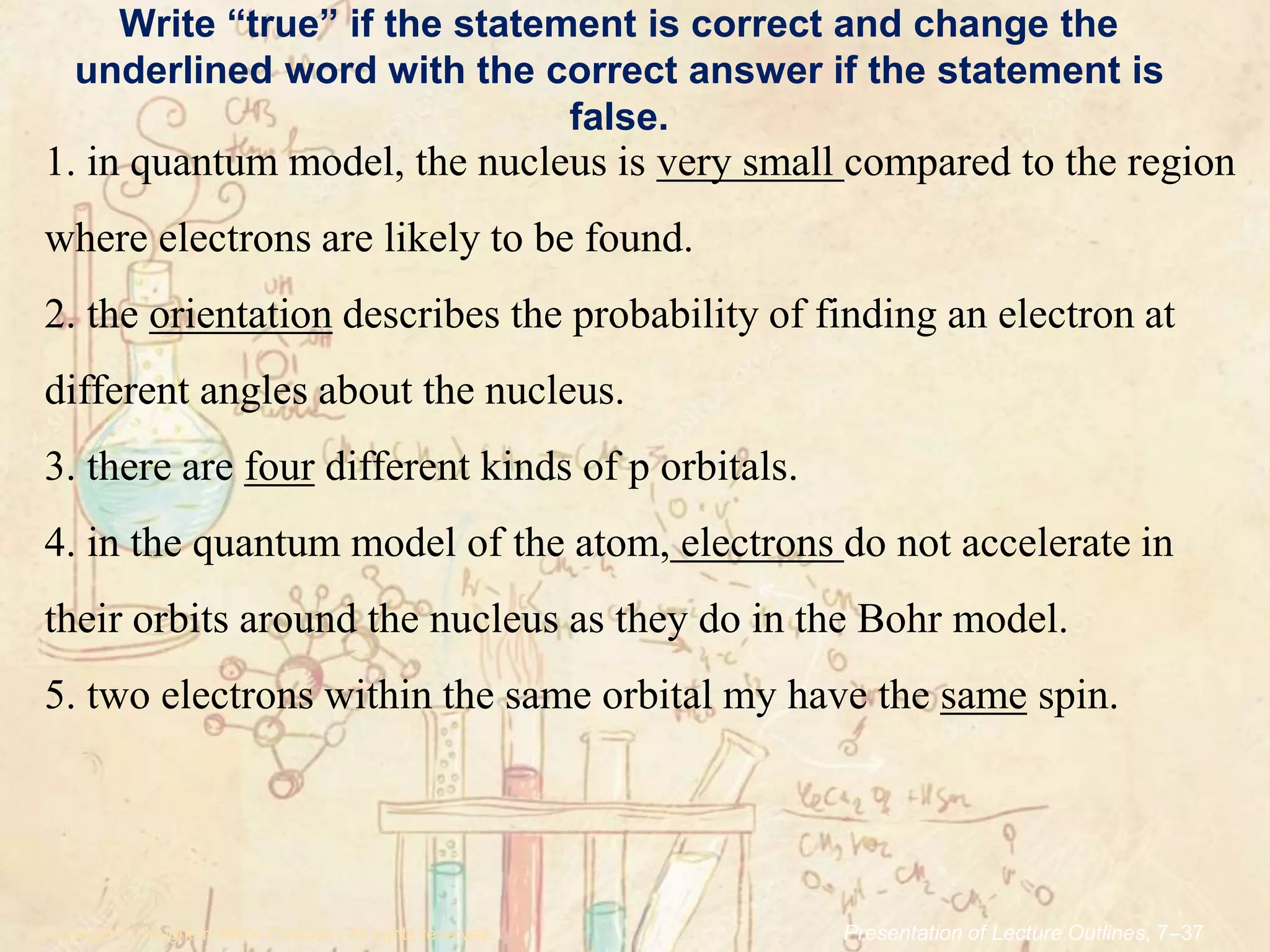
Write “true” if the statement is correct and change the
underlined word with the correct answer if the statement is
false.
.Copyright © Houghton Mifflin Company.All rights reserved. Presentation of Lecture Outlines, 7–37
1. in quantum model, the nucleus is very small compared to the region
where electrons are likely to be found.
2. the orientation describes the probability of finding an electron at
different angles about the nucleus.
3. there are four different kinds of p orbitals.
4. in the quantum model of the atom, electrons do not accelerate in
their orbits around the nucleus as they do in the Bohr model.
5. two electrons within the same orbital my have the same spin.
Identification
.Copyright © Houghton Mifflin Company.All rights reserved. Presentation of Lecture Outlines, 7–38
1. The spin quantum number describes what?
2. The fourth quantum number is called what?
3. The magnetic quantum number describes what?
4. Scientist accept that an electron spends how much time inside
an atomic orbital?
5. Each orbital holds how many electrons?
6 – 7. probabilities are used because of Heseinberg’s Uncertainty
Principle. This principle states that the ___ and ___ of an electron
can be measured but not simultaneously.
Identification
.Copyright © Houghton Mifflin Company.All rights reserved. Presentation of Lecture Outlines, 7–39
8. Why are electrons assigned quantum numbers?
9. Electrons are assigned how many quantum numbers?
10. The first quantum number is called what?
11. The principal quantum number describes what?
12. Which principal quantum number describes the ground state?
13. The second quantum number is called what?
14. The azimuthal quantum number describes what?
Identification
.Copyright © Houghton Mifflin Company.All rights reserved. Presentation of Lecture Outlines, 7–40
15. The third quantum number is called what?
16. The magnetic quantum number describes what?
17. It is a region in space in which the electrons are most likely to
be found.
18. What is the shape of the p orbitals?
.Copyright © Houghton Mifflin Company.All rights reserved. Presentation of Lecture Outlines, 7–41
Direction: tell what type of orbital (such as 1s,
3d, and so on) is described by each of the
following sets of quantum numbers:
1. n=2, l=0
2. n=4, l=2
3. n=3, l=1
4. n=4, l=0
5. n=5, l=3
.Copyright © Houghton Mifflin Company.All rights reserved. Presentation of Lecture Outlines, 7–42
Direction: tell how many electrons there can be
in a given atom, with the following sets of
quantum numbers.
1. n=4
2. n=3, l=2
3. n=4, l=2,m1= -1,0
4. n=8 (3 pts.)
5. n=3, l=2, m1=1, ms=+1/2
.Copyright © Houghton Mifflin Company.All rights reserved. Presentation of Lecture Outlines, 7–43
Direction: tell how many orbitals there are
in each of the following sets.
1. s
2. d
3. g
4. i
5. p
Answer
.Copyright © Houghton Mifflin Company.All rights reserved. Presentation of Lecture Outlines, 7–44
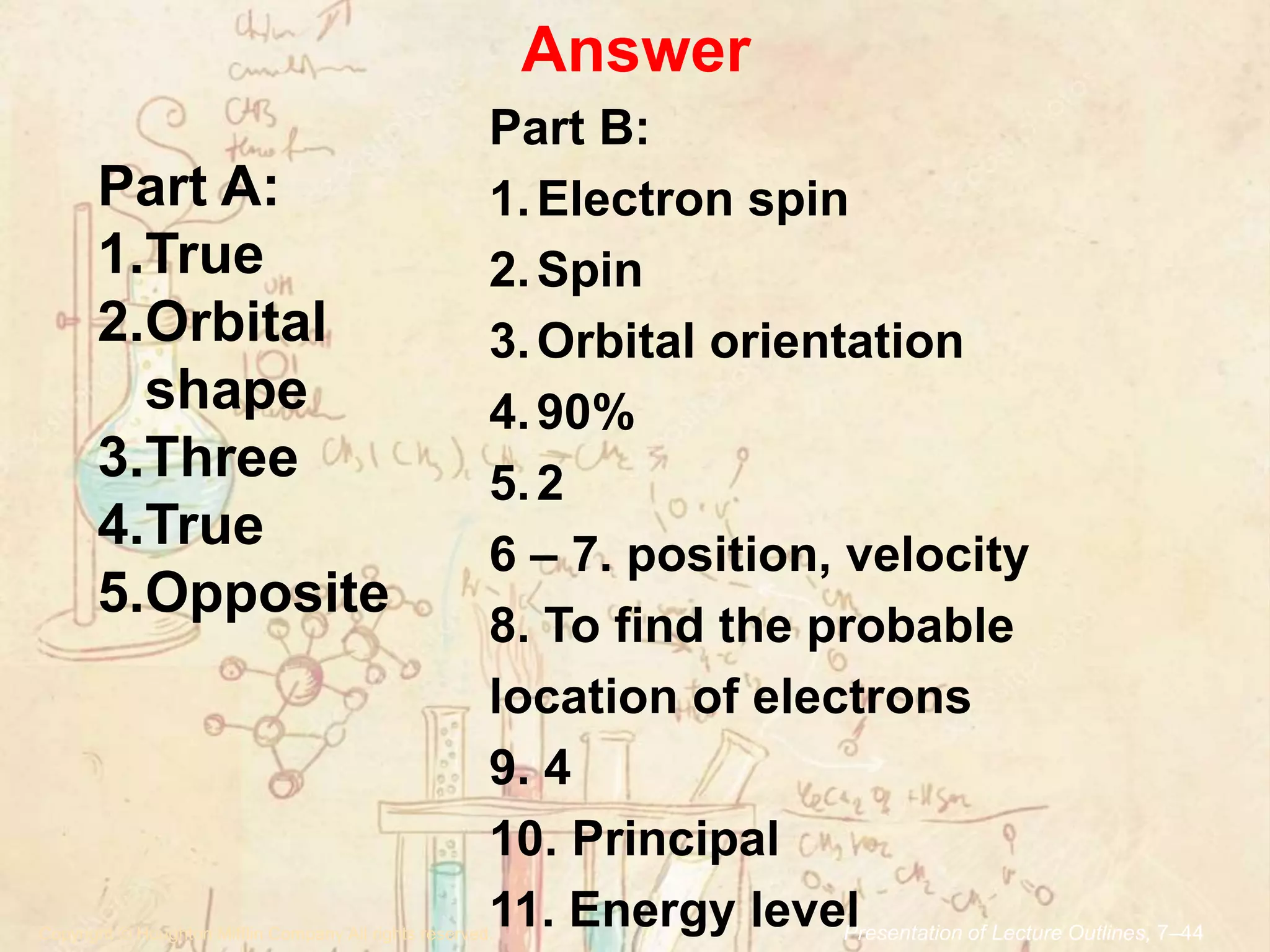
Part A:
1.True
2.Orbital
shape
3.Three
4.True
5.Opposite
Part B:
1.Electron spin
2.Spin
3.Orbital orientation
4.90%
5.2
6 – 7. position, velocity
8. To find the probable
location of electrons
9. 4
10. Principal
11. Energy level
Answer
.Copyright © Houghton Mifflin Company.All rights reserved. Presentation of Lecture Outlines, 7–45
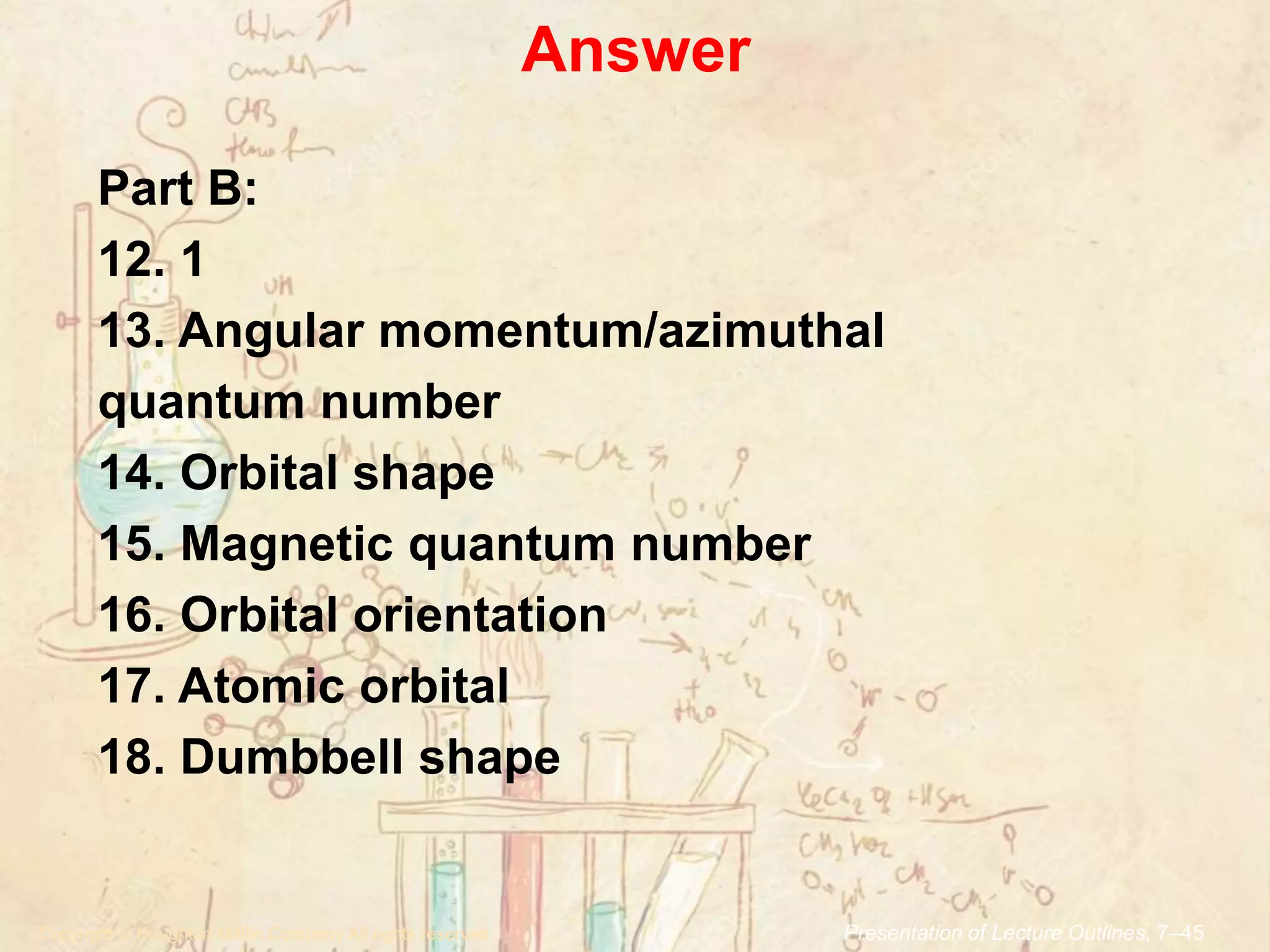
Part B:
12. 1
13. Angular momentum/azimuthal
quantum number
14. Orbital shape
15. Magnetic quantum number
16. Orbital orientation
17. Atomic orbital
18. Dumbbell shape
Answer
.Copyright © Houghton Mifflin Company.All rights reserved. Presentation of Lecture Outlines, 7–46
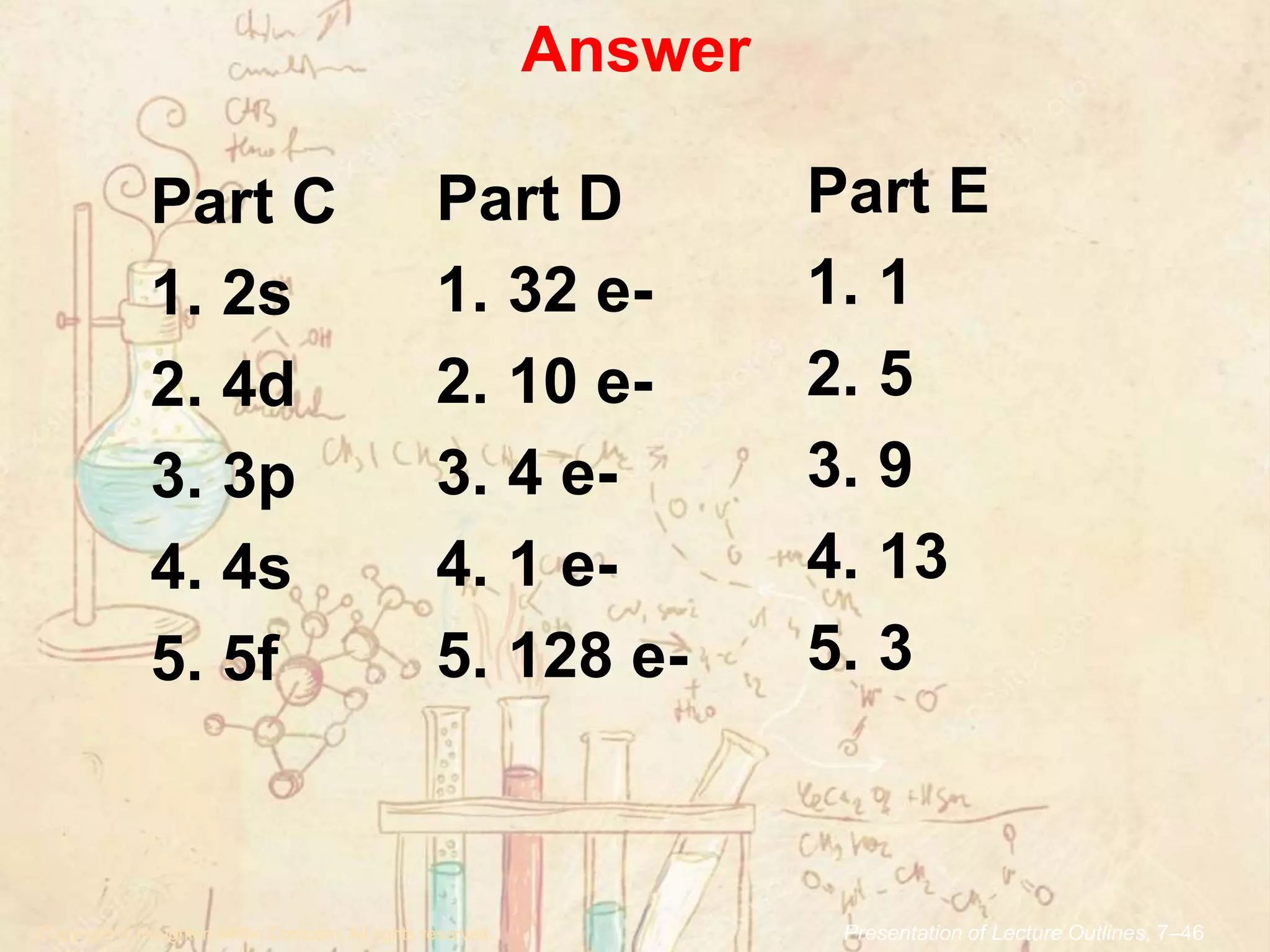
Part C
1. 2s
2. 4d
3. 3p
4. 4s
5. 5f
Part D
1. 32 e-
2. 10 e-
3. 4 e-
4. 1 e-
5. 128 e-
Part E
1. 1
2. 5
3. 9
4. 13
5. 3
ASSIGNMENT
.Copyright © Houghton Mifflin Company.All rights reserved. Presentation of Lecture Outlines, 7–47
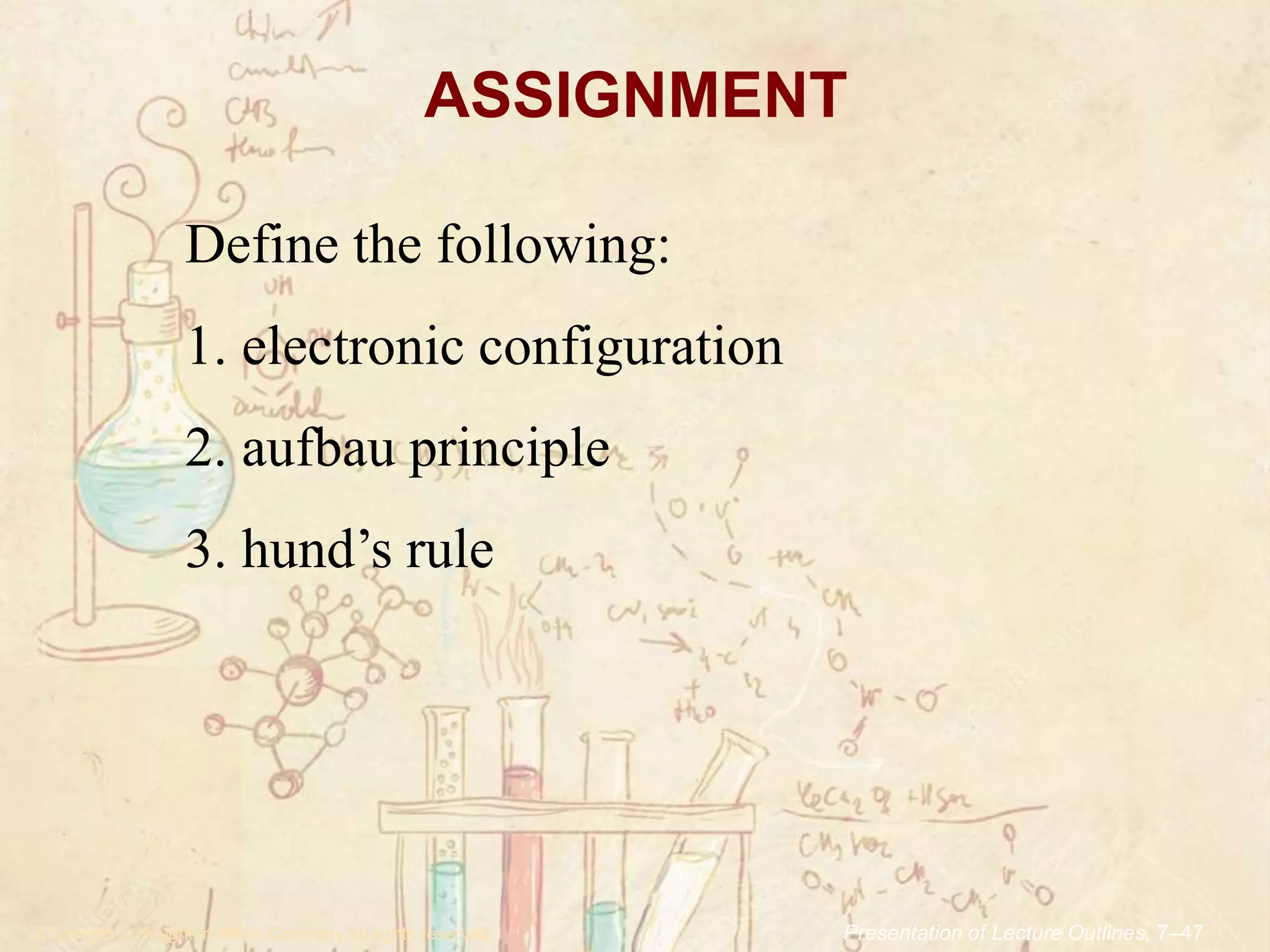
Define the following:
1. electronic configuration
2. aufbau principle
3. hund’s rule

The quantum mechanical model of the atom

  • 2.
    What is thechance of finding an electron in the nucleus?
  • 3.
    QUANTUM MECHANICAL MODELOF ATOM STATES THAT: • Electrons are NOT in circular orbits around nucleus. • Electrons are in a 3-D region around the nucleus called atomic orbitals. • The atomic orbital describes the probable location of the electron.
  • 5.
    Where does thismodel come from? A quick history. • Louis de Broglie: Electrons behave with wave and particle properties at the same time.
  • 6.
    • Werner Heisenberg:It is impossible to know both the position and velocity of an electron simultaneously. • *Heisenberg's Uncertainty Principle
  • 7.
    Erwin Schrodinger: Refinedthe wave-particle theory proposed by de Broglie. Developed an equation that treated an electron like a wave and predicted the probable location of an electron around the nucleus called the atomic orbital.
  • 8.
    The quantum mechanicalmodel of the atom treats an electron like a wave.
  • 9.
    The Quantum MechanicalModel –The quantum model determines the allowed energies an electron can have and how likely it is to find the electron in various locations around the nucleus. 5.1
  • 10.
    The Quantum MechanicalModel • The probability of finding an electron within a certain volume of space surrounding the nucleus can be represented as a fuzzy cloud. – The cloud is more dense where the probability of finding the electron is high.
  • 11.
    Atomic Orbitals • (fuzzycloud) = An atomic orbital is often thought of as a region of space in which there is a high probability of finding an electron. 5.1
  • 12.
    Quantum Mechanics Radial DistributionCurveOrbital • Orbital (“electron cloud”) –Region in space where there is 90% probability of finding an e-
  • 13.
    .Copyright © HoughtonMifflin Company.All rights reserved. Presentation of Lecture Outlines, 7–13 Scanning Tunneling Microscope Electron Clouds
  • 14.
  • 15.
    Smaller atom Smaller atom— Fewerelectrons take up less space. Larger atom— More electrons take up more space. s-orbitals are spherically shaped.
  • 16.
  • 17.
  • 18.
  • 19.
  • 21.
    Shells and Orbitalsand Atomic Structure •Shells of an atom contain a number of stacked orbitals 1 2 3 4 s p d f
  • 22.
    1st and 2ndlevel s-orbitals and the p-orbitals all together.
  • 23.
    Atomic Orbitals 5.1 • Differentatomic orbitals are denoted by letters. The s orbitals are spherical, and p orbitals are dumbbell- shaped. • Four of the five d orbitals have the same shape but different orientations in space.
  • 24.
    .Copyright © HoughtonMifflin Company.All rights reserved. Presentation of Lecture Outlines, 7–24 1s 3s2s 2px 3pz 3d 2py 2pz 3py 3px
  • 25.
    Atomic Orbitals • Thenumbers and kinds of atomic orbitals depend on the energy sublevel. 5.1 Energy Level, n # of sublevels Letter of sublevels # of orbitals per sublevel # of electrons in each orbital Total electrons in energy level
  • 26.
    Atomic Orbitals • Thenumbers and kinds of atomic orbitals depend on the energy sublevel. 5.1 Energy Level, n # of sublevels Letter of sublevels # of orbitals per sublevel # of electrons in each orbital Total electrons in energy level 1 1 s 1 2 2 2 2 s p 1 3 2 6 8 3 3 s p d 1 3 5 2 6 10 18 4 4 s p d f 1 3 5 7 2 6 10 14 32
  • 27.
    The quantum mechanicalmodel describes the probable location of electrons in atoms by describing: • -Principal energy level/Principal quantum number (n) • -Energy sublevel/Angular momentum quantum number (l) • -Orbital (in each sublevel)/Magnetic quantum number (ml) • -Spin/Spin quantum number (ms)
  • 28.
    .Copyright © HoughtonMifflin Company.All rights reserved. Presentation of Lecture Outlines, 7–28 • The principal quantum number(n) represents the “shell number” in which an electron “resides.” • n = 1, 2, 3, 4…
  • 29.
    .Copyright © HoughtonMifflin Company.All rights reserved. Presentation of Lecture Outlines, 7–29 • The angular momentum quantum number (l) distinguishes “sub shells” within a given shell that have different shapes. – Each main “shell” is subdivided into “sub shells.” Within each shell of quantum number n, there are n sub shells, each with a distinctive shape. – l can have any integer value from 0 to (n - 1) – The different subshells are denoted by letters. – Letter s p d f g … – l 0 1 2 3 4 ….
  • 30.
    .Copyright © HoughtonMifflin Company.All rights reserved. Presentation of Lecture Outlines, 7–30 • The magnetic quantum number (ml) distinguishes orbitals within a given sub-shell that have different shapes and orientations in space. Each sub shell is subdivided into “orbitals,” each capable of holding a pair of electrons. ml can have any integer value from -l to +l. Each orbital within a given sub shell has the same energy.
  • 31.
    The spin quantumnumber (ms) refers to the two possible spin orientations of the electrons residing within a given orbital. Each orbital can hold only two electrons whose spins must oppose one another. The possible values of ms are +1/2 and – 1/2. .Copyright © Houghton Mifflin Company.All rights reserved. Presentation of Lecture Outlines, 7–31
  • 32.
    .Copyright © HoughtonMifflin Company.All rights reserved. Presentation of Lecture Outlines, 7–32
  • 33.
    .Copyright © HoughtonMifflin Company.All rights reserved. Presentation of Lecture Outlines, 7–33 Tell how many electrons in a given atom can have the following sets of quantum numbers: a.n=2 b.n=2, l = 1 c.n=2, l=1, ml= -1 d.n=2, l=1, ms= +1/2
  • 34.
    a.Eight electrons b.Six electrons c.Two electrons d.1 electron
  • 35.
    how is itlikely to find the electron in an atom by probability? .Copyright © Houghton Mifflin Company.All rights reserved. Presentation of Lecture Outlines, 7–35
  • 36.
    ASSESSMENT .Copyright © HoughtonMifflin Company.All rights reserved. Presentation of Lecture Outlines, 7–36
  • 37.
    Write “true” ifthe statement is correct and change the underlined word with the correct answer if the statement is false. .Copyright © Houghton Mifflin Company.All rights reserved. Presentation of Lecture Outlines, 7–37 1. in quantum model, the nucleus is very small compared to the region where electrons are likely to be found. 2. the orientation describes the probability of finding an electron at different angles about the nucleus. 3. there are four different kinds of p orbitals. 4. in the quantum model of the atom, electrons do not accelerate in their orbits around the nucleus as they do in the Bohr model. 5. two electrons within the same orbital my have the same spin.
  • 38.
    Identification .Copyright © HoughtonMifflin Company.All rights reserved. Presentation of Lecture Outlines, 7–38 1. The spin quantum number describes what? 2. The fourth quantum number is called what? 3. The magnetic quantum number describes what? 4. Scientist accept that an electron spends how much time inside an atomic orbital? 5. Each orbital holds how many electrons? 6 – 7. probabilities are used because of Heseinberg’s Uncertainty Principle. This principle states that the ___ and ___ of an electron can be measured but not simultaneously.
  • 39.
    Identification .Copyright © HoughtonMifflin Company.All rights reserved. Presentation of Lecture Outlines, 7–39 8. Why are electrons assigned quantum numbers? 9. Electrons are assigned how many quantum numbers? 10. The first quantum number is called what? 11. The principal quantum number describes what? 12. Which principal quantum number describes the ground state? 13. The second quantum number is called what? 14. The azimuthal quantum number describes what?
  • 40.
    Identification .Copyright © HoughtonMifflin Company.All rights reserved. Presentation of Lecture Outlines, 7–40 15. The third quantum number is called what? 16. The magnetic quantum number describes what? 17. It is a region in space in which the electrons are most likely to be found. 18. What is the shape of the p orbitals?
  • 41.
    .Copyright © HoughtonMifflin Company.All rights reserved. Presentation of Lecture Outlines, 7–41 Direction: tell what type of orbital (such as 1s, 3d, and so on) is described by each of the following sets of quantum numbers: 1. n=2, l=0 2. n=4, l=2 3. n=3, l=1 4. n=4, l=0 5. n=5, l=3
  • 42.
    .Copyright © HoughtonMifflin Company.All rights reserved. Presentation of Lecture Outlines, 7–42 Direction: tell how many electrons there can be in a given atom, with the following sets of quantum numbers. 1. n=4 2. n=3, l=2 3. n=4, l=2,m1= -1,0 4. n=8 (3 pts.) 5. n=3, l=2, m1=1, ms=+1/2
  • 43.
    .Copyright © HoughtonMifflin Company.All rights reserved. Presentation of Lecture Outlines, 7–43 Direction: tell how many orbitals there are in each of the following sets. 1. s 2. d 3. g 4. i 5. p
  • 44.
    Answer .Copyright © HoughtonMifflin Company.All rights reserved. Presentation of Lecture Outlines, 7–44 Part A: 1.True 2.Orbital shape 3.Three 4.True 5.Opposite Part B: 1.Electron spin 2.Spin 3.Orbital orientation 4.90% 5.2 6 – 7. position, velocity 8. To find the probable location of electrons 9. 4 10. Principal 11. Energy level
  • 45.
    Answer .Copyright © HoughtonMifflin Company.All rights reserved. Presentation of Lecture Outlines, 7–45 Part B: 12. 1 13. Angular momentum/azimuthal quantum number 14. Orbital shape 15. Magnetic quantum number 16. Orbital orientation 17. Atomic orbital 18. Dumbbell shape
  • 46.
    Answer .Copyright © HoughtonMifflin Company.All rights reserved. Presentation of Lecture Outlines, 7–46 Part C 1. 2s 2. 4d 3. 3p 4. 4s 5. 5f Part D 1. 32 e- 2. 10 e- 3. 4 e- 4. 1 e- 5. 128 e- Part E 1. 1 2. 5 3. 9 4. 13 5. 3
  • 47.
    ASSIGNMENT .Copyright © HoughtonMifflin Company.All rights reserved. Presentation of Lecture Outlines, 7–47 Define the following: 1. electronic configuration 2. aufbau principle 3. hund’s rule