Chapter 5 Electrons in Atoms
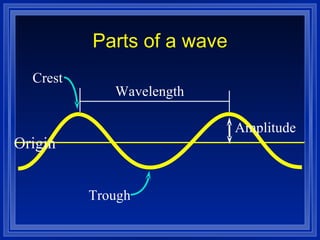
Light and Quantized Energy (5.1) The study of light led to the development of the  quantum mechanical model. Light is a kind of  electromagnetic radiation EM).  All move at  3.00 x 10 8  m/s  (c)  Speed of light.
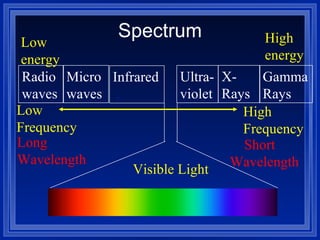
Spectrum Radio waves Microwaves Infrared  .   Ultra-violet X-Rays Gamma Rays Long Wavelength Short  Wavelength Visible Light Low energy High energy Low Frequency High Frequency
Light is a Particle Light is energy, Energy is quantized, therefore, Light must be quantized. These quantized pieces of light are called  photons .
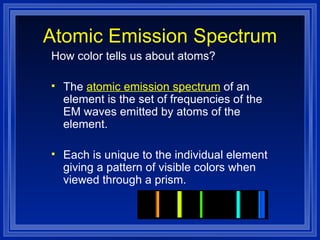
Atomic Emission Spectrum How color tells us about atoms? The  atomic emission spectrum  of an element is the set of frequencies of the EM waves emitted by atoms of the element.  Each is unique to the individual element giving a pattern of visible colors when viewed through a prism.
Prism White light is made up of all the colors of the visible spectrum. Passing it through a prism separates it into colors.
If the light is not white By heating a gas or with electricity we can get it to give off colors. Passing this light through a prism shows a unique color pattern
Atomic Emission Spectrum Each element gives off its own characteristic colors. Can be used to identify the atom. This is how we know what stars are made of.
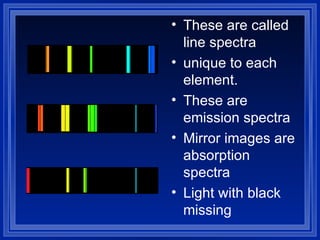
These are called line spectra unique to each element. These are emission spectra Mirror images are absorption spectra Light with black missing
An explanation of the Atomic Emission Spectra
Where the electron starts When we write electron configurations we are starting at the writing the lowest  energy level. The energy level an electron starts from is called its  ground   state .
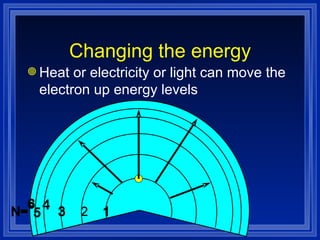
Heat or electricity or light can move the electron up energy levels Changing the energy
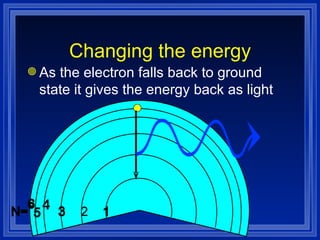
As the electron falls back to ground state it gives the energy back as light Changing the energy
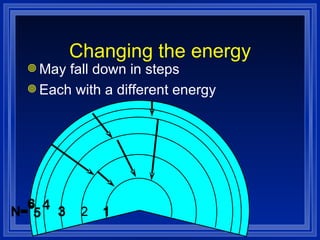
May fall down in steps Each with a different energy Changing the energy
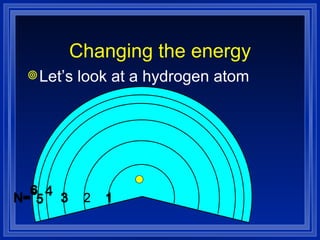
The Bohr Ring Atom n = 3 n = 4 n = 2 n = 1
The Further the electrons fall, the more the energy and the higher the frequency. Ultraviolet Visible Infrared
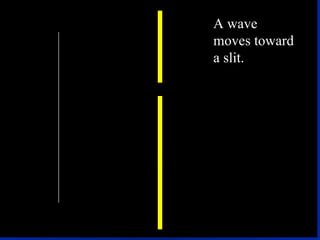
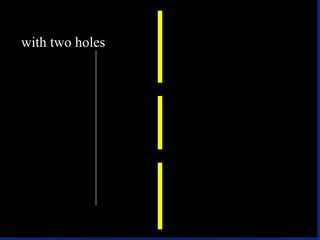
Light is also a wave Light is a particle  - it comes in chunks. Light is also a wave-  we can measure its wave length and it behaves as a wave The wavelength of a particle is calculated using    = h/mv  . (de Broglie equation)
Heisenberg Uncertainty Principle It is impossible to know exactly the speed and position of a particle.
Quantum Theory and the Atom (5.2) Rutherford’s  model Discovered the nucleus small dense and positive Electrons moved around in Electron cloud
Bohr’s Model Why don’t the electrons fall into the nucleus? Electrons move like planets around the sun. In circular orbits at different levels. Energy separates one level from another.
Bohr’s Model Nucleus Electron Orbit Energy Levels
Bohr’s Model Further away from the nucleus means more energy. There is no “in between” energy levels Increasing energy Nucleus First Second Third Fourth Fifth }
The Quantum Mechanical Model Energy is quantized. It comes in chunks. Quanta  - the amount of energy needed to move from one energy level to another. Quantum  is the leap in energy. Schrödinger derived an equation that described the energy and position of the electrons in an atom Treated electrons as waves. De Broglie equation predicts wave characteristics of moving particles. (   = h/mv)
Does have energy levels  for electrons. Orbits are not  circular. It can only tell us the  probability of finding  an electron a certain distance from the nucleus. The Quantum Mechanical Model
The electron is found inside a blurry “electron cloud” An area where there is a chance of finding an electron. Draw a line at 90 % probability. The Quantum Mechanical Model
Atomic Orbitals Principal Quantum Number  (n) = the energy level of the electron ( 1,2,3,4,5 ). Within each energy level, there are sublevels that have specific shapes  (s, p, d, f) Sublevels have atomic orbitals.   These are regions where there is a high probability of finding an electron.  (s=1,p=3,d=5,f=7) Each orbital can hold up to 2 electrons.  Electrons held: s=2, p=6, d=10, f=14
An  atomic orbital  is a three-dimensional region around the nucleus that describes the electrons probable location. There is one “s”  orbital for every energy level (1s,2s,3s,4s,5s). *  It has a SPHERICAL shape and can hold 2 electrons each. “ S” orbitals
“ P” orbitals Start at the second energy level (2p,3p,4p,5p)  Dumbbell shaped (3 types) Each can hold 2 electrons (6-total)
“ P” Orbitals  (aligned on the x,y,z axis)
“ D” orbitals Start at the third energy level (3d,4d,5d)  5 different shapes Each can hold 2 electrons (10-total)
“ F” orbitals Start at the fourth energy level (4f,5f) Have seven different shapes 2 electrons per shape (14-total)
“ F” orbitals
Summary 1 2 3 4 s 1 2 S P d S P D f Energy Level (n) S P Sublevels (S, p, d, f) Number of orbitals (Odd 1,3,5,7) 1 3 2 6 1 3 5 2 6 10 1 3 5 7 2 6 10 14 Maximum Number of Electrons (orbital x 2)
By Energy Level First Energy Level only s orbital only 2 electrons total Written as  1s 2 Second Energy Level s and p orbitals are available 2 in s, 6 in p Written as  2s 2 2p 6 8 total electrons total
Filling order Lowest energy level fills first. Each box gets 1 electron before anyone gets 2. Orbitals can overlap Counting system Each box is an orbital shape Has Room for two electrons
Increasing energy 1s 2s 3s 4s 5s 6s 7s 2p 3p 4p 5p 6p 7p 3d 4d 5d 6d 4f 5f
Increasing energy 1s 2s 3s 4s 5s 6s 7s 2p 3p 4p 5p 6p 3d 4d 5d 7p 6d 4f 5f
Electron Configurations (5.3) Shows the way electrons are arranged in atoms. Aufbau principle - electrons enter the lowest energy first. This causes difficulties because of the overlap of orbitals of different energies. Pauli Exclusion Principle - at most 2 electrons per orbital - opposite spins
Electron Configuration Hund’s Rule - When electrons occupy orbitals of equal energy they don’t pair up until they have to . Let’s determine the electron configuration for Phosphorus  Need to account for 15 electrons
The first to electrons go into the 1s orbital Notice the opposite spins only 13 more Increasing energy 1s 2s 3s 4s 5s 6s 7s 2p 3p 4p 5p 6p 3d 4d 5d 7p 6d 4f 5f
The next  electrons go into the 2s orbital only 11 more Increasing energy 1s 2s 3s 4s 5s 6s 7s 2p 3p 4p 5p 6p 3d 4d 5d 7p 6d 4f 5f
The next  electrons go into the 2p orbital only 5 more Increasing energy 1s 2s 3s 4s 5s 6s 7s 2p 3p 4p 5p 6p 3d 4d 5d 7p 6d 4f 5f
The next  electrons go into the 3s orbital only 3 more Increasing energy 1s 2s 3s 4s 5s 6s 7s 2p 3p 4p 5p 6p 3d 4d 5d 7p 6d 4f 5f
The last three electrons go into the 3p orbitals. They each go into separate shapes 3 unpaired electrons 1s 2 2s 2 2p 6 3s 2 3p 3   Increasing energy 1s 2s 3s 4s 5s 6s 7s 2p 3p 4p 5p 6p 3d 4d 5d 7p 6d 4f 5f
Easy way to remember - Fill from the bottom up, following the arrows 1s 2  2s 2  2p 6  3s 2  3p 6  4s 2  3d 10  4p 6  5s 2  4d 10  5p 6  6s 2  4f 14  5d 10  6p 6  7s 2  5f 14  6d 10  7p 6  118 electrons 1s 2s 2p 3s 3p 3d 4s 4p 4d 4f 5s 5p 5d 5f 6s 6p 6d 6f 7s 7p 7d 7f
Rewrite when done Group the energy levels (w/the same principal quantum #) together 1s 2  2s 2  2p 6   3s 2  3p 6  3d 10  4s 2  4p 6  4d 10  4f 14   5s 2  5p 6  5d 10 5f 14 6s 2  6p 6  6d 10   7s 2  7p 6  1s 2  2s 2  2p 6  3s 2  3p 6  4s 2  3d 10  4p 6  5s 2  4d 10  5p 6  6s 2  4f 14  5d 10  6p 6  7s 2  5f 14  6d 10  7p 6
Exceptions to Electron Configuration (optional)
Orbitals fill in order  Lowest energy to higher energy. Adding electrons can change the energy of the orbital. Filled and half-filled orbitals have a lower energy. Makes them more stable. Changes the filling order of d orbitals
Write these electron configurations Titanium - 22 electrons 1s 2 2s 2 2p 6 3s 2 3p 6 3d 2 4s 2 Vanadium - 23 electrons 1s 2 2s 2 2p 6 3s 2 3p 6 3d 3 4s 2 Chromium - 24 electrons 1s 2 2s 2 2p 6 3s 2 3p 6 3d 4 4s 2  is expected But this is wrong!!
Chromium is actually 1s 2 2s 2 2p 6 3s 2 3p 6 3d 5 4s 1 Why? This gives us two half filled orbitals.
Chromium is actually 1s 2 2s 2 2p 6 3s 2 3p 6 3d 5 4s 1 Why? This gives us two half filled orbitals. Slightly lower in energy. The same principle applies to copper.
Copper’s electron configuration Copper has 29 electrons so we expect 1s 2 2s 2 2p 6 3s 2 3p 6 3d 9 4s 2 But the actual configuration is 1s 2 2s 2 2p 6 3s 2 3p 6 3d 10 4s 1 This gives one filled orbital and one half filled orbital. Remember these exceptions d 4 s 2     d 5  s 1 d 9 s 2     d 10 s 1
In each energy level The number of electrons that can fit in each energy level is calculated with Max e -  = 2n 2  where n is the energy level 1 st 2 nd   3 rd

Chapter 5 Electrons in Atoms

  • 1.
  • 2.
    Light and QuantizedEnergy (5.1) The study of light led to the development of the quantum mechanical model. Light is a kind of electromagnetic radiation EM). All move at 3.00 x 10 8 m/s (c) Speed of light.
  • 3.
    Spectrum Radio wavesMicrowaves Infrared . Ultra-violet X-Rays Gamma Rays Long Wavelength Short Wavelength Visible Light Low energy High energy Low Frequency High Frequency
  • 4.
    Light is aParticle Light is energy, Energy is quantized, therefore, Light must be quantized. These quantized pieces of light are called photons .
  • 5.
    Atomic Emission SpectrumHow color tells us about atoms? The atomic emission spectrum of an element is the set of frequencies of the EM waves emitted by atoms of the element. Each is unique to the individual element giving a pattern of visible colors when viewed through a prism.
  • 6.
    Prism White lightis made up of all the colors of the visible spectrum. Passing it through a prism separates it into colors.
  • 7.
    If the lightis not white By heating a gas or with electricity we can get it to give off colors. Passing this light through a prism shows a unique color pattern
  • 8.
    Atomic Emission SpectrumEach element gives off its own characteristic colors. Can be used to identify the atom. This is how we know what stars are made of.
  • 9.
    These are calledline spectra unique to each element. These are emission spectra Mirror images are absorption spectra Light with black missing
  • 10.
    An explanation ofthe Atomic Emission Spectra
  • 11.
    Where the electronstarts When we write electron configurations we are starting at the writing the lowest energy level. The energy level an electron starts from is called its ground state .
  • 12.
    Heat or electricityor light can move the electron up energy levels Changing the energy
  • 13.
    As the electronfalls back to ground state it gives the energy back as light Changing the energy
  • 14.
    May fall downin steps Each with a different energy Changing the energy
  • 15.
    The Bohr RingAtom n = 3 n = 4 n = 2 n = 1
  • 16.
    The Further theelectrons fall, the more the energy and the higher the frequency. Ultraviolet Visible Infrared
  • 17.
    Light is alsoa wave Light is a particle - it comes in chunks. Light is also a wave- we can measure its wave length and it behaves as a wave The wavelength of a particle is calculated using  = h/mv . (de Broglie equation)
  • 18.
    Heisenberg Uncertainty PrincipleIt is impossible to know exactly the speed and position of a particle.
  • 19.
    Quantum Theory andthe Atom (5.2) Rutherford’s model Discovered the nucleus small dense and positive Electrons moved around in Electron cloud
  • 20.
    Bohr’s Model Whydon’t the electrons fall into the nucleus? Electrons move like planets around the sun. In circular orbits at different levels. Energy separates one level from another.
  • 21.
    Bohr’s Model NucleusElectron Orbit Energy Levels
  • 22.
    Bohr’s Model Furtheraway from the nucleus means more energy. There is no “in between” energy levels Increasing energy Nucleus First Second Third Fourth Fifth }
  • 23.
    The Quantum MechanicalModel Energy is quantized. It comes in chunks. Quanta - the amount of energy needed to move from one energy level to another. Quantum is the leap in energy. Schrödinger derived an equation that described the energy and position of the electrons in an atom Treated electrons as waves. De Broglie equation predicts wave characteristics of moving particles. (  = h/mv)
  • 24.
    Does have energylevels for electrons. Orbits are not circular. It can only tell us the probability of finding an electron a certain distance from the nucleus. The Quantum Mechanical Model
  • 25.
    The electron isfound inside a blurry “electron cloud” An area where there is a chance of finding an electron. Draw a line at 90 % probability. The Quantum Mechanical Model
  • 26.
    Atomic Orbitals PrincipalQuantum Number (n) = the energy level of the electron ( 1,2,3,4,5 ). Within each energy level, there are sublevels that have specific shapes (s, p, d, f) Sublevels have atomic orbitals. These are regions where there is a high probability of finding an electron. (s=1,p=3,d=5,f=7) Each orbital can hold up to 2 electrons. Electrons held: s=2, p=6, d=10, f=14
  • 27.
    An atomicorbital is a three-dimensional region around the nucleus that describes the electrons probable location. There is one “s” orbital for every energy level (1s,2s,3s,4s,5s). * It has a SPHERICAL shape and can hold 2 electrons each. “ S” orbitals
  • 28.
    “ P” orbitalsStart at the second energy level (2p,3p,4p,5p) Dumbbell shaped (3 types) Each can hold 2 electrons (6-total)
  • 29.
    “ P” Orbitals (aligned on the x,y,z axis)
  • 30.
    “ D” orbitalsStart at the third energy level (3d,4d,5d) 5 different shapes Each can hold 2 electrons (10-total)
  • 31.
    “ F” orbitalsStart at the fourth energy level (4f,5f) Have seven different shapes 2 electrons per shape (14-total)
  • 32.
  • 33.
    Summary 1 23 4 s 1 2 S P d S P D f Energy Level (n) S P Sublevels (S, p, d, f) Number of orbitals (Odd 1,3,5,7) 1 3 2 6 1 3 5 2 6 10 1 3 5 7 2 6 10 14 Maximum Number of Electrons (orbital x 2)
  • 34.
    By Energy LevelFirst Energy Level only s orbital only 2 electrons total Written as 1s 2 Second Energy Level s and p orbitals are available 2 in s, 6 in p Written as 2s 2 2p 6 8 total electrons total
  • 35.
    Filling order Lowestenergy level fills first. Each box gets 1 electron before anyone gets 2. Orbitals can overlap Counting system Each box is an orbital shape Has Room for two electrons
  • 36.
    Increasing energy 1s2s 3s 4s 5s 6s 7s 2p 3p 4p 5p 6p 7p 3d 4d 5d 6d 4f 5f
  • 37.
    Increasing energy 1s2s 3s 4s 5s 6s 7s 2p 3p 4p 5p 6p 3d 4d 5d 7p 6d 4f 5f
  • 38.
    Electron Configurations (5.3)Shows the way electrons are arranged in atoms. Aufbau principle - electrons enter the lowest energy first. This causes difficulties because of the overlap of orbitals of different energies. Pauli Exclusion Principle - at most 2 electrons per orbital - opposite spins
  • 39.
    Electron Configuration Hund’sRule - When electrons occupy orbitals of equal energy they don’t pair up until they have to . Let’s determine the electron configuration for Phosphorus Need to account for 15 electrons
  • 40.
    The first toelectrons go into the 1s orbital Notice the opposite spins only 13 more Increasing energy 1s 2s 3s 4s 5s 6s 7s 2p 3p 4p 5p 6p 3d 4d 5d 7p 6d 4f 5f
  • 41.
    The next electrons go into the 2s orbital only 11 more Increasing energy 1s 2s 3s 4s 5s 6s 7s 2p 3p 4p 5p 6p 3d 4d 5d 7p 6d 4f 5f
  • 42.
    The next electrons go into the 2p orbital only 5 more Increasing energy 1s 2s 3s 4s 5s 6s 7s 2p 3p 4p 5p 6p 3d 4d 5d 7p 6d 4f 5f
  • 43.
    The next electrons go into the 3s orbital only 3 more Increasing energy 1s 2s 3s 4s 5s 6s 7s 2p 3p 4p 5p 6p 3d 4d 5d 7p 6d 4f 5f
  • 44.
    The last threeelectrons go into the 3p orbitals. They each go into separate shapes 3 unpaired electrons 1s 2 2s 2 2p 6 3s 2 3p 3 Increasing energy 1s 2s 3s 4s 5s 6s 7s 2p 3p 4p 5p 6p 3d 4d 5d 7p 6d 4f 5f
  • 45.
    Easy way toremember - Fill from the bottom up, following the arrows 1s 2 2s 2 2p 6 3s 2 3p 6 4s 2 3d 10 4p 6 5s 2 4d 10 5p 6 6s 2 4f 14 5d 10 6p 6 7s 2 5f 14 6d 10 7p 6 118 electrons 1s 2s 2p 3s 3p 3d 4s 4p 4d 4f 5s 5p 5d 5f 6s 6p 6d 6f 7s 7p 7d 7f
  • 46.
    Rewrite when doneGroup the energy levels (w/the same principal quantum #) together 1s 2 2s 2 2p 6 3s 2 3p 6 3d 10 4s 2 4p 6 4d 10 4f 14 5s 2 5p 6 5d 10 5f 14 6s 2 6p 6 6d 10 7s 2 7p 6 1s 2 2s 2 2p 6 3s 2 3p 6 4s 2 3d 10 4p 6 5s 2 4d 10 5p 6 6s 2 4f 14 5d 10 6p 6 7s 2 5f 14 6d 10 7p 6
  • 47.
    Exceptions to ElectronConfiguration (optional)
  • 48.
    Orbitals fill inorder Lowest energy to higher energy. Adding electrons can change the energy of the orbital. Filled and half-filled orbitals have a lower energy. Makes them more stable. Changes the filling order of d orbitals
  • 49.
    Write these electronconfigurations Titanium - 22 electrons 1s 2 2s 2 2p 6 3s 2 3p 6 3d 2 4s 2 Vanadium - 23 electrons 1s 2 2s 2 2p 6 3s 2 3p 6 3d 3 4s 2 Chromium - 24 electrons 1s 2 2s 2 2p 6 3s 2 3p 6 3d 4 4s 2 is expected But this is wrong!!
  • 50.
    Chromium is actually1s 2 2s 2 2p 6 3s 2 3p 6 3d 5 4s 1 Why? This gives us two half filled orbitals.
  • 51.
    Chromium is actually1s 2 2s 2 2p 6 3s 2 3p 6 3d 5 4s 1 Why? This gives us two half filled orbitals.
  • 52.
    Chromium is actually1s 2 2s 2 2p 6 3s 2 3p 6 3d 5 4s 1 Why? This gives us two half filled orbitals. Slightly lower in energy. The same principle applies to copper.
  • 53.
    Copper’s electron configurationCopper has 29 electrons so we expect 1s 2 2s 2 2p 6 3s 2 3p 6 3d 9 4s 2 But the actual configuration is 1s 2 2s 2 2p 6 3s 2 3p 6 3d 10 4s 1 This gives one filled orbital and one half filled orbital. Remember these exceptions d 4 s 2  d 5 s 1 d 9 s 2  d 10 s 1
  • 54.
    In each energylevel The number of electrons that can fit in each energy level is calculated with Max e - = 2n 2 where n is the energy level 1 st 2 nd 3 rd