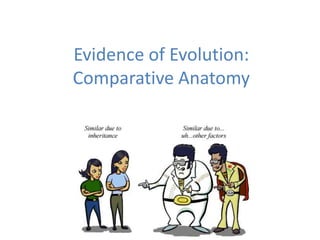
Evidence of Evolution:
Comparative Anatomy
Comparative Anatomy
Similarities in the basic pattern of anatomy is evidence of
inheritance from a common ancestor:
i) Homologous Structures
ii) Analogous Structures
iii) Vestigial Structures
Comparative Anatomy
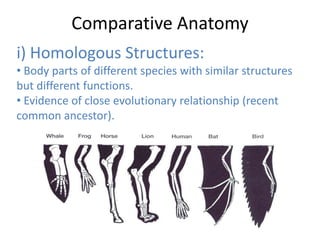
i) Homologous Structures:
• Body parts of different species with similar structures
but different functions.
• Evidence of close evolutionary relationship (recent
common ancestor).
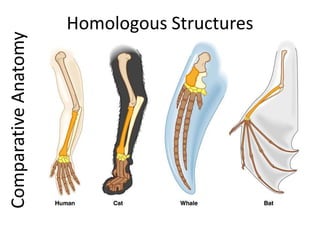
Comparative Anatomy

Homologous Structures
Comparative Anatomy
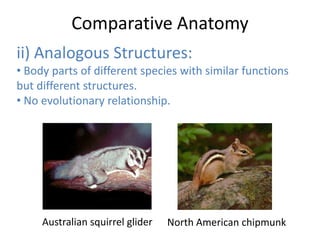
ii) Analogous Structures:
• Body parts of different species with similar functions
but different structures.
• No evolutionary relationship.

Australian squirrel glider

North American chipmunk
Comparative Anatomy
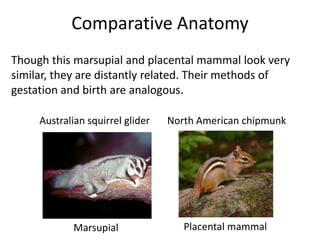
Though this marsupial and placental mammal look very
similar, they are distantly related. Their methods of
gestation and birth are analogous.
Australian squirrel glider

North American chipmunk

Marsupial

Placental mammal
Comparative Anatomy

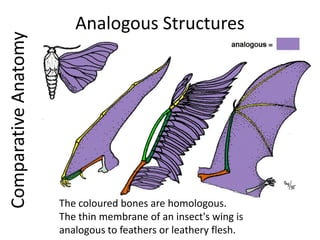
Analogous Structures

The coloured bones are homologous.
The thin membrane of an insect's wing is
analogous to feathers or leathery flesh.
Comparative Anatomy
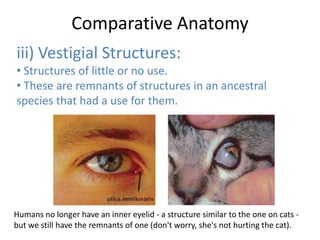
iii) Vestigial Structures:
• Structures of little or no use.
• These are remnants of structures in an ancestral
species that had a use for them.

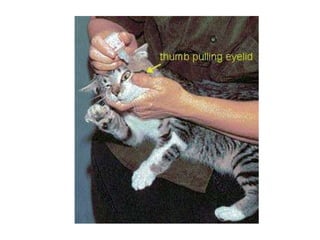
Humans no longer have an inner eyelid - a structure similar to the one on cats but we still have the remnants of one (don't worry, she's not hurting the cat).
Comparative Anatomy

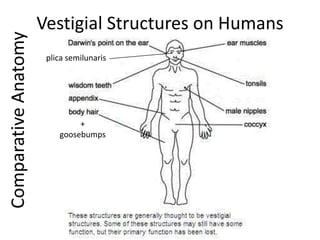
Vestigial Structures on Humans
plica semilunaris

+
goosebumps
Comparative Anatomy
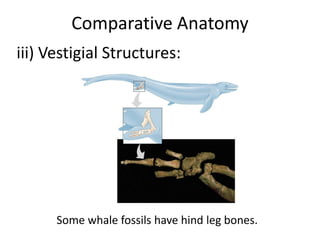
iii) Vestigial Structures:

Some whale fossils have hind leg bones.
Comparative Anatomy
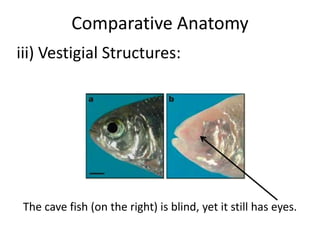
iii) Vestigial Structures:

The cave fish (on the right) is blind, yet it still has eyes.
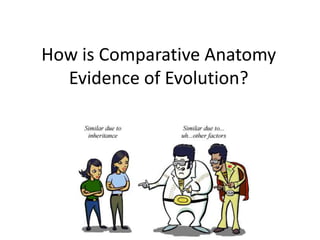
How is Comparative Anatomy
Evidence of Evolution?
02 evidence of evolution   comparative anatomy

02 evidence of evolution comparative anatomy