15.2 Evidence of Evolution15.2 Evidence of Evolution
Main idea:Main idea: Multiple lines of evidence support theMultiple lines of evidence support the
theory of evolution.theory of evolution.
Objectives:Objectives:

Describe how fossils provide evidence ofDescribe how fossils provide evidence of
evolution.evolution.

Discuss morphological evidence of evolution.Discuss morphological evidence of evolution.

Explain how physiology and biochemistryExplain how physiology and biochemistry
provide evidence of evolution.provide evidence of evolution.
New VocabularyNew Vocabulary

Derived traitDerived trait

Ancestral traitAncestral trait

Homologous structureHomologous structure

Vestigial structureVestigial structure

Analogous structureAnalogous structure

EmbryoEmbryo

FitnessFitness

MimicryMimicry

CamouflageCamouflage
Support for EvolutionSupport for Evolution
The theory ofThe theory of evolutionevolution states that allstates that all
organisms on Earth have descended from aorganisms on Earth have descended from a
common ancestorcommon ancestor..
TheThe fossil recordfossil record offers some of the mostoffers some of the most
significant evidence of evolutionary change.significant evidence of evolutionary change.

Fossils provide aFossils provide a recordrecord of species thatof species that
lived long ago.lived long ago.

Fossils show that ancient species shareFossils show that ancient species share
similaritiessimilarities with species that now live onwith species that now live on
Earth.Earth.
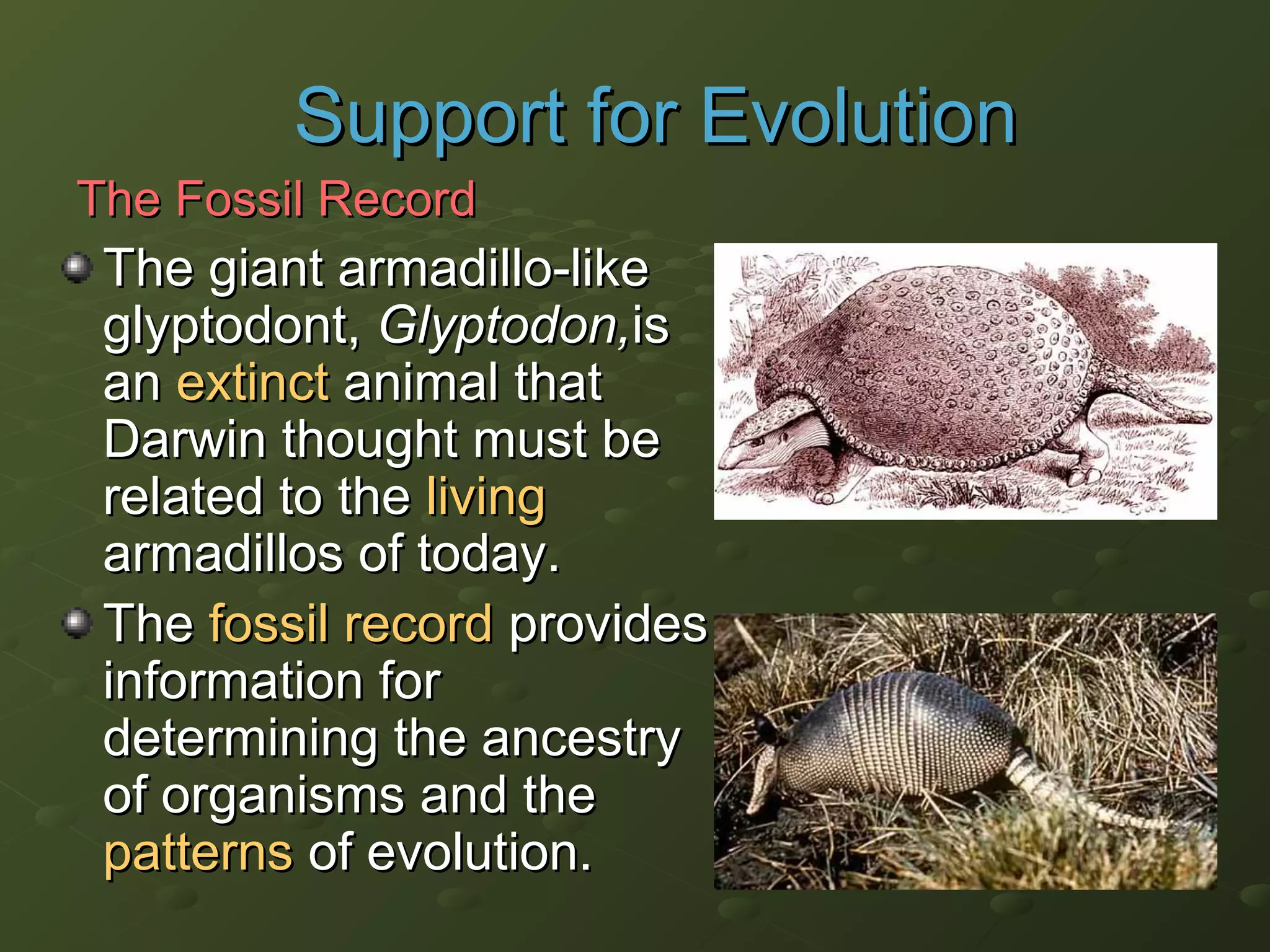
The giant armadillo-likeThe giant armadillo-like
glyptodont,glyptodont, Glyptodon,Glyptodon,isis
anan extinctextinct animal thatanimal that
Darwin thought must beDarwin thought must be
related to therelated to the livingliving
armadillos of today.armadillos of today.
TheThe fossil recordfossil record providesprovides
information forinformation for
determining the ancestrydetermining the ancestry
of organisms and theof organisms and the
patternspatterns of evolution.of evolution.
Support for EvolutionSupport for Evolution
The Fossil RecordThe Fossil Record
Two major classes of traits:Two major classes of traits:
Derived traits areDerived traits are newly evolvednewly evolved
features, such as feathers, that do notfeatures, such as feathers, that do not
appear in the fossils of commonappear in the fossils of common
ancestors.ancestors.
Ancestral traitsAncestral traits are moreare more primitiveprimitive
featuresfeatures, such as teeth and tails, that, such as teeth and tails, that
do appear in ancestral forms.do appear in ancestral forms.
Support for EvolutionSupport for Evolution
The Fossil RecordThe Fossil Record
Transitional fossils provide detailedTransitional fossils provide detailed
patternspatterns of evolutionary change forof evolutionary change for
ancestors of many modern animals,ancestors of many modern animals,
including mollusks, horses, whales andincluding mollusks, horses, whales and
humans.humans.
Example:Example:

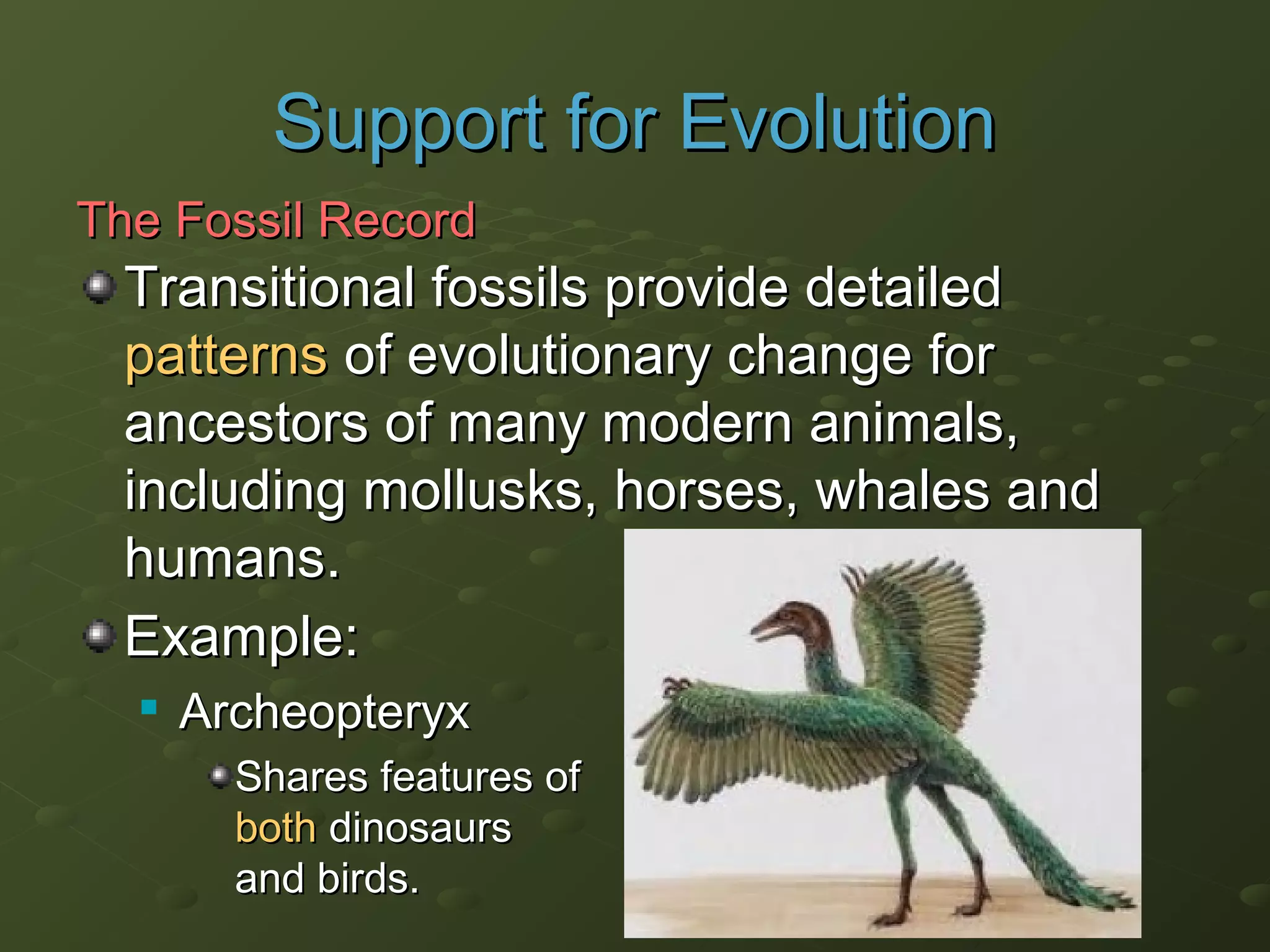
ArcheopteryxArcheopteryx
Shares features ofShares features of
bothboth dinosaursdinosaurs
and birds.and birds.
Support for EvolutionSupport for Evolution
The Fossil RecordThe Fossil Record
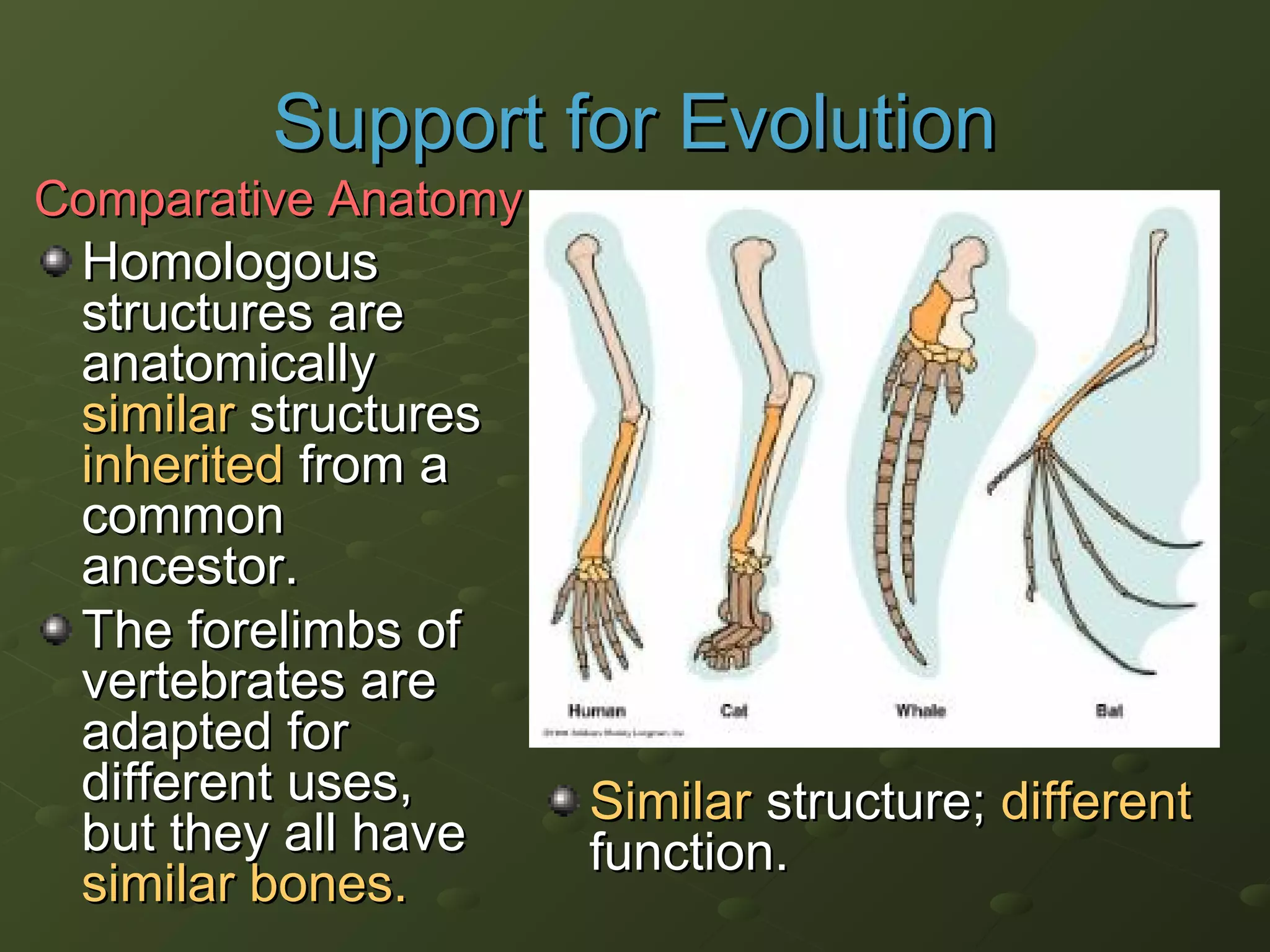
HomologousHomologous
structures arestructures are
anatomicallyanatomically
similarsimilar structuresstructures
inheritedinherited from afrom a
commoncommon
ancestor.ancestor.
The forelimbs ofThe forelimbs of
vertebrates arevertebrates are
adapted foradapted for
different uses,different uses,
but they all havebut they all have
similar bones.similar bones.
SimilarSimilar structure;structure; differentdifferent
functionfunction..
Support for EvolutionSupport for Evolution
Comparative AnatomyComparative Anatomy
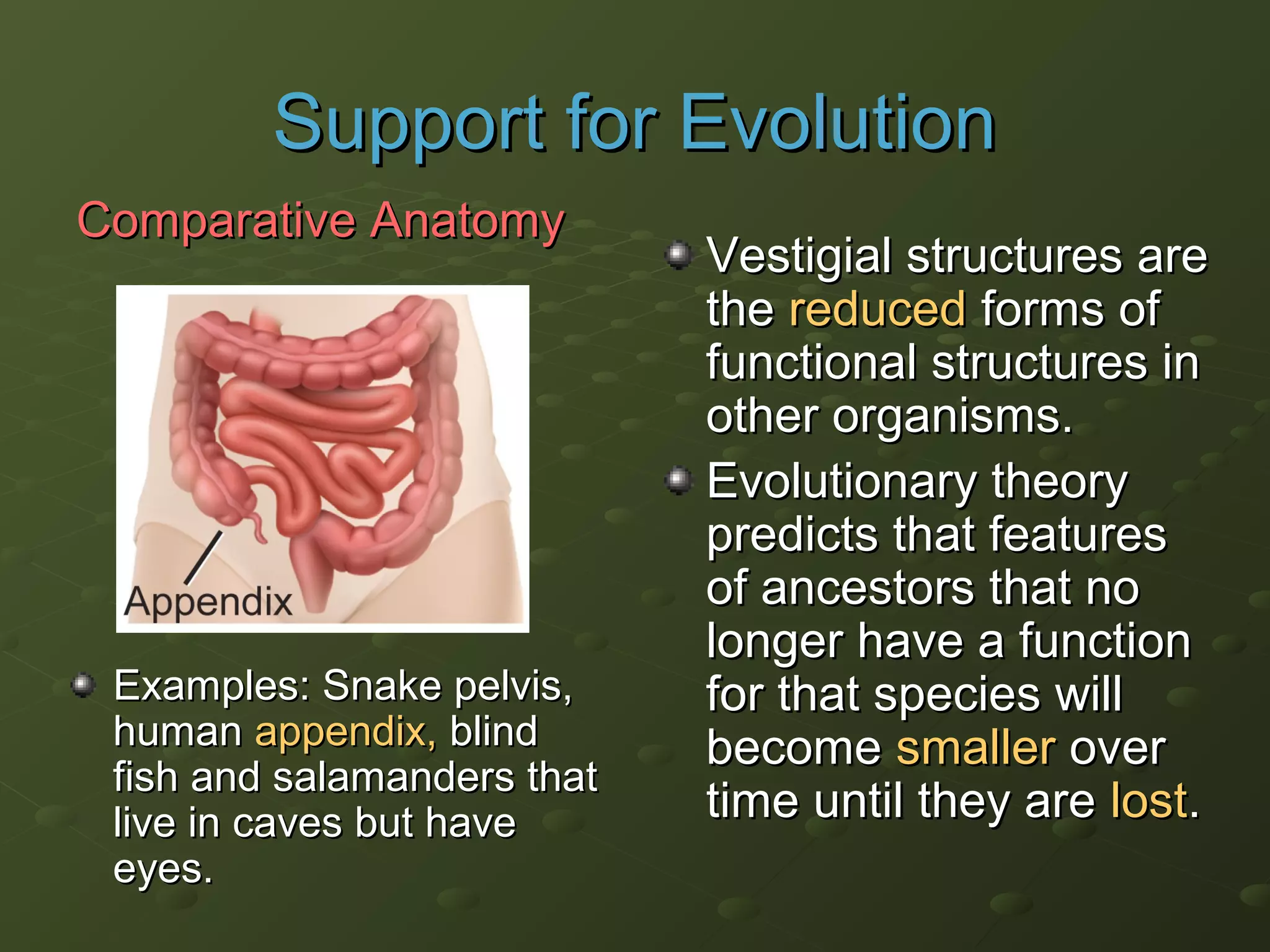
Vestigial structures areVestigial structures are
thethe reducedreduced forms offorms of
functional structures infunctional structures in
other organisms.other organisms.
Evolutionary theoryEvolutionary theory
predicts that featurespredicts that features
of ancestors that noof ancestors that no
longer have a functionlonger have a function
for that species willfor that species will
becomebecome smallersmaller overover
time until they aretime until they are lostlost..
Examples: Snake pelvis,Examples: Snake pelvis,
humanhuman appendix,appendix, blindblind
fish and salamanders thatfish and salamanders that
live in caves but havelive in caves but have
eyes.eyes.
Support for EvolutionSupport for Evolution
Comparative AnatomyComparative Anatomy
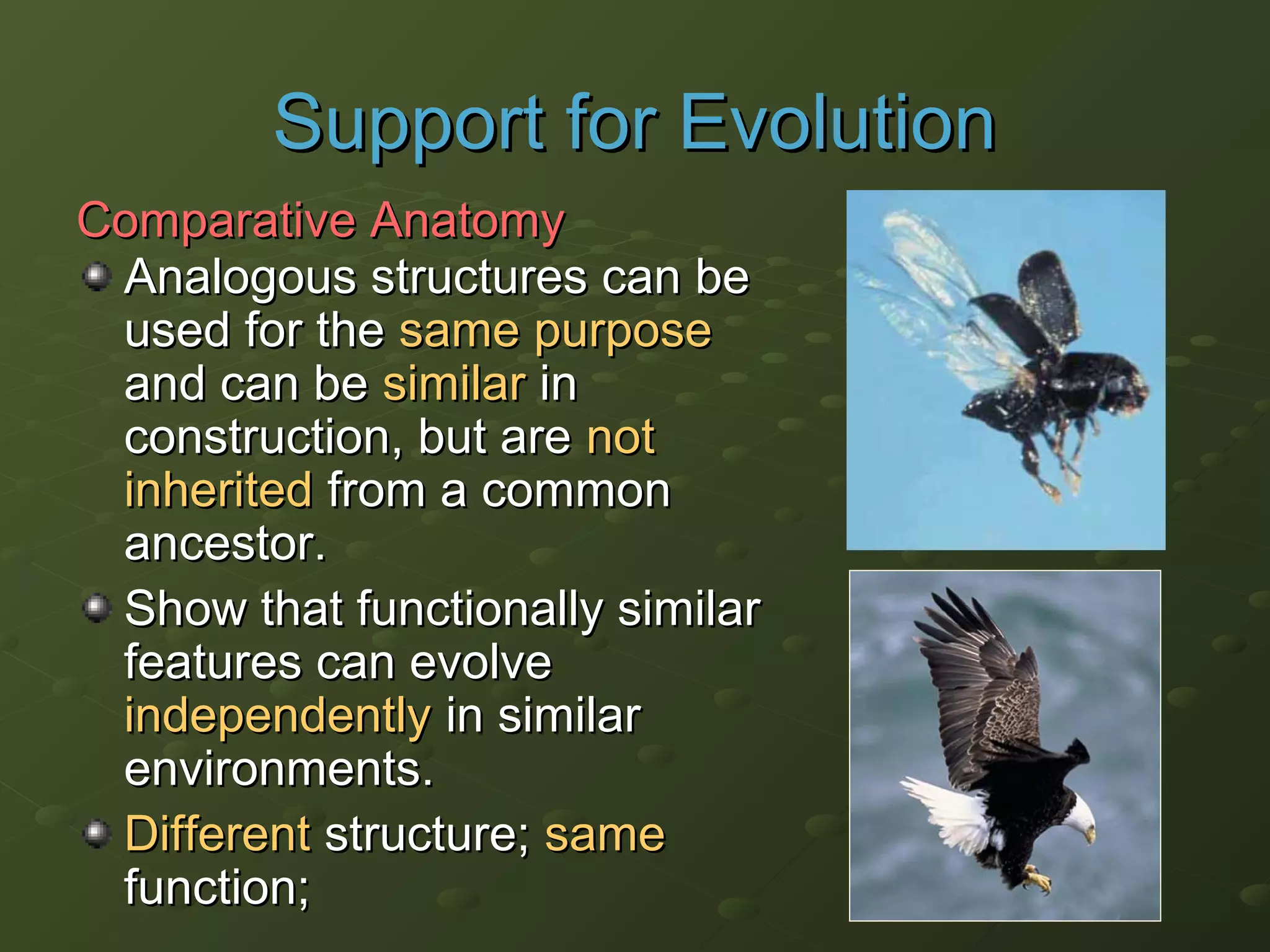
Analogous structures can beAnalogous structures can be
used for theused for the same purposesame purpose
and can beand can be similarsimilar inin
construction, but areconstruction, but are notnot
inheritedinherited from a commonfrom a common
ancestor.ancestor.
Show that functionally similarShow that functionally similar
features can evolvefeatures can evolve
independentlyindependently in similarin similar
environments.environments.
DifferentDifferent structure;structure; samesame
function;function;
Support for EvolutionSupport for Evolution
Comparative AnatomyComparative Anatomy
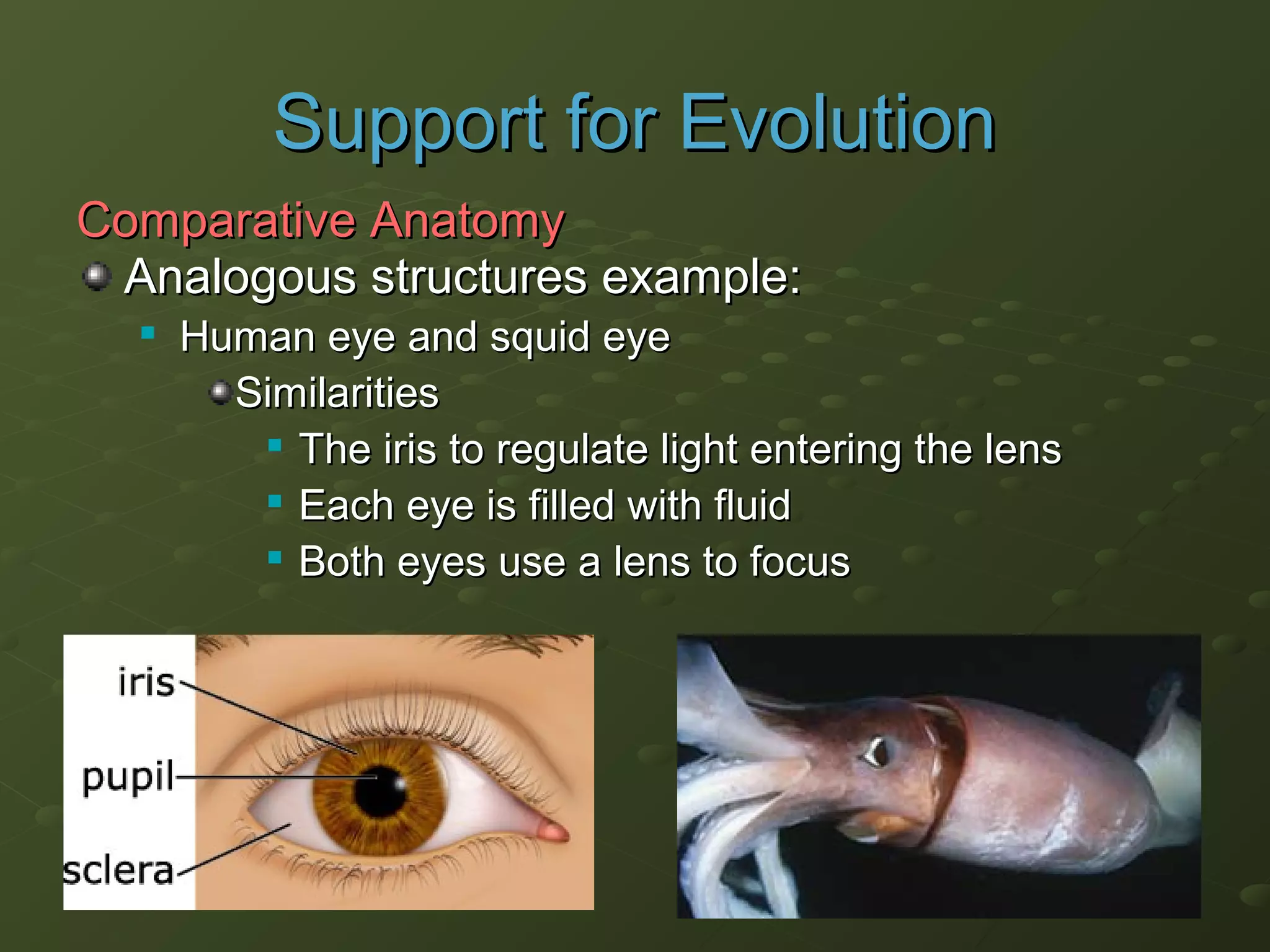
Analogous structures example:Analogous structures example:

Human eye and squid eyeHuman eye and squid eye
SimilaritiesSimilarities

The iris to regulate light entering the lensThe iris to regulate light entering the lens

Each eye is filled with fluidEach eye is filled with fluid

Both eyes use a lens to focusBoth eyes use a lens to focus
function;function;
Support for EvolutionSupport for Evolution
Comparative AnatomyComparative Anatomy
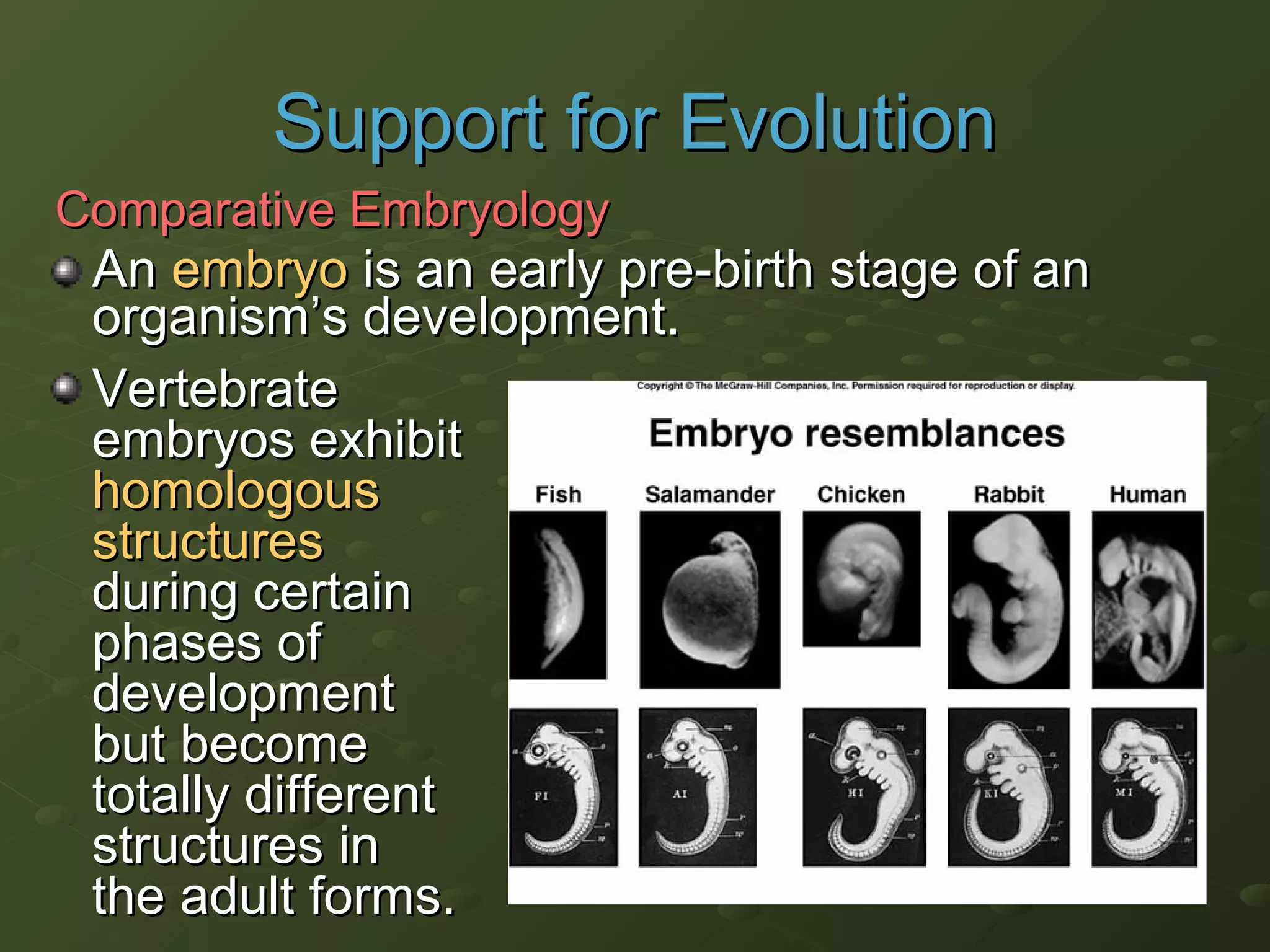
AnAn embryoembryo is an early pre-birth stage of anis an early pre-birth stage of an
organismorganism’s development.’s development.
VertebrateVertebrate
embryos exhibitembryos exhibit
homologoushomologous
structuresstructures
during certainduring certain
phases ofphases of
developmentdevelopment
but becomebut become
totally differenttotally different
structures instructures in
the adult forms.the adult forms.
Support for EvolutionSupport for Evolution
Comparative EmbryologyComparative Embryology
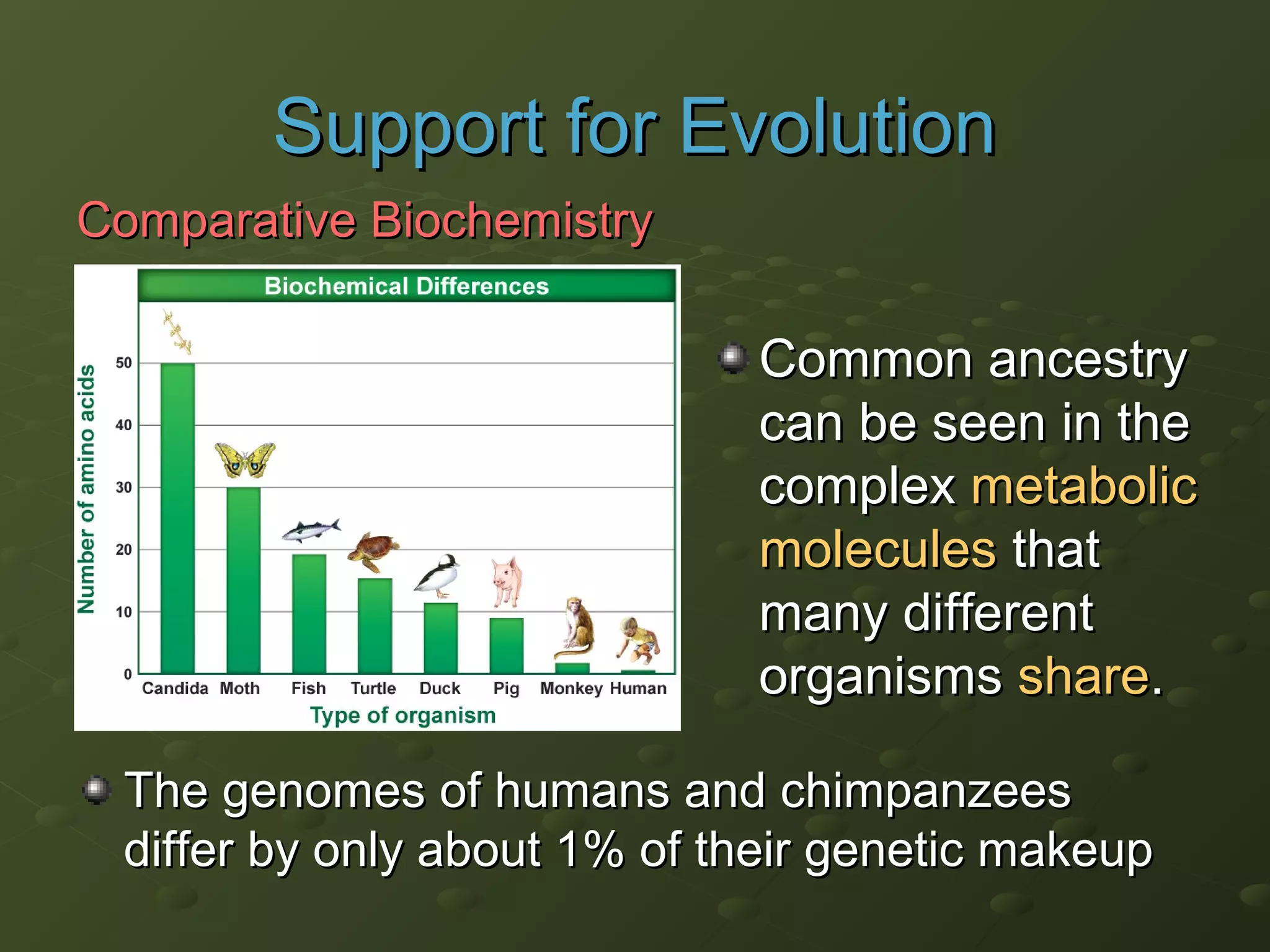
Comparative BiochemistryComparative Biochemistry
Common ancestryCommon ancestry
can be seen in thecan be seen in the
complexcomplex metabolicmetabolic
moleculesmolecules thatthat
many differentmany different
organismsorganisms shareshare..
Support for EvolutionSupport for Evolution
The genomes of humans and chimpanzeesThe genomes of humans and chimpanzees
differ by only about 1% of their genetic makeupdiffer by only about 1% of their genetic makeup
Geographic DistributionGeographic Distribution
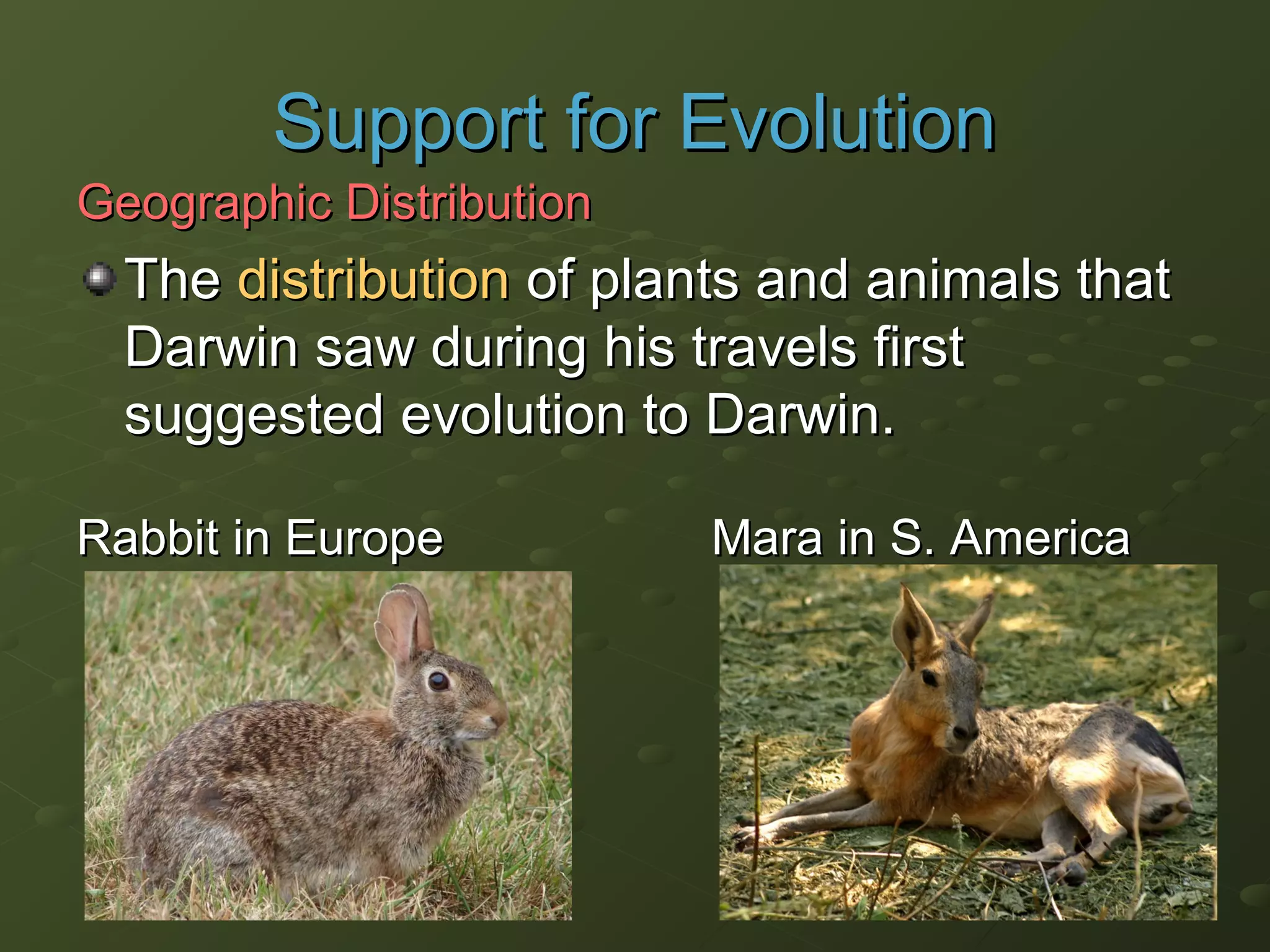
TheThe distributiondistribution of plants and animals thatof plants and animals that
Darwin saw during his travels firstDarwin saw during his travels first
suggested evolution to Darwin.suggested evolution to Darwin.
Rabbit in EuropeRabbit in Europe Mara in S. AmericaMara in S. America
Support for EvolutionSupport for Evolution
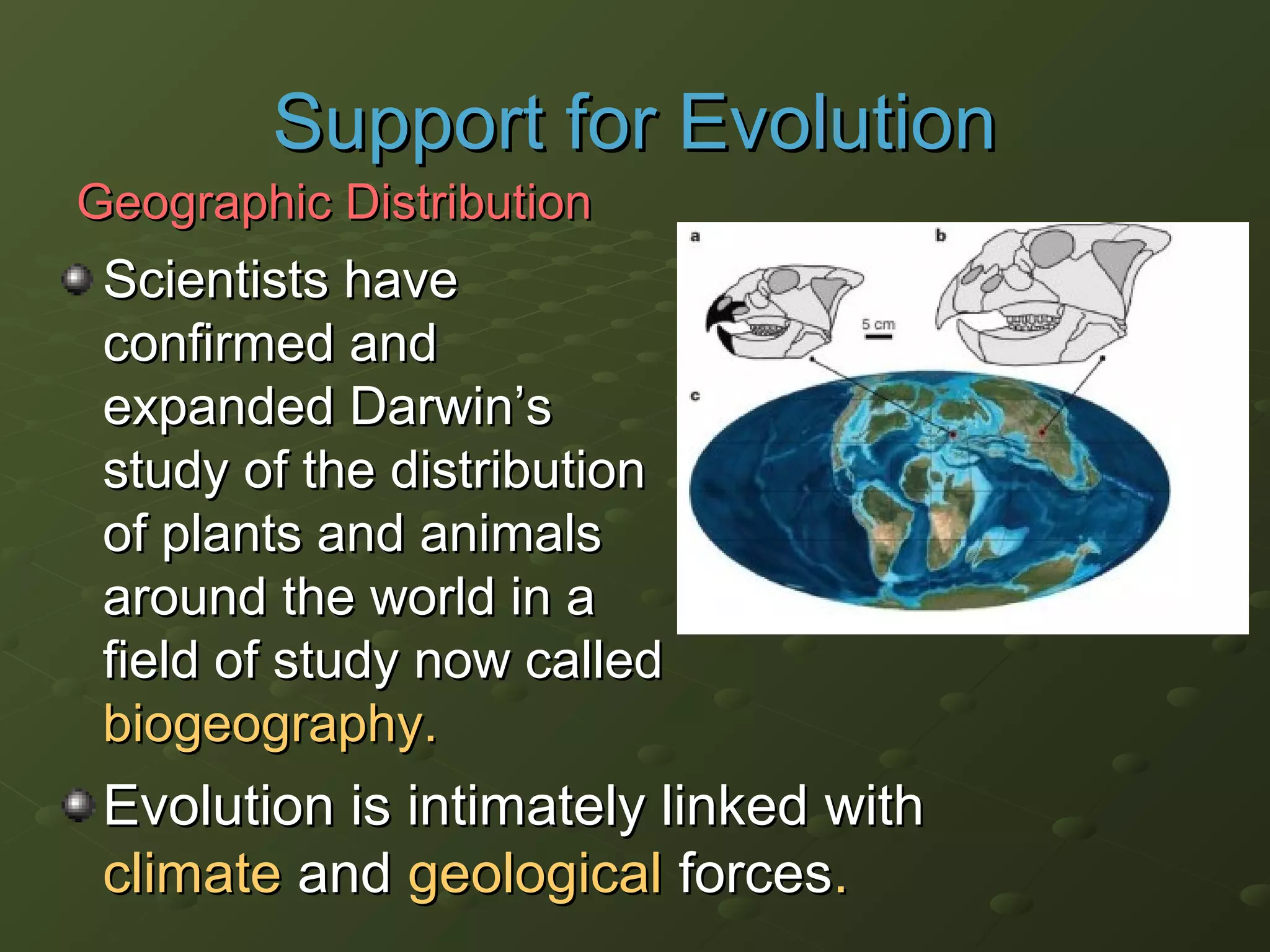
Scientists haveScientists have
confirmed andconfirmed and
expanded Darwinexpanded Darwin’s’s
study of the distributionstudy of the distribution
of plants and animalsof plants and animals
around the world in aaround the world in a
field of study now calledfield of study now called
biogeography.biogeography.
Evolution is intimately linked withEvolution is intimately linked with
climateclimate andand geologicalgeological forcesforces..
Geographic DistributionGeographic Distribution
Support for EvolutionSupport for Evolution
AdaptationAdaptation
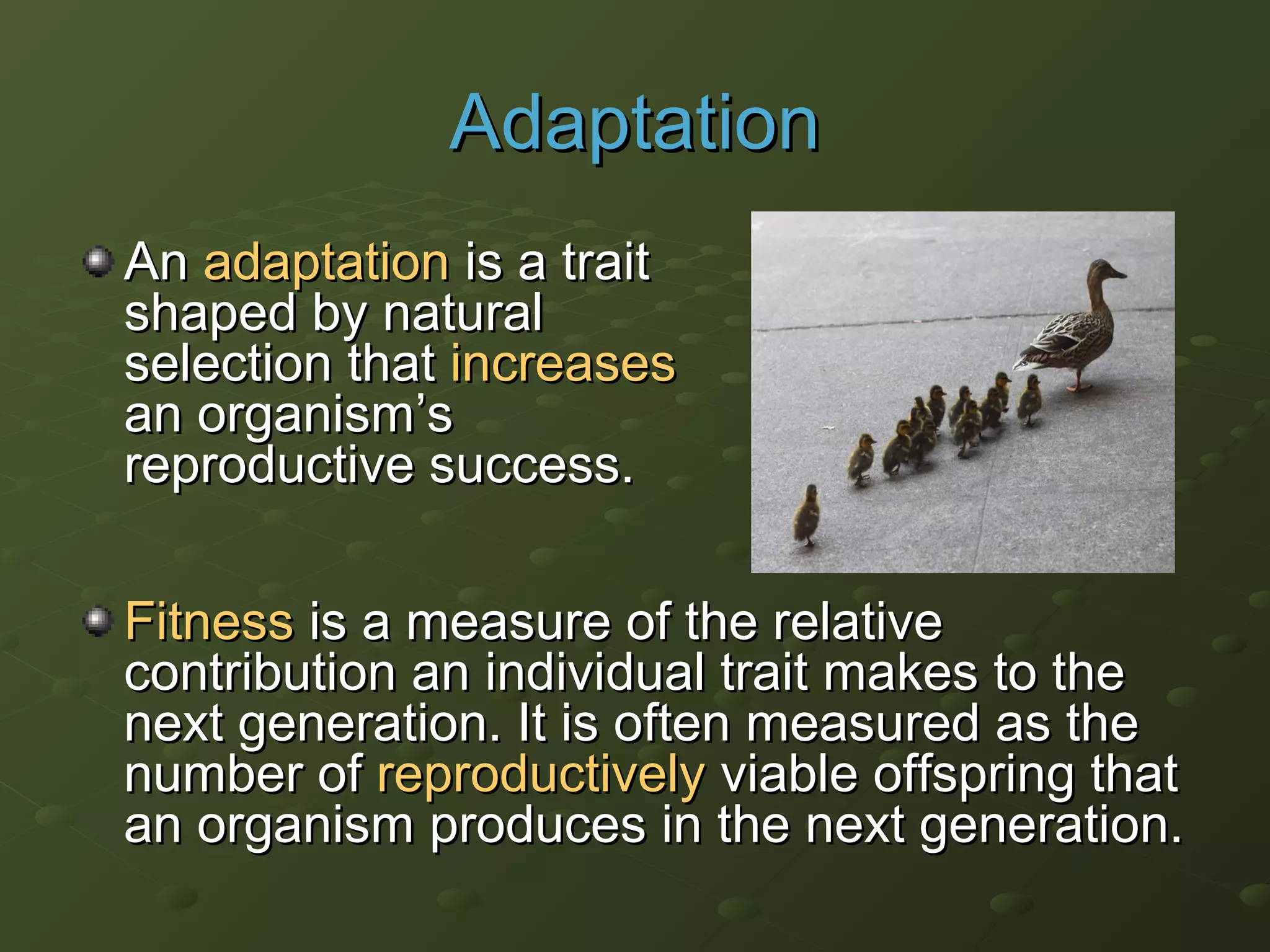
AnAn adaptationadaptation is a traitis a trait
shaped by naturalshaped by natural
selection thatselection that increasesincreases
an organisman organism’s’s
reproductive success.reproductive success.
FitnessFitness is a measure of the relativeis a measure of the relative
contribution an individual trait makes to thecontribution an individual trait makes to the
next generation. It is often measured as thenext generation. It is often measured as the
number ofnumber of reproductivelyreproductively viable offspring thatviable offspring that
an organism produces in the next generation.an organism produces in the next generation.
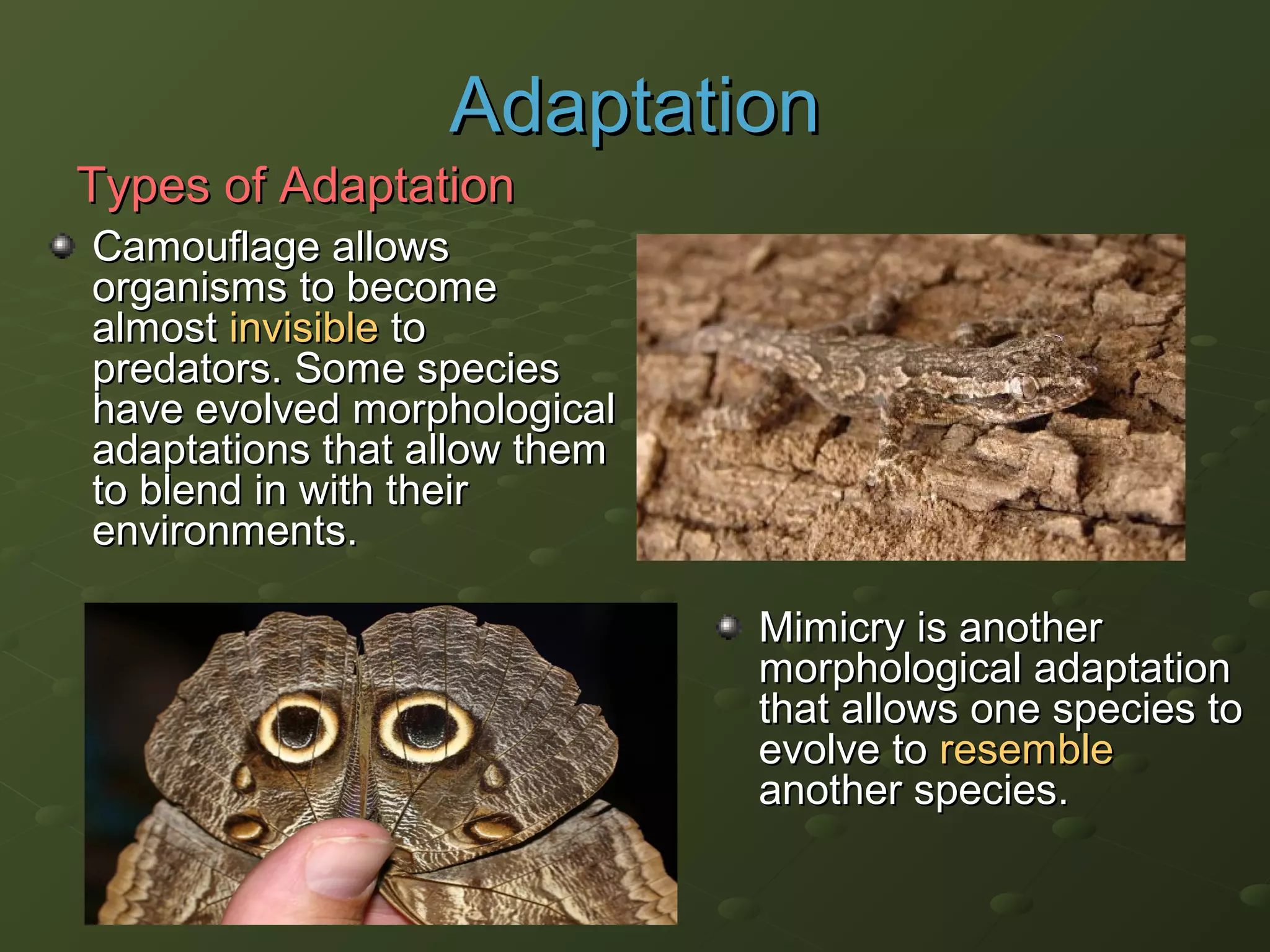
Camouflage allowsCamouflage allows
organisms to becomeorganisms to become
almostalmost invisibleinvisible toto
predators. Some speciespredators. Some species
have evolved morphologicalhave evolved morphological
adaptations that allow themadaptations that allow them
to blend in with theirto blend in with their
environments.environments.
MimicryMimicry is anotheris another
morphological adaptationmorphological adaptation
that allows one species tothat allows one species to
evolve toevolve to resembleresemble
another speciesanother species..
AdaptationAdaptation
Types of AdaptationTypes of Adaptation
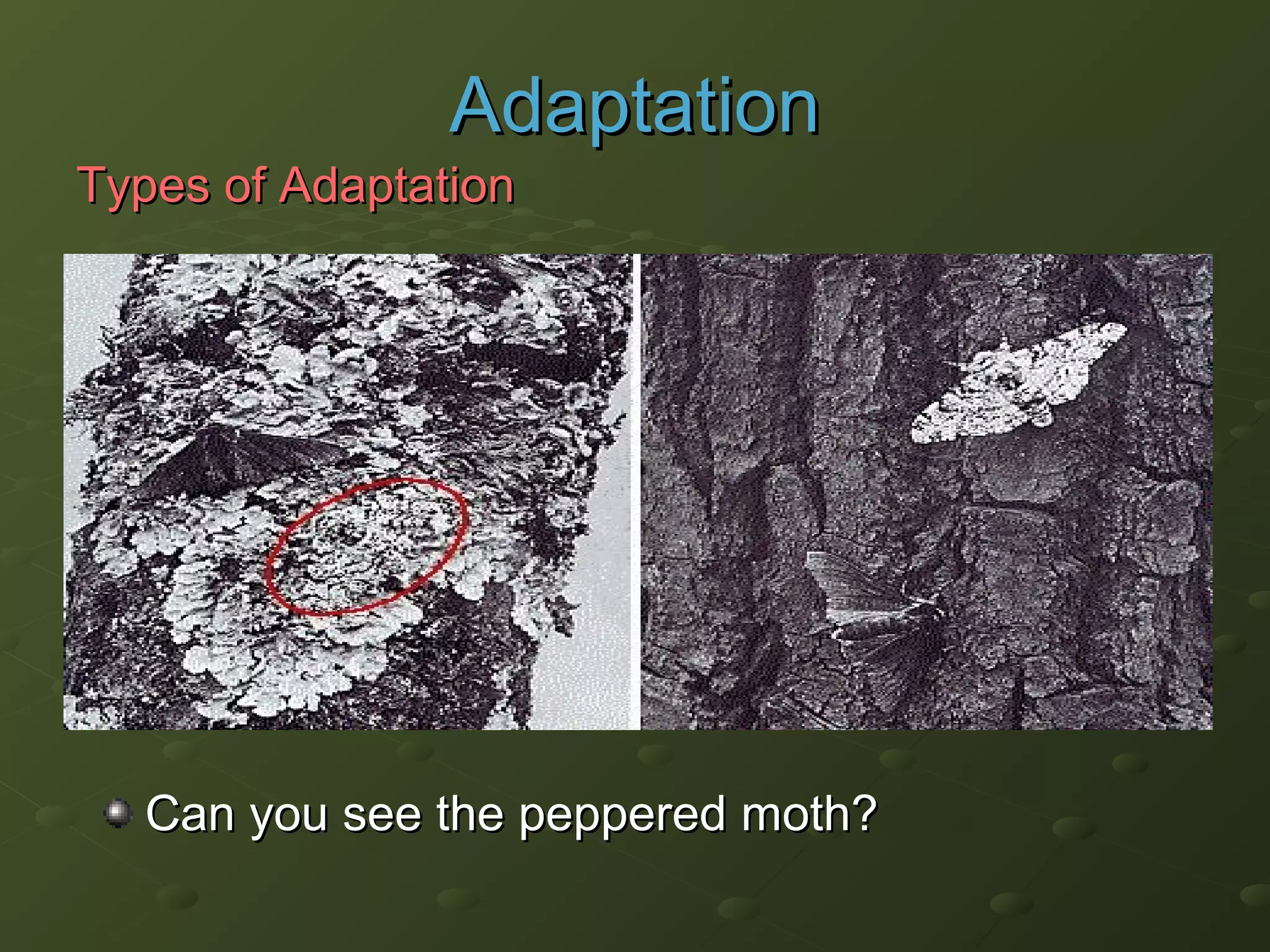
Can you see the peppered moth?Can you see the peppered moth?
AdaptationAdaptation
Types of AdaptationTypes of Adaptation
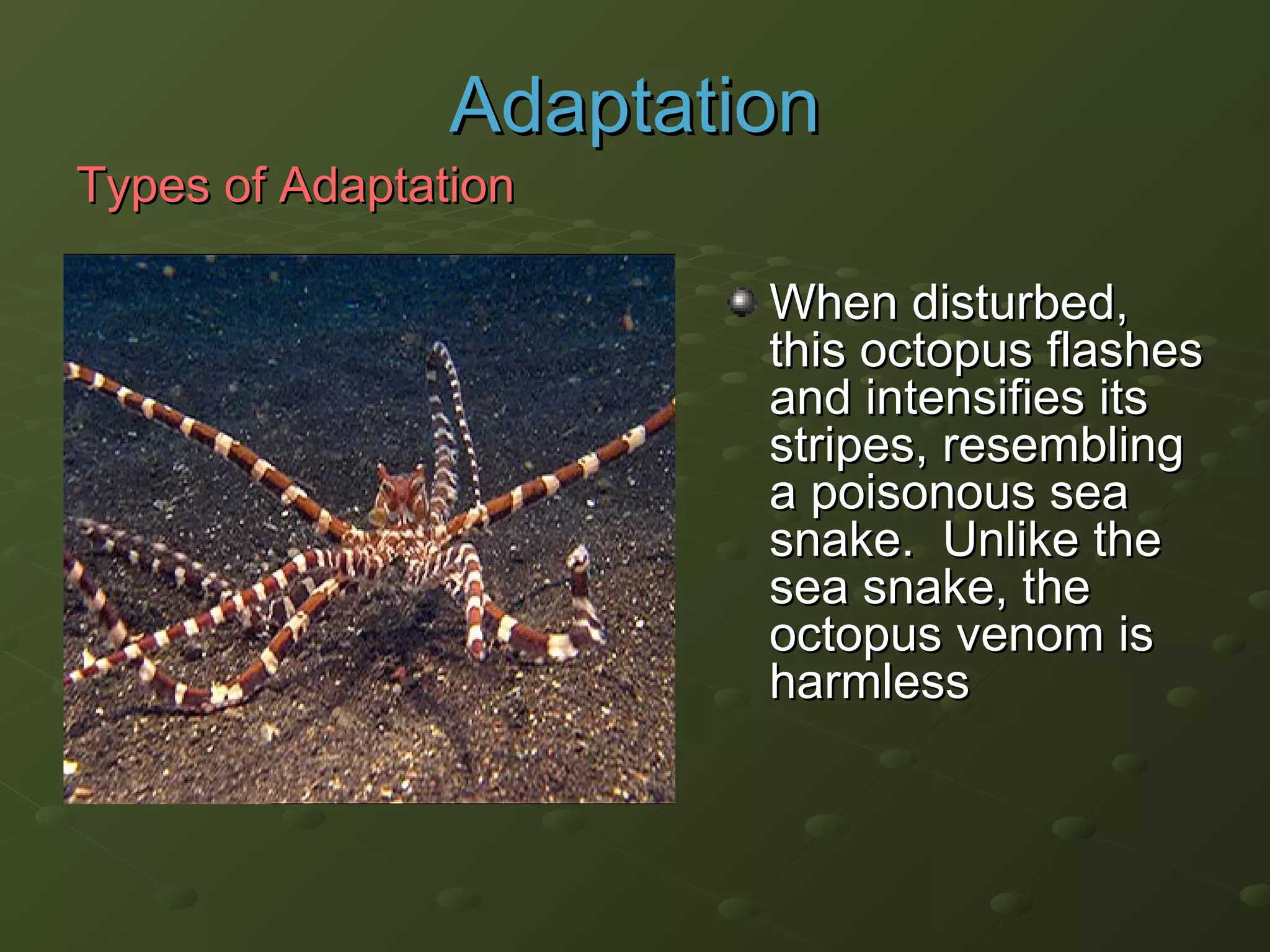
When disturbed,When disturbed,
this octopus flashesthis octopus flashes
and intensifies itsand intensifies its
stripes, resemblingstripes, resembling
a poisonous seaa poisonous sea
snake. Unlike thesnake. Unlike the
sea snake, thesea snake, the
octopus venom isoctopus venom is
harmlessharmless
AdaptationAdaptation
Types of AdaptationTypes of Adaptation
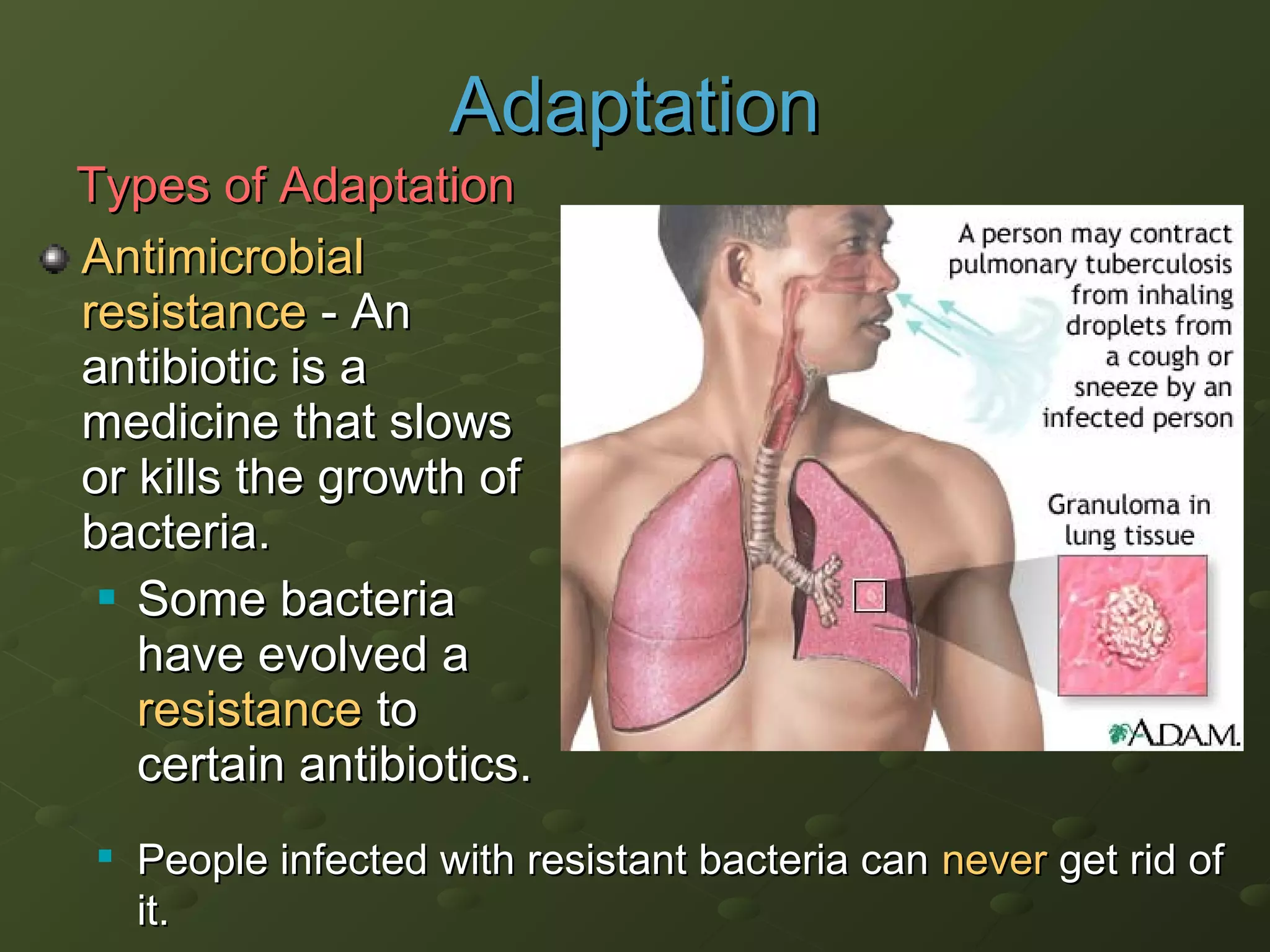
AntimicrobialAntimicrobial
resistanceresistance - An- An
antibiotic is aantibiotic is a
medicine that slowsmedicine that slows
or kills the growth ofor kills the growth of
bacteria.bacteria.
 Some bacteriaSome bacteria
have evolved ahave evolved a
resistanceresistance toto
certain antibiotics.certain antibiotics.

People infected with resistant bacteria canPeople infected with resistant bacteria can nevernever get rid ofget rid of
it.it.
AdaptationAdaptation
Types of AdaptationTypes of Adaptation

Chapter 15.2 evidence of evolution

  • 1.
    15.2 Evidence ofEvolution15.2 Evidence of Evolution Main idea:Main idea: Multiple lines of evidence support theMultiple lines of evidence support the theory of evolution.theory of evolution. Objectives:Objectives:  Describe how fossils provide evidence ofDescribe how fossils provide evidence of evolution.evolution.  Discuss morphological evidence of evolution.Discuss morphological evidence of evolution.  Explain how physiology and biochemistryExplain how physiology and biochemistry provide evidence of evolution.provide evidence of evolution. New VocabularyNew Vocabulary  Derived traitDerived trait  Ancestral traitAncestral trait  Homologous structureHomologous structure  Vestigial structureVestigial structure  Analogous structureAnalogous structure  EmbryoEmbryo  FitnessFitness  MimicryMimicry  CamouflageCamouflage
  • 2.
    Support for EvolutionSupportfor Evolution The theory ofThe theory of evolutionevolution states that allstates that all organisms on Earth have descended from aorganisms on Earth have descended from a common ancestorcommon ancestor.. TheThe fossil recordfossil record offers some of the mostoffers some of the most significant evidence of evolutionary change.significant evidence of evolutionary change.  Fossils provide aFossils provide a recordrecord of species thatof species that lived long ago.lived long ago.  Fossils show that ancient species shareFossils show that ancient species share similaritiessimilarities with species that now live onwith species that now live on Earth.Earth.
  • 3.
    The giant armadillo-likeThegiant armadillo-like glyptodont,glyptodont, Glyptodon,Glyptodon,isis anan extinctextinct animal thatanimal that Darwin thought must beDarwin thought must be related to therelated to the livingliving armadillos of today.armadillos of today. TheThe fossil recordfossil record providesprovides information forinformation for determining the ancestrydetermining the ancestry of organisms and theof organisms and the patternspatterns of evolution.of evolution. Support for EvolutionSupport for Evolution The Fossil RecordThe Fossil Record
  • 4.
    Two major classesof traits:Two major classes of traits: Derived traits areDerived traits are newly evolvednewly evolved features, such as feathers, that do notfeatures, such as feathers, that do not appear in the fossils of commonappear in the fossils of common ancestors.ancestors. Ancestral traitsAncestral traits are moreare more primitiveprimitive featuresfeatures, such as teeth and tails, that, such as teeth and tails, that do appear in ancestral forms.do appear in ancestral forms. Support for EvolutionSupport for Evolution The Fossil RecordThe Fossil Record
  • 5.
    Transitional fossils providedetailedTransitional fossils provide detailed patternspatterns of evolutionary change forof evolutionary change for ancestors of many modern animals,ancestors of many modern animals, including mollusks, horses, whales andincluding mollusks, horses, whales and humans.humans. Example:Example:  ArcheopteryxArcheopteryx Shares features ofShares features of bothboth dinosaursdinosaurs and birds.and birds. Support for EvolutionSupport for Evolution The Fossil RecordThe Fossil Record
  • 6.
    HomologousHomologous structures arestructures are anatomicallyanatomically similarsimilarstructuresstructures inheritedinherited from afrom a commoncommon ancestor.ancestor. The forelimbs ofThe forelimbs of vertebrates arevertebrates are adapted foradapted for different uses,different uses, but they all havebut they all have similar bones.similar bones. SimilarSimilar structure;structure; differentdifferent functionfunction.. Support for EvolutionSupport for Evolution Comparative AnatomyComparative Anatomy
  • 7.
    Vestigial structures areVestigialstructures are thethe reducedreduced forms offorms of functional structures infunctional structures in other organisms.other organisms. Evolutionary theoryEvolutionary theory predicts that featurespredicts that features of ancestors that noof ancestors that no longer have a functionlonger have a function for that species willfor that species will becomebecome smallersmaller overover time until they aretime until they are lostlost.. Examples: Snake pelvis,Examples: Snake pelvis, humanhuman appendix,appendix, blindblind fish and salamanders thatfish and salamanders that live in caves but havelive in caves but have eyes.eyes. Support for EvolutionSupport for Evolution Comparative AnatomyComparative Anatomy
  • 8.
    Analogous structures canbeAnalogous structures can be used for theused for the same purposesame purpose and can beand can be similarsimilar inin construction, but areconstruction, but are notnot inheritedinherited from a commonfrom a common ancestor.ancestor. Show that functionally similarShow that functionally similar features can evolvefeatures can evolve independentlyindependently in similarin similar environments.environments. DifferentDifferent structure;structure; samesame function;function; Support for EvolutionSupport for Evolution Comparative AnatomyComparative Anatomy
  • 9.
    Analogous structures example:Analogousstructures example:  Human eye and squid eyeHuman eye and squid eye SimilaritiesSimilarities  The iris to regulate light entering the lensThe iris to regulate light entering the lens  Each eye is filled with fluidEach eye is filled with fluid  Both eyes use a lens to focusBoth eyes use a lens to focus function;function; Support for EvolutionSupport for Evolution Comparative AnatomyComparative Anatomy
  • 10.
    AnAn embryoembryo isan early pre-birth stage of anis an early pre-birth stage of an organismorganism’s development.’s development. VertebrateVertebrate embryos exhibitembryos exhibit homologoushomologous structuresstructures during certainduring certain phases ofphases of developmentdevelopment but becomebut become totally differenttotally different structures instructures in the adult forms.the adult forms. Support for EvolutionSupport for Evolution Comparative EmbryologyComparative Embryology
  • 11.
    Comparative BiochemistryComparative Biochemistry CommonancestryCommon ancestry can be seen in thecan be seen in the complexcomplex metabolicmetabolic moleculesmolecules thatthat many differentmany different organismsorganisms shareshare.. Support for EvolutionSupport for Evolution The genomes of humans and chimpanzeesThe genomes of humans and chimpanzees differ by only about 1% of their genetic makeupdiffer by only about 1% of their genetic makeup
  • 12.
    Geographic DistributionGeographic Distribution TheThedistributiondistribution of plants and animals thatof plants and animals that Darwin saw during his travels firstDarwin saw during his travels first suggested evolution to Darwin.suggested evolution to Darwin. Rabbit in EuropeRabbit in Europe Mara in S. AmericaMara in S. America Support for EvolutionSupport for Evolution
  • 13.
    Scientists haveScientists have confirmedandconfirmed and expanded Darwinexpanded Darwin’s’s study of the distributionstudy of the distribution of plants and animalsof plants and animals around the world in aaround the world in a field of study now calledfield of study now called biogeography.biogeography. Evolution is intimately linked withEvolution is intimately linked with climateclimate andand geologicalgeological forcesforces.. Geographic DistributionGeographic Distribution Support for EvolutionSupport for Evolution
  • 14.
    AdaptationAdaptation AnAn adaptationadaptation isa traitis a trait shaped by naturalshaped by natural selection thatselection that increasesincreases an organisman organism’s’s reproductive success.reproductive success. FitnessFitness is a measure of the relativeis a measure of the relative contribution an individual trait makes to thecontribution an individual trait makes to the next generation. It is often measured as thenext generation. It is often measured as the number ofnumber of reproductivelyreproductively viable offspring thatviable offspring that an organism produces in the next generation.an organism produces in the next generation.
  • 15.
    Camouflage allowsCamouflage allows organismsto becomeorganisms to become almostalmost invisibleinvisible toto predators. Some speciespredators. Some species have evolved morphologicalhave evolved morphological adaptations that allow themadaptations that allow them to blend in with theirto blend in with their environments.environments. MimicryMimicry is anotheris another morphological adaptationmorphological adaptation that allows one species tothat allows one species to evolve toevolve to resembleresemble another speciesanother species.. AdaptationAdaptation Types of AdaptationTypes of Adaptation
  • 16.
    Can you seethe peppered moth?Can you see the peppered moth? AdaptationAdaptation Types of AdaptationTypes of Adaptation
  • 17.
    When disturbed,When disturbed, thisoctopus flashesthis octopus flashes and intensifies itsand intensifies its stripes, resemblingstripes, resembling a poisonous seaa poisonous sea snake. Unlike thesnake. Unlike the sea snake, thesea snake, the octopus venom isoctopus venom is harmlessharmless AdaptationAdaptation Types of AdaptationTypes of Adaptation
  • 18.
    AntimicrobialAntimicrobial resistanceresistance - An-An antibiotic is aantibiotic is a medicine that slowsmedicine that slows or kills the growth ofor kills the growth of bacteria.bacteria.  Some bacteriaSome bacteria have evolved ahave evolved a resistanceresistance toto certain antibiotics.certain antibiotics.  People infected with resistant bacteria canPeople infected with resistant bacteria can nevernever get rid ofget rid of it.it. AdaptationAdaptation Types of AdaptationTypes of Adaptation