

PRAYER
REVIEW
4 PICS, 1 WORD
V
E O L U T I O N
EVIDENCE FOR
EVOLUTION
4 EVIDENCES FOR EVOLUTION
1. Fossil Record
2. Comparative Anatomy
3. Embryonic Development
4. Amino Acid Sequence
What is EVOLUTION?
 In biology, evolution is the change in the
characteristics of a species over several generations
and relies on the process of natural selection.
 The theory of evolution is based on the idea that
all species? are related and gradually change over
time.
 Organisms inhabiting the earth changed
over time, their structures, traits, and
abilities allowed them to adapt and survive
in their environment.
 Data from fossil records, anatomy and
morphology, embryonic development and
biochemistry could be analyzed to
demonstrate if evolution of life on earth
has taken place.
1. Evidence from Fossils Records
 Have you ever seen fossils of any organism?
 Fossils are examples of evidences that
paleontologist use in studying evolution.
 Who are the paleontologist?
1. Evidence from Fossils Records
Paleontologist
a person who studies or is an expert in the branch of
science concerned with fossil animals and plants.
 Who are the paleontologist?
Paleontology
is the branch of science concerned with fossil animals
and plants.
1. Evidence from Fossils Records
 Fossils are the traces of organism that lived
in the past and were preserved by natural
process or catastrophic event.
 They can be remains of organisms which
includes bones, shells, teeth and also feces
embedded in rocks, peat, resin, and ice.
Evidence from Fossils Records
©www.worldatlas.com ©viewsofthemahantango.com
 Most fossils were commonly found in sedimentary rocks.
There were from the hard part of organism like woody
stem, bones, or teeth.
Types of fossil
COMPRESSION FOSSIL
Black organic residue (carbon ) from
original plant adheres to replica
IMPRESSION FOSSIL
Replica of plant parts lacking organic
remains
1.Evidence from Fossils Records
The age of fossils is determined through fossil dating. It can
be specified as either relative or absolute dating.
RELATIVE DATING
Method used to determine the age of the rocks by
comparing them with the rocks in the other layer. The
younger sedimentary rock layer is assumed to be found
on top and the older rock is found at the bottom layer.
Fossil found at the bottom layer is assumed to be older
than those on the upper layer.
1. Evidence from Fossils Records
The age of fossils is determined through fossil dating. It can
be specified as either relative or absolute dating.
ABSOLUTE DATING
is through the use of radioactive isotopes such as carbon 14.
Radiometric dating is a method used to determine the age of
rocks using the decay radioactive isotopes present in rocks. All
organisms has carbon 14 in it.
Plants and animals that are still alive constantly replace the
supply of carbon in their body and the amount of carbon 14 in
their body stays the same
PERIOD ERA
RECENT
CENOZOIC
QUARTERNARY
TERTIARY
CRETACEOUS
MESOZOIC
JURASSIC
TRIASSIC
PERMIAN
PALEOZOI
C
CARBOONIFERO
US
DEVONIAN
SILURIAN
ORDOVICIAN
CAMBRIAN
PRECAMBRIAN
TIME
TIME(MILLION YEARS
AGO)
PERIOD ERA
1.8-PRESENT RECENT
CENOZOIC
23-1.8 QUARTERNARY
65.5-23 TERTIARY
146-65.5 CRETACEOUS
MESOZOIC
200-146 JURASSIC
251-200 TRIASSIC
299-251 PERMIAN
PALEOZOIC
359-299 CARBOONIFEROUS
416-359 DEVONIAN
444-416 SILURIAN
488-444 ORDOVICIAN
542-488 CAMBRIAN
4600-542 PRECAMBRIAN TIME
2.Comparative Anatomy
HOMOLOGOUS STRUCTURE
Structure from different species which have similar internal
framework, position, and embryonic development are
considered to be homologous.
Homologous structures may perform different functions in
the species living in the different environment , or it may
have the same origin but different functions.
2.Comparative Anatomy
HOMOLOGOUS STRUCTURE
.
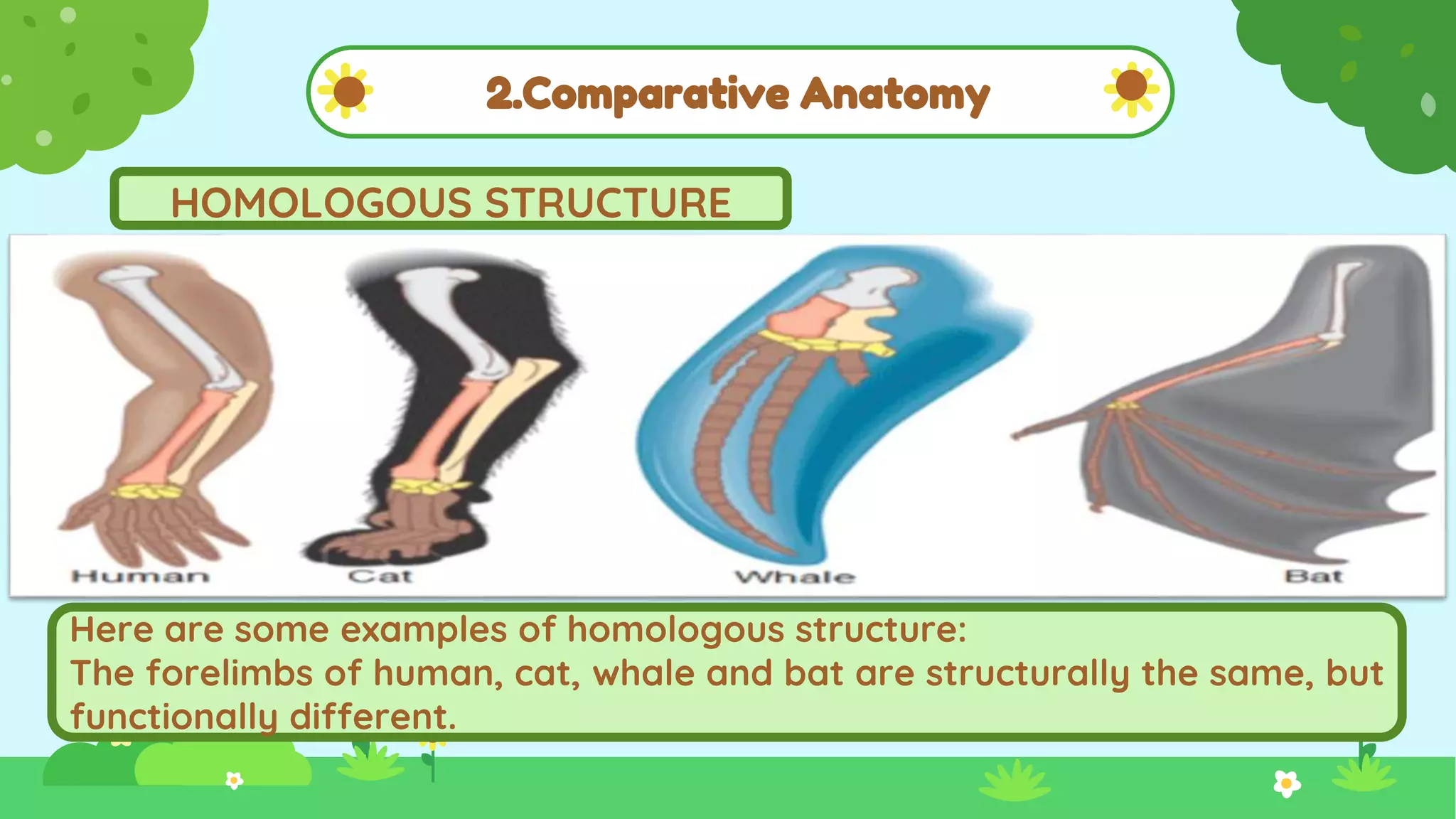
Here are some examples of homologous structure:
The forelimbs of human, cat, whale and bat are structurally the same, but
functionally different.
2.Comparative Anatomy
HOMOLOGOUS STRUCTURE
.
The presence of
homologous structure
is a strong indicator
that the organisms
evolved from central
ancestors.
This type of evolution
is called divergent
evolution.
Pliohippus
Horse
Zebra
2.Comparative Anatomy
ANALOGOUS STRUCTURE
Structures of unrelated species may evolved to
alike, because the structure is adapted to similar
function. These are called analogous structures.
Analogous structures have similar functions but
different origin.
2.Comparative Anatomy
ANALOGOUS STRUCTURE
.
Here are some examples of analogous structure:
Wings of birds ,bat and insect
have similar functions but different origin.
2.Comparative Anatomy
ANALOGOUS STRUCTURE
In convergent evolution, the
analogous structure of
unrelated organisms from
different ancestors develop
similar function such butterfly
wings and birds wings.
Ancestral reptile
Ancestral bird Ancestral mammal
FLIGHT
3. Embryonic Development
Stage 1
Stage 2
Stage 3
3. Embryonic Development
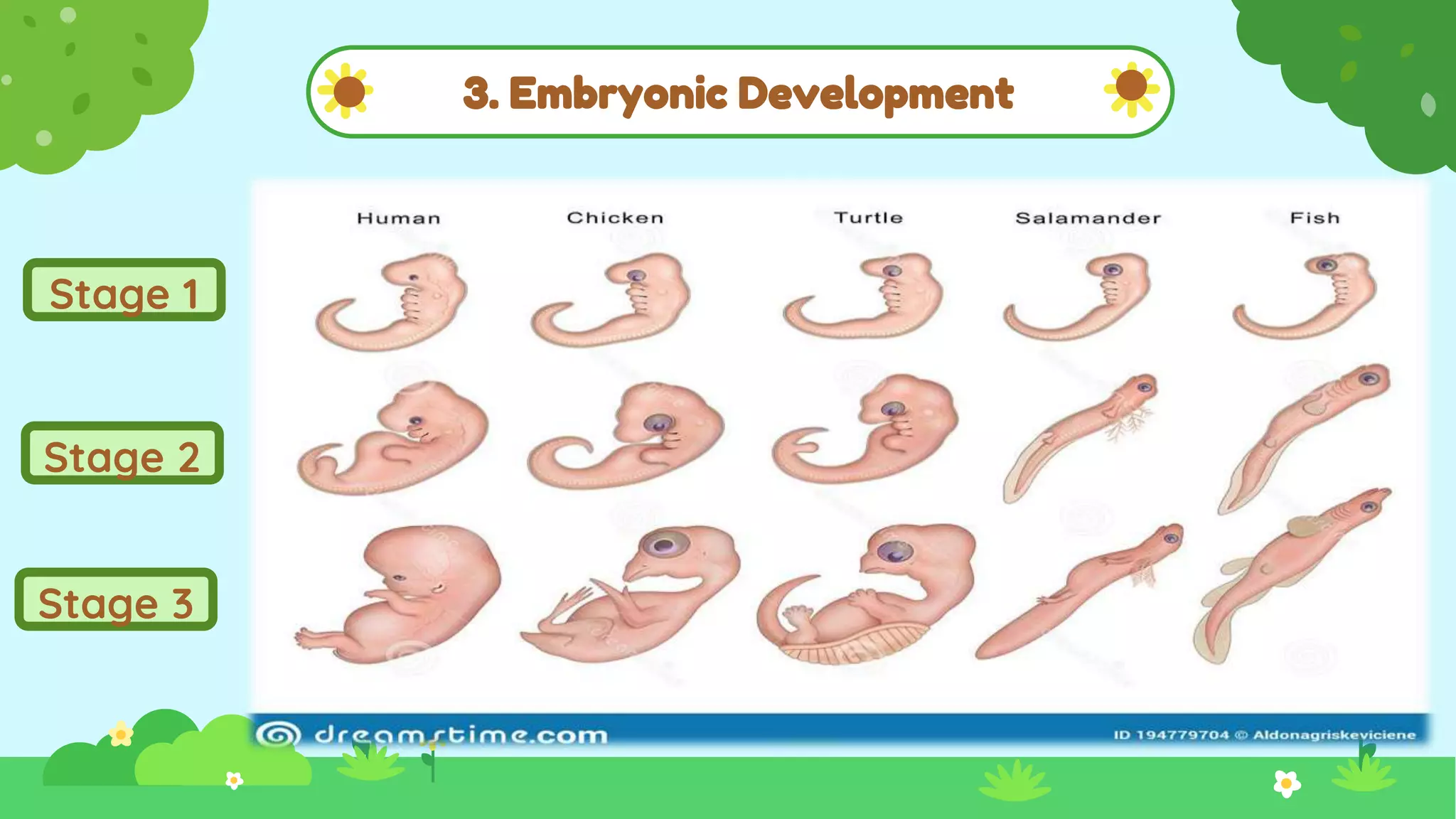
An embryo is an early stage of development in organisms.
Embryonic development include stages such as blastula,
gastrula, and organogenesis.
The embryo of fishes, salamanders, lizards, birds, cats, and
humans have similar during the first stage of their embryonic
development.
3. Embryonic Development
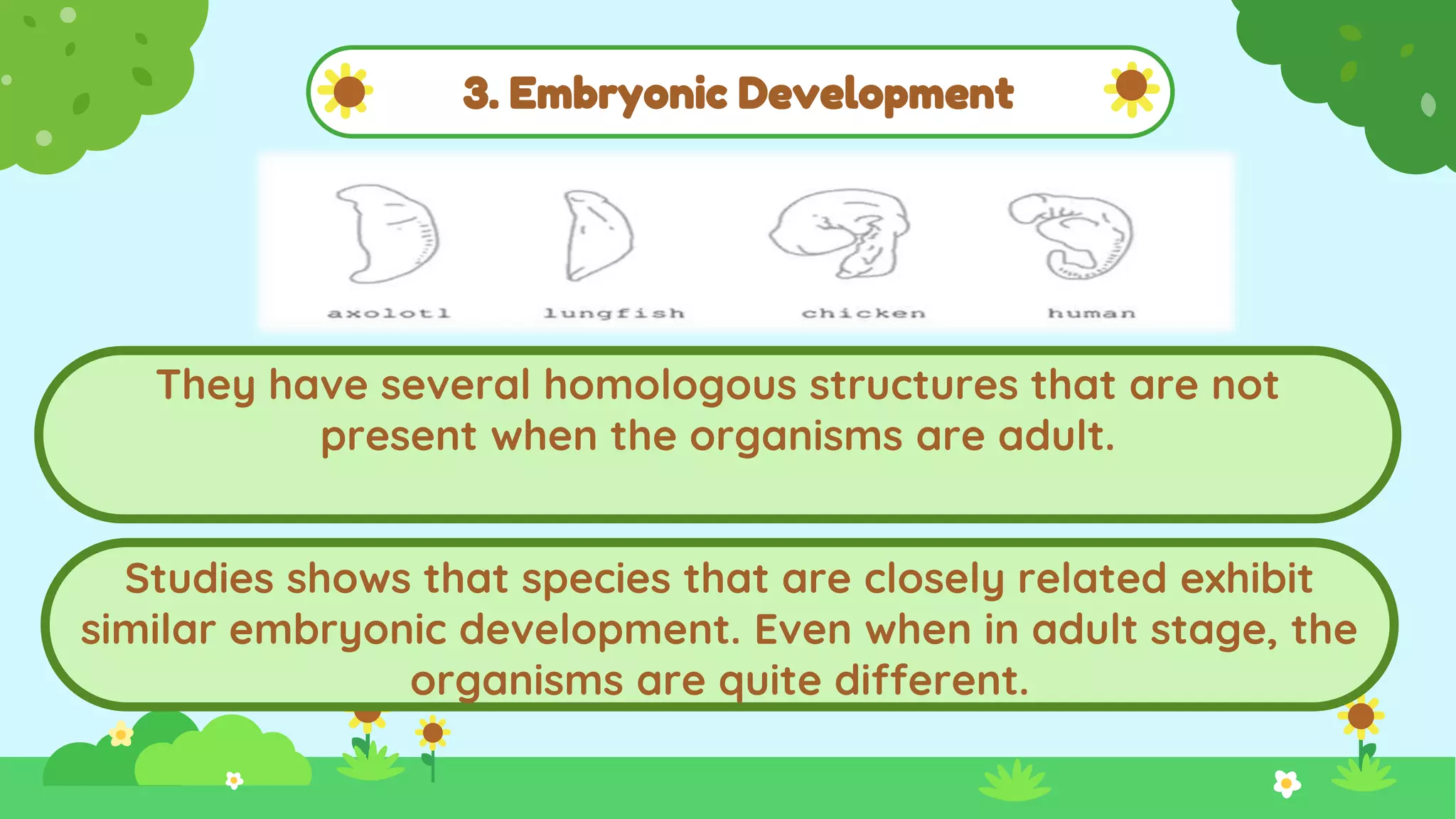
They have several homologous structures that are not
present when the organisms are adult.
Studies shows that species that are closely related exhibit
similar embryonic development. Even when in adult stage, the
organisms are quite different.
4. Amino Acid Sequence
The greater the similarity in amino acid sequence,
the closer the relationship of the organisms. The
organisms which are similar in structure and also
possess similarity at the biochemical level could
probably have a common ancestor.
4. Amino Acid Sequence
Which organism is closely related to humans?
Which organism is least related to humans?
Thanks you for
listening!

Grade 10 Science Week 6

  • 1.
  • 3.
  • 4.
    4 PICS, 1WORD V E O L U T I O N
  • 5.
  • 6.
    4 EVIDENCES FOREVOLUTION 1. Fossil Record 2. Comparative Anatomy 3. Embryonic Development 4. Amino Acid Sequence
  • 7.
    What is EVOLUTION? In biology, evolution is the change in the characteristics of a species over several generations and relies on the process of natural selection.  The theory of evolution is based on the idea that all species? are related and gradually change over time.
  • 8.
     Organisms inhabitingthe earth changed over time, their structures, traits, and abilities allowed them to adapt and survive in their environment.
  • 9.
     Data fromfossil records, anatomy and morphology, embryonic development and biochemistry could be analyzed to demonstrate if evolution of life on earth has taken place.
  • 10.
    1. Evidence fromFossils Records  Have you ever seen fossils of any organism?  Fossils are examples of evidences that paleontologist use in studying evolution.  Who are the paleontologist?
  • 11.
    1. Evidence fromFossils Records Paleontologist a person who studies or is an expert in the branch of science concerned with fossil animals and plants.  Who are the paleontologist? Paleontology is the branch of science concerned with fossil animals and plants.
  • 12.
    1. Evidence fromFossils Records  Fossils are the traces of organism that lived in the past and were preserved by natural process or catastrophic event.  They can be remains of organisms which includes bones, shells, teeth and also feces embedded in rocks, peat, resin, and ice.
  • 13.
    Evidence from FossilsRecords ©www.worldatlas.com ©viewsofthemahantango.com  Most fossils were commonly found in sedimentary rocks. There were from the hard part of organism like woody stem, bones, or teeth.
  • 14.
    Types of fossil COMPRESSIONFOSSIL Black organic residue (carbon ) from original plant adheres to replica IMPRESSION FOSSIL Replica of plant parts lacking organic remains
  • 15.
    1.Evidence from FossilsRecords The age of fossils is determined through fossil dating. It can be specified as either relative or absolute dating. RELATIVE DATING Method used to determine the age of the rocks by comparing them with the rocks in the other layer. The younger sedimentary rock layer is assumed to be found on top and the older rock is found at the bottom layer. Fossil found at the bottom layer is assumed to be older than those on the upper layer.
  • 16.
    1. Evidence fromFossils Records The age of fossils is determined through fossil dating. It can be specified as either relative or absolute dating. ABSOLUTE DATING is through the use of radioactive isotopes such as carbon 14. Radiometric dating is a method used to determine the age of rocks using the decay radioactive isotopes present in rocks. All organisms has carbon 14 in it. Plants and animals that are still alive constantly replace the supply of carbon in their body and the amount of carbon 14 in their body stays the same
  • 17.
  • 18.
    TIME(MILLION YEARS AGO) PERIOD ERA 1.8-PRESENTRECENT CENOZOIC 23-1.8 QUARTERNARY 65.5-23 TERTIARY 146-65.5 CRETACEOUS MESOZOIC 200-146 JURASSIC 251-200 TRIASSIC 299-251 PERMIAN PALEOZOIC 359-299 CARBOONIFEROUS 416-359 DEVONIAN 444-416 SILURIAN 488-444 ORDOVICIAN 542-488 CAMBRIAN 4600-542 PRECAMBRIAN TIME
  • 19.
    2.Comparative Anatomy HOMOLOGOUS STRUCTURE Structurefrom different species which have similar internal framework, position, and embryonic development are considered to be homologous. Homologous structures may perform different functions in the species living in the different environment , or it may have the same origin but different functions.
  • 20.
    2.Comparative Anatomy HOMOLOGOUS STRUCTURE . Hereare some examples of homologous structure: The forelimbs of human, cat, whale and bat are structurally the same, but functionally different.
  • 21.
    2.Comparative Anatomy HOMOLOGOUS STRUCTURE . Thepresence of homologous structure is a strong indicator that the organisms evolved from central ancestors. This type of evolution is called divergent evolution. Pliohippus Horse Zebra
  • 22.
    2.Comparative Anatomy ANALOGOUS STRUCTURE Structuresof unrelated species may evolved to alike, because the structure is adapted to similar function. These are called analogous structures. Analogous structures have similar functions but different origin.
  • 23.
    2.Comparative Anatomy ANALOGOUS STRUCTURE . Hereare some examples of analogous structure: Wings of birds ,bat and insect have similar functions but different origin.
  • 24.
    2.Comparative Anatomy ANALOGOUS STRUCTURE Inconvergent evolution, the analogous structure of unrelated organisms from different ancestors develop similar function such butterfly wings and birds wings. Ancestral reptile Ancestral bird Ancestral mammal FLIGHT
  • 25.
  • 26.
    3. Embryonic Development Anembryo is an early stage of development in organisms. Embryonic development include stages such as blastula, gastrula, and organogenesis. The embryo of fishes, salamanders, lizards, birds, cats, and humans have similar during the first stage of their embryonic development.
  • 27.
    3. Embryonic Development Theyhave several homologous structures that are not present when the organisms are adult. Studies shows that species that are closely related exhibit similar embryonic development. Even when in adult stage, the organisms are quite different.
  • 28.
    4. Amino AcidSequence The greater the similarity in amino acid sequence, the closer the relationship of the organisms. The organisms which are similar in structure and also possess similarity at the biochemical level could probably have a common ancestor.
  • 30.
    4. Amino AcidSequence Which organism is closely related to humans? Which organism is least related to humans?
  • 31.