IB Biology Grade 11
Clarissa Nitihardjo & Stella Sunarja
A body part with a same structure between some
 groups of organisms due to inheritance from a
 same ancestor

 Though   not necessarily sharing the same function
 Havinghomologous structure does not always
 have analogous structure

 Analogous structure: different species with
 similar features in function but not
 necessarily in structure
 To provide a track of evolutionary paths
 Diverges between species and sub-species
    Helps recognizing the same behavioral
     characteristics which are modified in different
     subspecies by their environments
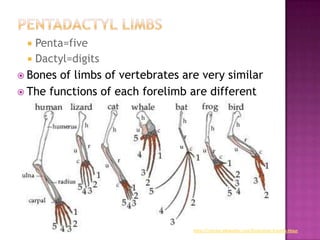
  Penta=five
   Dactyl=digits
 Bones of limbs of vertebrates are very similar
 The functions of each forelimb are different


                                  http://carrier.pbworks.com/Evolution-Fourth-Hour
 Structures
           or organs that are not very
 useful—vestigal
     Humans have tail bones
     Some snakes have limb bones
     Some salamanders have eyes (although they are
      blind)

 Vestigal   organs usually are useful in other
  species
 It can be viewed as an evidence of evolution:
  share common ancestors
http://www.talkorigins.org/faqs/comdesc/section1.html.

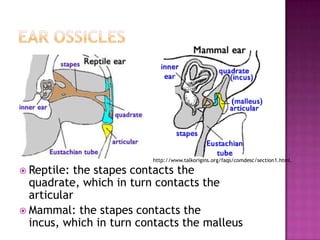
 Reptile: the stapes contacts the
  quadrate, which in turn contacts the
  articular
 Mammal: the stapes contacts the
  incus, which in turn contacts the malleus
   1. Analogous Structures. Biology Online. [Online] [Cited: September
    20, 2010.] http://www.biology-
    online.org/dictionary/Analogous_Structures.
   2. 29+ Evidences for Macroevolution. Talk Origins. [Online] [Cited:
    September 20, 2010.]
    http://www.talkorigins.org/faqs/comdesc/section1.html.
   3. iscid. Homologous Structure. [Online] 2005. [Cited: September
    18, 2010.] http://www.iscid.org/encyclopedia/Homologous_Structure.
   4. unknown. Evolution. [Online] [Cited: September 18, 2010.]
    http://bioweb.cs.earlham.edu/9-12/evolution/HTML/live.html.
   5. Allott, Andrew. Evidence for Evolution. Biology. New York : Oxford
    University Press, 2007, p. 37.
   6. ExamplesOF. Example of Homolgous Structure. [Online] 2010. [Cited:
    September 18, 2010.]
    http://www.examplesof.com/language/homologous_structure.html.
   7. Taylor, Stephen. Evolution. Science Video Recources. [Online] 2010.
    [Cited: September 18, 2010.] http://sciencevideos.wordpress.com/bis-
    ib-diploma-programme-biology/05-ecology-and-evolution/evolution/.

Homologous Structure (Evolution)

  • 1.
    IB Biology Grade11 Clarissa Nitihardjo & Stella Sunarja
  • 2.
    A body partwith a same structure between some groups of organisms due to inheritance from a same ancestor  Though not necessarily sharing the same function
  • 3.
     Havinghomologous structuredoes not always have analogous structure  Analogous structure: different species with similar features in function but not necessarily in structure
  • 4.
     To providea track of evolutionary paths  Diverges between species and sub-species  Helps recognizing the same behavioral characteristics which are modified in different subspecies by their environments
  • 6.
     Penta=five  Dactyl=digits  Bones of limbs of vertebrates are very similar  The functions of each forelimb are different http://carrier.pbworks.com/Evolution-Fourth-Hour
  • 7.
     Structures or organs that are not very useful—vestigal  Humans have tail bones  Some snakes have limb bones  Some salamanders have eyes (although they are blind)  Vestigal organs usually are useful in other species  It can be viewed as an evidence of evolution: share common ancestors
  • 8.
    http://www.talkorigins.org/faqs/comdesc/section1.html.  Reptile: thestapes contacts the quadrate, which in turn contacts the articular  Mammal: the stapes contacts the incus, which in turn contacts the malleus
  • 9.
    1. Analogous Structures. Biology Online. [Online] [Cited: September 20, 2010.] http://www.biology- online.org/dictionary/Analogous_Structures.  2. 29+ Evidences for Macroevolution. Talk Origins. [Online] [Cited: September 20, 2010.] http://www.talkorigins.org/faqs/comdesc/section1.html.  3. iscid. Homologous Structure. [Online] 2005. [Cited: September 18, 2010.] http://www.iscid.org/encyclopedia/Homologous_Structure.  4. unknown. Evolution. [Online] [Cited: September 18, 2010.] http://bioweb.cs.earlham.edu/9-12/evolution/HTML/live.html.  5. Allott, Andrew. Evidence for Evolution. Biology. New York : Oxford University Press, 2007, p. 37.  6. ExamplesOF. Example of Homolgous Structure. [Online] 2010. [Cited: September 18, 2010.] http://www.examplesof.com/language/homologous_structure.html.  7. Taylor, Stephen. Evolution. Science Video Recources. [Online] 2010. [Cited: September 18, 2010.] http://sciencevideos.wordpress.com/bis- ib-diploma-programme-biology/05-ecology-and-evolution/evolution/.