Solving System of Linear
Equations Methods
Presented by:
Aornwara Nitkhosakul No.1
M.4/1
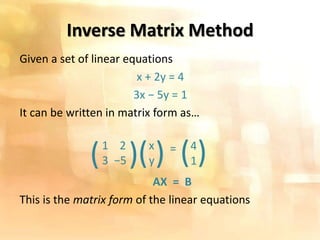
Inverse Matrix Method
Given a set of linear equations
x + 2y = 4
3x − 5y = 1
It can be written in matrix form as…
=
AX = B
This is the matrix form of the linear equations
1 2
3 −5( ) x
y( ) 4
1( )
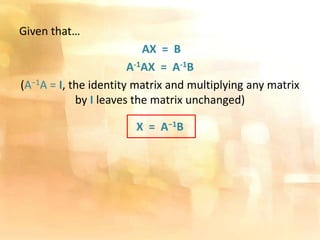
Given that…
AX = B
A-1AX = A-1B
(A−1A = I, the identity matrix and multiplying any matrix
by I leaves the matrix unchanged)
X = A−1B
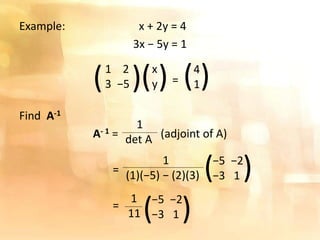
Example: x + 2y = 4
3x − 5y = 1
=
Find A-1
A- 1 = (adjoint of A)
=
=
1 2
3 −5( ) x
y( ) 4
1( )
1
(1)(−5) − (2)(3)
−5 −2
−3 1( )
1
det A
1
11
−5 −2
−3 1( )
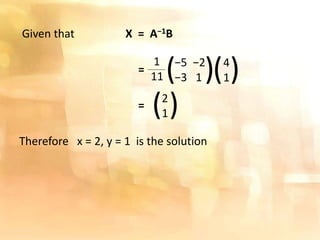
Given that X = A−1B
=
=
Therefore x = 2, y = 1 is the solution
1
11
−5 −2
−3 1( ) 4
1( )
2
1( )
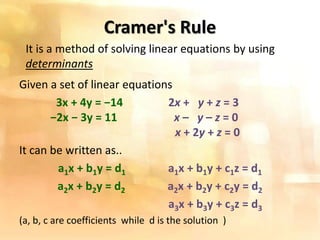
Cramer's Rule
Given a set of linear equations
3x + 4y = −14 2x + y + z = 3
−2x − 3y = 11 x – y – z = 0
x + 2y + z = 0
It can be written as..
a1x + b1y = d1 a1x + b1y + c1z = d1
a2x + b2y = d2 a2x + b2y + c2y = d2
a3x + b3y + c3z = d3
(a, b, c are coefficients while d is the solution )
It is a method of solving linear equations by using
determinants
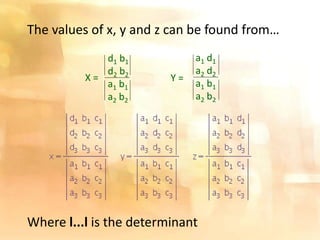
Where l...l is the determinant
The values of x, y and z can be found from…
X = Y =
d1 b1
d2 b2
a1 b1
a2 b2
a1 d1
a2 d2
a1 b1
a2 b2
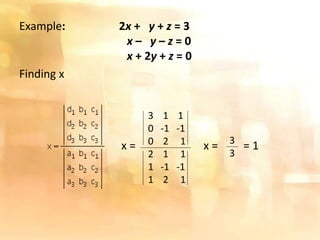
Example: 2x + y + z = 3
x – y – z = 0
x + 2y + z = 0
Finding x
x = x = = 1
3 1 1
0 -1 -1
0 2 1
2 1 1
1 -1 -1
1 2 1
3
3
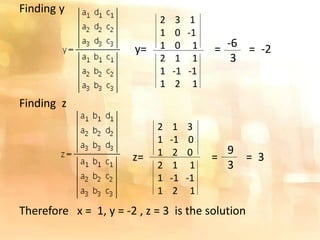
Finding y
y= = = -2
Finding z
z= = = 3
Therefore x = 1, y = -2 , z = 3 is the solution
2 3 1
1 0 -1
1 0 1
2 1 1
1 -1 -1
1 2 1
-6
3
2 1 3
1 -1 0
1 2 0
2 1 1
1 -1 -1
1 2 1
9
3
Notes
• If the coefficient determinant is zero
– It means that the system of equations has no
unique solution
– The system may has no solution at all or an infinite
solution
• The coefficient matrix of the system must be
square

Solving system of linear equations

  • 1.
    Solving System ofLinear Equations Methods Presented by: Aornwara Nitkhosakul No.1 M.4/1
  • 2.
    Inverse Matrix Method Givena set of linear equations x + 2y = 4 3x − 5y = 1 It can be written in matrix form as… = AX = B This is the matrix form of the linear equations 1 2 3 −5( ) x y( ) 4 1( )
  • 3.
    Given that… AX =B A-1AX = A-1B (A−1A = I, the identity matrix and multiplying any matrix by I leaves the matrix unchanged) X = A−1B
  • 4.
    Example: x +2y = 4 3x − 5y = 1 = Find A-1 A- 1 = (adjoint of A) = = 1 2 3 −5( ) x y( ) 4 1( ) 1 (1)(−5) − (2)(3) −5 −2 −3 1( ) 1 det A 1 11 −5 −2 −3 1( )
  • 5.
    Given that X= A−1B = = Therefore x = 2, y = 1 is the solution 1 11 −5 −2 −3 1( ) 4 1( ) 2 1( )
  • 6.
    Cramer's Rule Given aset of linear equations 3x + 4y = −14 2x + y + z = 3 −2x − 3y = 11 x – y – z = 0 x + 2y + z = 0 It can be written as.. a1x + b1y = d1 a1x + b1y + c1z = d1 a2x + b2y = d2 a2x + b2y + c2y = d2 a3x + b3y + c3z = d3 (a, b, c are coefficients while d is the solution ) It is a method of solving linear equations by using determinants
  • 7.
    Where l...l isthe determinant The values of x, y and z can be found from… X = Y = d1 b1 d2 b2 a1 b1 a2 b2 a1 d1 a2 d2 a1 b1 a2 b2
  • 8.
    Example: 2x +y + z = 3 x – y – z = 0 x + 2y + z = 0 Finding x x = x = = 1 3 1 1 0 -1 -1 0 2 1 2 1 1 1 -1 -1 1 2 1 3 3
  • 9.
    Finding y y= == -2 Finding z z= = = 3 Therefore x = 1, y = -2 , z = 3 is the solution 2 3 1 1 0 -1 1 0 1 2 1 1 1 -1 -1 1 2 1 -6 3 2 1 3 1 -1 0 1 2 0 2 1 1 1 -1 -1 1 2 1 9 3
  • 10.
    Notes • If thecoefficient determinant is zero – It means that the system of equations has no unique solution – The system may has no solution at all or an infinite solution • The coefficient matrix of the system must be square