MATHS PROJECT
CLASS - 12TH
ROLL NO. - 23
STUDENT’S NAME - TABREZ
KHAN
TEACHER’S NAME – SIR RAJ
KUSHWAHA
TOPIC - DETERMINANTS
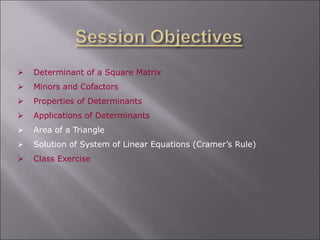
 Determinant of a Square Matrix
 Minors and Cofactors
 Properties of Determinants
 Applications of Determinants
 Area of a Triangle
 Solution of System of Linear Equations (Cramer’s Rule)
 Class Exercise
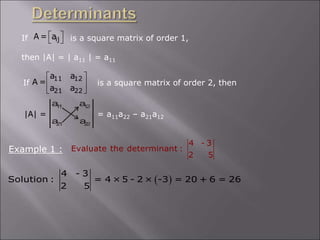
If is a square matrix of order 1,
then |A| = | a11 | = a11
ij
A = a
 
 
If is a square matrix of order 2, then
11 12
21 22
a a
A =
a a
 
 
 
|A| = = a11a22 – a21a12
a a
a a
1
1 1
2
2
1 2
2
Example 1 :
4 - 3
Evaluate the determinant :
2 5
 
4 - 3
Solution : = 4 × 5 - 2 × -3 = 20 + 6 = 26
2 5
If A = is a square matrix of order 3, then
11 12 13
21 22 23
31 32 33
a a a
a a a
a a a
 
 
 
 
 
[Expanding along first row]
11 12 13
22 23 21 23 21 22
21 22 23 11 12 13
32 33 31 33 31 32
31 32 33
a a a
a a a a a a
| A |= a a a = a - a + a
a a a a a a
a a a
     
11 22 33 32 23 12 21 33 31 23 13 21 32 31 22
= a a a - a a - a a a - a a + a a a - a a
   
11 22 33 12 31 23 13 21 32 11 23 32 12 21 33 13 31 22
a a a a a a a a a a a a a a a a a a
     
2 3 - 5
Evaluate the determinant : 7 1 - 2
-3 4 1
 
2 3 - 5
1 - 2 7 - 2 7 1
7 1 - 2 = 2 - 3 + -5
4 1 -3 1 -3 4
-3 4 1
[Expanding along first row]
     
= 2 1 + 8 - 3 7 - 6 - 5 28 + 3
= 18 - 3 - 155
= -140
Solution :
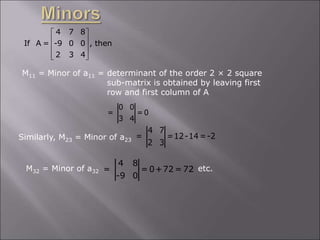
4 7 8
If A = -9 0 0 , then
2 3 4
 
 
 
 
 
M11 = Minor of a11 = determinant of the order 2 × 2 square
sub-matrix is obtained by leaving first
row and first column of A
0 0
= = 0
3 4
Similarly, M23 = Minor of a23
4 7
= =12-14=-2
2 3
M32 = Minor of a32 etc.
4 8
= = 0+72 = 72
-9 0
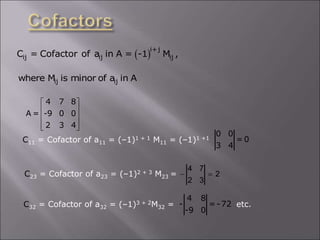
 i+j
ij ij ij
C = Cofactor of a in A = -1 M ,
ij ij
where M is minor of a in A
4 7 8
A = -9 0 0
2 3 4
 
 
 
 
 
C11 = Cofactor of a11 = (–1)1 + 1 M11 = (–1)1 +1
0 0
= 0
3 4
C23 = Cofactor of a23 = (–1)2 + 3 M23 =  
4 7
2
2 3
C32 = Cofactor of a32 = (–1)3 + 2M32 = etc.
4 8
- = -72
-9 0
11 12 13
21 22 23
31 32 33
a a a
If A = a a a , then
a a a
 
 
 
 
 
 
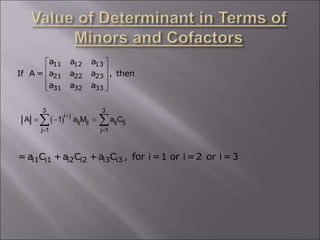
3 3
i j
ij ij ij ij
j 1 j 1
A 1 a M a C

 
  
 
i1 i1 i2 i2 i3 i3
= a C +a C +a C , for i =1 or i =2 or i =3
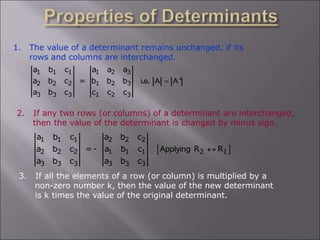
1. The value of a determinant remains unchanged, if its
rows and columns are interchanged.
1 1 1 1 2 3
2 2 2 1 2 3
3 3 3 1 2 3
a b c a a a
a b c = b b b
a b c c c c
i e A A

. . '
2. If any two rows (or columns) of a determinant are interchanged,
then the value of the determinant is changed by minus sign.
 
1 1 1 2 2 2
2 2 2 1 1 1 2 1
3 3 3 3 3 3
a b c a b c
a b c = - a b c R R
a b c a b c
Applying 
3. If all the elements of a row (or column) is multiplied by a
non-zero number k, then the value of the new determinant
is k times the value of the original determinant.
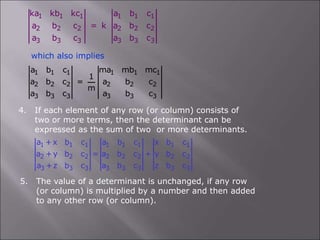
1 1 1 1 1 1
2 2 2 2 2 2
3 3 3 3 3 3
ka kb kc a b c
a b c = k a b c
a b c a b c
which also implies
1 1 1 1 1 1
2 2 2 2 2 2
3 3 3 3 3 3
a b c ma mb mc
1
a b c = a b c
m
a b c a b c
4. If each element of any row (or column) consists of
two or more terms, then the determinant can be
expressed as the sum of two or more determinants.
1 1 1 1 1 1 1 1
2 2 2 2 2 2 2 2
3 3 3 3 3 3 3 3
a +x b c a b c x b c
a +y b c = a b c + y b c
a +z b c a b c z b c
5. The value of a determinant is unchanged, if any row
(or column) is multiplied by a number and then added
to any other row (or column).
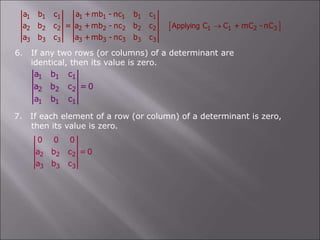
 
1 1 1 1 1 1 1 1
2 2 2 2 2 2 2 2 1 1 2 3
3 3 3 3 3 3 3 3
a b c a +mb - nc b c
a b c = a +mb - nc b c C C + mC -nC
a b c a +mb - nc b c
Applying 
6. If any two rows (or columns) of a determinant are
identical, then its value is zero.
1 1 1
2 2 2
1 1 1
a b c
a b c = 0
a b c
7. If each element of a row (or column) of a determinant is zero,
then its value is zero.
2 2 2
3 3 3
0 0 0
a b c = 0
a b c
 
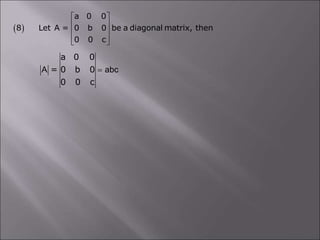
a 0 0
8 Let A = 0 b 0 be a diagonal matrix, then
0 0 c
 
 
 
 
 
a 0 0
= 0 b 0
0 0 c
A abc

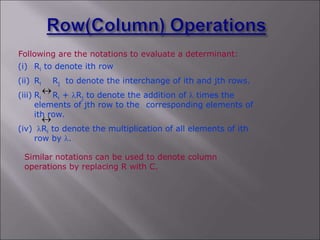
Following are the notations to evaluate a determinant:
Similar notations can be used to denote column
operations by replacing R with C.
(i) Ri to denote ith row
(ii) Ri Rj to denote the interchange of ith and jth rows.
(iii) Ri Ri + lRj to denote the addition of l times the
elements of jth row to the corresponding elements of
ith row.
(iv) lRi to denote the multiplication of all elements of ith
row by l.


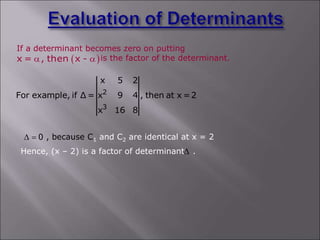
If a determinant becomes zero on putting
is the factor of the determinant.
 
x = , then x -
 
2
3
x 5 2
For example, if Δ = x 9 4 , then at x =2
x 16 8
, because C1 and C2 are identical at x = 2
Hence, (x – 2) is a factor of determinant .
  0

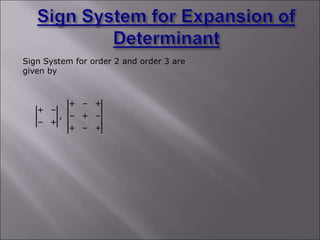
Sign System for order 2 and order 3 are
given by
+ – +
+ –
, – + –
– +
+ – +
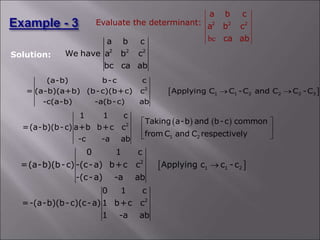
2 2 2
a b c
We have a b c
bc ca ab
 
2
1 1 2 2 2 3
(a-b) b-c c
= (a-b)(a+b) (b-c)(b+c) c Applying C C -C and C C -C
-c(a-b) -a(b-c) ab
 
   
2
1 2
1 1 c
Taking a-b and b-c common
=(a-b)(b-c) a+b b+c c
from C and C respectively
-c -a ab
 
 
 
bc
2 2 2
a b c
a b c
ca ab
Evaluate the determinant:
Solution:
 
2
1 1 2
0 1 c
=(a-b)(b-c) -(c-a) b+c c Applying c c -c
-(c-a) -a ab

2
0 1 c
=-(a-b)(b-c)(c-a) 1 b+c c
1 -a ab
 
2
2 2 3
0 1 c
= -(a-b)(b-c)(c-a) 0 a+b+c c -ab Applying R R -R
1 -a ab

Now expanding along C1 , we get
(a-b) (b-c) (c-a) [- (c2 – ab – ac – bc – c2)]
= (a-b) (b-c) (c-a) (ab + bc + ac)
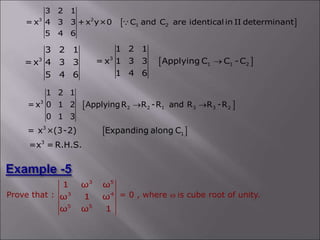
Without expanding the determinant,
prove that
3
3x+y 2x x
4x+3y 3x 3x =x
5x+6y 4x 6x
Solution :
3x+y 2x x 3x 2x x y 2x x
L.H.S= 4x+3y 3x 3x = 4x 3x 3x + 3y 3x 3x
5x+6y 4x 6x 5x 4x 6x 6y 4x 6x
3 2
3 2 1 1 2 1
= x 4 3 3 +x y 3 3 3
5 4 6 6 4 6
 
3
1 1 2
1 2 1
= x 1 3 3 Applying C C -C
1 4 6

 
3
2 2 1 3 3 2
1 2 1
=x 0 1 2 ApplyingR R -R and R R -R
0 1 3
 
 
3
1
3
= x ×(3-2) Expanding along C
=x = R.H.S.
3
3 2 1
=x 4 3 3
5 4 6
 
3 2
1 2
3 2 1
= x 4 3 3 +x y×0 C and C are identical in II determinant
5 4 6
Prove that : = 0 , where w is cube root of unity.
3 5
3 4
5 5
1 ω ω
ω 1 ω
ω ω 1
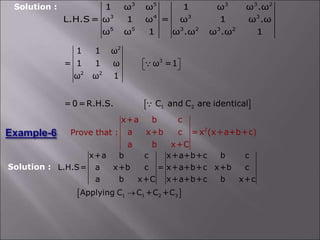
3 5 3 3 2
3 4 3 3
5 5 3 2 3 2
1 ω ω 1 ω ω .ω
L.H.S = ω 1 ω = ω 1 ω .ω
ω ω 1 ω .ω ω .ω 1
 
2
3
2 2
1 2
1 1 ω
= 1 1 ω ω =1
ω ω 1
=0=R.H.S. C and C are identical
 
 
Solution :
2
x+a b c
a x+b c =x (x+a+b+c)
a b x+C
Prove that :
Solution :
 
1 1 2 3
x+a b c x+a+b+c b c
L.H.S= a x+b c = x+a+b+c x+b c
a b x+C x+a+b+c b x+c
Applying C C +C +C

 
2 2 1 3 3 1
1 b c
=(x+a+b+c) 0 x 0
0 0 x
Applying R R -R and R R -R
 
Expanding along C1 , we get
(x + a + b + c) [1(x2)] = x2 (x + a + b + c)
= R.H.S
 
  1
1 b c
= x+a+b+c 1 x+b c
1 b x+c
Taking x+a+b+c commonfrom C
 
 
The area of a triangle whose vertices are
is given by the expression
1 1 2 2 3 3
(x , y ), (x , y ) and (x , y )
1 1
2 2
3 3
x y 1
1
Δ= x y 1
2
x y 1
1 2 3 2 3 1 3 1 2
1
= [x (y - y ) + x (y - y ) + x (y - y )]
2
Find the area of a triangle whose
vertices are (-1, 8), (-2, -3) and (3, 2).
Solution :
1 1
2 2
3 3
x y 1 -1 8 1
1 1
Area of triangle= x y 1 = -2 -3 1
2 2
x y 1 3 2 1
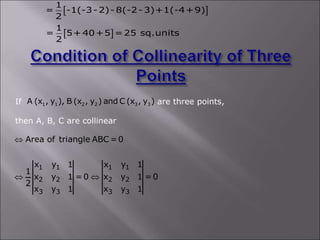
If are three points,
then A, B, C are collinear
1 1 2 2 3 3
A (x , y ), B (x , y ) and C (x , y )
1 1 1 1
2 2 2 2
3 3 3 3
Area of triangle ABC =0
x y 1 x y 1
1
x y 1 =0 x y 1 =0
2
x y 1 x y 1

 
 
1
= -1(-3-2)-8(-2-3)+1(-4+9)
2
 
1
= 5+40+5 =25 sq.units
2
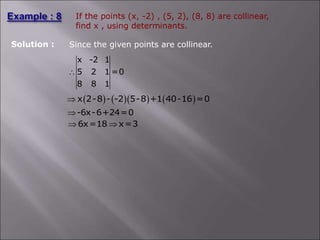
If the points (x, -2) , (5, 2), (8, 8) are collinear,
find x , using determinants.
Solution :
x -2 1
5 2 1 =0
8 8 1

      
x 2-8 - -2 5-8 +1 40-16 =0

-6x-6+24=0

6x=18 x=3
 
Since the given points are collinear.
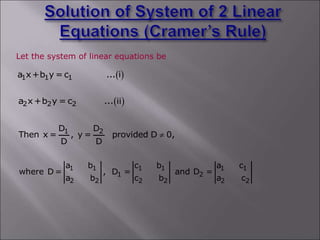
Let the system of linear equations be
 
2 2 2
a x+b y = c ... ii
 
1 1 1
a x+b y = c ... i
1 2
D D
Then x = , y = provided D 0,
D D

1 1 1 1 1 1
1 2
2 2 2 2 2 2
a b c b a c
where D = , D = and D =
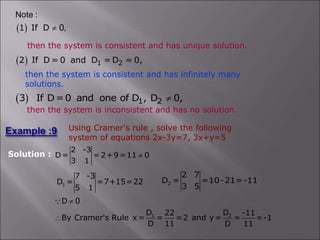
a b c b a c
then the system is consistent and has infinitely many
solutions.
  1 2
2 If D = 0 and D = D = 0,
then the system is inconsistent and has no solution.
 
1 If D 0
Note :
,

then the system is consistent and has unique solution.
  1 2
3 If D=0 and one of D , D 0,

Using Cramer's rule , solve the following
system of equations 2x-3y=7, 3x+y=5
Solution :
2 -3
D= =2+9=11 0
3 1

1
7 -3
D = =7+15=22
5 1
2
2 7
D = =10-21=-11
3 5
1 2
D 0
D D
22 -11
By Cramer's Rule x= = =2 and y= = =-1
D 11 D 11


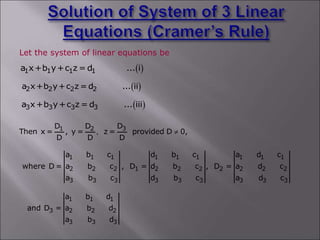
Let the system of linear equations be
 
2 2 2 2
a x+b y+c z = d ... ii
 
1 1 1 1
a x+b y+c z = d ... i
 
3 3 3 3
a x+b y+c z = d ... iii
3
1 2 D
D D
Then x = , y = z = provided D 0,
D D D
, 
1 1 1 1 1 1 1 1 1
2 2 2 1 2 2 2 2 2 2 2
3 3 3 3 3 3 3 3 3
a b c d b c a d c
where D = a b c , D = d b c , D = a d c
a b c d b c a d c
1 1 1
3 2 2 2
3 3 3
a b d
and D = a b d
a b d
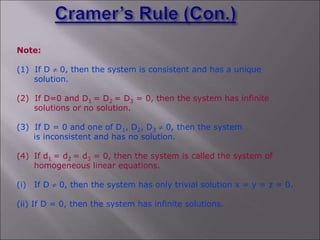
Note:
(1) If D  0, then the system is consistent and has a unique
solution.
(2) If D=0 and D1 = D2 = D3 = 0, then the system has infinite
solutions or no solution.
(3) If D = 0 and one of D1, D2, D3  0, then the system
is inconsistent and has no solution.
(4) If d1 = d2 = d3 = 0, then the system is called the system of
homogeneous linear equations.
(i) If D  0, then the system has only trivial solution x = y = z = 0.
(ii) If D = 0, then the system has infinite solutions.
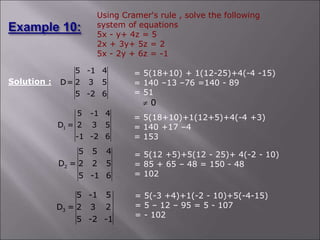
Using Cramer's rule , solve the following
system of equations
5x - y+ 4z = 5
2x + 3y+ 5z = 2
5x - 2y + 6z = -1
Solution :
5 -1 4
D= 2 3 5
5 -2 6
1
5 -1 4
D = 2 3 5
-1 -2 6
= 5(18+10)+1(12+5)+4(-4 +3)
= 140 +17 –4
= 153
= 5(18+10) + 1(12-25)+4(-4 -15)
= 140 –13 –76 =140 - 89
= 51
0

2
5 5 4
D = 2 2 5
5 -1 6
= 5(12 +5)+5(12 - 25)+ 4(-2 - 10)
= 85 + 65 – 48 = 150 - 48
= 102
3
5 -1 5
D = 2 3 2
5 -2 -1
= 5(-3 +4)+1(-2 - 10)+5(-4-15)
= 5 – 12 – 95 = 5 - 107
= - 102
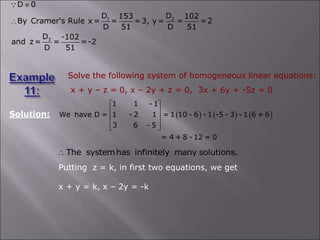
Solve the following system of homogeneous linear equations:
x + y – z = 0, x – 2y + z = 0, 3x + 6y + -5z = 0
Solution:      
1 1 - 1
We have D = 1 - 2 1 = 1 10 - 6 - 1 -5 - 3 - 1 6 + 6
3 6 - 5
= 4 + 8 - 12 = 0
 
 
 
 
 
The systemhas infinitely many solutions.

Putting z = k, in first two equations, we get
x + y = k, x – 2y = -k
1 2
3
D 0
D D
153 102
By Cramer's Rule x = = =3, y = = =2
D 51 D 51
D -102
and z= = =-2
D 51


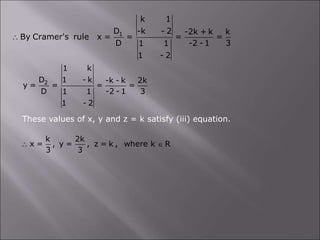
1
k 1
D -k - 2 -2k + k k
By Cramer's rule x = = = =
D -2 - 1 3
1 1
1 - 2

2
1 k
D 1 - k -k - k 2k
y = = = =
D -2 - 1 3
1 1
1 - 2
k 2k
x = , y = , z = k , where k R
3 3
 
These values of x, y and z = k satisfy (iii) equation.

TABREZ KHAN.ppt

  • 1.
    MATHS PROJECT CLASS -12TH ROLL NO. - 23 STUDENT’S NAME - TABREZ KHAN TEACHER’S NAME – SIR RAJ KUSHWAHA TOPIC - DETERMINANTS
  • 2.
     Determinant ofa Square Matrix  Minors and Cofactors  Properties of Determinants  Applications of Determinants  Area of a Triangle  Solution of System of Linear Equations (Cramer’s Rule)  Class Exercise
  • 3.
    If is asquare matrix of order 1, then |A| = | a11 | = a11 ij A = a     If is a square matrix of order 2, then 11 12 21 22 a a A = a a       |A| = = a11a22 – a21a12 a a a a 1 1 1 2 2 1 2 2 Example 1 : 4 - 3 Evaluate the determinant : 2 5   4 - 3 Solution : = 4 × 5 - 2 × -3 = 20 + 6 = 26 2 5
  • 4.
    If A =is a square matrix of order 3, then 11 12 13 21 22 23 31 32 33 a a a a a a a a a           [Expanding along first row] 11 12 13 22 23 21 23 21 22 21 22 23 11 12 13 32 33 31 33 31 32 31 32 33 a a a a a a a a a | A |= a a a = a - a + a a a a a a a a a a       11 22 33 32 23 12 21 33 31 23 13 21 32 31 22 = a a a - a a - a a a - a a + a a a - a a     11 22 33 12 31 23 13 21 32 11 23 32 12 21 33 13 31 22 a a a a a a a a a a a a a a a a a a       2 3 - 5 Evaluate the determinant : 7 1 - 2 -3 4 1   2 3 - 5 1 - 2 7 - 2 7 1 7 1 - 2 = 2 - 3 + -5 4 1 -3 1 -3 4 -3 4 1 [Expanding along first row]       = 2 1 + 8 - 3 7 - 6 - 5 28 + 3 = 18 - 3 - 155 = -140 Solution :
  • 5.
    4 7 8 IfA = -9 0 0 , then 2 3 4           M11 = Minor of a11 = determinant of the order 2 × 2 square sub-matrix is obtained by leaving first row and first column of A 0 0 = = 0 3 4 Similarly, M23 = Minor of a23 4 7 = =12-14=-2 2 3 M32 = Minor of a32 etc. 4 8 = = 0+72 = 72 -9 0
  • 6.
     i+j ij ijij C = Cofactor of a in A = -1 M , ij ij where M is minor of a in A 4 7 8 A = -9 0 0 2 3 4           C11 = Cofactor of a11 = (–1)1 + 1 M11 = (–1)1 +1 0 0 = 0 3 4 C23 = Cofactor of a23 = (–1)2 + 3 M23 =   4 7 2 2 3 C32 = Cofactor of a32 = (–1)3 + 2M32 = etc. 4 8 - = -72 -9 0
  • 7.
    11 12 13 2122 23 31 32 33 a a a If A = a a a , then a a a             3 3 i j ij ij ij ij j 1 j 1 A 1 a M a C         i1 i1 i2 i2 i3 i3 = a C +a C +a C , for i =1 or i =2 or i =3
  • 8.
    1. The valueof a determinant remains unchanged, if its rows and columns are interchanged. 1 1 1 1 2 3 2 2 2 1 2 3 3 3 3 1 2 3 a b c a a a a b c = b b b a b c c c c i e A A  . . ' 2. If any two rows (or columns) of a determinant are interchanged, then the value of the determinant is changed by minus sign.   1 1 1 2 2 2 2 2 2 1 1 1 2 1 3 3 3 3 3 3 a b c a b c a b c = - a b c R R a b c a b c Applying  3. If all the elements of a row (or column) is multiplied by a non-zero number k, then the value of the new determinant is k times the value of the original determinant.
  • 9.
    1 1 11 1 1 2 2 2 2 2 2 3 3 3 3 3 3 ka kb kc a b c a b c = k a b c a b c a b c which also implies 1 1 1 1 1 1 2 2 2 2 2 2 3 3 3 3 3 3 a b c ma mb mc 1 a b c = a b c m a b c a b c 4. If each element of any row (or column) consists of two or more terms, then the determinant can be expressed as the sum of two or more determinants. 1 1 1 1 1 1 1 1 2 2 2 2 2 2 2 2 3 3 3 3 3 3 3 3 a +x b c a b c x b c a +y b c = a b c + y b c a +z b c a b c z b c 5. The value of a determinant is unchanged, if any row (or column) is multiplied by a number and then added to any other row (or column).
  • 10.
      1 11 1 1 1 1 1 2 2 2 2 2 2 2 2 1 1 2 3 3 3 3 3 3 3 3 3 a b c a +mb - nc b c a b c = a +mb - nc b c C C + mC -nC a b c a +mb - nc b c Applying  6. If any two rows (or columns) of a determinant are identical, then its value is zero. 1 1 1 2 2 2 1 1 1 a b c a b c = 0 a b c 7. If each element of a row (or column) of a determinant is zero, then its value is zero. 2 2 2 3 3 3 0 0 0 a b c = 0 a b c
  • 11.
      a 00 8 Let A = 0 b 0 be a diagonal matrix, then 0 0 c           a 0 0 = 0 b 0 0 0 c A abc 
  • 12.
    Following are thenotations to evaluate a determinant: Similar notations can be used to denote column operations by replacing R with C. (i) Ri to denote ith row (ii) Ri Rj to denote the interchange of ith and jth rows. (iii) Ri Ri + lRj to denote the addition of l times the elements of jth row to the corresponding elements of ith row. (iv) lRi to denote the multiplication of all elements of ith row by l.  
  • 13.
    If a determinantbecomes zero on putting is the factor of the determinant.   x = , then x -   2 3 x 5 2 For example, if Δ = x 9 4 , then at x =2 x 16 8 , because C1 and C2 are identical at x = 2 Hence, (x – 2) is a factor of determinant .   0 
  • 14.
    Sign System fororder 2 and order 3 are given by + – + + – , – + – – + + – +
  • 15.
    2 2 2 ab c We have a b c bc ca ab   2 1 1 2 2 2 3 (a-b) b-c c = (a-b)(a+b) (b-c)(b+c) c Applying C C -C and C C -C -c(a-b) -a(b-c) ab       2 1 2 1 1 c Taking a-b and b-c common =(a-b)(b-c) a+b b+c c from C and C respectively -c -a ab       bc 2 2 2 a b c a b c ca ab Evaluate the determinant: Solution:   2 1 1 2 0 1 c =(a-b)(b-c) -(c-a) b+c c Applying c c -c -(c-a) -a ab  2 0 1 c =-(a-b)(b-c)(c-a) 1 b+c c 1 -a ab
  • 16.
      2 2 23 0 1 c = -(a-b)(b-c)(c-a) 0 a+b+c c -ab Applying R R -R 1 -a ab  Now expanding along C1 , we get (a-b) (b-c) (c-a) [- (c2 – ab – ac – bc – c2)] = (a-b) (b-c) (c-a) (ab + bc + ac) Without expanding the determinant, prove that 3 3x+y 2x x 4x+3y 3x 3x =x 5x+6y 4x 6x Solution : 3x+y 2x x 3x 2x x y 2x x L.H.S= 4x+3y 3x 3x = 4x 3x 3x + 3y 3x 3x 5x+6y 4x 6x 5x 4x 6x 6y 4x 6x 3 2 3 2 1 1 2 1 = x 4 3 3 +x y 3 3 3 5 4 6 6 4 6
  • 17.
      3 1 12 1 2 1 = x 1 3 3 Applying C C -C 1 4 6    3 2 2 1 3 3 2 1 2 1 =x 0 1 2 ApplyingR R -R and R R -R 0 1 3     3 1 3 = x ×(3-2) Expanding along C =x = R.H.S. 3 3 2 1 =x 4 3 3 5 4 6   3 2 1 2 3 2 1 = x 4 3 3 +x y×0 C and C are identical in II determinant 5 4 6 Prove that : = 0 , where w is cube root of unity. 3 5 3 4 5 5 1 ω ω ω 1 ω ω ω 1
  • 18.
    3 5 33 2 3 4 3 3 5 5 3 2 3 2 1 ω ω 1 ω ω .ω L.H.S = ω 1 ω = ω 1 ω .ω ω ω 1 ω .ω ω .ω 1   2 3 2 2 1 2 1 1 ω = 1 1 ω ω =1 ω ω 1 =0=R.H.S. C and C are identical     Solution : 2 x+a b c a x+b c =x (x+a+b+c) a b x+C Prove that : Solution :   1 1 2 3 x+a b c x+a+b+c b c L.H.S= a x+b c = x+a+b+c x+b c a b x+C x+a+b+c b x+c Applying C C +C +C 
  • 19.
      2 21 3 3 1 1 b c =(x+a+b+c) 0 x 0 0 0 x Applying R R -R and R R -R   Expanding along C1 , we get (x + a + b + c) [1(x2)] = x2 (x + a + b + c) = R.H.S     1 1 b c = x+a+b+c 1 x+b c 1 b x+c Taking x+a+b+c commonfrom C    
  • 20.
    The area ofa triangle whose vertices are is given by the expression 1 1 2 2 3 3 (x , y ), (x , y ) and (x , y ) 1 1 2 2 3 3 x y 1 1 Δ= x y 1 2 x y 1 1 2 3 2 3 1 3 1 2 1 = [x (y - y ) + x (y - y ) + x (y - y )] 2 Find the area of a triangle whose vertices are (-1, 8), (-2, -3) and (3, 2). Solution : 1 1 2 2 3 3 x y 1 -1 8 1 1 1 Area of triangle= x y 1 = -2 -3 1 2 2 x y 1 3 2 1
  • 21.
    If are threepoints, then A, B, C are collinear 1 1 2 2 3 3 A (x , y ), B (x , y ) and C (x , y ) 1 1 1 1 2 2 2 2 3 3 3 3 Area of triangle ABC =0 x y 1 x y 1 1 x y 1 =0 x y 1 =0 2 x y 1 x y 1      1 = -1(-3-2)-8(-2-3)+1(-4+9) 2   1 = 5+40+5 =25 sq.units 2
  • 22.
    If the points(x, -2) , (5, 2), (8, 8) are collinear, find x , using determinants. Solution : x -2 1 5 2 1 =0 8 8 1         x 2-8 - -2 5-8 +1 40-16 =0  -6x-6+24=0  6x=18 x=3   Since the given points are collinear.
  • 23.
    Let the systemof linear equations be   2 2 2 a x+b y = c ... ii   1 1 1 a x+b y = c ... i 1 2 D D Then x = , y = provided D 0, D D  1 1 1 1 1 1 1 2 2 2 2 2 2 2 a b c b a c where D = , D = and D = a b c b a c
  • 24.
    then the systemis consistent and has infinitely many solutions.   1 2 2 If D = 0 and D = D = 0, then the system is inconsistent and has no solution.   1 If D 0 Note : ,  then the system is consistent and has unique solution.   1 2 3 If D=0 and one of D , D 0,  Using Cramer's rule , solve the following system of equations 2x-3y=7, 3x+y=5 Solution : 2 -3 D= =2+9=11 0 3 1  1 7 -3 D = =7+15=22 5 1 2 2 7 D = =10-21=-11 3 5 1 2 D 0 D D 22 -11 By Cramer's Rule x= = =2 and y= = =-1 D 11 D 11  
  • 25.
    Let the systemof linear equations be   2 2 2 2 a x+b y+c z = d ... ii   1 1 1 1 a x+b y+c z = d ... i   3 3 3 3 a x+b y+c z = d ... iii 3 1 2 D D D Then x = , y = z = provided D 0, D D D ,  1 1 1 1 1 1 1 1 1 2 2 2 1 2 2 2 2 2 2 2 3 3 3 3 3 3 3 3 3 a b c d b c a d c where D = a b c , D = d b c , D = a d c a b c d b c a d c 1 1 1 3 2 2 2 3 3 3 a b d and D = a b d a b d
  • 26.
    Note: (1) If D 0, then the system is consistent and has a unique solution. (2) If D=0 and D1 = D2 = D3 = 0, then the system has infinite solutions or no solution. (3) If D = 0 and one of D1, D2, D3  0, then the system is inconsistent and has no solution. (4) If d1 = d2 = d3 = 0, then the system is called the system of homogeneous linear equations. (i) If D  0, then the system has only trivial solution x = y = z = 0. (ii) If D = 0, then the system has infinite solutions.
  • 27.
    Using Cramer's rule, solve the following system of equations 5x - y+ 4z = 5 2x + 3y+ 5z = 2 5x - 2y + 6z = -1 Solution : 5 -1 4 D= 2 3 5 5 -2 6 1 5 -1 4 D = 2 3 5 -1 -2 6 = 5(18+10)+1(12+5)+4(-4 +3) = 140 +17 –4 = 153 = 5(18+10) + 1(12-25)+4(-4 -15) = 140 –13 –76 =140 - 89 = 51 0  2 5 5 4 D = 2 2 5 5 -1 6 = 5(12 +5)+5(12 - 25)+ 4(-2 - 10) = 85 + 65 – 48 = 150 - 48 = 102 3 5 -1 5 D = 2 3 2 5 -2 -1 = 5(-3 +4)+1(-2 - 10)+5(-4-15) = 5 – 12 – 95 = 5 - 107 = - 102
  • 28.
    Solve the followingsystem of homogeneous linear equations: x + y – z = 0, x – 2y + z = 0, 3x + 6y + -5z = 0 Solution:       1 1 - 1 We have D = 1 - 2 1 = 1 10 - 6 - 1 -5 - 3 - 1 6 + 6 3 6 - 5 = 4 + 8 - 12 = 0           The systemhas infinitely many solutions.  Putting z = k, in first two equations, we get x + y = k, x – 2y = -k 1 2 3 D 0 D D 153 102 By Cramer's Rule x = = =3, y = = =2 D 51 D 51 D -102 and z= = =-2 D 51  
  • 29.
    1 k 1 D -k- 2 -2k + k k By Cramer's rule x = = = = D -2 - 1 3 1 1 1 - 2  2 1 k D 1 - k -k - k 2k y = = = = D -2 - 1 3 1 1 1 - 2 k 2k x = , y = , z = k , where k R 3 3   These values of x, y and z = k satisfy (iii) equation.