8.2 Writing Exponential
Models
What is an exponential equation?
An exponential equation has the general form

y=abx
where a ≠ 0, b〉 0 and b ≠ 1
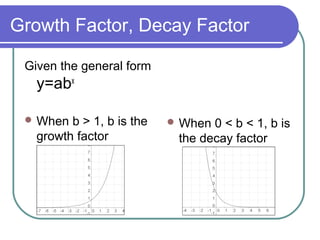
Growth Factor, Decay Factor
Given the general form

y=abx
 When

b > 1, b is the
growth factor

 When

0 < b < 1, b is
the decay factor
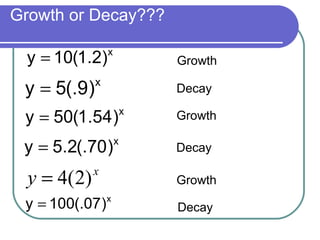
Growth or Decay???

y = 10(1.2)

y = 5(.9)

x

Growth

x

Decay

y = 50(1.54)

y = 5.2(.70)

y = 4(2)

x

y = 100(.07)

x

x

Growth
Decay
Growth

x

Decay
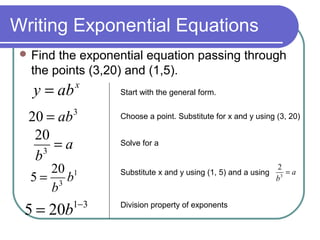
Writing Exponential Equations
 Find

the exponential equation passing through
the points (3,20) and (1,5).

y = ab
20 = ab
20
=a
3
b

x

3

Start with the general form.
Choose a point. Substitute for x and y using (3, 20)
Solve for a

20 1
5= 3 b
b
1−3

5 = 20b

Substitute x and y using (1, 5) and a using

Division property of exponents

2
=a
b3
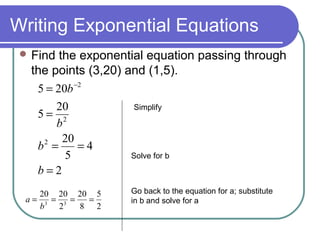
Writing Exponential Equations
 Find

the exponential equation passing through
the points (3,20) and (1,5).
5 = 20b −2
Simplify
20
5= 2
b
20
2
b =
=4
Solve for b
5
b=2

20 20 20 5
a= 3 = 3 =
=
b
2
8 2

Go back to the equation for a; substitute
in b and solve for a
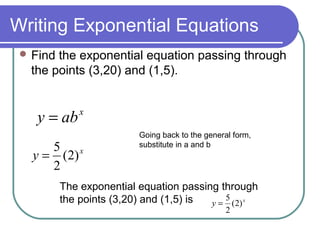
Writing Exponential Equations
 Find

the exponential equation passing through
the points (3,20) and (1,5).

y = ab

x

5 x
y = (2)
2

Going back to the general form,
substitute in a and b

The exponential equation passing through
5
the points (3,20) and (1,5) is
y = ( 2) x
2
Let’s Try One
 Find

the exponential equation passing through
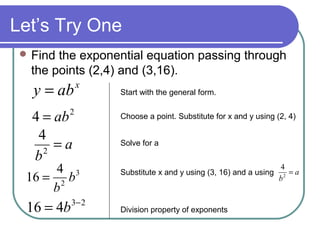
the points (2,4) and (3,16).

y = ab

x

4 = ab
4
=a
2
b

2

4 3
16 = 2 b
b

16 = 4b

3− 2

Start with the general form.
Choose a point. Substitute for x and y using (2, 4)
Solve for a

Substitute x and y using (3, 16) and a using

Division property of exponents

4
=a
b2
Writing Exponential Equations
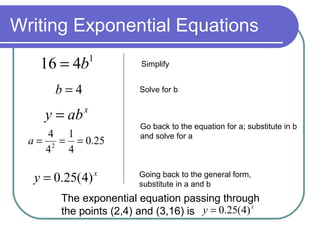
16 = 4b

1

Simplify

b=4

y = ab

Solve for b

x

4 1
a = 2 = = 0.25
4
4

y = 0.25(4)

x

Go back to the equation for a; substitute in b
and solve for a

Going back to the general form,
substitute in a and b

The exponential equation passing through
x
the points (2,4) and (3,16) is y = 0.25(4)
Putting it all together . . .
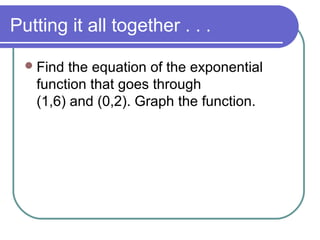
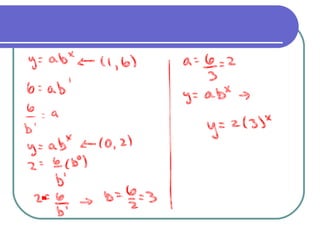
 Find

the equation of the exponential
function that goes through
(1,6) and (0,2). Graph the function.
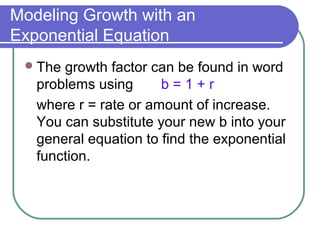
Modeling Growth with an
Exponential Equation
 The

growth factor can be found in word
problems using
b=1+r
where r = rate or amount of increase.
You can substitute your new b into your
general equation to find the exponential
function.
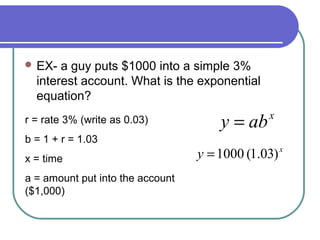
 EX-

a guy puts $1000 into a simple 3%
interest account. What is the exponential
equation?

r = rate 3% (write as 0.03)
b = 1 + r = 1.03
x = time
a = amount put into the account
($1,000)

y = ab

x

y = 1000 (1.03) x
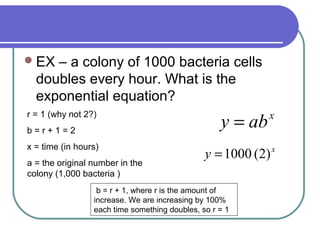
 EX

– a colony of 1000 bacteria cells
doubles every hour. What is the
exponential equation?

r = 1 (why not 2?)
b=r+1=2
x = time (in hours)
a = the original number in the
colony (1,000 bacteria )

y = ab

x

y = 1000 (2) x

b = r + 1, where r is the amount of
increase. We are increasing by 100%
each time something doubles, so r = 1
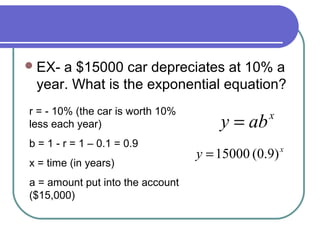
 EX-

a $15000 car depreciates at 10% a
year. What is the exponential equation?

r = - 10% (the car is worth 10%
less each year)
b = 1 - r = 1 – 0.1 = 0.9
x = time (in years)
a = amount put into the account
($15,000)

y = ab

x

y = 15000 (0.9) x
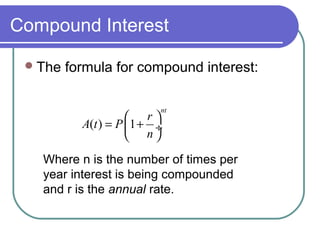
Compound Interest
 The

formula for compound interest:
nt

 r
A(t ) = P 1 + ÷
 n

Where n is the number of times per
year interest is being compounded
and r is the annual rate.
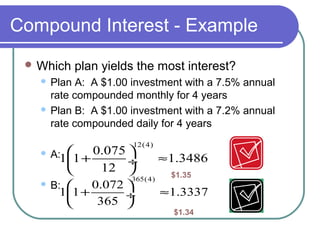
Compound Interest - Example
 Which

plan yields the most interest?

Plan A: A $1.00 investment with a 7.5% annual
rate compounded monthly for 4 years
 Plan B: A $1.00 investment with a 7.2% annual
rate compounded daily for 4 years


12(4)

A:11 + 0.075 

≈1.3486

÷
12 

$1.35
365(4)
 B: 
0.072 
11 +
≈1.3337
÷
365 



$1.34

8.2 Exploring exponential models

  • 1.
  • 2.
    What is anexponential equation? An exponential equation has the general form y=abx where a ≠ 0, b〉 0 and b ≠ 1
  • 3.
    Growth Factor, DecayFactor Given the general form y=abx  When b > 1, b is the growth factor  When 0 < b < 1, b is the decay factor
  • 4.
    Growth or Decay??? y= 10(1.2) y = 5(.9) x Growth x Decay y = 50(1.54) y = 5.2(.70) y = 4(2) x y = 100(.07) x x Growth Decay Growth x Decay
  • 5.
    Writing Exponential Equations Find the exponential equation passing through the points (3,20) and (1,5). y = ab 20 = ab 20 =a 3 b x 3 Start with the general form. Choose a point. Substitute for x and y using (3, 20) Solve for a 20 1 5= 3 b b 1−3 5 = 20b Substitute x and y using (1, 5) and a using Division property of exponents 2 =a b3
  • 6.
    Writing Exponential Equations Find the exponential equation passing through the points (3,20) and (1,5). 5 = 20b −2 Simplify 20 5= 2 b 20 2 b = =4 Solve for b 5 b=2 20 20 20 5 a= 3 = 3 = = b 2 8 2 Go back to the equation for a; substitute in b and solve for a
  • 7.
    Writing Exponential Equations Find the exponential equation passing through the points (3,20) and (1,5). y = ab x 5 x y = (2) 2 Going back to the general form, substitute in a and b The exponential equation passing through 5 the points (3,20) and (1,5) is y = ( 2) x 2
  • 8.
    Let’s Try One Find the exponential equation passing through the points (2,4) and (3,16). y = ab x 4 = ab 4 =a 2 b 2 4 3 16 = 2 b b 16 = 4b 3− 2 Start with the general form. Choose a point. Substitute for x and y using (2, 4) Solve for a Substitute x and y using (3, 16) and a using Division property of exponents 4 =a b2
  • 9.
    Writing Exponential Equations 16= 4b 1 Simplify b=4 y = ab Solve for b x 4 1 a = 2 = = 0.25 4 4 y = 0.25(4) x Go back to the equation for a; substitute in b and solve for a Going back to the general form, substitute in a and b The exponential equation passing through x the points (2,4) and (3,16) is y = 0.25(4)
  • 10.
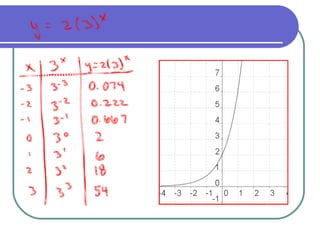
    Putting it alltogether . . .  Find the equation of the exponential function that goes through (1,6) and (0,2). Graph the function.
  • 13.
    Modeling Growth withan Exponential Equation  The growth factor can be found in word problems using b=1+r where r = rate or amount of increase. You can substitute your new b into your general equation to find the exponential function.
  • 14.
     EX- a guyputs $1000 into a simple 3% interest account. What is the exponential equation? r = rate 3% (write as 0.03) b = 1 + r = 1.03 x = time a = amount put into the account ($1,000) y = ab x y = 1000 (1.03) x
  • 15.
     EX – acolony of 1000 bacteria cells doubles every hour. What is the exponential equation? r = 1 (why not 2?) b=r+1=2 x = time (in hours) a = the original number in the colony (1,000 bacteria ) y = ab x y = 1000 (2) x b = r + 1, where r is the amount of increase. We are increasing by 100% each time something doubles, so r = 1
  • 16.
     EX- a $15000car depreciates at 10% a year. What is the exponential equation? r = - 10% (the car is worth 10% less each year) b = 1 - r = 1 – 0.1 = 0.9 x = time (in years) a = amount put into the account ($15,000) y = ab x y = 15000 (0.9) x
  • 17.
    Compound Interest  The formulafor compound interest: nt  r A(t ) = P 1 + ÷  n Where n is the number of times per year interest is being compounded and r is the annual rate.
  • 18.
    Compound Interest -Example  Which plan yields the most interest? Plan A: A $1.00 investment with a 7.5% annual rate compounded monthly for 4 years  Plan B: A $1.00 investment with a 7.2% annual rate compounded daily for 4 years  12(4) A:11 + 0.075  ≈1.3486  ÷ 12   $1.35 365(4)  B:  0.072  11 + ≈1.3337 ÷ 365    $1.34