
Operations with Complex Numbers
                Warm Up
              Lesson Presentation
              Lesson Quiz
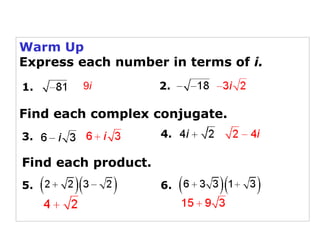
Warm Up
Express each number in terms of i.
1.      9i           2.

Find each complex conjugate.
3.                   4.

Find each product.
5.                   6.
Objective
Perform operations with complex
numbers.
Vocabulary
complex plane
absolute value of a complex number
Just as you can
represent real numbers
graphically as points on
a number line, you can
represent complex
numbers in a special
coordinate plane.


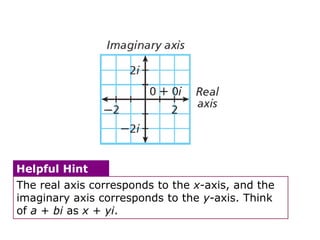
The complex plane is a set of coordinate axes in
which the horizontal axis represents real numbers
and the vertical axis represents imaginary numbers.
Helpful Hint
The real axis corresponds to the x-axis, and the
imaginary axis corresponds to the y-axis. Think
of a + bi as x + yi.
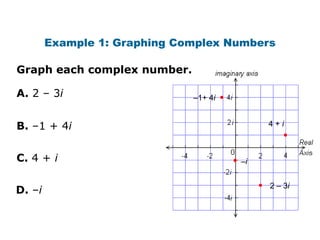
Example 1: Graphing Complex Numbers

Graph each complex number.

A. 2 – 3i                     –1+ 4i   •

B. –1 + 4i                                              4+i
                                                            •
C. 4 + i                                   •   –i


D. –i                                               •   2 – 3i
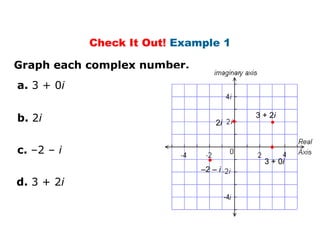
Check It Out! Example 1

Graph each complex number.
a. 3 + 0i


b. 2i                               2i   •
                                             3 + 2i
                                                 •

c. –2 – i                                        •
                                •              3 + 0i
                              –2 – i
d. 3 + 2i
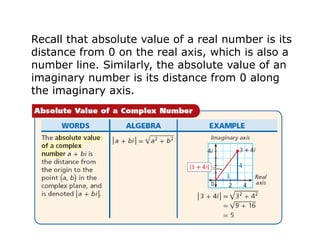
Recall that absolute value of a real number is its
distance from 0 on the real axis, which is also a
number line. Similarly, the absolute value of an
imaginary number is its distance from 0 along
the imaginary axis.
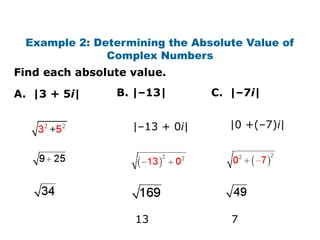
Example 2: Determining the Absolute Value of
              Complex Numbers
Find each absolute value.

A. |3 + 5i|     B. |–13|        C. |–7i|


                   |–13 + 0i|      |0 +(–7)i|


                   13              7
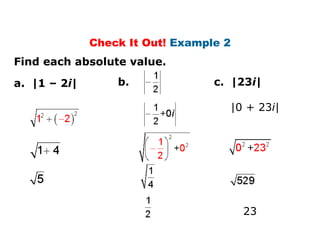
Check It Out! Example 2
Find each absolute value.

a. |1 – 2i|       b.              c. |23i|

                                    |0 + 23i|


                                        23
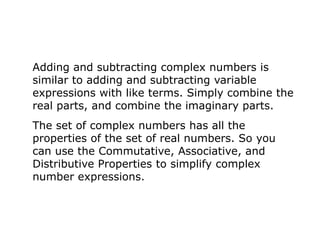
Adding and subtracting complex numbers is
similar to adding and subtracting variable
expressions with like terms. Simply combine the
real parts, and combine the imaginary parts.
The set of complex numbers has all the
properties of the set of real numbers. So you
can use the Commutative, Associative, and
Distributive Properties to simplify complex
number expressions.
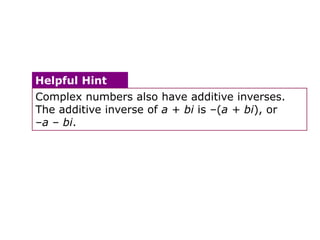
Helpful Hint
Complex numbers also have additive inverses.
The additive inverse of a + bi is –(a + bi), or
–a – bi.
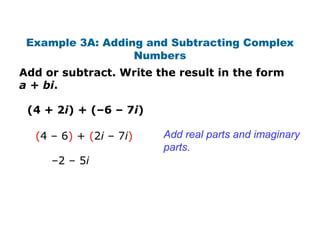
Example 3A: Adding and Subtracting Complex
                  Numbers
Add or subtract. Write the result in the form
a + bi.

 (4 + 2i) + (–6 – 7i)

  (4 – 6) + (2i – 7i)   Add real parts and imaginary
                        parts.
     –2 – 5i
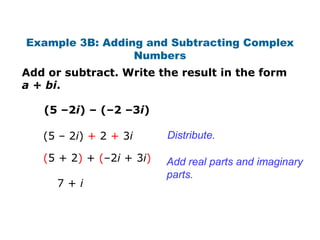
Example 3B: Adding and Subtracting Complex
                 Numbers
Add or subtract. Write the result in the form
a + bi.

   (5 –2i) – (–2 –3i)

   (5 – 2i) + 2 + 3i      Distribute.

   (5 + 2) + (–2i + 3i)   Add real parts and imaginary
                          parts.
     7+i
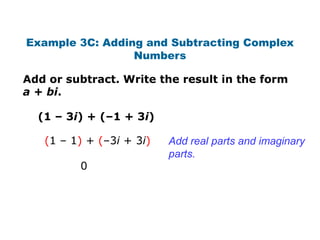
Example 3C: Adding and Subtracting Complex
                 Numbers

Add or subtract. Write the result in the form
a + bi.

  (1 – 3i) + (–1 + 3i)

   (1 – 1) + (–3i + 3i)   Add real parts and imaginary
                          parts.
         0
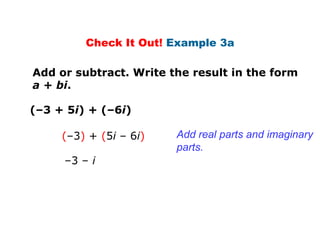
Check It Out! Example 3a

Add or subtract. Write the result in the form
a + bi.

(–3 + 5i) + (–6i)

     (–3) + (5i – 6i)   Add real parts and imaginary
                        parts.
     –3 – i
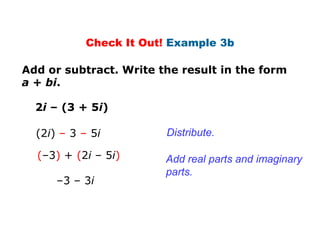
Check It Out! Example 3b

Add or subtract. Write the result in the form
a + bi.

  2i – (3 + 5i)

  (2i) – 3 – 5i          Distribute.

  (–3) + (2i – 5i)      Add real parts and imaginary
                        parts.
      –3 – 3i
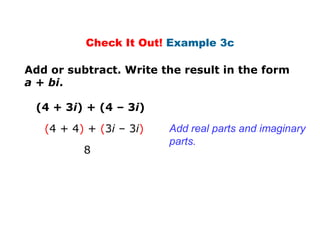
Check It Out! Example 3c

Add or subtract. Write the result in the form
a + bi.

 (4 + 3i) + (4 – 3i)
   (4 + 4) + (3i – 3i)   Add real parts and imaginary
                         parts.
          8
You can also add complex numbers by using
coordinate geometry.
Example 4: Adding Complex Numbers on the Complex
                     Plane
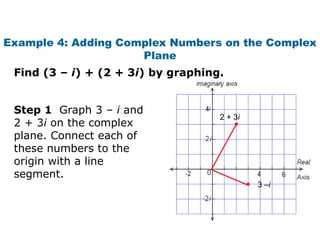
 Find (3 – i) + (2 + 3i) by graphing.


 Step 1 Graph 3 – i and
                                    2 + 3i
 2 + 3i on the complex                  •
 plane. Connect each of
 these numbers to the
 origin with a line
 segment.
                                             •   3 –i
Example 4 Continued

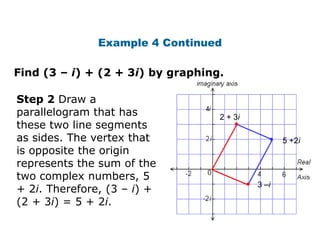
Find (3 – i) + (2 + 3i) by graphing.

Step 2 Draw a
parallelogram that has             2 + 3i
these two line segments                •
as sides. The vertex that                          •   5 +2i
is opposite the origin
represents the sum of the
two complex numbers, 5
+ 2i. Therefore, (3 – i) +                  •   3 –i

(2 + 3i) = 5 + 2i.
Example 4 Continued

Find (3 – i) + (2 + 3i) by graphing.


 Check Add by combining the real parts and
 combining the imaginary parts.

 (3 – i) + (2 + 3i) = (3 + 2) + (–i + 3i) = 5 + 2i
Check It Out! Example 4a

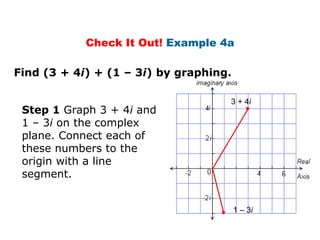
Find (3 + 4i) + (1 – 3i) by graphing.

                                       3 + 4i
 Step 1 Graph 3 + 4i and                   •
 1 – 3i on the complex
 plane. Connect each of
 these numbers to the
 origin with a line
 segment.


                                        1 – 3i
                                   •
Check It Out! Example 4a Continued

Find (3 + 4i) + (1 – 3i) by graphing.

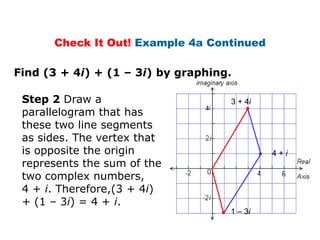
 Step 2 Draw a                         3 + 4i
 parallelogram that has                    •
 these two line segments
 as sides. The vertex that
 is opposite the origin                         •   4+i
 represents the sum of the
 two complex numbers,
 4 + i. Therefore,(3 + 4i)
 + (1 – 3i) = 4 + i.
                                   •   1 – 3i
Check It Out! Example 4a Continued

Find (3 + 4i) + (1 – 3i) by graphing.

 Check Add by combining the real parts and
 combining the imaginary parts.
 (3 + 4i) + (1 – 3i) = (3 + 1) + (4i – 3i) = 4 + i
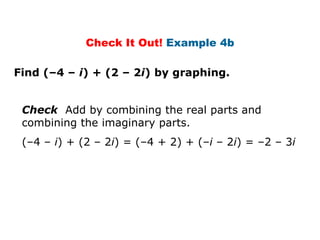
Check It Out! Example 4b

Find (–4 – i) + (2 – 2i) by graphing.


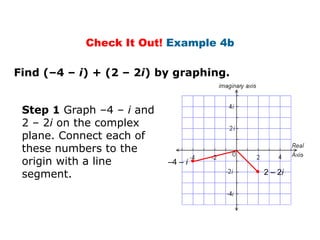
 Step 1 Graph –4 – i and
 2 – 2i on the complex
 plane. Connect each of
 these numbers to the
 origin with a line        –4 – i   •   2 – 2i
 segment.                                    ● 2 – 2i
                                             •
Check It Out! Example 4b

Find (–4 – i) + (2 – 2i) by graphing.

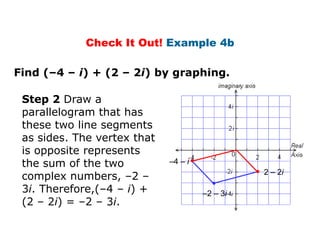
 Step 2 Draw a
 parallelogram that has
 these two line segments
 as sides. The vertex that
 is opposite represents
 the sum of the two          –4 – i •
 complex numbers, –2 –                            •   2 – 2i

 3i. Therefore,(–4 – i) +                 •
                                        –2 – 3i
 (2 – 2i) = –2 – 3i.
Check It Out! Example 4b

Find (–4 – i) + (2 – 2i) by graphing.


 Check Add by combining the real parts and
 combining the imaginary parts.
 (–4 – i) + (2 – 2i) = (–4 + 2) + (–i – 2i) = –2 – 3i
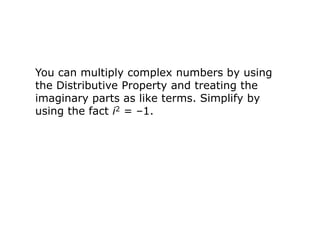
You can multiply complex numbers by using
the Distributive Property and treating the
imaginary parts as like terms. Simplify by
using the fact i2 = –1.
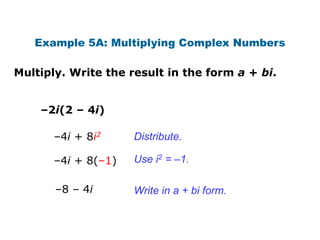
Example 5A: Multiplying Complex Numbers

Multiply. Write the result in the form a + bi.


    –2i(2 – 4i)

       –4i + 8i2     Distribute.

       –4i + 8(–1)   Use i2 = –1.

       –8 – 4i       Write in a + bi form.
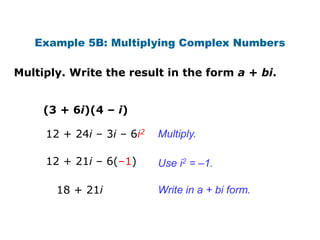
Example 5B: Multiplying Complex Numbers

Multiply. Write the result in the form a + bi.


     (3 + 6i)(4 – i)

     12 + 24i – 3i – 6i2   Multiply.

     12 + 21i – 6(–1)      Use i2 = –1.

       18 + 21i            Write in a + bi form.
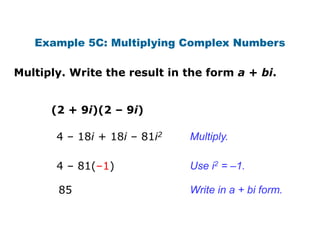
Example 5C: Multiplying Complex Numbers

Multiply. Write the result in the form a + bi.


      (2 + 9i)(2 – 9i)

       4 – 18i + 18i – 81i2   Multiply.

       4 – 81(–1)             Use i2 = –1.

       85                     Write in a + bi form.
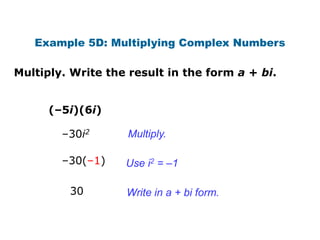
Example 5D: Multiplying Complex Numbers

Multiply. Write the result in the form a + bi.


      (–5i)(6i)

        –30i2      Multiply.

        –30(–1)    Use i2 = –1

         30        Write in a + bi form.
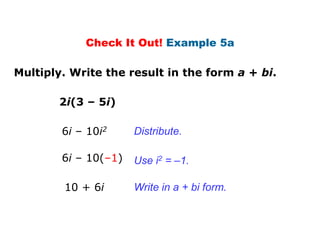
Check It Out! Example 5a

Multiply. Write the result in the form a + bi.

       2i(3 – 5i)

        6i – 10i2     Distribute.

        6i – 10(–1)   Use i2 = –1.

        10 + 6i       Write in a + bi form.
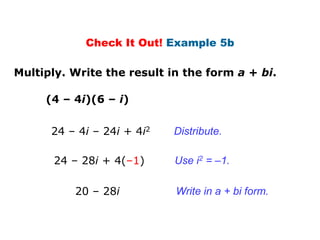
Check It Out! Example 5b

Multiply. Write the result in the form a + bi.

     (4 – 4i)(6 – i)


      24 – 4i – 24i + 4i2   Distribute.

       24 – 28i + 4(–1)     Use i2 = –1.

          20 – 28i          Write in a + bi form.
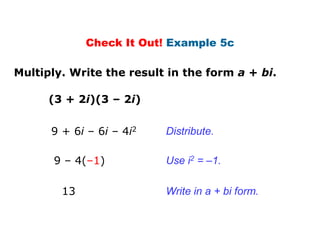
Check It Out! Example 5c

Multiply. Write the result in the form a + bi.

      (3 + 2i)(3 – 2i)


      9 + 6i – 6i – 4i2   Distribute.

       9 – 4(–1)          Use i2 = –1.

        13                Write in a + bi form.
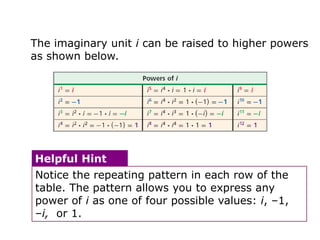
The imaginary unit i can be raised to higher powers
as shown below.


Helpful Hint
Notice the repeating pattern in each row of the
table. The pattern allows you to express any
power of i as one of four possible values: i, –1,
–i, or 1.
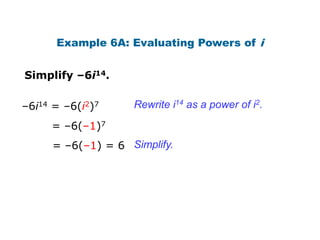
Example 6A: Evaluating Powers of i


Simplify –6i14.

–6i14 = –6(i2)7    Rewrite i14 as a power of i2.

     = –6(–1)7
     = –6(–1) = 6 Simplify.
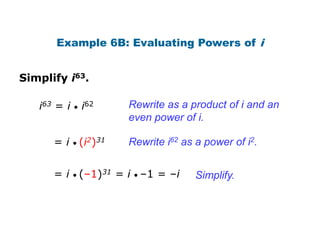
Example 6B: Evaluating Powers of i


Simplify i63.

   i63 = i   i62   Rewrite as a product of i and an
                   even power of i.

      = i (i2)31   Rewrite i62 as a power of i2.


      = i (–1)31 = i –1 = –i      Simplify.
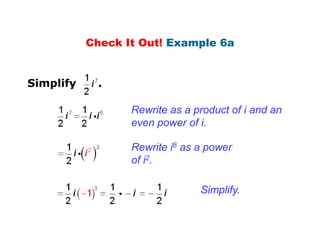
Check It Out! Example 6a


Simplify     .

                  Rewrite as a product of i and an
                  even power of i.

                  Rewrite i6 as a power
                  of i2.

                                Simplify.
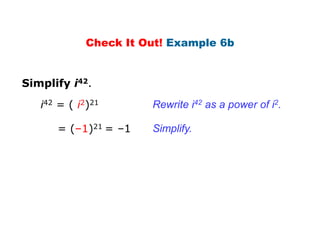
Check It Out! Example 6b


Simplify i42.
   i42 = ( i2)21       Rewrite i42 as a power of i2.

      = (–1)21 = –1    Simplify.
Recall that expressions in simplest form cannot have
square roots in the denominator (Lesson 1-3).
Because the imaginary unit represents a square
root, you must rationalize any denominator that
contains an imaginary unit. To do this, multiply the
numerator and denominator by the complex
conjugate of the denominator.

Helpful Hint
The complex conjugate of a complex number
a + bi is a – bi. (Lesson 5-5)
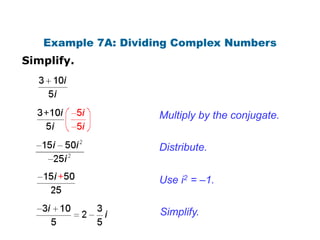
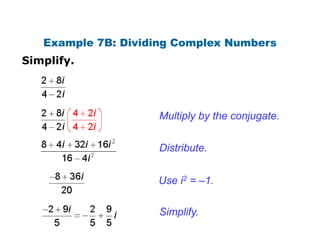
Example 7A: Dividing Complex Numbers
Simplify.


                    Multiply by the conjugate.


                    Distribute.


                    Use i2 = –1.


                    Simplify.
Example 7B: Dividing Complex Numbers
Simplify.


                    Multiply by the conjugate.


                    Distribute.


                    Use i2 = –1.

                    Simplify.
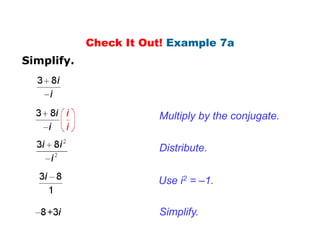
Check It Out! Example 7a
Simplify.


                       Multiply by the conjugate.


                       Distribute.


                       Use i2 = –1.

                       Simplify.
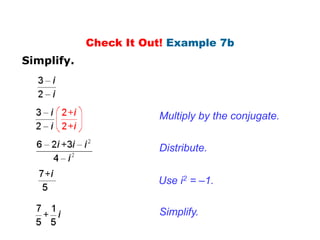
Check It Out! Example 7b
Simplify.


                       Multiply by the conjugate.


                       Distribute.


                       Use i2 = –1.

                       Simplify.
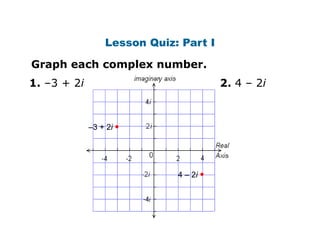
Lesson Quiz: Part I

Graph each complex number.
1. –3 + 2i                              2. 4 – 2i


             –3 + 2i •


                             4 – 2i •
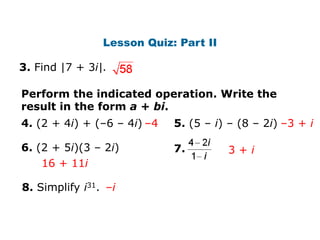
Lesson Quiz: Part II

3. Find |7 + 3i|.

Perform the indicated operation. Write the
result in the form a + bi.
4. (2 + 4i) + (–6 – 4i) –4   5. (5 – i) – (8 – 2i) –3 + i

6. (2 + 5i)(3 – 2i)          7.        3+i
    16 + 11i

8. Simplify i31. –i

Complex operations

  • 1.
    Operations with ComplexNumbers Warm Up Lesson Presentation Lesson Quiz
  • 2.
    Warm Up Express eachnumber in terms of i. 1. 9i 2. Find each complex conjugate. 3. 4. Find each product. 5. 6.
  • 3.
  • 4.
  • 5.
    Just as youcan represent real numbers graphically as points on a number line, you can represent complex numbers in a special coordinate plane. The complex plane is a set of coordinate axes in which the horizontal axis represents real numbers and the vertical axis represents imaginary numbers.
  • 6.
    Helpful Hint The realaxis corresponds to the x-axis, and the imaginary axis corresponds to the y-axis. Think of a + bi as x + yi.
  • 7.
    Example 1: GraphingComplex Numbers Graph each complex number. A. 2 – 3i –1+ 4i • B. –1 + 4i 4+i • C. 4 + i • –i D. –i • 2 – 3i
  • 8.
    Check It Out!Example 1 Graph each complex number. a. 3 + 0i b. 2i 2i • 3 + 2i • c. –2 – i • • 3 + 0i –2 – i d. 3 + 2i
  • 9.
    Recall that absolutevalue of a real number is its distance from 0 on the real axis, which is also a number line. Similarly, the absolute value of an imaginary number is its distance from 0 along the imaginary axis.
  • 10.
    Example 2: Determiningthe Absolute Value of Complex Numbers Find each absolute value. A. |3 + 5i| B. |–13| C. |–7i| |–13 + 0i| |0 +(–7)i| 13 7
  • 11.
    Check It Out!Example 2 Find each absolute value. a. |1 – 2i| b. c. |23i| |0 + 23i| 23
  • 12.
    Adding and subtractingcomplex numbers is similar to adding and subtracting variable expressions with like terms. Simply combine the real parts, and combine the imaginary parts. The set of complex numbers has all the properties of the set of real numbers. So you can use the Commutative, Associative, and Distributive Properties to simplify complex number expressions.
  • 13.
    Helpful Hint Complex numbersalso have additive inverses. The additive inverse of a + bi is –(a + bi), or –a – bi.
  • 14.
    Example 3A: Addingand Subtracting Complex Numbers Add or subtract. Write the result in the form a + bi. (4 + 2i) + (–6 – 7i) (4 – 6) + (2i – 7i) Add real parts and imaginary parts. –2 – 5i
  • 15.
    Example 3B: Addingand Subtracting Complex Numbers Add or subtract. Write the result in the form a + bi. (5 –2i) – (–2 –3i) (5 – 2i) + 2 + 3i Distribute. (5 + 2) + (–2i + 3i) Add real parts and imaginary parts. 7+i
  • 16.
    Example 3C: Addingand Subtracting Complex Numbers Add or subtract. Write the result in the form a + bi. (1 – 3i) + (–1 + 3i) (1 – 1) + (–3i + 3i) Add real parts and imaginary parts. 0
  • 17.
    Check It Out!Example 3a Add or subtract. Write the result in the form a + bi. (–3 + 5i) + (–6i) (–3) + (5i – 6i) Add real parts and imaginary parts. –3 – i
  • 18.
    Check It Out!Example 3b Add or subtract. Write the result in the form a + bi. 2i – (3 + 5i) (2i) – 3 – 5i Distribute. (–3) + (2i – 5i) Add real parts and imaginary parts. –3 – 3i
  • 19.
    Check It Out!Example 3c Add or subtract. Write the result in the form a + bi. (4 + 3i) + (4 – 3i) (4 + 4) + (3i – 3i) Add real parts and imaginary parts. 8
  • 20.
    You can alsoadd complex numbers by using coordinate geometry.
  • 21.
    Example 4: AddingComplex Numbers on the Complex Plane Find (3 – i) + (2 + 3i) by graphing. Step 1 Graph 3 – i and 2 + 3i 2 + 3i on the complex • plane. Connect each of these numbers to the origin with a line segment. • 3 –i
  • 22.
    Example 4 Continued Find(3 – i) + (2 + 3i) by graphing. Step 2 Draw a parallelogram that has 2 + 3i these two line segments • as sides. The vertex that • 5 +2i is opposite the origin represents the sum of the two complex numbers, 5 + 2i. Therefore, (3 – i) + • 3 –i (2 + 3i) = 5 + 2i.
  • 23.
    Example 4 Continued Find(3 – i) + (2 + 3i) by graphing. Check Add by combining the real parts and combining the imaginary parts. (3 – i) + (2 + 3i) = (3 + 2) + (–i + 3i) = 5 + 2i
  • 24.
    Check It Out!Example 4a Find (3 + 4i) + (1 – 3i) by graphing. 3 + 4i Step 1 Graph 3 + 4i and • 1 – 3i on the complex plane. Connect each of these numbers to the origin with a line segment. 1 – 3i •
  • 25.
    Check It Out!Example 4a Continued Find (3 + 4i) + (1 – 3i) by graphing. Step 2 Draw a 3 + 4i parallelogram that has • these two line segments as sides. The vertex that is opposite the origin • 4+i represents the sum of the two complex numbers, 4 + i. Therefore,(3 + 4i) + (1 – 3i) = 4 + i. • 1 – 3i
  • 26.
    Check It Out!Example 4a Continued Find (3 + 4i) + (1 – 3i) by graphing. Check Add by combining the real parts and combining the imaginary parts. (3 + 4i) + (1 – 3i) = (3 + 1) + (4i – 3i) = 4 + i
  • 27.
    Check It Out!Example 4b Find (–4 – i) + (2 – 2i) by graphing. Step 1 Graph –4 – i and 2 – 2i on the complex plane. Connect each of these numbers to the origin with a line –4 – i • 2 – 2i segment. ● 2 – 2i •
  • 28.
    Check It Out!Example 4b Find (–4 – i) + (2 – 2i) by graphing. Step 2 Draw a parallelogram that has these two line segments as sides. The vertex that is opposite represents the sum of the two –4 – i • complex numbers, –2 – • 2 – 2i 3i. Therefore,(–4 – i) + • –2 – 3i (2 – 2i) = –2 – 3i.
  • 29.
    Check It Out!Example 4b Find (–4 – i) + (2 – 2i) by graphing. Check Add by combining the real parts and combining the imaginary parts. (–4 – i) + (2 – 2i) = (–4 + 2) + (–i – 2i) = –2 – 3i
  • 30.
    You can multiplycomplex numbers by using the Distributive Property and treating the imaginary parts as like terms. Simplify by using the fact i2 = –1.
  • 31.
    Example 5A: MultiplyingComplex Numbers Multiply. Write the result in the form a + bi. –2i(2 – 4i) –4i + 8i2 Distribute. –4i + 8(–1) Use i2 = –1. –8 – 4i Write in a + bi form.
  • 32.
    Example 5B: MultiplyingComplex Numbers Multiply. Write the result in the form a + bi. (3 + 6i)(4 – i) 12 + 24i – 3i – 6i2 Multiply. 12 + 21i – 6(–1) Use i2 = –1. 18 + 21i Write in a + bi form.
  • 33.
    Example 5C: MultiplyingComplex Numbers Multiply. Write the result in the form a + bi. (2 + 9i)(2 – 9i) 4 – 18i + 18i – 81i2 Multiply. 4 – 81(–1) Use i2 = –1. 85 Write in a + bi form.
  • 34.
    Example 5D: MultiplyingComplex Numbers Multiply. Write the result in the form a + bi. (–5i)(6i) –30i2 Multiply. –30(–1) Use i2 = –1 30 Write in a + bi form.
  • 35.
    Check It Out!Example 5a Multiply. Write the result in the form a + bi. 2i(3 – 5i) 6i – 10i2 Distribute. 6i – 10(–1) Use i2 = –1. 10 + 6i Write in a + bi form.
  • 36.
    Check It Out!Example 5b Multiply. Write the result in the form a + bi. (4 – 4i)(6 – i) 24 – 4i – 24i + 4i2 Distribute. 24 – 28i + 4(–1) Use i2 = –1. 20 – 28i Write in a + bi form.
  • 37.
    Check It Out!Example 5c Multiply. Write the result in the form a + bi. (3 + 2i)(3 – 2i) 9 + 6i – 6i – 4i2 Distribute. 9 – 4(–1) Use i2 = –1. 13 Write in a + bi form.
  • 38.
    The imaginary uniti can be raised to higher powers as shown below. Helpful Hint Notice the repeating pattern in each row of the table. The pattern allows you to express any power of i as one of four possible values: i, –1, –i, or 1.
  • 39.
    Example 6A: EvaluatingPowers of i Simplify –6i14. –6i14 = –6(i2)7 Rewrite i14 as a power of i2. = –6(–1)7 = –6(–1) = 6 Simplify.
  • 40.
    Example 6B: EvaluatingPowers of i Simplify i63. i63 = i i62 Rewrite as a product of i and an even power of i. = i (i2)31 Rewrite i62 as a power of i2. = i (–1)31 = i –1 = –i Simplify.
  • 41.
    Check It Out!Example 6a Simplify . Rewrite as a product of i and an even power of i. Rewrite i6 as a power of i2. Simplify.
  • 42.
    Check It Out!Example 6b Simplify i42. i42 = ( i2)21 Rewrite i42 as a power of i2. = (–1)21 = –1 Simplify.
  • 43.
    Recall that expressionsin simplest form cannot have square roots in the denominator (Lesson 1-3). Because the imaginary unit represents a square root, you must rationalize any denominator that contains an imaginary unit. To do this, multiply the numerator and denominator by the complex conjugate of the denominator. Helpful Hint The complex conjugate of a complex number a + bi is a – bi. (Lesson 5-5)
  • 44.
    Example 7A: DividingComplex Numbers Simplify. Multiply by the conjugate. Distribute. Use i2 = –1. Simplify.
  • 45.
    Example 7B: DividingComplex Numbers Simplify. Multiply by the conjugate. Distribute. Use i2 = –1. Simplify.
  • 46.
    Check It Out!Example 7a Simplify. Multiply by the conjugate. Distribute. Use i2 = –1. Simplify.
  • 47.
    Check It Out!Example 7b Simplify. Multiply by the conjugate. Distribute. Use i2 = –1. Simplify.
  • 48.
    Lesson Quiz: PartI Graph each complex number. 1. –3 + 2i 2. 4 – 2i –3 + 2i • 4 – 2i •
  • 49.
    Lesson Quiz: PartII 3. Find |7 + 3i|. Perform the indicated operation. Write the result in the form a + bi. 4. (2 + 4i) + (–6 – 4i) –4 5. (5 – i) – (8 – 2i) –3 + i 6. (2 + 5i)(3 – 2i) 7. 3+i 16 + 11i 8. Simplify i31. –i