GAUSS ELIMINATION
METHOD & MATRIX
INVERSION METHOD
K.RAMYA
M.Sc. BIOPHYSICS
Department of Biophysics
Reg. no:34124003
GAUSS ELIMINATION METHOD
The Gauss Elimination, in linear and multilinear algebra, is a
process for finding the solutions to a system of simultaneous
linear equations by first solving one of the equations for one
variable and then substituting the expression into the remaining
equations.
GAUSS ELIMINATION METHOD
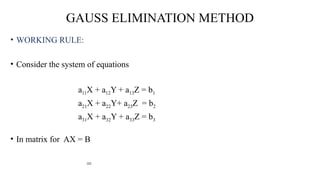
• WORKING RULE:
• Consider the system of equations
a11X + a12Y + a13Z = b1
a21X + a22Y+ a23Z = b2
a31X + a32Y + a33Z = b3
• In matrix for AX = B
=
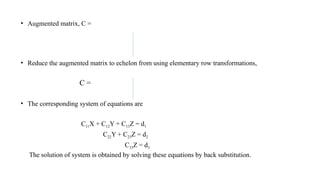
• Augmented matrix, C =
• Reduce the augmented matrix to echelon from using elementary row transformations,
C =
• The corresponding system of equations are
C11X + C12Y + C13Z = d1
C22Y + C23Z = d2
C33Z = d3
The solution of system is obtained by solving these equations by back substitution.
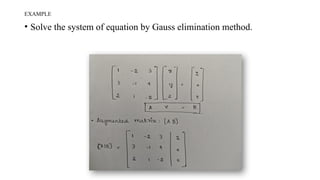
EXAMPLE
• Solve the system of equation by Gauss elimination method.
• Now let us convert[A|B] to upper triangular matrix:
For making 3(R2) as zero applying equation 1 in Row 2
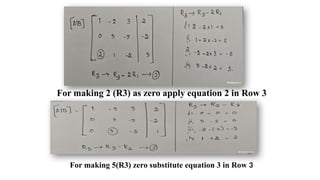
For making 2 (R3) as zero apply equation 2 in Row 3
For making 5(R3) zero substitute equation 3 in Row 3
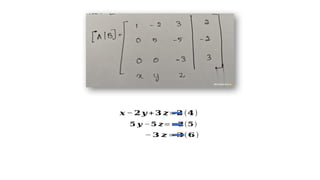
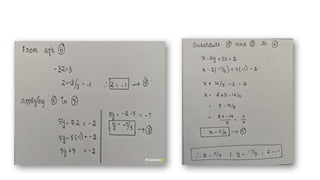
𝒙 − 𝟐 𝒚 + 𝟑 𝒛=𝟐 (𝟒)
𝟓 𝒚 −𝟓 𝒛=−𝟐(𝟓)
−𝟑 𝒛 =𝟑(𝟔)
MATRIX INVERSION
METHOD
MATRIX INVERSION
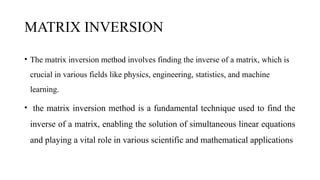
• The matrix inversion method involves finding the inverse of a matrix, which is
crucial in various fields like physics, engineering, statistics, and machine
learning.
• the matrix inversion method is a fundamental technique used to find the
inverse of a matrix, enabling the solution of simultaneous linear equations
and playing a vital role in various scientific and mathematical applications
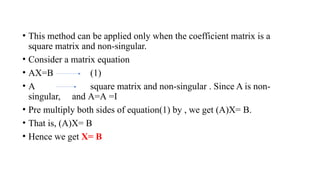
• This method can be applied only when the coefficient matrix is a
square matrix and non-singular.
• Consider a matrix equation
• AX=B (1)
• A square matrix and non-singular . Since A is non-
singular, and A=A =I
• Pre multiply both sides of equation(1) by , we get (A)X= B.
• That is, (A)X= B
• Hence we get X= B
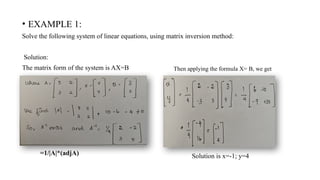
• EXAMPLE 1:
Solve the following system of linear equations, using matrix inversion method:
Solution:
The matrix form of the system is AX=B
Solssssssssssssss
Then applying the formula X= B, we get
Solution is x=-1; y=4
=1/|A|*(adjA)
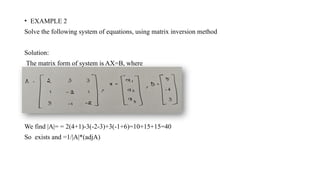
• EXAMPLE 2
Solve the following system of equations, using matrix inversion method
Solution:
The matrix form of system is AX=B, where
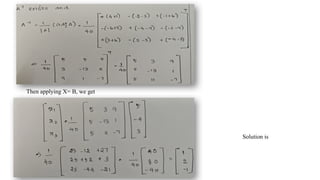
We find |A|= = 2(4+1)-3(-2-3)+3(-1+6)=10+15+15=40
So exists and =1/|A|*(adjA)
Then applying X= B, we get
Solution is
import numpy as np
# Define the 2x2 matrix
matrix = np.array([[1, 2], [3, 4]])
# Calculate the determinant
det = matrix[0, 0] * matrix[1, 1] - matrix[0, 1] * matrix[1, 0]
# Check if the matrix is invertible
if det != 0:
# Calculate the inverse matrix
inverse_matrix = np.array([[matrix[1, 1], -matrix[0, 1]], [-matrix[1, 0], matrix[0, 0]]]) / det
print("Inverse Matrix:")
print(inverse_matrix)
else:
print("Matrix is not invertible (determinant is zero).")
#output
Inverse Matrix: [[-2. 1. ] [ 1.5 -0.5]]
Reference: Engineering mathematics book by Dr. D.C. Agarwal
Thankyou!!!!!

GAUSS ELIMINATION METHOD.power point presentation

  • 1.
    GAUSS ELIMINATION METHOD &MATRIX INVERSION METHOD K.RAMYA M.Sc. BIOPHYSICS Department of Biophysics Reg. no:34124003
  • 2.
    GAUSS ELIMINATION METHOD TheGauss Elimination, in linear and multilinear algebra, is a process for finding the solutions to a system of simultaneous linear equations by first solving one of the equations for one variable and then substituting the expression into the remaining equations.
  • 3.
    GAUSS ELIMINATION METHOD •WORKING RULE: • Consider the system of equations a11X + a12Y + a13Z = b1 a21X + a22Y+ a23Z = b2 a31X + a32Y + a33Z = b3 • In matrix for AX = B =
  • 4.
    • Augmented matrix,C = • Reduce the augmented matrix to echelon from using elementary row transformations, C = • The corresponding system of equations are C11X + C12Y + C13Z = d1 C22Y + C23Z = d2 C33Z = d3 The solution of system is obtained by solving these equations by back substitution.
  • 5.
    EXAMPLE • Solve thesystem of equation by Gauss elimination method.
  • 6.
    • Now letus convert[A|B] to upper triangular matrix: For making 3(R2) as zero applying equation 1 in Row 2
  • 7.
    For making 2(R3) as zero apply equation 2 in Row 3 For making 5(R3) zero substitute equation 3 in Row 3
  • 8.
    𝒙 − 𝟐𝒚 + 𝟑 𝒛=𝟐 (𝟒) 𝟓 𝒚 −𝟓 𝒛=−𝟐(𝟓) −𝟑 𝒛 =𝟑(𝟔)
  • 10.
  • 11.
    MATRIX INVERSION • Thematrix inversion method involves finding the inverse of a matrix, which is crucial in various fields like physics, engineering, statistics, and machine learning. • the matrix inversion method is a fundamental technique used to find the inverse of a matrix, enabling the solution of simultaneous linear equations and playing a vital role in various scientific and mathematical applications
  • 12.
    • This methodcan be applied only when the coefficient matrix is a square matrix and non-singular. • Consider a matrix equation • AX=B (1) • A square matrix and non-singular . Since A is non- singular, and A=A =I • Pre multiply both sides of equation(1) by , we get (A)X= B. • That is, (A)X= B • Hence we get X= B
  • 13.
    • EXAMPLE 1: Solvethe following system of linear equations, using matrix inversion method: Solution: The matrix form of the system is AX=B Solssssssssssssss Then applying the formula X= B, we get Solution is x=-1; y=4 =1/|A|*(adjA)
  • 14.
    • EXAMPLE 2 Solvethe following system of equations, using matrix inversion method Solution: The matrix form of system is AX=B, where We find |A|= = 2(4+1)-3(-2-3)+3(-1+6)=10+15+15=40 So exists and =1/|A|*(adjA)
  • 15.
    Then applying X=B, we get Solution is
  • 16.
    import numpy asnp # Define the 2x2 matrix matrix = np.array([[1, 2], [3, 4]]) # Calculate the determinant det = matrix[0, 0] * matrix[1, 1] - matrix[0, 1] * matrix[1, 0] # Check if the matrix is invertible if det != 0: # Calculate the inverse matrix inverse_matrix = np.array([[matrix[1, 1], -matrix[0, 1]], [-matrix[1, 0], matrix[0, 0]]]) / det print("Inverse Matrix:") print(inverse_matrix) else: print("Matrix is not invertible (determinant is zero).") #output Inverse Matrix: [[-2. 1. ] [ 1.5 -0.5]]
  • 17.
    Reference: Engineering mathematicsbook by Dr. D.C. Agarwal
  • 18.