Conditionals
Sentence
By:
Aornwara Nitkhosakul No.1
Isaya Lorjitsa-ard No.3
• They describe the result of something that might
happen (in the present or future) or might have
happened but didn't (in the past)
• What could happen, what might have happened,
and what we wish would happen
4 Main Types
1. Zero - if + present simple, ... present simple
2. First - if + present simple, ... will + infinitive
3. Second - if + past simple, ... would + infinitive
4. Third - if + past perfect, ... would + have + past
participle
** Mixed
The Zero Conditional
• Used when the result will always happen (facts)
If + present simple,.... present simple
Example :
• If water reaches 100 degrees, it boils.
• People die if they don't eat.
Inversion: The 'if' in this conditional can usually be
replaced by 'when' without changing the meaning.
Example:
• When water reaches 100 degrees, it boils.
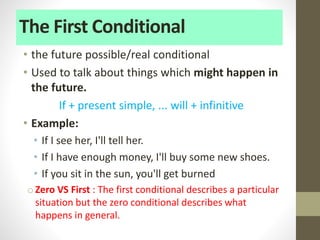
The First Conditional
• the future possible/real conditional
• Used to talk about things which might happen in
the future.
If + present simple, ... will + infinitive
• Example:
• If I see her, I'll tell her.
• If I have enough money, I'll buy some new shoes.
• If you sit in the sun, you'll get burned
o Zero VS First : The first conditional describes a particular
situation but the zero conditional describes what
happens in general.
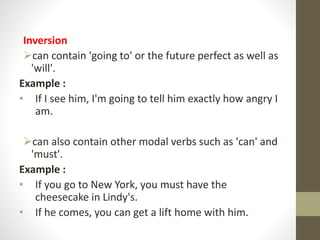
Inversion
can contain 'going to' or the future perfect as well as
'will'.
Example :
• If I see him, I'm going to tell him exactly how angry I
am.
can also contain other modal verbs such as 'can' and
'must'.
Example :
• If you go to New York, you must have the
cheesecake in Lindy's.
• If he comes, you can get a lift home with him.
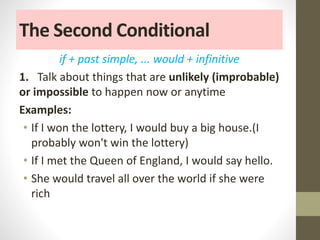
The Second Conditional
if + past simple, ... would + infinitive
1. Talk about things that are unlikely (improbable)
or impossible to happen now or anytime
Examples:
• If I won the lottery, I would buy a big house.(I
probably won't win the lottery)
• If I met the Queen of England, I would say hello.
• She would travel all over the world if she were
rich
2. Giving advice in the form 'If I were you'
Examples:
• If I were you, I'd look for a new place to live.
• If I were you, I'd go back to school and get more
qualifications.
**We can use 'were' instead of 'was' with 'I' and
'he/she/it'. This is mostly done in formal writing
Example:
• If she were happy in her job, she wouldn't be
looking for another one.
**Sometimes, we use should, could or might
(modal verbs) instead of would
Example:
• If I won a million dollars, I could stop working.
• If I won the lottery, I might donate some of it to
charity.
** Difference between first and second is second
is a lot more unlikely to happen
Inversion: Use ‘Were’ instead of if clause
Examples:
• If she were older, it would be better
Were she older, it would be better
• If I met the Queen of England, I would say hello.
Were I to meet the Queen of England,…….
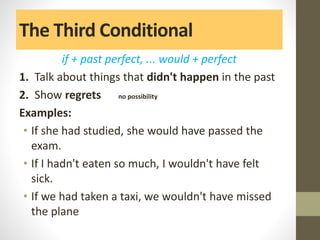
The Third Conditional
if + past perfect, ... would + perfect
1. Talk about things that didn't happen in the past
2. Show regrets no possibility
Examples:
• If she had studied, she would have passed the
exam.
• If I hadn't eaten so much, I wouldn't have felt
sick.
• If we had taken a taxi, we wouldn't have missed
the plane
**Sometimes, we use should have, could
have, might have instead of would have
Example:
• If you had bought a lottery ticket, you might
have won.
Inversion: Use ‘Had’ instead of if clause
Examples:
• Had she studied, she would have passed the
exam.
• Had I not eaten so much, I wouldn't have felt
sick. NO contracted forms
The Mixed Conditional
1. Refer to a condition in the past and its ongoing
result in the present
If + Past Perfect….would + infinitive
If this thing had happened, that thing would happen
Examples:
• If I had worked harder at school, I would have a
better job now
• If we had looked at the map we wouldn't be lost
2. Refer to an unreal present situation and its
probable (but unreal) result in the past
If + simple past… would + perfect
Examples:
• If I wasn't afraid of spiders, I would have picked it
up.
• If I was a good cook, I'd have invited them to
lunch.

Conditional Sentences

  • 1.
  • 2.
    • They describethe result of something that might happen (in the present or future) or might have happened but didn't (in the past) • What could happen, what might have happened, and what we wish would happen
  • 3.
    4 Main Types 1.Zero - if + present simple, ... present simple 2. First - if + present simple, ... will + infinitive 3. Second - if + past simple, ... would + infinitive 4. Third - if + past perfect, ... would + have + past participle ** Mixed
  • 4.
    The Zero Conditional •Used when the result will always happen (facts) If + present simple,.... present simple Example : • If water reaches 100 degrees, it boils. • People die if they don't eat. Inversion: The 'if' in this conditional can usually be replaced by 'when' without changing the meaning. Example: • When water reaches 100 degrees, it boils.
  • 5.
    The First Conditional •the future possible/real conditional • Used to talk about things which might happen in the future. If + present simple, ... will + infinitive • Example: • If I see her, I'll tell her. • If I have enough money, I'll buy some new shoes. • If you sit in the sun, you'll get burned o Zero VS First : The first conditional describes a particular situation but the zero conditional describes what happens in general.
  • 6.
    Inversion can contain 'goingto' or the future perfect as well as 'will'. Example : • If I see him, I'm going to tell him exactly how angry I am. can also contain other modal verbs such as 'can' and 'must'. Example : • If you go to New York, you must have the cheesecake in Lindy's. • If he comes, you can get a lift home with him.
  • 7.
    The Second Conditional if+ past simple, ... would + infinitive 1. Talk about things that are unlikely (improbable) or impossible to happen now or anytime Examples: • If I won the lottery, I would buy a big house.(I probably won't win the lottery) • If I met the Queen of England, I would say hello. • She would travel all over the world if she were rich
  • 8.
    2. Giving advicein the form 'If I were you' Examples: • If I were you, I'd look for a new place to live. • If I were you, I'd go back to school and get more qualifications. **We can use 'were' instead of 'was' with 'I' and 'he/she/it'. This is mostly done in formal writing Example: • If she were happy in her job, she wouldn't be looking for another one.
  • 9.
    **Sometimes, we useshould, could or might (modal verbs) instead of would Example: • If I won a million dollars, I could stop working. • If I won the lottery, I might donate some of it to charity. ** Difference between first and second is second is a lot more unlikely to happen
  • 10.
    Inversion: Use ‘Were’instead of if clause Examples: • If she were older, it would be better Were she older, it would be better • If I met the Queen of England, I would say hello. Were I to meet the Queen of England,…….
  • 11.
    The Third Conditional if+ past perfect, ... would + perfect 1. Talk about things that didn't happen in the past 2. Show regrets no possibility Examples: • If she had studied, she would have passed the exam. • If I hadn't eaten so much, I wouldn't have felt sick. • If we had taken a taxi, we wouldn't have missed the plane
  • 12.
    **Sometimes, we useshould have, could have, might have instead of would have Example: • If you had bought a lottery ticket, you might have won. Inversion: Use ‘Had’ instead of if clause Examples: • Had she studied, she would have passed the exam. • Had I not eaten so much, I wouldn't have felt sick. NO contracted forms
  • 13.
    The Mixed Conditional 1.Refer to a condition in the past and its ongoing result in the present If + Past Perfect….would + infinitive If this thing had happened, that thing would happen Examples: • If I had worked harder at school, I would have a better job now • If we had looked at the map we wouldn't be lost
  • 14.
    2. Refer toan unreal present situation and its probable (but unreal) result in the past If + simple past… would + perfect Examples: • If I wasn't afraid of spiders, I would have picked it up. • If I was a good cook, I'd have invited them to lunch.